Solterra Materials Reflects Nationwide Asphalt Industry Trend
Solterra Materials, Phoenix, announced in March company growth, expanded operations across Arizona, and a new website. Recent statistics from P&S Intelligence have shown that the overall market size of the asphalt industry will expand to roughly $52.9 million by 2032. Solterra Materials, a leading Arizona-based asphalt materials provider and a division of Sunland Asphalt, is already seeing the effects of this expected growth.
Since its founding in 2018, Solterra Materials has expanded from 29 to 42 employees. This represents a nearly 45% increase for the company that operates across the state of Arizona, serving private, commercial, highway and infrastructure projects, and supports a wide range of asphalt needs, from private developments and commercial projects to large-scale highway and infrastructure work, as well as specialized asphalt solutions.
Along with promoting its team internally in 2026 and launching its new website (www.solterramaterials.com), a key component of Solterra Materials’ 2026 growth strategy is its enhanced quality control (QC) division, which features a fully accredited lab where the team can provide mix designs and QC services internally and for customers, giving additional confidence, project reliability and support.
“Across Arizona and nationwide, we’re seeing continued momentum in infrastructure investment, private development and roadway improvements,” said General Manager Scott Bollinger. “That growth is translating into increased demand for reliable, high-quality asphalt production and technical support. By expanding our team, strengthening our QA/QC capabilities and fully staffing our plant maintenance operations, we’re positioning Solterra Materials to meet that demand.”
Solterra Materials provided the mix for Sunland Asphalt to complete the high-profile APEX Motor Club expansion.
In addition to team growth, Solterra Materials has also strengthened their fully staffed, in-house maintenance team responsible for plant repairs, equipment optimization and infrastructure improvements. This investment has enhanced production efficiency, minimized downtime and allowed the company to maintain consistent, high-performance output.
The company has also expanded its industry footprint through participation in Building Women in Construction (BWIC), through the Arizona Chapter of the Associated General Contractors (AZAGC), demonstrating its commitment to workforce development and industry leadership.
Take a look over the next few pages at the products and services that will assist the entire industry this season as our industry grows. AsphaltPro Magazine is using the next few product gallery departments to highlight new technology launched at the recent CONEXPO-CON/AGG in case you missed anything you need to enhance your bottom line.
From Cages to Cameras: Field-Tested Paver Safety Upgrades
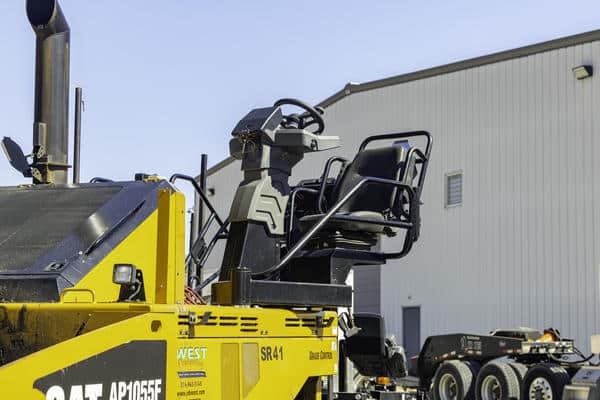
For N.B. West Contracting Co., Pacific, Missouri, it was a team effort to design and build the safety cages to protect paver operators from struck-bys. The final result garnered them the 2024 Asphalt Operations Safety Innovations Award from the National Asphalt Pavement Association. Photo courtesy of N.B. West
Augment your equipment some more to make the paving crew’s job safer, more efficient
In the November issue, we looked at a variety of ways to augment the paver delivered from the dealership or auction house, so it might offer its most efficient environment for the paving crew when handling, storing and using auxiliary equipment. Crew members need a safe, uncluttered workspace where they can access an increasing number of tools and tablets during the shift. Let’s take the discussion a step further this month with a deeper dive into safety and trucking, starting with a patent-pending design from N.B. West Contracting Co., Pacific, Missouri.
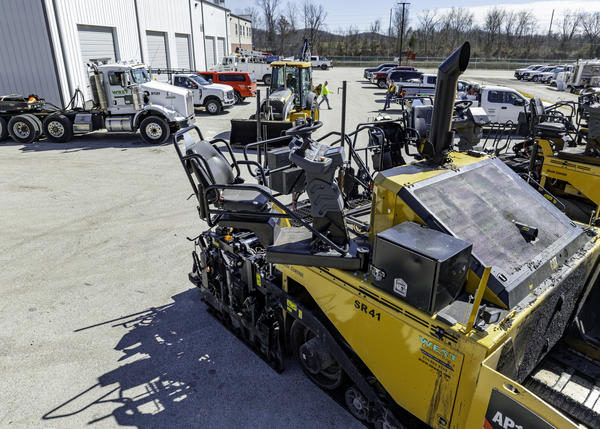
As of November 2024, all seven of N.B. West’s pavers had the safety cages installed. Now paver operators have added protection against struck-bys when they need to position seats for improved visibility. Photo courtesy of N.B. West
Award-Winning Aftermarket Safety Cages
The National Asphalt Pavement Association (NAPA), Greenbelt, Maryland, awarded N.B. West the 2024 Asphalt Operations Safety Innovations Award during a ceremony at the association’s 70th annual meeting, for its protective guards for paver operators. While original equipment manufacturer (OEM) standard guards protect operators in fixed positions, N.B. West’s custom-fabricated guards, welded to the operator’s seat frame, provide protection regardless of seat position. Since the first installation in May 2024, the company had reported zero incidents or near-misses and, as of press time, had received approval to move forward in the patenting process.
NAPA stated in a press release, this worker safety initiative fills a void in commercially available paving equipment protection and offers a replicable solution for other paving companies. N.B. West Safety Director Tim Swaringam confirmed this concept, stating all seven of the company’s pavers, which include various makes and models, had the safety cages installed as of November 2024.
Logistics Manager Noah DeRousse and Shop Manager Nick Brewer worked with Swaringam on the company’s safety committee and helped design and build the protective guards.
Before he took on the role of logistics manager, DeRousse spent six months working directly with Swaringam in the safety department as the field safety coordinator. “During that six-month period, we really worked on these cages and tried to improve the safety of our operators here at N.B. West,” DeRousse said. “Prior to the six months in the safety department, I ran one of these machines…for 21 years. I’ve seen a lot of incidents happen over the years, a lot of operators injured, a lot of really close calls.”
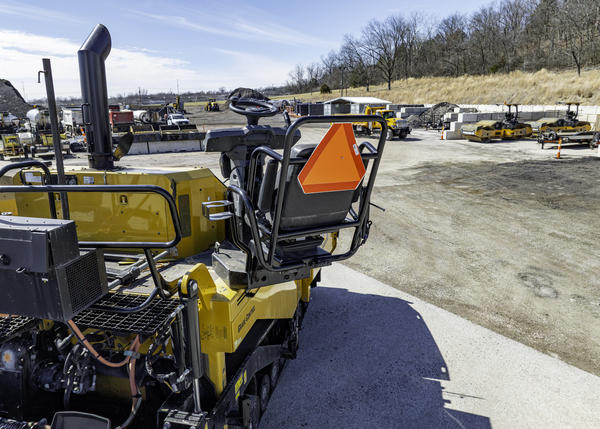
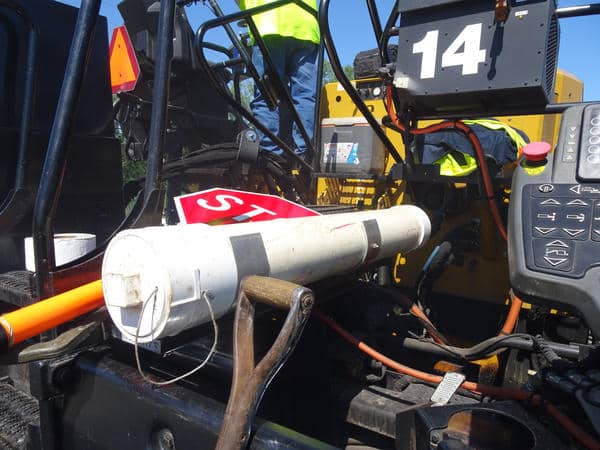
Another aspect of N.B. West’s award-winning safety cage design was to add the slow-moving vehicle triangle as a visual safety factor to the back of the operator’s “seat.” Photo courtesy of N.B. West
Brewer explained that his team in the shop helped design and install the safety cages. He shared that whenever the paver operator’s seat is positioned right along the inside of the confines of the paving machine, there’s protection for the operator with the OEM’s platform structure. This position is typically used when transporting the machine.
“This is more for transportation of the machine out on the highways to and from the job sites,” DeRousse shared. “If I’m sitting here and my asphalt hopper is lifted up…I can see just fine.” If the hopper wings are down for paving, “you can’t see your line. You can’t see where you’re trying to pave. So, you end up kicking this seat out the second or third click. Once you kick it out where you can see down the hopper, then you’re exposed out here if you don’t have a safety cage. Over all my years of running an asphalt paver, I was hit several times—one time causing some nerve damage in my elbow that never has gone away. And every operator that I’ve known that’s been a paver operator for any substantial amount of time has been hit or had a really close call. I would say over my 20-year career, probably 15 times I had trucks hit the back of my seat. Not all of them have hit me, but it would only take one to be a really big injury for someone.”
The safety cage design includes signage to alert drivers that the seat has been kicked out from the confines of the operator platform. Swaringam and Brewer spoke of adding the slow-moving vehicle triangle to the back of the operator’s seat.
When the operator moves the seat “out” to get a better view for paving, his upper torso is exposed. “The only thing protecting him is the back of that seat, which doesn’t really provide any protection at all,” Swaringam said. “Anything that hits that seat could possibly harm the operator. At nighttime whenever there’s low visibility, you can see there’s nothing on the back of that seat to visually see the operator sitting out there. The only thing is [the operator’s] Class 3 vest, but that’s really all that a passing motorist would see is his sleeve sitting there.”
The team began problem-solving by considering administrative controls—such as how to adjust truck driver behavior. But a truck pattern can’t always be perfected in a tight work zone, and passing motorist behavior is an uncontrollable variable. The next step was engineering controls—that’s where the safety cages began. The last step is personnel protective equipment (PPE), but the team focused on an engineered solution.
“That safety cage provides a lot of protection for the upper torso, the neck and back and head area, the sides. Whenever Nick designed this, he designed it where the side flanges actually will deflect anything away from the operator, not allow it to come in.”
“It was kind of a different aspect for me,” Brewer said. He shared that oftentimes, when different department heads approach the fabrication shop to make equipment modifications, the purpose is to increase production or functionality. This was one of the few times he’d been involved in a project with the sole purpose of increasing safety for the operator. “So, it was a little bit of a different kind of scope, but I wanted to design something that gave the operator a lot of protection, but didn’t disrupt the communication between him and the screed or anybody else working behind the paver or any trucks while using the paving machine. So, it started as just a simple sketch. I went around and took measurements because we own several different models and several different brands of machines. I wanted [the cages] to be somewhat universal, easy to install, and provide the protection needed…It seems to provide a lot of protection for the operator with no downfall of communication visually or verbally.
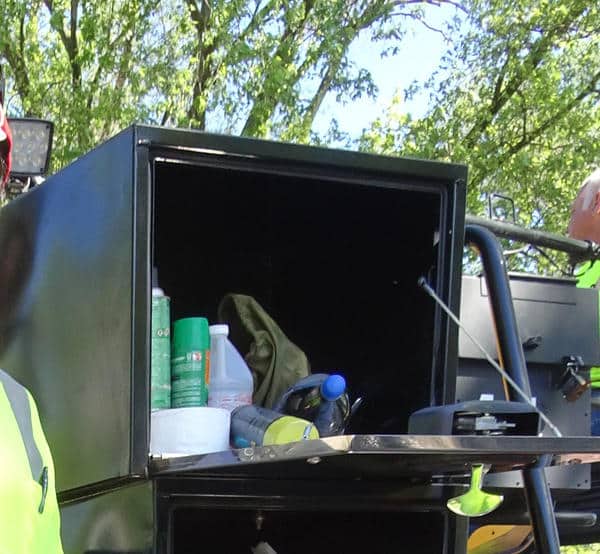
This crew has affixed an 18- by 24-inch box on the back of the paver to store pavement marking paint, headsets, measuring tape, release agent spray and other smaller items you don’t want to trip over or lose track of at the side of the project. The box can include a lock to protect the expensive items like headsets or sensors overnight. Photo courtesy of Ball
“Another aspect of the design was to add a visual safety factor as a slow-moving vehicle triangle to the back of the operator’s protection.”
The award committee for NAPA helped N.B. West create a video announcing their achievement in which Swaringam said, “It really helped propel our safety culture to a more collaborative safety culture where everyone wants to be involved in making safety innovations and looking at ways that we can improve our safety out in the field, for our workers that are working out there every day.”
Not only the collaborative nature of the project, but the winning of an award for the effort has brought renewed energy to the safety culture. “This really brought a lot of energy to our field workers to be bringing up safety innovative ideas to us…we’re all a team, we’re all trying to achieve the same goal, and that’s to make sure that the employees working out in the field make it home safely to their families every night.”
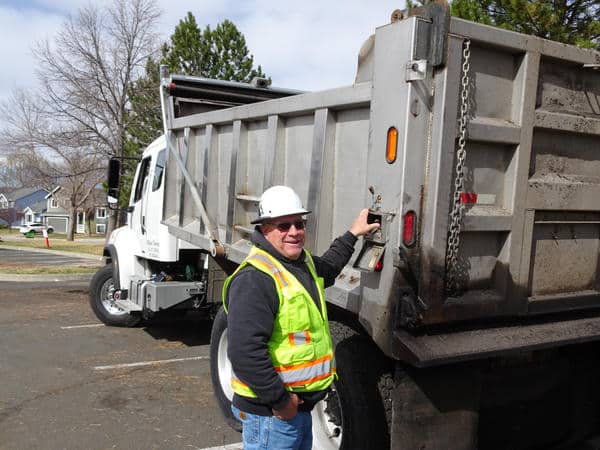
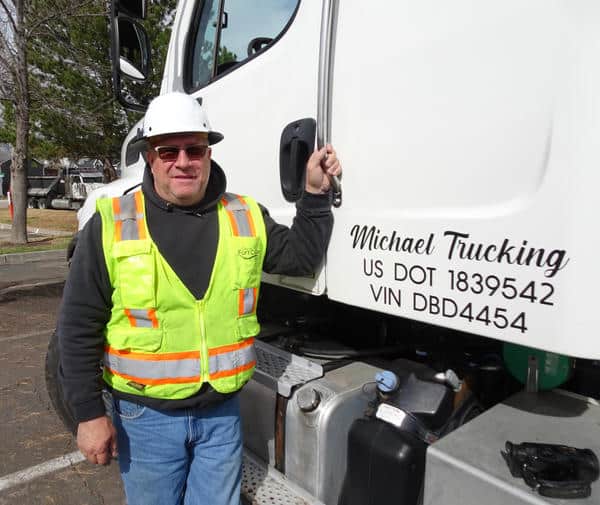
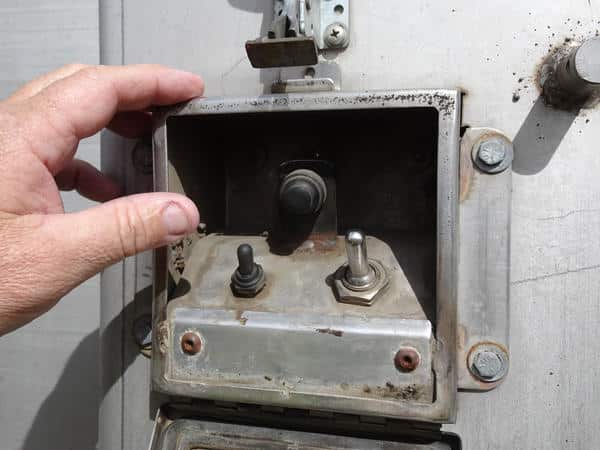
To help the paving crew when doing handwork, Dwight Michael of Michael Trucking, Ft. Collins, Colorado, installed a covered switch at the back of the haul truck. Now, from outside the cab, he can toggle the switches to hydraulically raise and lower the truck bed. The round button above the two switches turns the hydraulics on. Photos courtesy of John Ball, Top Quality Paving & Training, Manchester, New Hampshire
Safe Hauling
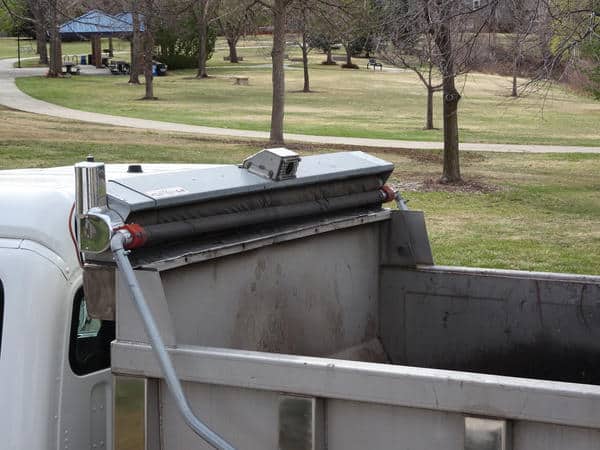
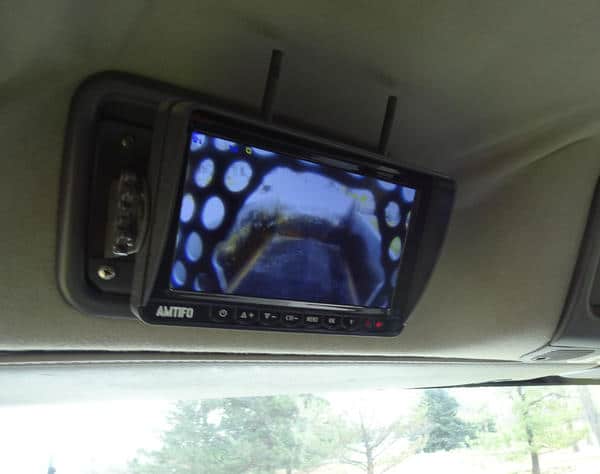
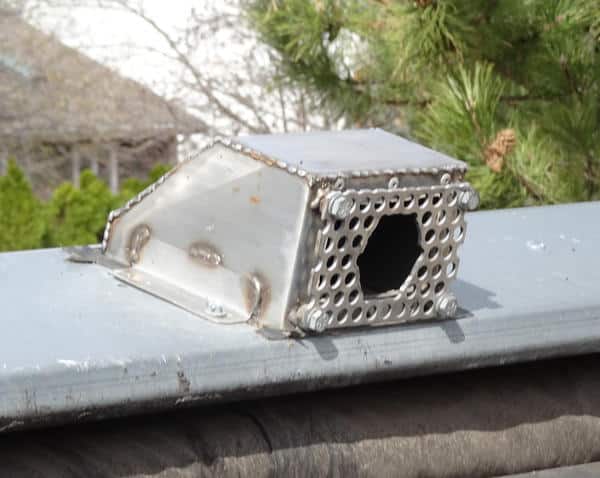
Dwight Michael of Michael Trucking, Ft. Collins, Colorado, has taken safety and efficiency a step further by installing a camera atop his haul truck cab and directing its feed to a screen above his driver’s seat. This helps with safety because, from inside the cab, he can monitor what’s happening in the truck bed. The camera lens is protected by a steel-mesh screen bolted around the camera’s housing.
The camera Michael installed is protected by a steel mesh cage. Photos courtesy of Ball
When sharing mix delivery and loadout articles, AsphaltPro Magazine reminds haul truck drivers to stay inside the safety of the haul truck cab at all times. We’ve stressed the importance of building systems at the asphalt plant and cleanout areas near the work zone to enable drivers to do all the stages of their jobs without having to wander around dangerous areas. Keep in mind, there are exceptions to every rule.
Dwight Michael of Michael Trucking, Ft. Collins, Colorado, installed a camera atop the cab of his haul truck. The camera gives him a view of the haul truck bed on a monitor while he’s in the driver’s seat. Photos courtesy of John Ball, Top Quality Paving & Training, Manchester, New Hampshire
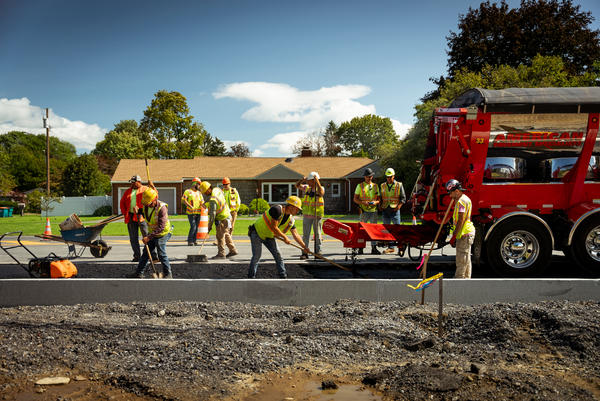
Michael is an entrepreneur who has devised a way to safely and efficiently help the paving crew that performs extensive handwork. In this case, he has built a hydraulic control at the back of his truck for lifting and lowering the bed when he’s outside the cab.
Dwight Michael of Michael Trucking, Ft. Collins, Colorado, installed a camera atop the cab of his haul truck. The camera gives him a view of the haul truck bed on a monitor while he’s in the driver’s seat. Photos courtesy of John Ball, Top Quality Paving & Training, Manchester, New Hampshire
The control is housed in a protected box on the side of the truck. Inside is a button to turn on/off the hydraulics and two toggle switches to raise or lower the truck bed. In the image in this article, you can see the chute in the center of the tailgate, which will feed material to the wheelbarrow as Michael gently lifts the bed with the toggle switch. You can also see in that image that Michael has parked the truck on a solid, level surface for this work.
The camera Michael installed is protected by a steel mesh cage. Photos courtesy of Ball
Because he has built this hydraulic system and can control it from this safe vantage point, he can watch and control the material flow without running back and forth from the cab to start the truck, raise the bed, etc. He has made the operation more efficient for the laydown crew he works with as well as himself.
To help the paving crew when doing handwork, Dwight Michael of Michael Trucking, Ft. Collins, Colorado, installed a covered switch at the back of the haul truck. Now, from outside the cab, he can toggle the switches to hydraulically raise and lower the truck bed. The round button above the two switches turns the hydraulics on. Photos courtesy of John Ball, Top Quality Paving & Training, Manchester, New Hampshire
As we saw in the November issue and here, many crews in the field devise those extra systems and clever contraptions to give equipment in the work zone that additional edge when it comes to safety and efficiency. Tell us about the unique device or setup your crew has built to make the job easier, faster or safer. You can share on our social media channels or send an email to our editor, sandy@theasphaltpro.com.
Watch a video from N.B. West Contracting on the creation of the safety cages at the company’s YouTube channel.
Augment Your Paver to Make the Crew’s Job Easier
The asphalt paver laser “attaches” to the paver either by a magnetic or clamp mount, depending on which bracket you select. The laser then points out the line for the operator to follow for a precise paving line. Photo courtesy of Frank Foore, PaverLaser.com, Akron, Ohio
You can achieve precision paving when everyone has what they need, safely at their fingertips
Once the crew gets the new paver to the job, each person has his or her preferred way to place the mat correctly behind it. Assuming everyone is trained on the best practices to achieve a smooth and well-compacted finish, let’s look at some ways to implement those practices in the most efficient and comfortable manner. Let’s look at ways to augment the paver delivered from the dealership or auction house.
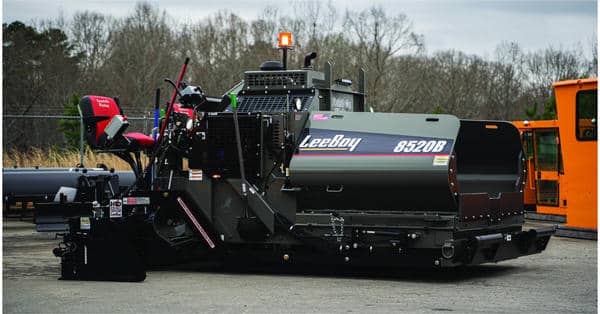
The special edition Raised on Blacktop paver from LeeBoy not only included the creature comforts Bill Stanley described for the article, but it also featured a distinctive paint job to make it stand out from the crowd. Photo courtesy of LeeBoy
A Precise Machine
We don’t want to imply original equipment manufacturer (OEM) factories don’t build something powerful and smart. Every paver out there has been designed to build specific pavement systems from golf cart paths to driveways to parking lots to city streets to airport pavements to highways. These machines are, after all, the original 3D printers.
The people working on and around these pieces of equipment have their preferences for how auxiliary equipment should be handled, stored and used. Those same people need a safe, uncluttered workspace where they can access an increasing number of tools and tablets during the shift.
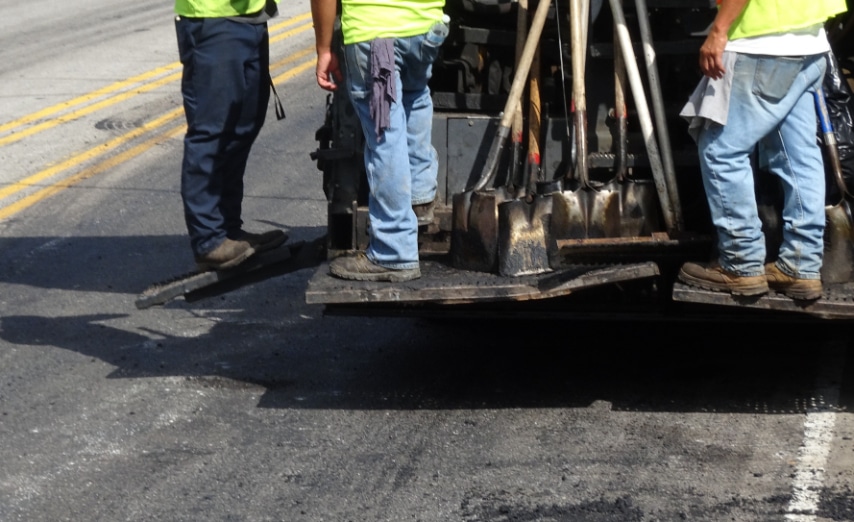
We asked our social media followers how they augment the paver, and a variety of responses came in focusing on convenience. One respondent shared they place a cooler full of iced drinks on the paver deck. Blayze Oyster wrote, “We like to build custom racks for our pavers for shovels, lutes, brooms, depth sticks, etc. Makes it a lot more efficient to have all tools on board with us.”
That need to organize hand tools is a common theme and one contractor in the Northeast took it to the next level through collaboration and communication with the OEM directly.
Pavers aren’t the only machines American Pavement Specialists and Raised on Blacktop work to improve in the industry. The Stanleys worked with Trout River Industries to turn two live bottom trailers into trucks that could auger asphalt mix into trenches. Check out the quick story at https://theasphaltpro.com/articles/partnering-on-the-perfect-truck/. Photo courtesy of APS
Collaboration for Precision
One of the more notable collaborations that took place in the paving industry a few years ago involved Raised on Blacktop, Danbury, Connecticut, and LeeBoy, Lincolnton, North Carolina. The two entities worked together to trick out a special edition Raised on Blacktop paver, which was available as of February 2021.
Bill Stanley, the owner of American Pavement Specialists, Danbury, and partner in Raised on Blacktop, explained they’ve worked with LeeBoy, Mauldin, X-Broom, Wirtgen Group and others to modify and adjust what he defines as “creature comforts” of equipment for the contractor’s benefit.
“I think my son said it best when he said he spends more hours a day on the paving machine than he does in bed,” Stanley shared.
With this truism across the paving industry, it was important to the Stanleys to get the creature comforts right.
“We didn’t re-engineer anything,” he said. Instead, the family offered ideas that brought an existing machine up a notch, like adding a complete tool-carrying kit to the LeeBoy 8520B commercial paver. “When you’re paving, especially if you’re doing large commercial areas, a lot of tools get carried on the paving machine. We designed something where we have a secure spot for everything that we need, whether it’s our paint cans, our tape measures, our razors that we use to scrape our tools with, additional shovel holders and rake holders. So, everything has a secure location.”
This ensures hand tools are within the workers’ grasp at all times and don’t fall off the machine as it moves around the project. “We did a cell phone holder. We did a USB port because the operator can track the trucks. We did a cup holder.”
Another enhancement the Stanleys suggested for the Raised on Blacktop edition of the 8520B was a lighting package. “We also did a lighting package with safety lighting, putting LED lighting in areas that were probably not known to the manufacturer that needed it, like inside the tunnel to the paver. We needed lights along the back of the screed, we needed lighting in front of the paver.”
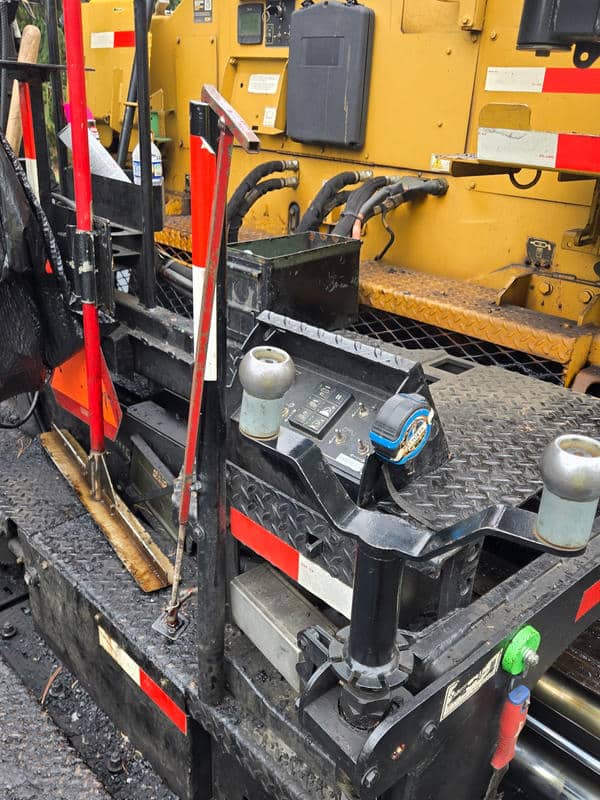
This is a convex mirror affixed to a light bracket. The team from APC, Golden, Colorado, has used a u-joint, which allows them to move the mirror forward and back, as needed. They’ve put one on either side of the hopper. The knob atop the u-joint allows them to loosen and tighten the grip on the mirror’s handle for ease of adjustment. The genius of this mirror placement is it gives the paver operator a better view of the entire material movement process from either operator platform. Photo courtesy of Ball
Stanley explained that the collaboration involved sitting down with the LeeBoy team to communicate what they were looking for openly and kindly. “When we sat down with the engineers with LeeBoy, the first thing I told them was, you know, we’re not here to redesign your paver. Actually, we’ve owned 20 of them. We love your paver. These are just things that the operator needs.”
Now that LeeBoy has offered these augmentations since 2021, Stanley has seen similar changes with other OEMs’ offerings. As he walks the floor at events like World of Asphalt, he notices other paving equipment OEMs have adopted cup holders, tool-carrying cages and other “creature comfort” elements on their equipment as well. It’s a positive development to see as OEMs have taken the operator’s work environment into consideration when designing and updating equipment.
For this crew working in a small housing development, the measuring tape and depth gauge are kept close at hand with brackets they’ve installed on their 8-foot Weiler 385B paver. Photo courtesy of Ball
Straight Precision
Frank Foore, the proprietor of PaverLaser.com, formerly Asphalt Pokers, headquartered in Akron, Ohio, also came up with an aftermarket item to help the paving crew. He developed the asphalt paver laser for his own use in paving a consistent, straight line a few seasons ago. It’s a device that attaches to the asphalt paver to “point” out a line for the operator to follow.
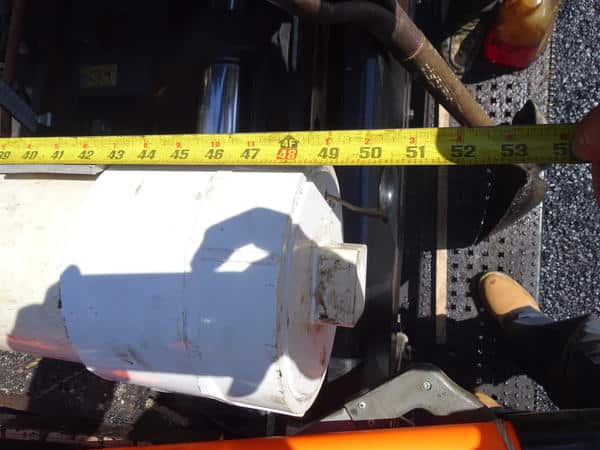
This PVC snorkel tube, with its cap tethered by a string, is about 4 feet long to house the smart levels. In these pictures, you can see how far it reaches beyond the paver deck, which doesn’t allow it to trip workers or get in the way of the screed operators. Both photos courtesy of Ball
“I made this for the paver to follow or else you’re painting lines all day,” Foore said. “We’ve had them for a couple years now.”
Each paver laser includes a 12-volt plug and a DC plug, so the crew can select how best to power it. The device also comes with either a magnetic mounting bracket or clamp-style mount, depending on which you need for your model of paver. It also helps to reduce trip hazards, contributing to a safer job site. It’s even equipped with a built-in cooling fan so it can handle the intense heat of paving operations.
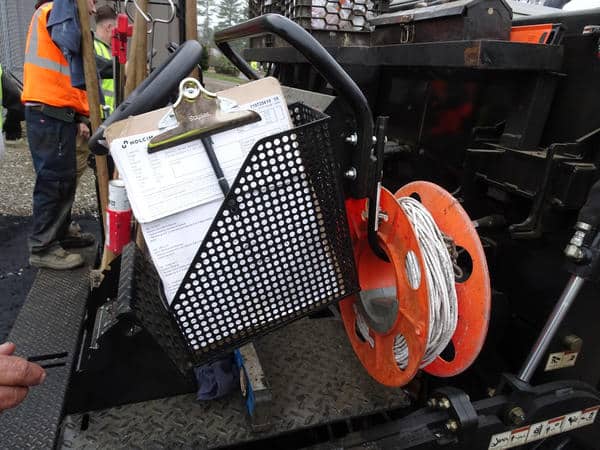
This left-hand screed operator pedestal includes modifications the T&K Asphalt Services Inc. crew in Whitman, Massachusetts, has made. They’ve added a basket to hold the work order and truck delivery slips. They’ve also attached a j-bracket where they keep the spool of string for lining out jobs. Photo courtesy of John Ball, Top Quality Paving & Training, Manchester, New Hampshire
Augment Your Precision
In the text to follow, we showcase some tried-and-true and new-to-you ideas for augmenting the paver on your job site. You probably have some ideas of your own to share with the industry. Maybe you have a photo of the brackets you’ve built to hold smart levels in place behind the tractor. Maybe you have a better way to cook lunch on the screed. Let’s see what kind of “better mousetrap” you’ve built to get a precise paving job.
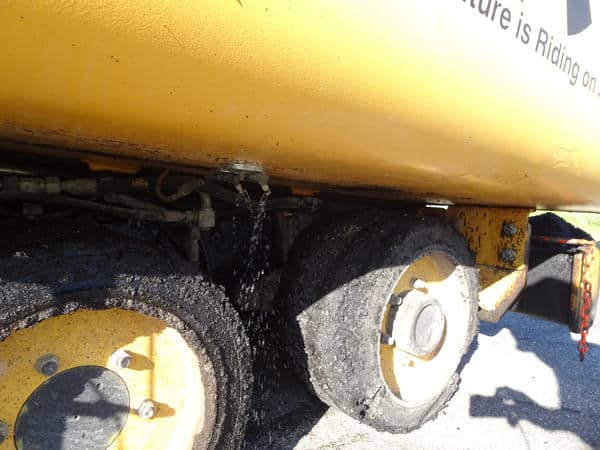
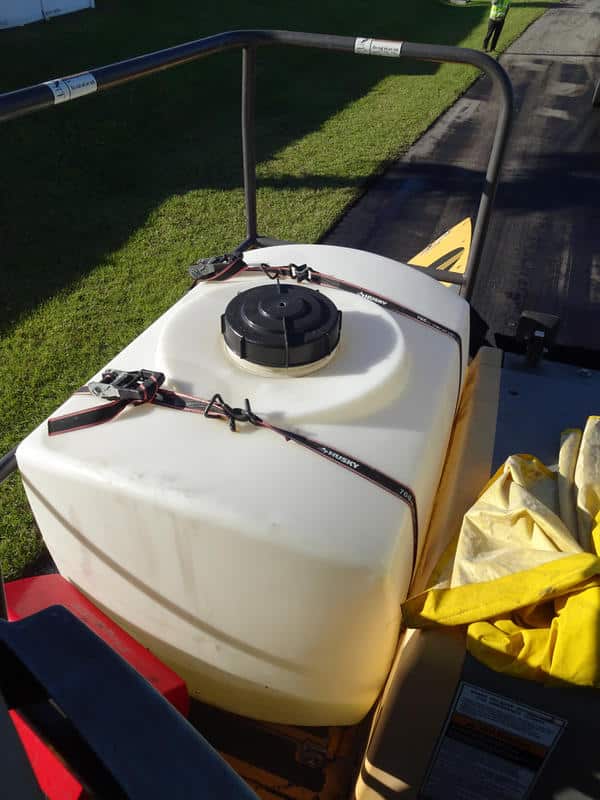
A plastic water tank holds 250 gallons of water with a small amount of dishwashing soap as a surfactant and nestles between the engine hood and safety railing. Husky nylon cables secure it in place on this Volvo 7170, rubber-tired paver. Typically, the steering tires would pick up tack and bring up mix. Laying a 7/8-inch mat means any pickup would be a problem. Using the spray system from a roller, the water is delivered via brass pipe, which is attached to 60-pound magnets on the underside of the hopper. The magnets saved the mechanic from drilling into the hopper or welding this setup together. Clamps hold the tubes. Notice the 30-degree angle of the nozzles direct the water onto the drive wheels only. For this job, you can see the Ajax Paving crew is using a shut-off valve on the hose coming out of the tank to ensure proper water control. The setup includes a pump. Photos courtesy of Ball
How to Set Up the Roller and Rolling Zone for Safest Practices
This operator could use additional safe practices. Someone should put a crash attenuator or other safety device between him and the traffic using this off-ramp. The strobe light atop the ROPS also needs to be fixed to make sure drivers see him. His headlights are on and that’s a positive work practice. Make sure you’re setting your operators up for a safe shift with all the lights and reflection you can.
Along with the equipment maintenance tips we’ve been sharing, there’s a safety aspect we need to address when it comes to the upkeep of paving and pavement maintenance machines. Hopefully, team members recognize by now how important it is to maintain pavers, rollers, skid steers, brooms and the like to keep this equipment in optimal condition for achieving a top quality job. But stop and think about the safety of your crew members and the traveling public when you’re performing routine and spring start-up maintenance tasks.
We’ve talked before about the importance of cleaning lights, safety decals and reflective tape on pavers and haul trucks. Any little bit of reflection could be the piece that catches a motorist’s eye before he or she glances away from the road and down at their phone—each bit of light or extra reflective tape you have on your paver could be the item that gets their attention and prevents them from plowing into your work zone.
Making your equipment reflective is like armoring yourself for battle. Don’t take it for granted. Instead, think of your piece of equipment like an extension of your safety vest. You want it to be in its best condition and you want to position it most effectively to protect you. Let’s use the roller this month to show you what I mean. I won’t name the companies or places where I saw these safety issues happening because my goal here is not to embarrass anyone; my goal is to educate others on best safety practices.
I cannot overstate how important it is to clean lights, safety decals and reflective tape on the equipment. Any little bit of reflection could be the piece that catches a motorist’s eye and prevents them from plowing into your work zone.
Make Your Roller a Safe Space
One of the first things to think about is putting all the safety features of the roller to work. When the lowboy driver delivered the roller to the jobsite, the collapsible Rollover Protective System (ROPS) was probably down to protect it from being damaged—and so were the mirrors—during transport. Someone needs to make sure the system is put back up and secured in place so it can do its job of protecting the operator.
The ROPS creates a safety cage that the operator sits in, but that doesn’t mean you can ignore your seatbelt. Back in the old days, before ROPS, if a roller was working on a slope and the machine tipped over, the operator needed to jump clear and hope he jumped the right direction to avoid the machine crushing him to death. Nowadays, the safety cage is a robust, heavy-duty system that prevents him from being crushed if, God forbid, the roller should tip over on an embankment or other slope. But the seat belt is what will keep the operator inside the cage that’s built to protect him. If he’s not wearing his seat belt, he could be thrown from the cage, in the wrong direction.
Roller platforms these days allow the operator to swivel; some of them have 360-degree swiveling that lets the operator see all angles of the mat. The joystick is right there in your hand, moving with you as you move. That means you don’t have to feel confined by seat belts. You can move and see the mat you’re compacting even when you have this safety device in place. That means there’s no excuse for leaving a seat belt dangling to the side, unused.
In this picture, the seat belt is dangling unused. The operator could be thrown away from the safety cage of the operator’s platform if the roller were to tip over. Instead of this unsafe situation, make sure the roller operators use all their protective gear. Also, note that the strobe light on the back of the ROPS needs to be relocated to the top and the bracket at the front of the machine (circled in red) is missing the mirror that could help the operator view not just the edge of the mat but also obstructions.
Another item that’s supposed to protect the roller operator and the people on the ground is the backup alarm. I’ve seen people stick paper or a rag in the megaphone backup alarm on the roller to muffle it because it was too loud and bothering them. This is unacceptable. The whole purpose of the alarm is to be loud enough to alert people that the 14-ton machine is moving toward them or their equipment. We have become complacent when hearing it.
And while we’re talking about people and other equipment on the ground, let’s talk about the whole scene around the roller. Let’s talk about the work zone.
For certain types of jobs, you are required to follow the Manual on Uniform Traffic Control Devices (MUTCD). This manual provides common sense guidelines for any work zone as well as rules and regulations for state and highway projects. The safety rules are set in place to safeguard the workers inside your work zone and the traveling (or walking) public outside your work zone.
On a job where the MUTCD wasn’t used, I suggested to the team that we place a work truck with its four-way flashers and strobe light at the beginning of the work zone in the off-ramp to help alert drivers to the work zone. The project had barrels set up on one side of the lane, but the roller operator was exposed to drivers coming up behind him. He was the first construction vehicle the drivers would notice as they exited a highway and decelerated from highway speeds.
This situation demands a crash attenuator and flashing lights to get drivers’ attention. This situation demands the roller have a clean, functioning strobe light atop the ROPs; clean, functioning lights on its corners; clean, functioning headlights that are turned on; and clean, well-maintained reflective tape to make it stand out. Even in the daytime, you want these lights to be on and reflecting properly.
Think about the individual person. He wears a reflective vest to catch everyone’s attention and to let everyone know where he is. His back is often to traffic so he needs mirrors adjusted to show him what’s going on. The lights on the roller are the roller operator’s reflective vest so people can see him. The lights are the extra safety apparatus for your equipment. If the roller is the first indication of a work zone, you want that thing to be lit up like a Christmas tree. You want that thing to reflect.
Above all, use common sense and work as a team to keep all members of the crew and the motoring public safe. The goal is to get a top quality mat while everyone goes home safe at the end of the shift.
John Ball is the proprietor of Top Quality Paving & Training, Manchester, New Hampshire. For more information, contact him at (603) 493-1458 or tqpaving@yahoo.com.
Basic roller safety guidelines:
Are you in a safe zone?
Follow the MUTCD for best work zone setup practices
Put a crash attenuator (or something with flashing lights) before the work zone
When you get to the jobsite:
Leave your vest on and zipped up
Make sure you’re using all available PPE properly
Make sure the ROPs are properly in place and check them over to make sure there aren’t any missing bolts or fractures
Clean and check the strobe light on top of the ROPS is secure
Clean and check the headlights to ensure they’re working properly
Clean and check all the lights on the corners of the machine, including four-way flashers
Clean and maintain the mirrors; focus them after they’ve been flattened for travel on the lowboy
Do not obstruct or disable the backup alarm; check it before you start your shift to ensure it’s 90 decibels or more, according to OSHA regs
Clean and maintain all the reflective tape and safety decals
When it’s time to roll:
Put on your seat belt
Turn on the strobe
No matter the time of day, turn the headlights on
Communicate Equipment Repairs Now for Spring Startup Success
The wire for the feed sensor will extend and flex but you still want to pay attention to it. Keep asphalt from building up and burying it. Make sure the extensions don’t pinch or damage it. Watch out for both the wires and the sensor itself when shoveling or manipulating mix near the endgates so you don’t damage these expensive components. But if something happens to damage them, let the mechanic know right away. These elements are in place to help you get a quality mat; don’t wait until winter downtime to surprise your mechanic with their need for repair.
No one will know what the equipment needs to prep it for spring startup if we don’t communicate this winter
When we’re talking about maintenance—with the paver or the roller especially—we’re also talking about mat quality. When I look at a paver, I focus on two categories—the screed and the tractor. These two main components affect the quality of the mat you’re placing; both have to be in optimal working order if you want a top quality mat. Both are on the mechanic’s mind when he gets started on winter maintenance.
Here’s a Quick Tip: Spray Pledge furniture polish in the paver’s extender cylinders so they slide out smoothly and properly.
When the mechanic enters the garage in January or February, he’s not going to know what might have been going wrong with the paver last season. Why? Because no one communicated it to him.
Even with telematics and fancy apps that automatically ping him about how many hours the paver has worked and when it’s time to grease a joint, no one stopped to tell him about a driver smashing the screed on the lowbed or the depth crank getting loose in its sleeve or the time the extension folded in and pinched the feed sensor’s wire. Those important things get lost in the day to day and add up to poor production for the paving crew, and they surprise the mechanic during the winter maintenance season if we don’t tell him about them.
The lowbed drivers have beat up the screed platforms of this paver. The crew has learned they can’t have the left platform in place when the screed is lowered for paving or this element will drag and leave a gouge in the mat. The middle piece that you see in this picture is a tripping hazard. The mechanic has to order new parts to repair this problem for the crew.
We need a system in place to forewarn the mechanic, telling him to order a new screed platform to replace a bent one so the broken one isn’t digging into and marring a mat we’re trying to build. And we need to use that system, communicating with the right people to get action when action is needed.
For example, when I noticed the lower scraper bar was missing on the back drum of one contractor’s breakdown roller, I asked the operator about it. His response was that he had informed a foreman about the missing scraper bar a few times already. But the foreman didn’t recognize the importance of the problem. He wasn’t the right person in the chain of command to do anything about the problem, the roller consistently used more water from the back tank than the front, and the machine went without a repair for months.
This is unacceptable, but the operator couldn’t get help with the problem until we went to a supervisor who had direct communication with a mechanic who could order the replacement part.
Inside the red circle, you can see the bracket for the scraper is still in place, but the scraper bar itself has been knocked off by incorrectly loading onto the lowbed. While the roller can still operate and still get compaction, it’s not efficient like this. There are two scraper bars on the drum for a reason: each bar collects and spreads the water across the width of the drum to lubricate the drum and assist in keeping it from picking up material as you compact the mat. When you remove one of these, you remove that device from either the forward or back motion of the rolling pattern.
You have to deliver a note—and usually it’s done at the end of the year—from the equipment operator to the mechanic, sharing what they think is broken or needs repair. Besides the mechanic using the manufacturer’s list of what needs to be done at 500 or 1,500 hours, for regular wear-n-tear, to check pump pressure, to replace seals, to check conveyor chains, and so on, he’ll also use a list from the operator of the piece of equipment. I have a maintenance sheet that I had at Pike Industries that I used for years and years and AsphaltPro has a paver maintenance checklist, a roller maintenance checklist, a crusher maintenance checklist and even a plant maintenance checklist at the magazine’s Digital Downloads page.
When we hand these lists of what we see going wrong to the mechanic, they include more than what you see flagged in an app or a telematics report. If I have a frayed wire, that may not come up. The telematics might pick up there’s a hydraulic leak, but not that there’s a failing O-ring. You must have the operator’s input to understand what’s going wrong and where with the piece of equipment he’s operating day in and day out. He’s using a special set of tools to notice when something needs to be scheduled for the mechanic’s attention.
In the end, the mechanic starting his winter season maintenance on the paver, roller, sweeper, material transfer vehicle or other equipment will have his best chance at setting the crew up for springtime success if the crew has made notes for him. If the paving crew and maintenance crew work hand in hand and with the operators’ notes—with telematics, apps, tablets, paper-and-pencil and phone calls to discuss the fine details—then the whole team can return in the spring with optimized, safe, efficient equipment to get a top quality mat right off the bat.
John Ball is the proprietor of Top Quality Paving & Training, Manchester, New Hampshire. For more information, contact him at (603) 493-1458 or tqpaving@yahoo.com.
Repairing Little Things on the Paver Saves Big
With the center rubber section missing and the side pieces torn, mix will spill out of the hopper. It will create a quality control problem in front of the paver and will build up on the push rollers, creating a secondary quality control problem. Fix all these issues by replacing the center piece and fixing or replacing the side pieces. All photos courtesy John Ball of Top Quality Paving & Training
Focusing on the paver, we look at tips to clean and maintain the iron to achieve top quality paving every season
This is the time of year when crews are rushing to fit in as many projects as they can before snow flies and even daytime temperatures could prevent top quality paving. As much as your team wants to dive in and start paving at the beginning of the shift to get the job done, you must ensure all the equipment is in working order first.
There’s no point in paving with a warped screed. There’s no point in spraying tack with a distributor that has gummed up nozzles. Instead, let’s look at a few routine maintenance items that can keep your crew working efficiently into this hurry-it-up part of the construction season.
As Sandy and I pointed out in the September article “Increase Quality on Any Job,” we should start with the all-important paver. And we should start with adjusting the attitude of the workers who are responsible for its upkeep.
There are members of the workforce who don’t yet understand why we’re telling them to take time out of their day to clean a machine. They don’t yet know why it’s important to wipe down vital components with release agent and a rag while the paver is still warm. We have to educate them so they understand:
a clean machine will work better;
a clean machine will make their job tomorrow easier;
a clean machine will make it possible to notice if a component is out of order;
a clean machine is safer to work around; and
a clean machine will help them get better quality for full pay on the final job.
All these things come into play because the equipment is clean enough to work properly. It’s up to each crew member to help keep it clean and in good working order.
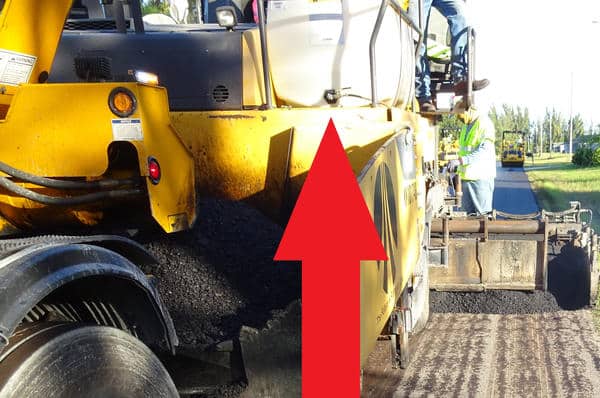
Starting at the very front of the tractor, if you see material buildup on the push rollers, you want to get at that and scrape it off. When the push rollers stick or fail to roll smoothly against the haul truck tires, the tractor will experience a jerking or shuddering motion as it drives forward. Even when this shuddering is slight, it affects the performance of the screed, thus the smoothness of the mat.
If you have globs of material built up anywhere else on the tractor or screed, this jerking motion might knock some of that loose, causing it to drop onto the surface and create cooled areas of material segregation. Your roller operators won’t be able to roll that out and you’ll have potholes in your finished project some day or you’ll have an inspector deducting your pay.
All of this can be avoided if you clean the push rollers at the end of each paving shift. While they’re still warm, take a rag and some release agent and wipe them off. It’ll only take one or two minutes to do while the components are warm. If you wait until morning when the paver is cool and stray material has hardened, it’ll require a putty knife, more release agent, more elbow grease and more time.
Another area to watch for material buildup to maintain smooth forward motion is the wheels—or track—of the tractor. We’ve talked about this in AsphaltPro before, but it bears repeating. Check the bogies and track at the end of the shift and clean out any asphalt you see starting to get caked in there. Do it while the components are still hot to make the job easier on yourself.
Ways to prevent the material from getting into the bogies include:
avoid overfeeding the head of material;
avoid flooding the endgates; and
avoid driving over piles of spilled material.
Let’s talk about driving over piles of spilled material for a moment. One way to prevent spills is through haul truck management and communicating with drivers. A good dump man who can get drivers to employ brakes, raise beds and charge the hopper properly is worth his weight in gold. See the article “Save on Costs with Your Professional Guide to Asphalt Mix Delivery—An Independent Look at Best Haul Truck Practices Part 3” for a tutorial on mix delivery.
Another way to prevent spills is to maintain the front of the hopper properly.
Look at the front left and right side of the hopper in these pictures. In the main picture, you can see that the rubbers have been replaced from what you see in the inset picture. The center panel will also be replaced but must come from the Caterpillar parts distributor. The conveyor belt material had become worn and torn, allowing mix to consistently fall out of the hopper during the paving day. This made extra handwork for the laborers to shovel material out of the way and often resulted in segregated areas in the mat. This does not lead to top quality paving results. On a state job, it could lead to failed lots or deducts.
By replacing torn or missing rubbers on the hopper, you can prevent some of the spillage that causes extra handwork for your crew and piles of mess that your tractor’s wheels end up running over. When the bogies pick up that material, it’s a mess to remove later.
Your roller operators won’t be able to roll that out and you’ll have potholes in your finished project some day or you’ll have an inspector deducting your pay.
The areas between the front and the screed are important to clean at the end of the shift, of course, and I’m not trying to minimize them by jumping to the back of the tractor. But let’s concentrate on the screed, nose and plates for a few minutes. The screed is your hot iron that will smooth the material into a flat, gorgeous mat. If you have material stuck to the bottom of the screed or caked against different elements, you lessen your chances for success.
In the picture at right (0571 gapping from warping), we can see a gap between the endgate and screed. We see mess and material all over the warped metal. This has happened for a number of reasons, including poor loading onto and off of the lowboy, but also because built up material was allowed to prevent good extension and retraction of the endgate and tunnels.
The result is warped metal that can’t line up correctly. If the endgates aren’t flush with your screed, you can’t build a good joint. That spells disaster for a pavement and deducts for your pay.
The buildup of material on the screed or its nose can change your angle of attack. It can degrade the wiring or disrupt the electronics. For example, if the electric heat is disrupted, the screed will not heat evenly all the way across, leaving you with uneven paving results. Look at this picture for some of the problems we’re talking about.
On the right side of the picture, the white stones indicate the endgate is too tight. That causes the shadow you’re seeing halfway into the main screed. The screed is cold there and it’s too high, causing the line.
The second area of shading is occurring because the endgate is forcing pressure on the extension. The mis-matched screed sections between the extendible and the main angle of attack isn’t the same, either. You can see this in the mat behind the paver.
The center section is tight and is screeding off correctly. This is good and offers the nice, left-hand side of the picture, which is what we’d like to see across the entire width of the mat. Instead, we’re seeing the uneven results of a screed that hasn’t been maintained properly or double-checked prior to the day’s paving start.
Your crew can prevent this uneven performance by:
maintaining all components of the screed;
cleaning the different elements of the screed and the underneath side of the screed/screed plate;
removing asphalt material from the nose of the screed at the end of the paving shift;
check to ensure the screed and extensions are parallel;
checking the straightness of the screed plate with a straightedge prior to paving; and
double-checking the electronics to ensure even heating all the way across.
When you see this article appear online, share some of your screed cleaning and maintenance tips, too.
Catch Up Over Winter
With the end of paving season upon us in many parts of North America, now is the time to schedule winter maintenance for all our paving equipment. You can download a paver maintenance checklist from TheAsphaltPro.com white paper repository and make a plan for your mechanic to address this all-important machine before season start-up 2025.
Also make a plan to incorporate equipment cleaning in your new-hire training and worker refresher training over the winter. I worked on an online training course with AsphaltPro a few years ago—Asphalt Paving 101, available here and one of the modules in that course outlines each worker’s job on the paving crew.
Don’t let your downtime go by without encouraging workers to do their jobs to the fullest. Some of these men and women come to our industry without any knowledge of the equipment or basics of paving. If we let them flounder and fail, allowing their daily performance to be hindered by gummed-up machines, they’ll have no pride in either the work or the equipment. They’ll leave as soon as something more enticing comes along.
To help the newcomers feel valued, we must show them the “why” behind the things we do. We must help them understand that the task of cleaning a machine at the end of the shift today saves them time and energy tomorrow, makes their job easier and more productive tomorrow, and gives them a top quality paving job with a better chance at full pay tomorrow.
We’ll dive into more equipment upkeep and tips in future articles, so keep an eye out for that in upcoming issues of AsphaltPro.
This Should be Covered
Make sure the mechanics and the crew members not only understand their jobs but also care about what they’re doing.
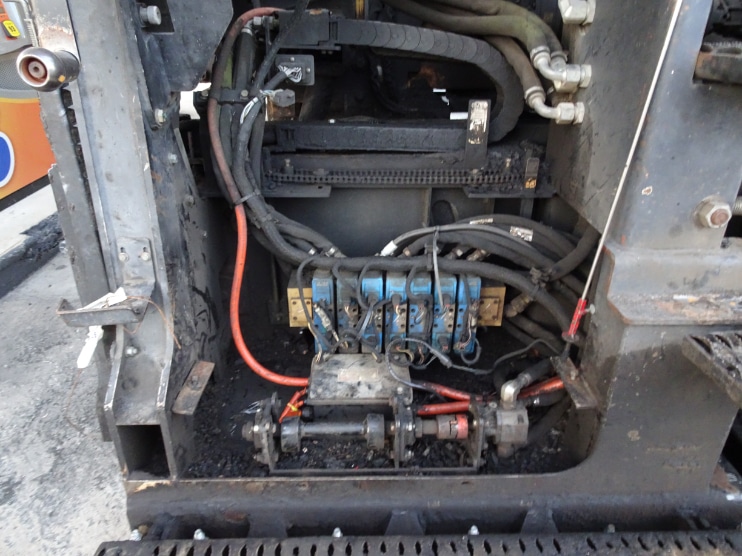
In this picture, we see an uncovered electrical section on the back of a paver, which was sent out to the field for a day of paving. You’ll notice the eccentrics at the lower center of the “box” are caked with asphalt and unable to spin, but what’s worse is this uncovered area is a shock hazard for the screed operator and any other worker who reaches into it. The seven blue boxes are 240-volt electrical connections for the screed.
There’s no excuse for this to go into the field without its panel cover. Don’t let mistakes like this cost someone their life. Instill care and knowledge in your crew.
John Ball is the proprietor of Top Quality Paving & Training, Manchester, New Hampshire. For more information, contact him at (603) 493-1458.