
How to Get Density on a 7-inch Lift
BY John Ball
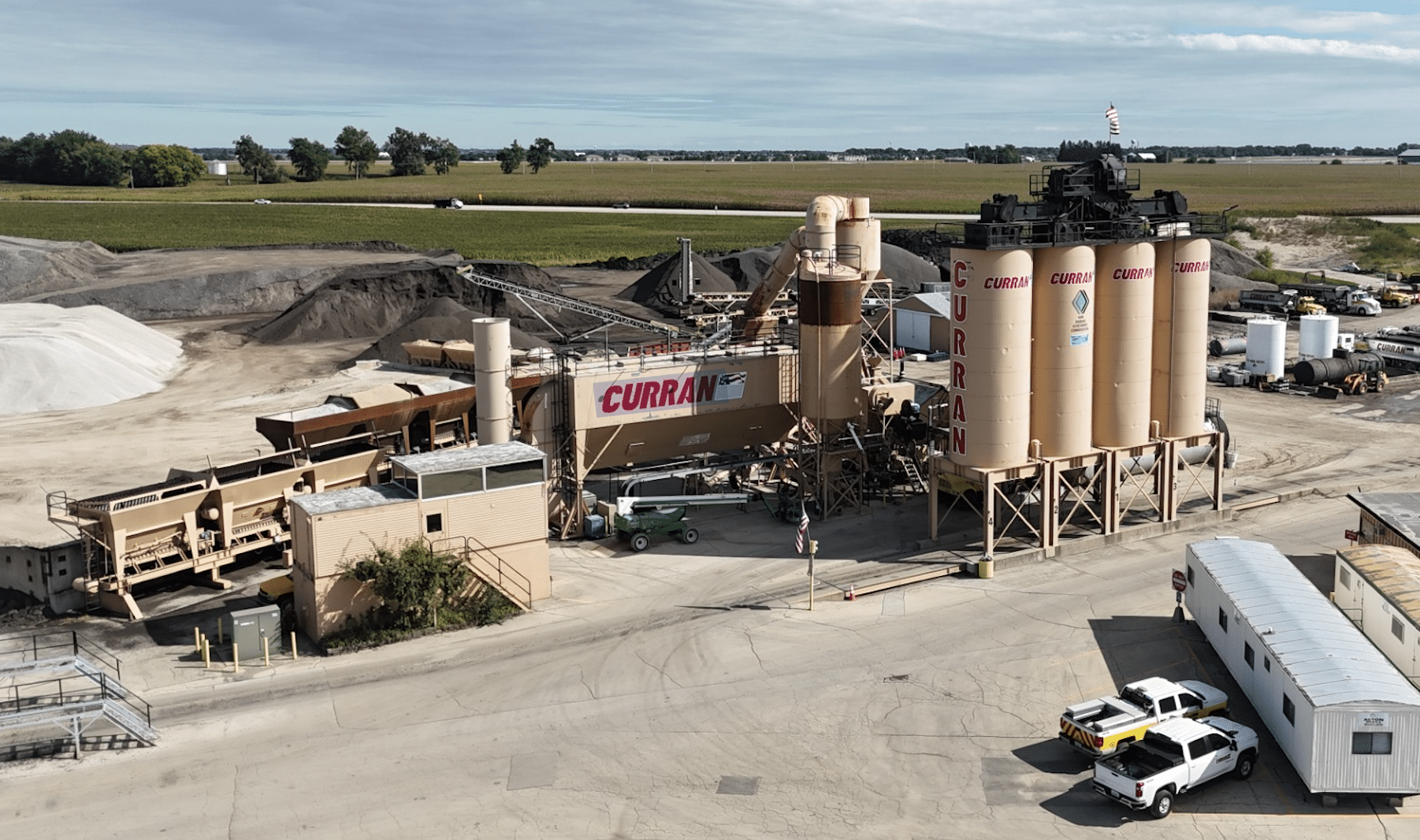
Curran Contracting shows how to achieve compaction on a thick lift base course for distribution center project
A cool and misty day in DeKalb, Illinois, made the perfect conditions for one day of a warehouse paving project. While asphalt professionals don’t usually like to pave in the rain, the light sprinkles here and there served us perfectly on this one because the moisture helped set and tighten the soil-cement base (or cement-treated base (CBT)) we were paving on.
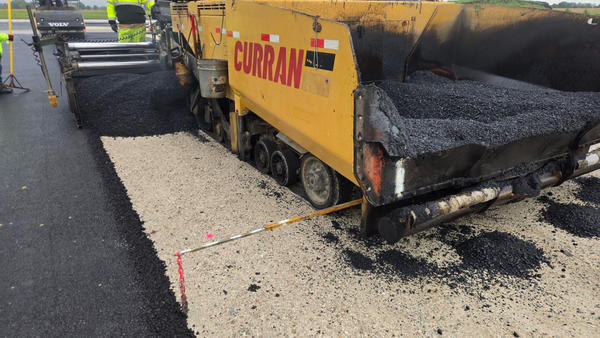
The 10-foot screed is extended equally on each side for a 17.5-foot paving width and the augers have no trouble keeping material fed to the endgates. Also notice the guide bar on the paver includes a chain that is painted to help the paver operator see it.
Typically, when paving on this type of base, we spray a light misting of water to tighten everything up, as I recommend for treating a gravel base. (See the article “How to Pave a Gravel Road” on page xx.) For this project, the weather provided just enough moisture, because the drizzle was off-n-on, to solidify the base and make it as hard as a blackboard. Even when executing a U-turn with the tracked paver at the end of a pass, we left no ruts in the surface. It offered a great surface for paving.
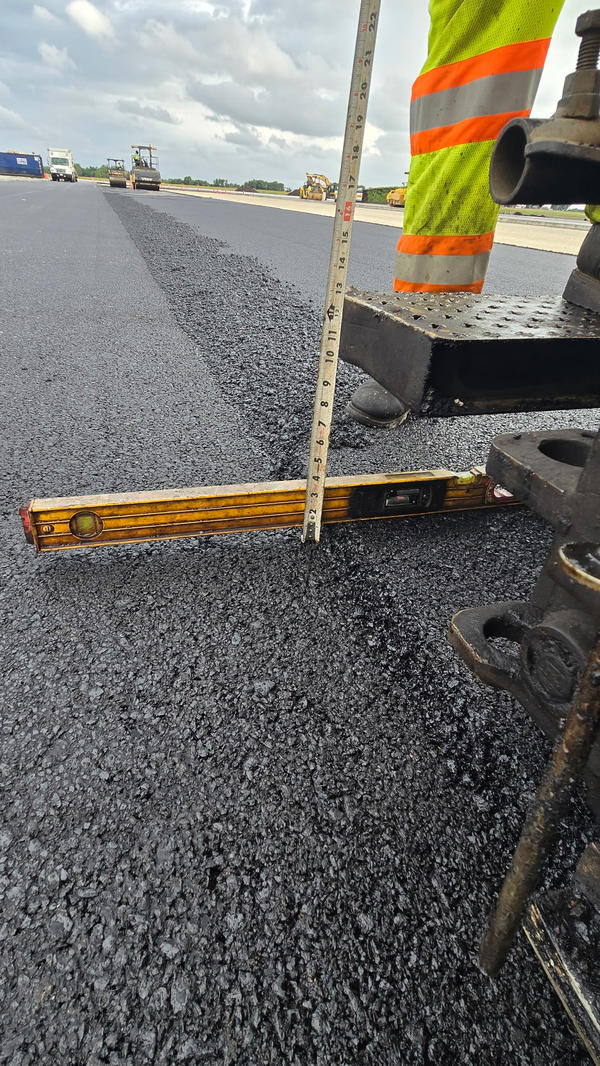
The crew placed the mix at 7 inches loose, 5.5 inches compacted, leaving a fluff factor of 1 1/2-inch. To ensure you maintain the right depth and compaction across your project, get out a straightedge and a tape measure and check. Place the straightedge across the joint prior to compacting the second lift and measure the difference. If the difference is the amount of fluff you’re building into each pull, then you’re on target.
The team from Curran Contracting, headquartered in Crystal Lake, Illinois, received mix from the plant about 5 miles away, keeping temperatures predictable as we placed pulls of 7 inches loose at 17.5 feet wide with the Cat 1055 paver. We extended the 10-foot screed by 3.5 feet and a few inches on each side to balance it and set the augers at 7 inches off the mat to keep from overfilling the head of material and to control volume.
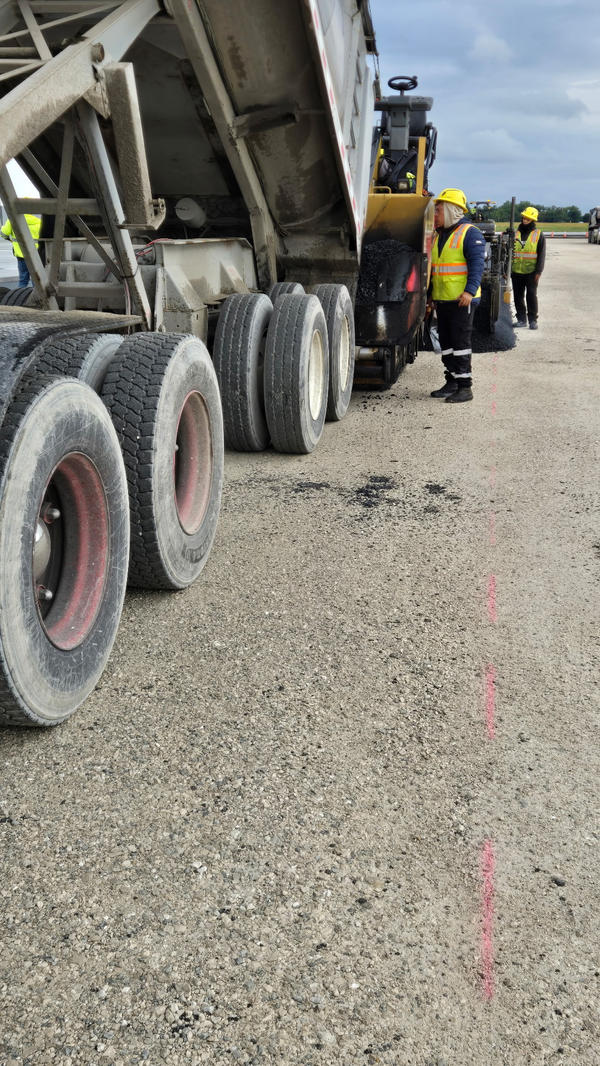
The Curran crew had 12 tractor trailers delivering mix on the Goodyear distribution center project.
Three large rollers followed the paver: two Volvos and a Cat 15. All three had 84-inch drum widths to get compaction of the thick, wide lift and leave us with a 5.5-inch depth and smooth results. Because this was a private job, density wasn’t a pay factor, but it was necessary to ensure quality.
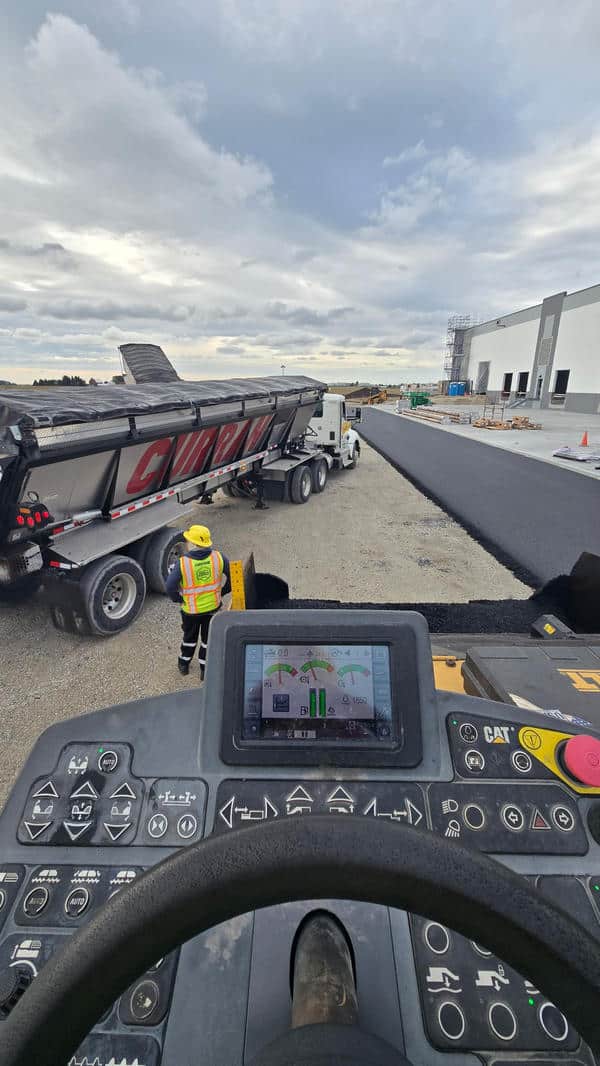
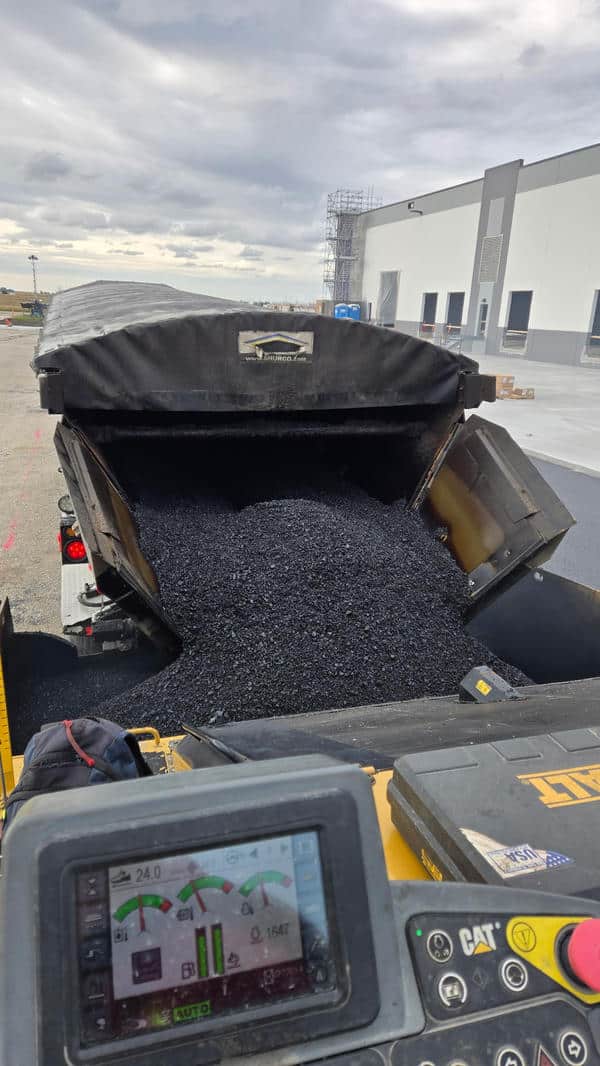
The Curran crew had 2 Etnyre live bottom trailers delivering mix on the Goodyear distribution center project. These trailers use a conveyor along the floor of the truck body to move the mass of material in a continuous unit to the hopper. Notice how the doors of the tailgate open as if guiding the material into the hopper.
Density Gauge Proves Twice is Nice
Curran’s QC Manager Dave Rushford has been in the asphalt industry for 30 years and explained the rolling team knew how to get compaction with this mix.
Base course = PG58-22 with NMAS of 19.0mm, 5.5 inches compacted
Intermediate course = SBS 70-28 plus polymer with NMAS of 19.0mm, 2.25 inches compacted
Surface course = SBS 70-28 plus polymer with NMAS of 9.5mm, 2.5 inches compacted
“With the mix itself, it’s an N70 binder, and we’ve already done a test strip for my jobs,” Rushford said. “We already had data on that to begin with.” He explained that for the N70 binder, it takes anywhere from 9 to 11 passes with the rollers to achieve the minimum densities you want at 2.25 inches. “We started off with the three rollers doing 5-5-5, and we just kind of augmented it as the mix progressed and how it looked for what we were doing.”
One of the challenges Rushford’s team came up against was temperature. “We had days where ambient temperatures were up in the 100s. The mix was taking a long time to cool down. We had to kind of lay back.”
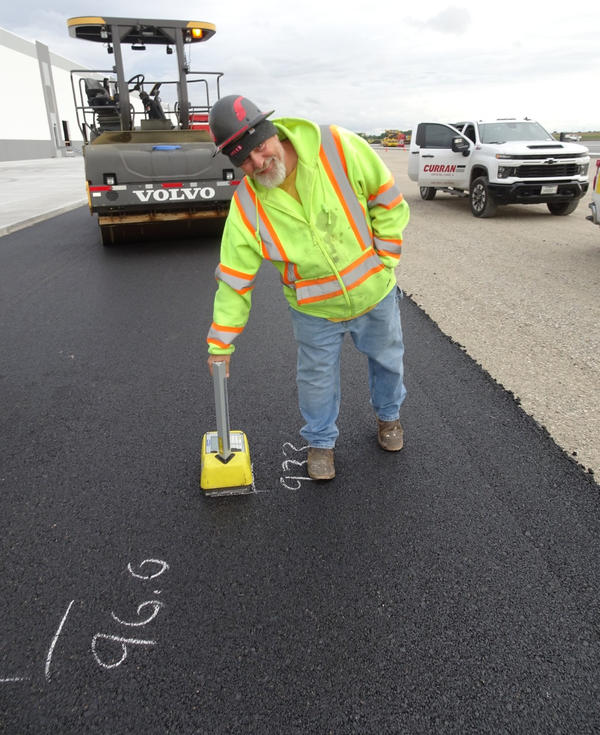
Dave Rushford has been in the asphalt industry for 30 years and with Curran Contracting since 2024.
The production temperature at the plant was around 320-325°F and because the job site is so close to the plant, there wasn’t time for the mix to cool during transport. “We were actually lowering the mix temp and we were running the trucks untarped just to kind of cool everything off.”
Getting compaction began with density off the screed of about 79 to 82% and then rolling what I call a double-hit. To cover a pull that’s 17.5-feet wide—or 210 inches—the 84-inch breakdown roller needed to make three coverages—or six passes—to roll the complete width. Then a seventh pass brought the roller back to his start position to begin the six passes again.
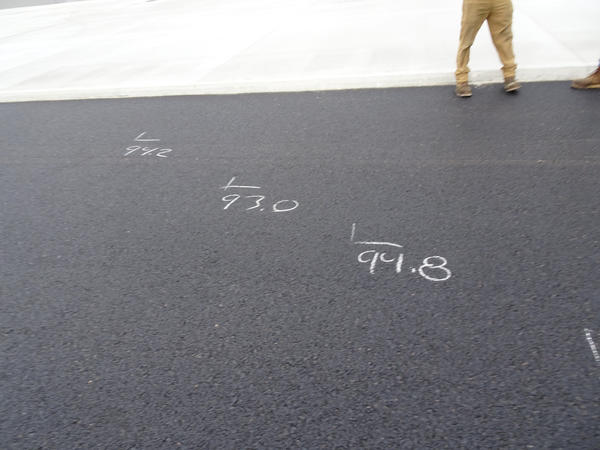
The 3440+ nuclear density gauge from Troxler Electronic Labs, Inc., Research Triangle Park, North Carolina, gave the team instant readings of the densities achieved on the base course.
The paver was only traveling about 24 feet per minute on this project and the rollers traveled between 150 and 200 feet per pass. Keep in mind, for a thick-lift project in cooler weather, the roller passes may need to tighten up. “When it was hotter out, we were actually making longer passes because we could,” Rushford said. “But it’s getting a little cooler now here in Illinois.”
Keep these back-to-basics tips in mind when going for density on thicker lifts:
Use wider rollers to cover more of the mat at once.
Make sure you have enough rollers to keep up with the paver.
Don’t let the paver outrun your rolling train.
Keep the breakdown roller at least a foot off the unconfined edge to keep from pushing out. The second and third rollers will cover this area.
Doublecheck density with a gauge before the mat cools so there’s time to make adjustments to the rolling pattern, if needed.
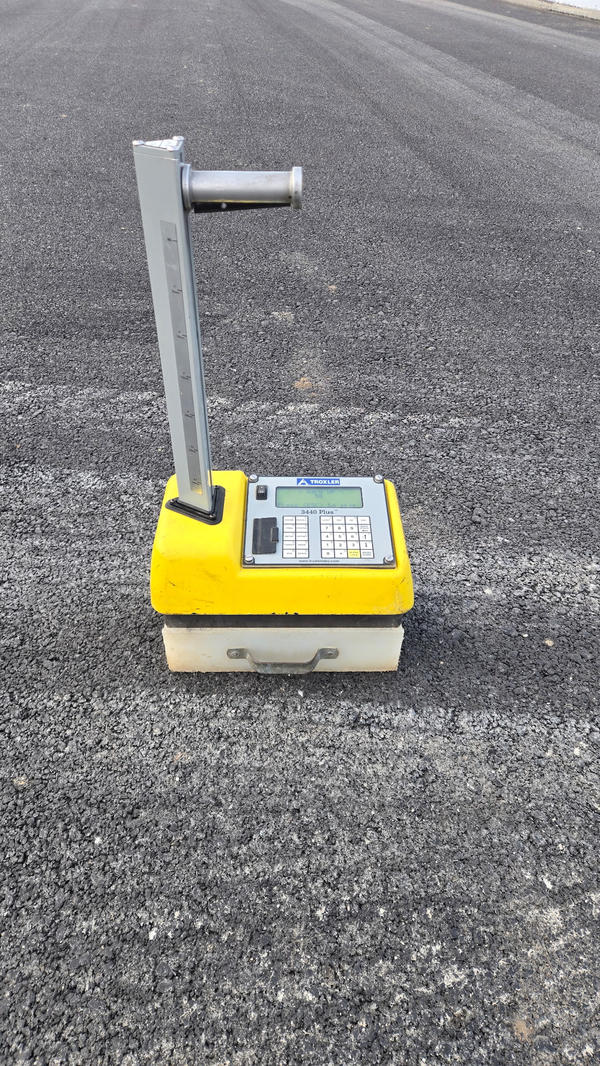
To double-check that the rolling train was giving us a good mat, Rushford used the 3440+ nuclear density gauge from Troxler. The device offers density measurement capability in backscatter or direct transmission mode and moisture measurement in backscatter mode for nondestructive testing of soil, asphalt and concrete. It gives a direct readout of the following test results: wet density, dry density, moisture, percent moisture, percent voids and percent compaction.
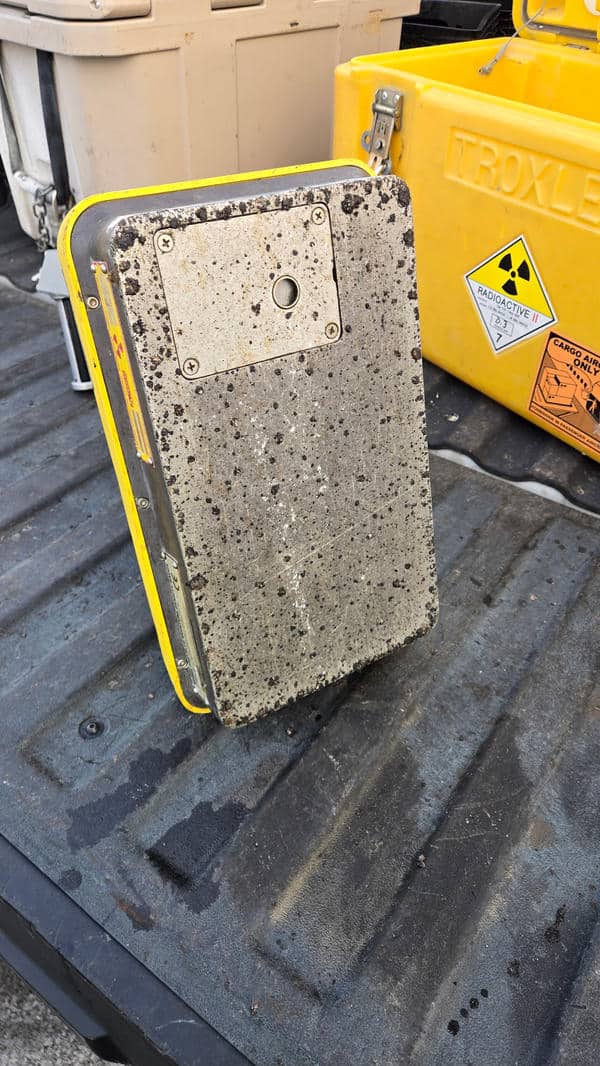
During normal use throughout the shift, the density gauge plate will pick up material, which will affect readings if left to build up. Curran’s QC Manager Dave Rushford recommends cleaning the plate two or three times a day, which is easy enough to do when the plate is retaining the pavement’s heat. Use a biodegradable release agent on a shop rag to wipe down the plate and return to work. Don’t spray the release agent directly on the plate, but spray it directly on the rag.
“Checking the base course density with a gauge is a quick and nondestructive step that helps identify if additional compaction is needed while the area is still accessible,” Troxler President and CEO Finch Troxler said. “For a distribution center, addressing density helps ensure the pavement will hold up as designed under all that stress from constant truck traffic.”
As you can see in the pictures, Rushford was getting readings on the base course of 93 to 96%. Rushford said they were averaging 94%.
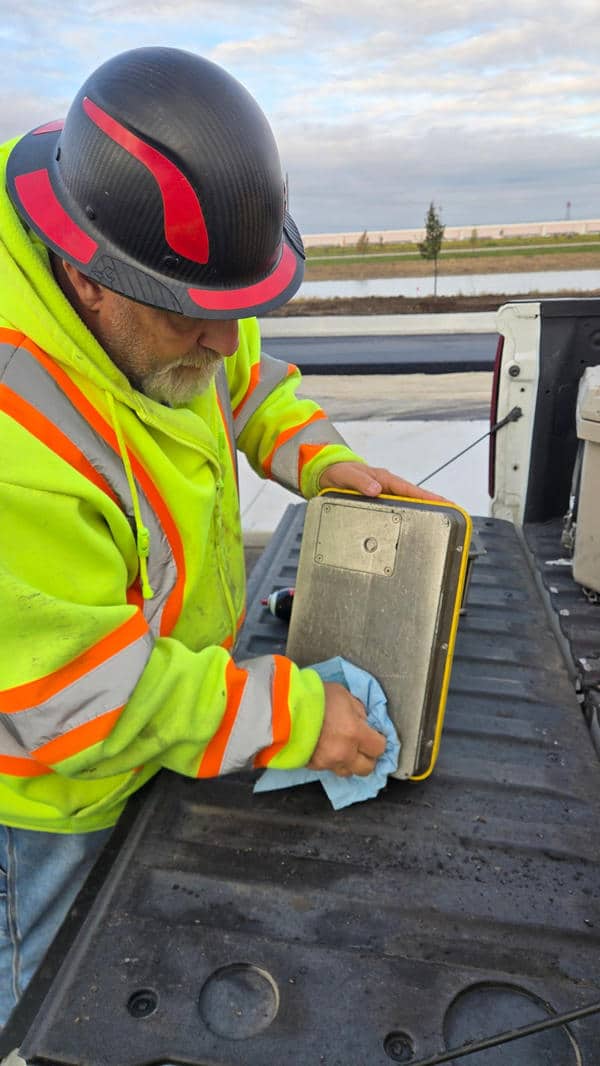
During normal use throughout the shift, the density gauge plate will pick up material, which will affect readings if left to build up. Curran’s QC Manager Dave Rushford recommends cleaning the plate two or three times a day, which is easy enough to do when the plate is retaining the pavement’s heat. Use a biodegradable release agent on a shop rag to wipe down the plate and return to work. Don’t spray the release agent directly on the plate, but spray it directly on the rag.
All the members of Rushford’s team are certified to use the gauge, and he talked about some of the reasons he prefers it to other devices on the market. Even with the certification and paperwork to complete, he doesn’t see those steps as a hassle.
“If you keep up on your paperwork, everything’s generally fine,” Rushford said. “I’ve used non-nuclear ones. I’ve had them. The problem with the non-nuclear ones, they’re just so way off. If you’re doing what we’re doing here…you’d have to come up with some sort of correlation to density. So, you’d have to cut cores to match the core reading or gauge reading like you would do in a test strip, which is a lot more work than if you just have a standard gauge like we’re dealing with.”
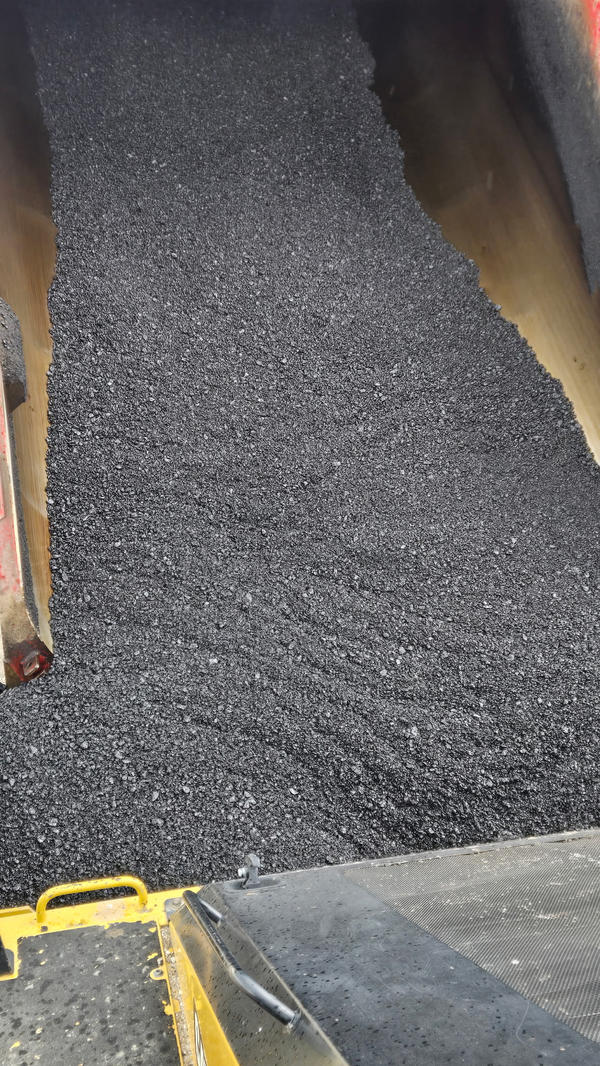
Here we can see the PG58-22 mix moving smoothly out of the live bottom trailer. The live-bottom’s conveyor facilitates this movement.
Certification isn’t a burden for Rushford, either; it’s part of quality control training.
“Every year we go through a safety course to be safe with the gauge, and then we have a transportation [training] to move the gauge. There’s an online course that you can take….There are a couple different companies [offering training] out there, but Troxler does have one. I like Troxler’s. It’s the best. They’ve been doing it for a really long time. They’re up on everything.”
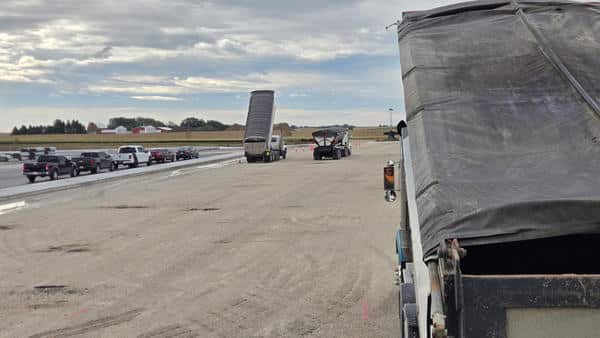
Designate an area off to the side of the project where trucks can clean out. Make sure all drivers know that’s the safe and appropriate place to knock cooling chunks out of the bed before heading back to the plant. You don’t want cooled chunks ending up all over the base where you’ll be paving or remaining in the truck to become a segregated portion of the next load.
Pave for Quality
Before the crew could achieve their good compaction numbers, they had to get the mix on the ground. And the paving relied on mix delivery. The Gencor plant was only 5 miles away in Dekalb and produced the PG58-22 mix at about 280 tph. We had 14 trucks bringing the mix: 2 Etnyre live bottoms and 12 tractor trailers. They were averaging 20 and a half tons per load.
For the tractor trailers, everything was business as usual. The trucks would back to the paver, stop, allow the paver operator to bring the tractor gently in contact with the back tires at the push rollers, then apply the brake and lift the bed to begin charging the hopper.
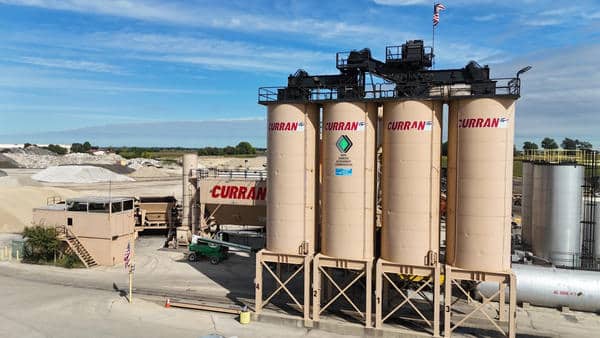
The plant located about 5 miles from the project produced the N70 binder mix for the base course at 320 to 330°F and at a rate of about 280 tph. The same plant handled the intermediate and surface courses, which both added a polymer to the mix.
For the Etnyre live bottoms, the process allowed a smoother transfer of material. The truck still backed to the paver, stopped, and allowed the paver operator to bring the tractor gently in contact with the back tires at the push rollers. But instead of lifting the truck bed, the driver released the tailgate to open like a pair of barn doors securing the truck end in the hopper and allowing the mix to flow in. The live bottom conveyor then moved the mix from the truck body to the hopper in a smooth, continuous mass as the truck and paver drove forward.
Each pass required about 800 tons and attention to detail. The crew from Curran marked their lines; the paver operator followed his guidebar; the team used joint matching automation; and everyone worked as a cohesive unit to pave a gorgeous distribution center lot for Goodyear in Dekalb, Illinois.
John Ball is the proprietor of Top Quality Paving & Training, Manchester, New Hampshire. For more information, contact him at (603) 493-1458 or tqpaving@yahoo.com.
Getting Density on a Thick Lift
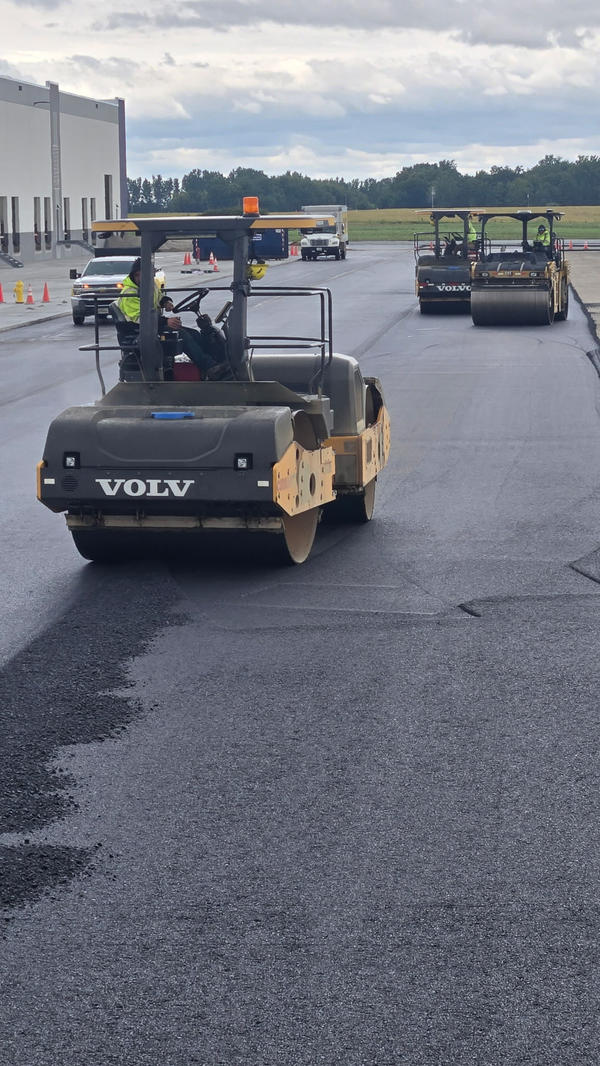
To get compaction of a lift that’s 7 inches thick and 17.5 feet wide, the Curran crew used three heavy rollers with 84-inch drums.
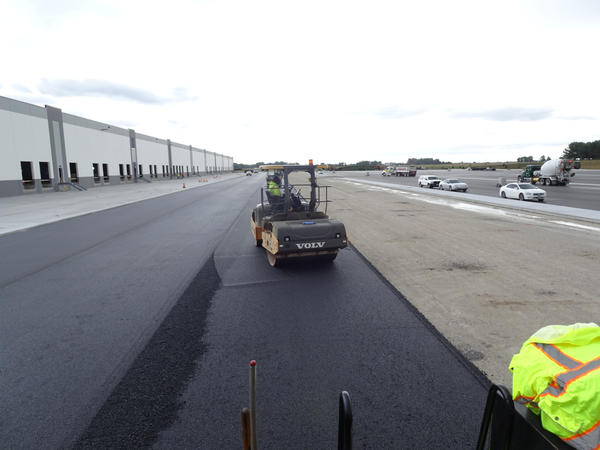
Here we see the breakdown roller performing its second coverage. The operator executed the rolling pattern by rolling up and back for coverage one, setting over; rolling up and back for coverage two, setting over; then rolling up and back for coverage three, all while staying 1 foot off the unconfined edge.
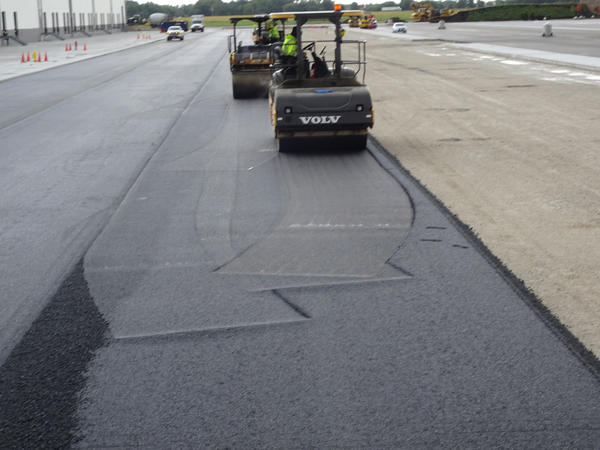
Here we see the roller finishing his third coverage. He was corrected to roll out the stop marks, but this picture lets you see where passes one, three and five stop behind the paver. Notice that you can clearly see how he’s staying off the unconfined edge. This is vital when working on a thick lift to keep from bending the joint and creating a V shape in the overall mat.