
Maximizing Off-Highway Haul Truck Productivity
BY AsphaltPro Staff

In asphalt and aggregate production, improving efficiency is essential for meeting demand and staying competitive. Off-highway haul trucks are often hindered by issues like underutilized capacity, spillage and downtime, which limit productivity.
At World of Asphalt/AGG1 2024, Josh Swank, chief growth officer at Philippi-Hagenbuch, Peoria, Illinois, and Philippi-Hagenbuch customer Clay Albright, vice president/owner at Caldwell Stone Co., Inc., Danville, Kentucky, discussed how haul trucks in quarry environments can be tweaked with tailgates and sideboards to increase load capacity, reduce material loss and speed up loading times.
1) Increase Your Average Load
Before Albright invested in tailgates on all of Caldwell Stone’s trucks, he ran the numbers using his scale ticketing software. “For the year before we put the tailgates on, one of our trucks averaged 31.4 tons [per load] for the year, with more than 1,000 loads across the scale that year,” Albright said. The 40-ton truck provided a good comparison, since it only hauls two types of material (½-inch chip or 3/16-inch sand). “After we put a tailgate on it, that truck was hauling an average of 36.7 tons per load—a 17% increase.”
According to Swank, tailgates increase volume capacity anywhere from 10 to 20%, depending on the material size and density. “The average most of my clients see is around 12%,” he said. For example, he added, “If you have a 70-ton haul truck and you’re leaving 8.4 tons behind per pass, that’s more than 20 tons per day and 1,000 tons per week you’re leaving behind.”
Regardless of which OEM you go with for your aftermarket solutions like tailgates and sideboards, make sure they’re mining-duty versus agriculture- or construction-duty, Swank said.
2) Decrease Cycle Time
Swank said adding tailgates to your haul trucks also improves loading efficiency. “It creates a larger loading target for your loader operator,” he said. “Without a tailgate, they’re trying to load closer to the front of the truck to keep material from falling off the back.” This results in slower loading times as operators take care to load material so it won’t fall out the open back.
3) Minimize Maintenance
This method of loading can also increase the maintenance your trucks require. “[Loading the front] puts more load on your front axle versus your rear axle,” Swank said, “and trucks are designed to have equal weight on all tires.”
Whenever Swank visits his clients, he always checks if any tires are more squished than the others (assuming equal air pressure). “If so, that means the weight distribution is off and creating unnecessary tire wear.”
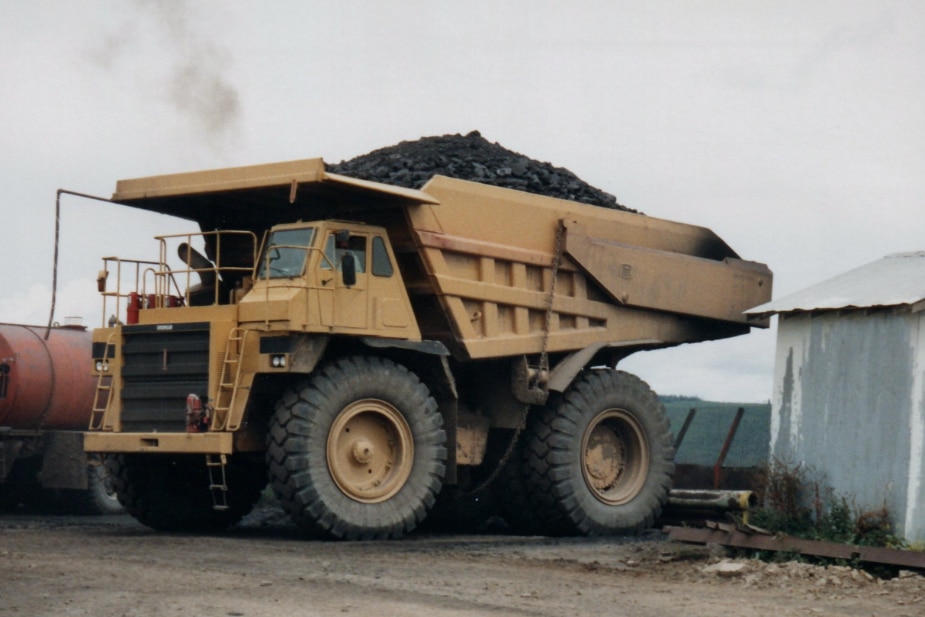
Adding a tailgate and sideboards increases a haul truck’s volumetric capacity, helping operations maximize their efficiency by hauling the truck’s full rated weight.
4) Reduce Spillage
Tailgates reduce spillage off the rear of the truck, while the addition of vertical side extensions/sideboards reduce spillage off the sides of the truck. “When you’re loading, it’s not uncommon for the loader operator to be so concerned with material falling off the back that they load it so material falls off the sides,” Swank said. “Sideboards are a very simple, easy way to keep the rocks in the box, while also increasing volume.”
Sideboards can be used with or without a tailgate, Swank said, adding, “As you go over the 6 to 9 inch number, it’s important that if you’re going to build up the sides you have a unified height all the way around.”
5) Reduce Emissions
“The more trips you take, the more fuel you burn, the more emissions you have,” Swank said. “If you can minimize your fuel burn, that’s great for your bottom line and for the environment.”
According to Albright, the 17% increase per load for their 40-ton trucks resulted in a negligible amount of extra fuel use compared to multiple additional haul loads per day to make up that 17% difference. “We’re getting closer to capacity on every load,” Albright said. “We’re making less trips and filling up quicker.”
6) Improve the Bottom Line
According to Swank, the average return on investment for adding tailgates to your trucks is 30 days. “I did a case study with a client a couple years ago, and those tailgates paid for themselves in five days because of the efficiencies they added,” Swank said. “Now, they have them on every truck in their company.”
“What else can you do to achieve that much growth in efficiency with an average return on investment of less than 30 days? The numbers don’t lie.”
Ultimately, Swank said, the addition of both tailgates and sideboards are a small tweak companies can make to their existing fleet to make it as efficient as possible. “It’s not about the number of trucks but about maximizing utilizing what you already have,” he said. “It’s ultimately going to be better for you to expand your trucks, not your fleet.”