
A Comprehensive Look at New Asphalt Compaction Technology
BY Sandy Lender

New asphalt compaction technology for safety, training, optimum density
Reduce air voids and optimize density across the mat and at the joint to get full pay and achieve a long-lasting pavement. Asphalt professionals know the drill, and contractors have more technology options than ever to assist them when it comes to the rolling train.
Many original equipment manufacturers (OEMs) have packed technology advancements behind their compaction controls to enhance roller offerings. During CONEXPO-CON/AGG 2026, we saw those offerings among the tried and tested compaction tools contractors have relied on for years. Those tools and their updates can come with a hefty price tag, so it behooves the savvy asphalt contractor to compare which technologies are best for specific field applications.
During his education session at the tradeshow, Bryce Wuori, CEO of Pavewise, Bismarck, North Dakota, took note of the pain points his audience brought up. During his session, “Smarter Paving: Real-World Lessons in Intelligent Compaction and Emerging Technologies,” he noticed almost half the time was taken up with crowd questions about new technologies, specs and struggles with technology from a cost standpoint.
“It was a true panel of sharing the good and bad of IC and other technologies from multiple perspectives,” Wuori said. “Overall, it seems that technologies like IC are really starting to get some interest and attention from the industry.”
He asked the audience to share their biggest issues when adopting new technologies. The answers ranged from cost to the learning or training curve. “It seems that the industry wants to use tech but is still a little hesitant of the cost and upfront work to implement it,” Wuori said.
We’ve compiled some highlights from the show that were geared specifically toward helping contractors with different aspects of compaction.
Safety Around the Asphalt Roller
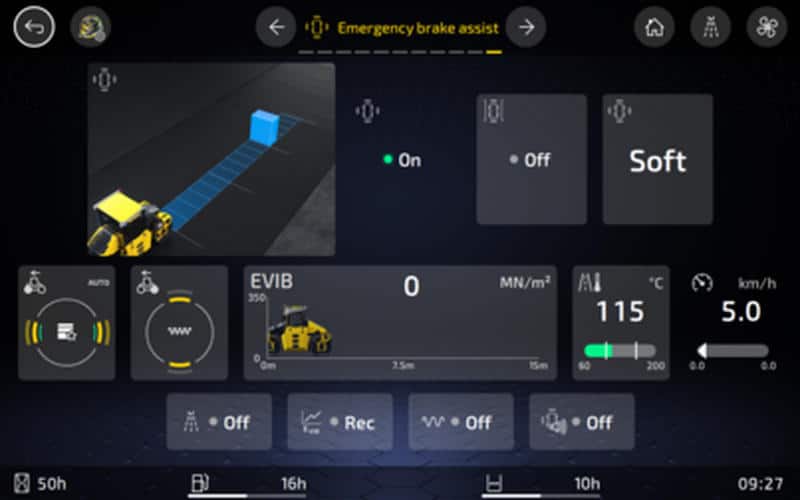
The BOMAG Emergency Brake Assist is a proactive, rapid stop system for asphalt rollers. It scans the machine’s surroundings with LiDAR technology to detect potential hazards, but only slows or brakes for obstacles in the machine’s path.
Rollover protective structures (ROPS) atop asphalt compactors are as essential to safe operation as properly directed lighting on a night project. Our industry has become accustomed to the sight of ROPS, strobes, seatbelts, adjustable mirrors and safety decals on the compactor and to the sound of backup alarms. Unfortunately, when an operator grows accustomed to a system or sound, he can also grow complacent. In recent years, OEMs like BOMAG Americas, Caterpillar, John Deere, Sakai and others have introduced technology to interrupt an operator’s unintentional complacency.
Keep in mind, each of these technologies has been introduced as assistance for the operator of the equipment. Safe operation still requires attention to detail and proper training.
How to Set Up the Roller and Rolling Zone for Safest Practices
During a presentation in Las Vegas, members of the FAYAT Group spoke of the iron and tech on offer from BOMAG Americas and Dynapac, including AI-powered obstacle detection. The BOMAG Emergency Brake Assist, originally launched during BAUMA 2025, is a proactive, rapid stop system for asphalt rollers. It scans the machine’s surroundings with LiDAR technology to detect potential hazards, but only slows or brakes for obstacles in the machine’s path, although it’s “looking” in both directions and considering all steering angles.
As the operator slows at the end of a pass and angles the roller, as is best practice on a hot mat, the system is still watching for obstacles in its path. Even when the machine is operated in crab mode around utilities or for other special compaction projects, the path being monitored widens.
The assistance system detects the distance and speed of obstacles using LiDAR technology; However, detecting the steering angle or control lever position and whether the roller is in crab mode are also decisive factors. This information is used to determine whether a hazardous situation exists.
If a collision is imminent, the roller is automatically slowed down or comes to a halt. But it brakes intelligently. If the situation allows, the roller’s working speed is only reduced. For example, if a person is already moving out of the vehicle’s path and thus away from the potential danger zone, the system recognizes this.
The assistance system is displayed and operated via a touchscreen, which is fitted as standard on pivot-steered BOMAG tandem rollers of the AP-5 generation. It can be individually adapted to the typical driving style of different roller operators and the construction site situation. Drivers can adjust the braking intensity in three stages at any time.
How to Roll for Bonus, Part 1—New Ideas in Roller Maintenance
Announced March 1, 2026, the Cat Detect—Collision Mitigation System from Caterpillar enhances situational awareness when operating the roller. It features an integrated, intelligent sensor array to provide forward and reverse collision warnings, people detection, motion inhibit and automatic braking.
“Critical zone detection events” are visible in real-time and are recorded for analysis in the future. These events are recorded and transmitted to VisionLink™ and can then be used as training material. When your team discusses the footage afterward, you can identify areas for improvement and train operators on better safety awareness for the future.
The system comprises:
- The Collision Warning radar system, which targets collision potentials in front of and behind the compactor using audible and visual alerts. These alerts allow the operator to see, manage and mitigate hazards that may otherwise go undetected.
- The People Detection, which leverages smart cameras and alerts the operator when on-site personnel are detected to the front and rear of the compactor. This provides alert levels that dynamically adjust travel speed based on the person’s proximity to the machine.
- The Motion Inhibit, which has manual override capability and prevents compactor movement when the machine is stationary for at least two seconds, and the detection system identifies a collision potential.
- The Automatic Emergency Braking, which activates when a set of criteria are met. Those criteria are first, the compactor is in motion when critical zone detection occurs, and second, the operator fails to act. When the critical zone detection clears, control of the roller returns to the operator.
Rabine Paving Invests in QC/QA with Pavement Quality Indicators
Sakai America displayed its Echelon Mode for the Guardman® Automatic Brake Assist System at the tradeshow in March 2026. This updated feature enhances the safety and efficiency of tandem asphalt rolling operations and received an honorable mention in AsphaltPro’s 15 Top Products list in 2025. Here’s how the system works.
Guardman uses millimeter-wave radar or 3D LiDAR (depending on the model) to detect potential collisions with personnel or equipment, warn the operator progressively, and automatically brake to prevent accidents if needed. The Echelon Mode introduced in 2025 built upon this foundation by specifically addressing the unique challenges of echelon rolling. It allows two SAKAI SW884 (79-inch) or SW994 (84-inch) asphalt rollers, equipped with Guardman, to operate in proximity without generating false alarms but still protecting against collisions. The system intelligently monitors distance to the lead roller, ensuring that both operator warning and braking is only initiated when an imminent collision risk is detected.
Key features of Echelon Mode include:
- Optimized tandem rolling to enable closer, more efficient formation
- Reduced false alarms to minimize unnecessary braking interruptions
- Collision prevention, which is the core Guardman functionality
- Real-time feedback for operators on the distance between rollers via the proximity indicator
- On-and-off toggle on the Guardman display screen
The Echelon Mode update is available for SAKAI SW884 and SW994 asphalt rollers equipped with the Guardman automatic emergency braking system.
Training for the Next Generation
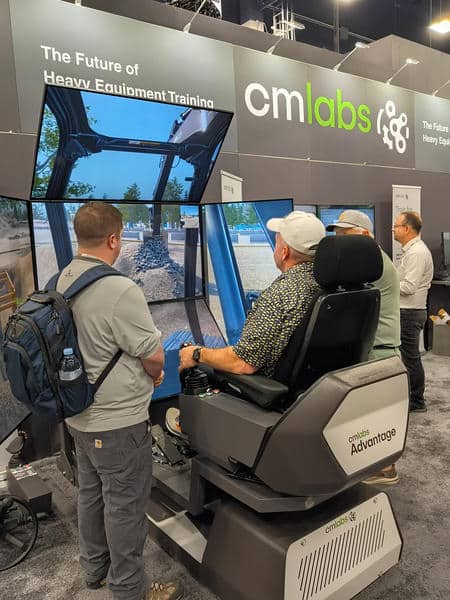
As the first company to make swappable controls, CM Labs wished to make it easy to switch controls and pedal sets in minutes. Thus, CM Labs’ full catalogue of heavy equipment training packs can be run from a single Advantage simulator.
Alongside safety comes training. An operator who knows the nuances of his machine is likely to be a safer operator, as well as a more proficient one. To that end, OEMs, dealers, consultants, trade associations, independent technology companies and others have offered a variety of training methods over the decades to ensure roller operators are trained for more than basic control of the machine.
If you have a training school or program for equipment operators, make sure our editor knows about it in time for our upcoming Training Guide. Send an email with your program’s name and URL to sandy@theasphaltpro.com.
One of the trending techniques for roller operator training is to use simulators. CM Labs Simulations of Quebec offers the Advantage simulator, which includes the seating, controls, pedals, computers and hi-res screens as a single unit for trainees. From the safety of a trailer or training room, a new worker (or a worker getting a refresher course) can learn how to operate a variety of machines from the training packs CM Labs offers. As the first company to make swappable controls, CM Labs wished to make it easy to switch controls and pedal sets in minutes. Thus, CM Labs’ full catalogue of heavy equipment training packs can be run from a single simulator.
This includes training packs for various crane types, excavator, wheel loader, backhoe, motor grader and, as of 2025, a single drum roller. The software is designed to simulate the real behavior of the machines, including: rigging, cables, loads and soil behavior, all validated against empirical and engineering data. Advantage simulators also track and log performance metrics, such as cycle time, fuel consumption, pendulums, collisions, failure to protect others on the worksite, and more.
Make note of that technology. The simulators today aren’t your 1990s video game technology. When an employee sits down to learn in the seat of a Volvo or FAYAT or CM Labs simulator, that employee gets to experience the feel of the controls and the feel of the machine tilting, pulling against forces, compacting soil into a denser surface, lifting a heavy load and so on. Simon Halabi from Simformotion, which is the team that designs and manufactures Cat® Simulators, explained that they use authentic controls and motion.
Dynapac and Superior Paving Put SEISMIC Compaction on Asphalt
“We use authentic controls,” Halabi said. “If you go into the real machine, every switch, button, control, joystick, whatever it is you’re using, we have identical on the simulator…The main reason we like doing that is when you leave the simulator as a trainee, you can roll right into the real machine and you don’t have that apprehension. We have line of sight to controls. We’re building muscle memory.”
Halabi also spoke of the experience in the seat. “Our motion system makes it pretty realistic to the movement of [the machine]. Our motion is really spot-on. One of the advantages we get is we have our Cat operators. They’re using these simulators before they’re ever public to anyone and they’re getting the details down to ‘this doesn’t feel right when I’m pulling this bucket back’ or just the movement…utilizing their experience in the actual machine.”
At press time, Cat Simulators, like those described above, offer training on a variety of machines, but Cat rollers and compactors have virtual headsets for training.
Get Density for Full Pay
As the roller operator works along the newly laid mat, Hamm’s Smart Compact Pro’s asphalt density scanner, affixed to the underside of the machine’s center, scans the asphalt and feeds information to the display in the cab.
One of the benefits of the technologies discussed herein is the built-in cheat code for less-experienced operators. As Wuori shared in the March 2025 issue, Border States Paving had to move one of their newer workers onto the breakdown roller during the Highway 14 project in North Dakota. The “new” operator was brought up to speed on the basics of driving the roller and, thanks to the tasks the Smart Compact technology from Hamm could perform on his behalf, he was able to execute the day’s production flawlessly. Wuori shared that the technology allows the employee to concentrate on operating and automates some of the mundane tasks of turning your vibes off and on at the right time or what speed needs to be achieved to get the required impacts for density. It simplifies the process and reduces the burden on the operator to perform successfully. Let’s talk about it.
https://theasphaltpro.com/autonomous-compaction-solutions/
Smart Compact Pro from Hamm is a digital assistant for enhanced process safety and density achievement. The assistant measures asphalt density in real time and automatically adjusts the compaction performance and modes in both of the roller’s drums. This enables more precise compaction, leading to optimal asphalt quality regardless of the operator’s experience or external conditions.
Thanks to real-time density measurement, core sampling tests can be eliminated. It works by automatically and continuously adjusting the compaction performance and modes of both drums separately based on real-time asphalt density. The digital assistant integrates weather data, taking into account both external temperature trends and the cooling behavior of the mat, for optimally adjusted compaction.
As the roller operator works along the newly laid mat, the Smart Compact Pro’s asphalt density scanner, affixed to the underside of the machine’s center, scans the asphalt. The technology measures process-relevant data such as the Hamm Measurement Value (HMV), asphalt temperature, layer thickness, cooling behavior of the asphalt, outside temperature, and local weather data. These input parameters are used to regulate the compaction force and modes in both drums. The device relays these input parameters to a control monitor in the roller’s cab, where density is displayed as a percentage and temperature is displayed in degrees. On the display screen, the operator can also see speed and drum settings, as well as other critical machine functions.
Hamm’s Dan Sant Anselmo told The Asphalt Pro that the weather station on top of the roller collects ambient air temperature, wind speed and humidity, to help the operator determine the cool-down rate of the material depending on the mat thickness and the weather conditions. He responded to an example of a vibration-restricted work zone.
He explained, if the rolling train is operating in a vibration-restricted area, with a machine that has dual oscillation or with a machine that allows only the front drum to vibrate and the rear drum to oscillate, “We have the capability in the Smart Compact display to say ‘oscillation only.’ So, it will not allow the machine to vibrate, it will only allow oscillation or run statically.”
These parameters are known ahead of the project and can be communicated to the roller operator for input before the project begins. “When we go into the pre-job meeting and we know this is going to be a vibration-restricted area, the project manager will convey that to the crew, then the project foreman or the supervisor will tell the operator ‘we cannot vibrate here’ and the operator can press that button on the display. He has that control.” That’s set at the beginning of the project or beginning of the paving process.
Volvo Construction Equipment offers Compact Assist Asphalt, powered by the Volvo Co-Pilot, to make the roller operator’s job easier. The system is designed to provide real-time data on compaction metrics, which allow the operator to achieve optimal compaction and move on to the next section of the mat. This, in turn, reduces rework and saves on fuel costs.
Volvo’s Compact Assist is displayed on a touchscreen in the roller’s cab, where the operator can tap, zoom and select elements to switch screens and review the job in progress. Key tools of the system include:
- Pass Mapping, which guides operators through a uniform rolling pattern, without over or under compaction. A quick glance at the pass mapping screen gives operators a clear view of their stop points and overlaps.
- Temperature Mapping, which ensures compaction is completed at the optimum pavement temperature. This screen offers a color-coded map of surface temperatures, and the operator can set the maximum/minimum range for the mix he’s working with. This enables the operator to avoid rolling on a mat that he can see is too hot or too cold.
- Density Direct, which is Volvo’s patented solution providing a real-time estimate of the material density percentage. This measures the quality of the pavement while you work.
Volvo also offers the Compact Assist Soil, which adds job site CAD data to the screen to provide the operator with an additional layer of guidance. Whether identifying a soil mixture that is too wet, or any buried infrastructure, Compaction Measurement Value (CMV) Mapping is designed to provide a complete image of the load bearing strength of the job site. This helps operators identify areas that require additional compaction or further investigation.
BOMAP is a brand-agnostic technology from BOMAG Americas that lets you document the work results on the construction site in real time and get a transparent overview of compaction performance. With BOMAP, you can monitor the results of your soil and asphalt compaction in real time, regardless of the manufacturer. The app works without any additional special hardware; it uses the mobile device’s internal GPS to detect the position of the construction machine on earthwork or asphalt construction sites. The app is immediately ready for use after installation.
The BOMAP Connect and JOBLINK upgrades offer even more options for networking the entire fleet of machines used on the construction site and processing the recorded data. An operator activates the BOMAP app from an Android tablet or smartphone from a BOMAG roller, and the app connects with the machine’s interface and registers its parameters. All compaction passes are then automatically recorded. If required by job specification, the interface can connect with BOMAG’s Joblink via Bluetooth, and in addition to roller passes, the system also records the Evib value, asphalt temperature, and vibration frequency and amplitude of the BOMAG rollers, and adds the data to the documentation.
For other roller brands in the fleet connected to the networked jobsite, BOMAP Connect logs and transmits the number of passes, generating a pass map for the entire site. By equipping the rollers with an optional high-precision antenna, GPS reception is maximized. All rolling data collected from the site are combined in real time in the cloud application and displayed as a colored map in Google Maps. The colored areas indicate where compaction has already been achieved and where it is still necessary.
Technology wasn’t the only new feature BOMAG brought to the industry. As seen in recent product galleries, the OEM launched a new series of plate compactors, but its BW 18 RH pneumatic tire roller offers an innovative kneading ability. It offers a three-way pivoting front axle to ensure even weight distribution across all tires. The manufacturer lists surface dressing; highway and airfield construction and maintenance; special surfacing materials; proof rolling; lime and cement-stabilized soils for this roller to tackle, stating, “The compaction and kneading effect of the pneumatic tires results in excellent surface sealing.”
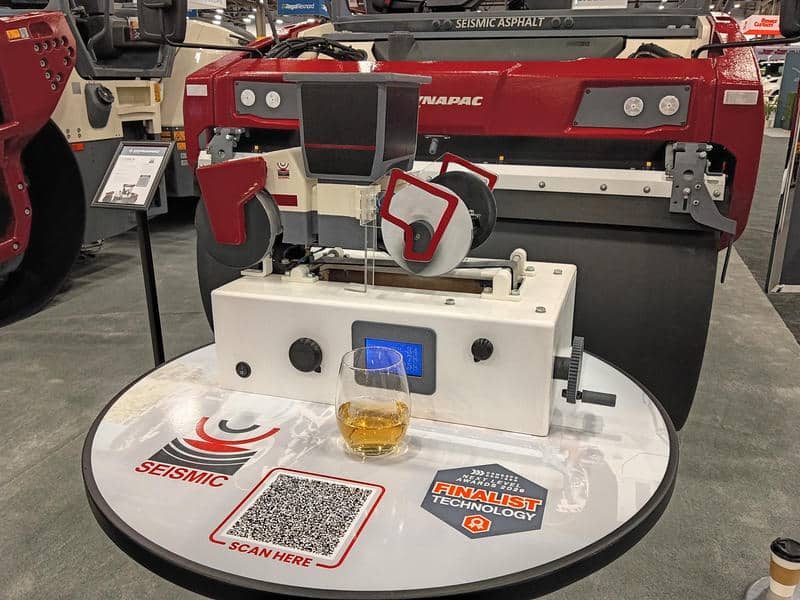
Dynapac’s Seismic Asphalt is designed to find the natural frequency between the drum and the surface. It enhances the drum amplitude by automatically feeding energy to the system at the right time.
Another product that offers a new way to compact asphalt is Dynapac’s Seismic Asphalt. While the company’s Seismic product has been available for soil compaction, SMEs and the technology’s inventor were on hand at CONEXPO 2026 to demonstrate its use for asphalt rollers. Dynapac’s engineering team have developed a compactive force whereby the drum and the soil act as one dynamic system; now they’ve applied that natural frequency to asphalt compaction.
While conventional vibratory compactors deliver a rapid succession of impacts to the soil surface (or asphalt mat) at a frequency that is either pre-set at a high or low amplitude or at a frequency that is adjusted manually, the Dynapac Seismic is designed to find the natural frequency between the drum and the surface. It enhances the drum amplitude by automatically feeding energy to the system at the right time. This, in turn, maximizes the contact force between the drum and the surface, which maximizes the compaction and energy efficiency.
Not only does this optimize compaction, but it also reduces wear and tear on the roller. Dynapac’s first step in letting a machine automatically decide compaction parameters was the introduction of Active Bouncing Control. If the compaction energy returns to the machine with the possibility of causing damage, vibration is actively shut off. This technology prevents unnecessary bouncing, which saves the machine from downtime.
In the cab, the operator can monitor progress: the Dynapac Compaction Meter and Dyn@lyzer display the compaction results in easy-to-understand graphics and eliminates any wasted time on unnecessary passes.
Looking Ahead at the Whole Site
Saving time and money are only two pieces of the puzzle OEMs are handing to asphalt professionals with the enhanced roller offerings of this century. With technology advancements behind their compaction controls and compaction action, OEMs continue to partner with contractors to provide training, safety and increased quality control. As Wuori observed during The Asphalt Pro’s Ask the Expert session at CONEXPO in March, “It was a year about density and rollers. From the Smart Compact to RTDensity and Equipment Manufacture, all presented ways to help get density with systems; it seemed like a trend at this event compared to others I have been a part of.”
His optimistic observation spoke to the connection between OEMs like those highlighted above and the contractors building our pavements. “There was a clear and growing interest in digital technologies designed to address real-world challenges, such as labor shortages and enhancing efficiency through data. Additionally, more niche software companies are emerging, each tackling unique industry problems with innovative solutions.”
As new compaction technologies hit the scene, The Asphalt Pro will bring you deep dives into their inner workings and how they help you optimize density for full pay and a long-lasting pavement.
Editor’s Note: Does your company use IC or other new compaction technology that’s not listed above to assist new operators, achieve optimum density, enhance safety around compaction equipment or other aspects of QC/QA? Whether your technology is all new in 2026, includes updates this year, or has features you’ve counted on for the past decade, The Asphalt Pro audience could benefit from hearing of your experience. Either you or your OEM is welcome to reach out to share information. Send an email to sandy@theasphaltpro.com.
Are you looking for best compaction practices?
Check out the two-part series titled “How to Roll for Bonus” on TheAsphaltPro.com starting at this link: | AsphaltPro Magazine | How to Roll for Bonus, Part 1—New Ideas in Roller Maintenance
And | AsphaltPro Magazine | How to Roll for Bonus, Part 2—Ideas for Perfect Compaction
Also download our free white paper on roller maintenance from our Digital Downloads page: | AsphaltPro Magazine | How to Maintain the Roller