
NDDOT Trials New Technologies on Hwy 14
BY Sandy Lender

How can autonomous rolling, paver mounted thermal profiles and robotic striping take human error off the paving table?
In 2024, the North Dakota Department of Transportation (NDDOT) let Job 23273 along Highway 14 in Burleigh County from Sterling to Wing. The project totaled 21.22 miles and was divided into eight test sections. The top 2-inch lift was a balanced mix design (BMD) of hot-mix asphalt (HMA), but the sections also incorporated milling, widening, pipe replacement and extensions, HMA and cement-treated base (CTB), with full depth reclamation (FDR) in some areas.
Pavewise Inc., Bismarck, North Dakota, and general contractor Border States Paving Inc., Fargo, used a variety of new technologies during the construction and quality control/quality assurance (QC/QA) processes. Over the next few issues of AsphaltPro, we’ll take a closer look at how the entire project came together; what mix designs were used in which test sections; how different technologies were used most effectively; how the contractor, consultant, and DOT responded to challenges and triumphs in the field; and what final numbers can tell us about the use of new technologies in the paving realm. In this first overview, let’s introduce some of the innovations employed in September and October 2024.
The parties involved have thousands of data points to assess to see how different technologies performed on different sections and in different conditions.
NDDOT Research and Technology Project 2024
Bryce Wuori of Pavewise prepared a document prior to the project’s start, stating, “Over the past decade, technology advancements like intelligent compaction and paver-mounted thermal profiling have tremendously improved the quality of construction during paving operations. These technological tools provide valuable data to users, enabling them to make better quality-driven decisions and identify the quality of work being performed.”
One of the challenges the asphalt industry still faces is the shortage of skilled workers who are trained to operate the equipment and interpret the data to adjust equipment and processes during construction. “In many cases, poor quality in a road-building process can be traced back to an operational issue that involves operator error or a lack of knowledge to adjust to the required specifications of the project for optimum quality,” Wuori wrote.
The State Aid Project No. FTF-X-SS-1-014(014)000 allowed the DOT to assess not only the technologies incorporated in the test sections, but also to assess how these technologies could assist in the unskilled workforce challenge facing the industry. Wuori wrote: “The goal of the asphalt innovation and technology project is to improve the quality of roads by providing advanced technology to the paving industry and testing its effectiveness in paving operations.”
He shared that this goal proved itself on this project. One day when the main roller operator wasn’t feeling well and wasn’t available, an unskilled operator who was not familiar with roller operation had to be substituted for the job or the project would’ve been stalled or could have suffered in quality requirements.
“We had to put an inexperienced operator on the machine,” Wuori said. “It could have been a mess.” The “new” operator was brought up to speed on the basics of driving the roller in short order and, thanks to the tasks the Smart Compact technology could perform on his behalf, he was able to execute the day’s production flawlessly. Wuori shared, the technology allows the operator to concentrate on operating and automates some of the mundane tasks of turning your vibes off and on at the right time or what speed needs to be achieved to get the required impacts for density. It simplifies the process and reduces the burden on the operator to perform successfully.
The experiment worked.
A less-skilled worker could do the job of the veteran worker with the aid of technologies like operator automation features that set frequency and impact spacings, turn off vibration as it rolls to a stop for changing direction, stay in the set pattern unless the mat dictates otherwise, and so on. The technology reduced what the operator had to manage, making his job easier and answering the question of “Can we put an inexperienced operator on the machine and still get a quality road?” with “Yes.”
Alongside the semi-autonomous rolling technology, the team used a variety of innovations on this project for safety and quality enhancements.
The technology allows the operator to concentrate on operating and automates some of the mundane tasks of turning your vibes off and on at the right time or what speed needs to be achieved to get the required impacts for density. It simplifies the process and reduces the burden on the operator to perform successfully.
Technology On Board
The technologies used on the project were as follows:
Pavewise GroundTruth Weather Station—To monitor and track weather conditions at the job site and ensure specification requirements, the team used the Pavewise GroundTruth stations and Pavewise AI cameras.
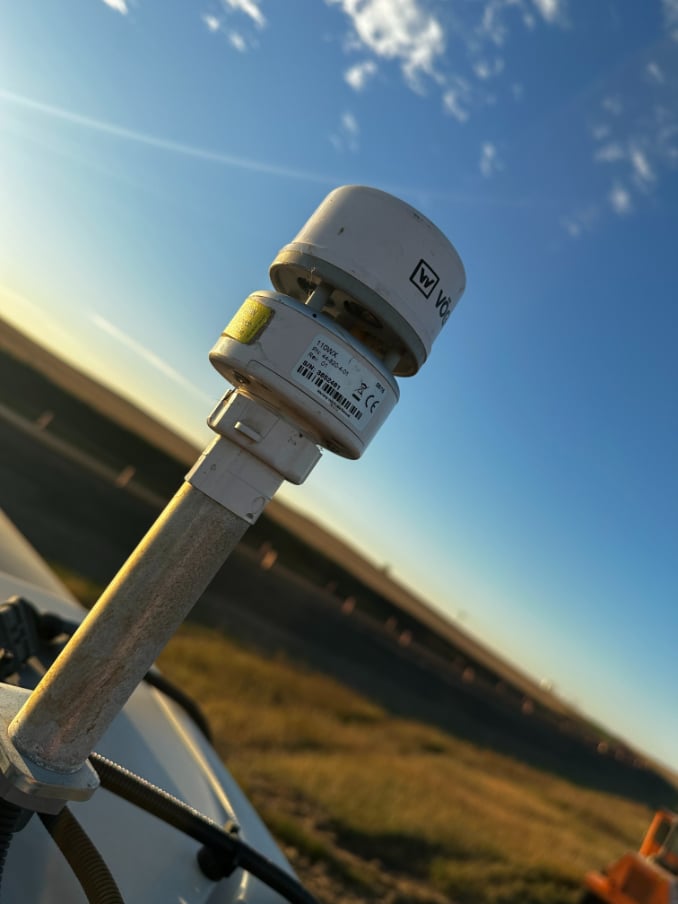
The weather monitor for the Smart Compaction is affixed to the roller to monitor conditions and make adjustments in the field.
Monsen Engineering TinySurveyor Terra Autonomous Line Striping Robot—To paint temporary guidelines for paving, the team used the TinySurveyor Terra from TinyMobileRobots. This device rolls down the roadway using your existing GNSS to pre-mark lines so your crew members don’t have to stake stringlines or fight oncoming traffic to paint.
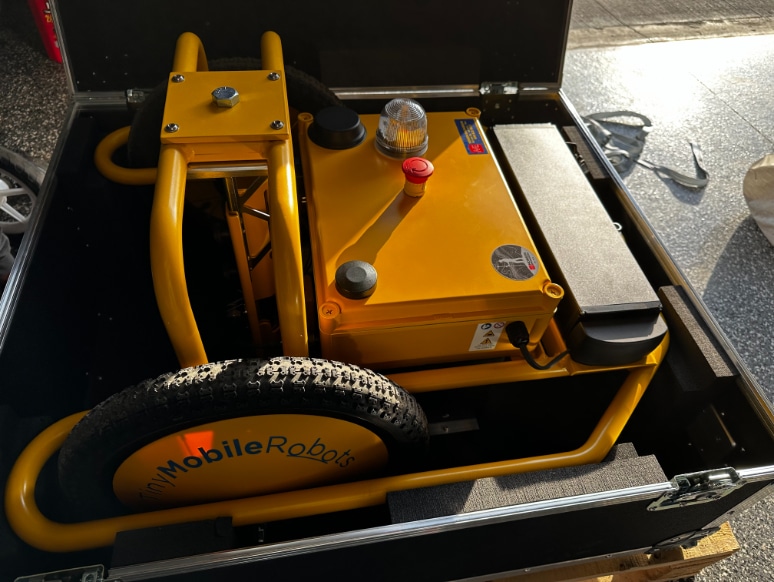
The TinySurveyor Terra from TinyMobile Robots rolled down the length of the centerline to paint road markings for the crew to follow. This eliminated the time and danger of having a survey team stringline or paint the guides.
E-Ticketing—The NDDOT standard special provision for the use of e-ticketing applied on this project.
Paver-mounted Thermal Profiler—To monitor and track mat temperatures behind the screed, the team mounted a TH-PI from Topcon atop the paver. It collected data across the width of the mat.
Notched Wedge Joint Maker—To meet the NDDOT special provision for longitudinal joint density for HMA pavements, the team used a notched wedge joint construction at the centerline.
The Border States team met the NDDOT longitudinal joint density special provision with the construction of a notched wedge joint on Hwy. 14. All photos courtesy of Pavewise
Intelligent compaction (IC)—Each roller was equipped with IC to help monitor pass count, stiffness and other concerns.
HAMM Smart Compact—The HD 120i High Frequency roller with Hammtronic and Smart Compaction installed was used for specific test sections. The Hamm Smart Compact technology, according to Tim Kowalski, application support manager for Hamm, auto adjusts amplitude and frequency while rolling. This machine also featured the manufacturer’s new Smart DOC system, which Kowalski pointed out handles pass count, temperature and stiffness monitoring, as well as uploading data to VETA via the Cloud.
Wuori indicated the team ran the Smart Compact test section with the HD 120i, on loan from RDO Equipment Co., starting the afternoon of Oct. 8 for two days of base lift atop the concrete-stabilized FDR base, and again two days on the top lift. The team tested its mettle in the intermediate rolling position to see how it would react to a noticeable tender zone the mat displayed at the temperature range of 180 to 210°F.
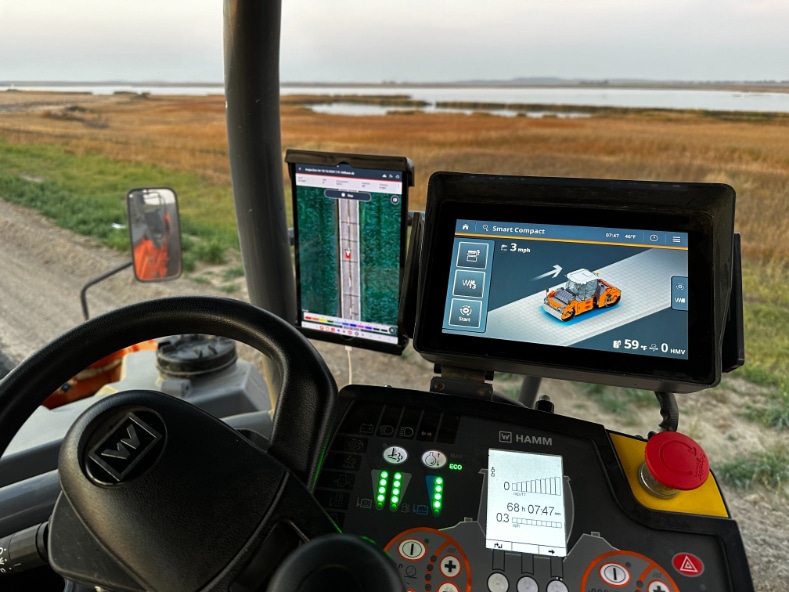
For asphalt construction, HAMM has developed the digital compaction assistant Smart Compact. It actively supports drivers in selecting the right settings for compaction. The driver specifies whether a base, binder or surface course is to be compacted, and the assistant automatically calculates the type of compaction required and the necessary compaction energy. Smart Compact is operated via a separate display that also functions as an on-board computer. The display indicates fill levels, operating hours and weather data, such as humidity, wind strength, wind direction and air pressure, among other data.
Density Plus Software—To streamline the compaction process, the team used Density Plus AI-powered conversion technology from Pavewise to transform gauge images into digital data. The real-time metrics were then used to assess and adjust rolling patterns as needed.
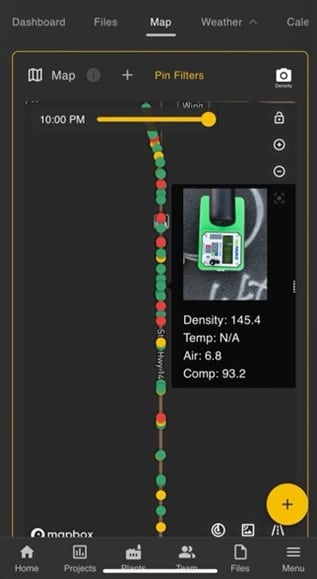
The team collected mat and joint density using the Pavewise Density Plus feature, which uses AI to extract, and density gauge location and information to develop, real-time density data and reports for the paving team.
GSSI PaveScan RDM and HighSpeed DPS System—For additional data collection and QC/QA proof, the team ran the GSSI and other scanning devices on the project.
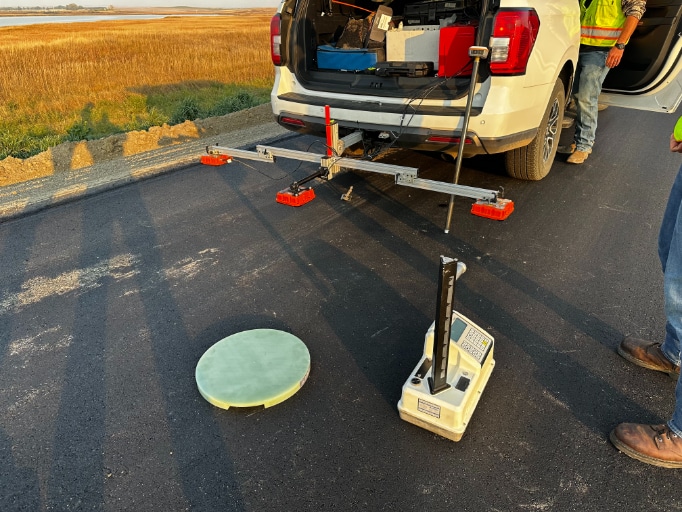
The proof is in the final numbers. The team used a variety of QC/QA methods to gather data to not only ensure the final mat met state specs, but also to showcase where different technologies stood up to control sections.
InstroTek NoNuke Density Gauge—To prove densities, the team collected over 400 readings with the non-nuclear density gauge.
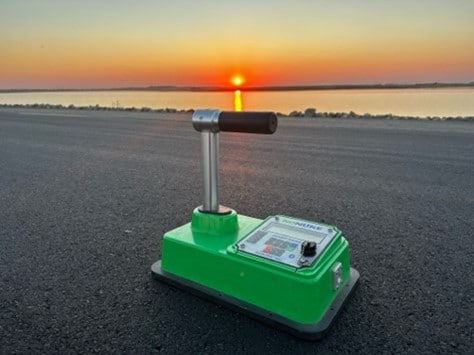
The team collected over 400 shots with the NoNuke density gauge.
With the robust set of innovations and technologies on hand to facilitate the Hwy. 14 project, all eight sections were placed and compacted successfully and to the required specifications. The parties involved have thousands of data points to assess to see how different technologies performed on different sections and in different conditions. As we revisit this project and its many aspects over the next few issues, we’ll also point out how these data points showcase the best practices Border States crewmembers employed while trying out new innovations.