
Remote Technology Teleo Solves Ajax Plant Pain Points
BY AsphaltPro Staff
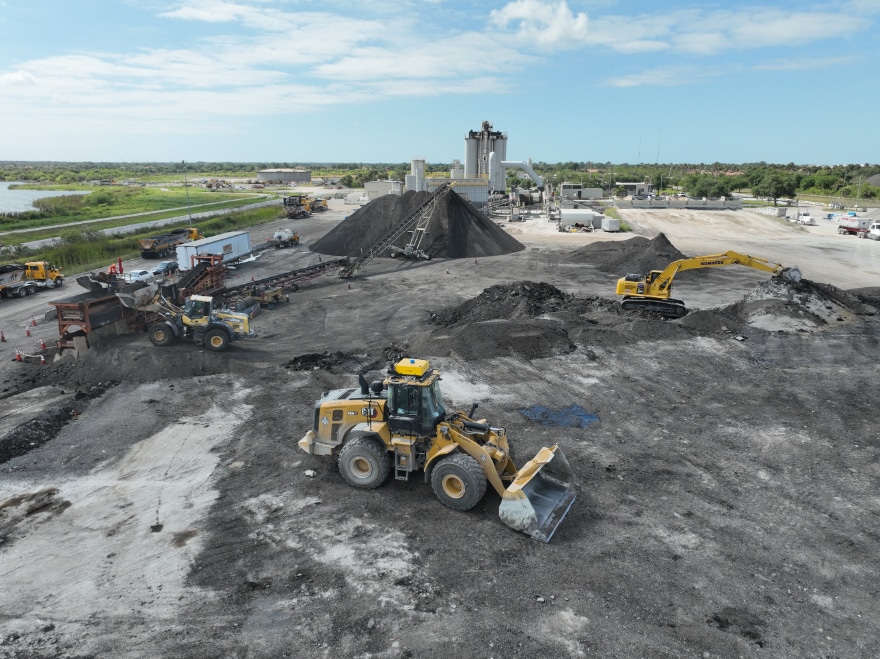
Teleo outfitted a new Caterpillar 966XE wheel loader with Teleo Supervised Autonomy, the technology that enables remote and autonomous operations of machines from a command center, for Ajax Paving of Florida. Now Ajax will have the option of running the machine, located at its Venice facility, even if the available worker for the day is clocked in at a command center 80 miles away. Here’s how Teleo is helping the asphalt industry attract workers who can keep production up and running.
Right now, Ajax’s plant in Venice, Florida has its first command center and the Teleo-equipped loader. The locations for the second wheel loader and the other two command centers will be determined by Ajax at press time.
Readers know asphalt production is a time-sensitive business. When customers need asphalt, it’s needed right away. Ajax Paving, which operates eight asphalt manufacturing plants across the state of Florida and has paved thousands of miles of roadways, needs to ensure they have enough operators to run the machines that feed their asphalt plants with reliability. The just-in-time nature of the business is hampered, however, by an ongoing labor shortage that has made heavy equipment operator roles tough to fill. According to the Associated General Contractors of America, 91% of construction firms are having a hard time finding workers to hire.
Ajax Paving turned to Teleo for help. The Teleo-enabled heavy equipment will provide a practical solution to help alleviate Ajax Paving’s staffing challenges. The loaders are to be stationed at two of the company’s asphalt manufacturing plants, which are roughly 80 miles apart. This means that once the second wheel loader is outfitted with Teleo’s technology, a single Ajax operator will be able to work across two job sites, simultaneously, from one of three of Ajax’s command centers.
Ajax Paving is also the industry’s first company to use remote operations to load an asphalt plant.
Vinay Shet, co-founder and CEO of Teleo, explained that the technology mixes remote and autonomous operations, and is designed to let a single operator control multiple machines. “When the machine is running in autonomous mode and it can’t handle a specific task, it stops and waits for the operator to take over to control the machine remotely,” Shet explained.
“For example, Tomahawk Construction integrated our technology into their operations and currently has a single operator in Ft. Myers, Florida, operating up to three articulated dump trucks 40 miles away in Naples, Florida.
“Ajax Paving has integrated Teleo Supervised Autonomy and will soon utilize the capabilities so that one operator can control Ajax’s two machines at once. The operator will have the ability to remotely operate one machine while the other is tramming, or autonomously hauling materials from one point to another, and the operator can switch back and forth between the machines and modes.
“Ajax will have three command centers in different locations from which the two machines can be operated. This provides for maximum operator flexibility: an operator in any of these command center locations can control any Teleo-equipped machine in their fleet.”
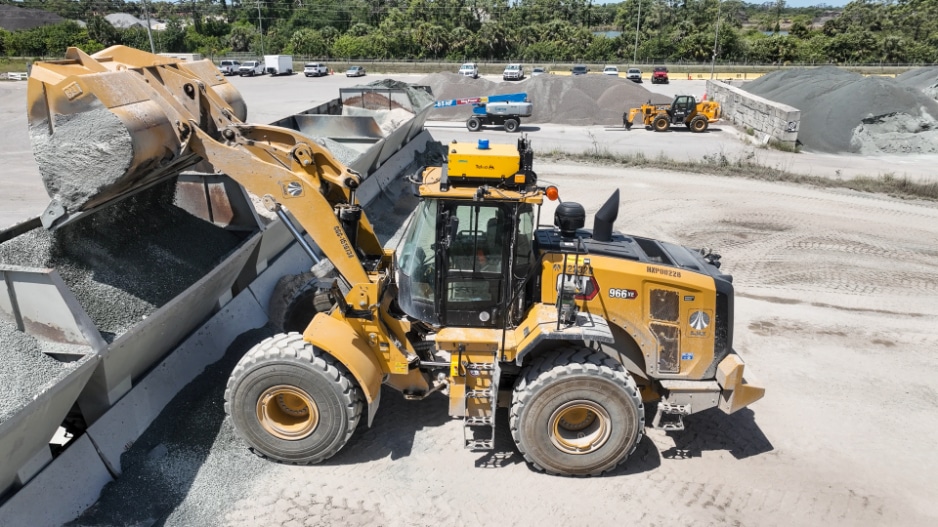
The Teleo-equipped Caterpillar wheel loader operates in the midst of other operations across the Ajax Paving asphalt plant in Venice, Florida.
Andy DeCraene, the executive vice president of operations at Ajax Paving, shared their vision. “We’ll be using Teleo at two of our asphalt facilities to remote-operate the loader which feeds the plant. This is going to allow us to not only staff the facility with just local folks, but we can do remote working from other places around the state.”
Having one operator able to control machines across multiple sites has many advantages for Ajax Paving. If an operator isn’t available on one site—due to a general staffing shortage or an operator calling out sick—another operator at a different site can step in and operate the machine.
Safety Matters
The safety aspects of operating multiple machines at once is handled through the machines’ pauses, as alluded to above. Shet explained, “Teleo’s central command center can control any type of machine and with Teleo Supervised Autonomy, one operator can safely control multiple machine types at once. It’s up to the customer and the operator’s comfort level whether they want to or need to switch between the different types of machines. If an operator knows how to operate multiple types of machines, they should have no issue doing so using Teleo’s technology. Alternatively, an operator with no experience operating heavy machines, can learn to do so from the Teleo central command center.”
Shet continued, sharing the Ajax model specifically. “At Ajax Paving, an operator can remotely switch between Teleo-enabled machines, but they are only remote operating one machine at a time. This means the operator’s full attention is on the machine and they have a complete view around the vehicle thanks to the many on-board cameras. Currently, they’re remotely operating a wheel loader and then parking the machine and switching to remotely operate another machine.”
Safety is enhanced by stacked technology that detects obstacles, as well as internal backups for shutting down if necessary.
“Our state-of-the-art tech stack is the same as what you’d find in self-driving cars,” Shet explained. “The perception stack detects obstacles such as people, vehicles, other construction machines, and when in autonomous mode, it will stop if something gets in its way. Further, there are multiple redundancies built into the system, so if there’s a network glitch or network loss, the vehicle comes to a safe, complete stop.
“Additionally, the onboard camera systems provide for a wide field of view when an operator is controlling a Teleo-equipped machine from the command center. They have better visibility from the command center than when they’re sitting in the machine because there are no blind spots.”
The perception system, which identifies objects around the machine using cameras, is always running and obstacles around the machine are detected when the Teleo system is on. In remote-operations mode, the operator is alerted by the visual—a big red box around the person or object—to draw the operator’s attention so they can react accordingly. If the machine is operating autonomously, the machine will stop if it detects any object without any need for oversight from the operator.
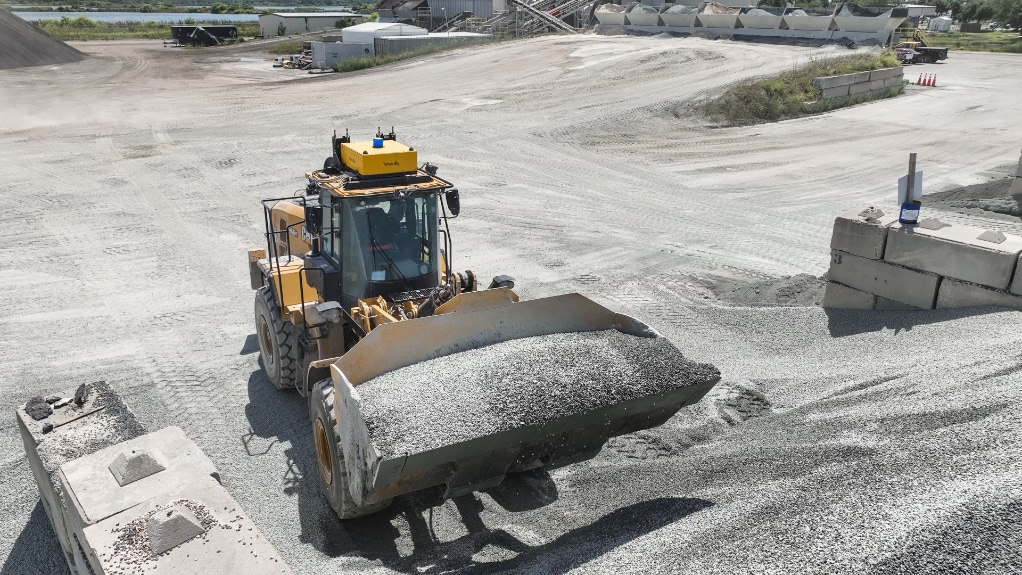
This Caterpillar 966XE wheel loader, equipped with Teleo Supervised Autonomy, pulls aggregate from the stockpile and delivers it to the appropriate cold feed bin at an Ajax Paving asphalt plant.
“Having the perception system running at all times provides the additional benefit of identifying potential hazards that can’t be easily seen by the naked eye, such as if a person or object is very far away or it is dark.”
Shet outlined the safety multi-layer concept in the Teleo technology:
- Layer one: the system always self-diagnoses, and if any subsystem is not running perfectly the machine will safely stop.
- Layer two: full visibility. The operator is fully immersed in the world around the machine and the environment in which it’s being operated.
- Layer three: the full autonomy perception stack is running at all times.
“Further, all data is recorded and provided back to foremen and other worksite leaders so they can review and observe operations and use the information to help further train their operators.”
Focus on Health
While it may seem that younger, tech-native operators—those who are more familiar with gaming and technology—would be the only ones who adapt to this new technology, that hasn’t been the case. “Even some of the older generation operators have picked it up within 20-25 minutes,” DeCraene noted.
Shet explained that the ideal candidate for remote-operating equipment is anyone. “Remote operations make the operator role more attractive and accessible. Teleo eliminates physically demanding aspects of operating heavy machinery, like harsh vibrations or sitting inside the vehicle for long periods of time, making the machines easier to operate. We expect remote operations to help Ajax attract a more diverse applicant pool to include people who are typically under-represented in this industry including women, people living with disabilities, veterans and more.”
And workers don’t have to feel anxiety over learning the system.
“We provided three weeks of training for everyone in Ajax’s organization who needed to be trained to become proficient operators, including both the veteran and younger operators,” Shet said.
Stress is, in fact, one of the factors the remote operation is alleviating for workers. The technology addresses physical wellbeing and mental health by bringing workers to a central location.
The job of a heavy equipment operator can be extremely stressful, both physically and mentally, because of heavy machine vibrations, secluded job sites and more. Ajax Paving President Vince Hafeli is an advocate for mental health in the construction industry and he quickly recognized how Teleo could help both the business and its operators.
“One of the perks of integrating Teleo’s technology is that it takes operators out of the cab, making their lives easier,” Hafeli said. “By removing the physical aspects of doing this job, the mental demand automatically decreases. It’s a welcome benefit of the technology.”
Teleo provides a solution that will help Ajax Paving broaden its hiring pool, allows operators to control machines in more than one location simultaneously, reduces maintenance costs, and provides meaningful mental health benefits that are a priority for the company. According to Hafeli, “We say that the future is riding on Ajax. Well, the future is now at Ajax!”