How Gaming Skills Translate to Asphalt Plant Operator Roles

Gaming for an asphalt plant operator could close the construction industry skills gap

The industrial sector has undergone drastic changes in recent years. Has your workforce followed suit? Decision-makers must overhaul their sourcing and training programs before the skills gap grows too wide to bridge.

Many are looking to younger generations to compensate for the swath of industry veterans set to retire. This approach has its merits, but is very broad. Instead, hiring managers could zero in on a highly skilled yet untapped population of gamers.

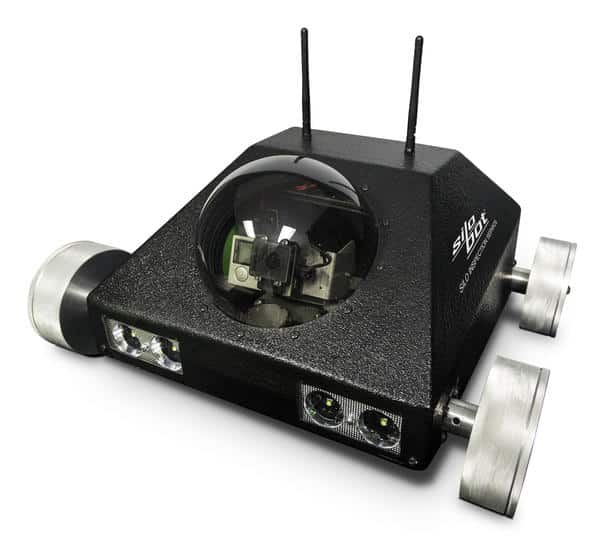
The SiloBot from Astec Industries is an example of robotics and humans working together to make a task at the plant go more quickly and safely. With the SiloBot service, confined space inspections are performed by the robotic device, keeping workers out of harm’s way.

The Problem: The Asphalt Industry Needs Plant Operators

As seasoned industry professionals retire, almost 4 million manufacturing jobs will become available. However, experts project approximately half of those roles will go unfilled.

Editor’s Note: Given the approximately 350,000 workers in the highway construction and maintenance industry overall include individuals who anecdotally share they intend to delay retirement or “never retire,” it’s hard to put a number on how many asphalt plant operators are retiring and how many are moving up the skills ladder.

With the skills gap widening, the need to scout and retain top talent is urgent. The best solution may require looking at unconventional talent pools such as the video gaming community.

Gamers have a reputation for being lazy and lonely, but that’s not always a fair assessment. Most are sociable, ambitious and tech-savvy. And the gaming population offers a sizable talent pool. According to the Pew Research Center, 85% of teenagers play video games, and over 50% of them agree that doing so has enhanced their problem-solving skills.

How to Get New Workers to Stick With It

A Solution: Some Gamers Would Make Good Plant Operators

Gamers’ technology skills go beyond the basics. They can quickly and independently troubleshoot technical issues. Many are familiar with the digital solutions plants will soon utilize, such as virtual reality (VR) or Internet of Things (IoT) devices. For instance, VR users could easily adapt to on-the-job VR training.

Astec Industries, Chattanooga, Tennessee, is one of several OEMs developing virtual, augmented or mixed reality solutions. At this time, Astec customers can use its Astec Digital extended reality solution to view an entire plant or a single piece of equipment at scale, allowing customers to “see” the plant footprint with new or “moved” components.

In 2024, Stockpile Reports®, Redmond, Washington, demonstrated the world’s first mixed reality stockpile measurement tool with its SR Measure, utilizing Apple Vision Pro. It made navigation intuitive, requiring only hand and eye movements—the wearer merely looks at the pile to create a three-dimensional reconstruction.

The emergence of collaborative robots (cobots) and artificial intelligence (AI) necessitates workforce-wide upskilling. One example from 2017 is Astec’s Silobot, which performs inspections inside the asphalt silo, using magnetic wheels and ultrasound technology. It shortens inspection times from days to hours, keeping crews out of the confined space.

Consider Spot, the robodog from Boston Dynamics, discussed in the recent article, “CRH’s Sustainable Practices Give Preferred Results.” This cobot performs repetitive tasks, like inspections, where it’s less than ideal for humans to work.

Gamers have interacted with AI for decades longer than the general population; many have backgrounds in programming, so they are positioned to adjust to such technologies quickly.

The Fifth Industrial Revolution focuses on how the relationship between humans and machines can help facilities increase output while decreasing errors. Those who have grown up gaming, programming and developing have probably explored this connection personally.

A New Value Proposition for Leaders

Which Skills Translate

Just because a young adult is a digital native doesn’t mean he or she possesses technical literacy. Millennials and Generation Z were born into a world where technology was optimized for a seamless user experience. Many passively consume content without understanding how all the tools work.

This is why focusing on the gaming population is more strategic than targeting young working adults as a whole. Those who grew up actively utilizing, exploring and troubleshooting technology are better equipped to perform well amid AI technology.

Gaming helps individuals develop a broad range of transferable skills, including problem solving, active recall, teamwork, pattern recognition, time management, deductive reasoning and leadership.

Recruitment and Training

The gaming population is large, but recruiting these individuals is not as easy as updating some language in the job description. There is little visible overlap between industrial operations and gaming, so these people may not be actively seeking an asphalt plant operator position. Hiring professionals should get creative. Advertising on video game blogs, posting VR training marketing material or leveraging social media may help.

These tech-savvy candidates will thrive if training is tailored to their skill sets. Gamified learning and upskilling—such as scoring, leveling, tiered rewards—would be familiar and engaging.

Stephens College Prepares Women for Asphalt Workforce

Long-term Strategies

Many young people play video games, and the market is only growing. Experts project the video game market will increase from $292.4 billion to $977.4 billion between 2025 and 2035. This bodes well for those rethinking the sourcing and hiring processes to target this segment.

With a swath of seasoned workers nearing retirement, facilities will want to update their talent pools. Gamification could be the key to attracting gamers and updating people’s outlook on the industry. As public perception shifts, more may start viewing asphalt plant careers as more than just lucrative—they’ll see them as competitive.

Ellie Gabel is the associate editor at Revolutionized.com.

Epiroc and Luck Stone Deploy First Fully Autonomous Drill in U.S.

Marking a historic milestone, Epiroc, Stockholm, Sweden, has partnered with Luck Stone, a division of Luck Companies, headquartered in Richmond, Virginia, to deploy the first fully autonomous SmartROC D65 drill rig in the United States. The SmartROC D65 MKII is equipped with Epiroc’s advanced automation technology and is capable of executing complete drill patterns without an operator in the cab, according to the manufacturer.

Compliant with the Global Mining Guidelines Group (GMG) Level 4 standard for full autonomy, the rig operates under remote supervision via Epiroc’s Common Automation Panel (CAP) and Link Open Autonomy (LinkOA) platform, to enable seamless data integration and fleet management.

Luck Stone views automation as a strategic investment in safety, operational excellence and talent attraction.

“Luck Stone’s leadership and commitment demonstrate that autonomy in quarries isn’t future vision—it’s current reality,” said Ron Hankins, business line manager at Epiroc USA. “Our partnership is not about a proof-of-concept, it’s about meaningful operational gains that the next generation of drilling will bring in the U.S.”

Luck Companies Celebrates 100 Years

Luck Stone, which is known for over 100 years of innovations including its early adoption of autonomous plants and autonomous haulage systems (AHS), continues to set the pace for innovation in the industry, and the company views automation as a strategic investment in safety, operational excellence and talent attraction.

“Our philosophy has always been about doing the work in the best possible way,” said Chuck Stilson, senior director of engineering at Luck Stone. “Partnering with Epiroc on autonomous drilling aligns perfectly with that vision. We’re not only improving productivity and safety, we’re providing new opportunities for our associates and rethinking what’s possible in aggregates.”

James River Equipment, an Epiroc dealer, played a key role in facilitating delivery of the SmartROC D65 MKII and will be instrumental in providing the ongoing local service, training and technical support that are essential to ensuring the project’s long-term success.

Luck Stone Expands Presence in North Carolina

The U.S. aggregate market is the largest globally and presents significant growth potential for autonomous technologies. Utilizing the same automation platform proven in mining, the SmartROC D65 MKII makes it easy for any operation to scale toward full autonomy, according to the manufacturer. By enhancing operational safety, optimizing machine fleet size, and addressing skilled labor shortages, this deployment represents a transformative shift in how quarries can operate.

Both Epiroc and Luck Stone have committed to sharing performance data following the implementation period, offering valuable insights for the broader industry and paving the way for future advancements in automation.

Safe Lift Practices: Training Tools to Protect Asphalt Plant Crews

Niftylift offers safety training to augment “high” HMA plant maintenance

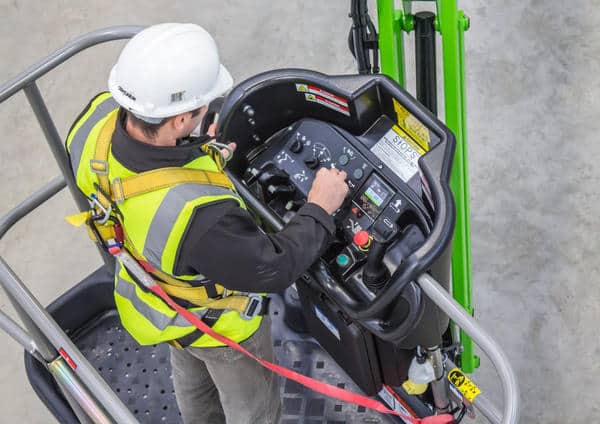
Many of the articles discussing plant maintenance remark on the importance of lockout/tagout protocol. Without minimizing the need to train workers on that vital step in plant maintenance, let’s also talk to workers about lift safety and fall-arrest protection. The team at Niftylift Ltd., headquartered in Europe, prepared a document to address the risks associated with uneven terrain when using a mobile elevating work platform (MEWP), and that discussion is relevant today.

Niftylift has therefore created the NiftyPRO mobile app to deliver accessible training and support.

The team explained “that many accidents are entirely avoidable if proper training has been given.” This extends to how and where an operator uses a MEWP in addition to the safety training he employs while using the equipment.

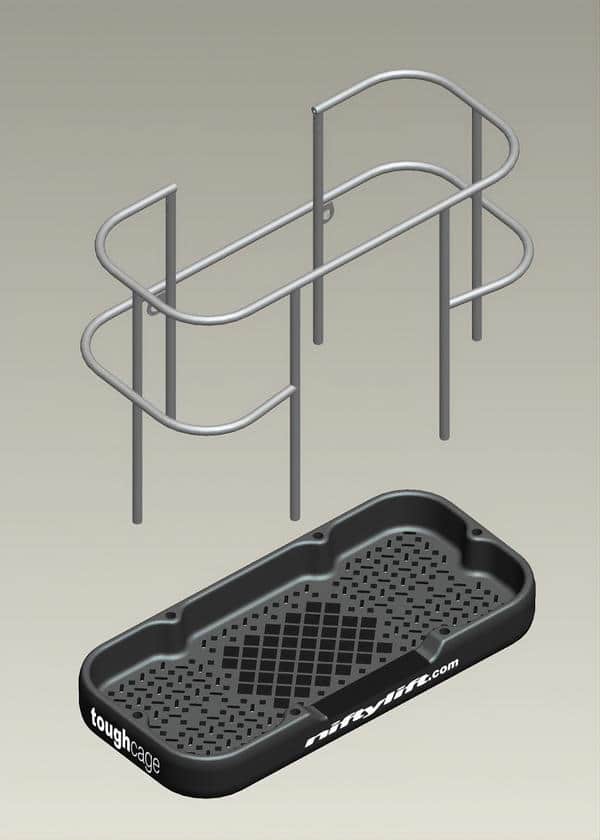
For example, the engineers at Niftylift have devised what they call the ToughCage platform. It comprises an impact-resistant, composite base and a large cross-section steel cage designed to protect the operator. In the event of an impact, the ToughCage is designed to absorb much of the force; damage to the boom is minimised as well.

Along with protecting the worker, the team at Niftylift have addressed educating the worker. The company provides its inclination sensing technology to address the risks associated with uneven terrain and its load sensing system to actively monitor a MEWP’s platform weight. These are only two of the technologies in place to help the operator with performance and safe operation, and the company provides training videos that address these risks and more.

The ToughCage from Niftylift is designed to absorb much of the force in the event of an impact.

The company shared that mistakes surrounding the use of personal fall protection equipment (PFPE), most notably harness and/or lanyard, are also an issue. So, the company offers its ClipOn system, which features red and green LED indicators and an audible alarm, as an intuitive means of ensuring operators correctly attach their harnesses before beginning operations.

A press release from Niftylift stated, “The fact remains, however, that many accidents are entirely avoidable if proper training has been given. Niftylift has therefore created the NiftyPRO mobile app to deliver accessible training and support for operators, fleet managers and technicians. With well over 100 video tutorials, covering Quick Start Guides, machine operation and recovery procedures, the app helps to bridge the gap between theoretical training and practical application. Accessible anywhere, anytime, this immediate access enhances on-site efficiency and safety, making learning and troubleshooting more convenient than ever.”

“Niftylift is synonymous with innovations in operator safety, introducing technologies over the years that have redefined safety standards, addressing critical risks in working at height, including entrapment, overloading, harness misuse and unsafe tilting,” concluded Tom Hadden, technical sales manager, Niftylift. “Together, they enhance operational efficiency and provide operators with the confidence they need to work safely at height. We are committed to continuing to lead the industry in promoting safer working practices worldwide.”

Myrl & Roy’s Harrisburg Plant Sets the Standard for Sustainable, Smart Growth

Collaboration and conservation: Myrl & Roy’s new HMA plant raises the bar

In South Dakota’s construction corridor, a new hot-mix asphalt (HMA) facility has come online. The recently completed Myrl & Roy’s asphalt plant in Harrisburg is a layered story of more than aggregate, asphalt and tons per hour. It’s about visionary planning, deliberate environmental stewardship, and a team that treats the job as a legacy.

The new 500-ton-per-hour (TPH) facility from CWMF Corp., Waite Park, Minnesota, is a shining example of what’s possible when engineering, environmental planning and collaborative partnerships align.

Myrl & Roy’s is a division of the fifth-generation, family-owned L.G. Everist, Inc., Sioux Falls, South Dakota.

Eric Leverson explained an overarching goal was to build a plant with higher production capabilities. That meant plenty of silo storage, with multiple loadout scales, and plenty of liquid AC storage. The team at Meeker Equipment supplied the tanks for the tank farm. Photo courtesy of Motion Engineering

An Idea Set in Asphalt and Stone

From the beginning of the project, Eric Leverson, VP construction materials, L.G. Everist, and his team at Myrl & Roy’s envisioned more than just their second plant. The new facility was designed to exceed their customers’ expectations, streamline material handling, and meet future market demands. The design includes a counterflow drum of 10 feet, 6 inches by 60 feet, four 300-ton silos, dual truck scales, and a fully paved traffic circle to eliminate bottlenecks and improve safety.

“The entire plant is designed to handle maximum production if needed,” Leverson shared. “The most important part of our business is customer service. Being able to handle their needs daily is critically important to us and them. We produce multiple mixes daily so having two scales and multiple silos coupled with the capacity of the plant allows us the flexibility to switch between mixes and customers’ needs and not sacrifice service. Our focus is to move the customers in and out in an orderly fashion and not slow them down.”
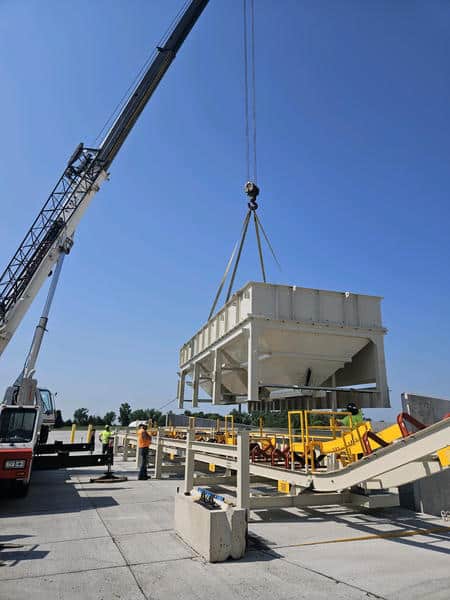
It was all hands on deck for installation of components to bring the Harrisburg plant to life. Both photos courtesy of Motion Engineering

Leverson noted that this new site had to fulfill the dual function of ready-mix and asphalt operations and prepare for future expansion, including recycling capabilities. The one-way truck traffic pattern minimizes cross-traffic and confusion, helping to protect drivers and plant personnel while accelerating loadout. According to Leverson, minimizing wait times and maximizing service is vital, as 75% of the mix will go to external customers.

“When we first laid out the site plan, it was very important that we understood the different activities that would be taking place on site,” Leverson explained. “We originally developed the site for the installation of a dual lane ready-mix plant, but we also wanted to have plans in place for a future asphalt plant and recycle yard.
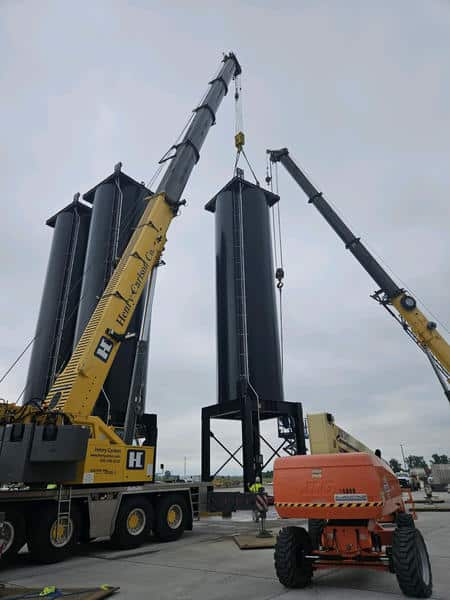
It was all hands on deck for installation of components to bring the Harrisburg plant to life. Both photos courtesy of Motion Engineering

“My main concern was to make sure we identified not only the current needs, but also the potential future needs. With the amount of incoming and outgoing materials along with accommodating employee and public activities, traffic flow was one of the important and critical things that needed to be thought through and addressed. The original plan had a high-level conceptual idea of traffic flow, but the final plan was not developed until much of the site was completed. Temporary traffic control was used while the new ready-mix plant was operational. This allowed us to monitor traffic patterns for the operating season and identify what the final plan would look like. Striping, delineation and signage was the last activity to take place.”

“In the end, we did have a successful lift off. With only being in operation for a couple of weeks, the initial planning, execution and overall operation has been successful.”—Eric Leverson
The CWMF Revolution D™ drum mixer offers counterflow drum technology and features the company’s adjustable Wedge-Lok™ tire suspension system. Both photos courtesy of CWMF

Planning with Environmental Purpose

From concept to execution, environmental stewardship was key. Leverson and his in-house engineering staff designed the site to function as a self-contained ecosystem. “We have an in-house engineering staff that put together a rough outline of the layout and what we wanted for the site,” he said. “A local civil engineer assisted in putting together the site plan.”

Every paved surface has drainage leading to a storm sewer system that channels water into two deep retention ponds that serve multiple on-site functions.
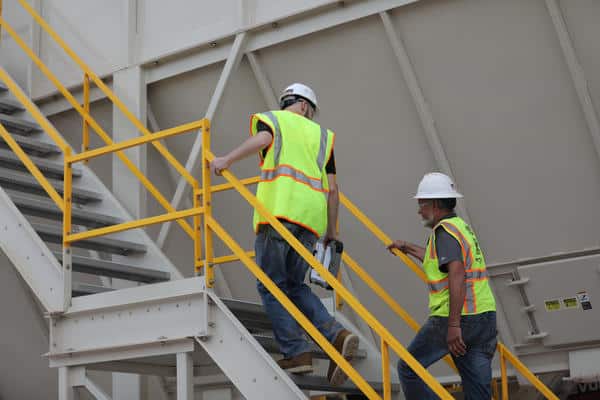
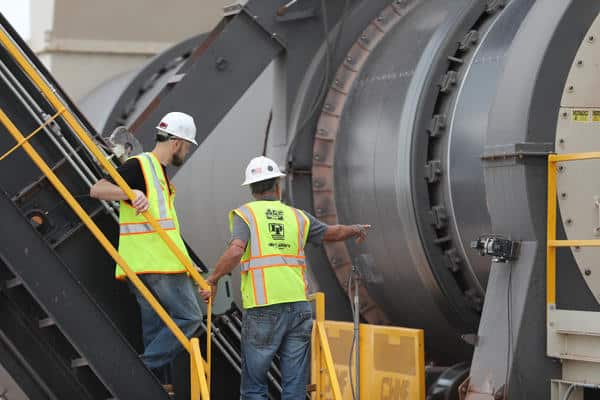
This image of crew members ascending the baghouse stairs highlights the company’s commitment to safety with full stair access around the plant. In the adjacent photo, at left, CWMF Sales Technician Steve Schmitz and, at right, Myrl & Roy’s Asphalt Operations and Performance Manager Brian Heger discuss startup from behind the safety railing prevalent around the plant. Both photos courtesy of CWMF

With 75% of the site paved in concrete or asphalt, according to CWMF’s Vice President Travis Mick, airborne dust is greatly reduced. “There is drain tile under the concrete paved surface of all the material storage areas, allowing moisture to optimally drain from the stockpiles,” Mick shared. “There is a massive truck staging area out of the busy area of the plant, keeping things safe and orderly. Berms and trees surround the perimeter to keep an upscale appearance and to match the beautiful, gated entrance and exit points of the site.” These elements were installed intentionally to ensure the site would be an environmentally responsible addition to the community.

“The entire site is self-contained and has its own storm sewer system,” Leverson said. “The storm sewer drains into a network of drainage ponds which ultimately end up in two large retention ponds. The site has a network of water hydrants at various locations that are used for not only dust control, site wash down, water truck fill stations, aggregate stockpile control but also ready-mix truck wash out ponds. All the stockpile areas are paved with positive drainage that allows the moisture to drain away and get captured by the storm sewer and recycled for onsite use.
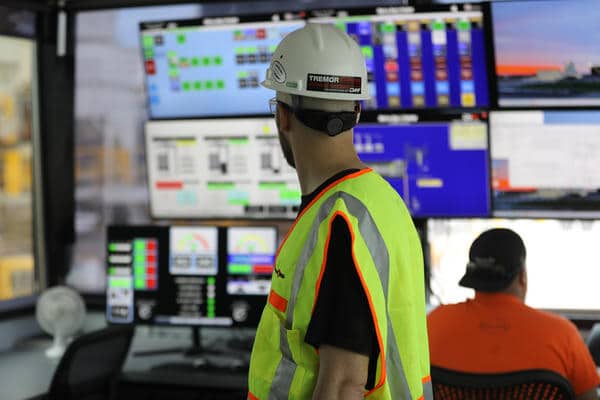
The 12-foot by 34-foot elevated control house features the advanced technology of Systems Equipment. Photo courtesy of CWMF

“It was important to us that we understood the impact a site like this would have on the area, not only for the traveling public but also the natural habitat. This was all taken into consideration when the site was built. We feel we have addressed not only the concerns of the public but also impacted the natural environment and habitat in a positive way.”

Leverson described how the team took extra steps to address local impact. LG Everist worked with the local governments to accommodate traffic increases and upgraded a portion of the farm-to-market road servicing the site—out of pocket. Leverson said it was part of being “good stewards of the land and the community.”
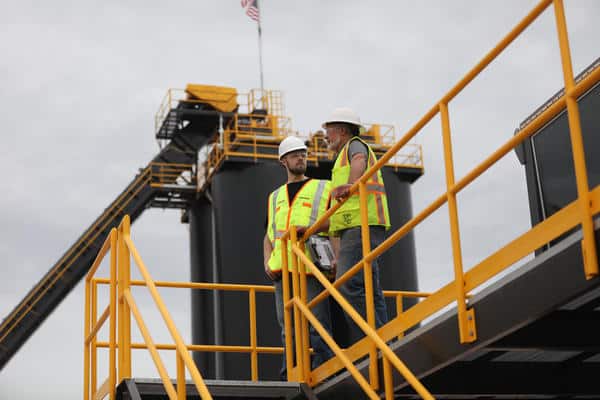
This image of crew members ascending the baghouse stairs highlights the company’s commitment to safety with full stair access around the plant. In the adjacent photo, at left, CWMF Sales Technician Steve Schmitz and, at right, Myrl & Roy’s Asphalt Operations and Performance Manager Brian Heger discuss startup from behind the safety railing prevalent around the plant. Both photos courtesy of CWMF

Seamless Collaboration Among Experts

CWMF served as the primary equipment provider, supplying the counterflow drum, slat conveyors, silos and control systems. CWMF’s Mick noted that this project, though not the first interaction with Myrl & Roy’s, was the first large-scale partnership with the company under LG Everist ownership. He spoke highly of the contractor’s planning and attention to neighborly details.

ARC Fabricators supplied the bins and scale conveyors. From there, CWMF contracted with Motion Engineering to install the plant and piping for the tank farm, and with Meeker Equipment to handle the tank farm.

Jeff Meeker described the intricate and safety-focused AC tank system: “Our part of the project was to supply the AC tank farm, which consists of six 40,000-gallon asphalt tanks, AC piping, hot oil heater, mass flow meter, a 10,000-gallon emulsion tank and associated pumping and loading equipment.”

Bowes Construction Buys Uptime, Security, Production

Meeker elaborated on the automation technology, sharing: “All the valves on the piping system are controlled by Meeker’s Liquid Vision valve control system and tank monitoring control. Inside the control room, we provided an Allen Bradley plc control and HMI. The plc has the logic done for normal operations and also unique situations. All scenarios are taken into consideration with the Liquid Vision.”

Motion Engineering was responsible for installation aspects. Mike Petrie, operations manager at Motion, clarified: “Motion Engineering was responsible for the mechanical installation of all equipment as well as mechanical installation of all hot oil and AC piping in the tank farm.” He pointed out the Motion Engineering team handled the insulation for the entire plant and spoke proudly of his team. “Our team did an incredible job with the insulation…and it’s becoming more important to emphasize the advantages of insulating equipment.”

“It was very clear to us at the beginning that Myrl & Roy’s was going to take the lead on exactly how they wanted everything designed,” Petrie continued, but that was no challenge for a team working in concert. Trust among the team was crucial and worked in everyone’s favor.

Palmetto Completes Successful Builds

“There is a great relationship that exists between Motion Engineering, Myrl and Roy’s, CWMF and Meeker,” Petrie said. “We all want to get it right at the end of the day to ensure longevity of the plant.”

Getting everything right at the end of the day requires coordination. “There is an intense amount of final fitting and changes that come with a new asphalt plant build,” Petrie emphasized. “All the AC piping/valving was prefabbed but the hot oil piping was something that we helped design in the field. We had to make sure that we built the hot oil piping according to what the OEM’s specifications are.”

ASCO Invests in Decreasing Down Days

Pre-Planning for Success

Mick shared that the quoting/conversation with CMWF and Myrl & Roy’s started in November of 2022. “We were awarded the job in August of 2023. This project hit production in March of 2024. The first components were delivered in the month of May. Equipment installs started with the tank farm. From there, we continued with the silos/slat.” By Labor Day, the plant was structurally in place. Final electrical work continued through the fall and winter.

When the team fired up the plant on May 28, 2025, Leverson said they targeted 2,000 tons on the first day—and exceeded it.

Leverson acknowledged the startup came with a learning curve. The team spent about three weeks identifying and resolving issues. Still, all underground electrical and mechanical systems installed prior to the winter performed as expected.

The planning, including conduit burial and early groundwork, was vital. Leverson and his in-house team oversaw months of activity long before the drum or silos went up—grading, paving, trenching, pouring footings—all choreographed for a seamless equipment installation.

Looking ahead, Leverson sees the Harrisburg plant as a blueprint for future-ready operations. “It’s about building something responsible, scalable, and respectful of the land and the community,” he said. “That’s what we set out to do, and I believe we achieved it.”
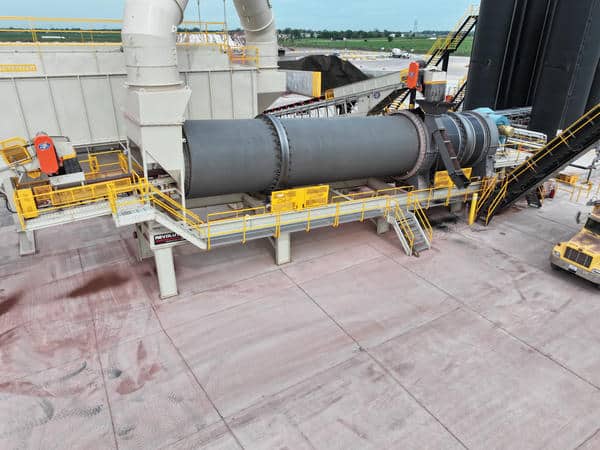
The CWMF Revolution D™ drum mixer offers counterflow drum technology and features the company’s adjustable Wedge-Lok™ tire suspension system. Both photos courtesy of CWMF

Technology in Action

Even in its earliest weeks of operation, the Harrisburg plant’s design choices are proving their worth. Leverson shared that the facility exceeded production expectations on opening day and has shown consistent reliability since.

The advanced systems supplied by CWMF, Meeker Equipment and ARC Fabricators play a pivotal role in this performance. With multiple silos and dual truck scales, the plant can handle several mix designs in a single day without disruption to customer service.

The Liquid Vision system from Meeker Equipment is already simplifying operations. The plant operator can manage tank flows and monitor levels without stepping foot outside the control room. Drivers unloading asphalt can access real-time tank data, reducing the risk of overfills and improving efficiency.

GMI Asphalt Maximizes Trucks, Fuel, Labor

“If a driver is in control, he can choose the tank he is delivering to,” Meeker said. “He knows the amount of liquid AC already in the tank, and it will alarm him if the tank is getting too full.

“All of the Meeker AC tanks come with a hi-level float—what we call a stainless steel basketball,” Meeker continued. “It’s a final safety measure to stop the flow of AC into a tank.”

That emphasis on automation and safety extends across the site. From automated truck spray-downs that reduce dust and eliminate the need for drivers to leave their vehicles, to traffic signage and scale lane separation, the site is focused on safety-first productivity.
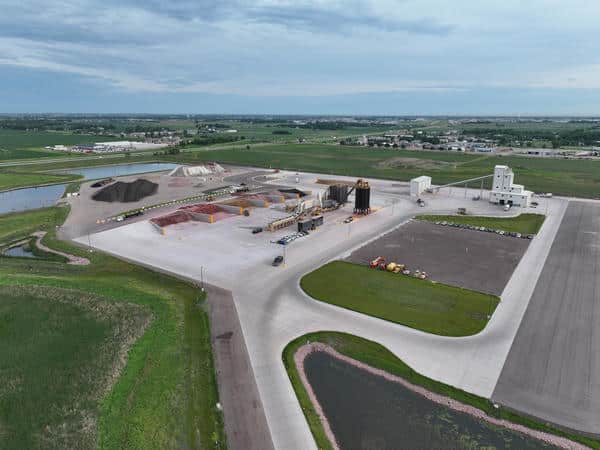
The team planned and built the Harrisburg plant with the future in mind. Leverson pointed out that meant production and sustainability. “We wanted this to be a benchmark facility, one that reflects who we are as a company and how we want to serve this community.” Photo courtesy of CWMF

Team Pride

Throughout every phase of the project—from site selection and early grading to the final wiring and commissioning—the Myrl & Roy’s team operated with precision and a strong sense of ownership. Their in-house crews coordinated infrastructure, utility trenching and poured critical foundations while managing the complexities of a multi-vendor installation.

Leverson noted how the team’s proactive attitude made the difference. Whether troubleshooting complex mechanical systems, refining traffic flow or accommodating last-minute layout adjustments, the crew never faltered. “The main objective was to build a plant that had [higher] production capabilities if we needed it, plenty of silo storage with multiple loadout scales and plenty of liquid AC storage. We have not been in operation very long, but those choices have proved themselves already.”

JM Fahey Celebrates 50 Years with CWMF’s Stationary Full Plant Build

He added that the Myrl & Roy’s staff took personal pride in the facility throughout the build. Employees guarded exposed conduit installations during active phases to prevent damage and monitored subcontractors to maintain site integrity. Their commitment ensured that no detail was overlooked. “All of the conduits, wiring and airlines survived the winter. They have performed as anticipated. We spent approximately three weeks in start-up mode, troubleshooting problems and eliminating issues. With the amount of electrical and mechanical parts that are involved, this was probably not unrealistic. We had plenty of trial and error, frustration and other emotions that we fought through, but in the end, we did have a successful lift off. With only being in operation for a couple of weeks, the initial planning, execution and overall operation has been successful.”

The team’s hands-on approach created an asphalt plant that blends high production with environmental responsibility, technology integration and site safety. Leverson emphasized that the people behind the work are the plant’s greatest asset.
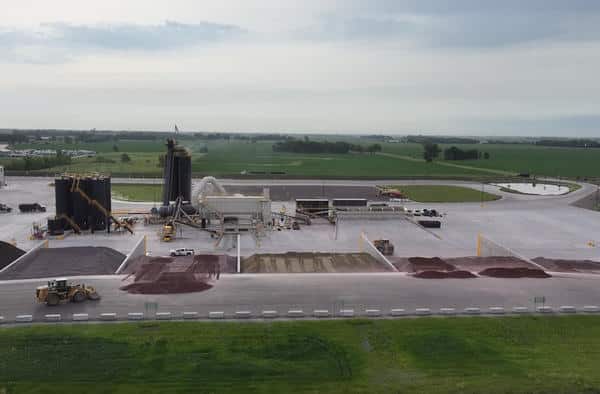
Myrl & Roy’s, a division of family-owned L.G. Everist, Inc., Sioux Falls, South Dakota, planned and built its new asphalt plant in Harrisburg with CWMF Corp., Waite Park, Minnesota. Additional vendors joined the team to facilitate delivery and installation of all systems for an environmentally friendly facility poised to meet market demands now and into the future. Photo courtesy of CWMF

Looking Ahead at a Sustainable Legacy

With the new plant now fully operational, Myrl & Roy’s has laid the groundwork for a long-term model of environmental stewardship. Leverson and his team continue to monitor and fine-tune systems to optimize efficiency and minimize impact.

Future goals include increasing the use of recycled materials. Leverson reflected on the larger mission: to build infrastructure responsibly, not just for business, but for the region and the environment. “Every aspect of the Harrisburg plant was built with the future in mind—not just in terms of production, but also sustainability,” he said. “We wanted this to be a benchmark facility, one that reflects who we are as a company and how we want to serve this community.”

The facility may have only recently opened its gates, but it already stands as a powerful symbol of what a responsible, forward-looking plant build can achieve.

Protecting Workers from Fatigue-Induced Injuries

Fatigue monitoring devices offer solutions for safer, more efficient mining operations

Worker safety is one of the paramount concerns in the mining industry. Among the various threats faced by mining professionals, fatigue remains one of the most critical, often leading to accidents, decreased productivity and longer recovery times after injuries. As a result, the demand for mining fatigue monitoring systems has surged in recent years, as companies strive to ensure a safer and more efficient working environment.

The global mining fatigue monitoring market is expected to experience a robust compound annual growth rate (CAGR) of 10.1% from 2024 to 2031. This growth is projected to elevate the market value from US$ 1.4 billion in 2024 to US$ 2.8 billion by 2031.

This article explores the innovations and advancements in fatigue monitoring technology and how they are transforming the mining industry, driven by increasing awareness about safety and regulatory compliance.

Fatigue monitoring is becoming an integral part of this digital ecosystem, with systems that integrate seamlessly with other operational technologies such as fleet management systems and real-time asset tracking.

Prevent Injuries from Manual Materials Handling

The Need for Fatigue Monitoring Systems

Fatigue is a silent yet deadly force in the mining industry. Long working hours, harsh environmental conditions, and physically demanding tasks make miners particularly susceptible to fatigue. According to recent studies, fatigue is a major contributor to accidents in mining operations, impacting not only the health of workers but also the overall productivity of mining sites. Persistent fatigue among workers can lead to impaired judgment, slower reaction times and reduced decision-making capabilities.

This has prompted a growing interest in fatigue monitoring systems, designed to detect the early signs of fatigue in miners before they lead to accidents. These systems leverage cutting-edge technologies, such as wearable sensors, real-time data analytics and machine learning, to continuously monitor vital signs and cognitive functions. By doing so, they provide early warnings to management, allowing them to take proactive measures to prevent accidents and minimize downtime.

Calculate the Cost of Occupational Injuries & Illnesses with OSHA’s Safety Pays

Innovations in Fatigue Monitoring Technologies

The mining fatigue monitoring market has seen rapid advancements in technology over the past few years. Today, a variety of solutions are available to mine operators, ranging from wearable devices to in-vehicle monitoring systems. These devices measure a variety of physiological and behavioral indicators to assess fatigue levels in real time.

Wearable fatigue monitoring devices, such as smart helmets, wristbands and eye-tracking goggles, are among the most popular options in the industry. These wearables track heart rate variability, eye movement and body temperature, all of which are key indicators of fatigue. The data collected by these devices is sent to a central system, where it is analyzed to determine whether a worker is becoming fatigued. In some cases, workers are alerted in real time, giving them an opportunity to take a break before fatigue becomes a hazard.

Moreover, the use of machine learning algorithms is revolutionizing fatigue detection. These algorithms are trained to recognize subtle patterns in workers’ behavior that may indicate fatigue. By combining data from wearable devices with historical accident data and environmental conditions, these systems can provide more accurate predictions and even suggest the optimal times for breaks to ensure that workers remain alert throughout their shifts.

Be Prepared for Accidents and Injuries

Market Growth and Key Players

The demand for mining fatigue monitoring solutions is growing rapidly due to the increasing recognition of the dangers posed by fatigue in mining operations. Mining companies are becoming more proactive about worker safety, driven by stricter regulatory requirements and the need to reduce operational risks. This has led to a surge in the adoption of fatigue monitoring technologies, particularly in regions with large-scale mining operations such as North America, Australia and parts of Europe.

The market is also benefiting from the rising focus on digital transformation in the mining industry. Companies are increasingly adopting smart mining technologies, which use data analytics and automation to optimize operations. Fatigue monitoring is becoming an integral part of this digital ecosystem, with systems that integrate seamlessly with other operational technologies such as fleet management systems and real-time asset tracking.

Persistence Market Research forecasts steady growth in the mining fatigue monitoring market over the next several years. The market is expected to be driven by several factors, including increasing investments in safety technologies, growing regulatory pressures and the need for operational efficiency. The increasing availability of advanced wearable devices and their integration with mining equipment is also expected to fuel the market growth.

6 Tips to Prevent Simple Recordable Injuries Around the Plant

Regional Insights and Market Dynamics

The demand for mining fatigue monitoring systems is geographically diverse, with North America and Europe being key markets due to their strict safety regulations and advanced mining operations. In North America, mining companies are facing growing pressure to comply with occupational health and safety regulations, which has accelerated the adoption of fatigue management solutions. Additionally, the rising number of fatalities and injuries caused by fatigue in the region has created a strong market for these technologies.

In Australia, where mining is a critical industry, companies are also prioritizing worker safety, and fatigue monitoring systems are being deployed across many mining sites. The Australian government has also introduced new regulations, further driving the market for fatigue monitoring solutions. Meanwhile, in emerging markets such as Latin America and Asia-Pacific, the increasing expansion of the mining industry and a rising focus on safety are likely to lead to growing demand for fatigue monitoring systems.

Prevent Simple Recordable Injuries: Prevent Falls

Challenges and Future Outlook

While the mining fatigue monitoring market presents significant growth opportunities, there are also several challenges to overcome. One of the major obstacles is the high initial cost of implementing these systems, which can deter smaller mining companies from adopting them. Additionally, the need for extensive training and education to ensure that workers can effectively use fatigue monitoring devices adds to the cost and complexity of these systems.

Despite these challenges, the future outlook for the mining fatigue monitoring market is positive. Technological advancements, such as the development of more affordable and effective wearables, are expected to drive broader adoption. Moreover, the continued emphasis on health and safety, along with regulatory requirements, will likely push more mining companies to invest in these systems.

The mining fatigue monitoring market is poised for significant growth as industry leaders seek innovative solutions to improve worker safety and operational efficiency. With the introduction of advanced technologies such as wearable devices and machine learning algorithms, fatigue monitoring systems are becoming more effective at detecting early signs of fatigue and preventing accidents. As the industry embraces these solutions, mining operations will become safer, more efficient, and more sustainable, ultimately benefiting both workers and companies alike. Persistence Market Research anticipates strong growth in this market, driven by increasing investments in safety technologies and regulatory pressures aimed at reducing fatigue-related accidents.

Prevent Fatalities with Better Truck Driver Training, Best Practices

A safe and quality job site starts with well-trained truck drivers delivering HMA to the paver

The haul truck is not just the vessel that brings vital, perishable material to our job sites throughout each shift. It’s a large and lumbering piece of equipment. The unladen truck can be 50,000 pounds by itself. Add 18 to 23 tons of hot-mix asphalt (HMA), and you have a heavy vehicle for the driver to control. The heaviest one I’ve seen arrive on a job was about 50 tons. That was on a project in Montreal where it’s not uncommon for larger live-bottom trailers to bring heavy loads to the paving project.

Get AsphaltPro’s 12 Safe Steps for Haul Truck Driver Training white paper! Click here to download now.

No matter what size of truck they’re driving, if the driver hasn’t been properly trained and shown best practices for every aspect of loading and delivery, they can be a liability for their company, the general contractor and the traveling public. Let’s look at the main areas where they need training:

  • Cleaning out the truck bed and getting out of the work zone
  • At the plant and during loadout
  • On the road, routes to and from the job
  • Getting into the work zone and to the paver
  • Charging the hopper

Before we look at some tips for training in each of these areas, let me share an example of why they’re all vital. During the 2024 construction season, I was helping a crew on a night project that involved paving one 12-foot lane of a five-lane highway. We followed the MUTCD and had barrels delineating the work zone; four state troopers were assisting with traffic control.

A subcontracted haul truck driver completed charging the hopper of the Shuttle Buggy around 3:15 a.m. and pulled away from the paving train. We didn’t know it, but the driver pulled over about a half of a mile ahead to clean out the bed of his triaxle while still within the safe confines of the work zone. He raised the body to clean it out and returned to traffic with the body still up.

Use a Sunroof to Spot Overhead Obstructions

About a quarter of a mile from his self-appointed cleanout area—still in the work zone—the elevated body struck and knocked down an overhead highway sign, resulting in debris in the road. The driver didn’t tell anyone what had happened, but continued to the plant, where he parked his damaged truck, signed out and went home.

Back at the debris field, tragedy was about to unfold. A motorcyclist entered the closed work zone at highway speeds and encountered the mangled signage. The tack truck driver saw this accident happen and was able to call for help, but the motorcyclist didn’t survive his injuries.

Training haul truck drivers for the niche job of delivering HMA sometimes falls to the asphalt contractor. Here are a dozen tips to help keep drivers and crew members safe and perishable material on-spec.

This loss of life could have been prevented if the driver had been trained on proper cleanout practices, if he had an alarm that alerted him when his truck body was elevated when moving at travel speeds, if he had stopped and asked for help after striking the highway sign, if the motorcyclist had heeded the signs telling him the highway was closed, and so on. A series of mistakes and lapses in judgment led to a terrible accident that we can only learn from now. Let’s look at a few lessons we can take away from this awful scene.

In this picture we have a bad practice in play. You can see turn marks on the fresh mat in the background. This is where one of the haul trucks made a U-turn on the uncompacted mat. No haul truck driver should be driving on the new mat, much less turning on it. Those tire marks represent an area that won’t achieve good density but will achieve potholes and raveling with weather events this winter. This is a sign of an untrained or apathetic truck driver who needs to be removed from the project.

Clean out the bed and get out of the work zone safely

The main training category for this article is that of assigning a dedicated cleanout area for trucks and making sure all drivers understand where it is and how to use it safely. Each driver who will be bringing material to the site should know a designated cleanout area exists and should know where that area is.

If the work zone is exceptionally long and the cleanout area will “move” before the job is complete, then each area designated on a map should be pointed out to each truck driver. Each area should be highlighted with the date and/or time it will be available for drivers to use. This type of update is easy to indicate in today’s work zone apps. Check with your app provider to ensure all members of the team—including subcontracted drivers—have access to the information in real time.

Tips to Maintain your Haul Truck

When the cleanout area is available for drivers, it should have clear, legible signage in the languages your team members read. Lights and arrows should designate how to access the area and where cleaning can happen. Tools and safety equipment should be easy to use. Then additional lights and arrows should designate how to leave the area safely.

For nighttime work zones, the cleanout area needs additional lighting to not only give the truck drivers a well-lit work area, but also to make it painfully obvious to motorists that this is a dangerous construction area off to the side of the road and not a rest stop or place where the traveling public is welcome. Signage and arrows should make it clear this is a lighted area for large trucks/heavy equipment only. The last thing you want is for confused motorists to think they’ve come to the end of the work zone “early” and enter this well-lit area where a haul truck driver might be outside of his or her cab.

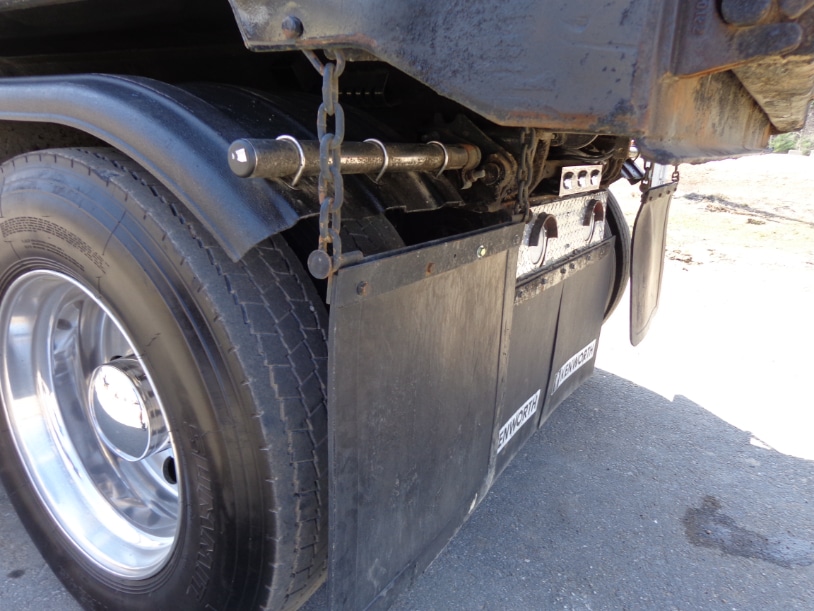
The driver uses a 3-inch putty knife or scraper to maneuver around the tailgate and hinges/dog ears to clean. This is also the time to reposition the mud flaps. They were lifted out of the way of the paver’s push rollers—now lower them back where they need to be for legal travel.

As cumbersome as it may seem, setting up a mechanical flagging system that clears the haul truck for return to traffic at the end of the cleanout area could prevent the type of accidents that happen from raised truck bodies. A system that prevents the truck from leaving the area if it can’t fit under a mechanical flagger’s arm will keep drivers from hitting bridges, overpasses, highway signs and other overhead obstructions. (Check out the Federal Highway Administration’s technical report “Review of Low-Clearance Early Device Warning Options for Illinois” for ideas on how LCDW systems are being used on bridges and other structures to reduce collisions here.)

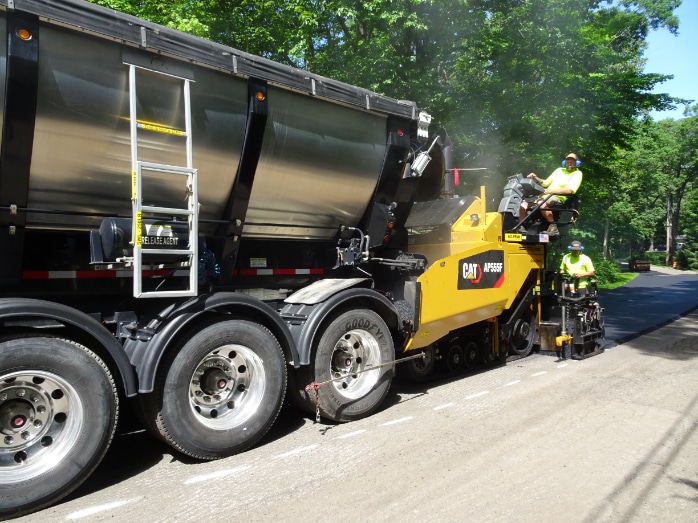
Notice a host of best practices in play here. First, the crew members are using headsets for clear communication. The guidebar on the paver is clean and follows a marked line for the paver operator to guide off of. The haul truck’s mud flap is up out of the way of the push rollers, which the back tires are snuggled against so the live-bottom can feed the hopper without dribbling mix in front of the paver.

Implement Procedures

The other training points mentioned at the beginning of this article can be covered when a company implements procedures and makes it clear those procedures are to be followed.

There absolutely should be a procedure in place for drivers to sign in, do a walk-around of the truck in a safe and well-lit location at the plant site, ensure previous maintenance items have been addressed, and check out the vehicle for the shift. When a shift is complete, there should be a procedure for the driver to do a walk-around of the truck in that same safe and well-lit location as before, perform cleaning of the equipment, ensure an easy and well-documented way to inform mechanics of any maintenance issues or worries, and to check in the vehicle at the end of the shift.

Have you cleaned the reflective tape, taillights, safety placards and other lighting lately? Make sure reflective tape, safety signs and lights on your haul truck aren’t obscured by grease or asphalt build-up. You want headlights hitting the tape to reflect light to the motoring public. You want them to see you. Your lights cannot do their job of protecting you, the crew and the public if they’re filthy and covered with grime. Get these and other training tips in this white paper from AsphaltPro.

Save on Costs with Your Professional Guide to Asphalt Mix Delivery, Part 5—Haul Truck Safety Pays Dividends

To make truck traffic safer at the plant, to make loadout safer under the silos, to make travel safer along designated routes to and from the job site, to make backing to the paver a safer operation and to make charging the hopper safer, drivers should be aware of the proper procedures at each step. And they need to be told why.

The reason for using the three-drop method of loadout at the silo makes perfect sense to the seasoned plant operator and the paving superintendent out on the job site. But the subcontracted driver who’s been hauling asphalt for two hours has no idea why he must stop the truck, receive a drop, back it up, receive another drop, and so on. This may feel like wasted time to him when he could center the bed under the silo gate and receive one lump stockpile of 20 tons, then get on with delivering the load. He doesn’t understand—yet—that taking one lumped load leads to material segregation and contributes to problems when charging the hopper. This isn’t something he’s born knowing—he has to learn it, like each one of us had to learn it. (Watch the November issue for an article on how to load out different types of trucks most efficiently.)

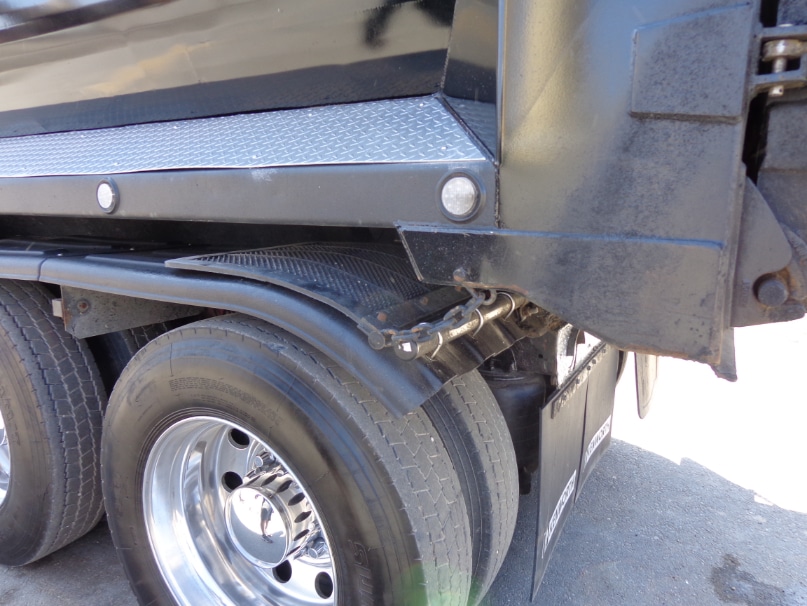
The mud flaps lay on the back tires, out of the way. | When the haul truck backs to the paver, either the dump man or the truck driver will want to position the mud flaps over the back tires. There are systems available for trucks today that allow the driver to press a button and have the mud flaps retract or lift without anyone having to physically touch them. This means there’s nothing between the truck tires and the paver’s push rollers. When the truck is ready to leave the paver, the mud flaps need to be returned to their proper position not only for traffic safety but also to be “street legal.” If the driver has a button he can press in the cab to lower the flaps back in place, that’s great. Otherwise, he can ensure they’re hanging properly when he stops at the designated cleanout area.

The mud flaps are returned to hanging position for safe travel. | When the haul truck backs to the paver, either the dump man or the truck driver will want to position the mud flaps over the back tires. There are systems available for trucks today that allow the driver to press a button and have the mud flaps retract or lift without anyone having to physically touch them. This means there’s nothing between the truck tires and the paver’s push rollers. When the truck is ready to leave the paver, the mud flaps need to be returned to their proper position not only for traffic safety but also to be “street legal.” If the driver has a button he can press in the cab to lower the flaps back in place, that’s great. Otherwise, he can ensure they’re hanging properly when he stops at the designated cleanout area.

When the driver gets to the paving site, depending on the type of project, he’ll have a variety of options for backing to the paver. The first and most important procedure is to locate the dump man when he gets to the job. In the pre-job meeting or tailgate talk, he’ll be told who the dump man is for the job—and that might be the paver operator or the foreman. (See the sidebar titled “You Can’t Skip the Tailgate Talk” for information.)

No matter what kind of project the driver is delivering to, the dump man will be the person who guides him and helps him get lined up to the paver’s push rollers. That person, normally, will be wearing a different colored shirt, vest and/or hat. He should have a safety baton or a safety whistle, as well, to acknowledge the driver and direct him. (See the article “Save on Costs with Your Professional Guide to Asphalt Mix Delivery, Part 3—An Independent Look at Best Haul Truck Practices” here for a detailed discussion of how to get to the job and deliver material to the hopper efficiently.)

Save on Costs with Your Professional Guide to Asphalt Mix Delivery, Part 3—An Independent Look at Best Haul Truck Practices

For drivers who will be receiving millings in an empty bed, locating the ground man is just as important. This person is the driver’s second set of eyes; both driver and ground man must trust one another but this doesn’t leave room to forget good training. On a recent parking lot project, a haul truck driver watching the milling machine via his side mirror neglected to watch where he was going and ran into a parked work truck (See the sidebar titled “Train Drivers to Watch Where They’re Going” for details). This accident proves we need to keep all our senses on alert when in the field.

The haul truck driver can’t be expected to handle everything that’s happening around his truck when he gets to the job site, but we can give him a fighting chance at safe success when we train him on the proper, safe procedures expected of him. We must train the drivers who are controlling these large and lumbering vehicles that come so close to our co-workers, pricy equipment and motoring public if we want to have quality jobs with safe records.


John Ball is the proprietor of Top Quality Paving & Training, Manchester, New Hampshire. For more information, contact him at (603) 493-1458.