
Stephens College Prepares Women for Asphalt Workforce
BY Sandy Lender
Ahead of historic highway funding in Missouri, a Columbia college institutes a Women in Trades program that solves specific challenges to continued education for the demographic.
Attracting women to the asphalt industry workforce faces a set of challenges that attracting other demographics does not. For the director of workforce development at Stephens College in Columbia, Missouri, taking on those challenges came to the forefront due to historic highway funding waves in his hometown.
Founded in 1833, Stephens College is the second-oldest women’s college in the country. In August 2023, Governor Mike Parsons visited Columbia to ceremonially sign legislation that would repair and expand Interstate 70 (I-70) to six lanes across the state and members of the Stephens College team were on hand to witness the event. The $2.8 billion in funding to expand and rebuild I-70 from Kansas City to St. Louis is a once-in-a-lifetime opportunity for the state’s economic development, including high paying jobs for Missouri’s construction and skilled trade workforce.
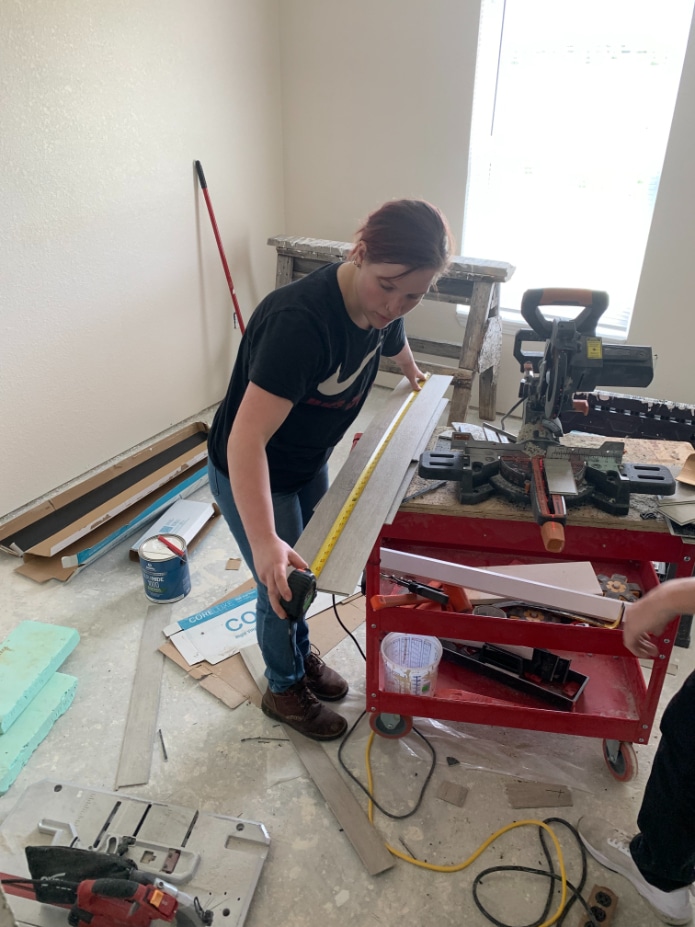
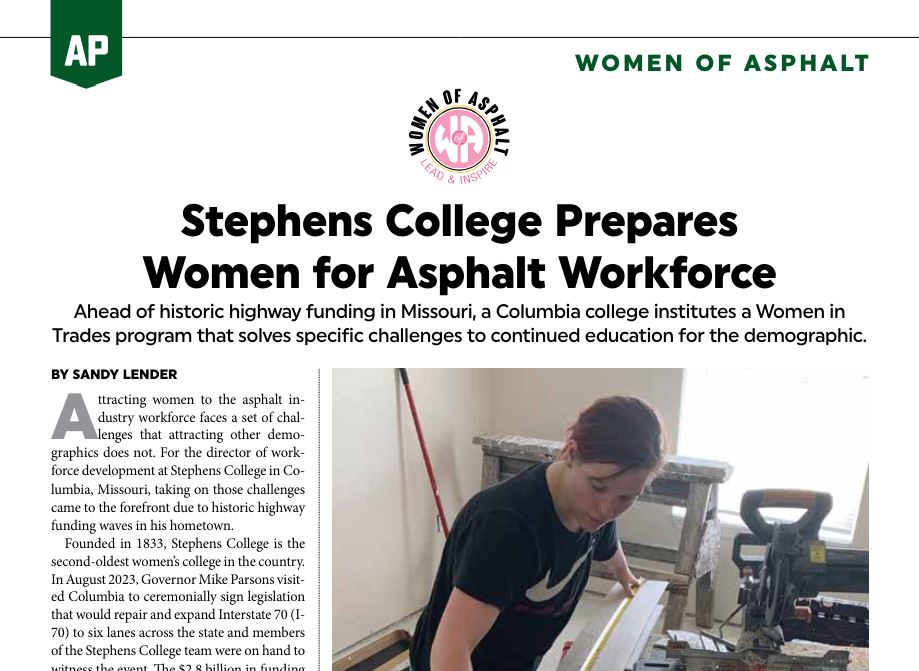
The Women in Trades program at Stephens College kicked off April 29 with 10 women participating. The first week in the field involved construction with a Habitat for Humanity project. The second week saw the women working in “flat” construction, according to Dr. Scott Taylor. Photo courtesy of Taylor
“I-70 is a game changer for this state,” Gov. Parson said. During his remarks, he emphasized economic and workforce development as well as improved highway safety. “We have the opportunity to set the pace for the rest of the country.”
Stephens College Director of Workforce Development Dr. Scott Taylor met with Gov. Parson and Lt. Gov. Mike Kehoe to share Stephens College’s more intentional emphasis on workforce development. Earlier in 2023, Taylor had put a plan in motion.
“The upcoming I-70 project is what started turning the gears,” Taylor said. He acknowledged that women make up less than 15% of the workforce in the construction trade nationally “and 5% or less are women locally in Missouri. There’s a huge demand for workers in the trades and that’s going to magnify once this project begins. If companies are having difficulties finding qualified workers now, what’s going to happen when such a significant project begins? Where’s the labor coming from?”
As his mind worked on the ways Stephens College already encourages women, the possibilities to help the workforce blossomed. It’s no secret our industry is trying to recruit new workers to the workforce and that includes women. New data from the Department of Labor (DOL) shows the construction sector added 39,000 jobs in March 2024, which is an increase over the 27,000 jobs added in February and 11,000 jobs added in January, according to Aspectus Group. We need skilled laborers and workers willing to learn a new trade to fill those posts.
Stephens College is working with industry partners like Reinhardt Construction and Capital Paving & Construction to upskill women, so they are job-ready for opportunities such as the I-70 expansion. The Women in Trades program at Stephens is a pre-apprenticeship program that will lead to an apprenticeship—or fulltime job—at the worksite. The stackable certificate program will help women get college credit along the way that can build into a degree if they wish to continue their education beyond the apprenticeship.
“We are grateful to our industry partners like Susan Hart, vice president of Reinhardt Construction, and Jeff Hayes, human resources director at Farmer Companies, who have lent their expertise as we develop an earn-and-learn program that will empower women to enter into an historically male-dominated field,” Taylor said.
Stephens College President Dr. Dianne Lynch noted that programs like the Women in Trades program will set the College up for the future. “I really believe that Stephens is going to emerge as a national model for how to meld and blend traditional liberal arts residential learning with service to and opportunities for workforce development and at the same time developing new programs that bring industry and education together in partnership to produce new kinds of outcomes.”
All-women crews will ensure a more comfortable experience on the worksite and wraparound services including childcare, work gear and transportation will support them as they transition into a new career.
“This is a workforce opportunity,” said Ed Hassinger, Missouri Department of Transportation (MoDOT) deputy director and chief engineer at the bill signing. “We’re going to develop a diverse workforce as we deliver this project and create jobs across the entire state.”

Kelly Landreth works as a laborer and equipment operator for the City of Portland. Here she joins in on routine equipment maintenance. Photo courtesy of Landreth
Women Solve Pain Points
The Stephens website showcases its program by highlighting some of the pain points the program addresses. It states: “Women report feeling that careers in these high-paying fields (like construction, carpentry and transportation) are out of reach because they: can’t afford to take time off work to get the credentials they need; struggle to find a way to pay more for childcare while they learn; feel underprepared for these highly skilled technical roles; worry about facing bullying and harassing behavior on worksites; and generally feel unsupported in their career choice/change.”
The “Workforce Development at Stephens” programs are designed in an apprenticeship model, where women can earn as they learn. The goal, according to the website, is to empower women to enter into historically male-dominated fields. The three programs available are Construction Pre-Apprenticeship, General Carpentry Apprenticeship and Highway Construction Apprenticeship. Each offers immersive, hands-on learning; childcare; transportation to and from job sites; PPE and required workwear; all-women crews on job sites to ensure a more comfortable transition; stipends; and more.
A woman of asphalt (WofA) we spoke with recently, Marquisha Williams, who is the HR area partner/EEO at Milestone Contractors LP, Muncie, Indiana, exemplifies the concept of learning on the job. She’s a self-made woman of asphalt who joined the asphalt industry in 2004 as a laborer apprentice with a desire to explore the industry.
Women of Asphalt Mentorship Program Offers Opportunities for Women in Trades
One of the assets Williams brings to every position she’s held is the desire to work with others. She enjoys getting outside and working alongside the crew, whether she’s the density technician, the flagger, the safety director or the EEO. She joined Milestone in 2014 as a laborer and QC tech. By 2017, she had advanced to a safety director. When we spoke with her in 2023, she was gearing up for classes in the state of Indiana. Her experience can be an encouragement to others.
“Starting my career off as an apprentice laborer is twofold for me,” Williams shared. “First, it was a great way to learn the trade with the classes Indiana Laborers’ Training Trust Fund (LiUNA) offered at either their Bedford or Logansport facilities. During my time as an apprentice, I was able to gain the fundamentals of a laborer and apply those skill sets in the field. And the second part is the sense of accomplishment knowing I completed a trade apprenticeship, and no one gave that to me.
“Furthering my education was important not only for this role but also to become a well-rounded employee and person,” Williams continued. “I want to always make sure that I say college isn’t for everyone and it doesn’t define your journey in this industry. I started in this industry with no high school diploma, and I received my GED in 2012. Anything is possible.”
What she recommends is to stay engaged in your career and “get involved. If you have a passion, speak with the organization you are currently working with and let them know you would like to attend job fairs, safety audits or learn more about a job you are interested in. We have to remember the organization doesn’t know what you want until you inquire about it. The most important skill is the skill of being authentically yourself. It will get you far in this industry.”
Taylor’s explanation of the Women in Trades program at Stephens shows how it caters to this motivated demographic. “We’re breaking down the barriers for bringing a diverse workforce in,” he said. “We’ll provide you with transportation if you’re local and you need it. We’ll provide you a stipend to replace wages while you train in the program. With our Early Childhood Facility, we’ll provide childcare while you’re training.”
The Early Childhood Facility at Stephens College is also a candidate for expansion to assist signatory companies’ workers once they’ve completed the program, but that concept is still in progress. What’s refreshing is the fact it’s on someone’s radar—the need for family support to encourage and assist workers who can excel in the asphalt industry is being addressed.
Another WofA we spoke with in 2022 is Kelly Landreth, currently a Local 483 member with the City of Portland. Her story also helps women address some of the pain points listed on the Stephens College website. Landreth joined the construction industry in 1993 with Lonestar Concrete, where the “good ol’ boys’ attitudes” presented a challenge to overcome. But she worked her way to a position with the City of Portland in January 2000. Her first job with the city was a utility worker/laborer and her time has included using skills and continuing education to advance and succeed.
“After my first three years as a utility worker, I became a heavy equipment operator,” Landreth shared. “The main operator for cold milling. I have always been intrigued with equipment and truck driving all my life and I thought it was cool that a girl can do it, too.”
She’s been in the construction trade since 1993 and has seen changes. Considering the equipment mentioned on the Stephens website, Landreth has seen improvements there, as well. “I think [one] thing is good boots and inserts. It’s easier to find the boot that fits your job now. Mine for asphalt are heat-resistant with minimal tread.”
 In the Stephens programs, such specific equipment is provided for a four-week bootcamp where candidates move as a cohort through education and hands-on training. The women receive their OSHA-10 certification as well as training in hand tools and power tools. The four-week bootcamp can apply toward an 80-hour apprenticeship for signatory companies or can ready them to go to work in non-union companies who are partnering with the college.
Taylor shared his excitement with the number of candidates who jumped at the chance to be in the first cohort, which takes place in April 2024. “We’re not running this on a regular school calendar,” he said. “The first one is in April and those women will be work-ready or apprenticeship-ready by May. We’ll run another one in June. We hope to run four to six per year.”
We Can Do It
Both Landreth and Williams have encouragement for women who are interested in the asphalt industry.
“I think I would tell her it’s a rewarding job you look back on and a job complete and well done for years,” Landreth said.
For Williams, outside of the men and women that work in this industry it’s the communities she works in that she finds rewarding. “It tickles me when I walk up on job site and a young girl is outside playing and she looks at her parent and says ‘I didn’t know girls worked here.’ I always say, ‘yes, we do, and we hope to see you in the future.’”