
Prepare to Sell Your Asphalt Business, Part 2
BY Ori Eldarov
Checklist when you’re preparing to sell your asphalt business
Editor’s Note: This is the second installment of a two-part series on positioning your asphalt business for sale. Part one addressed workforce planning, financial organization, and building a strong revenue base. This installment focuses on the operational work that separates a smooth, premium transaction from a difficult one.
The deals that close smoothly and at a premium share a common trait: the owner spent years building systems before ever calling an investment banker. The deals that stall or sell at a discount? The owner was the system. The work covered below isn’t glamorous, but when a buyer’s due diligence team sits down across from you, it’s exactly what they’re looking for.
Build a business that runs itself
You want to create systems that reduce owner dependency. Every buyer asks the same question early in the process: “What happens if the owner walks away?” If the honest answer is that the business falls apart, that will show up in your valuation and in how long you, as the owner, are required to stick around after closing.
Put simply: if you want to sell 100% of your equity at close, you need a capable replacement for every task you currently handle. If you don’t have those people in place, buyers will either lose interest or require you to stay on.
A common structure we see at OffDeal is owners selling 75% of their stake and rolling over 25% equity, which can work, but it means you’re not fully walking away at closing. The more self-sufficient your operation, the more options you have.
Start by writing things down. Document your scheduling process and create a crew leader checklist for every job type you run. Build a training sequence for new hires that goes beyond “ride along with me for a week.” If your estimator left tomorrow, could someone else produce an accurate bid by Friday? If not, start there.
Two examples from the field: One paving contractor we worked with wanted to sell 100% of his equity at close, but he was still the primary estimator, the main client contact, and the only person who knew the crew scheduling system. Buyers saw a business that couldn’t function without him, and they walked away.
Compare that to another owner who had spent years building a management layer beneath him. He sold 75% of his stake, rolled over 25%, and stayed on to continue running and growing the business (though no longer as CEO). Because buyers could see the operation would hold up without him at the helm, he attracted multiple competitive offers and secured a premium valuation. The equity rollover was a strategic choice that gave him continued upside in the combined entity.
Document Relationships
As part of building a business that runs itself, make sure you document vendor relationships, contacts and pricing. Your supplier relationships and subcontractor networks are real assets, but only if they’re documented in a way that transfers cleanly to a new owner.
Wherever possible, push for written contracts over handshake agreements. Informal arrangements create friction during due diligence and introduce risk around continuity.
Maintain a current vendor list with pricing terms and payment arrangements on file. Collect and update certificates of insurance from subcontractors annually. If you’ve negotiated favorable rates with a local asphalt plant, get those terms in writing so a new owner can maintain them from day one.
Favorable supplier pricing that shows up in your margins is a genuine competitive advantage, but only if it’s documented well enough to survive the ownership transfer.
3 Steps Business Owners Should Take Prior to Succession Planning
Track More Data
When a buyer sits down to evaluate your business, the more operational data you have tracked and available, the better. Most paving companies in the lower middle market don’t do formal job costing, and buyers know that. But the ones that have started tracking even basic metrics stand out. If you can show actual costs against estimates on a per-job or per-job-type basis, that’s a significant advantage.
Job costing software is a nice-to-have that becomes increasingly valuable as you scale, and there are affordable platforms designed for contractors that can get you started without a heavy lift. Even if you’re not there yet, start with what you can: track material costs, labor hours, and subcontractor spend by project. The goal is to give a buyer confidence that your margins are grounded in real data, not just gut instinct.
An example from the field: A word of caution: A common pattern we see in due diligence is companies running estimates in one platform and accounting in another, with no connection between them. Reconciling that gap during a live transaction takes weeks and creates uncertainty that buyers price in. Even basic data hygiene, like making sure your systems talk to each other, can prevent this from becoming a deal issue.
Keep Sales Clean
As part of building a self-sufficient business, you want to maintain clean client records and a clear sales pipeline. A buyer isn’t just purchasing your past revenue—they’re purchasing your future revenue. Client records spread across multiple systems, or a sales pipeline that exists only in the owner’s head, make it impossible for a buyer to assess the health of your customer base independently. Buyers who can’t clearly see repeat rates, customer longevity, and pipeline activity will discount what they can’t measure. Invest in a basic CRM before you go to market. It doesn’t need to be complicated—it needs to exist.
Diversify Revenue
Maintenance and repair work commands higher valuations than new construction because it recurs. Parking lots need to be sealed, patched and striped on regular cycles. That’s predictable, bankable revenue that doesn’t depend on new development or economic cycles. Sealcoating programs, annual lot maintenance contracts, and recurring crack repair agreements all create the kind of forward revenue stream that buyers will pay a premium for.
If your book is heavily weighted toward large, one-time construction projects, consider diversifying your revenue and pushing for as much recurring work as possible. The time to build that book is now, not when you’re ready to sell.
Client concentration is equally important. If your top two customers represent 30% or more of revenue, that’s a red flag in any due diligence review. Even when those relationships are long-standing and loyal, a buyer still has to price in the risk of losing them post-close. And that risk shows up in your valuation. The goal is a client base diversified enough that no single account can materially damage the business if it walks.
What Buyers Want: A Tale of Two Businesses
Consider two paving companies that went through the sale process. Both were profitable. Both had experienced owners. The difference was what each owner had built around the business over time.
This example from the field is illustrated in these tables with the details of Company A, which was built to sell, and Company B, which was built around the owner.
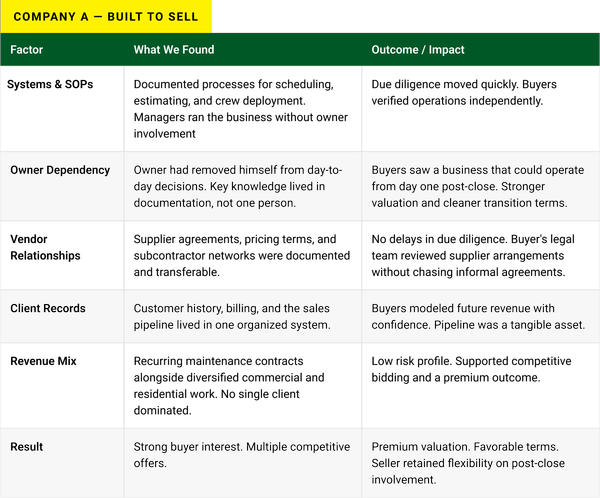
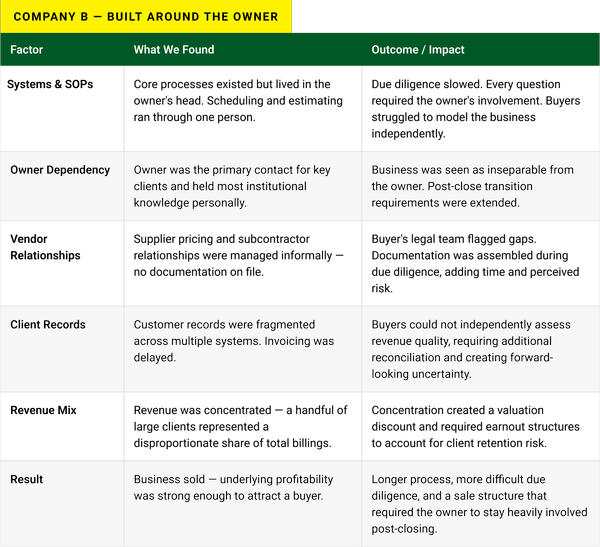
While both owners built excellent paving businesses, Company A’s owner had spent years building systems alongside the business. Company B’s owner had built the business around himself. That distinction showed up in every phase of the sale from the number of interested buyers to the pace of due diligence to the final structure of the deal.
The contractors who get the best outcomes when selling are the ones who started preparing years in advance. SOPs, vendor files, clean client records, and revenue diversification don’t generate the same excitement as landing a big contract or adding a new piece of equipment to the yard, but when the time comes to sell, that operational infrastructure is what separates a smooth, premium transaction from a difficult one. Start building it now. Your future buyer will notice, and your bottom line will show it.
Ori Eldarov is the lead CEO and banker at OffDeal.