
Bowes Construction Buys Uptime, Security, Production
BY AsphaltPro Staff
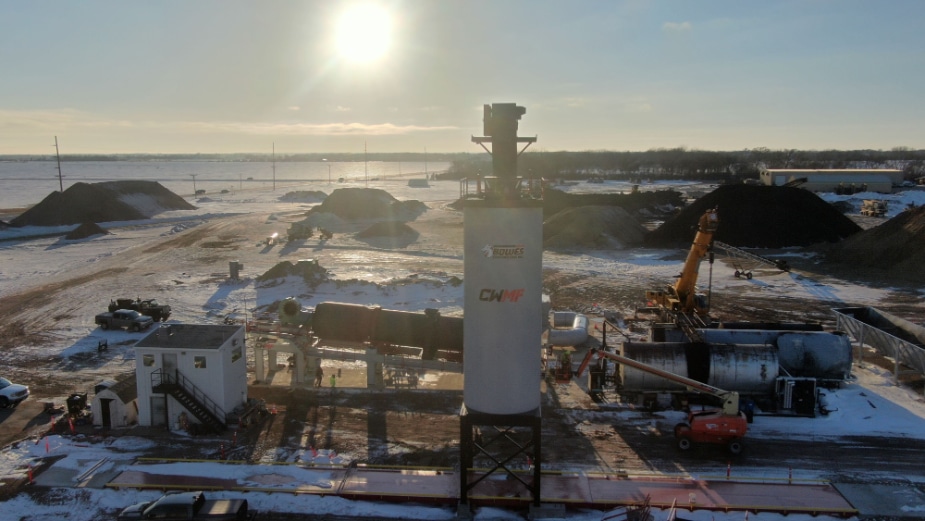
Over the years, Bowes Construction, Brookings, South Dakota, made significant updates to the stationary 250-TPH Barber Green plant it purchased in 1991. They replaced the wet dust collector with a baghouse for improved air quality, purchased a new control house, and modified and replaced their drum several times to increase production.
“It got to the point where the drum had been modified so much that we felt we needed to do a full upgrade to increase our daily and hourly production,” said Joe Mendel, asphalt production manager for Bowes. Although they enjoyed their Digi control system, it became increasingly more difficult to find parts. “Our big fear was at some point, something would happen, and we wouldn’t be able to source parts for the control system and we’d be shut down for two, three, four weeks.”
Simultaneously, local market conditions indicated it was time to increase production. “We’ve seen people flocking to South Dakota, I think as a result of our lower cost of living, increased safety, and lack of an income tax,” Mendel said. According to the U.S. Census Bureau, South Dakota is the 10th fastest growing state in the country, with a population change of 3.7% from 2020 to 2023. “With that growth, we’re seeing a need for new housing development and infrastructure.”
Bowes Construction’s asphalt plant is located in the state’s fourth most populous city (Brookings, population 24,000), which is halfway between the state’s most populous city (Sioux Falls, population 206,000) and its fifth most populous city (Watertown, population 23,000). It was in a prime location for growth.
“Sioux Falls has three asphalt plants and Watertown has one, but being 50 miles from both cities puts us in a great niche to serve our area while remaining competitive for projects both to the north and south,” Mendel said. “We’ve seen a lot of growth [in the state] for the past five or so years, and there’s definitely been a lot more infrastructure work going on in the past three years—including in smaller municipalities where we don’t typically see much work—and we don’t think that’s likely to stop.”
Given the state of the plant, the controls, and the market conditions, it was an ideal time to invest in a new asphalt plant.
The general population growth in South Dakota has also helped Bowes in terms of attracting talent. “We’ve brought staff in from Florida, Indiana, Canada,” Mendel said.
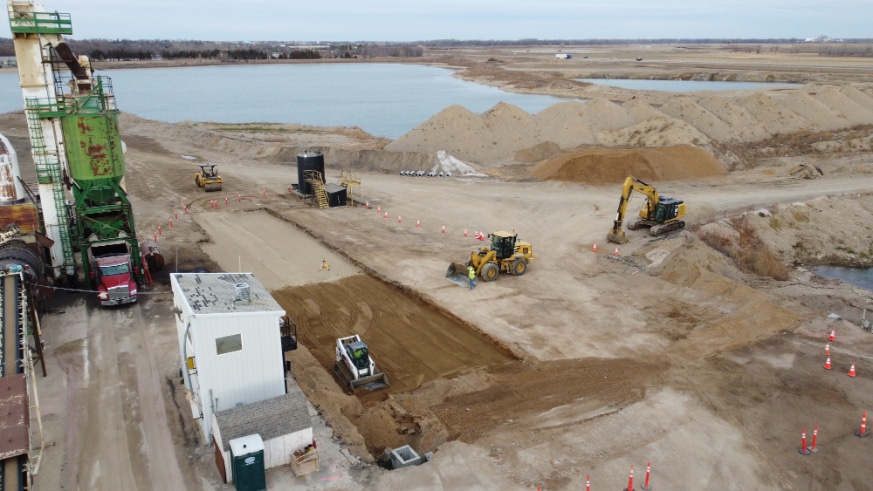
Although Bowes considered relocating its plant to another location, the company ultimately decided to keep the plant at the same location. Here, we see prep work for the installation of Bowes’ new silo from CWMF.
Picking the Perfect Plant
Once the company decided to invest in a new plant, the real work began. “We needed to identify the type of plant we were looking for, the manufacturer we wanted to purchase it from, and how we were going to make the transition without losing any production time,” Mendel said.
Ultimately, Bowes chose to invest in a stationary 400 TPH plant with a parallel flow drum from CWMF, Waite Park, Minnesota. “They’re only three hours away from us, so we consider CWMF local,” Mendel said. Furthermore, Travis Mick at CWMF had been helping Bowes with issues arising at its existing plant over the years. “He’d been giving us a lot of attention, so of course CWMF was top of mind when we started looking at new plants.”
Given the company’s customer service and that the price was right for Bowes, it turned out to be a perfect match. “From the moment we chose CWMF, we felt very comfortable about everything,” Mendel said.
They chose a Hauck MegaStar burner, running on natural gas “because it’s readily available, cheaper, and we feel it runs better,” Mendel said. Bowes’ existing plant used a Hauck JetStar burner, which gave them confidence to stick with Hauck for the new burner. “We had good luck with our JetStar, so we wanted to stick with a Hauck burner while upgrading to more of a Cadillac burner model.”
Bowes also chose to invest in CWMF’s 80,000 cubic foot DustEater baghouse. “We only needed 70,000 cubic feet of space, but by stepping up the size a bit we know our production will never be limited by the size of our baghouse,” Mendel said.
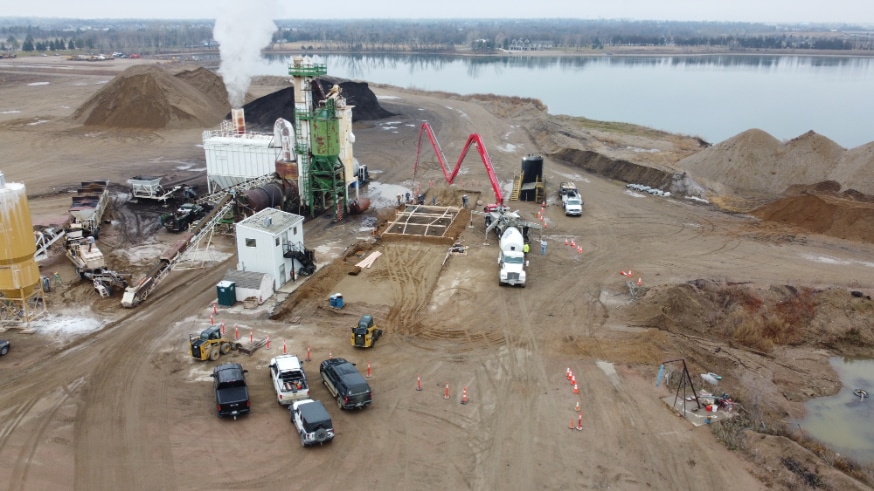
As Bowes prepares the location of its new silo, their old Barber Green plant runs in the background.
According to Mick, vice president of CWMF, the company’s equipment production rates are based on composite moisture of 5%. “A general rule of thumb is that you need 200 cubic feet per minute (CFM) per ton of produced material at 5% composite moisture,” he said. In Bowes’ climate/conditions, Mick said their moisture levels are unlikely to reach 5%. However, he added, the baghouse size is good insurance. “Extra air can make up for nuisance leaks that may not yet be corrected. It also allows you to still get your desired production levels when moisture levels spike due to rain, given that a 1% increase or decrease in composite moisture will have an impact on production by about 13%.”
Mick cautioned against oversizing too much, though. “Oversizing a baghouse will make it difficult to reach appropriate temperatures at the stack, as it may be too large of a space to heat with the given BTU from the burner on the drum,” he said, “and temperatures below 212 degrees Fahrenheit can start to result in moisture in the baghouse.”
Bowes Construction Regrades, Rubblizes for a Smoother, Safer Ride
Bowes also opted for an 86-foot drag slat conveyor, the first drag slat system for the company. “Our old plant had a vertical bucket elevator,” Mendel said. Bowes also replaced the two 100-ton silos at its existing plant with one 200-ton CWMF silo.
“At the old plant, we almost never used our second silo because the plant could only produce 250 tons per hour,” Mendel said. “Once we loaded our first round of trucks, our plant couldn’t keep up with our production in the field.”
Although outside sales only comprise 10 to 15% of Bowes’ asphalt production, if they received an order of even a few hundred tons on a day where their own crews were busy, the plant would struggle. “Under perfect conditions, our old plant could only push out 2,500 tons per day, which limited our production in the field while facilitating outside sales,” Mendel said. “Upgrading to a bigger plant eliminated that issue.”
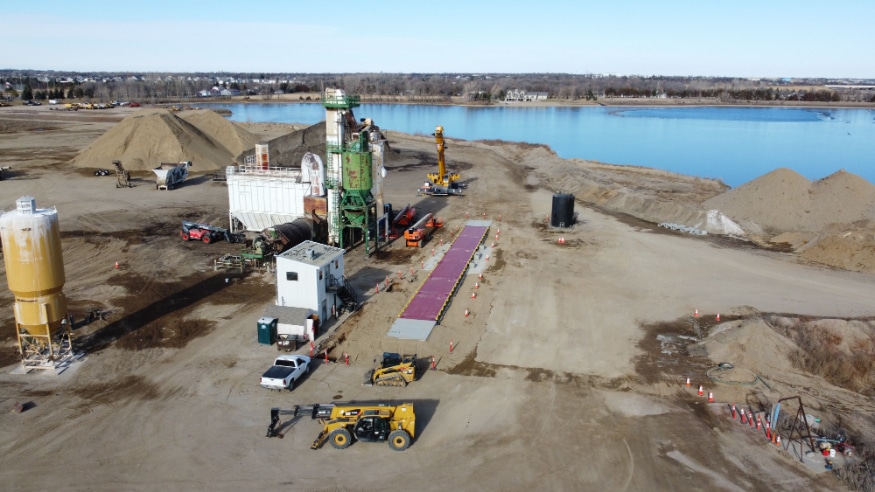
Bowes shut down its old plant for the last time on Nov. 10, 2022. By Nov. 15, they began tearing it down.
Given the role plant controls played in Bowes’ decision to invest in a new plant, investing in the right controls for their new plant was very important. After much research and discussion, Bowes chose Minds for its plant controls. “Minds controls allowed us to have a more programmable and updatable control system as the plant grew,” Mendel said.
“We actually installed them at the old plant a year prior to the installation of the new plant to protect against our old controls going down again,” Mendel said, “and so we could get familiar with them before the new plant came to avoid having to learn everything at once.” This approach enabled them to be 100% focused on each new component during the installation process.
JM Fahey Celebrates 50 Years with CWMF’s Stationary Full Plant Build
Install & Start On Time
Bowes shut down its old plant for the last time on Nov. 10, 2022. By Nov. 15, they began tearing it down—a process they would complete before Christmas so they could start the install in January 2023.
“We started with a clean slate, except for our control shack,” Mendel said. They installed the platform scale, silo footings, drum platforms, concrete platform, etc. in January, working through the cold, snow and wind to stay on schedule. “Thank God for Carhartt gear!”
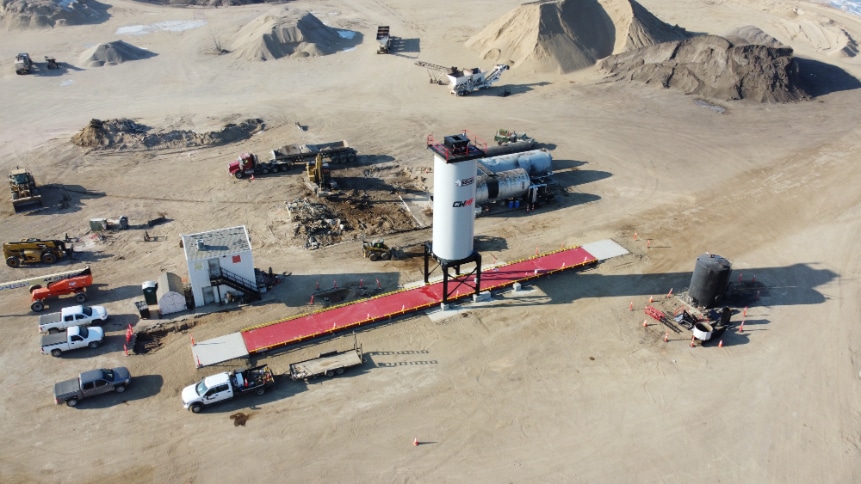
Once the old plant was torn down, Bowes installed its new silo and began to prepare for the installation of its new asphalt plant.
Throughout the spring, Bowes organized the transport of each new piece of equipment. The two cranes from Northwest Construction, Sioux Falls, that had been on site for the teardown of the old plant were mobilized to set up the new equipment as each piece arrived. “By April 29, we were commissioning the new plant, integrating the Minds controls, performing our calibrations, and finalizing our setup for production,” Mendel said. “Our normal startup date is the last week of April, so we were right on target for the tear down and install.”
Ultimately, other than challenges with weather, the entire process went smoothly, “better than anyone had even hoped for,” Mendel said, attributing the success of the transition to the planning that went into every step of the process.
“We looked very hard at what we wanted, how we would implement it, the location, etc.,” he said. At one point in the process, Mendel said they considered moving the plant to another location, but decided against it due to infrastructure challenges. “If we had relocated the plant, we wouldn’t have been under such a tight schedule.” Keeping the plant in the current location also simplified the permitting process.
“We crossed our fingers, kept the plant where it was, and thankfully everything went right,” Mendel said. “But it only went right because we had our i’s dotted and our t’s crossed. The planning was a big part of the success of the transition, paired with a little good luck.”
Mick seconded the importance of planning. “Without planning, success is just good fortune,” he said. At CWMF, he added, planning is a team effort. This starts with highly detailed layout drawings in 2D and 3D to ensure everyone is on the same page. “Taking it a step further, before projects are released from engineering, we have a meeting with our clients to give them a 3D virtual tour of their equipment. This helps to ensure that we address any issues or concerns right then and there versus in the field, where delays can be detrimental to the outcome.”
This meant everyone was on the same page by the time the equipment arrived at Bowes’ plant site. “Bowes supplied a great team to install the equipment and CWMF was onsite to assist as needed,” Mick said. “It was a great effort by all parties involved.”

The existing control house was the only part of the old plant that remained.
The Inaugural Season
After the new plant began producing mix in the spring of 2023, there were of course minor bugs to find and correct. “Those little tweaks are to be expected with any plant,” Mendel said. “You’re never not tweaking something at the plant.”
For example, minor electrical issues or learning how the new plant affected the mixes Bowes uses most often. “It’s like cooking the same thing you’ve made for years in a new oven with a different sized pan,” Mendel said. “It’s going to come out a little bit differently.”
“Once we got the plant dialed in and calibrated and learned how the new plant affected the mix designs we regularly use, she’s been running very well,” Mendel said. “As with anything, we had some fine tuning to do on those little things that are bound to pop up, but our first season with the plant went really well.”
In fact, 2023 was Bowes’ second highest production year on record, producing 145,000 tons. “Our volume really depends on the DOT and county work available, and in 2023 we had two big DOT projects and one big county job that really brought our production up,” Mendel said. “It was a perfect year to have our new plant, because it would have been difficult to get the production we needed with our old plant.”
Although increasing production was of course one of Bowes’ goals for its new plant, a pleasant surprise they learned throughout the first year with the plant was that its production capacity was in fact more than the company had anticipated. “Even with how big 2023 was for us, we haven’t had to push the plant too hard yet, but we know that we could if we needed to,” Mendel said.
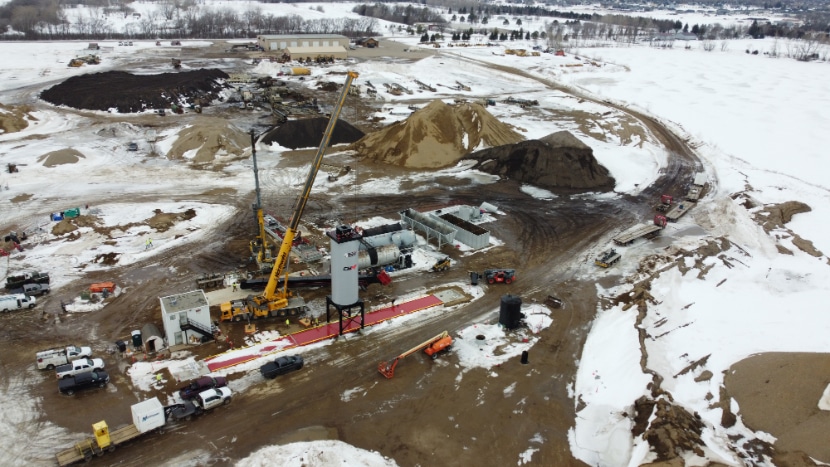
Throughout the spring, Bowes organized the transport of each new piece of equipment. The two cranes from Northwest Construction, Sioux Falls, that had been on site for the teardown of the old plant were mobilized to set up the new equipment as each piece arrived.
Every Piece in Place
The troubleshooting didn’t stop with the plant installation. By nearly doubling Bowes’ mix production capacity, the paving crew also had to make adjustments. “They’d been used to laying down at a certain rate, and now they aren’t hampered by the plant,” Mendel said. “They can pave twice as fast as they could with the old plant.”
Although Bowes’ paver was big enough to handle the increased production rate, that wasn’t the only piece of the equipment equation that needed to be adjusted. “When the plant and the paver are achieving a higher production rate, you have to have enough rolling power and trucking capacity.”
Bowes staffed its jobs with additional rollers and trucks. “Trucking capacity wasn’t an issue with our old plant because once you initially got that first hundred tons loaded, you could only load so many trucks an hour,” Mendel said. “We’ve pretty much doubled that, so there was a bit of a growing pain there.”

Bowes opted for a 86-foot drag slat conveyor, the first drag slat system for the company.
To date, Bowes hasn’t been on a project its new plant couldn’t handle. “I don’t think this plant would have any problems producing 4,000 to 4,500 tons per day if we had the right road to pave,” Mendel said. “And that’s not even pushing it very hard, just letting the plant hum along. It’s a big step up from 2,700 tons per day at our old plant’s very best.”
The new plant should certainly enable the growth Bowes is anticipating in the coming years, but the company isn’t stopping there. “We built the plant with a second set of silo footings in order to add another 200-ton silo in the future,” Mendel said. “That’s not in the works right now, but we expect it to come eventually and want to be ready when the opportunity arises.”