CRH’s Sustainable Practices Give Preferred Results
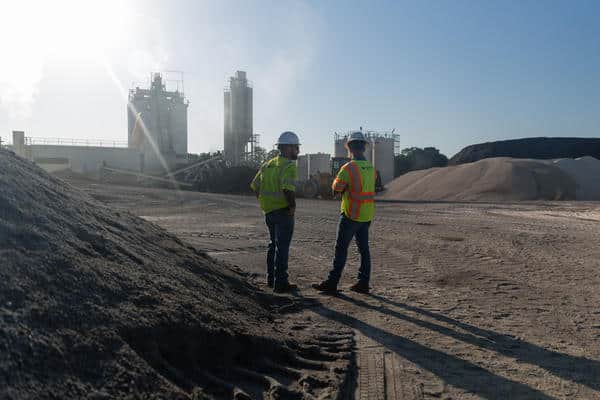
Preferred Materials, A CRH Company exemplifies circularity with award-winning I-75 project

As CRH’s footprint has grown in the United States, the operating companies in its portfolio have brought a wealth of ideas and innovations to the multinational group. The team from Florida highlighted herein has added a host of quality paving awards alongside its contributions. President of CRH’s Americas Materials business, Jason Jackson, sat down with AsphaltPro to discuss Preferred Materials Inc., A CRH Company, Tampa, and the overall progress award-winning projects help bring to light.

The Dale Mabry Highway project was a resurfacing of a major thoroughfare with numerous businesses, side streets, signalized intersections, median turn lanes, acceleration and deceleration lanes, and high traffic count.

From Aug. 4, 2022, to July 21, 2023, the Preferred Materials team handled a range of technical and logistical challenges to repave the Dale Mabry Highway (State Road 597) in Tampa. The resurfacing of the busy urban corridor handling traffic to and from Tampa International Airport demanded coordination with MacDill Air Force Base, the Raymond James Stadium® ongoing event schedule, a dense network of local businesses, as well as the Florida Department of Transportation (FDOT). In the end, Preferred Materials achieved an average International Roughness Index (IRI) of 32 on this project and was awarded the 2024 A.P. Bolton Award and Florida’s Smoothest Pavement Award from the Asphalt Contractors Association of Florida, and FDOT’s 2023 Best in Construction Award.

Let’s examine the Dale Mabry project and the mindset that brings innovation and excellence to individual CRH companies.

Within its Americas Materials business alone, CRH has 1,660 locations and about 29,000 employees. CRH is comprised of hundreds of established local operating companies. Notable brands include MidSouth Aggregates, Preferred Materials, Tilcon, Mulzer Crushed Stone, Texas Materials, Staker Parson, Dufferin Construction, Callanan Industries and Bodean. According to the company’s 2024 Annual Report, CRH’s Americas Materials Solutions business reported $16bn in revenue in 2024, achieved an adjusted EBITDA of $3.7bn, up 22% year-over-year, with an adjusted EBITDA margin of 23.2%.

Meet a Woman of Aggregates: Capital Materials’ Ericka Baxter

Opening the AI Envelope

One of the ways CRH is innovating for the future is through leveraging digital technology, which the company sees as a key enabler of enhancing the way it does business and delivers for customers. This includes the exploration and adoption of Artificial Intelligence (AI).

“When we look at AI or we look at technology and innovation, we do that with an enterprise lens,” Jackson said. “When we think about innovation, it’s important that we leverage our scale.”

He listed asphalt, aggregates, ready mixed concrete, below-grade infrastructure solutions, water management and other elements of the construction industry where piloting AI technologies offer exciting options. The size and scale of the company means it’s well positioned to explore AI’s benefits.
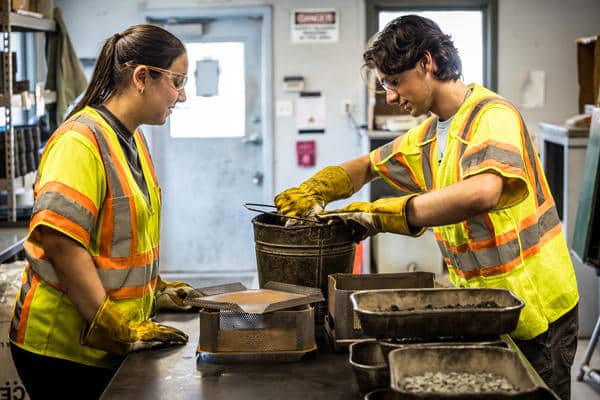
One of the ways CRH is optimizing mix design is by focusing on next-generation surfaces to stand up to extreme temperatures, heavy traffic weights and erosion. They’re designing specialty asphalt mixes that help reduce the road’s impact on the environment.

“CRH has been in this space in roads, in water, in aggregates and cementitious materials for many decades,” Jackson said. “We have a massive amount of expertise and data and so the big question that we challenge our teams and ourselves with is how do we take all that expertise that may exist in thousands of locations and leverage technology as a whole? Or, more specifically, how do we push the envelope to drive improvements utilizing technology?”

One of the areas where the company is leveraging that depth of knowledge is in mix design. “We’ve got a few things going on that are very exciting,” Jackson said. “Number one is around mix optimization.”

How to Make Your Plant Efficient, Part 1

With the decades of experience and thousands of locations, Jackson believes CRH stands out for the company’s ability to deliver both performance and quality through its approach to materials science. “This includes creating new attributes for products and materials that have been in place for many years. So, it’s about evolution, which is something we take very seriously in and around materials science.

“When we bring new businesses in, we’re consistently learning from folks that join our company through acquisition,” he continued. “We want to leverage what they’re working on, what their knowledge base is and when we combine that at scale, we have the opportunity to do wonderful things in and around materials science.
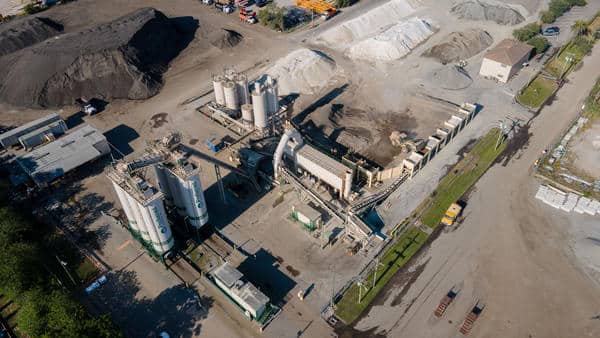
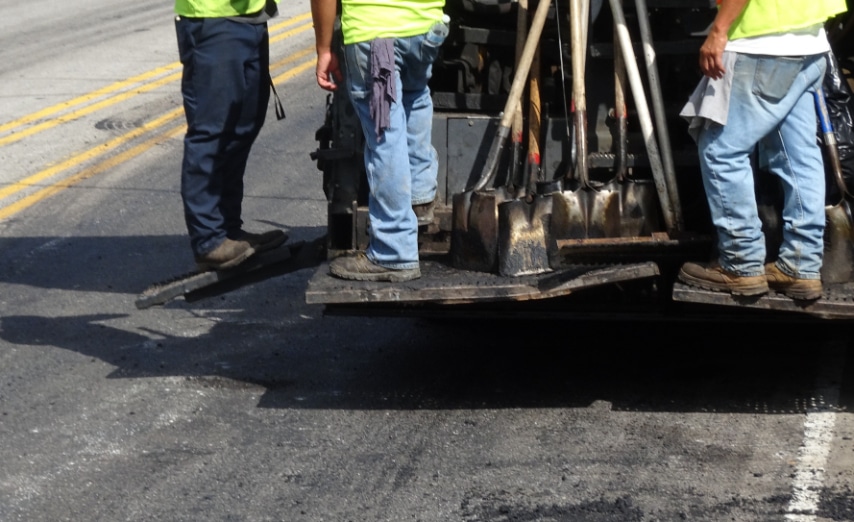
A Preferred Materials asphalt plant produced HMA for the Dale Mabry Highway project. The paving crew achieved an IRI of 32 placing and compacting it.

“We make sure to bring these teams together to really reimagine the art of the possible. When you think about new mixes—and that goes for asphalt mixes in particular—we’ve probably made the most significant strides in those areas by bringing those experienced, localized teams together to leverage high levels of technical knowledge.”

It’s not only CRH operating companies innovating, as Jackson mentions above. The company welcomes and encourages outside collaboration for problem-solving too.

“When you think CRH, we’re the largest building materials player in the market,” Jackson said. “And while our reach is international, we’re deeply committed to operating at a very local level.”

Consider how climate needs and geography influence state specs. Not only is this the foundation for making our industry’s asphalt mix designs more resilient, but it also gives companies like CRH the opportunity to work on solutions to local challenges.

Where You Process Your RAP Affects Your EPD

“Our local folks are very engaged in their local markets,” Jackson said. At the corporate level, CRH can take the connected portfolio of knowledge to prepare solutions “at scale,” but it takes boots on the ground at the local level to know where different solutions are best applied.

“CRH leverages its scale and connectivity to deploy innovation—whether it’s a higher percentage of RAP or innovative mixes with recycled shingles. But importantly, there is no one-size-fits-all approach. We pride ourselves on engaging with local authorities, DOTs and the traveling public to truly understand their challenges and design a solution specific to their needs. Scale is important, but customer connectivity, local knowledge and relationships are paramount.

One of the hallmarks of the Dale Mabry project for Jason Jackson, President of CRH’s Americas Materials business, was its circularity. The team maxed out the percentage of RAP allowed in the mix designs and still achieved an award-winning pavement with an IRI that spells resilience and longevity for FDOT.

“It’s really a team approach in problem identification and then we’re developing solutions in partnership with our customers. And I think that’s how you change specifications, that’s how you increase adoption. That’s how we’ve really taken a lot of these new and innovative solutions forward through a partnership approach—starting with the problem statement and then working to a solution.”

“I think we’ve probably made the most significant strides in the area of mix design by bringing those experienced, localized teams together to leverage high levels of technical knowledge to reimagine the art of the possible.”—Jason Jackson

Protecting the Team at the Speed of Business

Another area of AI implementation important to Jackson is that of safeguarding CRH’s most valuable asset: its workforce.

“The other area we focus on in terms of AI, and it’s important and near and dear to my heart, is the people and safety element,” Jackson shared. “If we think about how we make our locations safer, jobs easier, more efficient and therefore safer, AI is another way we have implemented new measures.”

CIR Revitalizes Colorado Mountain Pass

We see this in action in the trial of smart robotics. One of CRH’s first uses of Spot, the agile mobile robot from Boston Dynamics, Waltham, Massachusetts, was at the Ash Grove Cement Plant in Seattle, Washington. In a year-long pilot, the robodog performed proactive yet repetitive inspection routines. According to CRH, this sophisticated robot can operate in hot and dusty conditions, improving safety and freeing up skilled teams to solve complex issues elsewhere on site.

Jackson went on to say, “Spot helps do inspections at our cementitious plant locations, taking thousands of readings. The bot knows if there’s a motor running too hot or if a there’s a trip hazard or something that’s an upset condition, etc.”

According to CRH, this state-of-the-art machine is capable of navigating treacherous industrial terrain, taking on hazardous tasks, while its human counterparts stay safely at a distance. For example, at Ash Grove Cement, Spot uses laser scanning to take brick measurements inside the kiln, eliminating potential safety incidents among the workforce. In the early stages of the trial, the robot was able to detect a failing bearing in part of the site’s rotating equipment, which might have eventually led to unplanned downtime. This AI technology eliminates unnecessary downtime, decreases manufacturing site costs and drives efficiencies. Meanwhile, the data collected can be used to better enhance the overall efficiency of critical assets and maximize their uptime.
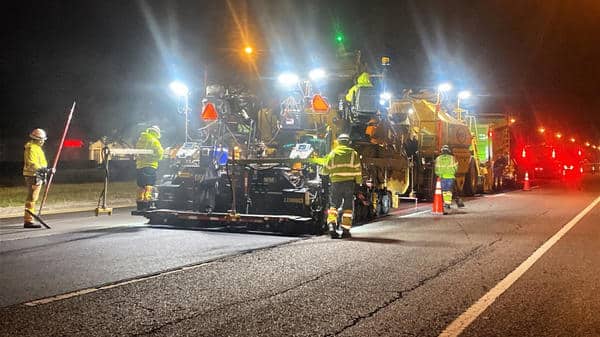
A Preferred Materials asphalt plant produced HMA for the Dale Mabry Highway project. The paving crew achieved an IRI of 32 placing and compacting it.

If Spot can handle the temperatures at a cement plant, imagine what it can handle at an asphalt plant to assist ground personnel and plant managers in assessing operations.

The implementation of AI for CRH is “taking the data and the expertise that we have over many, many decades of experience to try to optimize and create higher performing mixes and solutions that we can take to our customers to improve a number of things,” Jackson said. “But it’s also leveraging AI to help protect our teams and ensure that we’re producing the highest quality materials.

“I believe there’s a perception by some that our industry is slow to adopt change. I disagree with that. I think we are making improvements across [the construction industry]. This industry is implementing change at a very good pace, and leveraging these new technologies is something we should all be proud of. Whether it’s a bot that can help do inspections and identify issues that may cause safety or quality problems or it’s leveraging data to improve efficiency, we’re taking significant steps across our industry. CRH is positioned very well—having the size and scale—to lead the way in these new innovative ways of thinking.

“The beauty of our connected portfolio allows us to leverage data at varying positions of the construction value chain and when we do that right, we’re able to help solve our customers’ and our customers’ customers’ most pressing challenges.”
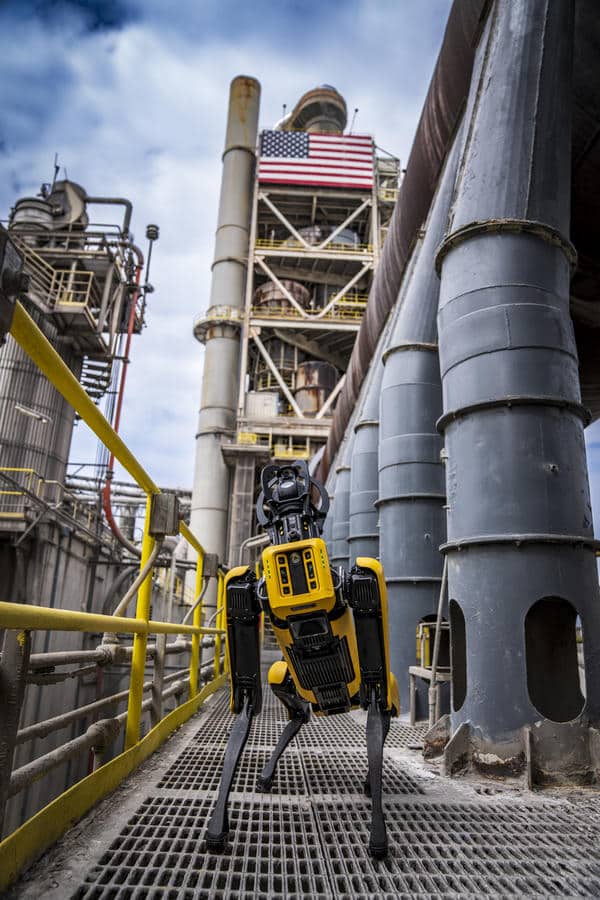
One of CRH’s first uses of Spot, the agile mobile robot from Boston Dynamics, was at the Ash Grove Cement Plant in Seattle. In a year-long pilot, the robodog performed proactive yet repetitive inspection routines, operating in hot and dusty conditions that freed up skilled teams to work elsewhere on site.

Satisfying the FDOT Customer

For the Dale Mabry project success story shared herein, FDOT is the customer whose pressing challenge was the resurfacing of a major thoroughfare with numerous businesses, side streets, signalized intersections, median turn lanes, multiple acceleration and deceleration lanes, and high traffic count. The Preferred Materials team stepped up to the task of protecting nesting eagles in the area and businesses along the route with ingenuity, smart equipment choices and the innovative mix design mentioned next.

Preferred’s Tampa plant is an Astec Double Barrel with 500 TPH capacity, located about 15.7 miles from the job. The crew ran three mixes for the project using a significant amount of reclaimed asphalt pavement (RAP) for each:

  • A structural course of SP12.5 with 40% RAP and PG52-28
  • A surface course of FC12.5 with 20% RAP and PG76-22 polymer-modified
  • A surface course of OGFC FC5 with PG76-22 polymer-modified

An anti-strip was added to each binder to help with mix properties and as a compaction aid. They used the oscillation technology of their Sakai rollers in place of traditional vibration. This technique is known to:

  • minimize vibrations that would otherwise affect nearby structures and underground utilities;
  • reduce disturbance to local wildlife; and
  • lower noise levels for surrounding neighborhoods.

The team achieved an average of 92.7% compaction on the structural mix; the friction course mixes were placed in density exception areas (intersections) and did not require density testing.

Preferred Materials Executes the Plan to Get the Best IRI in Florida

Jackson also shared his thoughts on the Preferred Materials crew. “This gives me an opportunity to highlight the most important element of CRH, which is our people and our teams. The Dale Mabry project example doesn’t happen without our teams.

“Across CRH, when we look at what we’re able to accomplish, it’s all because of our people. I mean, the project had its own unique challenges, including some of the things they had to contend with—the MacDill Air Force Base that was right there and Tampa International Airport. Don’t forget the Buccaneers. We had Raymond James Stadium right there, and we didn’t shut down during football season or game days. The amount of coordination and our team’s ability to partner with FDOT, who is an amazing customer and partner of ours, is so important to highlight.

“The awards are great, and I know our teams appreciate them and they’re very proud of them. And they should be because the elements of safety, quality, on-time delivery and performance, are hallmarks of what make CRH companies and crews so great. On the front lines, the team leaders and supervisors and the folks in the back office that are making sure everything’s coming together in the right way. I couldn’t be prouder of that team.”

Amid the accolades Preferred Materials received for a job well done, there is also a positive environmental component that should not be overlooked.

Scenic Mountain Road Gains Smoothness with CIR

“We are only scratching the surface when we talk about circularity,” Jackson said. “We can’t emphasize circularity enough through the broader construction value chain and specifically in and around roadway design and asphalt. I like to look at the roadway as an ecosystem that has a number of parts and pieces that come together to create that finished surface that the people in our communities drive on every single day.

“In 2024, we’ve recycled over 44 million tons of waste and byproduct that has been sourced either internally or from other industries,” Jackson continued. “This makes us the leading recycler in North America. If we think about what we’ve integrated from a recycled asphalt pavement and a recycled asphalt shingle aspect, we’ve used over 13 million tons of RAP and RAS just in 2024 alone and we are expanding this in 2025.

“Dale Mabry is a great example of how that came together. Not just the results and some of the awards that were won on that project, which are already amazing, but the fact that, just looking at the circularity element of what went into that roadway. That’s what gets me excited. We’ve built these positions where we are able to lead the way and really reinvent the way we look at circularity in road projects. We can 100% do more with less.”


One of the ways CRH is optimizing mix design is by focusing on next-generation surfaces to stand up to extreme temperatures, heavy traffic weights and erosion. “We design specialty asphalt mixes that help extend the lifespan of the road, reduce its maintenance costs, improve its strength and resilience, and reduce traffic noise, which reduces its impact on the environment,” Jackson shared. Examples include:

  • Super Sand Mix (SSM), which is a custom blend incorporating RAP, infused fibers, waste sand and used tire rubber;
  • A low-carbon, high-percentage RAP asphalt mix used on the Dale Mabry highway project;
  • Self-healing asphalt or warm-mix asphalt, which is engineered to repair cracks automatically.

Self-healing asphalt trials are still in early stages of maturity across the United States. The company is routinely using bio-based rejuvenators to improve asphalt mixture flexibility, which provides for a more durable, long-lasting pavement.

“Additionally, we are innovating with fibers (synthetic and natural) to distribute stress more evenly throughout the asphalt mix, helping to reduce fatigue cracking under heavy traffic loads. For example, Texas Materials, A CRH Company, has successfully pioneered the first large-scale use of an asphalt mix we call Super Sand Mix (SSM) in the city of Fort Worth. It’s an innovative, highly durable, fiber-reinforced asphalt, specially formulated to enhance the surface texture of city streets and rural country roads. With proper maintenance, SSM is expected to achieve double the lifespan of a traditional asphalt product.”
Arizona Paving Company Puts Legacy in Every Layer

Primavera puts legacy in every asphalt lift, now with electric rollers

From humble beginnings patching potholes to tackling major roadways, Primavera Grading and Paving has steadily grown its business by prioritizing quality, fostering a dedicated team and forging invaluable partnerships.

In the competitive world of asphalt paving, a company’s reputation is its most valuable asset. For Oscar Estrada, CEO of Primavera Grading and Paving, this truth resonates deeply, echoing a sentiment once shared by legendary investor Warren Buffett: “We can afford to lose money—even a lot of money. But we can’t afford to lose reputation—even a shred of reputation.”

It’s this unwavering commitment to quality and integrity that has propelled Primavera from a small family venture to a thriving business now laying asphalt across major cities in Arizona.

J. Banicki Construction Uses Rubberized Asphalt on I-17 in Arizona

A Family Commitment to Growth

The company’s story is deeply intertwined with the Estrada family. Oscar Estrada, Sr., Oscar’s father, laid the groundwork decades ago with Estrada Grading and Paving, starting with Massey Ferguson equipment and gradually moving into asphalt. Oscar grew up learning the trade alongside his father, running equipment and discovering the nuances of paving.

In 2019, Oscar decided to branch out, establishing Primavera Grading and Paving with a clear vision to pursue larger contracts and expand the company’s capabilities.

“When we started, it was Oscar Senior and me,” he said. “From there, one of my sisters, Priscilla, wanted to be a part of it. She’s currently doing a great job as an estimator.”

The family involvement didn’t stop there. Oscar’s oldest daughter, Nicole, now manages the financial operations, while daughter Adrianne recently joined the office to assist the estimators. Even his younger children, 10-year-old Daniella and 16-year-old Oscar Jr., are eagerly contributing.

“It’s been interesting working with family,” Oscar said. “Sometimes it gets tough, but it’s great to see them help out today, and it’ll be nice to see them running it all down the road.”

This multi-generational commitment is a testament to Primavera’s enduring strength and future potential.

“Initially we ran small equipment, but as we grew, we needed bigger machines to match the jobs,” Oscar Estrada said.

From Patchwork to Roadwork

Primavera’s journey from small patching jobs to significant road projects required more than just ambition.

“We started with parking lots,” Oscar explained. “Then we got an opportunity to get on the roads with one of our biggest customers, ViaSun. They helped us get into that.”

ViaSun provided the initial contracts that allowed Primavera to tackle larger streets and highways in cities like Peoria and Phoenix. This expansion necessitated a shift to larger, more advanced machinery.

“Initially we ran small equipment, but as we grew, we needed bigger machines to match the jobs,” he said.

This is where the relationships with Arnold Machinery Company and Volvo Construction Equipment became crucial.

“With our dealer, one of the biggest things that makes it easier is having partners when we’re out here,” he said. “They have the brand of equipment I like—the equipment I need. One of them is on my rollers. I use Volvo, and I love them.”

How to Roll for Bonus, Part 1—New Ideas in Roller Maintenance

Precision, Performance and Progress

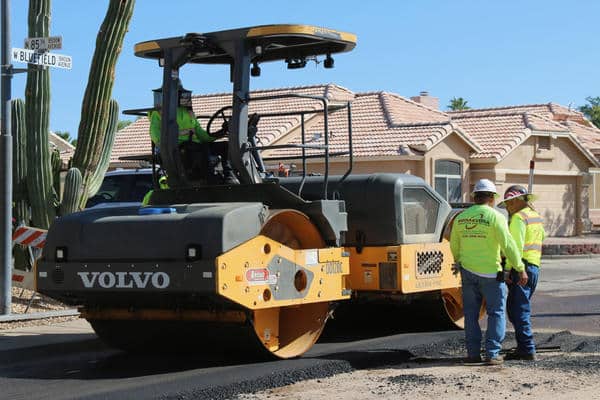
On a recent patching job in a residential neighborhood in Peoria, Primavera deployed a fleet of Volvo compactors, including a DD128, a DD25 diesel-powered asphalt compactor and a new DD25 Electric asphalt compactor. The project provided the perfect opportunity to compare the electric model against its diesel counterpart.

Eulojio Barrientes, a seasoned operator for Primavera, noted the critical role these machines played in meeting project specifications.

“Our compactors have to be able to hit hard so I can get the numbers that I need. And so far, we’re hitting them,” he said.

Barrientes, who has operated a range of brands over the years, said his experience with the new DD25 Electric was positive.

“It’s a lot smoother. It’s not as loud and there’s no exhaust,” he said.

The absence of diesel fumes and noise makes for a safer, more comfortable working environment, especially in the residential areas where Primavera often operates.

Oscar has also learned to appreciate the advanced technology available in today’s compactors, particularly Density Direct™ on the Volvo DD128, which displays mat temperatures, pass counts, density readings and more.

“I think having compactors with technology screens like these will take us to the next level. They help us understand the different mixes and how we can get the best results,” Oscar explained.

This real-time data allows operators to work more efficiently and to consistently meet stringent compaction requirements, which are essential for Primavera to maintain their reputation for high-quality results.

“Initially we ran small equipment, but as we grew, we needed bigger machines to match the jobs,” Oscar Estrada said.

The Right Partner, Mile After Mile

The relationship with Volvo dealer Arnold Machinery has been instrumental in Primavera’s success. Jake Zayas, the dealership’s Arizona branch manager, understands the unique demands of the paving business.

“There can be 10 trucks stacked up on an asphalt job, and if the paver or compactor goes down, it shuts the job site down,” he explained. “That material has a lifespan, and it can cost the contractor a lot of money and reputation. So, with customers like these, if we get a call, it’s our number one priority.”

This commitment to uptime and responsive service has earned Arnold Machinery Oscar’s loyalty.

“Volvo compactors are great, and the service they bring me is what makes me stay with them,” he said. “I can call them any time, and they’ll have the equipment here for me. And if we need service or a part, they’re hands-down better than anything else out there.”

Oscar specifically credits Zayas for lifting Primavera to new heights.

“He really pushes us out here. He either makes me smile or gets me a little bit ticked off because he’s putting me somewhere uncomfortable, but I know it’s something better. It’s for me to grow and that’s what I’m going to keep pushing to, so I appreciate it.”

How to Roll for Bonus, Part 2—Ideas for Perfect Compaction

A Reputation Built on Pride and Performance

Primavera’s commitment to excellence extends beyond the equipment. Oscar takes immense pride in his team and his company’s appearance, which directly contributes to their strong reputation in the area.

“What makes us different is that we show up with great, good-looking, clean equipment that we’re proud of,” he said.

In residential areas, the stakes are even higher.

“The compaction has to be perfect on the asphalt. You can’t have bumps or things like that,” Oscar explained. “Especially in neighborhoods, we want to make sure the liability goes down and make sure the families have smooth surfaces to walk and drive on.”

This dedication to safety and quality ensures a smooth, safe experience for the community.

Future Contracts and Crews

Oscar has ambitious plans. In the next three to five years, he aims to transition from being a subcontractor to becoming a prime contractor on major projects, which will require more equipment and more crews.

“My goal is to have about seven crews working on that side of our business,” he said, up from their current four.

This vision relies heavily on the continued support of partners like Arnold Machinery and Volvo.

“Going back to Arnold Machinery, they’ll be able to help us out,” he said. “We know they can get us the equipment we need and can rely on.”

But it’s more than compactors he’ll be looking at. Oscar anticipates acquiring more Volvo compactors and even exploring other Volvo products like loaders and excavators for their dirt work down the road.

Primavera Grading and Paving has come a long way. Their journey is a testament to the power of strong partnerships, a commitment to quality and a deeply rooted family ethos. With powerful partners by their side, Oscar and his team are well-positioned to continue paving the way for a successful future.

Justin Zupanc is the compaction product manager for Volvo CE.

WOA/AGG1 2025 Highlights Workforce and Equipment Advances

WOA/AGG1 wrap-up offers highlights from asphalt and aggregate trade show in St. Louis

Even if you attended the 2025 co-hosted World of Asphalt Show & Conference (WOA) and AGG1 Aggregates Academy & Expo in St. Louis March 25-27, you probably missed a technology or two due to the overwhelming number of offerings on site. This recap of the show won’t be able to summarize every single thing available to the asphalt and aggregates professional that week, but AsphaltPro Magazine has multiple product galleries coming up over the next few months in which you can find new product news straight from the combined shows. Let’s kick off the coverage with a look at some important updates.

Helping the Workforce

Asphalt professionals have sought solutions to the workforce challenge for years, with the introduction of proxy mechanics as far back as 2018 (see this discussion in the Training Directory 2018 on TheAsphaltPro.com) through the introduction of artificial intelligence (AI) assisting intelligent compaction (IC) in 2024 (see this discussion in the “NDDOT Trials New Technologies on Hwy. 14” article). Methods for training and assisting our evolving workforce dotted the WOA/AGG1 tradeshow floor.

NDDOT Trials New Technologies on Hwy 14

For example, the growing portfolio from CM Labs, a vendor for simulation-based training solutions in the construction, utilities and ports industries, announced prior to WOA the launch of its Intellia Single Drum Roller Simulator Training Pack, which it states is the industry’s first-ever single drum roller simulation training. It’s designed to address the growing labor shortage by delivering a highly realistic training experience tailored to beginners who have no prior experience operating heavy equipment. This training module was on display at WOA and is described in this month’s product gallery.

Training took place in the education sessions and around the show floor. AsphaltPro Magazine once again hosted its “Ask the Expert” with American Paving Specialists’ Bill Stanley in the hot seat. Attendees could stop by the AsphaltPro booth and fire their questions and quandaries at Stanley for the hour that he was available. That popular series returns to CONEXPO-CON/AGG 2026 with an impressive lineup already signing up over the five-day show to offer answers for paving, production, safety and QC/QA, so watch this space for details.

Asphalt Plant, Paving and QCQA Training in 2018

For contractors seeking a way to augment a “green” workforce, exhibitors had offerings in the AI space, as well. GSSI and Hamm have collaborated on aspects of the Hamm Smart Compact system to assist roller operators in perfecting compaction no matter the operator’s skill level. And the engineers at Sakai have added echelon rolling to its Guardman™ technology for safeguarding equipment and personnel. All of these teams were on hand to discuss the benefits of implementing these systems to help the new—and veteran—workers on the crew, and some of those benefits are outlined in this month’s product gallery.

Show management reported more than 11,500 industry professionals gathered in the America’s Center Convention Complex, stating in a March 27 press release that 59% of total attendees were under the age of 45, reflecting the positive future of the industry. Additionally, 10% of attendees were women, underscoring this growing segment of the industry. Visitors traveled from across the country and abroad, some traveling as far as Australia, England, Argentina and Mexico to take part in the leading asphalt and aggregates trade show and conference, including a special delegation from Nigeria.

The 2025 WOA/AGG1 event featured a record amount of square footage, including a new feature called the Community Zone. “This success is a direct result of the collaboration and hard work of all our partners, exhibitors and staff,” said World of Asphalt Show Director Brittany Schmidtke. “The momentum and growth in the asphalt and aggregates industry is evident by what we saw exhibited on the show floor and ultimately provided a richer experience for our attendees.” Photo courtesy of the Association of Equipment Manufacturers’ WOA website

Attendees engaged in more than 120 educational sessions through the People, Plants, and Paving and AGG1 Academy. These conferences covered a wide range of topics essential to the asphalt and aggregates industries. AEM reported a few of the most popular sessions included “Lean Principles: It’s About People, Process & Change,” “Unleashing the Power of Intentional Leadership: Leading Yourself to Lead Others,” “Autonomous Quarry Trucks 101,” “Extreme Ownership for Business and Life,” “Laydown Best Practices” and “Compaction 101: Doing the Right Things, the Right Way.”

Multi-Tasking at WOA

In addition to education and equipment, the co-located shows offered a venue for networking and business meetings. For example, a new feature of the show this year was the Community Zone, which provided a dedicated space for attendees to relax, work and network. The Community Zone included presentations, such as one from Ashley Batson of the Women of Asphalt, and a book signing by Ajax Paving’s Vince Hafeli.

“The 2025 AGG1 and World of Asphalt show offered the increased ability for exhibitors and attendees to connect—from the Community Zone area, to the larger show floor space and media one-on-one opportunities,” said Michele Stanley, interim CEO of NSSGA. “Every year the event becomes better with new innovations and updates. We are proud to offer our NSSGA members this unique meeting environment so they can continue to reach their own business goals.”

Show management shared 10% of show attendees were women, underscoring that growing demographic in our industry. On March 26-27, the Women of Asphalt organization hosted its Women of Asphalt Day, during which industry professionals presented career and motivational information for the men and women who’d registered to attend this conference-within-a-conference. Also at the show, the AsphaltPro staff had the opportunity to meet with WofA leadership to make plans to support the group’s important work into the future. From left: Cara Owings, media sales representative of AP; Sarah Redohl, digital editor for AP; Brittyn Heisler, national executive director of WofA; Sandy Lender, editor of AP; Ashley Batson, chair of the board of directors for WofA. Photo courtesy of Rapport Storytelling

And speaking of NSSGA, the association’s annual convention ran concurrently with AGG1. More than 600 aggregates industry leaders convened in St. Louis for the meeting, which featured the announcement of the 2025 NSSGA Leadership including Board Chair Ted Baker II of Blue Water Industries and the presentation of the Barry K. Wendt Memorial Commitment Award to Ward Nye of Martin Marietta. The annual membership meeting keynote was a moderated discussion by football legend Archie Manning. This year’s meeting comes as the association marks its 25th anniversary.

The first general session of the NSSGA Annual Convention March 23-26 featured Dr. Helena Boschi, an internationally recognized psychologist and neuroscientist specializing in the application of brain science to the workplace.

Women of Asphalt also hosted a conference-within-a-conference with the second annual Women of Asphalt Day. Women and allies from across the country participated in special programming and networking activities.

CM Labs’ Intellia Single Drum Roller Simulator Training Pack features a comprehensive nine-exercise curriculum designed to build a strong foundation in operating heavy equipment. Image courtesy of CM Labs

“We’ve talked to a lot of women,” said Silver Star Construction’s Trish Morris, who’s opening an Oklahoma branch of Women of Asphalt. “A lot of men have come by and grabbed our cards so they can get their team members signed up. I think it’s great they’re willing to take that step and get their ladies involved as well, even if they’re not here.”

Aside from conferences, attendees could multi-task with receptions and networking. For the second year in a row, Raised on Blacktop and WOA collaborated to host a sold-out kick-off party. Also sponsored by Wirtgen and a handful of others, the event brought together nearly 400 asphalt professionals at Busch Stadium, the iconic home to the St. Louis Cardinals, to build relationships and excitement the night before the show’s opening.

Contractor’s New Museum Offers Glimpse of Route 66 History

On the first day of the show, a handful of guests visited Campbell’s Service Station, owned by a local contractor and celebrating the historic Route 66. Check out the article “Contractor’s New Museum Offers Glimpse of Route 66 History” in the March issue for details and send your stories about preserving the iconic roadway to sandy@theasphaltpro.com.

Attendees enjoyed the Rock & Road Reception where a relaxed atmosphere allowed for networking on the show floor on Wednesday evening. It featured live music, mascots from the St. Louis Cardinals and St. Louis Blues, and treats from roaming characters. Another group of guests attended the EdgeVanta and Gearflow happy hour event at the nearby Buddy’s Wine Bar & Bistro. Everyone was welcome to attend the relaxed happy hour in the Stansteel Hotmix Parts & Service booth as well. Basically, attendees had ample opportunity to unwind with new and established friends amid the crush to gather information and business tips.

Save the Date for 2027! Next year CONEXPO-CON/AGG takes place in Las Vegas, but WOA and AGG1 co-locate in New Orleans March 15-17, 2027.

The Remix™ kiosk at the Astec Industries booth showed the almost imperceptible differences between Cold Central Plant Recycling (CCPR) and traditionally produced asphalt. Photo courtesy of AsphaltPro Staff

Get More Tons

Of course, the name of the game at a show like WOA/AGG1 is to see the iron and learn what new technology will help your bottom line. AEM reported the exhibitors unveiled new products, partnerships and advancements at a record 19 press events.

One of those unveilings took place at the ShoulderMaster booth on the first day of the show. This family-owned company introduced to the industry its center paving attachment for skid steers, the CP-1000, which is detailed in this month’s product gallery. Also check out the family’s story at the beginning of this month’s gallery.

Volvo Construction Equipment showcased during its press conference enhancements to its soil and asphalt compaction product lines with upgrades to multiple models and a forthcoming electric model. Show attendees also got the first look at a DD15 electric asphalt compactor.

IntelliShift unveiled its advanced asset-tracking technology. The system allows companies to monitor equipment location, track utilization and idle time, and mitigate theft and misuse.

Metso unveiled the Nordberg® HPe™ range expansion and aftermarket kits for the new HPe range. The company also celebrated a major milestone, the 40th anniversary of the Lokotrack® mobile crushers.

While the company didn’t host a press conference, Astec Industries had a few updates and official launches to share. Its SiteLine™ operator environmental awareness camera system for its cold planers was previewed at the 2024 WOA show and launched this year. Another stand-out item was the IntelliPac™ Moisture System, which is now compatible with RAP in addition to virgin aggregates.

Asphalt Drum Mixers (ADM), Huntertown, Indiana, displayed a brand-new EX 8845 asphalt plant in its booth. Because bigger plants can bring bigger profits, ADM EX Series asphalt plants are designed to produce up to 425 TPH and handle up to 50% RAP to meet producers’ high-capacity production needs. The EX 8845 features an 88-inch drum diameter and 45-foot drum length. Like all EX Series plants, it provides long aggregates drying and mixing times to offer consistent, quality asphalt.

Across the aisle from ADM, fellow FAYAT family member BOMAG premiered its new BD 2000 asphalt distributor and new CR 820 T-2 rubber track paver. The distributor offers an automatic burner and computer-controlled distribution. The paver features a 173-horsepower diesel engine and a new operating system for each console to provide easy viewing of critical operations. The BOMAG WOA display also included:

  • BOMAG CR 1030 T-2 highway class paver with VERSA 20 front-mount screed
  • BM 2200/65 cold planer 2-meter class mill
  • BM1200/35-2 cold planer with maximum 13-in (330.2-mm) milling depth
  • BW 28 RH pneumatic tire roller with large ballast compartment
  • BW 120 AD e-5 Electric light tandem roller with electric drive

While WOA attendees could see the Honey Badger and Tremor Shaker from CWMF Corp., Waite Park, Minnesota, on display, they also had the chance to pick up information on CWMF’s newly branded Dust Pilot reverse-flow baghouse. This baghouse features precision airflow control, an advanced inertial separator and CWMF’s unique indexing wheel mechanism.

Eagle Crusher, Galion, Ohio, also introduced something new at the show: its next generation 1200-CC portable crushing and screening plant. Its new features include a redesigned return conveyor, a new fully hydraulic side discharge conveyor, a self-lowering control panel, and an available onboard cross-belt permanent magnet that stays on for transport.

This quick overview of WOA/AGG1 offerings showcases the vast array of iron and technology that was on display. We’ll have opportunities to share more in future issues of AsphaltPro and we look forward to hearing back from you on your favorite innovations.

For more information visit WorldOfAsphalt.com and www.agg1.org.

How to Set Up the Roller and Rolling Zone for Safest Practices

Along with the equipment maintenance tips we’ve been sharing, there’s a safety aspect we need to address when it comes to the upkeep of paving and pavement maintenance machines. Hopefully, team members recognize by now how important it is to maintain pavers, rollers, skid steers, brooms and the like to keep this equipment in optimal condition for achieving a top quality job. But stop and think about the safety of your crew members and the traveling public when you’re performing routine and spring start-up maintenance tasks.

We’ve talked before about the importance of cleaning lights, safety decals and reflective tape on pavers and haul trucks. Any little bit of reflection could be the piece that catches a motorist’s eye before he or she glances away from the road and down at their phone—each bit of light or extra reflective tape you have on your paver could be the item that gets their attention and prevents them from plowing into your work zone.

Making your equipment reflective is like armoring yourself for battle. Don’t take it for granted. Instead, think of your piece of equipment like an extension of your safety vest. You want it to be in its best condition and you want to position it most effectively to protect you. Let’s use the roller this month to show you what I mean. I won’t name the companies or places where I saw these safety issues happening because my goal here is not to embarrass anyone; my goal is to educate others on best safety practices.

I cannot overstate how important it is to clean lights, safety decals and reflective tape on the equipment. Any little bit of reflection could be the piece that catches a motorist’s eye and prevents them from plowing into your work zone.

Make Your Roller a Safe Space

One of the first things to think about is putting all the safety features of the roller to work. When the lowboy driver delivered the roller to the jobsite, the collapsible Rollover Protective System (ROPS) was probably down to protect it from being damaged—and so were the mirrors—during transport. Someone needs to make sure the system is put back up and secured in place so it can do its job of protecting the operator.

The ROPS creates a safety cage that the operator sits in, but that doesn’t mean you can ignore your seatbelt. Back in the old days, before ROPS, if a roller was working on a slope and the machine tipped over, the operator needed to jump clear and hope he jumped the right direction to avoid the machine crushing him to death. Nowadays, the safety cage is a robust, heavy-duty system that prevents him from being crushed if, God forbid, the roller should tip over on an embankment or other slope. But the seat belt is what will keep the operator inside the cage that’s built to protect him. If he’s not wearing his seat belt, he could be thrown from the cage, in the wrong direction.

Roller platforms these days allow the operator to swivel; some of them have 360-degree swiveling that lets the operator see all angles of the mat. The joystick is right there in your hand, moving with you as you move. That means you don’t have to feel confined by seat belts. You can move and see the mat you’re compacting even when you have this safety device in place. That means there’s no excuse for leaving a seat belt dangling to the side, unused.

In this picture, the seat belt is dangling unused. The operator could be thrown away from the safety cage of the operator’s platform if the roller were to tip over. Instead of this unsafe situation, make sure the roller operators use all their protective gear. Also, note that the strobe light on the back of the ROPS needs to be relocated to the top and the bracket at the front of the machine (circled in red) is missing the mirror that could help the operator view not just the edge of the mat but also obstructions.

Another item that’s supposed to protect the roller operator and the people on the ground is the backup alarm. I’ve seen people stick paper or a rag in the megaphone backup alarm on the roller to muffle it because it was too loud and bothering them. This is unacceptable. The whole purpose of the alarm is to be loud enough to alert people that the 14-ton machine is moving toward them or their equipment. We have become complacent when hearing it.

How to Roll for Bonus, Part 2—Ideas for Perfect Compaction

Make the Scene Safe

And while we’re talking about people and other equipment on the ground, let’s talk about the whole scene around the roller. Let’s talk about the work zone.

For certain types of jobs, you are required to follow the Manual on Uniform Traffic Control Devices (MUTCD). This manual provides common sense guidelines for any work zone as well as rules and regulations for state and highway projects. The safety rules are set in place to safeguard the workers inside your work zone and the traveling (or walking) public outside your work zone.

On a job where the MUTCD wasn’t used, I suggested to the team that we place a work truck with its four-way flashers and strobe light at the beginning of the work zone in the off-ramp to help alert drivers to the work zone. The project had barrels set up on one side of the lane, but the roller operator was exposed to drivers coming up behind him. He was the first construction vehicle the drivers would notice as they exited a highway and decelerated from highway speeds.

How to Roll for Bonus, Part 1—New Ideas in Roller Maintenance

This situation demands a crash attenuator and flashing lights to get drivers’ attention. This situation demands the roller have a clean, functioning strobe light atop the ROPs; clean, functioning lights on its corners; clean, functioning headlights that are turned on; and clean, well-maintained reflective tape to make it stand out. Even in the daytime, you want these lights to be on and reflecting properly.

Think about the individual person. He wears a reflective vest to catch everyone’s attention and to let everyone know where he is. His back is often to traffic so he needs mirrors adjusted to show him what’s going on. The lights on the roller are the roller operator’s reflective vest so people can see him. The lights are the extra safety apparatus for your equipment. If the roller is the first indication of a work zone, you want that thing to be lit up like a Christmas tree. You want that thing to reflect.

Above all, use common sense and work as a team to keep all members of the crew and the motoring public safe. The goal is to get a top quality mat while everyone goes home safe at the end of the shift.

John Ball is the proprietor of Top Quality Paving & Training, Manchester, New Hampshire. For more information, contact him at (603) 493-1458 or tqpaving@yahoo.com.


Basic roller safety guidelines:

Are you in a safe zone?

  • Follow the MUTCD for best work zone setup practices
  • Put a crash attenuator (or something with flashing lights) before the work zone

When you get to the jobsite:

  • Leave your vest on and zipped up
  • Make sure you’re using all available PPE properly
  • Make sure the ROPs are properly in place and check them over to make sure there aren’t any missing bolts or fractures
  • Clean and check the strobe light on top of the ROPS is secure
  • Clean and check the headlights to ensure they’re working properly
  • Clean and check all the lights on the corners of the machine, including four-way flashers
  • Clean and maintain the mirrors; focus them after they’ve been flattened for travel on the lowboy
  • Do not obstruct or disable the backup alarm; check it before you start your shift to ensure it’s 90 decibels or more, according to OSHA regs
  • Clean and maintain all the reflective tape and safety decals

When it’s time to roll:

  • Put on your seat belt
  • Turn on the strobe
  • No matter the time of day, turn the headlights on

NDDOT Trials New Technologies on Hwy 14

How can autonomous rolling, paver mounted thermal profiles and robotic striping take human error off the paving table?

In 2024, the North Dakota Department of Transportation (NDDOT) let Job 23273 along Highway 14 in Burleigh County from Sterling to Wing. The project totaled 21.22 miles and was divided into eight test sections. The top 2-inch lift was a balanced mix design (BMD) of hot-mix asphalt (HMA), but the sections also incorporated milling, widening, pipe replacement and extensions, HMA and cement-treated base (CTB), with full depth reclamation (FDR) in some areas.

Pavewise Inc., Bismarck, North Dakota, and general contractor Border States Paving Inc., Fargo, used a variety of new technologies during the construction and quality control/quality assurance (QC/QA) processes. Over the next few issues of AsphaltPro, we’ll take a closer look at how the entire project came together; what mix designs were used in which test sections; how different technologies were used most effectively; how the contractor, consultant, and DOT responded to challenges and triumphs in the field; and what final numbers can tell us about the use of new technologies in the paving realm. In this first overview, let’s introduce some of the innovations employed in September and October 2024.

The parties involved have thousands of data points to assess to see how different technologies performed on different sections and in different conditions.

Prevent Temperature Segregation with a Thermal Profile

NDDOT Research and Technology Project 2024

Bryce Wuori of Pavewise prepared a document prior to the project’s start, stating, “Over the past decade, technology advancements like intelligent compaction and paver-mounted thermal profiling have tremendously improved the quality of construction during paving operations. These technological tools provide valuable data to users, enabling them to make better quality-driven decisions and identify the quality of work being performed.”

One of the challenges the asphalt industry still faces is the shortage of skilled workers who are trained to operate the equipment and interpret the data to adjust equipment and processes during construction. “In many cases, poor quality in a road-building process can be traced back to an operational issue that involves operator error or a lack of knowledge to adjust to the required specifications of the project for optimum quality,” Wuori wrote.

The State Aid Project No. FTF-X-SS-1-014(014)000 allowed the DOT to assess not only the technologies incorporated in the test sections, but also to assess how these technologies could assist in the unskilled workforce challenge facing the industry. Wuori wrote: “The goal of the asphalt innovation and technology project is to improve the quality of roads by providing advanced technology to the paving industry and testing its effectiveness in paving operations.”

NB West Wins Quality Award for I-44

He shared that this goal proved itself on this project. One day when the main roller operator wasn’t feeling well and wasn’t available, an unskilled operator who was not familiar with roller operation had to be substituted for the job or the project would’ve been stalled or could have suffered in quality requirements.

“We had to put an inexperienced operator on the machine,” Wuori said. “It could have been a mess.” The “new” operator was brought up to speed on the basics of driving the roller in short order and, thanks to the tasks the Smart Compact technology could perform on his behalf, he was able to execute the day’s production flawlessly. Wuori shared, the technology allows the operator to concentrate on operating and automates some of the mundane tasks of turning your vibes off and on at the right time or what speed needs to be achieved to get the required impacts for density. It simplifies the process and reduces the burden on the operator to perform successfully.

The experiment worked.

A less-skilled worker could do the job of the veteran worker with the aid of technologies like operator automation features that set frequency and impact spacings, turn off vibration as it rolls to a stop for changing direction, stay in the set pattern unless the mat dictates otherwise, and so on. The technology reduced what the operator had to manage, making his job easier and answering the question of “Can we put an inexperienced operator on the machine and still get a quality road?” with “Yes.”

Alongside the semi-autonomous rolling technology, the team used a variety of innovations on this project for safety and quality enhancements.

The technology allows the operator to concentrate on operating and automates some of the mundane tasks of turning your vibes off and on at the right time or what speed needs to be achieved to get the required impacts for density. It simplifies the process and reduces the burden on the operator to perform successfully.

Technology On Board

The technologies used on the project were as follows:

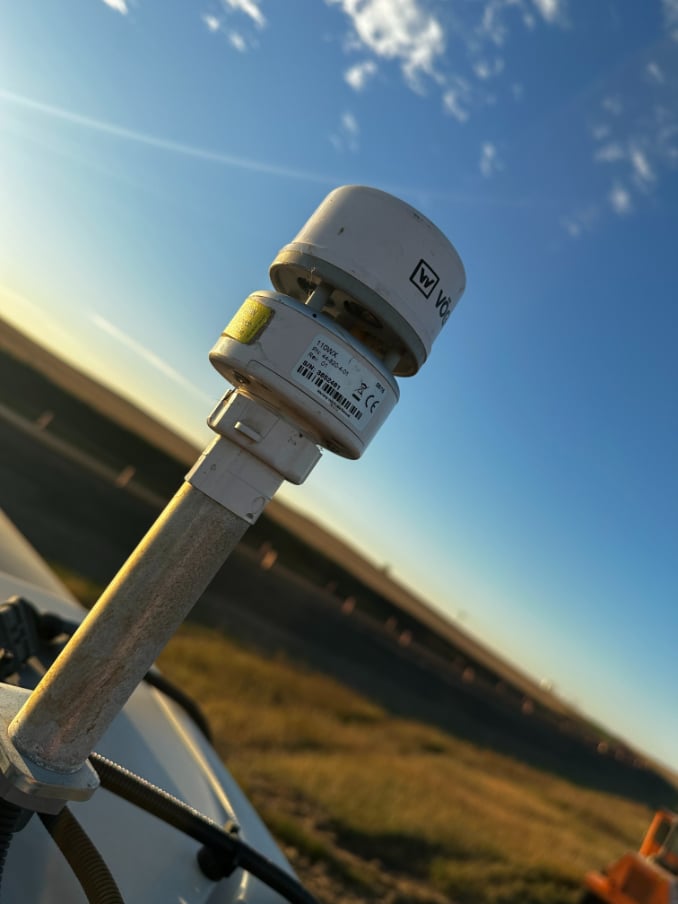
Pavewise GroundTruth Weather Station—To monitor and track weather conditions at the job site and ensure specification requirements, the team used the Pavewise GroundTruth stations and Pavewise AI cameras.

The weather monitor for the Smart Compaction is affixed to the roller to monitor conditions and make adjustments in the field.

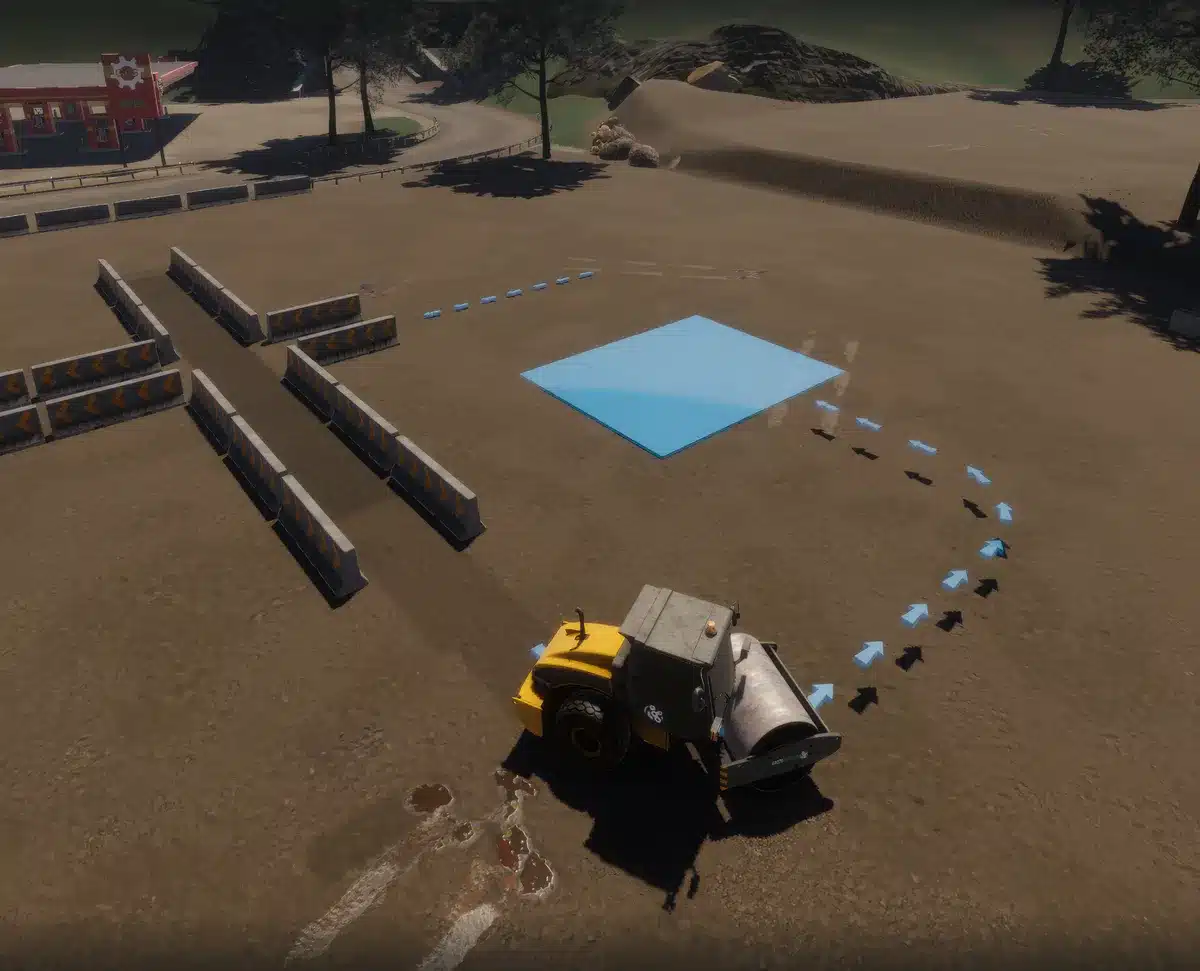
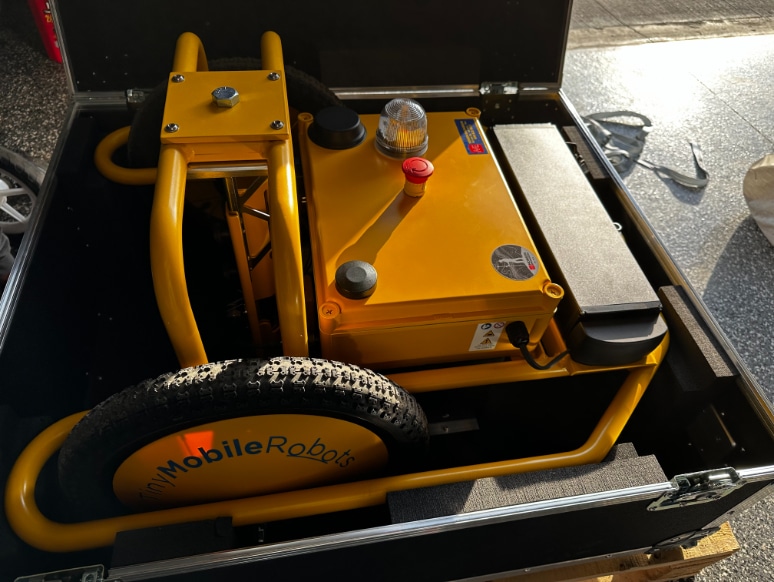
Monsen Engineering TinySurveyor Terra Autonomous Line Striping Robot—To paint temporary guidelines for paving, the team used the TinySurveyor Terra from TinyMobileRobots. This device rolls down the roadway using your existing GNSS to pre-mark lines so your crew members don’t have to stake stringlines or fight oncoming traffic to paint.

The TinySurveyor Terra from TinyMobile Robots rolled down the length of the centerline to paint road markings for the crew to follow. This eliminated the time and danger of having a survey team stringline or paint the guides.

E-Ticketing—The NDDOT standard special provision for the use of e-ticketing applied on this project.

Paver-mounted Thermal Profiler—To monitor and track mat temperatures behind the screed, the team mounted a TH-PI from Topcon atop the paver. It collected data across the width of the mat.

Notched Wedge Joint Maker—To meet the NDDOT special provision for longitudinal joint density for HMA pavements, the team used a notched wedge joint construction at the centerline.

The Border States team met the NDDOT longitudinal joint density special provision with the construction of a notched wedge joint on Hwy. 14. All photos courtesy of Pavewise

Intelligent compaction (IC)—Each roller was equipped with IC to help monitor pass count, stiffness and other concerns.

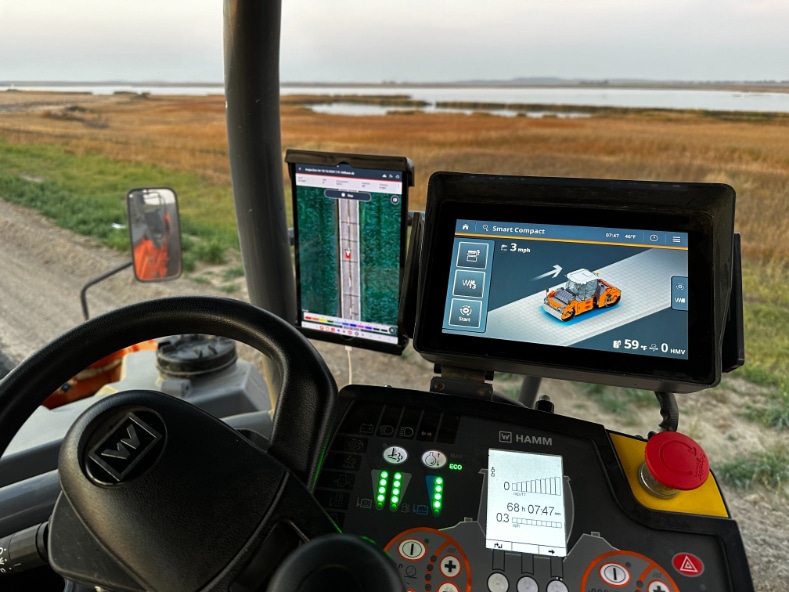
HAMM Smart Compact—The HD 120i High Frequency roller with Hammtronic and Smart Compaction installed was used for specific test sections. The Hamm Smart Compact technology, according to Tim Kowalski, application support manager for Hamm, auto adjusts amplitude and frequency while rolling. This machine also featured the manufacturer’s new Smart DOC system, which Kowalski pointed out handles pass count, temperature and stiffness monitoring, as well as uploading data to VETA via the Cloud.

Wuori indicated the team ran the Smart Compact test section with the HD 120i, on loan from RDO Equipment Co., starting the afternoon of Oct. 8 for two days of base lift atop the concrete-stabilized FDR base, and again two days on the top lift. The team tested its mettle in the intermediate rolling position to see how it would react to a noticeable tender zone the mat displayed at the temperature range of 180 to 210°F.

For asphalt construction, HAMM has developed the digital compaction assistant Smart Compact. It actively supports drivers in selecting the right settings for compaction. The driver specifies whether a base, binder or surface course is to be compacted, and the assistant automatically calculates the type of compaction required and the necessary compaction energy. Smart Compact is operated via a separate display that also functions as an on-board computer. The display indicates fill levels, operating hours and weather data, such as humidity, wind strength, wind direction and air pressure, among other data.

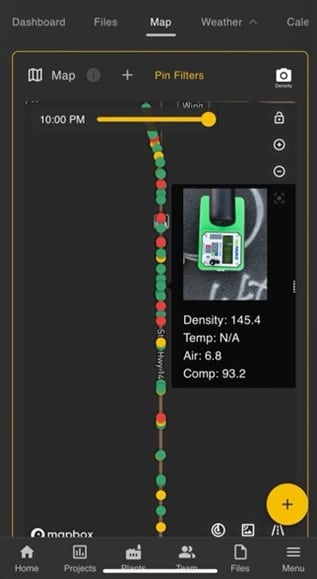
Density Plus Software—To streamline the compaction process, the team used Density Plus AI-powered conversion technology from Pavewise to transform gauge images into digital data. The real-time metrics were then used to assess and adjust rolling patterns as needed.

The team collected mat and joint density using the Pavewise Density Plus feature, which uses AI to extract, and density gauge location and information to develop, real-time density data and reports for the paving team.

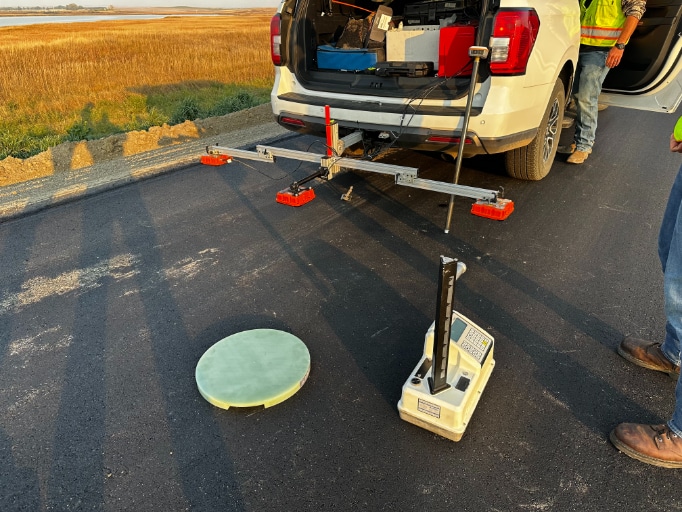
GSSI PaveScan RDM and HighSpeed DPS System—For additional data collection and QC/QA proof, the team ran the GSSI and other scanning devices on the project.

The proof is in the final numbers. The team used a variety of QC/QA methods to gather data to not only ensure the final mat met state specs, but also to showcase where different technologies stood up to control sections.

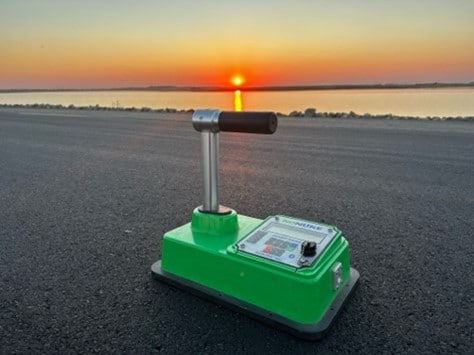
InstroTek NoNuke Density Gauge—To prove densities, the team collected over 400 readings with the non-nuclear density gauge.

The team collected over 400 shots with the NoNuke density gauge.

With the robust set of innovations and technologies on hand to facilitate the Hwy. 14 project, all eight sections were placed and compacted successfully and to the required specifications. The parties involved have thousands of data points to assess to see how different technologies performed on different sections and in different conditions. As we revisit this project and its many aspects over the next few issues, we’ll also point out how these data points showcase the best practices Border States crewmembers employed while trying out new innovations.

Communicate Equipment Repairs Now for Spring Startup Success

No one will know what the equipment needs to prep it for spring startup if we don’t communicate this winter

When we’re talking about maintenance—with the paver or the roller especially—we’re also talking about mat quality. When I look at a paver, I focus on two categories—the screed and the tractor. These two main components affect the quality of the mat you’re placing; both have to be in optimal working order if you want a top quality mat. Both are on the mechanic’s mind when he gets started on winter maintenance.

Here’s a Quick Tip: Spray Pledge furniture polish in the paver’s extender cylinders so they slide out smoothly and properly.

When the mechanic enters the garage in January or February, he’s not going to know what might have been going wrong with the paver last season. Why? Because no one communicated it to him.

Drag Slat Conveyor Checklist for Winter Maintenance

Even with telematics and fancy apps that automatically ping him about how many hours the paver has worked and when it’s time to grease a joint, no one stopped to tell him about a driver smashing the screed on the lowbed or the depth crank getting loose in its sleeve or the time the extension folded in and pinched the feed sensor’s wire. Those important things get lost in the day to day and add up to poor production for the paving crew, and they surprise the mechanic during the winter maintenance season if we don’t tell him about them.

The lowbed drivers have beat up the screed platforms of this paver. The crew has learned they can’t have the left platform in place when the screed is lowered for paving or this element will drag and leave a gouge in the mat. The middle piece that you see in this picture is a tripping hazard. The mechanic has to order new parts to repair this problem for the crew.

We need a system in place to forewarn the mechanic, telling him to order a new screed platform to replace a bent one so the broken one isn’t digging into and marring a mat we’re trying to build. And we need to use that system, communicating with the right people to get action when action is needed.

Solve Winter Potholes

For example, when I noticed the lower scraper bar was missing on the back drum of one contractor’s breakdown roller, I asked the operator about it. His response was that he had informed a foreman about the missing scraper bar a few times already. But the foreman didn’t recognize the importance of the problem. He wasn’t the right person in the chain of command to do anything about the problem, the roller consistently used more water from the back tank than the front, and the machine went without a repair for months.

This is unacceptable, but the operator couldn’t get help with the problem until we went to a supervisor who had direct communication with a mechanic who could order the replacement part.

Inside the red circle, you can see the bracket for the scraper is still in place, but the scraper bar itself has been knocked off by incorrectly loading onto the lowbed. While the roller can still operate and still get compaction, it’s not efficient like this. There are two scraper bars on the drum for a reason: each bar collects and spreads the water across the width of the drum to lubricate the drum and assist in keeping it from picking up material as you compact the mat. When you remove one of these, you remove that device from either the forward or back motion of the rolling pattern.

You have to deliver a note—and usually it’s done at the end of the year—from the equipment operator to the mechanic, sharing what they think is broken or needs repair. Besides the mechanic using the manufacturer’s list of what needs to be done at 500 or 1,500 hours, for regular wear-n-tear, to check pump pressure, to replace seals, to check conveyor chains, and so on, he’ll also use a list from the operator of the piece of equipment. I have a maintenance sheet that I had at Pike Industries that I used for years and years and AsphaltPro has a paver maintenance checklist, a roller maintenance checklist, a crusher maintenance checklist and even a plant maintenance checklist at the magazine’s Digital Downloads page.

Plant Maintenance Checklist Download

When we hand these lists of what we see going wrong to the mechanic, they include more than what you see flagged in an app or a telematics report. If I have a frayed wire, that may not come up. The telematics might pick up there’s a hydraulic leak, but not that there’s a failing O-ring. You must have the operator’s input to understand what’s going wrong and where with the piece of equipment he’s operating day in and day out. He’s using a special set of tools to notice when something needs to be scheduled for the mechanic’s attention.

In the end, the mechanic starting his winter season maintenance on the paver, roller, sweeper, material transfer vehicle or other equipment will have his best chance at setting the crew up for springtime success if the crew has made notes for him. If the paving crew and maintenance crew work hand in hand and with the operators’ notes—with telematics, apps, tablets, paper-and-pencil and phone calls to discuss the fine details—then the whole team can return in the spring with optimized, safe, efficient equipment to get a top quality mat right off the bat.


John Ball is the proprietor of Top Quality Paving & Training, Manchester, New Hampshire. For more information, contact him at (603) 493-1458 or tqpaving@yahoo.com.