
How to Make Your Plant Efficient, Part 1
BY Sandy Lender
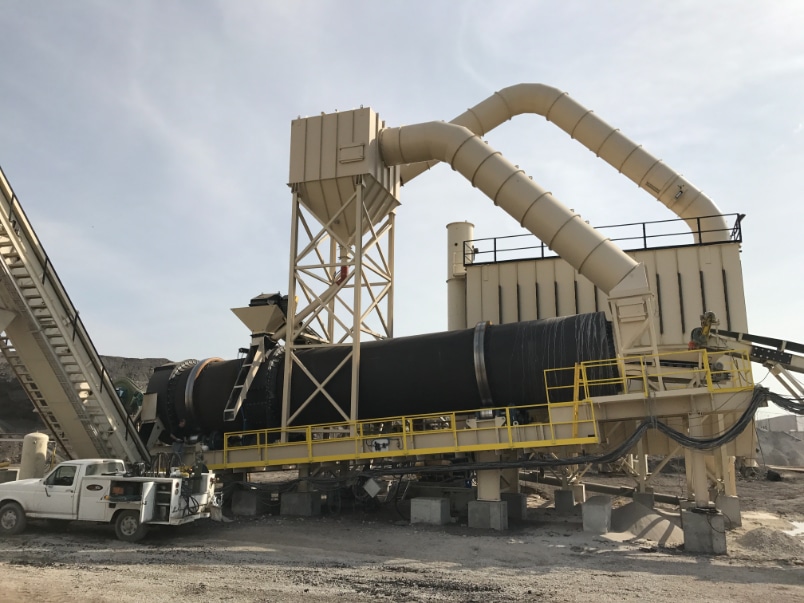
Industry veterans offer real-world scenarios for planning or updating efficiencies to make your asphalt plant its most sustainable and cost-effective operation.
Editor’s Note: For 2024, AsphaltPro Magazine allows experts in the industry to share how to expand your operations to the next phase of business. Are you ready to build or update your own hot-mix asphalt (HMA) plant? Let’s turn to some professionals who have equipment, services, software and tenure to help you expand to mix design, production, hauling and more. This month’s installment takes a deep dive into the environmentally responsible task of finding and implementing tactics that reduce carbon and increase efficiencies throughout your HMA plant.
For our final two-part installment of 2024 in the series on expanding your asphalt business, we’re looking specifically at reducing your carbon and environmental footprint at the hot-mix asphalt (HMA) plant. No two plants are alike, but of course similarities abound. Those constants help us identify scenarios wherein problems can be averted and best practices implemented. For example, at one of the many National Asphalt Pavement Association (NAPA) environmental committee meetings I’ve attended, Ron Sines of CRH shared with the attendees his top “quick tip” of turning off the lights.
Every asphalt plant that runs past dusk will turn on the lights for safe operation. When the sun comes up, leaving the lights on is a waste of energy as well as utility budget. Doesn’t that sound simple? Sines has stated that it’s an easy fix for a plant manager to put lights on a timer but it’s not a fix that everyone stops and thinks about.
In the August 2020 issue of AsphaltPro, we reported on the ENERGY STAR program that NAPA and the U.S. Environmental Protection Agency (EPA) were introducing to the asphalt industry. The article here includes the “treasure hunt” concept that helps asphalt producers discover simple-to-complex energy savings like the one Sines starts with when decreasing a plant’s environmental footprint.
If you’re in the planning phase of setting up your plant, which is the spirit of the Expand Your Business series, you may not be ready to conduct a treasure hunt in a full-fledged ENERGY STAR capacity. Instead, let’s take a look at the laundry list of great ideas industry veterans like Greg Renegar of Astec Industries, James M. (Jay) Winford, Jr., and Troy Bollich of Prairie Contractors LLC, and Malcolm Swanson of E5 Engineers can add to Sines’ advice above. And as you read this article online, share on our social media platforms the tips you would add to this discussion to showcase your industry knowledge as well.
Prairie’s Plant Manager Troy Bollich explained, once the plant is running, you want to keep it running steadily. That takes communication between the foreman at the job site and the plant operator. “Every time the plant starts and stops, the company will lose, on average, 4 to 8 tons of material.”
Access Industry Resources
If you’re assembling your new HMA facility this winter, the asphalt industry has resources to assist you in making it an efficient operation. But how does the industry define efficiency? Over the past few years, you might have heard the word “efficiency” shifting in meaning to include the energy and sustainability discussion. Astec’s vice president, customer success, Renegar, wrote in Part 2 of this feature, “a second sustainability/energy efficiency revolution has started” whereby producers are focusing on where heat can be saved or used more effectively.
For Part 1 of this feature, we’ll look at all manner of energy savings, including heat, to explore areas where producers can improve operations while cutting down on wasteful “emissions.” Winford reminded readers of the brochure NAPA published in 2008. The “101 Ideas to Reduce Costs and Enhance Revenue,” written by Kent Hansen and Roger Sandberg, is available at the NAPA store and includes a list of common-sense tweaks and best practices that a committee of producers shared in the spirit of helping the industry during a fiscally challenging time.
While making upgrades and changes to an asphalt plant is certainly not a game, Winford shared that it doesn’t have to be drudgery either, saying it can be fun to find ways to save money at the plant. “Even if every little incremental change saves a nickel, that adds up to a large amount of savings over a decade because we run such volumes,” Winford said. “The best ways to learn are to visit a best-in-class peer, go to an Astec School and read the AsphaltPro Magazine.”

No matter which component you’ll put on a variable frequency drive (VFD), the electronics must be installed with care. The drives and their wiring must be located in a dust-free, cool environment. Photo courtesy Patrick Ahern of Ahern Industries
Top Tips
Of course, we think those are great tips from Winford! We also like this list of 10 items he prepared for industry peers:
- Eliminate air leaks.
- Pave stockpiles.
- Cover stockpiles where you can; especially the fine aggregate piles that are prone to higher moisture contents.
- Insulate everything!
- Use variable frequency drives where you can. (Editor’s note: Check out the in-depth article titled “Vary Your Energy Use, Increase Your Utility Savings” and see some of the non-traditional places you can make good use of VFDs from the January 2018 issue.) https://theasphaltpro.com/articles/vary-energy-use-increase-utility-savings/
- Use more RAP.
- Take advantage of excess sized materials at the quarry/pit.
- Maintain proper levels in the silos.
- Check aggregate/RAP moistures frequently and keep the plant moisture input accurate.
- Make sure the plant is properly calibrated.
Winford expanded on the concept of RAP, specifically, sharing that not only is it good for the environment when we increase the percentages we use, but that increased use also gives us the opportunity to showcase that we’re engineering the stone back into a valuable product.
For example, Prairie Contractors is one of the producers in our industry that takes milled or fractured concrete and pays a nominal fee to have it crushed to be reused. Every recycled rock that finds its way to Prairie’s yard has a place in our infrastructure. And that’s a win for Prairie, for elected officials and for Louisiana DOT personnel to talk about.
Troy Bollich, the plants manager at Prairie Contractors, reminded readers that fractionating RAP also offers more opportunity. “The process of fractionating the RAP is very important to help in the plant’s efficiency and production.”
Industry Agrees on Efficiency Points
Swanson is the proprietor of e5 Engineers and shared the nuances of correct baghouse sizing in the December 2023 issue’s “Mix-and-Match Asphalt Plants” article, which you can read here.
“As I wrote several months ago, mismatched components can stifle production,” Swanson said. “For instance, a baghouse that is too small for the dryer is the bottleneck to the whole plant system.” There’s even more insight on this concept in Part 2 of this feature, by Renegar, on page 46.
Bollich turned to baghouse efficiency when discussing shoring up areas against air leaks. When eliminating air leaks, also check the condition of the bags, Bollich suggested.
For the new plant site, you have the opportunity to slope and pave the area where you’ll build your stockpiles. Renegar shared, if your plant is in an area where rain is frequent, you can better manage aggregate moisture by sloping and paving under the wettest stockpiles. “The impact on energy efficiency and tons produced per day can be significant,” Renegar wrote. “The return on investment occurs quickly.”
Bollich suggested taking the extra time to slope the piles and training the wheel loader to pull material from the “higher” face. This leads into best practices for your loader operator—you’ll want to train him or her to load from the dry side above the moisture line.
“Take the time to explain to your loader man that he can make or break you on the day,” Bollich suggested. “Teaching the loader man to eat the material that is the driest even if it’s eating 2 feet or 3 feet up on the pile is important. A lot of them think it’s just their job to get the material from the pile to the bin. But explaining to them and including them in plant efficiency and operations is key. Remember, they sit in a loader all day without a lot of outside interaction.”
You also want to train incoming aggregate suppliers to dump material where it won’t contaminate the drier material. “This process goes hand in hand with trying to control plant moistures,” Bollich shared. “Moistures need to be checked at least twice a day, if possible. Incorrect moistures can cost you a lot in liquid if not input correctly.”
Step Up Hot-Mix Production with Your Facility’s Own Crushing Plant
Moisture will also affect fuel use, as will temperature loss. Winford listed insulation as one of his top 10 efficiency points, and Bollich echoed that idea. “Insulate all asphalt piping. Once piping is insulated, you will need to retune your heater burner so this is running efficiently. Also, while the tech is there, have him tune the drum burner.”
Swanson reminded readers to assess the burner’s age and condition. “Older burner types that have little control of excess air and combustion efficiency are also a detriment to plant productivity and profitability.”
“Calibration is another forgotten key factor in plant efficiency,” Bollich shared. “Not only is it a huge cost savings but also can eliminate the lab tech from having to spend a lot of time trying to figure out mix design issues.” He explained one of the common factors in deducts on jobs can be linked back to plant calibration.
Increasing the use of RAP also gives industry the opportunity to showcase that we’re engineering the stone back into a valuable product.
Calibrate Efficiency
With equipment tuned and calibrated, make good use of the VFDs. Bollich explained that putting the drum on a VFD can help in reducing the drying costs of material. “By speeding it up when it’s dry to slowing it down when it’s wet can save a lot on fuel consumption.”
When you put the drag slat on a VFD, you can expand its wear life. “One of the greatest expenses on a drag is reflooring it,” Bollich shared. “On the average, to redo a drag from material and labor is around $250,000. Slowing the drag down will reduce the wear on the floor and extend the life of the drag floor.”
Swanson also spoke of the opportunity producers have to save on costs and energy when focusing on the dryer and parameters there. “There are many dryers in the industry—and I am including drum mixers in this context—that are not performing nearly as well as they could for a small variety of reasons. First, there really are not many good flight systems and some of the good ones are worn. Second, variable frequency drum drives are still not used on many drums and, actually, a VFD typically does not help with conventional flights. It usually only helps with the new generation of flights, the Astec V-Flight and the e5 Engineers FlexFlight, but, with those flights and some understanding of dewpoint temperature, the VFD offers big saving and production gains. It can be used to control baghouse temperature through an extreme range of mix designs including extremes of RAP content.”
One area the producer might overlook when it comes to improving the plant’s sustainability is communication and scheduling. Bollich shared that these elements are key to plant cost and efficiency. For example, you want to have enough trucks on hand to keep the plant running at a steady pace.
“Also let the plant know what is needed in the future,” Bollich said. “Because once the plant is running, it’s in the plant’s best interest to run as long and as much as possible. Like storing mix for the following day, which goes under silo usage. In order for that to happen the foreman on the job site has to communicate with the plant. Every time the plant starts and stops, the company will lose, on average, 4 to 8 tons of material.”
With the variety of components to double-check and best practices to implement, HMA producers have ample opportunity to enhance performance. Readers have myriad options for setting up a new facility, or updating an existing one, with efficiency in mind for their most sustainable operation.