
How to Be the Plant Everyone Buys From
BY Sandy Lender

Editor’s Note: For 2024, AsphaltPro Magazine allows experts in the industry to share how to expand your operations to the next phase of business. Are you ready to start making your own hot-mix asphalt? Let’s turn to some professionals who have equipment, services, software and tenure to help you expand to mix design, production, hauling and more. This month’s installment looks at the best practices you can employ with the storage silo to offer customers quick, quality asphalt mix for their paving projects.
If you’re in the hot-mix asphalt (HMA) industry, you know one of the game-changing inventions of last century was the storage silo. During his “Asphalt Plant Efficiency” presentation during a World of Asphalt People, Plants and Paving session in Nashville in March 2024, Greg Renegar, the vice president of customer success for Astec Industries, Chattanooga, discussed the benefits of planning ahead with your storage silos in mind.
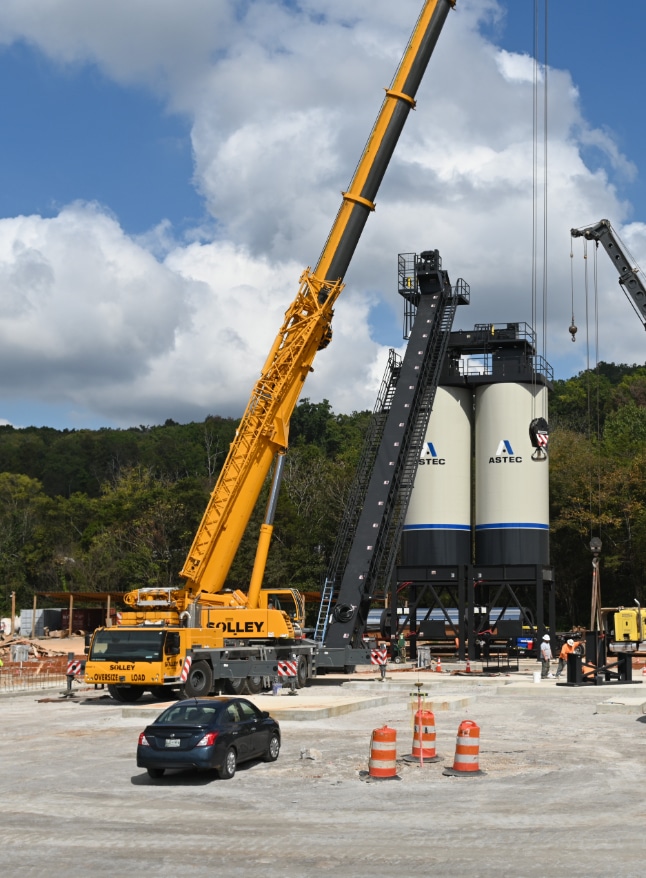
If your “why” is to provide mix for both customer and in-house crews, you’ll want to plan ahead for overnight storage of appropriate mixes as you build your new plant. During his presentation to the World of Asphalt audience in March, Astec’s Greg Renegar reminded attendees the plant that can start loading out customers first thing in the morning will be the plant everyone flocks to.
As he explained, even if you have older components you’ve been unable to update the past few years, you can operate efficiently if you maintain those parts, tighten up your environmental footprint, and follow best practices, such as optimizing the use of storage silos.
Notice that’s “optimizing” the use of storage silos. Not every mix design is ideal for the suggestions to come, and we’ll talk about those.
“If you are using very low absorption aggregates, it may lead to a high film thickness and the mix is more prone to drain down.”—Steve Jackson
Store It for Fast Startup
Renegar’s presentation included a side-by-side comparison of operations you might be able to share with your production team to showcase what’s optimal and what’s not.
Amazing Producer ABC
Using old technology
- Starts loading out of prefilled silos at 6 a.m.
- Starts up the plant at 8:30 a.m.
- Runs two to three mixes on various jobs, with enough trucks for the day
- Runs all day with changeovers but no mid-streams
- Fills the silos at the end of the day for tomorrow’s early customers
Struggling Producer XYZ
Using new technology
- Starts making mix at 6 a.m.
- Runs two to three mixes on various jobs, short of trucks
- Mid-streams at 8:30 for 45 minutes
- Runs another 300 tons and finishes for the day!
- Cleans out
- Gets a call at 10:15 a.m. for a 150-ton parking lot job
- Fires back up at 11 a.m., runs 147 tons, then mid-streams while paving foreman figures the last bit needed
One of the two producers in our examples is using new technology for its efficiency and sustainability but isn’t using best planning strategies. Renegar shared plants that start and stop more than three times per shift use up to 20-35% more fuel than they do when they run steadily. These percentages are published in the National Asphalt Pavement Association (NAPA) publication QIP-132.
You can probably monitor the effect of starting and stopping on your own fuel use. By using the storage silo to take up the slack and prevent starts and stops, you keep a steady, even production. Renegar stated Astec’s most successful customers are the ones who use long-term storage capabilities to become more profitable.
Think about it.
Because 95% of breakdowns occur at startup, you have a leg up on the day even if unplanned downtime hits you at first light. You also have a leg up on your competition on the other side of the county if your plant already has mix in the silo while Producer XYZ is still getting fired up.
Renegar explained it this way: “Storage in multiple silos plus planning allows FOB customers to get in and out quickly in the morning. Serving the FOB customers better than your competition will result in more business.”
Design Your Storage
This isn’t rocket science. But it does require forethought. Renegar cautioned producers on some reasons you might not want to store mix overnight. For example, lack of planning from your customers could result in wasted mix. There’s no point in producing a hundred tons of state mix at 300 degrees if your top five customers will show up wanting a less-pricy mix produced at 340 degrees.
If you don’t have proper heating systems in place, you run the risk of losing mix temperature. There are companies making electric heating elements that can be placed in silo cone packages to take the fear out of overnight storage. These entities might not make the silo itself, but are experts in the manufacture of electric heating components and provide these to OEMs like CWMF Corp., Waite Park, Minnesota, who then assemble the complete silo.
Even with the concern of temperature under control, you want to consider the mix design you’ll store. Renegar listed the “fear of storing polymer” as one of the reasons producers shy away from filling up the silo overnight or over a weekend. Folks in the field echo his concern when it comes to open-graded mixes due to a phenomenon known as drain down. This is when gravity pulls the liquid asphalt cement (AC) away from the aggregate and down toward the silo cone.
Steve Jackson, the vice president of plant operations and sustainability for NB West Contracting, Pacific, Missouri, spoke of this phenomenon in stone matrix asphalt (SMA) mixes. “The worst mix that I have seen for drain down is SMA,” Jackson shared. “That is why some agencies are reluctant to remove the cellulose fibers even when you add ground tire rubber or reduce the mix temperature.”
He gave an example. “I remember an SMA project where we filled a silo, and that was all the mix that we made for the night. The first sample, from the bottom of the silo, had high AC and 1.5% air voids. The second sample, toward the top of the silo, had low AC and 7% air voids. We made the mix extra hot because it was going to spend a long time in the silo.” The expensive lesson he shared was having to mill out that tonnage and replace it.
“SMA, open-graded friction course and other gap-graded mixes are the worst for this phenomenon,” Jackson continued. “They also usually have specified minimum asphalt contents. If you are using very low absorption aggregates, it may lead to a high film thickness and the mix is more prone to drain down. When Joe Schroer (NB West’s construction materials engineer) worked at MoDOT, he evaluated some of those mixes, and started calculating the volume effective binder, and approved some of the SMA mixes with less than the minimum spec requirement AC content of 6.0%.”
In other words, there’s hope for “fixing” the gap-graded mix so it can be stored overnight for quick loadout in the morning, if you’re willing to work with it.
Malcolm Swanson, industry consultant and president of e5Engineers LLC, Chickamauga, Georgia, shared his thoughts. “Coarse graded mixes, SMAs, any mix with little surface area will tend to drain down. That is a major reason for adding fiber to a mix. Fiber adds surface area without changing gradation. The added surface gives the AC a place to hang on.”
“If the state allows the contractor to design their own non-gap-graded mixes, then the mix has the absolute minimum asphalt content, so they are less likely to drain down,” Jackson said. “If there are mixes that specify a minimum asphalt content, then I would be careful. Take a look at the aggregate absorption as well. We typically use aggregates with 1% or lower water absorptions in our high type mixes, these are mixes that we try to drop the mix temperature as low as possible to prevent drain down.”
For producers looking to optimize the use of the storage silos, it’s possible to adjust the mix design and temperature to ensure you have exactly what your customers are looking for first thing in the morning. It might take a little forethought and planning, but the producer who plans ahead is the producer who can optimize all the components for a tight environmental footprint, an efficient operation and a plant that all the customers flock to.