Renewance Inc. Revolutionizes Battery Asset Management with Remote Monitoring Center

The global market for energy storage systems (BESS) and Electric Vehicle (EV) batteries has grown exponentially since 2022 as electricity demands accelerate. Renewance Inc., Elmhurst, Illinois, launched in late January 2025, the Renewance Monitoring Center to provide that surging market with insightful analytics to optimize battery performance, maximize lifespan and prevent system failures.

Renewance, Inc. provides services and software that assist the BESS and EV sectors in managing batteries from deployment, operations and maintenance, to recycling or reuse. Its Renewance Connect™ digital platform is software designed for lifecycle battery management.

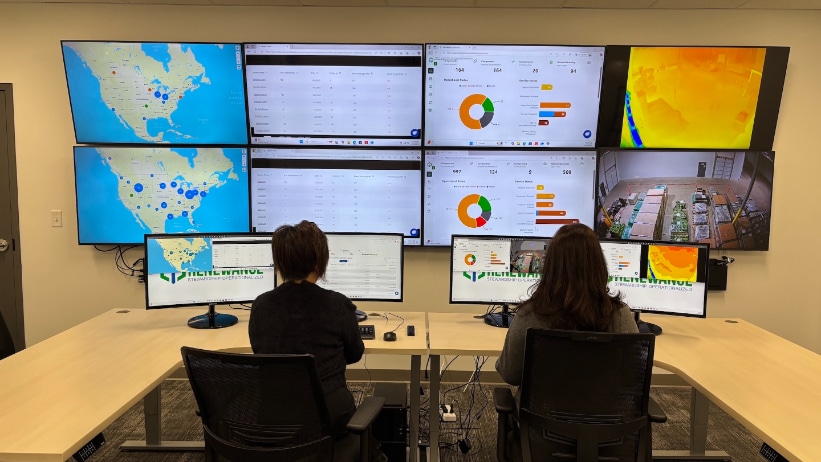
The Renewance Monitoring Center (RMC), at the Elmhurst headquarters, is an advanced operational hub that leverages Renewance Connect’s advanced analytics, real-time dashboards, and cutting-edge monitoring technologies for the Energy Storage Operations and Maintenance (O&M) segment.

Industry observers including McKinsey & Company and Bloomberg NEF report that the global BESS market tripled in 2022 and 2023. The U.S. Energy Information Administration projects that the BESS market in the United States doubled in 2024. The RMC launch positions Renewance to provide scalable and value-added battery asset management services that meet the projected demand for the next five to 10 years.

“Our investment in the Monitoring Center underscores Renewance’s commitment to advancing battery lifecycle management, ensuring that our customers achieve optimal performance and sustainability goals,” said Jamal Burki, Renewance CEO.

The RMC was completed in late 2024 as part of the expansion of Renewance’s Elmhurst headquarters. Technology investments include high-performance computing systems for data processing and enhanced network security to protect sensitive customer data. Renewance also invested in personnel, with additional skilled analysts and technicians to operate the RMC.

The facility is a dedicated, purpose-built space with ergonomically designed workstations and high-resolution monitors that display RenewanceConnect’s dynamic dashboards, offering real-time insights into batteries’ lifecycle and operational status.

The seamless integration with RenewanceConnect ensures data consistency while providing enhanced visualization of lifecycle and operational status for O&M activities. Alerts and notifications are integrated into customer workflows, which enable predictive analytics to anticipate potential issues and provide preventive measures.

RMC dashboards are customizable to client specifications and display data including battery state-of-health (SoH), temperature profiles, charge/discharge cycles and warranty compliance metrics. They provide automated alerts when batteries reach critical thresholds, such as overcharging and potential thermal runaway risks, and support the production of incident tracking and resolution logs and generate monthly, quarterly and annual performance reports.

For Renewance clients, the RMC provides actionable insights that improve their decision-making and allow them to mitigate risks and reduce downtime, ensuring peak efficiency of their operations. The RMC also allows Renewance to better leverage its in-house expertise to support complex battery ecosystems and scale its service delivery as industry demand continues to grow.

“This state-of-the-art facility exemplifies our dedication to innovation, creating tangible value for our customers while driving the renewable energy industry towards a more sustainable future,” Burki said. “The Renewance Monitoring Center represents a pivotal step forward in our mission to deliver end-to-end solutions for battery asset management. Through its launch, we aim to set a new industry benchmark for operational excellence and customer value.”

For more information, please visit https://batterystewardship.com.

Communicate Equipment Repairs Now for Spring Startup Success

No one will know what the equipment needs to prep it for spring startup if we don’t communicate this winter

When we’re talking about maintenance—with the paver or the roller especially—we’re also talking about mat quality. When I look at a paver, I focus on two categories—the screed and the tractor. These two main components affect the quality of the mat you’re placing; both have to be in optimal working order if you want a top quality mat. Both are on the mechanic’s mind when he gets started on winter maintenance.

Here’s a Quick Tip: Spray Pledge furniture polish in the paver’s extender cylinders so they slide out smoothly and properly.

When the mechanic enters the garage in January or February, he’s not going to know what might have been going wrong with the paver last season. Why? Because no one communicated it to him.

Drag Slat Conveyor Checklist for Winter Maintenance

Even with telematics and fancy apps that automatically ping him about how many hours the paver has worked and when it’s time to grease a joint, no one stopped to tell him about a driver smashing the screed on the lowbed or the depth crank getting loose in its sleeve or the time the extension folded in and pinched the feed sensor’s wire. Those important things get lost in the day to day and add up to poor production for the paving crew, and they surprise the mechanic during the winter maintenance season if we don’t tell him about them.

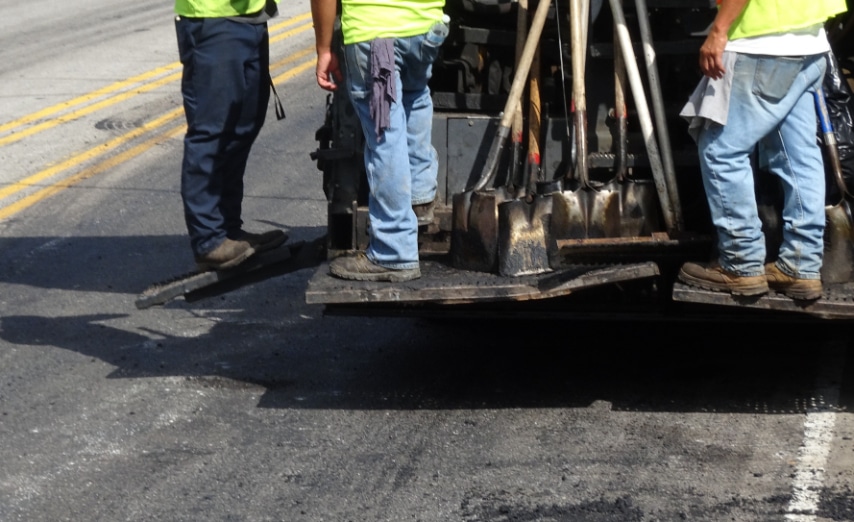
The lowbed drivers have beat up the screed platforms of this paver. The crew has learned they can’t have the left platform in place when the screed is lowered for paving or this element will drag and leave a gouge in the mat. The middle piece that you see in this picture is a tripping hazard. The mechanic has to order new parts to repair this problem for the crew.

We need a system in place to forewarn the mechanic, telling him to order a new screed platform to replace a bent one so the broken one isn’t digging into and marring a mat we’re trying to build. And we need to use that system, communicating with the right people to get action when action is needed.

Solve Winter Potholes

For example, when I noticed the lower scraper bar was missing on the back drum of one contractor’s breakdown roller, I asked the operator about it. His response was that he had informed a foreman about the missing scraper bar a few times already. But the foreman didn’t recognize the importance of the problem. He wasn’t the right person in the chain of command to do anything about the problem, the roller consistently used more water from the back tank than the front, and the machine went without a repair for months.

This is unacceptable, but the operator couldn’t get help with the problem until we went to a supervisor who had direct communication with a mechanic who could order the replacement part.

Inside the red circle, you can see the bracket for the scraper is still in place, but the scraper bar itself has been knocked off by incorrectly loading onto the lowbed. While the roller can still operate and still get compaction, it’s not efficient like this. There are two scraper bars on the drum for a reason: each bar collects and spreads the water across the width of the drum to lubricate the drum and assist in keeping it from picking up material as you compact the mat. When you remove one of these, you remove that device from either the forward or back motion of the rolling pattern.

You have to deliver a note—and usually it’s done at the end of the year—from the equipment operator to the mechanic, sharing what they think is broken or needs repair. Besides the mechanic using the manufacturer’s list of what needs to be done at 500 or 1,500 hours, for regular wear-n-tear, to check pump pressure, to replace seals, to check conveyor chains, and so on, he’ll also use a list from the operator of the piece of equipment. I have a maintenance sheet that I had at Pike Industries that I used for years and years and AsphaltPro has a paver maintenance checklist, a roller maintenance checklist, a crusher maintenance checklist and even a plant maintenance checklist at the magazine’s Digital Downloads page.

Plant Maintenance Checklist Download

When we hand these lists of what we see going wrong to the mechanic, they include more than what you see flagged in an app or a telematics report. If I have a frayed wire, that may not come up. The telematics might pick up there’s a hydraulic leak, but not that there’s a failing O-ring. You must have the operator’s input to understand what’s going wrong and where with the piece of equipment he’s operating day in and day out. He’s using a special set of tools to notice when something needs to be scheduled for the mechanic’s attention.

In the end, the mechanic starting his winter season maintenance on the paver, roller, sweeper, material transfer vehicle or other equipment will have his best chance at setting the crew up for springtime success if the crew has made notes for him. If the paving crew and maintenance crew work hand in hand and with the operators’ notes—with telematics, apps, tablets, paper-and-pencil and phone calls to discuss the fine details—then the whole team can return in the spring with optimized, safe, efficient equipment to get a top quality mat right off the bat.


John Ball is the proprietor of Top Quality Paving & Training, Manchester, New Hampshire. For more information, contact him at (603) 493-1458 or tqpaving@yahoo.com.

Maximizing Off-Highway Haul Truck Productivity

In asphalt and aggregate production, improving efficiency is essential for meeting demand and staying competitive. Off-highway haul trucks are often hindered by issues like underutilized capacity, spillage and downtime, which limit productivity.

At World of Asphalt/AGG1 2024, Josh Swank, chief growth officer at Philippi-Hagenbuch, Peoria, Illinois, and Philippi-Hagenbuch customer Clay Albright, vice president/owner at Caldwell Stone Co., Inc., Danville, Kentucky, discussed how haul trucks in quarry environments can be tweaked with tailgates and sideboards to increase load capacity, reduce material loss and speed up loading times.

Track Haul Trucks with New Fleet Management Tools

1) Increase Your Average Load

Before Albright invested in tailgates on all of Caldwell Stone’s trucks, he ran the numbers using his scale ticketing software. “For the year before we put the tailgates on, one of our trucks averaged 31.4 tons [per load] for the year, with more than 1,000 loads across the scale that year,” Albright said. The 40-ton truck provided a good comparison, since it only hauls two types of material (½-inch chip or 3/16-inch sand). “After we put a tailgate on it, that truck was hauling an average of 36.7 tons per load—a 17% increase.”

According to Swank, tailgates increase volume capacity anywhere from 10 to 20%, depending on the material size and density. “The average most of my clients see is around 12%,” he said. For example, he added, “If you have a 70-ton haul truck and you’re leaving 8.4 tons behind per pass, that’s more than 20 tons per day and 1,000 tons per week you’re leaving behind.”

Regardless of which OEM you go with for your aftermarket solutions like tailgates and sideboards, make sure they’re mining-duty versus agriculture- or construction-duty, Swank said.

Tips to Maintain your Haul Truck

2) Decrease Cycle Time

Swank said adding tailgates to your haul trucks also improves loading efficiency. “It creates a larger loading target for your loader operator,” he said. “Without a tailgate, they’re trying to load closer to the front of the truck to keep material from falling off the back.” This results in slower loading times as operators take care to load material so it won’t fall out the open back.

3) Minimize Maintenance

This method of loading can also increase the maintenance your trucks require. “[Loading the front] puts more load on your front axle versus your rear axle,” Swank said, “and trucks are designed to have equal weight on all tires.”

Whenever Swank visits his clients, he always checks if any tires are more squished than the others (assuming equal air pressure). “If so, that means the weight distribution is off and creating unnecessary tire wear.”

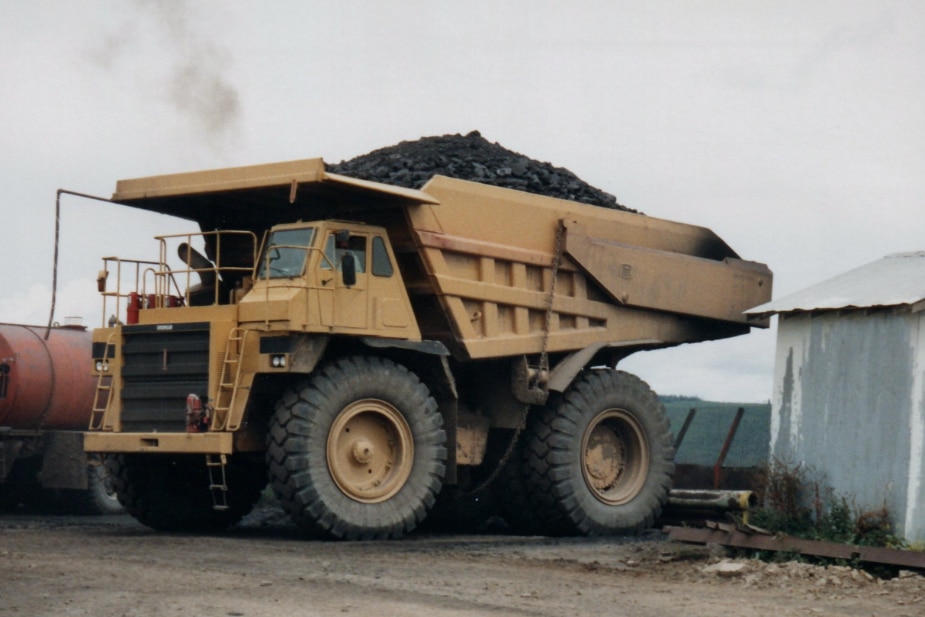
Adding a tailgate and sideboards increases a haul truck’s volumetric capacity, helping operations maximize their efficiency by hauling the truck’s full rated weight.

4) Reduce Spillage

Tailgates reduce spillage off the rear of the truck, while the addition of vertical side extensions/sideboards reduce spillage off the sides of the truck. “When you’re loading, it’s not uncommon for the loader operator to be so concerned with material falling off the back that they load it so material falls off the sides,” Swank said. “Sideboards are a very simple, easy way to keep the rocks in the box, while also increasing volume.”

Sideboards can be used with or without a tailgate, Swank said, adding, “As you go over the 6 to 9 inch number, it’s important that if you’re going to build up the sides you have a unified height all the way around.”

Mobile Fleet Inspections Offer Efficiency

5) Reduce Emissions

“The more trips you take, the more fuel you burn, the more emissions you have,” Swank said. “If you can minimize your fuel burn, that’s great for your bottom line and for the environment.”

According to Albright, the 17% increase per load for their 40-ton trucks resulted in a negligible amount of extra fuel use compared to multiple additional haul loads per day to make up that 17% difference. “We’re getting closer to capacity on every load,” Albright said. “We’re making less trips and filling up quicker.”

Save on Costs with Your Professional Guide to Asphalt Mix Delivery, Part 3—An Independent Look at Best Haul Truck Practices

6) Improve the Bottom Line

According to Swank, the average return on investment for adding tailgates to your trucks is 30 days. “I did a case study with a client a couple years ago, and those tailgates paid for themselves in five days because of the efficiencies they added,” Swank said. “Now, they have them on every truck in their company.”

“What else can you do to achieve that much growth in efficiency with an average return on investment of less than 30 days? The numbers don’t lie.”

Ultimately, Swank said, the addition of both tailgates and sideboards are a small tweak companies can make to their existing fleet to make it as efficient as possible. “It’s not about the number of trucks but about maximizing utilizing what you already have,” he said. “It’s ultimately going to be better for you to expand your trucks, not your fleet.”

Crossing the Finish on S.T. Wooten’s I-40 Overhaul in Raleigh

Completed interstate in Eastern North Carolina offers milestone for S.T. Wooten

While S.T. Wooten crews knew the I-40 road widening project was going to be expansive, nobody could have guessed just how far it would take them. The project already marked a milestone as the biggest in company history when construction kicked off in 2018, but new initiatives combined with Raleigh’s fast growth brought adjustments that added extra years of work to the scope.

After the project was underway, the North Carolina Department of Transportation (NCDOT) was challenged to address additional traffic concerns along Jones Sausage Road from a new Amazon distribution center, which S.T. Wooten also worked on.

S.T. Wooten’s I-40 project was initially scoped as a four-year, $360 million job, but expansions added an extra $60 million to the budget along with two additional years of construction. The project will be reaching completion this fall as crews put the finishing touches on years of hard work and dedication.

I-40 Gets a Redesign in Raleigh

Enhancements to the plan

The purpose of the I-40 project was to improve traffic conditions through a busy 13-mile stretch—extending from the I-440 divide in Raleigh to 2 miles east of the N.C. 42 interchange in Johnston County—with two new lanes added in each direction. Construction also involved a total of 15 bridges being built or revamped, along with the installation of two diverging diamond interchanges (DDIs).

After the project was underway, the North Carolina Department of Transportation (NCDOT) was challenged to address additional traffic concerns along Jones Sausage Road from a new Amazon distribution center, which S.T. Wooten also worked on. The NCDOT took swift action and with recommendations from their engineers, decided to retrofit a DDI across the existing bridge that crosses I-40 to help with congestion. That’s just one example of how the NCDOT was flexible in making accommodations for the developing area to better help the traveling public.

Crews from S.T. Wooten handled nighttime and day paving to complete different portions of the project as it developed and expanded over the years.

Diverging diamonds

The first DDI crews tackled for the I-40 project was positioned at the 40/42 area, which is where Highway 42 crosses over I-40. To accommodate the DDI, two new bridges were constructed with the roads widened on either side of the bridge. The new pattern was put in place during the spring of 2024.

For construction on the DDI at Jones Sausage Road, the process was unique since it was built utilizing the existing bridge. Work included:

  • Tearing down existing barrier rail and adding sidewalk and 3-bar metal rail
  • Installing new latex deck overlay
  • Installing a median barrier to separate traffic

In the fall of 2023, the intersection was put into a temporary single-lane DDI pattern. Crews had to pave the first lift of surface then adjust and activate new signals for the pattern over a single weekend. Once in this pattern, there was a 28-day timeline to complete the median barrier and islands before opening to a full pattern. Crews successfully opened into the full pattern on the weekend before Thanksgiving in 2023.

A 280-foot-long conveyer handled about 169,000 tons of asphalt, saving crews about 8,500 truckloads entering and exiting traffic.

Asphalt conveyer comes in handy

Faced with constant traffic surrounding the I-40 work zone near Clayton, S.T. Wooten engineered a unique asphalt conveyor to help streamline hauling processes for crews. The solution helped move asphalt safely from the Astec double barrel plant, over the highway, and into an 85-ton Gencor silo in the median-area work zone. From there, dump trucks were able to transport the asphalt to onsite paving equipment without having to haul through traffic and impact the traveling public.

The plant had two 300-ton silos and was rated for 350 tons per hour. The team produced multiple mixes for the project—the average load out temperature was 300 degrees for standard B and C mixes utilizing 64-22, and 325 degrees for the D mixes utilizing 76-22 asphalt cement.

After the project was underway, the North Carolina Department of Transportation (NCDOT) was challenged to address additional traffic concerns along Jones Sausage Road from a new Amazon distribution center, which S.T. Wooten also worked on.

We used Astec’s Weighmate system for controls and ticketing; communication among our team members was excellent. Between the plant control house, median control house, as well as the person controlling the trucks dumping for transfer across the conveyor, we used handheld radios. We also used red and green lights operated by the median control house to make sure the hopper and belt weren’t overloaded when the trucks were dumping.

The approximately 280-foot-long conveyer offered benefits to both crews and drivers. The system:

  • Handled about 169,000 tons of asphalt, transporting it through an enclosed conveyor belt over the highway.
  • Prevented dump trucks from needing to merge in and out of traffic while working. This ended up saving crews about 8,500 truckloads entering and exiting traffic.
  • Reduced the total number of trucks and fuel needed to run the project. A single truck only has to drive around 100 yards to move the asphalt from the plant to the conveyer. Compare this to a 20-mile round trip that might be required without the conveyer.

While it was a unique structure, S.T. Wooten has used the asphalt conveyor approach before—about a dozen years ago on a separate stretch of I-40.

The Astec double barrel plant had two 300-ton silos and was rated for 350 tons per hour.

Bifurcated slope creates efficient split

Like most large highways, I-40 has a split between the eastbound and westbound lanes. To accommodate construction, a tall barrier wall was installed the full length of the median and in some areas with the roadway positioned at different elevations. This was done to ensure crews could adjust the profile of the roadway to accommodate the additional lanes.

That difference in elevation, also called a “bifurcated” slope, was successful in allowing each direction of I-40 to have necessary variation and reduce the amount of cut or fill dirt needed. Using this bifurcated setup also made it easier to split off the ‘collector’ and ‘distributor’ lanes that people use for entering and exiting the highway, which was important in helping ease the flow of traffic in the NC-42 and newly added Cleveland Rd. interchange.

Strategic planning and close communication between crews and subcontractors was instrumental in staying on schedule with so many moving parts across the I-40 job.

With the additions considered, the number of lanes throughout the length of the entire project varies from 12 lanes (six in each direction) to six lanes (three in each direction) and due to the very wide pavement section and the curvature of the road the bifurcation was required.

Making the Shift on S.T. Wooten’s I-40 Road Widening Project 

Strategically overcoming setbacks

While traffic was the most consistent challenge for crews on I-40, other obstacles came up as they do with any project. The pandemic, employee turnover and bad weather all threw a wrench into plans at times. Traffic shifts were also a unique element to manage and execute – since crews were on a tight turnaround to complete the paving and grading before traffic had to be re-opened with each transition.

Strategic planning and close communication between crews and subcontractors was instrumental in staying on schedule with so many moving parts across the I-40 job. Experience was also an asset for the team, as S.T. Wooten has now worked with the NCDOT on numerous large road construction projects – including a similarly expansive overhaul taking shape on I-95 near Fayetteville.

Wooten Expands North Carolina’s I-95

End of a journey

The I-40 project wouldn’t be reaching its completion date without the significant progress made by crews this past year. Crews have been working diligently to finish the surface and complete the punch list for the final stretch running from 70 bypass to Cornwallis Road. Extending 4 miles, that covers roughly a third of the total project. Final touches will also include wrapping up construction at NC42, Cleveland Road and Rocky Quarry Road.

While the team is excited to finally cross the finish line, lessons learned from the project will be invaluable for future jobs. One such thing is the ability to adapt to changing conditions and situations. We go into these projects with a very detailed plan and schedule, but being flexible to make adjustments as you move forward—even if it’s not what you initially had in mind—is key to success.

To accommodate construction, a tall barrier wall was installed the full length of the median and in some areas with the roadway positioned at different elevations.

Hundreds of crew members had a hand in construction on the I-40 project over the past six years. They should be proud of their work and a successful product that commuters will be grateful for in Wake and Johnston County’s growing communities.

Matt Davis is a division manager for S.T. Wooten Corporation. He shared, “Our hearts are with all the individuals and communities affected by Hurricane Helene, which unfolded as this article was going to press. We stand in solidarity with everyone impacted, and we are committed to supporting recovery efforts during this challenging time.”

How to Load Different Asphalt Haul Truck Bodies

Editor’s Note: For 2024, AsphaltPro Magazine allows experts in the industry to share how to expand your operations to the next phase of business. Are you ready to start making your own hot-mix asphalt? Let’s turn to some professionals who have equipment, services, software and tenure to help you expand efficiently to mix design, production, hauling and more. This month’s installment from Top Quality Paving & Training, Manchester, New Hampshire, delves into the mechanics of safe loadout for the new plant operator and new haul truck driver, no matter the type of truck.

Not all haul trucks are built the same. They shouldn’t all be loaded the same to deliver our perishable hot-mix asphalt (HMA) to the job site. Something I noticed while helping a crew in 2023 made me reconsider offering the same old advice of the three-drop method for loading all trucks at the silo.

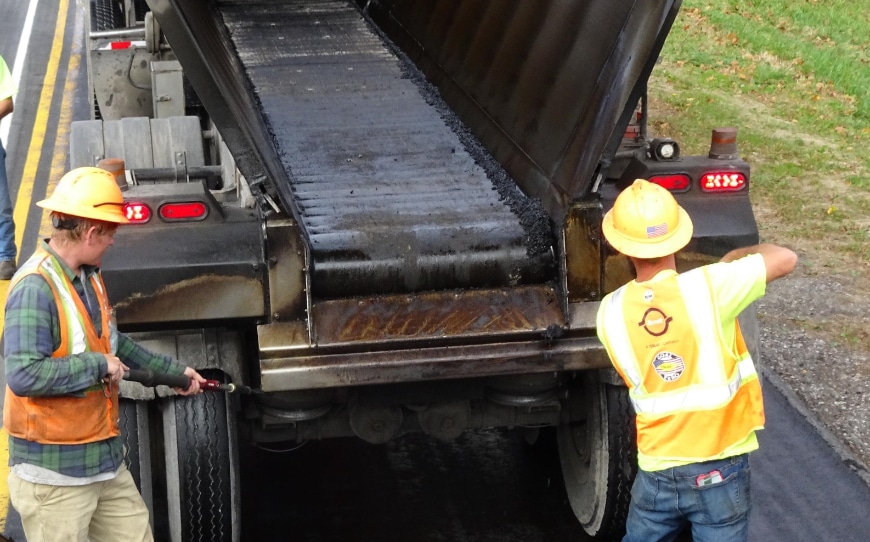
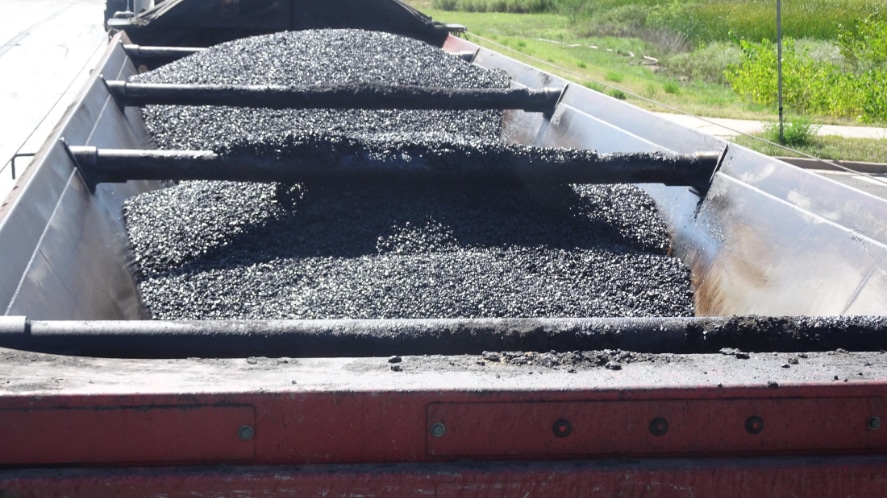
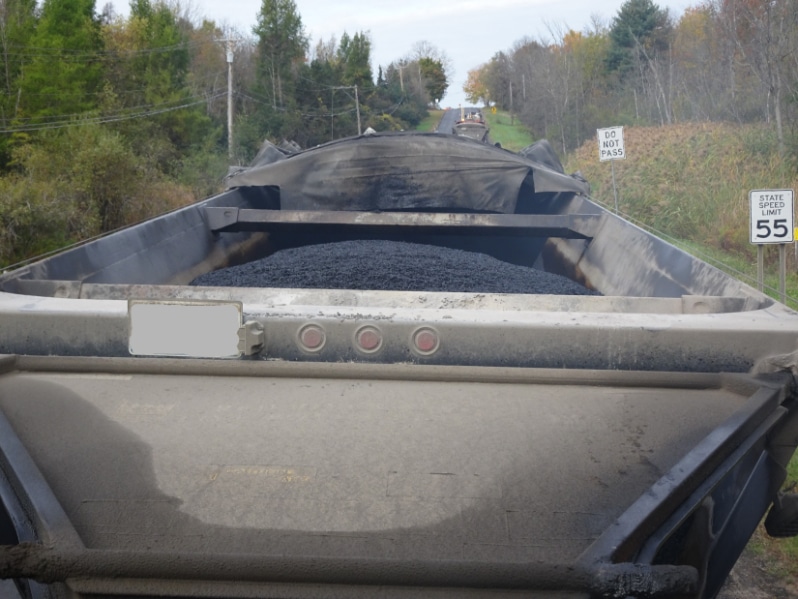
In the first picture, we can clearly see the support frame of the live body trailer with material loaded properly beneath and between the supports. In the next picture, we can see where the material was loaded too high and dropped over the supports. Mix has piled on top of the frame where it has cooled. The next load of mix will knock these cooled chunks into the bed where they will contribute to segregation.

We had a live-bottom trailer on its second round-robin to the job site and as the material slid into the hopper, chunks of cooled hot-mix asphalt (HMA) plopped in, too. When I investigated, I discovered the railings across the top of the truck’s bed were acting as a shelf for mix that had dropped from the silo.

Mix sitting on the support structures cooled as the perishable material was delivered to the job. The material cooled more as the truck returned to the plant. Then new mix knocked the cold chunks into the bed. Let’s talk about how to avoid this problem and how to best use different truck bodies for asphalt delivery.

Save on Costs with Your Professional Guide to Asphalt Mix Delivery, Part 3—An Independent Look at Best Haul Truck Practices

Conventional Trucks

Think about your tandem haul trucks. They’re typically square-bodied. They haul about 20 to 24 tons on average. It’s smart to put a plastic liner in them to create curves in the corners so mix isn’t lodging and building up in the corners. Make sure to stop and spray a release agent in the bed before approaching the scale.

When you get to the scale, follow the marks or lights that the plant has in place to help you line up under the gate correctly. Many plant loadout controls these days won’t let the silo gate open until the operator sees that you’re in the correct position and presses a button “unlocking” the system. This is for your safety. (See the sidebar about AI Loadout Technology for more information.)

Save on Costs with Your Professional Guide to Asphalt Mix Delivery, Part 5—Haul Truck Safety Pays Dividends

The plant operator will want to use the three-drop method to load in three “hills” in the truck to minimize material segregation. You start with the first drop at the very front of the bed; pull forward so the second drop lands in the back of the bed; then back up so the third drop lands in the center. Pull forward, raise the tarp, and proceed directly to the job site. When charging the paver’s hopper, you can raise the bed in a manner that helps the material move as a mass, but the mix tends to roll. (See the article “Save on Costs with Your Professional Guide to Asphalt Mix Delivery, Part 3—An Independent Look at Best Haul Truck Practices” on TheAsphaltPro site for best practices when approaching the job site and backing to the paver.)

In the first picture, we can clearly see the support frame of the live body trailer with material loaded properly beneath and between the supports. In the next picture, we can see where the material was loaded too high and dropped over the supports. Mix has piled on top of the frame where it has cooled. The next load of mix will knock these cooled chunks into the bed where they will contribute to segregation.

U-Shaped Truck Bodies

U-shaped bodies have no corners or crevices for material to build up in. They haul about 20 to 24 tons on average. You’ll want to use the same three-drop method for these trucks. When you charge the hopper at the job site, the mix won’t roll as much as it slides. Be aware, it’ll slide out quickly.

Loading mix correctly at the plant is only one step in preventing material segregation. Maximize loadout efficiency by considering truck body style. All photos courtesy of John Ball, Top Quality Paving & Training

Live-body Trucks

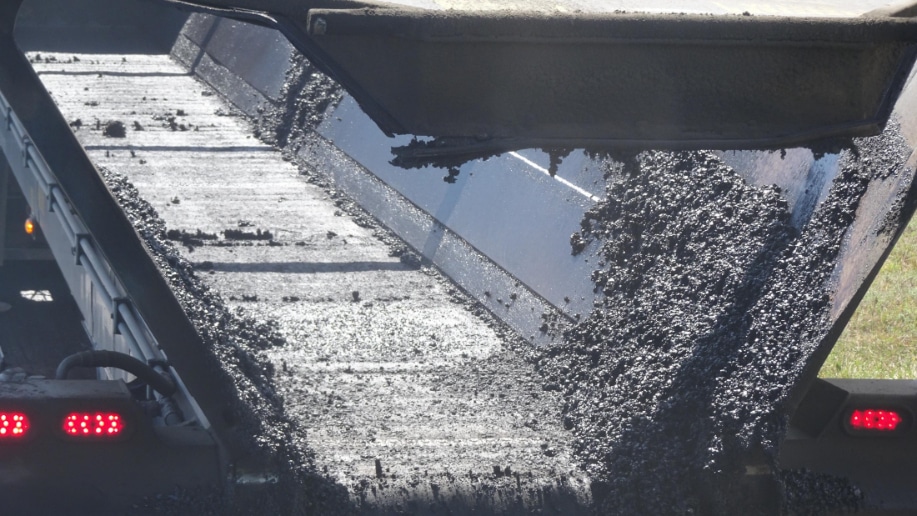
The live-body trucks are typically v-shaped with a chain, like a lattice, or a conveyor belt at the bottom of the V. This conveyor moves the whole load in a mass to help eliminate material segregation; the mix doesn’t roll at all, but moves as a mass. These trucks haul anywhere from 20 to 28 tons, although I’ve seen ones in Canada capable of hauling 35 tons.

For this type of truck body, you want to load in four 5-ton dumps instead of three larger dumps. It’s smart to line the truck up under the silo so you center the gate between the support bars of the truck body. You want to keep each of the “hills” lower than the rafters so the material can’t collect up there and begin to cool.

When drivers fail to clean the truck beds, material can build up on the sloped walls of the live-body trailers as easily as it can build up in the corners of tandem bodies. Spraying beds with a release agent at the plant prior to loadout will only go so far to help with charging the hopper smoothly and with cleanout. Make sure you get to a designated cleanout area and take care of issues like this before they can cool and become a material segregation problem in the next load of material.

Conclusion

Getting the mix loaded correctly at the plant is only one step in preventing material segregation. You can maximize the efficiency of that loadout if you take your truck body style into consideration.

John Ball is the proprietor of Top Quality Paving & Training, Manchester, New Hampshire. For more information, contact him at (603) 493-1458 or tqpaving@yahoo.com.

Central Specialties Wins Excellent IRI

The team at Central Specialties Inc., headquartered in Alexandria, Minnesota, isn’t new to achieving quality with its work. With the motto of “It’s on Us,” the full-service general road contractor has received accolades from various departments of transportation and recently expanded operations to handle the additional work that comes with success.

As demonstrated in the Highway 85 project we discussed in the October issue, they’re open to trying out new technology and they put innovation into their day-to-day business for continuing success. Let’s look specifically at an award-winning project CSI performed on Interstate 94 (I-94) in Stark County in 2023 for another example of their innovation and quality workmanship, and how it all contributes to the expansion.

SDX Trial Success

I-94 Project

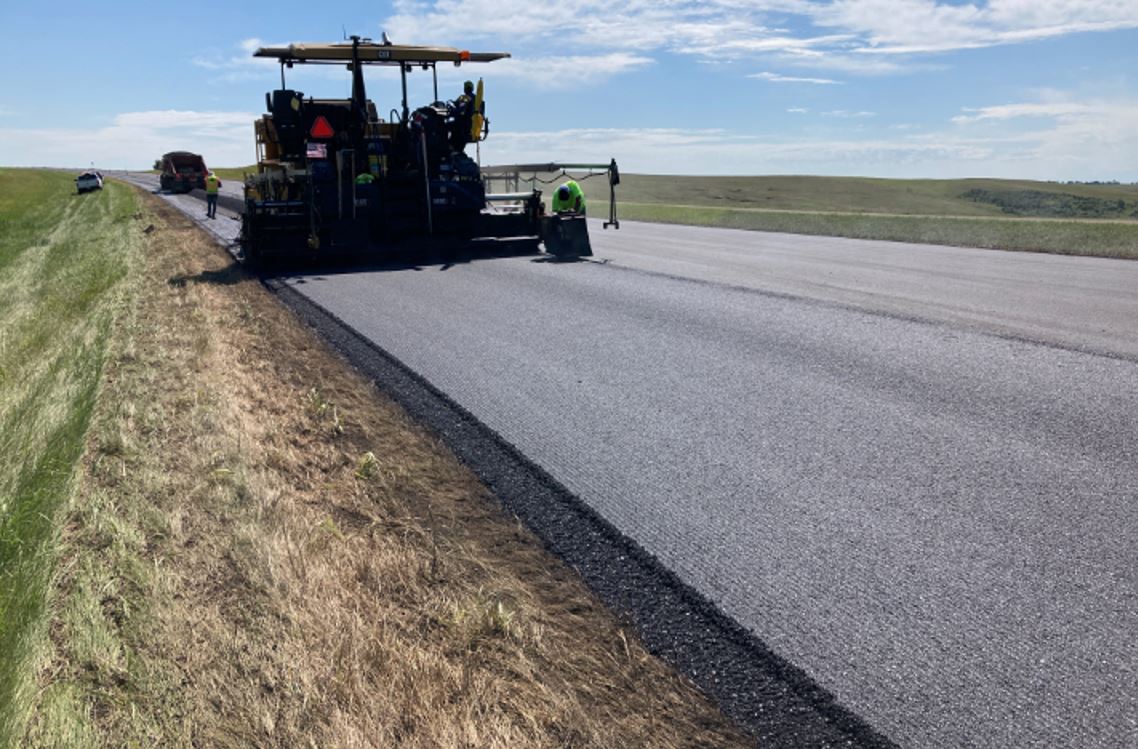
The mill-and-overlay project called for two 1.5-inch lifts along 9.6 miles of two-lane interstate. Operations Manager Joey Johnson shared that it involved concrete removal and repair, as well as hot-mix asphalt (HMA) repairs before the team mobilized their HMA plant for mainline paving to the tune of 38,000 total tons—about 18,500 per lift.

The plant they used for the project is a parallel flow drum plant from CWMF, Waite Park, Minnesota, which can produce up to 700 tons per hour (TPH). CSI positioned their plant about 14 miles from the project and produced the RAP Superpave FAA 45 with a PG58H-34 asphalt cement at 295°F.
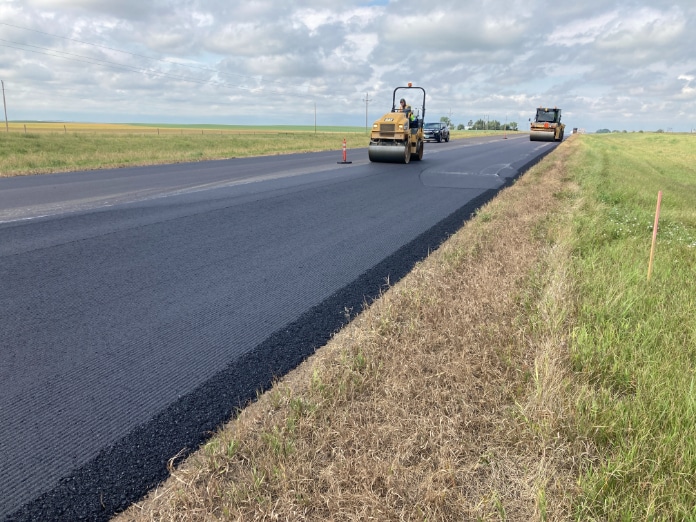
Here we can see the SDX screed pattern on the mat and the roller operators performing their passes. All photos provided by CSI

CWMF Vice President Travis Mick spoke in glowing terms of the team. “Partnering with Central Specialties has been a rewarding experience due to their dedication to excellence and integrity, which perfectly complements our own values at CWMF. Their ‘get it done attitude’ and commitment to building the best road infrastructure ensure our equipment is utilized to its fullest potential, resulting in outstanding outcomes for their projects.”

While the crew used state of the art equipment and new technology like infrared thermal mapping and the patterned SDX screed, Johnson also credits the people who take the time for best practices for a stunning finish. You see, the I-94 project won a North Dakota Pavement Quality Award for ride and density. Johnson reported the bonus-worthy overall total international ride index (IRI) was 25.8 and the average density was 98.7%.

Preferred Materials Executes the Plan to Get the Best IRI in Florida

Those are numbers worth emulating. Here’s how they did it.

On I-94, the team was getting good density right off the bat. Immediately behind the breakdown roller, which was a CAT CB 15 with VersaVibe, purchased in 2020, they were getting a density of 92.5. In the intermediate position, on the bottom lift, they ran a CAT CW34 pneumatic purchased in 2017. In the intermediate position, on the top lift, they ran a CAT CB 15 purchased in 2018. The finish roller was a CAT CB 34.

Laying the first lift was straightforward. It was a standard mill-and-fill. On the second lift, they used the notched wedge joint system from Willow Designs LLC on the center seam to increase longitudinal joint density.
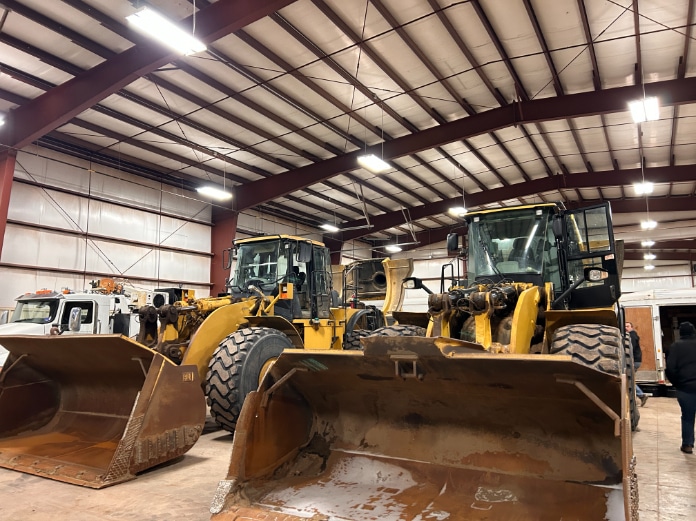
Now that the company has expanded operations to Western North Dakota, they’ve hired additional mechanics to maintain equipment rather than hauling heavy machinery to and from headquarters about 450 miles away.

First of all, they were getting good density numbers behind the screed. Johnson shared: “The Trimble infrared thermal imaging camera was used for tracking mat temperature. Combined with VETA data and analysis software it gave us good confidence with our rolling pattern coverage which resulted in good densities.” As mentioned above, they were seeing densities of 92.5 behind the breakdown roller.

“To be honest, this [thermal mapping] is a very helpful tool to be able to better help get density and ride, seeing issues and ways to improve rolling patterns,” Johnson shared.

The crew wasn’t using a material transfer vehicle on this project—just best practices and a cohesive team. The paver operator, Tomas Chavez, has been with the company for two years and was at the helm of a CAT AP 1055F paver equipped with the new SDX screed CSI is testing for Caterpillar.

Highly Modified Asphalt (HiMA) Offers Results on I-40

Johnson shared that the paving widths varied along the project from 10 to 12 to 16 feet, yet the crew handled the changes smoothly. The dump man on the project was Jose Becerra, and the screed operator, Carlos Pasillas, has nine years of experience.

“Carlos is a very strong leader for our main line crew and a positive person,” Johnson shared. “I believe the reason we won the award was that the crew works together to make the best road possible. There is really a team atmosphere when it comes to Plant 4 crew for CSI. It really starts with John Fales leading the crew and developing them and then the crew taking ownership of the paving. At the end of every job the crew is always asking how they did on ride and density, which shows they have pride in their work.”
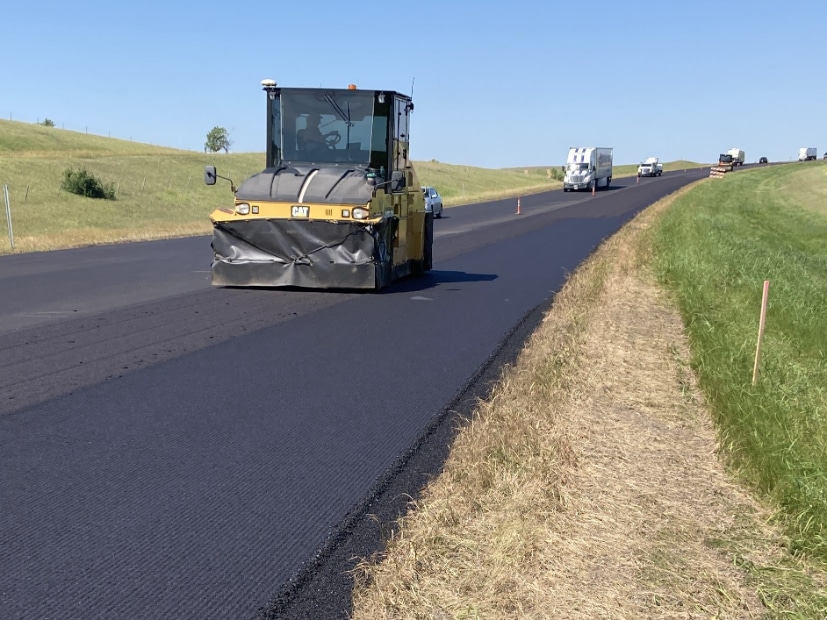
Jill O’Brien operates the intermediate roller toward the award-winning density and ride numbers on I-94.

Winning Against Challenges

CSI began the I-94 project April 4, 2023, and finished it Aug. 14. During those four months, the crew had challenges to overcome to hit an award-winning completion.

“There was a lot of concrete removal, and the state would only close down a certain amount of interstate at a time,” Johnson explained. “Then we would have to go out and patch back in to let traffic back on it. It was difficult scheduling to keep subs on track working and getting a crew deployed on a short window to get the patching done.”

He gave credit to Dave Winkler, the project manager, and John Fales, the paving superintendent for their leadership and expertise on the job. “The project manager really kept a close eye on the subs on when they would be completed with their phases and lining up our paving crew to come in and patch in mix, then move the subs to the next phase to complete to stay on track for the job.”

Supervisor John Fales and Dump Man Jose Becerra—in the foreground—work on the I-94 project.

One aspect of the project that the crew gave extra attention to was the centerline joint. “Making sure centerline is clean after the milling machine,” he shared. “On the bottom lift we had some longitudinal joint failures that we had to mill out and repair because we did not get centerline completely clean but after finding the issue the crew took ownership and got the project back on track.”

At the end of the day, the crew handled best practices and challenges with professionalism that Johnson’s proud of. “I like the fact that when there were issues the crew stuck together to get the job done. They never pointed the finger; they owned the issue and moved on. That is what makes a great crew.”

The completed side of I-94 looks gorgeous and won a 2023 Hot Mix Asphalt Quality Award.

New Location

If you think the logistics of the I-94 project look complex on paper, consider what it was like in the field. With the amount of work available across North Dakota, CSI management decided it was time to expand operations. They purchased a building to start a shop and office in Watford City, North Dakota.

“We expanded with offices and a shop in Watford City, North Dakota, in January of 2024,” Johnson said. The team then used the office space to hold interviews every two to three weeks and set up the offices and a conference room for the project managers to use during the 2024 construction season for both a home base and for meetings with local agencies when needed.

Joey Johnson is the operations manager for Central Specialties.

Immediately behind the breakdown roller, they were getting a density of 92.5.

“The shop is running well,” Johnson shared. “We have three current mechanics working out there and are looking to staff up to four to six full-time mechanics in the future. That will really save us time and money in the future not hauling our equipment in the area all the way back to our main shop in Alexandria, Minnesota.”

Fleet maintenance, whether in Watford City or Alexandria, is another key to CSI’s success. “We really feel that we keep our equipment up to date and have some of the best technology. We swap out our mainline pavers every three years and we send our crews to paving classes every year to keep them up to date on new methods and ideas. We are constantly trying innovation to see what works, such as the new SDX screed CAT has us trying out.”

With updated technology and innovation for a fully trained workforce, CSI takes ownership of its success on every project. The award-winning I-94 project exemplifies this attitude and aptitude and offers a great example of the company’s motto “It’s On Us.”