
Haskell Lemon Preserves Route 66, With Incentive
BY Sandy Lender
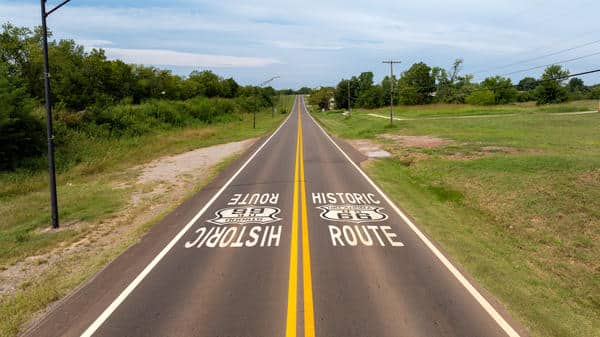
Route 66 Centennial pavement preservation celebration
As our nation celebrates its 250th birthday, its most famous highway celebrates its 100th. To recognize both, AsphaltPro Magazine is proud to highlight a 2025 pavement maintenance project on Route 66 near Chandler, Oklahoma, in which Haskell Lemon Group, headquartered in Oklahoma City, received a smoothness incentive for their good work. Here’s how they improved conditions on that stretch of the Mother Road.
Know Your History
Oklahoma Department of Transportation (ODOT) District 3 let the patching, leveling and surfacing project in spring 2025 to preserve 12 lane miles of a section of Route 66 outside Chandler. This involved milling part of the project, placing a ¾-inch leveling course and 1 ¼-inch surface course over all of it, and installing guard rail. None of this work was foreign to Haskell Lemon crews, which have performed maintenance and preservation along this historic roadway for decades.
Jay Lemon, president of the company and this year’s chair of the National Asphalt Pavement Association (NAPA), shared that they’ve been proud to work on sections of Route 66 within the state for as long as he can remember. In 2015, for example, they handled a project on the business road near Hydro and Weatherford.
A significant project he’s proud of took place in 2001 near Geary. For that one, the crews did more than repair the original concrete highway; they contributed to the nation’s history about this road.
“We removed six concrete slabs to be installed in the Smithsonian,” Lemon said. “We had to be gingerly with the process.” He explained that the team cut and removed the slabs, lifting them onto flatbeds for transport to Washington, D.C., where they are on display today.
For the Main Street of America, crews go where the road takes them. In 2022, Haskell Lemon performed a mill and overlay in the middle of a town. In 2020 and again in 2023, they worked on a section designated 66 north of Oklahoma City. It’s a proud moment to win a bid on the famous route.
Lemon explained that maintenance of Oklahoma’s stretch of Route 66 in the past typically consisted of bringing the highway up to new traffic conditions. “It was a 20-foot-wide, original concrete-paved road, and some sections are still that. But that’s way too narrow for today’s traffic. The majority is widened and replaced, so it’s a more durable product. Maintenance and widenings add 3 to 5 feet to either side and overlay it with asphalt.”
Celebrate our Shared History: https://theasphaltpro.com/route-66-road-construction/

Many of the preservation projects have seen the original 20-foot-wide, concrete-paved road repaired, widened 3 to 5 feet to either side, and overlaid with asphalt. Photo courtesy of Haskell Lemon
Maintain Your History
And that’s the structure his team worked on in 2025; a 24-foot-wide asphalt surface.
“In addition to the pavement patching and overlays, we installed widenings for approximately 40 locations to add guard railing, as a safety improvement,” Lemon shared.
In all, they placed about 19,700 tons of ODOT Type S-5 mix, which requires a PG64-22 binder. They included reclaimed asphalt pavement (RAP) for the ¾-inch leveling course. They produced this in their stationary CMI drum mix plant, averaging production temperatures of 320°F, located about 40 miles from the project.
“We call it our East Plant,” Lemon shared. It’s rated for 300 tons per hour, and for this project, “We averaged 150 tph.”
For paving, the crew used a CAT 1055F machine. “We utilize a CAT conventional paver with an Integral Spray Paver system added to it,” Lemon said. “The spray paver has been used on other US-66 projects, but this one was conventional paving with tack coat applied by distributor truck. We were able to maximize the smoothness incentive on this contract thanks in part to the grade/slope automation.”
“We didn’t consistently utilize thermal mapping on this project, but did use a transfer vehicle for best quality and consistency throughout the whole job. We were seeing 290-310 degrees F behind the screed.” He reported the mix behaved normally at those temperatures for them.
To get compaction and build the joint, they used industry best practices.
“We paved two each, 12-foot-wide lanes. We would match centerline joints within one to two days to ensure that we could provide the best joint possible, before degradation could potentially occur. We utilized a combination of CAT double drum and Dynapac double drum rollers in our rolling train.”
The rolling team was exemplary in their work.
“No intelligent compaction technology was used. We utilized portable density measuring devices to monitor and ensure quality compaction. Our gauges were showing acceptable, and no cores were required as the lifts were too thin to utilize that practice.”
Instead of cores, the gauges used by Haskell Lemon and ODOT proved the team’s success. Lemon shared that they used an “ODOT-approved rolling pattern with verification occurring every day. This was successful for both teams.”
“They completed all of this work with zero accidents, internally or to any of the motoring public,” Lemon said proudly. “This is huge considering the tight working conditions and the rural nature of the project,” which included flagging operations on the two-lane interstate. “We were pleased with how the project was planned and performed.”
Considering the high-profile nature of the historic roadway, having a successful project executed with no accidents is its own reward. Add to that receiving an incentive for its smoothness, and the Haskell Lemon team has even more to be proud of when pointing to their participation in the Mother Road’s centennial celebrations this year.
Share Your History
Has one of your asphalt crews worked on Route 66? Share that with the wider asphalt audience!
Reach out to Sandy Lender at AsphaltPro Magazine so we can write about your project and what that project meant to you. Email sandy@theasphaltpro.com
And if you’re reading this while at CONEXPO-CON/AGG, stop by booth GL30901 to chat in person.