
Using the Screed Effectively: Part 2
BY Benjamin Everett
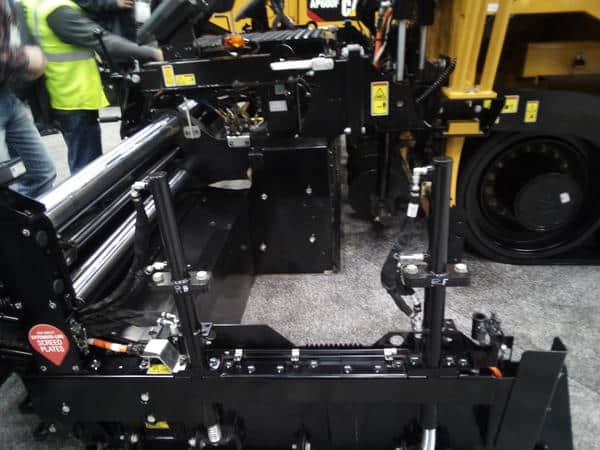
Use the rear mount vibratory screed effectively in asphalt paving
Starting with the February issue, we began a bit of a review on the three most common types of screeds we use in asphalt paving. The first installment included an overview on the three most common types of hydraulically extendable asphalt screeds, along with a bit of a deep dive on the European style tamping screed versions (which are always going to feature rear mount extenders) that are very common in Europe and certain other regions in the world. The tamping screed is rarely used in the United States and Australia for the thinner asphalt overlays, mill and inlays, and generally thinner single layer asphalt passes that differentiate the U.S. approach to asphalt paving versus that of Europe.
To recap, Europe tends to pave much thicker layers in a single pass than the United States and relies very much on imparting a significant proportion of compaction to the asphalt layer early in the process, directly at the paver screed in the form of single or duo-tamp high compaction screeds.
These high compaction European style tamping screeds have a relatively limited presence in the U.S. market other than in specialist, niche applications such as roller compacted concrete and cement-treated base or very thick layers required to be placed in a single pass.
As most asphalt paving in the United States and Australia is usually placed in 2- to 3-inch compacted layers at a time, a vibratory screed is usually the most used tool in these regions. It is most often capable of delivering acceptable and achievable levels of density.
Let’s look at the first of two common versions that we see on most any U.S. paving site—the rear mount (extenders are behind the main screed unit) vibratory asphalt screed.
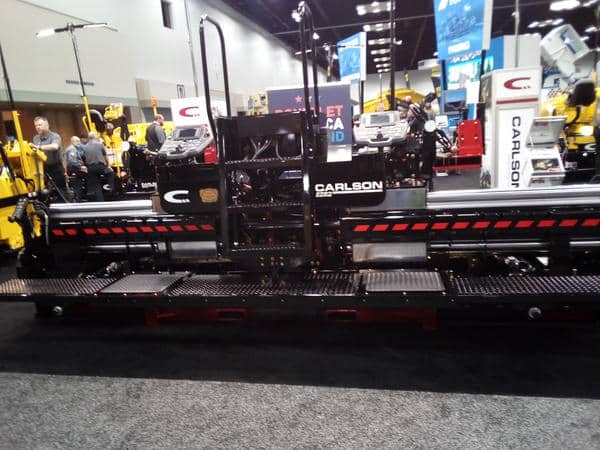
The Carlson EZR2 vibratory rear mount screed includes heavy duty large diameter chrome guide tubes to avoid flex in the screed at wider paving widths.
When to use the rear mount screed
These typically feature on a lot of high specification work such as airports, racetracks, and mainline or interstate paving where density and a consistent mat texture are important.
Because a U.S.-style rear mount vibratory screed is generally a heavily built, strong and stable unit, it usually places a homogeneous and tight mat texture across the entire screed width even at fully extended widths. The extender units are frequently attached to the main screed assembly with massive, 4- or 5-inch-diameter chrome guide tubes with solid guide tube bushes to help prevent flex in the extenders at maximum width and when additional screed sections are installed to increase the overall paving width. Generally, a rear mount vibratory U.S.-built screed is seen in heavy highway applications where paving runs are of a fixed or constant width, and which are less variable in width than those typically encountered in commercial type paving and inner-city streets.
In this application, they typically perform well at lifts of 2 to 4 inches thick. Most often the screed plate widths of both the main and extenders are symmetrical. For example, an 8-foot basic width, rear mount vibratory unit can usually hydraulically extend out to double its closed width to 16 feet at the flick of a switch (before bolting on additional screed sections). This is kind of convenient and pretty nice to be able to do on the fly.
Further, because of the design of a rear mount screed, as the paver moves along, the material being augured out from the ends of the main screed naturally flows into the void created with the extendable sections located behind the main screed. This essentially means you can most often get away with not having to install additional bolt-on auger extensions and tunnel guards. However, the drawback is you end up carrying a fairly large head of material versus a front mount design, and as we will discuss further on, this can create some operational challenges.
Another feature the rear mount vibratory U.S. screed often offers is the main screed plate depth (front to back dimension) in relation to that of the extenders. Most heavy highway rear mounts seem to have at least 16 inches deep main and extender screed plates, with the majority tending to be in the 18-inch or even 19-inch range.
There are advantages and disadvantages with this design. Having a heavy, solid and very stable platform with deep screed plates invariably leads to a very tight, dense and pleasing “ironed” mat texture across the full width of the screed, with generally consistent mat densities at all widths.
The downside of deep screed plates is the longer they are (front to rear), the more volume of excess material you end up carrying. Once you have created a large amount of material, it becomes difficult to quickly (or effectively) reduce the size of this pile of mix on the fly.
For example, if you were paving along quite happily, doing a great job, then encounter an obstruction such as a narrowing from a concrete pedestrian refuge or traffic calming measures approaching an intersection where the available width to be paved is reduced, it is simply not very easy, quick or practical to somehow “get rid of” that large pile of mix sitting in front of the extenders. It wasn’t really causing too much of an issue on the constant-width sections of work. It’s not so easy to reduce that pile by turning off the conveyor feed to the side affected by the obstruction, as what usually happens is the outer corner of the main screed and even the main screed will become starved of material well before you have made much of an impact in reducing the extender pile.
Not only that, given that it’s a fundamental rule of thumb in proper paving practices to maintain a consistent, balanced head of material across the full width of the screed at all times, compromising that known requirement is basically a cardinal sin and doesn’t do much for both your overall mat quality, nor the ability for you to control the screed. Remember our golden rule from the January issue: “Control the feed, and you control the screed.”
Another problem issue for commercial paving contractors trying to use a rear mount highway class design screed on jobs with a lot of short runs is, by design a rear mount requires quite a lot of additional material in the area outside the ends of the main screed and the extenders. It’s a void. Basically, it takes quite a lot of material to be carried in that area just to float the extenders. If you have to keep stopping every 100 feet to pick up and set up adjacent to that short pull to place a series of consecutive passes, it becomes time consuming and labor intensive to continually pick up a substantial pile of mix at the end of each pass. That’s usually why you won’t see too many highway class rear mounts in commercial work.
There is a further peculiarity unique to all rear mount screed designs that doesn’t predispose them particularly well to tricky sites that feature a lot of obstacles to navigate or sites with sharp curves and concrete work. This is the fact that because the extendable sections are located behind the main screed, the length of the side plates (or end gates) is typically around twice the length of a front mount screed.
What this means in practical terms is that you are not able to trace an end gate around a sharp radius particularly well with a rear mount on account of its overall length. There’s going to be a lot more hand work required around obstructions such as light poles and the like. This is not a dig at or a criticism of the rear mount design. In the right application, these screeds shine and can deliver excellent outcomes when set up and operated correctly in their “natural habitat.” As we discussed in the February installment, we want to select the right screed for the right project at the right parameters.
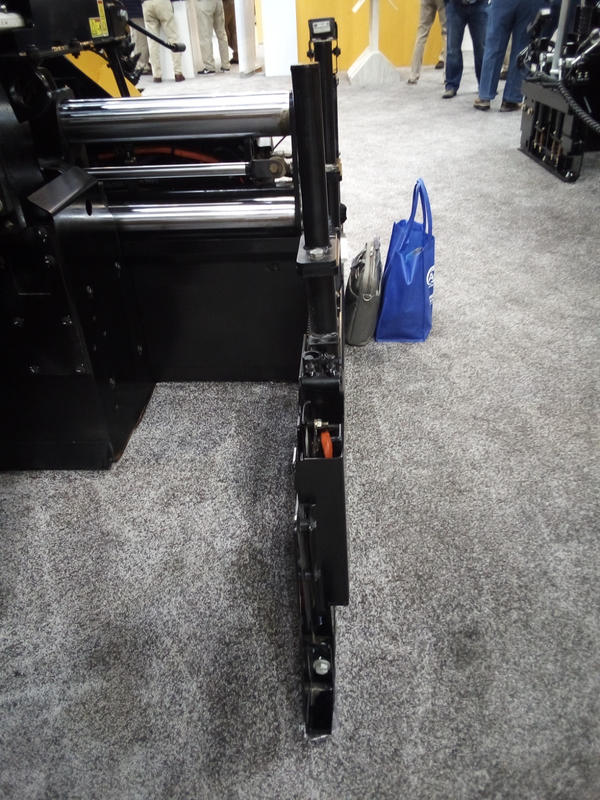
This rear mount vibratory U.S.-style screed shows the location of the hydraulically extendable sections behind the main screed.
Real-world use
Constant width, wide open highway or interstate work, placing multiple lane widths at a time, and high spec airport work is where the rear mount vibratory unit really shines and is most in its element.
There are a number of very capable and popular U.S.-made rear mounts out there that deliver, such as Caterpillar’s SE50 V, SE60 V, SE60 V XW, Carlson’s EZR2 08 and 10, Dynapac’s Mat Master 16R and 20R along with the identical Bomag U.S.A. Stretch 16E and 20E well proven Cedarapids design legacy model, as well as Vogele’s VR 600 and newer 8-foot VR 500-3 V (which I got to inspect at World of Asphalt in March 2025 and was pretty impressed with). In my opinion, these are all fairly well proven, solid platforms that could be considered industry standards.
Further, Astec/Carlson have recently released a new 8-foot and 10-foot heavy highway class rear mount platform—the EZR3 08 and EZR3 10. Given that both Astec/Roadtec and Caterpillar have both had the inventor of the modern day fully floating asphalt screed as we know it through the Barber-Greene line in their respective history, it is sure to have proven design philosophy in its pedigree. (Astec acquired the Barber-Greene brand in 1986, then on-sold it five years later to Caterpillar in 1991, who still hold ownership of Barber-Greene paver branding).
But as always, there can be an exception to the rule, and I’m going to touch on that next.
Recently, I have noticed an interesting new commercial type rear mount platform Caterpillar has designed and built for its new medium sized commercial class 8-foot AP455 and 555 models. The platform seems to have been intentionally conceived to try and address many of the issues I alluded to earlier that typically disqualify most rear mounts from being the screed of choice or at least seriously considered by commercial contractors.
The new model SE47 V is an impressive looking, compact and low-profile design, 8-foot commercial class rear mount screed. It has quite a short 12.8-inch main and extender screed plate depth measurement, which should mean it is a lot easier to manage the volume of material on commercial work and require shorter take off pads. Plus it has quite a low overall operating height compared to most typical highway class rear mount designs. This should mean it is better for screed operators to see into the auger chamber, making it easier to monitor and manage the all-important head of material. It would currently appear to be the only purpose built, compact rear mount design oriented toward commercial paving, from what I can see. I’d be interested in seeing how it performs, and I will be watching with interest.
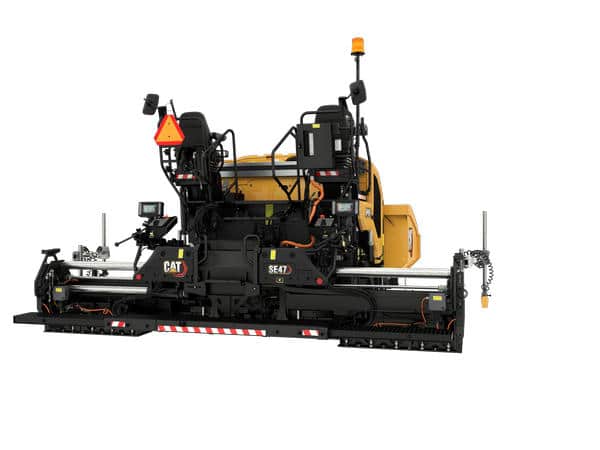
This newer SE47 V vibratory screed from Cat, mounted on an AP455 paver, offers a low-profile design as a commercial class rear mount screed. It features a 12.8-inch main and extender screed plate depth measurement, which should mean it is a lot easier to manage the volume of material on commercial work and require shorter take off pads. Photo courtesy of Caterpillar
Let’s talk in Vegas
Did you pick this up while you’re at the CONEXPO-CON/AGG show? I’d be happy to talk more about these positives, negatives, and best use cases, as well as other asphalt paving topics during my Ask the Expert session at the AsphaltPro Magazine booth GL30901. I’ll be at the booth on Wednesday, March 4, from 1:30 to 3:30 p.m.
In the next installment of this short series, I’ll drill down on that traditional North American commercial paver contractor’s weapon of choice: the front mount vibratory hydraulically extendable screed.
Benjamin Everett is the owner of About Asphalt Ltd., and has worked in the asphalt industry for nearly four decades. For more information, contact him at bjeverett@aboutasphalt.co.