
Beyond the Stockpile: Why Material Visibility Matters More Than Ever
BY Maria McNeil

Managing the stockpile: material visibility impacts your bottom line
Every aggregate producer has experienced an inventory management nightmare. The schedule is set. Customer orders are lined up. Trucks are moving. Then someone realizes the material everyone thought was available is not where it needs to be. Instead of focusing on production, the operations, plant and inventory managers are under pressure to find and transfer inventory.
This kind of uncertainty affects plant flow, truck movement, customer service, month-end reconciliation and operating cost. The inventory problem may show up when a stockpile runs low. But it usually starts earlier, when the information that teams rely on no longer matches what is happening in the field.
Epiroc and Luck Stone Deploy First Fully Autonomous Drill in U.S.
The hidden cost of uncertainty
In many aggregate operations, inventory management still depends on a mix of physical measurements, spreadsheets, manual updates, periodic reconciliations and team knowledge. Those methods have supported producers for years. But they can become harder to manage as material moves across more sites, more products, more customers and more operational handoffs. Every movement changes the inventory picture. The challenge is making sure those changes are visible soon enough to support decisions in the moment.
When visibility lags, uncertainty spreads across the operation. Operations teams lose confidence in the numbers. Plant teams make decisions based on what they believe is available. Inventory teams spend more time investigating discrepancies. Transfers happen at the last minute. Purchasing decisions get delayed because no one is fully confident in current stock levels.
For many teams, the biggest frustration is not simply the shortage itself. It is the time spent reacting to a problem that could have been easier to manage with earlier visibility.
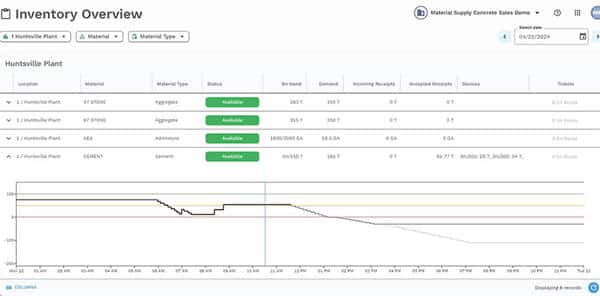
This screen capture shows an inventory overview in the Material Supply platform.
Inventory visibility is not just about knowing how much material is on the ground. It is about knowing what is available, where it is available, how quickly it is moving and what action may be needed next.
Material visibility matters differently depending on the role.
- For an operations manager, visibility supports better coordination across plants, trucks, materials, and customer demand. It helps reduce last-minute scrambling and gives teams a clearer view of bottlenecks before they disrupt the day.
- For a plant manager, visibility helps keep the site moving. When material availability is unclear, the plant may lose time waiting for answers, adjusting loads or working around issues that should have been caught earlier.
- For an inventory manager, visibility supports accuracy, reconciliation and confidence. Inventory teams need to know what material has moved, what has been consumed, what remains available and where discrepancies need attention.
These roles may look at the problem from different angles, but they are connected by the same need: reliable material information that reflects operational reality.
Getting Dwell Time Right: Balancing Heat, Moisture & Mix Design
From reconciliation to operational control across the material supply chain
Historically, inventory management has often centered on reconciliation. Teams measure stockpiles, compare numbers against records, investigate discrepancies and work backward to understand what changed. Reconciliation still matters, but it is no longer enough on its own.
Aggregate producers are operating in an environment where labor is tight, material costs are under pressure and customer expectations continue to rise. Waiting until the end of a cycle to discover a discrepancy can leave teams with fewer options and higher costs. That is why many producers are shifting their focus from simply reconciling inventory to improving material visibility throughout the operation.
Visibility means understanding how material is moving across sites, plants, tickets, transfers and consumption points. It means giving teams a clearer view of what is happening sooner, so they can act before a shortage or discrepancy becomes a larger operational issue.
One of the biggest challenges aggregate producers face is that material data often lives in different places. Aggregate shipments may be tracked in one system. Asphalt consumption may be tracked somewhere else. Purchasing, production, scale operations, dispatch and inventory teams may each have a different view of material movement.
When information stays disconnected, no one has a complete picture. That creates friction for the people closest to the work. Command Alkon’s Material Supply is designed to help organizations gain a clearer view of inventory movement, consumption and availability across operations. Rather than relying only on manual updates and periodic reconciliation, Material Supply can help teams better understand how materials are flowing through the business, so inventory information is more aligned with operational activity.
The goal is not to create more administrative work for plant or inventory teams. It is to help reduce the time spent chasing numbers, checking disconnected records and reacting to surprises.
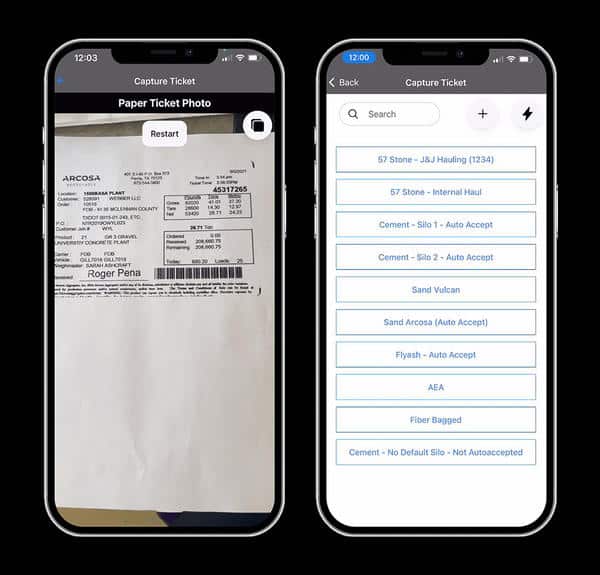
Capture and feed information to gain stronger visibility.
A real-world example: Heidelberg Materials
The value of connected material visibility becomes clear when aggregate and asphalt operations depend on each other.
Heidelberg Materials is currently using Material Supply within its New York and Pennsylvania markets to support the flow of ticket data between aggregate and asphalt operations. By connecting information across both sides of the business, teams can gain a more complete understanding of material movement and consumption. Instead of relying only on separate inventory records, operational data can help provide a clearer picture of how materials are being used and where replenishment decisions may be needed.
The goal is to help reduce the time spent chasing numbers, checking disconnected records and reacting to surprises.
For operations, that can support better planning. For plant teams, it can reduce uncertainty around material availability. For inventory teams, it can create a more connected trail of material movement.
As producers look for ways to improve efficiency, examples like Heidelberg Materials point to a larger shift: inventory can no longer be managed as a standalone function. It is part of the broader material supply chain, and the teams responsible for production, plant performance, and inventory accuracy all need a shared view.
Moving from reactive to predictable
Every producer knows some challenges are unavoidable.
The weather changes. Equipment breaks down. Customer demand shifts. Job sites get delayed.
But inventory shortages often provide warning signs before they become emergencies.
The problem is not that operations lack data. Most aggregate producers generate large amounts of information every day through tickets, transfers, sales, production, consumption and purchasing activity. The challenge is turning that information into visibility that teams can use while there is still time to act.
When visibility improves, operations become more predictable. That predictability matters because many costly inventory problems start with a simple lack of awareness. By the time a shortage becomes obvious, options may be limited. Earlier visibility changes the conversation.
The producers that perform best are not always the ones with the largest stockpiles. They are often the ones with the clearest understanding of what material is available, how quickly it is moving and what decisions need to happen next. That level of visibility helps teams operate with more confidence. In an industry where every ton matters, knowing what is available—and knowing it with confidence—can make all the difference.
Maria McNeil is the solutions specialist at Command Alkon. For more information, visit www.commandalkon.com/products/material-supply/.
Stronger Visibility Gives the Aggregate Producer an Edge
- Purchasing decisions can happen before inventory reaches a critical point.
- Transfers can be planned before they become urgent.
- Plant teams can adjust with more confidence.
- Inventory teams can identify discrepancies earlier.
- Operations leaders can make decisions based on current activity instead of assumptions.
The result of better material visibility and management is not just cleaner inventory data. It is a more predictable operation.