Beyond the Stockpile: Why Material Visibility Matters More Than Ever

Managing the stockpile: material visibility impacts your bottom line

Every aggregate producer has experienced an inventory management nightmare. The schedule is set. Customer orders are lined up. Trucks are moving. Then someone realizes the material everyone thought was available is not where it needs to be. Instead of focusing on production, the operations, plant and inventory managers are under pressure to find and transfer inventory.

This kind of uncertainty affects plant flow, truck movement, customer service, month-end reconciliation and operating cost. The inventory problem may show up when a stockpile runs low. But it usually starts earlier, when the information that teams rely on no longer matches what is happening in the field.

Epiroc and Luck Stone Deploy First Fully Autonomous Drill in U.S.

The hidden cost of uncertainty

In many aggregate operations, inventory management still depends on a mix of physical measurements, spreadsheets, manual updates, periodic reconciliations and team knowledge. Those methods have supported producers for years. But they can become harder to manage as material moves across more sites, more products, more customers and more operational handoffs. Every movement changes the inventory picture. The challenge is making sure those changes are visible soon enough to support decisions in the moment.

When visibility lags, uncertainty spreads across the operation. Operations teams lose confidence in the numbers. Plant teams make decisions based on what they believe is available. Inventory teams spend more time investigating discrepancies. Transfers happen at the last minute. Purchasing decisions get delayed because no one is fully confident in current stock levels.

For many teams, the biggest frustration is not simply the shortage itself. It is the time spent reacting to a problem that could have been easier to manage with earlier visibility.

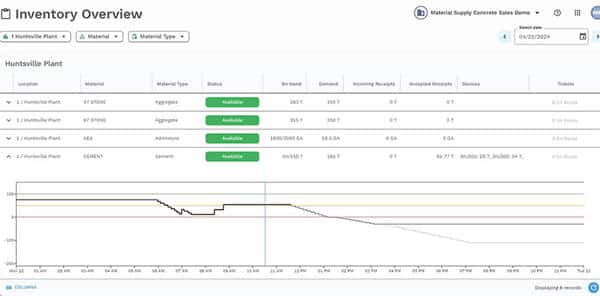
This screen capture shows an inventory overview in the Material Supply platform.

Inventory visibility is not just about knowing how much material is on the ground. It is about knowing what is available, where it is available, how quickly it is moving and what action may be needed next.

Material visibility matters differently depending on the role.

  • For an operations manager, visibility supports better coordination across plants, trucks, materials, and customer demand. It helps reduce last-minute scrambling and gives teams a clearer view of bottlenecks before they disrupt the day.
  • For a plant manager, visibility helps keep the site moving. When material availability is unclear, the plant may lose time waiting for answers, adjusting loads or working around issues that should have been caught earlier.
  • For an inventory manager, visibility supports accuracy, reconciliation and confidence. Inventory teams need to know what material has moved, what has been consumed, what remains available and where discrepancies need attention.

These roles may look at the problem from different angles, but they are connected by the same need: reliable material information that reflects operational reality.

Getting Dwell Time Right: Balancing Heat, Moisture & Mix Design

From reconciliation to operational control across the material supply chain

Historically, inventory management has often centered on reconciliation. Teams measure stockpiles, compare numbers against records, investigate discrepancies and work backward to understand what changed. Reconciliation still matters, but it is no longer enough on its own.

Aggregate producers are operating in an environment where labor is tight, material costs are under pressure and customer expectations continue to rise. Waiting until the end of a cycle to discover a discrepancy can leave teams with fewer options and higher costs. That is why many producers are shifting their focus from simply reconciling inventory to improving material visibility throughout the operation.

Visibility means understanding how material is moving across sites, plants, tickets, transfers and consumption points. It means giving teams a clearer view of what is happening sooner, so they can act before a shortage or discrepancy becomes a larger operational issue.

One of the biggest challenges aggregate producers face is that material data often lives in different places. Aggregate shipments may be tracked in one system. Asphalt consumption may be tracked somewhere else. Purchasing, production, scale operations, dispatch and inventory teams may each have a different view of material movement.

When information stays disconnected, no one has a complete picture. That creates friction for the people closest to the work. Command Alkon’s Material Supply is designed to help organizations gain a clearer view of inventory movement, consumption and availability across operations. Rather than relying only on manual updates and periodic reconciliation, Material Supply can help teams better understand how materials are flowing through the business, so inventory information is more aligned with operational activity.

The goal is not to create more administrative work for plant or inventory teams. It is to help reduce the time spent chasing numbers, checking disconnected records and reacting to surprises.

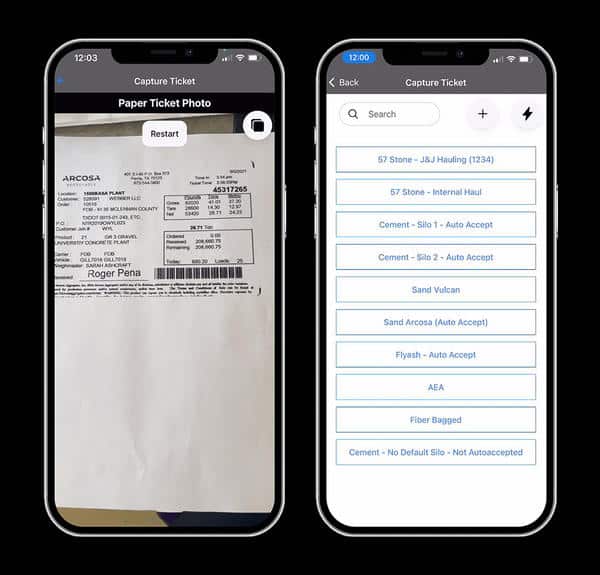
Capture and feed information to gain stronger visibility.

A real-world example: Heidelberg Materials

The value of connected material visibility becomes clear when aggregate and asphalt operations depend on each other.

Heidelberg Materials is currently using Material Supply within its New York and Pennsylvania markets to support the flow of ticket data between aggregate and asphalt operations. By connecting information across both sides of the business, teams can gain a more complete understanding of material movement and consumption. Instead of relying only on separate inventory records, operational data can help provide a clearer picture of how materials are being used and where replenishment decisions may be needed.

The goal is to help reduce the time spent chasing numbers, checking disconnected records and reacting to surprises.

For operations, that can support better planning. For plant teams, it can reduce uncertainty around material availability. For inventory teams, it can create a more connected trail of material movement.

As producers look for ways to improve efficiency, examples like Heidelberg Materials point to a larger shift: inventory can no longer be managed as a standalone function. It is part of the broader material supply chain, and the teams responsible for production, plant performance, and inventory accuracy all need a shared view.

When and How to Add a Magnet to Your Crushing Circuit

Moving from reactive to predictable

Every producer knows some challenges are unavoidable.

The weather changes. Equipment breaks down. Customer demand shifts. Job sites get delayed.

But inventory shortages often provide warning signs before they become emergencies.

The problem is not that operations lack data. Most aggregate producers generate large amounts of information every day through tickets, transfers, sales, production, consumption and purchasing activity. The challenge is turning that information into visibility that teams can use while there is still time to act.

When visibility improves, operations become more predictable. That predictability matters because many costly inventory problems start with a simple lack of awareness. By the time a shortage becomes obvious, options may be limited. Earlier visibility changes the conversation.

The producers that perform best are not always the ones with the largest stockpiles. They are often the ones with the clearest understanding of what material is available, how quickly it is moving and what decisions need to happen next. That level of visibility helps teams operate with more confidence. In an industry where every ton matters, knowing what is available—and knowing it with confidence—can make all the difference.

Maria McNeil is the solutions specialist at Command Alkon. For more information, visit www.commandalkon.com/products/material-supply/.


Stronger Visibility Gives the Aggregate Producer an Edge

  • Purchasing decisions can happen before inventory reaches a critical point.
  • Transfers can be planned before they become urgent.
  • Plant teams can adjust with more confidence.
  • Inventory teams can identify discrepancies earlier.
  • Operations leaders can make decisions based on current activity instead of assumptions.

The result of better material visibility and management is not just cleaner inventory data. It is a more predictable operation.

Modern Dispatch and Scale Ticketing for Asphalt

There is a moment most asphalt producers know well. A truck is sitting at the scale, the driver is waiting, the plant is running and the phone is ringing again. Someone is flipping through paper tickets while someone else is rekeying the same information into another system, and dispatch is answering another “Where’s my truck?” call.

Nothing is broken, the process works, but there is undeniable friction at exactly the points where speed and accuracy matter most.

Walbec Updates, Integrates, Innovates with Command Alkon’s Apex

Familiarity Costs More

Most asphalt operations did not end up with this scenario by accident. These processes were built over time, layered in as operations grew, and for a long time they have gotten the job done.

The problem is that what used to be “good enough” starts to show its age when production speeds increase, margins tighten and expectations go up across the board. A load gets entered at the plant, then entered again in the office, and later someone must reconcile the two for billing. Each step seems reasonable on its own but analyzed as a whole, they create extra work and plenty of opportunities for mistakes. A missed digit or a misplaced ticket might not seem like a big deal until it turns into a billing delay or a customer dispute.

Over the course of a day, week or month, those small issues add up. Trucks take a little longer to turn. The line backs up a little more than it should. The office spends more time sorting things out than moving things forward.

None of it is dramatic, but it is persistent. And persistent inefficiency has a way of quietly eating into both time and margin.

It’s important to recognize that connecting new and efficient processes across the business is not just a small operational tweak. It represents a broader shift in how the operation is managed, and it requires alignment from leadership to make it stick.

Connection

What has changed in recent years is not just the technology, but the expectation that systems should work together and processes should be streamlined across the operation. Modern, cloud-based platforms are built around that idea. Instead of separate systems at the plant and in the office, they provide a shared foundation where dispatch, ticketing and operational data all live in the same environment. The goal is simple. Capture information once and let it move through workflows without being touched again.

When ticketing is handled digitally at the source, that information can flow directly from the plant to the office in real time. Solutions designed specifically for bulk materials operations, including asphalt, are increasingly focused on standardizing these workflows so that scale houses are not relying on workarounds or manual steps to keep things moving.

That alone eliminates a surprising amount of friction.

Instead of tracking down answers or double-checking entries, teams are working from the same data at the same time. The scale house keeps moving, dispatch and the field have better visibility, and the office is not waiting on paperwork to catch up before doing its job.

It’s not about making things more complicated. If anything, it tends to simplify the day-to-day because fewer steps means fewer chances for something to go sideways.

Benevento Enhances Asphalt Operations with HaulHub, CONNEX

Customer Expectation Shift

At the same time, customers have gotten used to a different level of visibility in almost every other part of their business. They can track shipments, check statuses and pull documents on their own schedule.

Then they get to materials, and suddenly it’s back to calling dispatch and hoping someone can give them an update.

That disconnect is becoming more noticeable.

Many producers are starting to address this by offering customer-facing portals that provide access to order status, ticket information and load activity. When the field can find that information on their own, the volume of routine calls tends to drop, and the plant can stay focused on keeping trucks moving instead of answering repeat questions.

When customers have access to clear, timely information, they plan better, call less and gain confidence in the operation because it feels predictable and consistent. In a competitive market, that reliability and ease of doing business carries real weight, and producers who provide it are less likely to see customers looking elsewhere.

A Practical Path Forward

For most producers, modernization is less about making a big leap and more about removing the steps that do not need to be there anymore. At the same time, it’s important to recognize that connecting these processes across the business is not just a small operational tweak. It represents a broader shift in how the operation is managed, and it requires alignment from leadership to make it stick.

Platforms like Command Cloud are part of this shift, providing a connected environment where dispatch, scale ticketing, fleet activity, inventory, sales and back-office processes operate together instead of in isolation. When those pieces are aligned, the operation starts to function as a single system rather than a collection of handoffs. Within that kind of framework, purpose-built tools for dispatch and scale ticketing help standardize loadout workflows and eliminate the need for re-entry, while customer portals extend visibility outward without increasing the burden on dispatch or sales teams.

The result is not a completely different operation, but it is a more connected and coordinated version of the one you already have. The day runs with fewer interruptions, trucks move more consistently, and the office spends less time fixing problems and more time keeping things moving. That kind of improvement does not happen by accident. It comes from taking a more deliberate approach to how information flows across the business and making sure teams are working from the same playbook.

At the end of the day, asphalt production is already a complex business with a lot of moving parts. There are enough variables to manage without adding avoidable friction between systems and teams. Cleaning that up is not about chasing the latest technology. It’s about putting the right foundation in place so the operation can run more consistently, scale more effectively and adapt as demands continue to change.

Greg Fleisch is a solutions specialist at Command Alkon with 25+ years’ experience in asphalt operations and technology/software, supporting customers from evaluation through implementation and optimization.

Plant Operators Benefit from New Controls in the Market

Plant operations benefit from new controls in the asphalt market

For the “Today’s Asphalt Plant” theme of this edition of AsphaltPro Magazine, let’s look at the hot-mix asphalt (HMA) facility’s controls. Original Equipment Manufacturers (OEMs) like Astec Digital, FAYAT Mixing Plants, Gencor Industries and others, launched full plant controls systems or component monitoring systems around CONEXPO-CON/AGG 2026 (CECA). This breakdown gives an overview of offerings to make your plant operator’s job easier and your bottom line more robust.
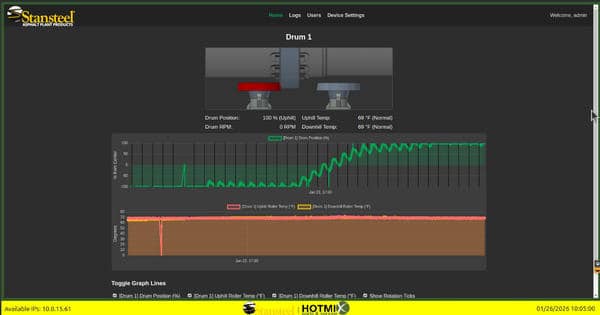
This graphic illustrates the positioning of the Drum Drift Monitoring System™ and Critical Status Modules with the ACCU-pulse system from Stansteel Hotmix Parts & Service.

New Tech to Control Your Plant

CECA attendees who stopped by the Stansteel Hotmix Parts & Service booth saw a handful of new products, including the ACCU‑pulse™ featuring the new Drum Drift Monitoring System™. ACCU-pulse is designed as a plant health monitoring platform.

Llew Williams, general manager, operations, for Stansteel Hotmix Parts & Service, explained that depending on how the system is configured, it can provide operators with visibility into critical operating conditions. “As an example, in addition to the Drum Drift Monitoring System, we recommend adding the Critical Status Modules. [This] includes sensors that monitor material or mix discharge temperature, baghouse inlet temperature, baghouse differential pressure and burner negative pressure.

“Viewed together, these measurements function much like vital signs for the plant. Rather than reacting after failure at the plant, operators gain early awareness of trends that affect production stability.”

At the tradeshow, the company introduced the Drum Drift Monitoring System, which is a way to detect when the rotary dryer has gone too far uphill or downhill. The alert system also monitors thrust roller temperatures.

“Monitoring the temperature of the uphill and downhill thrust roller bearings adds important context to drum drift data,” Williams explained. “When a drum is improperly aligned or no longer ‘floating’ correctly, it will tend to run continuously against one thrust roller. That sustained contact increases bearing load, friction and heat. By tracking bearing temperature in real time, the system helps operators distinguish between a short-term correction and a developing mechanical issue—such as misalignment, lubrication problems or excessive thrust load. Rising temperature is often one of the earliest indicators of a problem that could otherwise go unnoticed until accelerated wear or an unplanned shutdown occurs. In that sense, bearing temperature serves as a ‘confirmation signal’ to the drift data and strengthens early decision‑making.

“Drum position alone shows what the drum is doing; thrust roller temperature helps explain the impact of that movement on critical components. Together, those data points turn drift monitoring from a visual reference into a predictive tool.”

5 Ways to Pay for Your Plant Controls

FAYAT Mixing Plants also brought new controls to the North American marketplace at CECA 2026. Subject matter experts demonstrated the company’s new Vision unified control software.

The Fayat Group, through its brands ADM, Ermont and Marini, now provides customers with broad-spectrum data sharing across its entire product portfolio. This is possible because Vision is a unified “language” that connects all systems. It features simple, user-friendly display modes with dynamic animation and visuals that track the flow of materials and features a digitized “notepad” to simplify daily orders. With Vision, operators can schedule daily production, utilize a predictive maintenance application, take advantage of a virtual assistant that provides the best actions for maintaining plant efficiency during the production process, and more.

The new Vision control software allows all of the ADM, Ermont and Marini brands’ systems to communicate with the outside world. In fact, Vision can receive notifications and data from a cloud platform that allows road construction site management programs to exchange data, receive lists of production orders from remote locations and gather pertinent weather information.

The new software will gradually replace the systems currently used by the respective brands, becoming the unified language for all of the plants. It will allow access to and sharing of big data while enabling comparisons between different types of production processes. For example, a customer with both continuous and batch plants on their production sites can evaluate, as needed, the most cost-effective and efficient process for similar types of recipes by comparing their energy consumption.

Technicians opted for a simplified dashboard, designed to show only the essential process information and material flows. In this way, should problems or anomalies arise, the operator can still dynamically recall additional functions.

With the Vision graphical interface, the company aimed to make the user experience and interaction between the operator and the system as intuitive as the devices many people, especially younger generations, already use every day.

Another key feature in the operator’s process display is the use of realistic digital animation, which visually represents the material flow within the plant in a way that is both immediate and intuitive. The use of different colors in the animation allows the operator to distinguish and recognize the various materials (solid, liquid and gaseous) as well as the different mixes being processed.

With the new interface, the operator will no longer be limited to controlling individual functions. He will be able to see where and how the material is being transported at any time, with different color flows when there are multiple active mixes in production.

The new Vision control software will also rely on Artificial Intelligence (AI) algorithms, complete with a new series of smart features to simplify the operator’s work. For example, the production orders can now be managed in a more energy-efficient way by creating sequential recipe lists.

In conjunction with the predictive maintenance application, the operator will be notified. Guided by the expertise of ADM, Ermont and Marini technicians, this program gathers data from the various systems and provides the operator with notifications and alerts on maintenance needs, potential system risks, possible causes of downtime, and suggestions for restarting operations, and other useful functions. The first tests of this exclusive application were conducted at the plant of an Italian customer, who made their facility available to the technicians for several days.

The operator will also have access to a virtual assistant, which, when consulted, can recommend the best actions to maintain the plant’s efficiency during the production process. In turn, the chatbot will be trained on the process using data collected from both the smart ecosystem cloud platform and specific information on the production flow of the individual plant. Consequently, the chatbot’s ability to provide information will refine over time, but it already starts with a substantial data set. The information that is gathered on the cloud platform is sent by the machine’s sensors, while the recipe, productivity and energy consumption data will be managed in a totally confidential manner.

An additional advantage of these solutions is that they will all be retro-installable: the open structure of the new Vision software will also allow for the integration of new applications in the future, which can be run within the same environment.

CONEXPO/CON-AGG Highlights to Guide Your Asphalt Business

Astec Industries, Chattanooga, launched its Signal Connectivity Suite from Astec Digital during the show. The platform allows communication and monitoring across all plant and mobile assets, letting the owner stay connected, gain actionable insights and optimize operations. Specifically, Signal includes an asset map, machine overview, plant overview, LiveJob (live tracker) and paver tracker screens.

When on the Asset Map screen, you have a visual, location-based view of all assets, allowing you to check key statuses like fuel level and engine hours. This offers you access to your entire fleet for easy navigation and lets you spot assets needing attention.

When on the Machine Overview screen, you have a comprehensive, real-time snapshot of a specific piece of equipment. This shows you “live” machine status indicators for fuel, faults, location, live schematics and so on, letting you identify any issues with real-time diagnostics and historical data views.

When on the Plant Overview screen, you have a real-time, high-level snapshot in one dashboard of all the plant operations, from production rates and energy use to historical trends. This offers instant visibility into top-level plant performance with production and energy metrics and drill-down views into the individual details like mix information, silo inventory, tank inventory, alarm information and so on.

When on the LiveJob screen, you have a real-time, live dashboard of ticketed material output and job progress. This gives you visibility into tons loaded and job progress with detailed breakdowns by job, customer, mix and truck rotations.

When on the Paver Tracker screen, you have real-time location and activity tracking of the asphalt paver. This screen provides insight into job activity such as total runtime, distance paved, average feet per minute, idle events and reasons, and it integrates with Astec Digital’s telematics ecosystem for unified data and alerts.
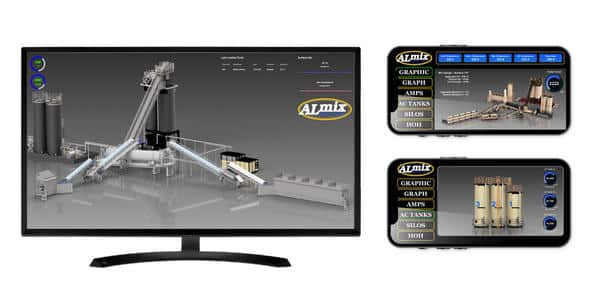
ALmix Insignia Vision provides information about the plant in real time, allowing users to view and organize data not just from the ICS blending controls, but also from the loadout and ticketing side of the plant.

Another total plant control system that’s been on the market for over a decade is the ALmix Insignia Control System (ICS), but ALmix debuted the ALmix Insignia Vision, its remote monitoring for ICS, during the show. ICS gives you a comprehensive view of your plant’s performance and now you can access that information remotely via the ALmix Insignia Vision remote monitoring app.

Rob Barker, an ALmix program engineer, explained that ALmix Insignia Vision provides information about the plant in real time, and that means you can monitor your ongoing operations from offsite. The remote capabilities aren’t just monitoring temperatures and product levels, but are also offering owners or managers a look at what’s happening in real time, such as loadout activities. Insignia Vision allows users to view and organize data from the ICS blending controls, and from the loadout and ticketing side of the plant.

“You can also see tickets from the Insignia Loadout System,” Barker said. “We have camera integration so you can see your local cameras from your iPhone or Android.” When owners can’t be on site, they can still be in tune with what’s happening. “This is for someone not to control their plant, but to look at their plant. If they [can’t] be there all the time, they can take a break and still monitor.”

Of course, monitoring materials in real time is a valuable aspect of the technology. “When looking at the hot oil heater, we can monitor all the status, such as status indicators for the e-stop, burner switch on, the oil level, circulation pump status, low or high oil pressure alarms, stack relay, burner enabled, call for heat, and more. For AC tanks, we can see the quantity that’s in there. Same thing with our inventory silos. We can see how much we currently have in our silos. And, of course, we can see all of our amp meter readings.”

The ALmix Insignia Vision mobile app will be available to ALmix customers. “It works with our Insignia control system and loadout and we also have it in the ALmix Cloud for casting to monitors in conference rooms.”
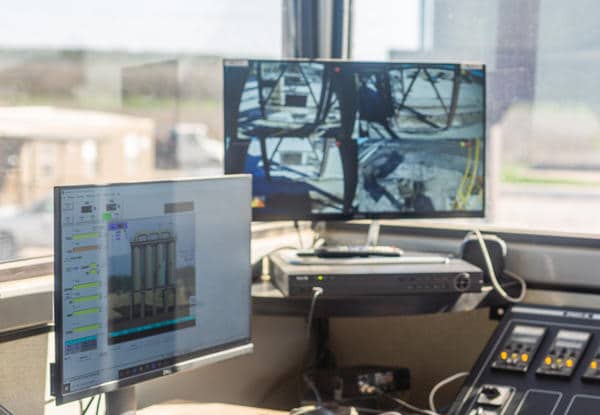
With the Command Intelligence Assistant from Command Alkon, dispatch and operations teams can evaluate delivery priorities and determine which orders should be fulfilled first based on operational conditions and available data.

Command Alkon hosted a press conference at the show during which Chief Product Officer Ranjeev Teelock previewed Command Intelligence, the company’s new agentic AI capability within its Command Cloud platform. Teelock introduced the capability as the company’s next step in bringing AI directly into operational decision-making for materials producers.

Command Intelligence enables users to interact with operational data in an intuitive and actionable way through the Command Intelligence Assistant. The assistant allows teams to access key performance indicators and operational metrics to support faster and more informed business decisions. For example:

  • Dispatch and operations teams can evaluate delivery priorities and determine which orders should be fulfilled first based on operational conditions and available data.
  • Billing personnel can rely on the assistant to identify and adjust incorrectly priced tickets, reducing manual effort and minimizing errors.
  • Users can ask questions or issue directives, and the assistant can generate reports, visualized data elements, or prioritized task lists using data from the Command Cloud platform as well as production, quality control, and enterprise systems used across the industry.

The goal is to simplify how the user runs the business while reducing reliance on tribal knowledge by providing consistent, data-driven insights.

The company also previewed new Command Cloud capabilities designed to support more flexible operations, including multi-plant remote batching, which allows operators to manage batching activities across multiple locations from a single interface or tablet. This capability helps producers improve staffing flexibility, streamline plant operations and maintain production oversight across distributed facilities. With innovations like Command Intelligence and Batch AI, the company is continuing its mission to help producers modernize operations and move confidently into the next era of intelligent, data-driven materials production.

New Tech to Control or Monitor Your Burner, Heater
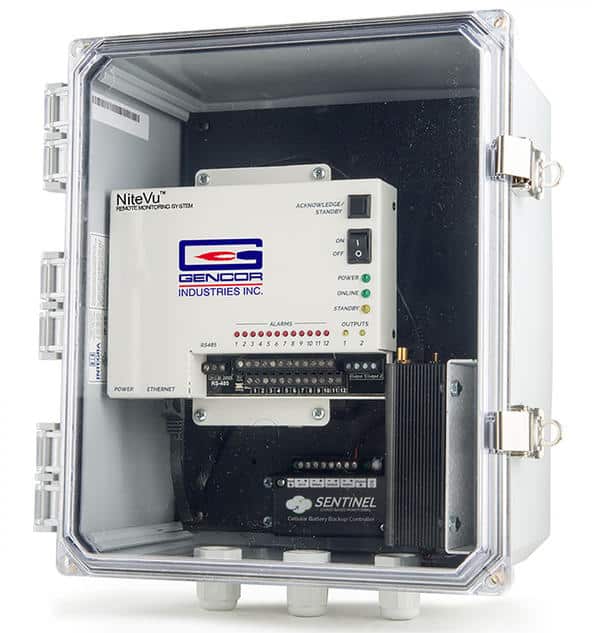
The self-contained NiteVu monitor from Gencor is mounted to a conventional thermal fluid heater or asphalt tank. Real-time monitoring and alert features detect early warning signs of equipment malfunctions or changes in conditions of the burner and fluid temperature.

Gencor Industries, Orlando, debuted the NiteVu™ cloud-based remote monitoring system for heater and asphalt tank applications during the show. Plant operators will recognize that thermal fluid heaters and liquid asphalt storage tanks are typically equipped with devices like burner flame scanners, thermocouples, pressure transducers and limit switches to control the heating process. You must monitor these elements along with everything else you’re tracking at the plant.

The NiteVu from Gencor takes the signals from these devices and inputs them to a software application that monitors them and their settings for you. Any failure or excess limits immediately triggers NiteVu to alert the user (or users sequentially).

It works via a NiteVu “box” that is mounted to any conventional thermal fluid heater or asphalt tank equipped with standard electrical connections. The device is completely self-contained in a NEMA weatherproof enclosure. Real-time monitoring and alert features detect early warning signs of equipment malfunctions or changes in conditions of the burner and fluid temperature. Because NiteVu uses a cellular connection, internet access isn’t required. When an alarm event occurs, NiteVu can send an email, text message or voice phone call to alert users via ATT or Verizon cellular service.

The NiteVu remote monitoring system stores all sensor readings in the cloud. Multiple devices can be managed from one account with an unlimited number of user profiles. Alarm levels are programmable. Enhanced data logging capabilities allow users to print, graph or export historical records. The system can also produce event reports as well as generate an audit trail of all user data activities, edits or deletions.

Basically, Gencor’s cloud-based NiteVu system lets facility managers monitor heater and asphalt tank functions, including critical conditions, remotely from any smartphone or internet device. The system takes the burden out of managing the tank farm by monitoring burner functions and temperatures, delivering alarms and datalogs, from various equipment sensors and giving you access to your readings from anywhere in the world.

Make More Tons with the Right Asphalt Plant Parts

Another remote monitoring system plant operators may be familiar with is the NiteOwl® Advantage Alert System from Stansteel Hotmix Parts & Service. During the tradeshow, the OEM introduced an expanded liquid AC circuit monitoring feature to the system and launched the Day&NiteOwl product.

The unit monitors the same points as the NiteOwl—which is designed to automatically call up to four phone numbers repeatedly until someone is alerted if the temperature of liquid AC or hot oil exceeds the pre-set high or low limits or when conditions are abnormal—but now also allows the plant operator and personnel to check and monitor other items on the plant, such as the level in the AC tanks. It also monitors for amps on motors in case the unload pump used by delivery drivers goes awry.

The foundational system includes a rugged back-up battery that automatically recharges and provides 20 hours of continuous operation should electric power fail. Other standard equipment includes a temperature probe in a stainless-steel drywell placed directly into the hot oil circulating line to continuously monitor temperature levels. A surface-mounted temperature sensor is also available.

Here’s Your Next Best Asphalt Plant Investment

Other expanded features of the Stansteel Day&NiteOwl include:

  • The capability to call and/or text via cellular network when an alarm is triggered.
  • Monitoring the main power connection. In case of failure, the system can still be fully operational for several hours and trigger an alarm alerting the user of the power failure situation.
  • Registered users can inquire about the status at any time via call or text.
  • Monitor, record and modify operations from the database records that are remotely accessible.

Basically, the Day&NiteOwl monitoring system is designed to prevent surprise cold-asphalt mornings and reduce weekend plant visits while giving you the ability to check tank farm status anytime. A prime benefit of the system is the remote accessibility of the Day&NiteOwl, which allows an immediate update of plant conditions available 24 hours a day, seven days a week from any location, using any telephone equipment.

New Tech to Control Your Crushing & Screening
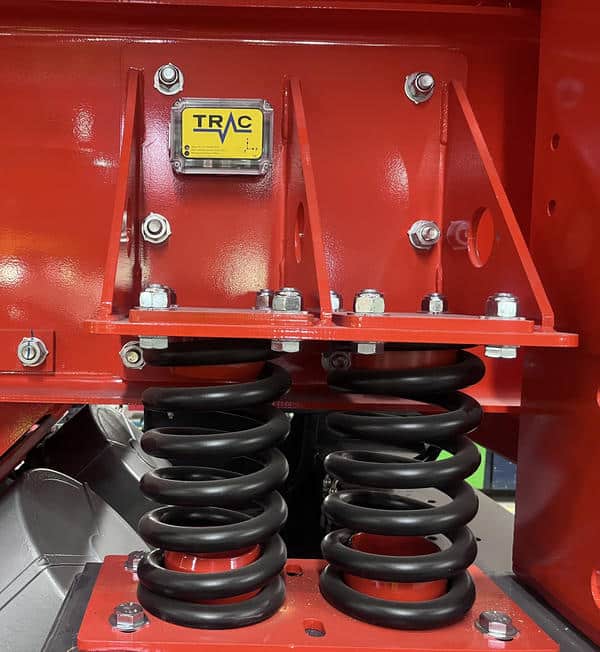
Developed by Terex screening engineers for vibratory screening equipment, the portable, multi-sensor system, TRAC, focuses on how screens behave in real operating conditions.

On the screening side of production, Cedarapids, a Terex brand, released its new TRAC vibration analysis system during the show. This system has been engineered specifically for crushing and screening environments, with the potential to extend across a broad range of vibrating equipment.

The system uses four WIFI-enabled sensors mounted on the screen structure to capture acceleration, velocity, movement, inclination, orbit and bearing behavior. This coordinated data allows operators to identify issues such as loose components, damaged media, broken springs, hazardous frequencies, imbalance and or timing problems, and to confirm correct screen installation and performance. (For an article on how to correct screen imbalances, check out the February issue’s “Crusher Maintenance: Let’s Correct Abnormal Vibrations” by Eagle Crusher’s Louis Fitzpatrick.)

The TRAC technology is now available across screening equipment within Terex Materials Processing (MP) brands including Powerscreen, EvoQuip, Terex MPS (Cedarapids, Simplicity) and others. Pat Brian, vice president of Terex Aggregates, said, “It helps take some of the guesswork out of understanding screen performance, giving customers and distributors clearer insight into how the screen is operating and where attention may be needed.”
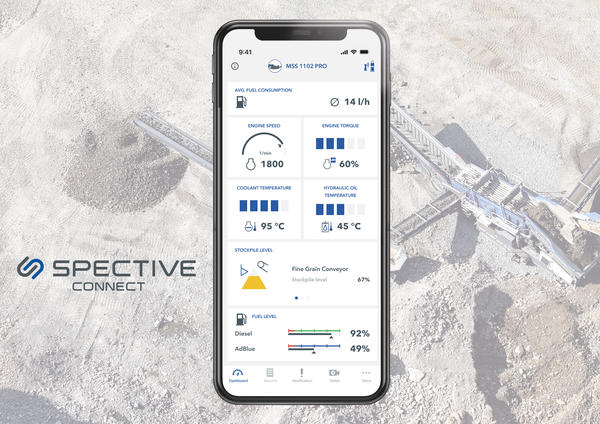
Kleemann, introduced the Spective Connect operator information app for screening systems to the North American market during CONEXPO.

Kleemann, in the Wirtgen Group family, now offers the Spective Connect operator information app for screening systems and launched it for the North American market during CECA. The company describes Spective Connect as “the logical extension of the Spective operating concept.”

With Spective Connect, all important information about the machines in a train is transmitted to the operator’s smartphone. Whether he’s in an excavator or wheel loader or somewhere else nearby, he has relevant information on the status of each connected machine.

The digital application provides the screening operator with relevant data such as speed, consumption values and fill levels directly on his smartphone. Stockpile monitoring can be used to display the status of material stockpiles. When a certain predefined value is reached, the operator is notified that the stockpile should be cleared promptly.

Editor’s Note: Does your company run software or an app that’s not listed above to control the blending, loadout, burners, crushing or other aspects of production? Whether your technology is all new in 2026, includes updates this year, or has features you’ve counted on for the past decade, the AsphaltPro audience could benefit from hearing of your experience. Either you or your OEM is welcome to reach out to share information. Send an email to sandy@theasphaltpro.com.

Increase Tons in 2026 with Strategic Plant Tech and Pre-Checks

Get your winter plant upgrades and spring pre-check list to increase 2026’s production success

January is the right time of year for most North American asphalt producers to handle updates and upgrades at the hot-mix asphalt (HMA) plant. Maintenance activities that were too cumbersome to schedule during the height of construction season when a shutdown would mean a costly delay to production can be executed now.

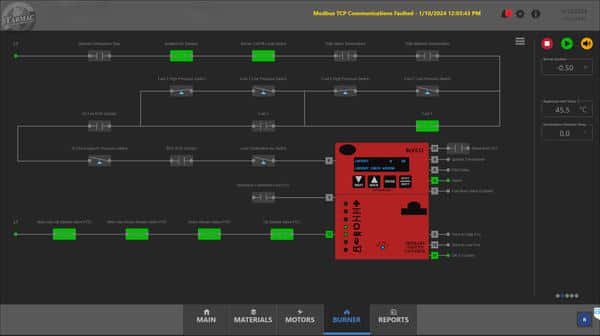
Here’s an example of the limit stream on a burner controller and the self-diagnosis screen immediately showing the operator a failed interlock. This screen shows the plant operator the limits that must be met before the burner can function. Photo courtesy of Tarmac International

Five original equipment manufacturers (OEMs) and plant service providers took time prior to seasonal shutdown to offer their top tips for making the most of your winter schedule. Starting with ideas for upgrading to enhance your 2026 production, these gentlemen offer non-branded advice you could implement before season startup. They also dive into the top maintenance issues you should be watching out for in today’s asphalt mix production climate.

“A plant dry run not only verifies equipment’s operational capacity but gives a team a baseline for typical plant noises and vibrations they can expect during operation. This gives the team a head start on keying in on new noises or smells that may indicate looming issues.”—Ted Hope

The 2026 Pre-Checklist for Your Plant

Check and Control the Burner

More than one source wanted to remind asphalt professionals of the burner at the heart of your HMA plant. Terry Elbert of Commercial Asphalt Plant Services, Minneapolis, Minnesota, suggested inspecting and performing maintenance on the burners prior to spring startup.

“Both the hot oil heater burner and rotary dryer burner have fans that suck in dust throughout the year,” Elbert said. “This dust can collect in and on areas such as impellers, dampers, pressure switches and lines, pilot valves, ignitors, and scanners. Buildup of debris on dampers can affect air-fuel ratios, resulting in inefficiency. Buildup on impellers can cause balance issues, resulting in premature bearing failure. Buildup of debris in pressure switch lines, ignitors and pilot valves/plumbing can result in the dreaded misfire. Just a little cleaning in these areas can save you a lot of trouble later.

“It is also a good idea to test burner safeties at this time,” he continued. He cautioned that some burners in the field might have safety switches that have failed or weren’t wired or adjusted properly.

Make Plans for Plant Maintenance this Winter

But don’t stop there. “While you’re at it, have your combustion gases analyzed. This will tell you if you are burning efficiently throughout the firing range. Sometimes small air-fuel adjustments can result in big savings.”

Ron Heap, the president of Tarmac International, Inc., Kansas City, Missouri, spoke of investing in burner control technology for remote monitoring and troubleshooting. He started with a financial scenario.

“Let’s say mid-year, a burner goes down and the plant cannot make repairs and bring the dryer back online,” Heap theorized. “It will cost $2,000 to get a burner tech to the site and $2,000 for him to return home. If there is one day of work, that brings the cost to $6,000. Add to that the lost revenue from being down. My suggestion is to invest in a burner control that allows the operator to see the instrument limit stream that caused the failure and allow a serviceman to get online and see the burner, negative pressure at the burner faceplate, and the ID fan function. 90% of the onsite service calls can now be via a phone call and an internet connection to the burner control.”

This plant was retrofitted in fall 2025, with Commercial Asphalt Plant Services repairing the components and making the connection points for the customer. Terry Elbert explained his team designed the layout to set the tanks at least 300 feet from a creek and to facilitate a northern exit road due to a blind intersection on the south side of the plant site. These are the types of overhauls and big projects you may be saving for winter downtime. Photo courtesy of CAPS

Iván Fernández Hevia, international sales director of Intrame, Valladolid, Spain, also highlighted the importance of investing in various controls, stating this will depend heavily on the specific plant being evaluated.

“Generally speaking, for an older plant, I would suggest upgrading the controls and automation systems, including a full set of sensors,” Fernández Hevia shared. “This allows operators to monitor and control every parameter, generate comprehensive reports, and ultimately reduce operating costs while detecting potential failures in advance.”

Does it snow on your plant? “For customers in cold regions with snow during the winter such as Greenland, Switzerland, United States and Poland, we usually recommend covering all the motors, allowing ventilation,” Intrame’s Fernández Hevia shared. “When snow slowly melts, moisture can get inside and damage the motors, so this helps prevent that.”

How Lubrication Strategies Cut Costs at the Plant

Analyze the Parts

“Each year it is required that a NFPA® (National Fire Protection Association) test be performed on the burner and the fuel train,” Heap said. “This can check the double block valves for leaks, which can reduce the risk of an explosion if both stay open when they should be closed. The review will also point out other instruments that have failed. Finally, the burner can be tuned for lower CO which saves money on fuel and reduces emissions of CO to the atmosphere.”

Michael Petrie, the president of Motion Engineering, Caledonia, Wisconsin, also addressed analyzing the burner’s efficiency prior to season startup.

“I recommend firing up the burner, lighting it, and cycling it up and down while making some test mix if possible,” Petrie shared. “Be sure to use an analyzer during this process as it is the only way to confirm proper fuel efficiency and reliable burner performance. Running test mix helps confirm that every component is ready for a smooth, productive asphalt season.”

Winter Asphalt Plant Greasing: What to Know and Avoid

The team at Astec Industries, Chattanooga, Tennessee, agreed with the importance of using an analyzer to double-check burner and fuel efficiency. They also recommended the use of another type of analyzer all over the plant. Ted Hope, the director of service at Astec, suggested plant personnel perform a thermographic electrical inspection.

“A thermographic electrical inspection helps reveal electrical issues with the equipment such as: Loose connections, which can be from installation, overtime due to vibrations, or even thermal cycling; undersized components; and failing or damaged breakers and starters. These catches early in the season can help avoid costly downtime and last-minute repairs. A thermographic electrical inspection can be done with just the equipment running but will reveal the best results under a load.

“The start of a season would be a great time to do an inspection,” Hope continued. “These inspections can help operators across all regions and plant sizes find and repair issues before they create downtime. It is always less costly to do the repairs on your schedule than the equipment’s.”

Get Clean Production Next Season

The inspection isn’t something your plant personnel will necessarily do on their own. Hope explained: “A thermographic electrical inspection requires an infrared thermal camera (major brands being FLIR or Fluke), but the inspection is almost always sold as a service. The reason for this is due to certifications and training the inspector must have to provide an adequate report and results. There are many providers across the world that provide this service.”

Along with investing in a thermographic electrical inspection, plant personnel should consider investing in an inline flow meter on the main gas line to track fuel consumption.

Petrie suggested this technology “provides precise tracking of fuel consumption, which is critical for optimizing plant efficiency. As the industry moves toward transparency and accountability of a plant’s carbon footprint, accurate tracking will likely at some point no longer be optional. This technology is one way to start collecting meaningful data to understand how your asphalt plant is performing to benchmark energy use. I think that in time, regulatory agencies will require documentation of fuel consumption per ton of asphalt produced. Adopting this technology early would allow for a strategic advantage.”

Replacing the floor of the drag slat conveyor is one of the large projects you may have saved for winter downtime. Photo courtesy of Motion Engineering

Get Strategic

Elbert suggested another technology that can add a strategic advantage as we head into 2026.

“As far as adding a new technology, my first choice as an operator would be license plate identification for trucks coming onto the scale,” Elbert said. “Information for that truck can be saved and auto populated on the scale ticket. This may not make sense for a smaller operation that utilizes the same small group of trucks but, for a larger operation selling multiple mix types to multiple customers, this can free up unnecessary CB chatter, reduce ticket errors and save data entry time. Any technology that allows your operator more time to focus on the plant will pay dividends.”

It will also pay dividends to run some strategic tests during the off season when performing maintenance doesn’t require an interruption in production.

“Run a rotational test on veiling,” Heap suggested. “Here you would run a plug of material into the drying section and watch the veil as it moves through the drying zone. Misadjusted drying flights can be easily seen, and a movie taken with a phone. Doing [such testing] improves safety and reduces dollars spent.”

Mix-and-Match Asphalt Plants

“Complete a dry run before starting up,” Astec’s team suggested.  “A trial run of the equipment can give the team on site time to test all the motors, belts and rotating steel—all before it is used to make asphalt. A plant dry run not only verifies equipment’s operational capacity but gives a team a baseline for typical plant noises and vibrations they can expect during operation. This gives the team a head start on keying in on new noises or smells that may indicate looming issues.”

Petrie recommended getting the tank farm hot and circulating liquid asphalt cement (AC) throughout the system.

“Circulation of the hot oil system is paramount to ensure that the meter pump is functioning properly and that there is proper flow without restriction in the system,” Petrie said. “It is important to check that valves and pumps are working properly and there are no blockages throughout the system. If this is not checked, it could lead to a multitude of problems including changing out valves and pumps, replacing or cleaning strainers, flow problems, and leaks.”

“This technology is one way to start collecting meaningful data to understand how your asphalt plant is performing to benchmark energy use.”—Michael Petrie

These workers are completing a bearing and pin inspection on batcher gates. Photo courtesy of Motion Engineering

Back to Basics

Along with the guidance offered here, don’t forget the foundational concepts of good plant operation. If your plant has been running for a few years, the winter downtime is the right time to get back to basics with maintenance and inspection.

“I would encourage them to inspect the entire plant for buildup,” Elbert said. “Inspect the baghouse for buildup. Baghouses tend to condensate more at the end of the season as temperatures drop; this can lead to ‘mudding’ on the baghouse walls or on the auger grates if you have them. You will want to clean this so it doesn’t continue to build.

“Inspect the ductwork between the dryer and baghouse,” he continued. “Oftentimes, dust can settle out and build up in the bottom of the ductwork. This causes higher velocity and premature wear. Clean or chisel the recycle scoops and the drum mixing area. Check the silos. Buildup on the cones will not go away when you put hot mix on top of it; it will only continue to grow. Start the season out free of buildup throughout your plant.”

Top Plant Fixes to Plan for Winter Downtime

Hope also spoke of general housekeeping. “A clean and organized plant site greatly enhances the chance of catching issues before they turn into lost production time,” he shared. “Clean equipment can show leaks potentially long before the seal or bearing completely fails. This gives the plant personnel time to get the item replaced before its inevitable failure. This extends well beyond mechanical as a clean electrical cabinet or panel is not only safer but prevents potential issues caused by dust and greatly decreases troubleshooting time if an issue arises.”

By using this winter’s downtime to install meaningful upgrades and prepare your pre-startup checklist, you’re strategically planning for a prosperous 2026 and guarding against unpleasant surprises in the spring. At the end of the winter day, the guidance and ideas mentioned above are the top tips to help enhance your bottom line.

Resources for More Information

The original equipment manufacturers (OEMs) and service providers who responded to questions for this article took time to share their expertise with the readers of AsphaltPro and provided excellent information. To address additional questions you might have, reach out to them, or your specific OEM, directly.

Astec Industries

Ted Hope

thope@astecindustries.com

Office (423) 827-1591

Commercial Asphalt Plant Services

Terry Elbert

Terry@caplantservices.com

Office (763) 910-0051

Intrame

Iván Fernández Hevia

ivan.fernandez@intrame.com

Office (954) 865-9627

Motion Engineering

Michael Petrie

Mike@motionengineering.net

Office (414) 510-6097

Tarmac International

Ron Heap

Rheap@tarmacinc.com

Office (816) 220-0700

Loadout Control Offers Peace of Mind for Hall Contracting

Loadout control offers peace of mind for Hall Contracting’s plant operations

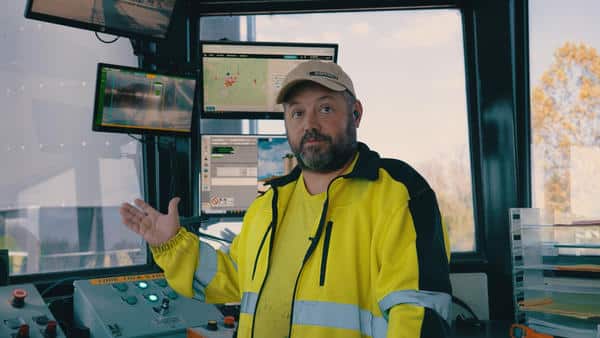
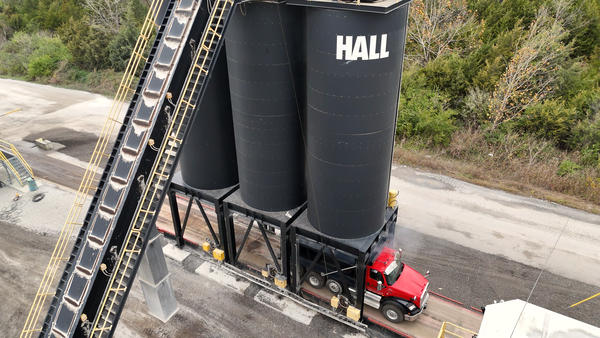
The team at Stansteel Hotmix Parts & Service, Louisville, Kentucky, met up with Robert Schedko, a plant operator for Hall Contracting of Kentucky, to assess the performance of a new loadout system. The producer had installed the OEM’s Look, Lock ’n Load technology, and the team wished to check in to share Schedko’s experience with the industry.

Schedko confirmed in an online interview that Hall had the system installed at the end of 2023/beginning of 2024 and, “Since we have used it, we have had zero hood hits and zero spills on the deck for this whole season.”

Is Everything Ready for Season Startup Except Loadout?

Let’s look at how that works and what it means for the producer.

A controls engineer for the OEM shared the “Look Lock and Load Safety Loadout Truck Recognition System,” via a smart computer, uses “computer vision” to mathematically use images to train its neural network. When a haul truck pulls up to the silos, the Look, Lock ’n Load system digitally scans an image of the incoming truck and differentiates between the truck’s cab and bed. The display for the plant operator indicates a red zone for the cab and a green zone for the loading bed. More than that, the system can lock out the silo gates in the red zone.

Robert Schedko is a plant operator for Hall Contracting.

Basically, if you see two green lights on your display screen, you’re ready to load, Schedko shared in his online interview. If you don’t have two green lights on your display screen, you need to look at your lines and see where errors are happening. He explained that the iteration of Look, Lock ’n Load that Hall had installed locks out all the silos until a truck pulls under the one it’s supposed to load from. Then only the one selected is unlocked; the others remain locked.

“Before the Look, Lock ’n Load, you could dump any time from any silo whether there was a truck on the scales or not,” Schedko said. “It didn’t detect weight. It didn’t detect if there was even anything there that was supposed to be there. This here will actually look out and if it sees a cab of a truck or a person, it shuts it down to where nothing will open. It has to have a truck bed underneath the silo for it to work or another device designed to receive asphalt; not a hood or a cab. This has added a whole new field of safety that we had none of before with our basic loadout system.”

Safe HMA Loadout

That kind of pressure weighs on the operator who’s monitoring 100+ loads per day along with his other responsibilities.

Lennie Loesch, the president and CEO of Stansteel Hotmix Parts & Service, reminded us, “Human plant operators do not just ‘run machines by pushing buttons.’ They manage dynamic plant systems with moving parts, volatile materials and human factors. Humans watch for unsafe conditions, respond to alerts, coordinate with ground crews and keep an eye on everything using their sight, hearing, smell and their irreplicable human intuition.”

With the management of those dynamic yet repetitive systems comes unintentional complacency. It’s not difficult to miss a step in a process you’ve executed a few dozen times in a day.

When trucks approach the scales, Schedko has a smart computer system assisting in lining everything up and preventing gates from opening until it’s safe to load.

“We have done over 3,000 tons in one day, about 120 loads,” Schedko said. “That’s 120 opportunities for a mistake. The odds aren’t good for the operator running by himself to not make a mistake…and sometimes it’s not even the operator making the mistake. It could be a truck driver driving out from underneath of [the silo].”

Schedko has seen it happen.

“I’ve had a truck drive out and [the Look, Lock ’n Load system] shut the doors and I had maybe two shovels worth of mix on the side on the floor.”

The former loadout system Schedko had been working with required updates but wasn’t giving him confidence. “Loading trucks has always been quite the stress for us because of having a loadout system you couldn’t trust. You had to be the one that had to manage all the security and safety because of that. The [new] system takes that burden off of us.”

AI Loadout Technology

“We are honored to have been granted by the United States Patent and Trademark Office, a patent on the AI-based Look, Lock ’n Load System,” Loesch said. “It uses AI technology to stop accidentally dumping silo discharge onto the cabs and hoods, or past the tail gate of trucks loading out. It removes the operator’s repetitive or tedious task of making a decision—up to several hundred times a day—that the trucks are lined up properly under the correct silo gates.”

“My favorite part about the system is having something there to watch out for me; basically, another set of eyes,” Schedko said. “It’s like having another person that all they do is watch and make sure things get loaded safely and having that has taken a lot of stress off of me doing my job.

“The Look, Lock ’n Load system has allowed me to step away and do other things with a lot more peace of mind. Before, I still had to do that stuff but it was more of my head was spinning in circles trying to stay with what I’m doing and watch the loadout…now I can rely on the Look, Lock ’n Load to handle a lot of the ‘what ifs’ or ‘what if something goes wrong.’ It handles that.”

Train Humans for Plant Maintenance and Operation

Train the mechanic, operator for maintenance at the automated HMA plant

Throughout 2025, AsphaltPro Magazine has included a set of how-to plant maintenance articles from Stansteel Hotmix Parts & Service, Louisville, Kentucky, in the February, March/April, June and August issues. These checklist-heavy pieces are designed to help your plant personnel plan for optimum uptime during the paving season by performing routine and intentional maintenance on plant componentry on a schedule.

While a number of plant-related original equipment manufacturers (OEMs) mention their training opportunities in this year’s Training Directory, let’s focus on the Hotmix University (HU) offered by Stansteel as a wrap-up to those plant maintenance training pieces. Specifically, let’s dive into the philosophy behind offering training to your plant operators when so many automated systems are available in the marketplace.

“It is vital for hot mix producers/plant owners to send their plant operations and management personnel (both new and experienced) to training courses and peer networking events—to better hone their craft with input and direction from trusted specialists, industry veterans, and their peers.”—Lennie Loesch

First, the HU sessions offered in Louisville every January and February are split into two. One is for asphalt plant managers and superintendents. Two identical sessions are for plant operators.

The instructors boast decades of experience working on multiple plant brands and types, and the company offered brief bios on a few of them. Gregg Gilpin, the director of electronic controls, has 37 years in the industry. Rick Rees, who authored the articles included this year, is a product developer who has visited, consulted on and upgraded 1,000 plants and has 40-plus years in the industry. Randy Ficklin is a market development manager for the Mountain West region with 40-plus years in the industry after flying C-130s in the United States Air Force. Steve Elam is the director of Hotmix Parts & Service and started running asphalt plants during college 43 years ago. Rick Bloodworth is a project engineer, a CMI Triple Drum specialist and a key developer of the company’s RAP Eater, with 45 years in the industry. Bill Winkers is a service manager, former plant operator/foreman and has 45 years in the industry. These men, and others, offer real-world experience to the students attending the sessions.

As mentioned above, many companies, including Stansteel Hotmix Parts & Service, offer automation and controls systems to help producers augment the less-skilled workforce plaguing the industry today. With these new systems available, a producer may be tempted to forego training, leaving a warm body in the control house while the intelligent systems do all the work. Lennie Loesch, owner of Stansteel Hotmix Parts & Service, shared the growing philosophy among OEMs, whether or not they offer robust controls packages to “fool-proof” maintenance schedules, blending and loadout.

“Regarding the question of whether A.I. technology has advanced to the capability of safely running an asphalt plant entirely on its own, let’s first consider commercial airplane pilots,” Loesch began. “While some phases of airplane flight are controlled via autopilot, there are still several strong reasons why human pilots are essential. For example, humans are still better at making complex, real-time decisions in unpredictable situations such as sudden weather changes, irrational passenger behavior or system malfunctions.”

“Specifically for asphalt plant operations, placing a human operator in the lead is still the wise and essential choice.”—Lennie Loesch

Anyone who’s operated an asphalt plant for a day can see the parallel he’s drawing here.

“Plus, human pilots provide an additional layer of redundancy to ensure passenger safety, especially for when electronic systems fail or become exposed to software bugs or cyberattacks,” he continued. “In other words, it’s not just about flying the plane—it’s about everything else that human pilots do through intuition, which AI cannot reliably replace.”

Now let’s apply this to asphalt plant operation.

“Specifically for asphalt plant operations, placing a human operator in the lead is still the wise and essential choice. While AI systems can control mix production, monitor temperatures and even adjust ingredient flow, asphalt plants are not pristine, fully standard, precisely controlled environments. There are unexpected equipment issues, material inconsistencies and other human factors on the ground (truck drivers, loaders) that can introduce safety threats. A human operator can adapt in real-time, troubleshoot and quickly ‘save the day,’ while AI systems could only report an error message under similar circumstances.

“Furthermore, human plant operators do not just ‘run machines by pushing buttons.’ They manage dynamic plant systems with moving parts, volatile materials and human factors. Humans watch for unsafe conditions, respond to alerts, coordinate with ground crews and keep an eye on everything using their sight, hearing, smell and their irreplicable human intuition.

“So, while we can consider AI-based systems to be super assistants, they cannot fully replace human operators; they can help a good operator become an excellent one. While AI can help, it cannot care, adapt or intervene like a human. It is still the human operator and superintendent who should make the final calls toward asphalt plant operation.”

With human beings still essential for safe plant operation, human beings need to understand the ins and outs of safe plant operation and maintenance.

“That’s why it is vital for hot mix producers/plant owners to send their plant operations and management personnel (both new and experienced) to training courses and peer networking events—to better hone their craft with input and direction from trusted specialists, industry veterans, and their peers,” Loesch concluded.

No matter which training program you find most convenient for your set of plant personnel to attend, the fact remains that training is vital for safe and efficient operation and for optimum uptime next construction season.