
Asphalt Improves Waikiki Thoroughfare in Road Builders Rehabilitation Project
BY Sandy Lender

The asphalt professionals at Road Builders paved approximately 200 tons a day on a Waikiki mill-n-fill project amid heavy tourist traffic
Performing a pavement maintenance project in paradise may sound like a dream job, but it takes the same dedication from the crew and commitment to best practices that paving anywhere else in the world requires. In fact, the rehabilitation of Kalakaua Avenue on Waikiki also required strategic work zone setup and safety vigilance to keep foot-traffic off the fresh mat—a mat that met specs for the City & County of Honolulu Department of Design and Construction (DDC). Let’s take a look at how an experienced team from Road Builders Corporation, Honolulu, handled it all.

Project Manager Jennifer Gallego-Nakamoto shared the team worked together to ensure the project could “flow as we go,” with communication between crew members, foremen, engineer, superintendent, project manager, city inspector, safety officer, traffic control technicians and special duty officers. Operational Manager Mike Park said the company hired six Hawaii Police Department officers to assist in traffic control and used common courtesy as part of standard operating procedures. “You have to be humble,” Park said. “You can’t have arrogant people coming in. We have to be gentlemen,” he said of the way everyone carefully directed tourists around the site. “They did a great job out there.”
Hawaiian Project Specs
For the 2024 Rehabilitation of Streets, Unit 76A Kalakaua Avenue project, Road Builders milling and paving crews began in May, milling at a depth of 4 inches. The width, varying from 19 to 24 feet, depended on the lane structure. You see, Kalakaua is a four-lane thoroughfare with bike lanes along its ocean side and multiple four-way intersections with turn lanes. Mike Park, VP of operations, said “every day presented different challenges” even though every day the crew milled and paved back at least two lanes of an 800- to 1,000-foot section between 8:30 a.m. and 3:00 p.m.
To accomplish all this, they used a Wirtgen W 210 Fi cold planer and Astec’s Roadtec RP-195 10-foot tracked paver. Seven haul trucks delivered a State IV mix from the ADM EX 8844 Series plant located about an hour from the job site. Production averaged 160 to 180 tons per hour at a temperature of 330°F.
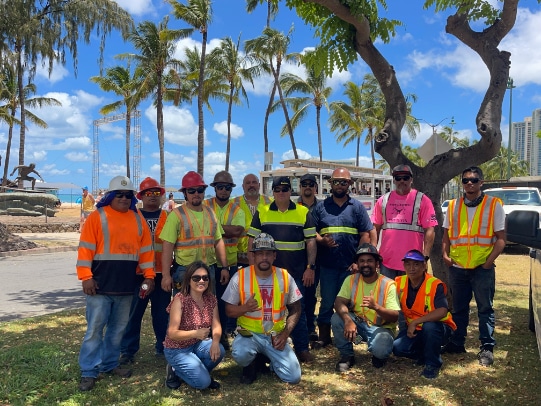
Back row, from left: Alani, Larry, Noah, Mana, Lewis, Johnny, Pana, Mike, Derek, Vinny. Front row, from left: Jennifer, Aaron, Jay, Edgar. This is the Road Builders paving crew that achieved paving and safety success along Kalakaua Ave. in the summer of 2024.
“Kawika Ishikawa has been in the asphalt industry for about 19 years and has worked as a plant operator for 16 of those 19 years,” Project Manager Jennifer Gallego-Nakamoto shared. “He currently is the plant manager/operator at Ala Imua LLC, which supplies the hot mix for Road Builders Corporation. We are fortunate to have him on our team. He’s not just the operator, he’s also our troubleshooter and will work tirelessly to find solutions whenever challenges arise. His expertise has been instrumental in continuing to keep our plant in operation.”
Paver Operator Aaron Manuel is a veteran asphalt industry professional as well. Gallego-Nakamoto shared Manuel “has worked in the asphalt industry for 16 years with 8 years as a paver operator with Road Builders.” She remarked that his positive, “do-whatever-I-have-to-do” attitude makes him a valuable part of the team.
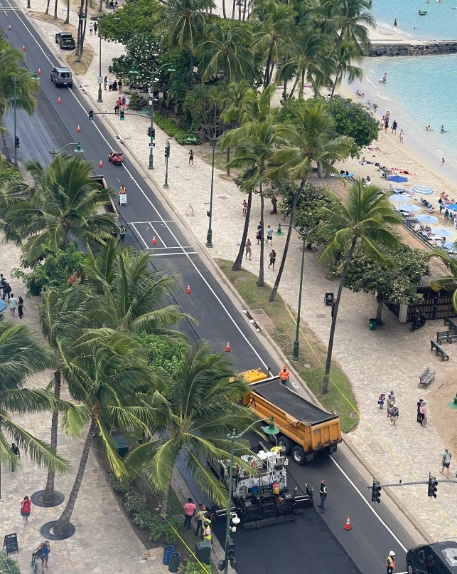
As one of seven haul trucks brought State IV hot mix to the Roadtec RP-195 10-foot tracked paver, multiple Road Builders workers handled traffic control on the Kalakaua Ave. rehabilitation project. If you look closely, you can see one worker in PPE near the “top” of this photo drawing attention to a sandwich-board sign. A multitude of safety cones delineated the lengthy work area and yellow caution tape was tied to trees as one more “flag” to pedestrians to pay attention and prevent them walking into danger. Photo courtesy of Project Manager Jennifer Gallego-Nakamoto, who took a number of these photos from the rooftops of Outrigger Hotel and Waikiki Circle Hotel
Behind the paver, the team ran a SW654ND Sakai roller. The 8-ton roller with 58-inch drum achieved 91% compaction and a Sakai 5-ton roller took care of finishing and final compaction of 94%.
Gallego-Nakamoto explained they built transverse joints by trimming the cold joint each day, applying tack coat and paving into the edge of the joint. In fact, she spoke of the crew’s performance on the joints with pride. “Our crew did a good job with the transverse joints. Roller operator John Dorser thoroughly compacted the transverse joint, ensuring a smooth transition. John did a great job achieving his rolling pattern to reach the required compaction.”
The 4.5 lane miles of Kalakaua Ave. to be rehabilitated were between Olohana St. to Monsarrat Ave. and Dillingham Fountain to Poni Moi St. Currently there are four, one-way lanes that reduce to three lanes toward the end of the roadway. The avenue is the main thoroughfare to Waikiki connecting tourists to shops, restaurants, entertainment venues and, of course, the beach. “Originally it was called Waikiki Road, and later changed to Kalakaua Ave., which was named after King Kalakaua, the last male monarch of the Hawaiian Kingdom in 1905,” Gallego-Nakamoto explained.

This EX 8844 Series plant by Asphalt Drum Mixers (ADM) features three 150-ton silos. It’s owned and operated by Ala Imua LLC, which is part of the Road Builders Corporation family and supplies three Road Builders’ paving crews. In this image, you can see the spray platform where drivers can stop to spray release agent in the beds prior to loadout. Photo courtesy of John Ball, Top Quality Paving & Training, Manchester, New Hampshire
Managing Foot Traffic
Getting a smooth transition despite all the stops is something to take note of. Both Park and Gallego-Nakamoto spoke of the challenges the general public posed on this job.
As stated above, milling started in May and paving ended early July, according to Gallego-Nakamoto, with a total of about 6,300 tons of asphalt placed in two 2-inch lifts while the team kept tourists, surfers and shoppers from walking between machines. The scope of work included new concrete curbs and gutters; adjustment of utility manholes; and restoration of pavement striping, marking and markers, which were subcontracted.
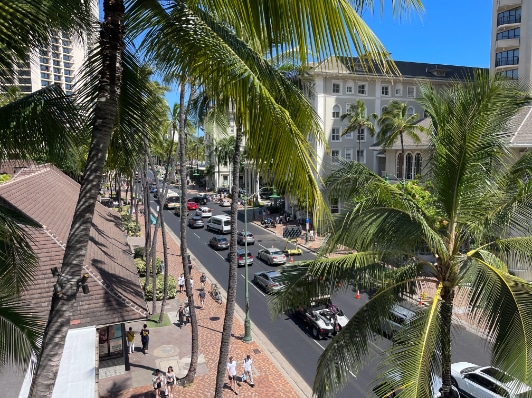
The daily closure for milling and paving was two lanes, but when the crew cut from the gutter side to the center of the road, the last pass of the milling impacted the third lane, which was the live lane. They took extra precautions to safeguard workers and the traveling public.
Due to heavy traffic along the work area, the city denied Road Builders’ request to close three lanes and only allowed the closure of two lanes at a time, leaving vehicular and foot traffic moving around their work zone in what could have been a safety nightmare if not for careful planning and diligent execution. Gallego-Nakamoto explained the traffic control plan (TCP) in detail, saying it was a challenge to get it approved prior to the start of the project due to the limitations of lane closures:
“Because it’s a busy road, we could only close two lanes at a time. However, three-lane closure would be ideal, that way we could work on two lanes each day and have one lane as a buffer of safety precautions for both public and crew members. As a result, we made adjustments to work safely for both public and crew members. Our daily closure for cold planing and paving was two lanes; and when we cut from the gutter side to the center of the road, the last pass of the cold planing always impacted the third lane, which was the live lane. As a result, we made our last pass 3 to 5 feet so we had less impact on traffic. Time was sensitive to the project, we had 270 calendar days to complete the project. With the delays we had from getting traffic control plan approved and rainout days, we were able to get a time extension.” An additional 204 calendar days were added to the contract, with a total of 474 calendar days to complete the work.

The rolling train included an 8-ton SW654ND Sakai roller in the breakdown position.
Gallego-Nakamoto gave credit to Derek Samson, the foreman, for clever planning. “He played an important role because he mapped it all out for us.”
The general public doesn’t necessarily understand the dangers an active work zone presents or the importance of staying off an uncompacted mat. To that end, the team had to communicate with shops and hotels along the route and stay one step ahead of the work zone closure as the crews progressed. Just because the paver had passed an area didn’t mean pedestrians could safely walk past an orange cone or drivers could pull a vehicle out of a hotel’s driveway. They still had to wait for the roller operator to compact the fresh mat and meet compaction requirements. Signage and communication were key, and crew members had to keep their heads on a swivel.

The blending control screen shows the operator his five cold feed bin and two RAP bin levels with a popup screen in the corner showing production targets. Key elements are shown as illustrations with PG grade, capacities, temperatures and other metrics specified on one screen. The corresponding bins outside are prepped for production, complete with berms to prevent aggregate sizes from bleeding into the wrong bin. Both photos courtesy of Ball

The blending control screen shows the operator his five cold feed bin and two RAP bin levels with a popup screen in the corner showing production targets. Key elements are shown as illustrations with PG grade, capacities, temperatures and other metrics specified on one screen. The corresponding bins outside are prepped for production, complete with berms to prevent aggregate sizes from bleeding into the wrong bin. Both photos courtesy of Ball
Jade Richardson, the president of Road Builders, spoke of the safety team’s efforts on site. “This project was challenging due to its high visibility and popularity as a tourist destination. When I say all eyes were on us, I mean literally. Our safety manager, Lewis Boucher, sometimes doubled as traffic control to keep the pedestrians from crossing through our cut and in between the equipment just to avoid walking around the project.”
As Park stated, a typical paving job requires everyone to be vigilant, but this project required everyone’s senses to be on high alert. “While you’re working, you’re also watching everything around you,” he said, estimating thousands of tourists walked past their work zone. “Jennifer was in constant communication with all the vendors and businesses in Waikiki. She knows the tonnage and how far it’s going to pave. All our engineers do a great job, but she was on top of it.”

The paving train included the Roadtec RP-195, now from Astec Industries. This tracked, 10-foot paver was equipped with an extendible screed to accommodate the changing widths the crew handled from day to day, extending up to 21 feet wide.
As the paving crews moved down the avenue, the work zone delineation moved as well. Gallego-Nakamoto explained: “We placed precaution tape along our work areas every day. Our safety officer, special duty officers and traffic control technicians played an important role in keeping the work area safe. We tried our best to keep pedestrians crossing the road away from the work area.
“Coordination with hotel personnel was also a challenge. We needed to stay ahead of the paving work to ensure hotels were informed when we would close their driveways.”
Keeping the bike lane “safe” was another piece of the puzzle. “The bike lanes were also a challenge,” Gallego-Nakamoto said. “We needed to pave bottom and top lifts each day when paving the bike lanes to avoid any tripping hazard when opening the work area.”

Note in this image the material charging the hopper was sliding as a homogeneous mass, leaving a clean truck bed behind.
Smooth Crew Makes A Smoother Finish
Along with the personnel mentioned above, Gallego-Nakamoto pointed to the importance of Pana Widemann’s contributions to a successful project. Widemann has been in the paving industry for 15 years. She listed Widemann as an asset to the project, saying, “He was always working with the pedestrians, hotels and businesses ensuring projects would flow. He works well with the public and ensures the safety of everyone is met. He works with the foreman and project manager as far as daily production schedule.”
Richardson spoke of the effort her team put into making the project run smoothly. “Jennifer is an outstanding project manager,” Richardson said. “She wants to avoid attracting attention to herself, although I can say that this project went well because she was at the helm. Tiny but mighty, her attention to detail and her ability to communicate effectively with the crew and the city inspector are contributing factors to the success of this project. She earned and was given the respect of others who towered over her 4-foot, 11-inch frame.”

The quality control team took readings with a nuclear density gauge, showing an average 91% compaction behind the breakdown roller, and achieved a gorgeous mat over the project.
Gallego-Nakamoto has been in the industry 20 years, the past three have been with Road Builders. For this specific project, she was in charge of running the project, ensuring the scope of work was met, and working directly with subcontractors and the city agency. As Park noted above, she was on top of the details, keeping meticulous paperwork. She explained part of her responsibilities were “making sure specs were met and proper submittals were submitted before, during and after project. Communicating with Waikiki personnel was important so that businesses were aware of our closure each day.” She sent the weekly schedule to notify all businesses and worked with the foreman and engineer to ensure the project was flowing.
The collaborative atmosphere shone through the discussions with the Road Builders team. From communication to best practices, the crew kept everyone’s safety top of mind for a lengthy and high-profile mission.

The quality control team took readings with a nuclear density gauge, showing an average 91% compaction behind the breakdown roller, and achieved a gorgeous mat over the project.
“I am equally proud of this crew and their exceptional ability to work as a team,” Richardson said. “With Derek as their foreman and Pana as their QC/project engineer, they effectively communicated the daily production rates; everyone knew their task and performed it well. It was beautiful.”