
When the Density Number Doesn’t Match the Mat
BY Bill Stanley
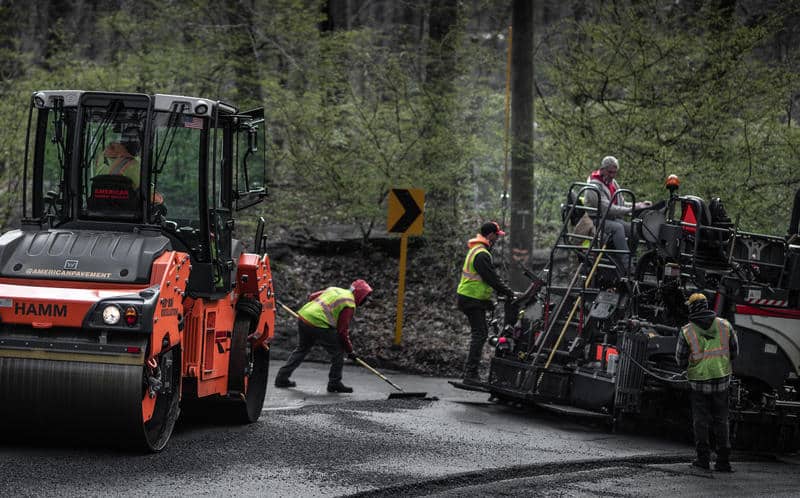
I’ve been on plenty of jobs over the years where we’re paving along, everything looks right, the rollers are doing what they’re supposed to do, and then the tester comes out and says we’re not hitting our density numbers.
So we roll it again. And again.
Next thing you know, we’re spending all day chasing a number, even though anyone who’s been around paving long enough knows the mat is already compacted. At that point, you’re starting to risk doing more harm than good—working the mat more than it needs and even risking fracturing the aggregate.
Then the next day another tester comes out on the same job, same material, same setup, and suddenly it’s 95, 96, no problem.
If you’ve been around paving long enough, you’ve probably seen that happen. The crew knows the mat is where it needs to be, but the gauge says otherwise. There have been times where I’ve had to tell the tester to write down the number he’s getting, even if it’s not where it’s supposed to be, because we’ve rolled enough, we’re wasting daylight, and we need to move on.
Don’t get me wrong, those numbers are an important part of verifying quality and making sure we’re building pavement that performs. It’s not that I don’t think hitting those numbers is important—in many ways, it protects me as the contractor by demonstrating my quality paving. Because, at the end of the day, the contractor is still the one holding the bag if something goes wrong two years later and there’s no proof of what happened on the job.
The problem is, while my experience can be challenged, the density number usually isn’t. If the gauge says we’re not there, that’s the end of the conversation—even though the gauge can be wrong too.
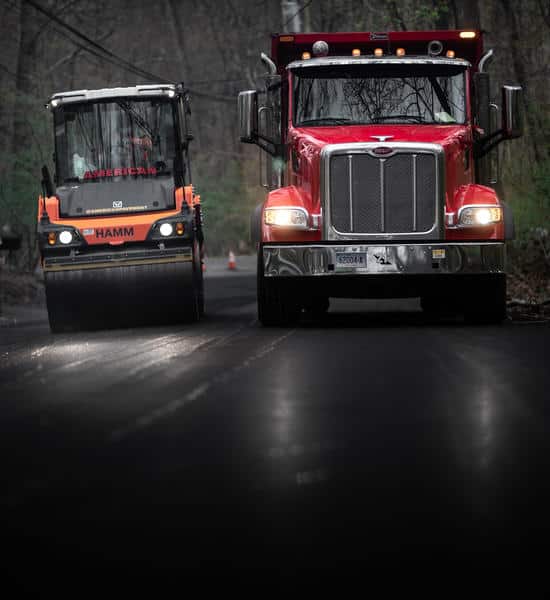
A Hamm roller from American Pavement Specialists works alongside a haul truck delivering fresh mix to the paving train. The compaction target the crew is trying to achieve behind the paver ultimately begins at the plant, where mix design numbers help determine the density the roller operator is working to hit.
Compaction Gone Wrong
A lot has to go right for compaction testing to tell the full story, and it usually starts with the gauge and the person running it.
Right now, most of the testing in my area is still done with nuclear gauges. Those machines are sensitive. They can overheat. They can lose calibration. I’ve seen guys have to put ice under them to keep them cool. If the machine isn’t working right, the number you’re getting might not mean much in the first place.
Then there’s the technician running it. Some testing guys have been doing it a long time. They know the material, they know the plant, and they know what they’re looking for. Those are usually the days where they come out, take a couple readings and you’re good.
Other days you get someone new. In my experience we’re seeing more of that, and that’s when things can turn into a long day.
But the gauge and the technician are only part of it.
A lot of the number the tester is chasing actually starts at the plant. Where I work, they’re usually using a Marshall or RICE number from the mix design. The problem is that number can change depending on moisture, material coming into the plant, or when the mix was last tested.
You can start paving with one number in the morning and find out later in the day the plant updated it. That alone can move the compaction target several points and suddenly everyone on the job is chasing a different number than they started with.
Then you add in the material itself.
The mixes we’re paving with today aren’t the same ones contractors were working with decades ago. There’s more recycled asphalt pavement going into them and less asphalt cement than there used to be. That makes the material a little less forgiving during compaction than it was years ago.
So now you’ve got all these variables affecting compactability—equipment, technicians, plant numbers, mix design, moisture, stone content—but once the mat is down there’s really only one thing anyone tells you to do if the number isn’t there: roll it again.
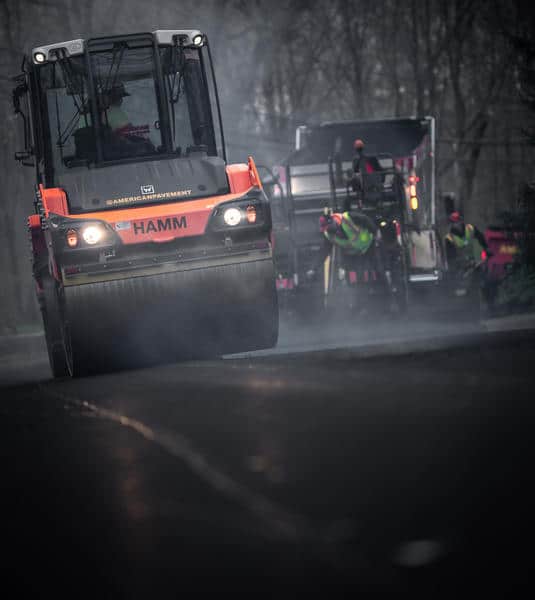
A Hamm roller works alongside the paving operation as trucks deliver mix to the site.
Compaction Getting Better
For a long time, that’s basically been the playbook. If the density isn’t there, you roll it again. But the good news is I think things are about to get a lot better.
There are improvements happening on the plant side too, with better testing and better communication around mix numbers, but what really has my attention is the technology that’s starting to show up on the contractor side.
Right now, most jobs are judged by spot checks. A testing company comes out with a nuclear gauge and takes a few readings around the job. Those readings represent the entire project, even though anyone who’s been around paving knows density can vary across the mat depending on temperature, mix characteristics, and how the material was placed.
How to Roll for Bonus, Part 1—New Ideas in Roller Maintenance
What’s starting to come into the industry are scanning systems that can measure compaction across the full width of the mat while the roller is actually doing the work. Technologies like PaveScan—and similar systems manufacturers are beginning to integrate directly into rollers—can read the pavement continuously instead of relying on a few test locations.
That’s a big change.
Instead of waiting for a tester to show up and drop a gauge on the pavement, the roller operator can see how the mat is responding while it’s still warm and optimally workable. If the mix needs another pass, you can see it. If the rolling pattern needs to change, you can adjust it right then.
Another advantage is that if the job requires third-party testing, the contractor can use that information from the rollers as a second source to verify density numbers.
At the end of the day, compaction testing protects the contractor as much as anyone. If there’s a problem a year or two down the road, the paving contractor is usually the one answering the phone. When compaction data is collected across the entire mat and recorded during paving, it gives you a much clearer record of what actually happened on the job. And when the data lines up with what experienced crews already knew about the mat, that technology doesn’t replace experience—it backs it up.