
Using the Screed Effectively: Part 3
BY Benjamin Everett
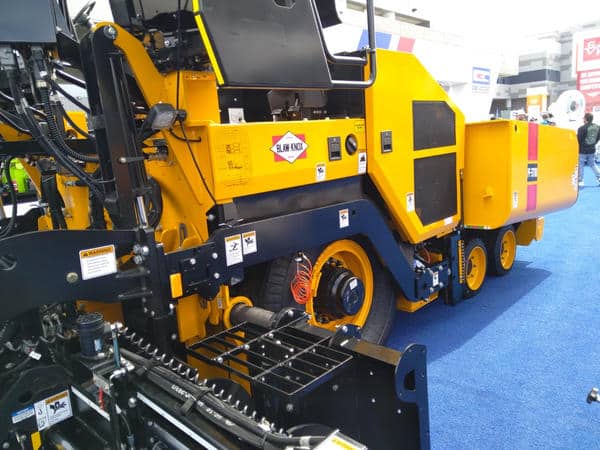
Use the front mount vibratory screed effectively in asphalt paving
Starting with the February issue, we began a bit of a review on the three most common types of screeds we use in asphalt paving. In the second installment, we reviewed the U.S.-style rear mount design hydraulically extendable asphalt screed, and got into its primary area of expertise, which is mainline paving. This is also commonly known as the heavy highway class category, including interstates and airports.
Now let’s look in detail at the other common screed version that we see on most U.S. paving sites—the front mount (extenders are in front of the main screed unit) vibratory asphalt screed.
When to use the front mount screed
A front mount’s primary work type typically features a lot of difficult commercial and street paving work, such as tight quartered and variable width carparks, industrial sites along with complicated urban areas in major cities, especially those sites that have complex shapes and ever-changing dimensions.
This type of paving is very different from essentially straightforward mainline work. In this area, asphalt contractors have to quickly adapt “on the fly” to constant width adjustments, navigating around obstructions ranging from planters and light posts, wheelchair ramps and pedestrian refuges in private and commercial work, to abrupt carriageway width changes featuring long tapers into and out of lanes, intersections and roundabout approaches. To throw in another curve ball when you thought it couldn’t get any more challenging, many older urban roads are frequently highly crowned, meaning you often need to bend the main screed and dial in maximum extension + slope to maintain target thickness and avoid “running the screed aground” on high areas in the grade.
This is very challenging work. Those who do this work every day understand exactly what I’m talking about. I grew up doing this type of commercial paving; it’s not easy, I assure you. It soon sorts out those who can walk the walk, not just talk the talk. This is very labor intensive, precision work requiring much detailing.
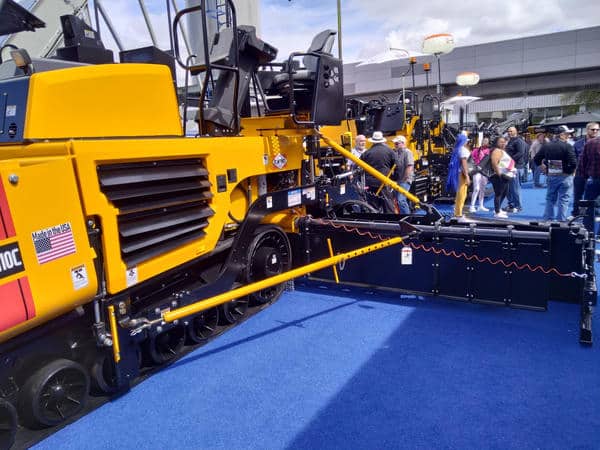
This is the Blaw-Knox OMNI 318 10- to 18-foot front mount vibratory screed on display. This screed has been proven since 1983 and, in my opinion, keeps getting better with each iteration. It features equal, 18-inch main and extender screed plate depths.
It requires a unique blend of flexibility, quick reactions and adaptability from a paver screed. These are features a well-designed and properly balanced front mount screed delivers in bucket loads.
Generally speaking, commercial paving work such as carparks and private work, along with thin mill and inlay, or overlay paving in metropolitan areas is less about a billiard table smooth mat and density, and more about mat appearance, neat finishing against adjacent features such as curb and gutter and achieving specified mat thickness on a grade that is frequently variable. In this vocation, the front mount vibratory screed bests a heavy highway rear mount on most counts, because it requires a fundamentally different skill set than what the rear mount offers.
Usually, a U.S.-style front mount vibratory screed is strongly built and able to cope with quite a lot of torsion and stress imposed on it, both in the transverse plane through extreme crowning, and also the longitudinal, when often differing requirements on either side of the screed require each tow point to sometimes be at extreme opposites to one other. That’s a big ask, I believe. If you have undertaken this work, it’s pretty unique how bent out of shape you can make a good front mount become, and yet it takes it in stride and comes back every day asking for more.
In this application, they generally perform well at depths of 1.5 to 4 inches thick. Most often the screed plate widths of both the main and extenders are not the same, and with one exception I know of, most front mounts can’t go double width as a rear mount usually can.
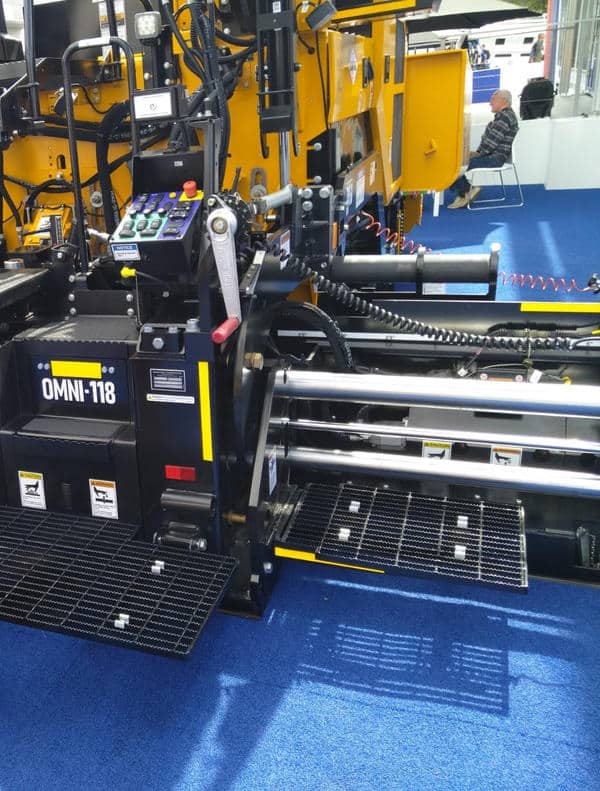
This is the Blaw-Knox OMNI 118 new model front mount screed on display. This screed also features 18-inch deep main and extender screed plates like its bigger brother, the OMNI 318.
The reason for this is due to the design of a front mount, which gives it one of its key strengths.
Remember, I just stated that a particular advantage of a well-conceived front mount screed is its ability to comfortably manage constantly changing paving widths. This is due to the fact the extender depths (front to back dimension or length) are typically half that of the main screed, and sometimes only one-third of the main screed depth. Commonly, the depth of front mount extenders is only in the range of 8.5 to 10 inches. Technically this is classed as a “strike off,” not a true screed plate.
The general industry rule of thumb for a screed plate is 12 inches or greater. There are currently only two front mount brands that offer this. One range is the Vogele VF 500 8-foot and VF 600 10-foot commercial front mount models, while the other is the Blaw-Knox OMNI 318 10-foot front mount. This is a unique design which I’ll delve into.
The narrow strike off extender plates both allow a front mount to carry a much smaller volume of mix in front of the main screed, and for them to be retracted on demand quite quickly. This feature is exceptionally desirable and a real advantage on variable width paving work.
Because of that, the front mount requires an open void or gap between the inner ends of each extender when the screed is fully retracted to its 8-foot or 10-foot basic width. This is so it can basically “store” all that mix that was being carried in front of the main screed at moderate to maximum paving widths. For example, if you were paving a typical lane width of say 12 feet wide, on an 8-foot front mount, this means each extender would typically be pushed out around 2 feet. Imagine you encounter a temporary lane width narrowing, such as a concrete pedestrian refuge that projects out into the lane, meaning you have to quickly reduce the width to say 9.5 feet. All of that material has to go somewhere when you retract the extenders in over half the distance they were out just a moment before. The front mount design provides the space for you to do this.
However, a rear mount’s ability (versus a front mount’s) to feed material out to wider widths soon becomes apparent, once you have each front mount extension pushed out 2 feet or more.
While a rear mount can manage up to twice its basic paving width without having to add bolt-on auger extensions, generally once you go wider than about 20 inches with a front mount type extender, it becomes harder to get material out to the end gate, and it’s better to install a set of 6- or 12-inch bolt-on auger extensions, provided the default minimum paving width you intend to do will allow for this.
QUICK TIP: Beware of a trap for the unwary. Because bolt-on auger extensions and guards are essentially a fixed width and can’t reduce below the length they are, if you find the need to drastically reduce your paving width on the fly to deal with some kind of obstruction, it can be easy to become preoccupied and lose sight of the imminent collision you might have between the outside of the fixed auger extensions and the telescopic screed extensions.
Real-world use
Commercial paving contractors frequently have to build a lot of takeoff pads by hand due to the work requiring many paving runs to start off against a wall or some other impediment on a building site. This is a labor intensive, repetitive step and the 16-inch depth of a rear mount screed’s plate forces you to build a much longer start off pad for your screed structure to sit on for each new run. Time is money, and commercial paving crews don’t enjoy having to exert more manual labor and time to construct longer take off pads than they need to, especially when a nimble commercial style front mount with its generally much narrower extender plate depths offers them an easier way. This is why front mounts are preferred in variable width and parking lot paving work.
There are some disadvantages to the front mount design to keep in mind. Having significantly shallower (front to rear dimension) extender screed plates versus that of the main screed depth, leads to a much different mat texture across the full width of the screed, with sometimes inconsistent mat densities at fully extended or even moderately extended paving widths. This is because with such a shallow footprint, the mix passing beneath the extenders only gets about half the amount of time to receive energy and weight into it, relative to the much deeper main screed plates.
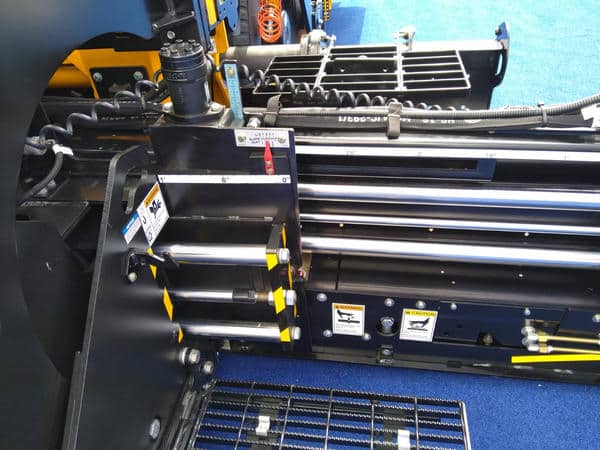
The Blaw-Knox UltiMat 160 front mount vibratory screed is the only front mount screed I’m aware of that can go double its basic width, making it unique.
Because of this, it is often necessary to dial in around ¼-inch positive extender angle of attack relative to the main screed. What I mean by this is the front edge or bullnose of the extenders needs to be at a steeper attitude than the main screed angle of attack in order to force feed more material under those short strike off plates to try and pack in more density and to match the mat texture behind the main.
These screeds require properly trained, skilled screed operators who understand the correct operation of the screeds they are in charge of, and how to make the necessary adjustments when required to maintain acceptable mat texture, density and a smooth mat free of transition lines.
I need to tell you that it isn’t as simple as “one and done” on a front mount. Different mat thicknesses require more or less angle of attack on the extenders, as do different types of mixes. If you are placing a 3/8-inch or smaller nominal maximum aggregate size (NMAS) carpark mix at around 1.5 inches one day, then the following day you need to place a ¾-inch NMAS FAA-spec asphalt at 3 inches thick, you are going to need to put in some work to fine tune it, because it won’t lay the same. Some can be a bit fussy to get the best out of them I’ve found. Nevertheless, there are a few really good front mount designs about.
I have found some model front mount screed designs to be not very well balanced due to their weight distribution and positioning “fore and aft” (and in the vertical plane) of their screed pivot point. This is the pin lower down on the screed drop arm, which allows the depth cranks to set the main screed initial angle of attack or pitch. By its very nature, the location and position of this pivot point affects the screed’s behavior. Sometimes, it can prove quite challenging to get a front mount to place a perfectly flawless mat, completely free of transition lines. It takes effort.
There are a number of very capable and popular U.S.-made front mounts out there that, such as Blaw-Knox’s time honored and unique double width 8- to 16-foot UltiMat 160 and UltiMat 16 models, plus the 10- to 20-foot UltiMat 200, Caterpillar’s 8-foot SE47 FM and 10-foot SE60 FM, and Carlson’s EZIV 08 and 10, that are all very well proven, solid platforms, and could all be considered as an industry standard, in my opinion, along with Vogele’s 10-foot VF 600 and 8-foot VF 500 models also.
As always, there can be an exception to the rule, and I’m going to touch on that one next.
The Blaw-Knox LBP front mount model 01E is an 8- to 16-foot vibratory screed.
That of course, is the legend of all proven heavy screed platforms, the Blaw-Knox OMNI 318 10-foot front mount. This over 40-year-old veteran is unlike anything else, because no other front mount offers similar features. It has equal depth (front to back), 18-inch main and extender screed plates (double a 9-inch strike-off), along with the original Blaw-Knox conceived pre-strike off plates that are located in front of the main screed. These function to carefully meter the amount of mix that is carried in front of the main screed, allowing operators to maintain just the right amount to float the screed, but not so much it prevents the extenders from being able to fully retract back in on demand. I really like this type of screed; it imparts a particularly tight, ironed mat texture, similar to what you normally associate with a heavy highway class rear mount vibratory screed.
Now the previously highlighted front mount platforms from Blaw-Knox, Cat, Carlson/Astec and Vogele are all fairly heavy units, and rightfully fit into the heavy commercial/heavy highway line.
On the lighter, commercial side of it, for the contractors who specialize more in carparks, private driveways and more lightly trafficked secondary roads, there are pretty much five well known manufacturers who have become household names: LeeBoy (recently acquired by the FAYAT Group, which also owns Dynapac and Bomag), Weiler, Carlson/Astec, Dynapac and Mauldin.
Conclusion
This final installment has focused on the front mount vibratory hydraulically extendable screed, but don’t forget your other options. If you specialize in more than just heavy highway or commercial paving, there are plenty of folks out there who make a living by covering all of those bases on a routine basis. While there is no hard and fast rule, and it is true that a rear mount can be used in commercial work and a proven, solid front mount platform easily delivers heavy highway, high spec FAA type work and even precision racetracks, I suggest the 70-30 rule as a guide.
If 70% or more of your work is straightforward, constant width mainline and heavy highway paving, probably one of the proven rear mount platforms we covered earlier would serve well.
Conversely, if nearly 3/4 of your primary work is difficult, variable width and commercial work, then I’d suggest looking closely at a well-respected front mount screed. It’ll be your best friend. Select the right screed for the right project with the right parameters, and you can’t go wrong.
Benjamin Everett is the owner of About Asphalt Ltd., and has worked in the asphalt industry for nearly four decades. For more information, contact him at bjeverett@aboutasphalt.co.