
Using the Screed Effectively: Part 1
BY Benjamin Everett
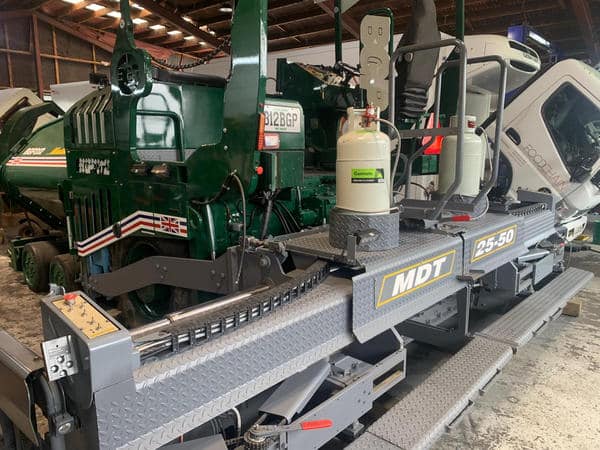
Use the tamping screed effectively in asphalt paving
Starting with this issue, let’s do a bit of a review on the three most common types of screeds we tend to use. Please note, there are still certain regions that mandate and use fixed screeds. However, for the most part, the lion’s share of hydraulically extendable paver screeds tend to be in three distinct camps:
- European Union style tamping, tamping and vibratory, duo-tamp and tamping with pressure bars
- Rear mounted hydraulic extendable screeds with vibration (common in the United States)
- Front mounted hydraulic extendable screeds with vibration (common in the United States)
In this first installment, I’ll focus on the European style tamping screeds, which are rare in the United States. We typically see them used in limited numbers in specialized niche markets such as roller compacted concrete and cement-treated base work.
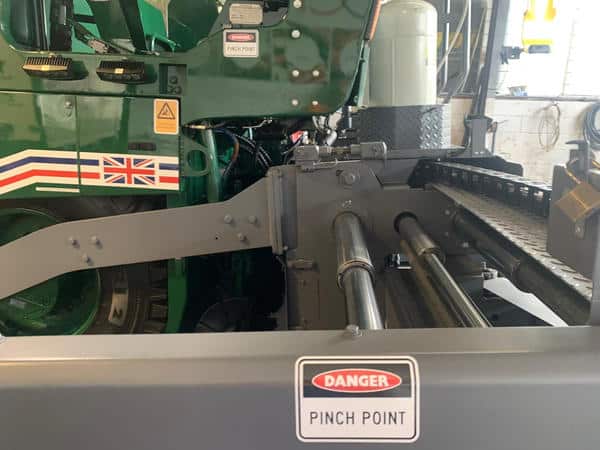
This is the European Union style tamping screed setup. It usually has threaded bolts to adjust the screed pitch. If the crew hasn’t brought wrenches to the job site with them, this will not be an easy thing to adjust. This means many crews using this style of screed won’t adjust the screed pitch as they should when encountering a change in mat thickness.
Why do we have such a range? Why can’t one type of screed do everything? One size doesn’t fit all in asphalt paving. Consider: we don’t all perform the exact same type of work. Asphalt is as specialized and highly technical as anything requiring skill. You won’t see surgeons performing complex operations with a single, wide bladed meat cleaver. They have a variety of specialized instruments to have the right tool for the right job.
Just as surgeons or mechanics have more than one type of tool in their toolboxes and a golfer uses multiple types of golf clubs depending on what they are trying to do, so it is in the asphalt paving world.
But before we get too far into it, let’s have a quick recap on the fundamental differences between paving in Europe and paving in North America, because therein lies the key to answering this. Paving in the continental United States, Australia and New Zealand is not like in Europe.

This image shows the threaded bolts on a European style tamping screed.
In a nutshell, Europe tends to pave about half the speed of that typically seen in the United States. Asphalt lifts in Europe are usually placed much more thickly with each pass (other than the final surface layer), with a strong emphasis on pre-compaction from the paver screed via the action of tampers.
This is advantageous from the standpoint that because the paver has already done much of the initial compaction, final density is easier to attain, and there is less of a need to rely on a large flotilla of heavy rollers. This is why when we see European final lift or surface placement, they are often using only a few very modest sized 4- to 5-tonne tandem vibratory steel rollers.
The E.U.-style tamping screeds also generally plane at a lower angle of attack versus a North American type of vibratory screed (1/8-inch versus ¼-inch), which allows the screed plates to be “flatter” to impart more dynamic energy into the mix.
When to use a tamping screed
Think of your screed the way we have been taught to think of pavement preservation methods. We choose the right treatment for the right pavement at the right time. Apply that logic to the screed. We want to select the right screed for the right project at the right parameters.
There are both advantages and disadvantages to a tamping screed design compared to a standard vibratory screed. So, what is the rule of thumb when you should consider using a tamping screed over a vibratory screed?
My rule(s) of thumb are these:
- If 75% or more of your work is over 3 to 4 inches compacted depth with one lift of asphalt
- If you are consistently placing predominantly large size asphalt mix such as ¾- to 1-inch nominal maximum aggregate size (NMAS)
- If you are primarily placing roller compacted concrete, concrete-treated base, unbound granular base such as railway ballast or 1.5-inch size subbase with an asphalt paver instead of placing it with a grader
- If you are struggling to get the target density and/or air voids from a standard vibratory screed
If I’m not having to contend with the above, my screed of choice is a vibratory one.
Mostly in North America, we are placing mixes in the ½- to ¾-NMAS range, in lifts of 2 to 3 inches compacted depth. Further, there is an unspoken (yet an undeniable) need for speed in the U.S. asphalt paving market.
Someone trying to use a tamping screed paver and thinking they will be able to keep up with a competitor using a vibratory screed paver on a 2-inch compacted depth commercial site with a ½-inch NMAS dense graded mix is likely to be outgunned and out paved. It’s like expecting a long distance or marathon runner to be competitive in a 300-meter sprint.
It’s not that a tamping screed is wrong or a bad idea. On the contrary, it’s an excellent tool in the right setting. Generally speaking, this rules out most tamping screeds from being the tool of choice for commercial and residential paving as well as thin overlays or mill and inlay jobs.
Real-world use
Think of it like this. Most tamping screeds are heavy, rigid and extremely solid in build. They are pretty much designed to be set up once, at the start of a project, and to place a deep, consistent thickness over essentially constant widths. Think airports and heavy industrial sites like ports and terminals.
In this application, they are usually the right choice and can deliver great results. If you need to get target density and consistent compaction results on high spec work with something that requires essentially a flat transverse profile, the tamping screed does it like a champ all day long. I often use tamping screed pavers, and in fact I have two of my own units, which I like. I find them predictable and a nice unit to use; in the right application that is.
Now imagine another scenario; one no less challenging but in a different way. It’s something most people outside of the industry don’t usually comprehend or appreciate. Many older, urban metropolitan roading networks feature a heavily crowned road profile that constantly changes, with a longitudinal shape that resembles a roller coaster. I grew up exposed to that sort of road type, and it’s not something for the faint hearted.
When performing pavement maintenance on these roadways, you are tasked with typically getting in and out quickly to hand the road back to the public as soon as possible. You must place a consistent 1.25- to 2.0-inch overlay (or mill and inlay as it usually is) while matching into existing misshapen concrete curb and gutter (that’s all up and down) and dodging manhole covers. Often, we have to introduce extreme + or – slope and maximum crowning from the main screed to avoid “grazing the highs” and “filling the lows” to ensure we meet the target mix quantity.
These jobs aren’t usually about ride quality or compliance with a straightedge, because they are rarely flat. They are frequently of a transverse profile that alternates between a crown and a gulley (or swale). And just to make it even more difficult, almost always they are bid and paid on a square meter basis rather than tons, meaning if you go over the calculated mix quantity for the area paved, that extra mix cost is on you.
In my opinion, there is only one tool for a challenge like that—a North American design vibratory screed with front mounted extenders, power crown, slope and match height, and if possible, a berm builder feature. Think of models like the Blaw-Knox UltiMat 16 and 160, Carlson EZ4, and Caterpillar SE47 FM. For these “roads from hell,” these screed models can be “shaped” to the extreme road profile. That’s not typically something a rigid, heavy, inflexible tamping screed is designed to do.
As always in life, there are one or two exceptions to the rule. I have noticed Caterpillar’s heavy 3.0- to 6.0-m tamping screed model SE 60 VT XW comes standard with power crown, extender slope and match height and it appears to be the only tamping screed offered with traditional rotary depth cranks (screws) instead of the typical E.U. threaded rod type angle of attack adjusters.
Further, ABG/Ammann is offering two sizes of rear mount (single and duo tamping models) screed versions that come standard with power crown and power extender slope (+ and -) as well as match height. These are the 8-foot, 2-inch basic width VB-79/VDT-V 79 and the 9.84-foot basic width model VB-89/VDT-V 89. Both types can slope each extender +/- 10%, which is rather impressive in my view for an E.U. tamping screed. With these two brands of E.U. tamping screeds offering those very desirable features as standard, it puts them into quite a unique category. I consider them the exception to the rule. I’m watching both with some interest.
Let’s talk in Vegas
I think I’ve managed to articulate pretty much what I’m trying to convey via a typical E.U. design tamping screed, along with the many positives, and also some negatives it has. Bottom line—in the right application, a tamping screed is an excellent choice and delivers results. Just be sure to carefully evaluate your particular type of work to decide if it’s right for you.
I’d be happy to talk more about these positives, negatives, and best use cases, as well as other asphalt paving topics during my Ask the Expert session at the AsphaltPro Magazine booth GL30901 during CONEXPO-CON/AGG. I’ll be at the booth on Wednesday, March 4, from 1:30 to 3:30 p.m.
In the next installment, I’ll go over the traditional and common North American vibratory style screeds that we use almost every day, and do a deep dive on the front and rear mount designs.
Benjamin Everett is the owner of About Asphalt Ltd., and has worked in the asphalt industry for nearly four decades. For more information, contact him at bjeverett@aboutasphalt.co.