P&S Scores Statewide Award on I-4

When P&S Paving Inc., Daytona Beach, Florida, was founded by Tim and Todd Phillips a little more than 30 years ago, the company had just one employee and one piece of equipment. The company’s three decades of operation have been marked by a number of milestones, from growing to employ more than 250 people and performing jobs valued at up to $75 million.

In 2023, P&S achieved another major milestone. The company was recognized with four Florida Pavement Excellence Awards from the Asphalt Contractors Association of Florida (ACAF). Not only was P&S awarded two special project awards and a third award for the best project in Florida’s District Five, but the company’s District Five project was also recognized with the A.P. Bolton Award for the Florida Road Builder of the Year.

The A.P. Bolton Award is ACAF’s highest award, named in honor of one of the association’s charter members with a reputation for high quality work. “A.P. Bolton was such an influential figure in our industry that it makes sense for him to be associated with the project that stood above all others in the state,” said P&S Quality Control Manager Tim Carter.

P&S Paving Warms Up Quality on I-95

The award-winning statewide project is selected from award-winning district projects, including new construction, reconstruction or major overlays on interstate or multi-lane primary highways requiring at least 30,000 tons of asphalt.

“This was the first time we’ve ever won a statewide award for any of our projects,” Carter said. “When they said our name at the ceremony, I almost couldn’t believe it. For a 250-employee company with just one asphalt plant to win that award out of all the fantastic paving companies in the state is amazing.”

The Florida Pavement Excellence Awards have been recognizing and honoring the best in pavement construction in the state of Florida since 1979.


All Eyes on I-4
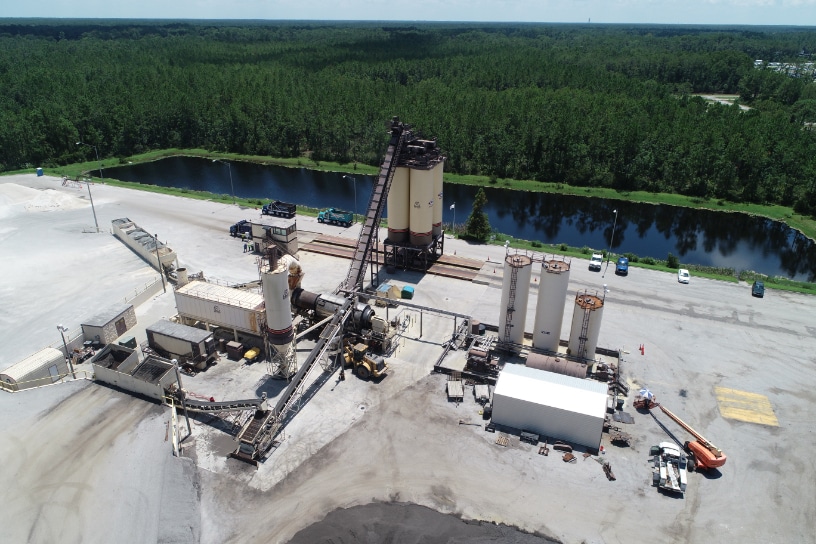
One of the aspects of the I-4 project that stood out to P&S Paving was its proximity to the company’s asphalt plant just 10 miles from the project.

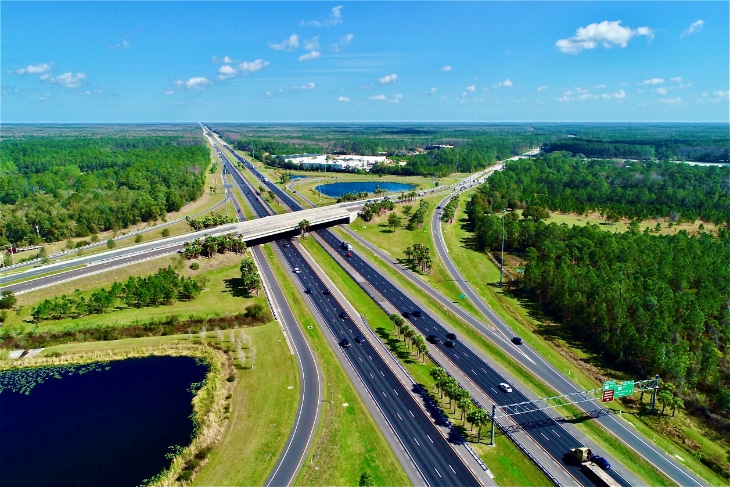
The A.P. Bolton Award-winning project stretched along 10.25 miles of Interstate 4 in Florida’s Volusia County, from west of County Road 4139 to State Road 44.

“I-4 is a highly traveled major artery that connects Tampa to Daytona,” Carter said, adding that it’s a common route not only for the transport of goods and services from one side of the state to the other but also for traffic to and from Florida’s theme park attractions. “Everybody in this area who goes anywhere and does anything, whether it’s work or weekend, travels on I-4.”

This, Carter added, includes many district and DOT employees. “It was a very high-profile project,” he said. It’s also along the route Carter travels to and from work each day. “Let me tell you, it was horrible. I couldn’t wait for it to be fixed. So, I was pretty excited when we won the contract to do it.”

According to Carter, the pavement had reached the end of its service life. “It had a rough texture, a lot of surface cracking, some rutting, loss of retroreflectivity of striping—those types of things,” he said.

The Florida Department of Transportation (FDOT) opted for full-depth repairs of a crack running the entire length of the project before milling and resurfacing the existing roadway, as well as pavement widening and improved traffic signalization.

This Too Shall Pass

“Mill and resurfacing was the most reasonable approach to rehabilitate this roadway,” Carter said. But before the road could be resurfaced, P&S had to repair that crack. “When the road was widened years ago, the joint between the existing pavement and the widened section turned into a huge crack running for miles in both directions. There had been some attempts to patch along some of the crack to try to mitigate further damage, but the patching was almost as bad as the crack itself.”

To repair the crack, P&S milled 2 feet on either side of the crack to a depth of 8 inches a full 10.25 miles and paved back two 3-inch lifts and one 2-inch lift of asphalt before milling and resurfacing the entire stretch of roadway.

“When we bid on the job, the first thing that caught my eye was its proximity to the plant—less than 10 miles,” Carter said. The second thing that caught his eye was the crack. Several years ago, P&S performed a very similar job on an adjacent section of I-4 in Volusia County.

“With the success of the previous project, I think that gave the department confidence to utilize that process again,” Carter said, adding that P&S’s past experience gave the company an edge over other bids. “We had already done something similar on I-4, so we knew we were capable of it, equipped for it, and had the knowledge and experience to perform that job.”

Time to Trench
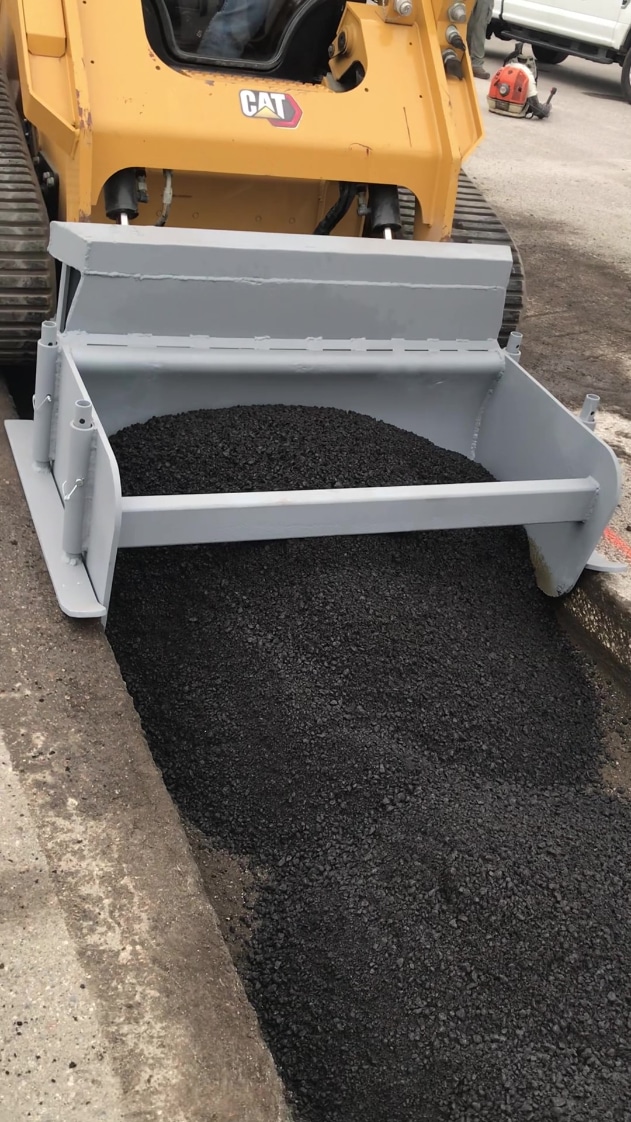
The I-4 project required P&S to mill a 4-foot-wide trench along a crack running the length of the project. To introduce material into the trench, P&S devised and fabricated an attachment for the front of a skid steer that would feed material down into the trench. Prior to the I-4 project, P&S milled and filled a 4-foot trench at its main office to test and tweak the device.

P&S bid the project in 2020, began construction Nov. 21, 2021, and completed the project Nov. 13, 2022. The first 42 days on the project were devoted exclusively to the trench repair along the crack.

“When you’re paving a trench, you have to take your time,” Carter said. You also need to have the right equipment, he added. This includes a 4-foot milling machine, a 4-foot roller and some kind of device to get material into the trench. “If you have the right equipment and you take your time to get it right, by the time you’re ready to pave, you’ll have a solid base on which to pave.”

To introduce material into the trench, P&S devised and fabricated an attachment for the front of a skid steer that would feed material down into the trench. “There was nothing on the market we could buy off the shelf, so we had to bring everyone together to brainstorm and make our own.”

P&S Paving Puts Down Dry Process Plastics Pilot

To test and tweak the device, P&S milled and filled a 4-foot trench at its main office. “Once we got the device right, we invited the DOT officials out to the plant to demonstrate how we planned to execute the project,” Carter said. “Not only did that illustrate the spirit of partnership we have with the DOT, but it also put everyone’s minds at ease before we got out to the project.”

According to Carter, this quick ability to problem solve is where P&S’s smaller size is an asset. “It’s easier to create a culture of communication and innovation in a smaller company,” he said. “There’s not a lot of red tape if you need to get something done. If we need to order something, we order it. If we need to make something, we make it.”
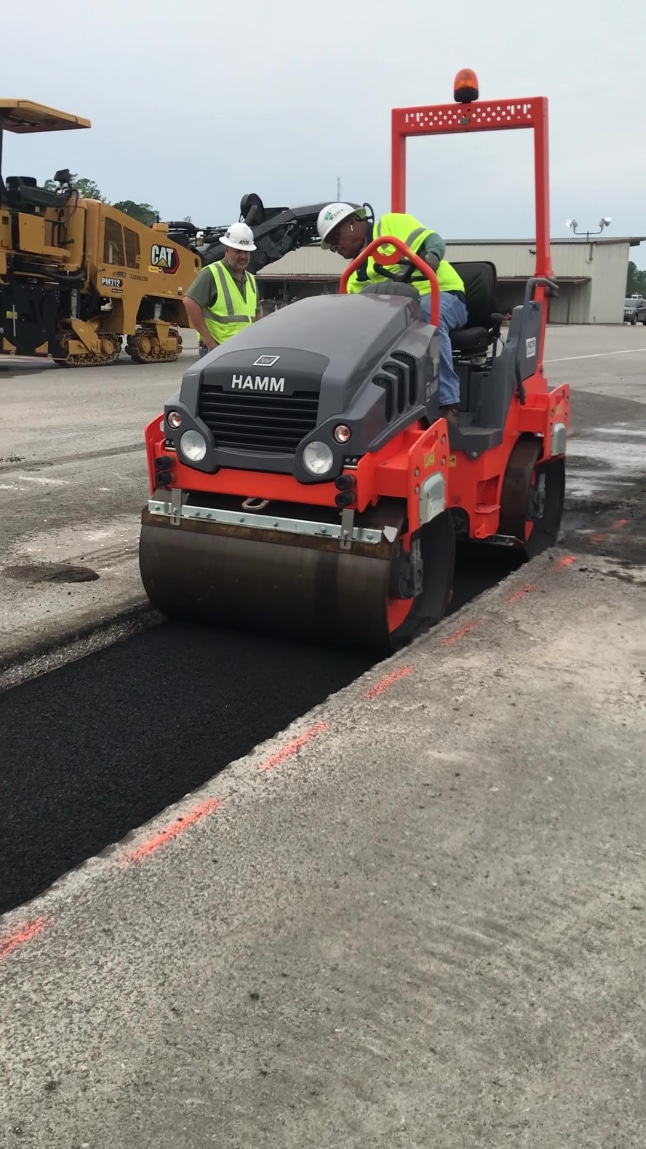
The I-4 project required P&S to mill a 4-foot-wide trench along a crack running the length of the project. To introduce material into the trench, P&S devised and fabricated an attachment for the front of a skid steer that would feed material down into the trench. Prior to the I-4 project, P&S milled and filled a 4-foot trench at its main office to test and tweak the device.

Once the trench was milled out and refilled, P&S milled the entire span of pavement (including the new trench) before resurfacing. “Some of the repair efforts of the trench were sacrificed to make a smooth ride all the way across the pavement so you’d never know there was a repair underneath,” Carter said.

“Other than the trench, this was a fairly standard mill and resurface project,” Carter said. “That said, there are some basic tenets that go along with any successful mill and resurface project.”

Among these best practices, Carter stresses the importance of taking time to mill properly. “A smooth ride doesn’t start at the top, it starts at the bottom,” he said. Consistency is key, from keeping a consistent milling speed to a consistent flow of trucks and a consistent paving speed.  “If you limit the amount of times the paver has to stop then you will limit the possibility of bumps and joint issues.”

This also requires consistency at the plant. “The best way to keep your paver moving is to control your trucking and keep your plant production rates consistent,” he said. “And the best way to make consistent mix is to consistently make it; don’t stop and start and stop and start.”

Paving Weather
In total, the I-4 project required 58,000 tons of asphalt: 48,000 tons of Superpave 12.5 mm Traffic Level D HMA for the trench and 1 ½-inch surface course (with PG76-22 polymer modified AC) and 10,000 tons of open graded friction course (OGFC) FC5 HMA with PG76-22 for the ¾-inch friction course.

In total, the I-4 project required 58,000 tons of asphalt: 48,000 tons of Superpave 12.5 mm Traffic Level D HMA for the trench and 1 ½-inch surface course (with PG76-22 polymer modified AC) and 10,000 tons of open graded friction course (OGFC) FC5 HMA with PG76-22 for the ¾-inch friction course.

“Whenever you’re making OGFC in the winter, it’s a challenge—even in central Florida,” Carter said. The I-4 project had to be paved at night and FC-5 HMA has a minimum laydown temperature of 65 degrees Fahrenheit in Florida. “We can often get down below that between midnight and 5 a.m.”

Carter’s decision to use a warm mix additive in all of its mixes, including hot mix, was particularly useful for this project. “We don’t necessarily make warm mix designs with them, but we use Ingevity’s Evotherm product in everything, typically as a compaction aid,” Carter said. This means that even when placing HMA, the asphalt is workable at lower temperatures than it would otherwise be.

P&S also uses Evotherm as its anti-strip additive. “Everyone here is required to use a liquid anti-strip in all mixes, so it doubles to fill that role,” Carter said. “Why wouldn’t I use a product that also allows me more compaction at lower temperature without having to do anything differently?”

FDOT allows FC-5 to be placed at 60 degrees Fahrenheit when approved by the engineer, based on the contractor’s demonstrated ability to achieve satisfactory surface texture and appearance. For mixes containing PG76-22, the minimum average temperature may be further reduced to 55 when using a warm mix technology, if agreed to by both the engineer and the contractor.

“We were able to use Evotherm to our advantage to meet our production goals and avoid the loss of production days due to weather,” Carter said. “And the results speak for themselves.”

Hat Trick
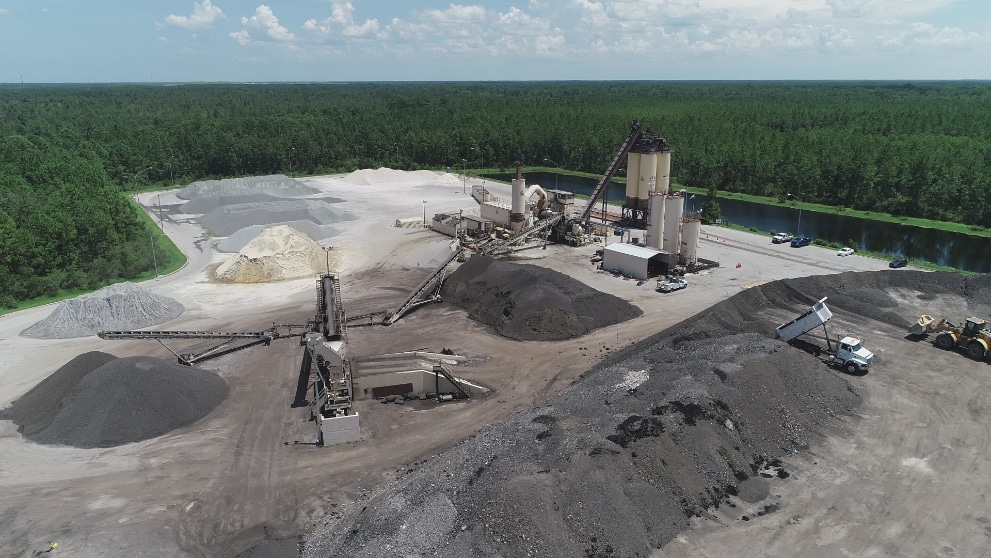
According to Carter, P&S scored very well on mix production for the I-4 project. “We did well in all three categories; it’s a great looking project, it rides great, and it paid well,” he said.

Even before P&S won the A.P. Bolton Award, the I-4 project was a success. “We had a lot of district folks call up to let us know we were doing a great job on I-4,” Carter said. “I can’t tell you how many people called to tell us how good it looked, how well it rides, that we did a great job. That speaks volumes to the quality.”

The judges for the Florida Pavement Excellence Awards—including both FDOT district employees and ACAF staff—must have agreed. Projects are judged based on a number of factors, including technical scores for mix production, rideability score from a profiler test, and a visual score.

“The judges ride each lane of the road to check joint construction, edge of pavement, texture and surface anomalies, etc.,” Carter said. “The joints on our I-4 project are practically indiscernible, the texture of the OGFC was super consistent, the lane lines are symmetrical. It looks like we laid out that asphalt mat like a black carpet.”

But appearance wasn’t the only area in which the I-4 project scored well. It also achieved an International Roughness Index (IRI) of 31—the best IRI score P&S has ever received. “Most highways like this score anywhere in the 40-50 range,” Carter said. “That 31 isn’t the lowest score in the state, but it’s among the lowest. I think that’s what pushed us over the edge to win the statewide award over some of the bigger contractors in the state who had really constructed some outstanding projects that same year.”

P&S also received bonus composite pay factors for the surface level and friction course. “We scored very well on mix production here at the plant and on our densities, and we got incentives for those as well,” Carter said. “We did well in all three categories; it’s a great looking project, it rides great, and it paid well.”

Carter attributes the smoothness to the expertise of the crew to use the automatics on its Roadtec RP190 paver. “The pavement equipment is naturally a big part of that, but having the expertise and the skill to use the automated electronics is key,” Carter said. “It’s one thing to have them, but it’s another thing to know how to use them and use them well. If you can use automatics well, this is what you get.”

P&S has established a training process to ensure its crew knows how to best utilize the automatics on its equipment. The company regularly sends its mechanics and paving crews to Roadtec’s training program in Chattanooga, Tennessee.

“Success comes down to discipline,” Carter said. “Do you keep your folks well trained, your equipment in good working order, and your morale high?” Keeping morale high, he adds, includes ensuring every employee feels as though their opinions matter, their good work is appreciated, and they are full participants in their employers’ victories.

“When we won these awards, we really shared that victory with everybody,” Carter said. “When we received the incentives from the ride bonus, the owner chose not to pocket that money but instead shared it with all the people involved in that project because they did such a great job. I’ve never worked anywhere where someone did that.”

Carter said everyone at P&S was at peak performance on the I-4 project, but that the company’s success isn’t a matter of performing on one single job. “Our guys perform every single day,” he said. “Not once or twice a week, but all five days of the workweek, week after week. That’s the real trick. Anybody can do something well once, but can you repeat that over and over again?”


Smoother AND Safer

The I-4 project also included widening of the shoulders. “If you drive around Florida, you’ll see that many of our shoulders are up to 10 feet wide,” Carter said, adding that FDOT has been adding that to many contracts in the past few years. “The DOT makes extensive use of the Road Ranger program, and they want to make sure these contracts are designed to maximize safety for those guys out there helping motorists.”

An intelligent transportation system (ITS) was installed at the intersection of State Route 44, another major corridor that runs north-south through Volusia County. “The Volusia County Fairgrounds are about 1/4 mile from that intersection, and there’s a lot of activity at the fairgrounds throughout the year, so they upgraded the traffic signals to make traffic there more efficient and safer,” Carter said.

“Ultimately, this project enabled FDOT to repair that crack while giving this piece of roadway some new life with the resurfacing part of the project while also improving safety by widening the shoulders and adding some signalization to improve traffic flow.”


Three Projects, Four Awards

Caption: Space Coast Regional Airport is the nearest airport to Kennedy Space Center, one of the 10 field centers belonging to the National Aeronautics and Space Administration (NASA).

In addition to the two awards P&S received for its I-4 project, the company also received two Florida Pavement Excellence Awards in the special projects category. One of the awards was for the milling and resurfacing of runway nine at Space Coast Regional Airport.

“It’s a really old regional airport, so the project wasn’t without its challenges,” Carter said. P&S used machine control guidance through the milling phase to get the proper cross sections, then placed the P401 wearing course.

The second project for which P&S received a special projects award was the reconstruction of the running track at Embry Riddle Aeronautical University in Daytona, a world-renowned aviation school.

“They have a pretty robust sports program there at the university and host international track and field events,” Carter said. P&S was chosen to full-depth mill the oval running track and pave back 1 ¼ inches before the specialty contractor could come out to apply a rubberized surface course.

“The paving of the underlying asphalt is key for the specialty contractor who will be placing the rubberized materials on top,” Carter said, given the tight specs they must meet to ensure no competitors are given an unfair advantage. “When the paving is done, these guys typically have to grind out some areas and fill in other areas. The more of that they have to do, the worse the paving job was.”

After the track was completed, P&S received a letter from the specialty contractor’s field superintendent that said, in his opinion, “the work by P&S couldn’t have gone better. In fact, it was probably the best paving job I’ve seen in 10 years.”

The superintendent told Carter they sometimes use 25 to 35 barrels of filler material to even out the pavement, but this job required only two and very minor grinding. “That goes back to the discipline that our guys use when they’re paving these high spec projects,” Carter said.
Select Your Plate Compactor MVP

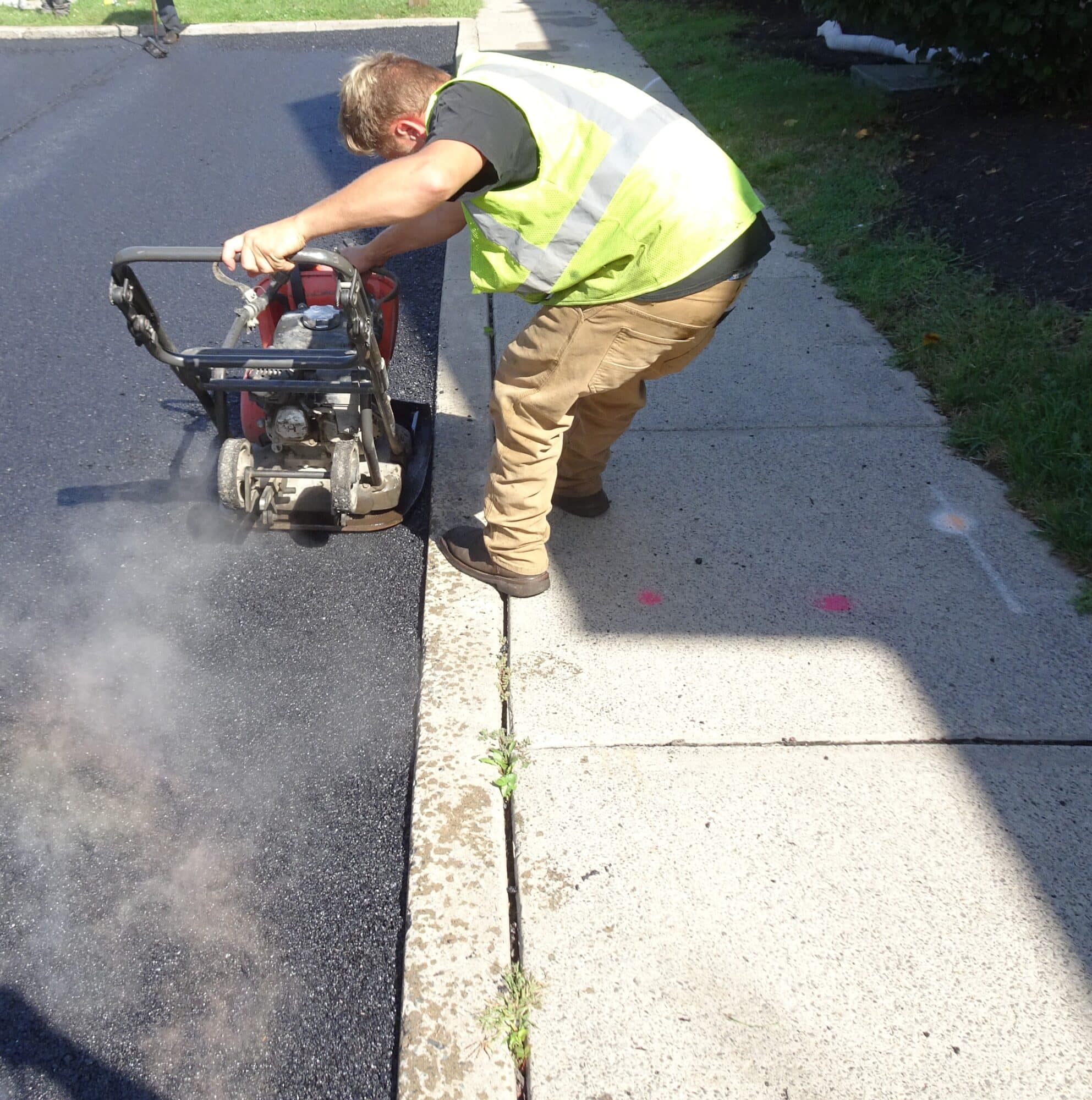
You can’t complete handwork on the paving job without a plate compactor and a willing worker to run it. This person is sometimes easy to overlook when you’re rounding out your paving crew, but he—or she—is essential to completing a top quality residential or commercial project.

The roller operator has already rolled the speed bump, but Barrett is manipulating the material into the structure they’ve built for final compaction and to remove lines.

It’s not only the starter pad that needs to be compacted with this tool, but any part of the mat where the mix has been agitated by the crew. Any area that’s been dumped into place by the wheelbarrow, skid steer bucket or shovels is an area the plate compactor needs to address. Any spot that’s been touched with the rake or shovel has been irritated and the material needs to be soothed back into place with the plate compactor’s vibration. The savvy laborer is always on the lookout for those blemishes to fix them and seal them. He’s looking to tighten up the mat and make it beautiful. He’s taking out the cut marks or imperfections.

Perfect Example

For the crew at Superior Surfacing Systems Ltd., Middletown, New York, Justin Barrett is the crewmember who is assigned to run the plate compactor. That’s been his job for the past three to four years. Over the past few years, he has not only learned his craft, but he’s also come to exemplify the type of dedicated laborer you want for the position.

The wheels on the compactor are typically in the locked position. You can release them, tilt it back and push to another portion of the job quickly. The u-shaped handle on top of the compactor is strong enough to support the weight of the tool when loaded onto a truck or lowboy with a lift.

Keith Reardon, the president of Superior Surfacing, spoke of Barrett’s talent and dedication to his craft. “He’s responsible for plate compaction and hand tamping of all applicable and critical areas of the job. It’s a somewhat tedious job that requires constant movement and attention to all the little details. It’s often the final touches that make a difference between some other contractors and our high expectations of a truly quality job. Justin has been with us for approximately three to four years, is reliable and enjoys his work and interaction with the crew. I wish I could clone him and spread him around. He truly enjoys what he does and takes pride in the finished product at the end of the day.”

Put Wheels on the Plate Compactor

I don’t know of any other crews that have one person dedicated to running the plate compactor. Barrett is the silent member of the paving squad, but, in this example, he’s the guy who’s making the job noteworthy. This position is so exciting that if you’re doing it right, you’re taking it seriously and you’re sweating bullets out there. You’re hopping from one end of the project to the other to keep up with all the different sections of the mat and all that those sections need.

The roller operator has already rolled the speed bump, but Barrett is manipulating the material into the structure they’ve built for final compaction and to remove lines.

Because he’s moving around the project so often and so quickly, Barrett strategically places 5-gallon buckets of water around the project site for refilling the compactor. The specific plate compactor that he uses is the Husqvarna LF 100 LAT, which has a tube bolted down at the front of the plate. The holes in the tube let water out and the vibrations let the water spatter and splatter to lubricate the plate.

How to Pave a Complex Lot

If a crew has the luxury of paving a straight line for the day’s project, a plate compactor can often follow the rolling train, which means a water truck can be following along or a water tank can be situated on a roller deck. For a parking lot project like we see in the pictures here, having water buckets scattered strategically around the job site is a smart idea.

All good roller operators know to put boards down to protect the joint when “climbing” onto a mat. Here, the Superior Surfacing Systems crew demonstrates using the boards to protect the speed bump’s integrity as it is built. Barrett fine-tunes the bump and removes lines with the plate compactor after it’s been rolled. Notice how smooth and clean the finished mat is on the left side of the photo. The crew leaves no lines; you see no joints in the pavement.

When the rolling train is compacting, the pattern depends on time and temperature. The same is true for the lone plate compactor operator. He has to think about time and temperature but also how well the crew raked out the material he’s about to manipulate. He has to jump on it quickly and seal it quickly because the minute someone interrupts the mix with raking, they have changed the characteristics of the mat. He has to be alert and get on the sections in a timely manner.

If the crew is paving at 25 feet per minute, and he needs three or four minutes to seal the starter pad at one end of the pull, the paver is 75 to 100 feet down the lane by the time he’s ready to move to the next area. He’s looking for the extra places that need his attention all the time and he’s answering to multiple members of the crew.

How to Repair a Utility Trench

The people who call for this laborer’s help throughout the paving day are the roller operator, the raker/lute artist, and the screed operator who’s matching the joint. The fellow running the plate compactor is at their beck and call throughout the shift and he’ll keep an eye on all three of them for when they need him.

In the case of Superior Surfacing Systems’ Barrett, the young man is a natural. As you can see by the pictures here, he puts his whole body into the job. He uses his strength to move, turn and steer the compactor. The Husqvarna LF 100 LAT weighs 236 pounds. It has a 4.8-horsepower Honda engine and is rated with 17 Newtons of centrifugal force. The plate width is 19.69 inches, and its edges curve up like the ski of an endgate to prevent cutting and digging the mat as you work.

It has a corrosion-resistant, removable water tank, and I want to point out the large cap that makes it easier to refill than other models I’ve operated. Also notice the uniqueness of the knob to control the water system being located on top of the water tank as well. It makes it easy to access a visible, sizable knob to adjust the water flow. You can see Barrett adjusting the knob on the fly—and the water spatter action—in the video uploaded with this article at TheAsphaltPro.com website.

John Ball is the proprietor of Top Quality Paving & Training, Manchester, New Hampshire. For more information, contact him at (603) 493-1458.

How to Build a Notch Wedge Joint

When trying to increase the life of the mat, notch wedge joints (NWJ) are a superior alternative to butt joints. Since it is not always possible to run hot echelon paving, contractors can use the overlap of a notch wedge joint to increase the density of the longitudinal joint thus increasing the life of what traditionally seems to be the first failure point in paving. For example, we see an average of a three points increase in joint density when building with our notch wedge device versus a butt joint.

There are two predominant types of notch wedge devices right now:

  • devices that go inside the screed
  • devices that are attached to the outside of the endgate

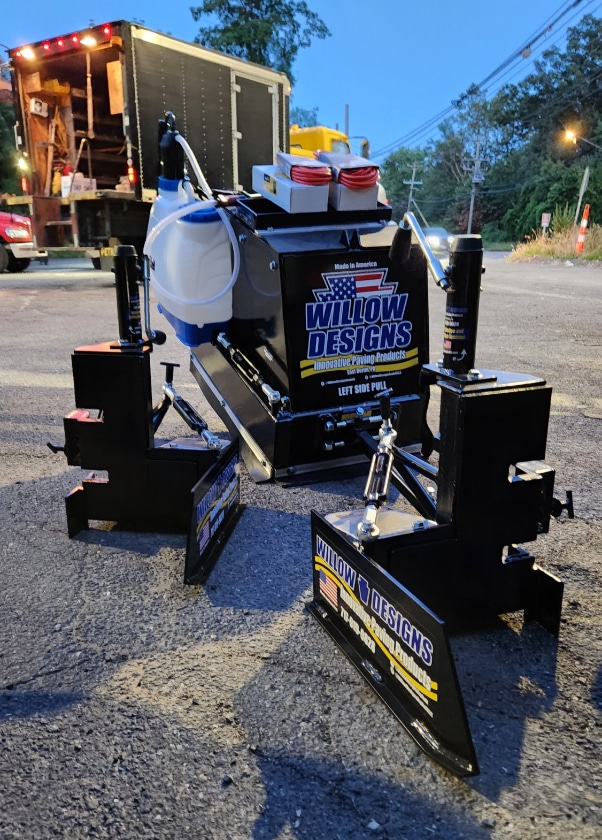
We prefer the efficiency of the on-and-off devices that attach outside the endgate, such as our Willow Notch Wedge device, so when referring to devices in this article, we will be referencing the ones pictured here. Simply put, the mechanic can attach a bracket to be left on the screed or use the simple bolts on the device that allow for in-field attachment and removal in a few minutes.

These devices are offered by Willow Designs, East Berlin, Pennsylvania. Jerod Willow, the proprietor, took the time to prepare this step-by-step guide for building a successful notch wedge joint for the 2024 Training Directory.

Depending on the climate and quality of the mix, there are also options to add heat and/or vibration compaction with devices. Additionally, many companies choose to also use a specialized pneumatic roller from Willow Designs that attaches via a hand twist bolt to the notch wedge device alleviating the need to roll the wedge portion with an additional machine.

The Willow Designs notch wedge device affixes outside the endgate.

This pneumatic roller adds compression to the vertical joint while reducing raveling and fracturing of aggregate at the wedge. When used in tandem with the pneumatic roller, we see joint densities increase by an average of four to seven points.

For the first-time use of the Willow notch wedge device and pneumatic roller, I provide a shift of support to the paving crews so that they can achieve the best numbers with the product the conditions will allow. Often a full shift is not necessary due to the ease of use, but once in a while the team takes advantage of all my experience and they dig into the weeds of best paving practices.

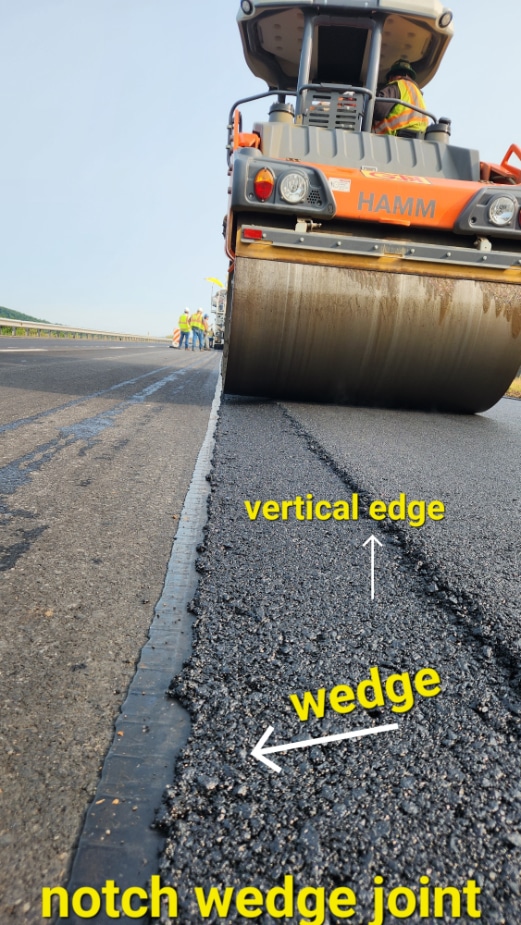
When a contractor purchases the notch wedge device and pneumatic roller, the paving crew receives a shift of support to help them understand how to affix it to the endgate, how to use it, how to pave and compact the joint properly, and so on, to achieve the best numbers with the product that conditions will allow. Notice in the second image that the breakdown roller is rolling the first pass with the steel drum overhanging the joint. The Willow Designs team has found the breakdown roller should be rolling as soon as it can fit behind the paver, compacting as hot as possible and overhanging the joint by 12-18 inches of drum. All photos courtesy of Willow Designs

Here is the step-by-step process to build a notch wedge joint.

Step 1: Select your system of choice and affix it to the endgate.

Based on your paver’s screed type, a simple bracket can be bolted to the endgate that the device can then be attached to. The device could also be directly bolted to the endgate.

The pneumatic roller is attached with a T-bolt to a stud on the notch wedge device. The release agent container is filled and snaps into brackets on the mat side of the roller.

When a contractor purchases the notch wedge device and pneumatic roller, the paving crew receives a shift of support to help them understand how to affix it to the endgate, how to use it, how to pave and compact the joint properly, and so on, to achieve the best numbers with the product that conditions will allow. Notice in the second image that the breakdown roller is rolling the first pass with the steel drum overhanging the joint. The Willow Designs team has found the breakdown roller should be rolling as soon as it can fit behind the paver, compacting as hot as possible and overhanging the joint by 12-18 inches of drum. All photos courtesy of Willow Designs

Step 2: Apply tack.

Some states are now requiring that a longitudinal joint sealant (LJS) or void reducing asphalt membrane (VRAM), such as the J-Band product from Asphalt Materials Inc., be applied along the centerline. Check with your state specifications.

Step 3: Pave the first pass.

This is the time to dial in the device according to the mix and specifications of the job.

The primary jack is used to lower the inside portion of the device’s screed for the depth of the vertical notch. Bear in mind that you need to add the compaction depth of the mix to the depth of the vertical notch. We try to set the notch of the device at 40% above the compacted mat thickness while also trying to accommodate the largest aggregate in the mix.

Here you see the primary jack and turnbuckle highlighted.

Once the depth is set, use the turnbuckle which adjusts the slope of the wedge/toe slope/outside portion of the device’s screed. Also, the toe of the slope on the wedge should not be less than a stone’s thickness, otherwise there could be segregation in the wedge mat. Most states specify a 12-inch width of wedge, but the Maine DOT is playing with a 6-inch wedge for lift thicknesses that are less than 2 inches.

  • Some devices have vibratory options, and during this step, you would turn on the vibration to the setting of your choice.
  • With cold weather climates and SMA mixes, the heated screed plate would be plugged in before paving and then shut off once the device is running hot mix.

If the pneumatic roller is being used, then this is also the time to generously add release agent to the roller via the attached spray tank and nozzle. Release agent needs to be maintained until the roller heats up and then less material is required. Adjust the turnbuckle on the mat side to adjust the lateral tracking to just overlap the vertical edge by 0.5 or 1 inch.

The paver lays the second pass against the vertical edge and overlaps the wedge. Be careful to match the joint at the proper elevation so as not to starve the joint for asphalt mix.

Step 4: Roll the first lane.

This we find is probably the number one improvement to be made in low joint density numbers for compaction of the first lane with an open wedge joint. The breakdown roller should be rolling as soon as it can fit behind the paver, compacting as hot as possible. The rolling allows for the roller to overhang the joint by 12-18 inches of drum over the wedge. It does not seem to matter if it is rolled first or last in the pattern. We always recommend using the extra pass (if there is one) in a pattern on the open joint. This applies to all steel drum rollers in the paving train.

We have found that running another method of compaction on the 12 inches of wedge is not necessary if the Willow pneumatic roller was used initially.

As mentioned in Step 1, release agent is used for the pneumatic roller compacting the wedge immediately behind the screed. Keep in mind, the release agent is applied liberally at the beginning of the operation but is required in smaller amounts as the roller heats up.

Step 5: Apply tack to the second lane.

Spray the wedge with a double application in addition to coating the second lane. If there are any voids in the mat of the notch wedge joint, the heavy tack coat application will fill these and actually increase your chances of achieving higher joint density numbers.

Step 6: Lay the second lane.

The paver lays the second pass against the vertical edge and overlaps the wedge. Be careful to match the joint at the proper elevation so as not to starve the joint for asphalt mix. Longitudinal joints that are matched low will ultimately produce low joint density numbers because the compaction train will bridge on the cold lane of pavement being matched. We often see screed operators do this because they have been taught to build an “invisible joint” that rolls in clean with less distinction. We now know this is a failed joint waiting to happen. We can check good joint elevation by depth-checking proper loose depth thickness of the pavement at the matched joint 14 inches into the hot mat. The wedge will then heat back up and become the second lane as shown by joint density cores.

Cores should be centered over top of the wedge, which is roughly 3 inches from the seam. That provides the best representation of the joint.

The paver lays the second pass against the vertical edge and overlaps the wedge. Be careful to match the joint at the proper elevation so as not to starve the joint for asphalt mix.

Step 7: Roll the second lane.

Based on project conditions, for the breakdown, stay 12 to 14 inches off the matched joint with the first pass toward the paver. For the second pass, steer the roller to where the drum has a 12- to 18-inch overhang onto the cold lane. Not all job conditions allow for a great overhang, but the best results from our testing show that an 18-inch overhang puts the weight of the roller directly over the joint. This compacts the material into the joint, stabilizing the mix over the wedge. Then you continue rolling the mat as normal. We always recommend if there is an extra pass in the pattern to put it over the joint.

If specified density is not being achieved with this equipment, we need to dig deeper into good paving practices.

Jerod Willow is the proprietor of Willow Designs, East Berlin, Pennsylvania, and has over 20 years experience in the asphalt and paving industry. He saw a chance to improve asphalt life by developing user-friendly devices to meet the needs of contractors. He also uses this knowledge to teach paving classes and does onsite training as well as consulting for companies looking to improve their paving practices. For more information, contact him at (717) 919-9828.

Preferred Materials Executes the Plan to Get the Best IRI in Florida

Preferred Materials Inc., a CRH company based in Tampa, has a host of quality in construction (QIC) project wins to its name, but there’s a pair of projects along Interstate 75 (I-75) in Florida that deserves extra attention. Let’s start with the one you can find between exits 254 and 256, which crews returned to traffic Oct. 12, 2021.

The company took home a QIC award from the National Asphalt Pavement Association (NAPA) in January 2022 for this project of over 50,000 tons. The mill-and-fill encompassed eight total lanes north of CR672 to south of Progress Blvd. on SR93A/I-75 where the company placed a surface mix of FC5 Superpave mix design. The crew first milled and replaced 2 inches compacted of structural course, then placed the open-graded friction course (OGFC) at a mere ¾ of an inch, yet they achieved something remarkable—an average international roughness index (IRI) on the project of 25.

What’s more remarkable than that? The same crew performed the same mill-and-fill work with the same mixes immediately south of the 8-mile project in 2020 with an average IRI of only 24.

Farhad Zafaranian, E.I., M.S., is the construction manager for Florida Department of Transportation (FDOT), Tampa Operations Center, and shared this represents the “[s]moothest pavement in the history of FDOT since IRI has been recorded. It is important to note that the low IRI number would reflect consistency in production as well as placement procedures, which is the ideal goal of FDOT’s quality control process.”

“As both the state construction pavement engineer and a road user, I’m very happy to see our roads getting smoother than ever before,” said FDOT’s Richard M. Hewitt, P.E. “I believe it is a direct result of the department’s incentive/disincentive smoothness specifications and a contractor who has put effort into trying to pave smoother than ever before. I’m very proud of the work Preferred Materials achieved on their two I-75 projects, as well as the majority of our asphalt paving contractors who have been paving significantly smoother in recent years.”

That pride is shared. Richard Crocker, operations manager of Preferred Materials Asphalt Division Tampa, wore his commemorative “24-IRI Club” polo shirt during our interview at CONEXPO-CON/AGG and spoke readily of his team’s accomplishments. He proudly named the foremen and roller operators who contributed to the success of the 24-IRI project and easily spoke about their skills, not only on the I-75 projects, but also on a recent racetrack project that took all hands on deck.


“A year-and-a-half later, we went up and did another project just north of it and repeated the same,” Crocker said. “That same crew with the same rollers, with the same operators. And this is why you must take care of your people. You don’t want your people coming and going and losing their expertise.”
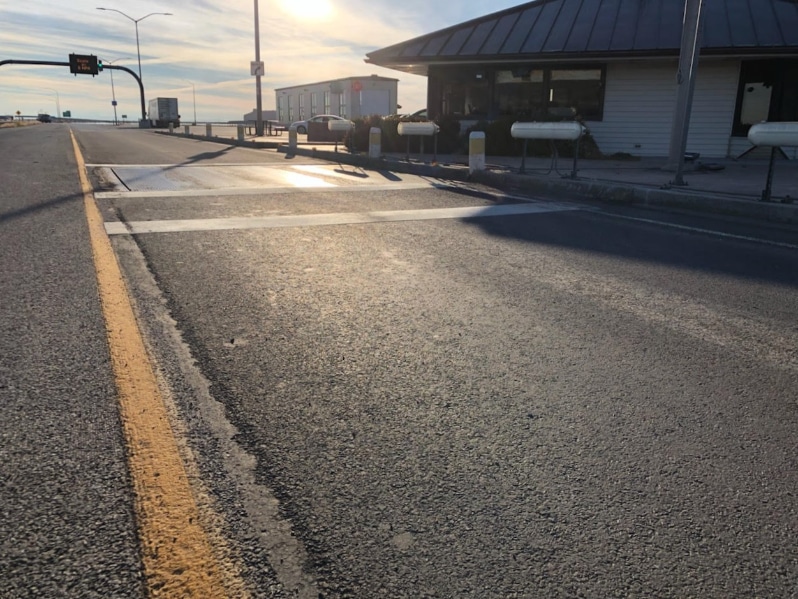
The secret to success is working with skilled operators who know their best practices and know their equipment. “Try to keep people on the same piece of equipment as often as you can,” Crocker said. He advised the successful companies out there will crosstrain crewmembers and have multiple workers who can perform the vital tasks on the paving train, but you’re building a team of experts.
Pat Longstreet is the foreman for the crew that handled the I-75 project and his breakdown roller operator is Javier Gonzalez, who has 14 years with Preferred Materials. He runs a Sakai in the breakdown position and typically runs it with both drums in oscillation mode.

“For I-75, for the structural mix, we were putting down about 900 to 1,000 tons per shift due to lane closure restrictions,” Crocker said. The team performed layout and milling, so they had about six hours of paving before they had to turn things over to striping and open it up to traffic. “We were paving at about 28 to 32 feet per minute on the structural on 75 at 12 feet wide, 2 inches compacted.”

Collaboration Across the Board

Charles Holzschuher, P.E., is the state pavement materials engineer for FDOT. He spoke of attaining smoothness as a collaboration: “Based on collaboration with industry and the department, roadway construction and implementation of these smoothness specifications has improved the quality of paving resulting in smoother IRI. Ultimately, the goal of smoother pavements and utilizing industry leading construction techniques is to embrace innovation, technology, and competition which has resulted in smoother pavements on a statewide level.”

While FDOT isn’t going to dictate a specific technology, the one Crocker spoke of as integral to smoothness success during our time at CONEXPO was oscillation for compaction.

Good Density Equals Smoothness Bonus

The crews use rollers from Sakai, as mentioned above, and they typically have them set in oscillation mode, according to Crocker. It’s a feature of Sakai rollers that the front and back drums can be set in either vibratory or oscillation mode, or be switched from one mode to the other, or be both in oscillation mode.

“I like the capabilities of both drums being able to oscillate,” Crocker said. “Very seldom do we oscillate with only one drum. 99% of the time, we are oscillating with both drums. We do use the vibration on the 750 pneumatics, too. That’s usually on a #3 or #4 setting, whether we’re putting out a poly mix or not, we use them. And, again, that’s training roller operators and setting expectations and knowing what to do.”

While at the booth at CONEXPO, attendees could gather information about the benefits of mixing and matching technologies. Studies showed using both drums in oscillation mode offered bonus potential; check out the sidebar below for that information.

Crocker also spoke of the importance of collaboration and cooperation with all the partners and owners. By communicating needs and requests up front, contractors increase their opportunities to use best practices. They increase their chances to achieve the smooth results the asphalt industry can offer the taxpayers.

“We try to do a lot of continuous paving and that’s why we get the IRI result numbers we do,” Crocker said. “We coordinate, we plan, and we execute. There are a lot of partners that go along with that. Trucking, traffic control, the plant, QC, milling, cleanup.”

Crocker explained that the plant might be producing 4,000 tons of FOB mix on a given day, but his crew needs to pull 1,000 tons of structural. That takes coordination. Planning. A dedicated group of silos and one lane of the scales that the truckers know they’re to access.

Simon Wins for Smoothness on SH-14

“It’s all relative,” Crocker said. “If we can continuously pave, then we can continuously roll.”

One way to increase the time spent paving is to ask for it. If you have a good reputation, you might get that time. For example, he said the I-75 projects had clear start times at 10 p.m. and stop times before rush hour traffic kicked in. “You had to be off the road, and that’s painted, everything’s off the road by 6, some spots of the road was by 5.”

What Crocker shared is how to wisely extend that time. “If you can go out and show, hey listen, over this 12 miles, I can eliminate four sets of transverse joints,” you could gain “an hour or an hour and a half at the beginning of the shift.”

He explained that you can approach the project owner, even if that’s a DOT with set specs for the project, and show them what you can do with the extended time. By eliminating transverse joints, you eliminate the potential for bumps in the road. By extending time on the northbound lanes while most traffic is building up southbound, you’re using time wisely.

“You gain an hour, hour and a half at the beginning of the shift going northbound because all the traffic then is trying to go south,” Crocker said. “Then when you go the other way, you get it on the other end.”

Quality, Smoothness and Speed to Completion in Colorado

Crocker said you must then execute what you say you will, or the agencies won’t be eager to grant requests in the future. That means instilling pride in workmanship in your crewmembers and getting quality results that back up what you say you’ll do.

“We try to empower all of our people from the guy putting out the cones all the way up to our VP,” Crocker said. “We try to empower our people to take pride. Our reputation has got to get us something. And it has. We have a great safety record, and we have the smoothest road in the history of Florida DOT.

“And this is worth talking about; you have to back up what you say. With our equipment, with our rollers, I was confident we were going to get joint density, I was confident we were going to get mat density, and I was confident we were going to get ride.”

Asking for what your crew needs helped Preferred Materials get the recent racetrack paved in an efficient manner as well. Crocker explained they worked with the owner to gain access to the site for continuous paving. “We had to talk to the (track) owner about access, about ingress and egress because they had the guardrail up. There’s only so much opportunity to get in on a racetrack.”

As Crocker said above, the team coordinates, plans and executes the plan. For the racetrack project, they wanted to eliminate any centerline joint, so they made a plan to build up, staggering and layering with echelon paving in mind. “We figured out which crew should be wider and which narrower to stagger the center joint.”

They placed the base with one paver and material transfer vehicle paving 17 feet wide; the other coming alongside at 13 feet wide to total the 30-foot width. When it was time to place the surface, they staggered differently. “For the friction course, the joint was right down the center.”

The racetrack crew also faced a temperature challenge with a high-polymer mix. It was produced at about 340 degrees but lost temperature in a hurry once it left the haul truck. “We had a 15-minute haul. By the time it was coming out the back of the screed, it was already down to 285, 290 degrees and that’s with 80-degree ambient temperatures in Florida.”

“We were only paving 18 to 20 feet per minute,” Crocker said. “We’re using automation on the paver. We’re using two non-contact skis. It’s a MOBA-based system. Your rollers are trying to roll this joint. The first roller has to stay off the joint. The second roller has to roll it over and push it down. The rollers are the key. We had to look at when do you start the breakdown process? In this case, immediately.” And the rollers had to come right up to the screed. “We had to communicate that in the pre-construction meeting.”

Solve Rideability at the Paver Track

Best practices came into play. “When the roller starts to approach, he has to come right up to the screed. We can’t stop 20 feet away, and we can’t stop straight. He has to always stop at an angle. And when we come onto the mat; we have transverse joints, we can’t come onto the mat straight, we have to come on at an angle.”

Pat Longstreet and his crew had Gonzalez as the breakdown roller operator on the racetrack project. Chris Longstreet and his crew were the second crew on the project. They had two breakdown roller operators during the project: Ceasar Jimenez, who has been with the company for eight years, and Mytara “Nubs” McCray, who has been with the company for 22 years.

That longevity, coupled with the skill and pride in workmanship so evident in the Preferred Materials ethos, lends itself to a set of low-IRI, high-quality pavements that our industry can point to as examples of exemplary asphalt construction. As the team at FDOT pointed out, getting high quality translates to long lasting pavements for the taxpayers, and that’s a win we can all be proud of.


Smoothness Matters

The Florida Department of Transportation (FDOT) has put time and energy into its smoothness specifications to encourage and reward those contractors who take on state projects. One of the measurements of smoothness is the International Roughness Index (IRI), which members of FDOT discuss here.

Farhad Zafaranian, E.I., M.S., Construction Manager, Tampa Operations Center: “IRI describes how much total vertical movement a standard passenger vehicle’s body would experience if driven over a 1-mile segment of the subject pavement at 50 mph. IRI is useful for assessing overall pavement ride quality; a higher IRI value indicates a rougher road surface. It is used by highway professionals throughout the world as a standard to quantify road surface roughness. A continuous profile along the road is measured and analyzed to summarize qualities of pavement surface deviations that impact vehicle suspension movement.

“Lower IRI equates to a smoother pavement surface which equates to increased pavement life and it will create a more pleasurable driving experience for the travelling public. Ultimately it would contribute to lower number of accidents, and decreased maintenance cost.”

Charles Holzschuher, P.E., State Pavement Materials Engineer: “Pavement smoothness is a key performance indicator and top priority for road users. Smooth-riding pavements provide comfort, raise optimum travel speeds, maintain traffic flow, reduce safety hazards, and increase fuel efficiency. Pavement smoothness also imparts a positive reflection on the construction and maintenance proficiency of the owner agency. Furthermore, research has shown that over time, smooth roads cost the owner/agency and users less in maintenance and lead to longer pavement service lives.

“To better achieve smooth pavements and increase the service life of our roads, FDOT in partnership with the paving industry has formed smoothness-based specifications to promote good construction practices and to develop and implement profile-based construction smoothness specifications. The long-term success of profiler-based specifications relies in part on the implementation of an FDOT profiler certification program to verify the accuracy and repeatability of test equipment to measure a longitudinal surface elevation profile.

“To realize this goal, a certification test track was constructed at Williston Municipal Airport. The test track meets the reference and inertial profile requirements set forth in AASHTO R-56. This certification program will ensure profiler operators have the ability to collect profile data and evaluate the quality of the acquired data.”

Richard M. Hewitt, P.E., State Construction Pavement Engineer: “Smoother pavements are not only more enjoyable to ride on, but they last longer and can help reduce some vehicle maintenance costs. Since smoother pavements last longer, the cost is spread out over a greater number of years resulting in a lower annual cost for pavement.

“The IRI provides a rating of the quality of a pavement’s ride with lower numbers representing smoother pavements and higher numbers representing rougher pavements. Lower IRI, i.e., smoother pavements, last longer and result in less maintenance costs for the state and for road users’ vehicles.

“Most drivers are not familiar with asphalt content, aggregate gradation, air voids, or density, but they do know if a pavement is smooth or not. As such, smoothness is the measure by which road users evaluate pavements.”


Let’s Oscillate

The team from Sakai set up an educational section of their booth at CONEXPO-CON/AGG 2023 where they displayed three slabs of SMA pavement, constructed using six passes of a breakdown roller moving at 3.4 miles per hour.

The first sample showed results of a Sakai SW994ND roller with both drums in vibratory mode at 3,000 VPM. The objective results showed an IRI of 99 (inch/mile), a theoretical maximum specific gravity (TMD) of 95.9% and MPD of 0.39. The summary suggested fair rideability and that “Vibe may reduce surface air void due to downward pressure.”

The second sample on display at the Sakai CONEXPO-CON/AGG 2023 booth showed results of a Sakai SW994ND with both drums in oscillation mode. Photo courtesy of AsphaltPro

The second sample showed results of a Sakai SW994ND roller with both drums in oscillation mode. The objective results showed an IRI of 50, a TMD of 97% and MPD of 0.61. The summary suggested this one’s IRI value fell in the FHWA’s “very good” rideability category; its highest MPD value of the three tested offered better draining and the quietest, safest ride; and that “Dual drum oscillation with reduced amplitude reduces scoring of binder content.”

The third sample showed results of a conventional roller with one drum in oscillation mode and one in static. The objective results showed an IRI of 174, a TMD of 97% and MPD of 0.42. The summary suggested this one’s IRI value fell in the FHWA’s “very poor” rideability category and that “Excessive oscillation amplitude in single drum scores aggregate/binder, reducing life.”

How to Repair a Utility Trench

After a utility repair has been performed, it’s time to get the pavement put back in place. To execute this properly to ensure no water intrusion or raveling at the joints, a key step is preparing the walls of the trench, no matter their height. Getting clean surfaces that tack will adhere to is vital.

For the project in the pictures on this page, the crew not only placed two 5-inch lifts of hot-mix asphalt, but also placed 2 inches of aggregate over the electrical cable in the deep trench. Whatever your project’s requirements, make sure you follow this basic template for best end results.

How to Pave on a Moving Surface

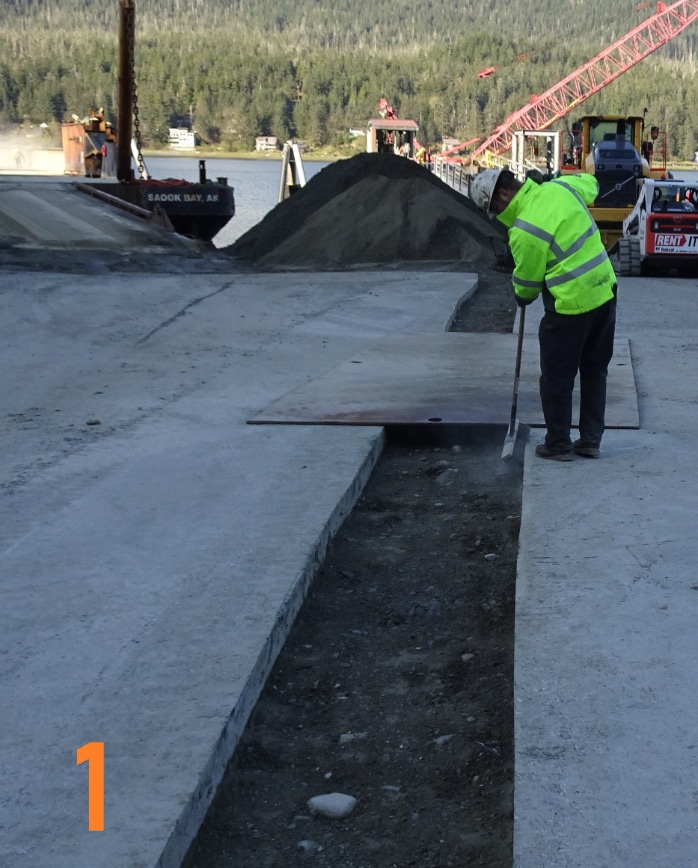
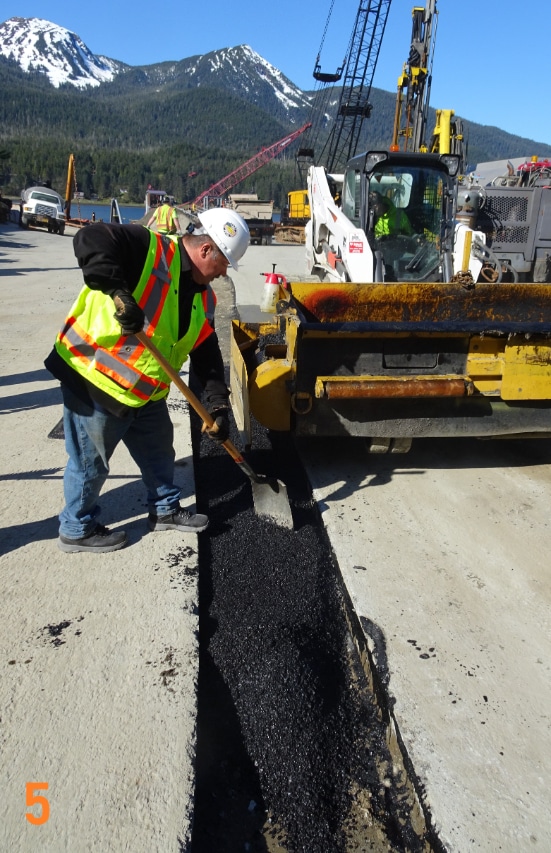
Step 1. Hand-sweep the “walls” and edges. Clean off dirt and dust with a leaf blower to ensure the sides of the trench are clean.

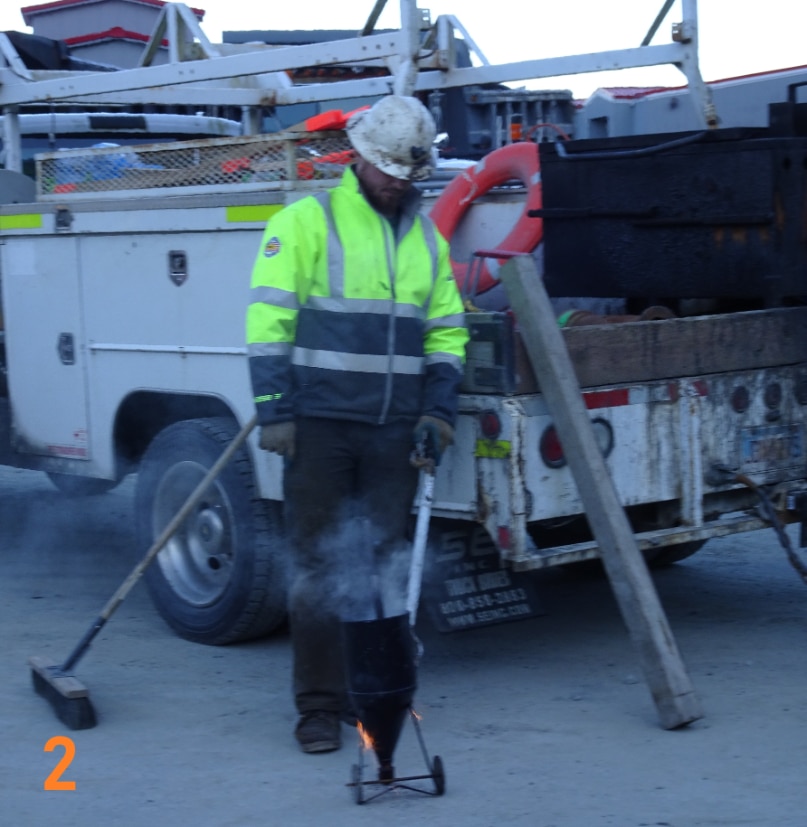
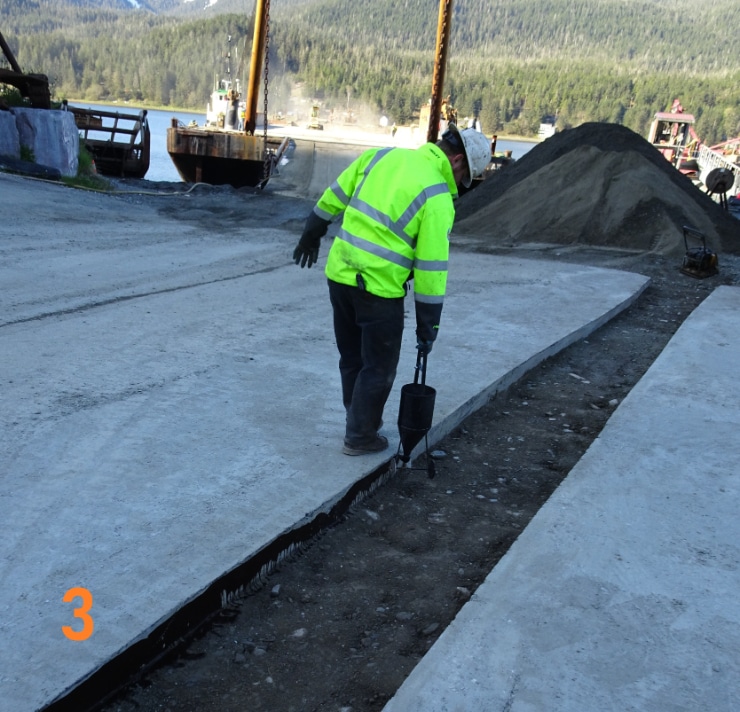
Step 2. If you don’t have a spray wand on your distributor truck, heat up the tack in a kettle and get the sides tacked efficiently. Make sure your team members know safe practices for working with 180-degree material and wear the appropriate PPE.

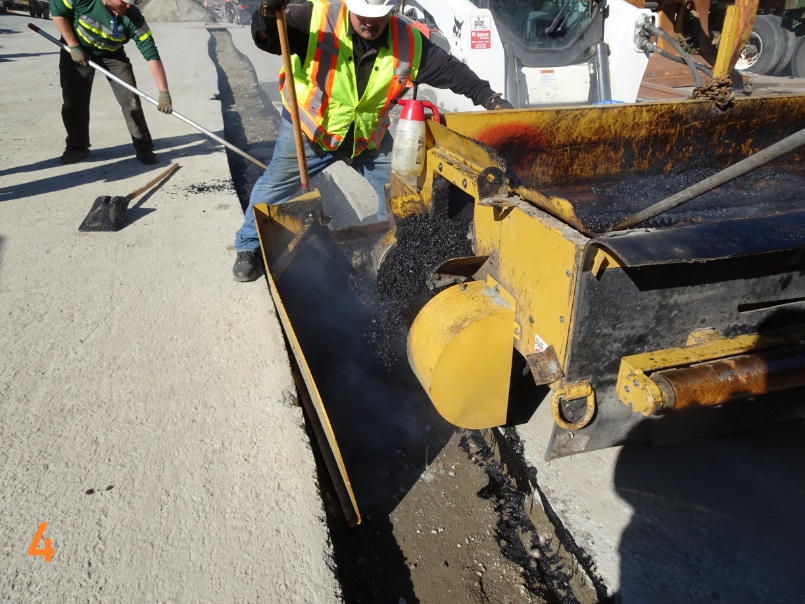
Step 3. Use a skid steer, sidewalk paver, or good old-fashioned shovels and elbow grease to fill the trench with HMA.

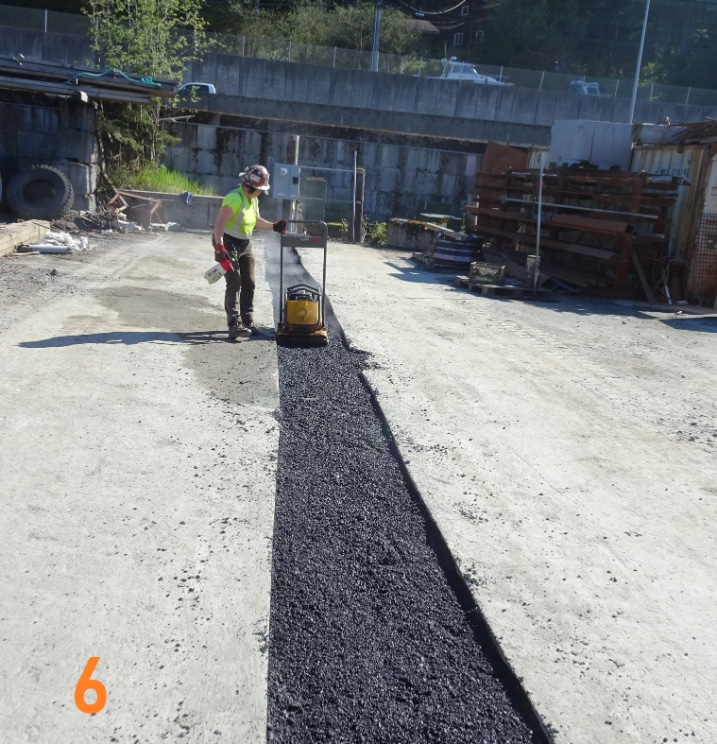
Step 4. Pinch both sides of the trench with a plate compactor to seal it against the existing pavement before compacting right down the center. You may have a large enough trench that you need a tandem roller for this step.

Before filling in the trench, the crew will sweep the sides, clean it with a leaf-blower, and tack the sides. For the project pictured here, the tack was heated to 160 degrees F.

Before filling in the trench, the crew will sweep the sides, clean it with a leaf-blower, and tack the sides. For the project pictured here, the tack was heated to 160 degrees F.

Before filling in the trench, the crew will sweep the sides, clean it with a leaf-blower, and tack the sides. For the project pictured here, the tack was heated to 160 degrees F.

This crew used a Road Widener attachment with conveyor belt in its hopper, affixed to the front of a skid steer, to put two 5-inch lifts of HMA on top of a 2-inch lift of gravel to fill in an electrical cable trench. Your crew may have a different way to throw mix into the prepped and tacked trench.

This crew used a Road Widener attachment with conveyor belt in its hopper, affixed to the front of a skid steer, to put two 5-inch lifts of HMA on top of a 2-inch lift of gravel to fill in an electrical cable trench. Your crew may have a different way to throw mix into the prepped and tacked trench.

Here the laborer uses a plate compactor to get the first lift compacted in the 3-foot-wide trench.

Utah Thick Lift Stands Up to Truck Traffic

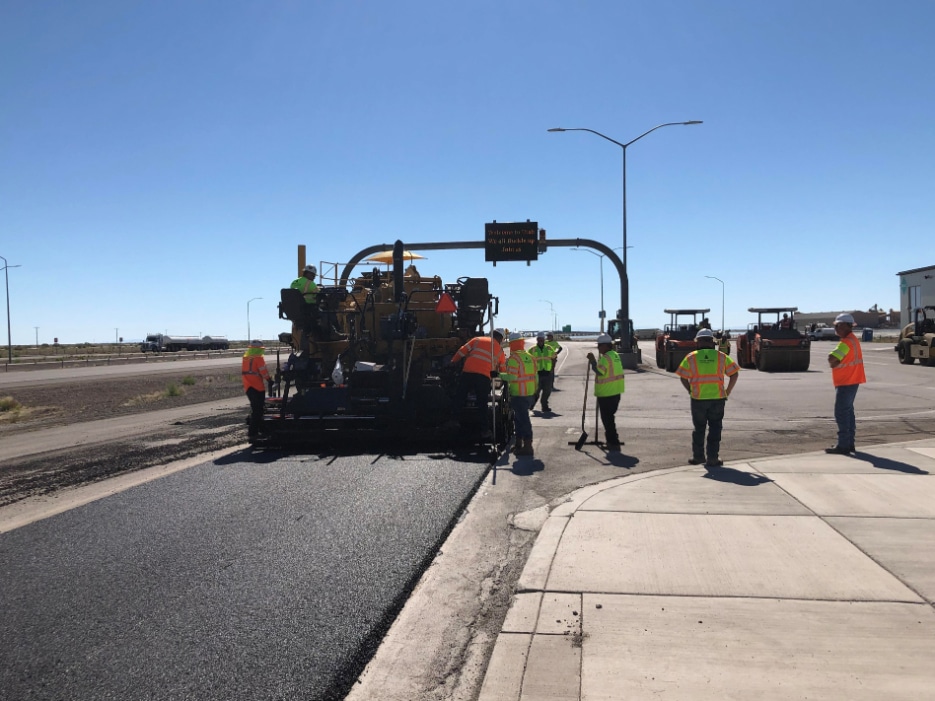
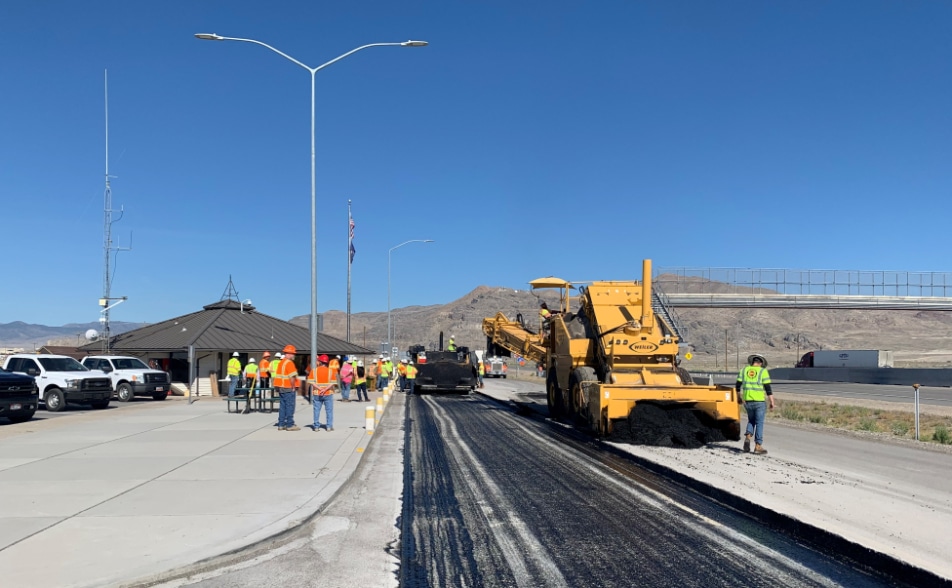
In the middle of the Bonneville Salt Flats at the state line between Nevada and Utah lies the Interstate 80 port of entry.

Subject to intense summer sun and temperatures regularly hitting more than 100 degrees Fahrenheit, as well as brutally cold winters where temperatures regularly reach the single digits, the port of entry faces a set of circumstances that would present a challenge to any pavement.

Pair that with heavy truck traffic slowing, stopping, and accelerating through the port of entry day in and day out on its way inland from the California ports, and you’ve got a recipe for pavement distress.

“With all the trucks stopping in the same places, it’s a very difficult place for any pavement to survive out there,” said Howard Anderson, state asphalt engineer with the Utah Department of Transportation (UDOT) for more than 30 years.

“A number of solutions have been tried out there and have shown issues within days,” said Luke Peterson, asphalt quality control manager for the South Wasatch Front for Staker Parson Materials and Construction, a CRH Company, in Draper, Utah.

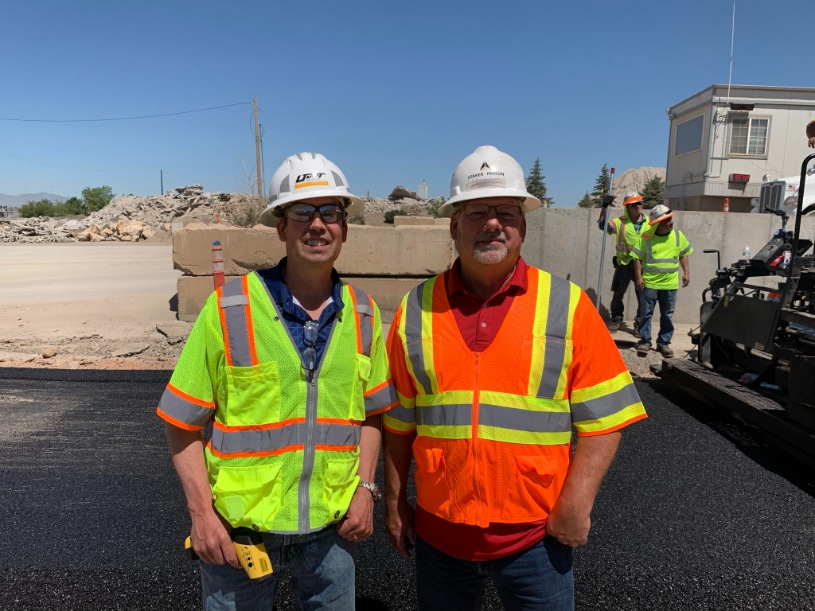
Anderson, left, first presented the idea of paving a rich thick lift using highly modified binder in 2016. Anderson is pictured here, at left, with Staker Parson’s General Manager for Oil Terminals and Liquid Asphalt Craig Fabrizio in front of the thick lift paved at Staker Parson’s test strip in its pit.

In early June 2021, Staker Parson executed an innovative test strip at the port of entry, paving a single 6-inch-thick lift of highly polymer-modified asphalt with 1 percent air voids.

It’s a mix design and concept Anderson has been investigating for the past five years, one that seemed well suited to such strenuous circumstances. As UDOT Region 2 Materials Engineer Lonnie Marchant said, “If it works here, it’ll work anywhere.”

I-80 along the port of entry has an average annual daily traffic count of 7,600 per day, with 51 percent trucks.

Oklahoma Anticipates I-40 Performance Gain with HiMA

Lots of Polymer, Less Air Voids

“Normal mix designs aim for 4 percent air voids,” Anderson said. “In Utah, we moved to 3.5 percent (75 gyrations), but on this job we moved to 1 percent with only 50 gyrations. That’s like heresy in the asphalt world.”

Anderson, who studied under Jon A. Epps when he was at University of Nevada – Reno, was aware of the rutting risks associated with air voids below 2 percent. However, he thought aiming for 4 percent air voids was too conservative and based on the binders of the past.

“Back then, they didn’t have polymers to help hold everything together,” Anderson said, adding that UDOT uses polymer-modified binders on all state roads as well as 100 percent crushed aggregates. “Now that we have a stronger ‘glue’ we don’t have to stay at 4 percent air voids.”

In early 2016, Anderson asked UDOT Central Lab Technician Clark Allen to run a series of Hamburg rut tests using 76-34 polymer-modified binder instead of UDOT’s standard 64-34 polymer-modified binder. The 76-34 is two grades higher than UDOT’s standard binder, with twice as much polymer.

Allen ran the tests at binder contents of 4.8 percent (the Superpave mix design content), as well as 5.8 percent and 6.8 percent. “Even with over-asphalting, the mix using a 76-34 binder wouldn’t rut,” Anderson said, even when extra weight was added and another test was run on the same slab. “That just blew my mind because it goes against everything I learned in school.”

What Anderson came to understand was as the binder approaches 7 percent polymer, it begins to perform differently. “It takes on more of the properties of the polymer than the regular asphalt,” Anderson said. “The mix didn’t become sensitive to over-asphalting, like we’d see if we had used a normal binder or even a normal polymer-modified binder. When I saw this, I knew we could be doing things differently.”

HiMA Design Reduces Studded Tire Wear Rutting

This higher binder content, without the elevated risk of rutting, could not only reduce air voids and help mitigate cracking, Anderson said, but it could also enable compaction of thicker lifts of asphalt than what has been possible in the past.

“Our industry usually doesn’t pave thick lifts because it’s hard to get density,” Anderson said, “so we instead pave two lifts with a tack coat in between.” However, Anderson continued, increasing binder lubricates compaction throughout the thick lift. Anderson first presented the idea of paving a rich thick lift using highly modified binder at the WASHTO Conference in Salt Lake City in April 2016. “It took some time and further presentations to get such a radical idea on a project,” he said. Eventually, an opportunity arose in Utah to put Anderson’s ideas to the test: the I-80 port of entry.

Staker Parson decided to pave its own 100-ton test strip in its pit the day before paving UDOT’s test strip at the port of entry (pictured here) to ensure success on the project.

The Test Strip Before the Test Strip

The 330-ton thick lift test strip at the port of entry was part of a much larger and more conventional project, milling 2 inches off 20 miles of I-80 and replacing it with 2 inches of stone matrix asphalt (SMA).

“We were going after the large 40,000-ton SMA project,” said Staker Parson’s South Wasatch Front Construction Manager Jonas Staker. “When we saw the spec in there for a 6-inch lift on the port of entry, we were willing to give it a shot.”

The mix was produced at Staker Parson’s Beck Street Plant in Salt Lake City, a 1.5-hour haul from the port of entry. “We felt we needed to give ourselves any advantage we could, which is why we decided to use Evotherm,” Peterson said, adding that WMA is very common in Utah. “I think that helped with the long haul and also with compaction.”

The final mix design was a 12.5 mm 50 gyration Superpave mix with 15 percent RAP, PG76-34 binder with 0.5 percent Evotherm and a total asphalt content of 6 percent, with 1 percent air voids. UDOT’s usual mix is a 12.5 mm 75 gyration mix with about 5 percent binder and an air void target of 3.5 percent.

When Mike Stevens, Staker Parson’s superintendent on the project, began talking to Peterson about the thick lift test strip well in advance of the job, Stevens knew the project was “something special.”

Highly Modified Asphalt (HiMA) Offers Results on I-40

“There were so many unknowns about the material,” Peterson said. That’s why Staker Parson decided to pave its own 100-ton test strip in its pit the day before paving UDOT’s test strip at the port of entry. “We were very committed to making sure everything was going to succeed in the end.”

The test strip provided a number of insights, including some changes to the rolling pattern and an opportunity to calibrate all of Staker Parson’s equipment. “We were able to shoot density on the test strip and then core it to make sure our gauges were reading correctly,” Peterson said. “That made us feel very comfortable using a nuclear gauge on the job.”

“It also helped us realize how stiff the mix was and how fast we’d have to pave it down,” Peterson said.

They also learned how long such a thick lift would retain heat. They planned to core the test strip at their pit that afternoon, but it was still too hot. “We cored it that night and ran tests through the night to make sure we had the information we needed for the next day,” Peterson said.

When the pavement was still 150 degrees Fahrenheit the following morning, there were discussions about cancelling the project altogether. However, Anderson was confident that once the mat had cooled, it would set up strong.

The mix was produced at Staker Parson’s Beck Street Plant in Salt Lake City, a 1.5-hour haul from the port of entry. They decided to use Evotherm to assist with the long haul and compaction on site.

The original plan was to open the port of entry to traffic the same day of paving, but Staker Parson’s test strip in its pit prompted UDOT to wait to open the port of entry to traffic. The job was paved on a Thursday and didn’t open to traffic until Sunday afternoon.

“Normally we won’t have to wait that long,” Anderson said, “but we were unusually nervous since this was our first job with it.” He suggests waiting until the pavement reaches a temperature of 100 to 120 degrees Fahrenheit before reintroducing traffic, which the test strip in the pit reached two days after it had been paved.

“The test strip told us that, as much as we needed to pave it rapidly, we needed to be patient after it was compacted to give the mat time to let that heat out,” Stevens said.

A Sticky Success Story

Before Staker Parson’s crew could pave the port of entry on June 3, 2021, subcontractor Construction Material Recycling (CMR), Coalville, Utah, first milled out 3 inches of asphalt and 3 inches of concrete 300 feet ahead of the scale and 100 feet after the scale at a width of 14 feet. In addition to milling, they had to chip off the concrete stuck to the metal housing of the scale and sweep before paving could begin.

Staker Parson exhibited the same commitment to quality on the job as it did at its plant.

“Anything we thought we might need during the job, we brought out there – plus spares – just in case so we wouldn’t find ourselves waiting on anything,” Stevens said. They even had a spare paver, material transfer vehicle and roller out there. “We lined up everything for our success.”

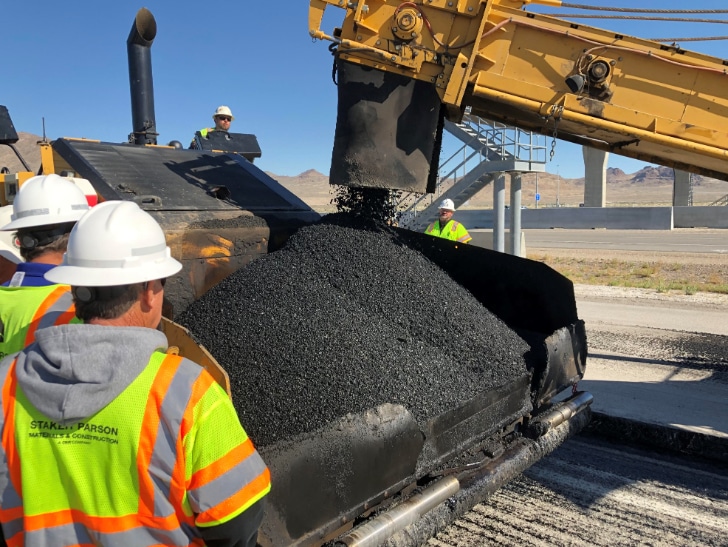
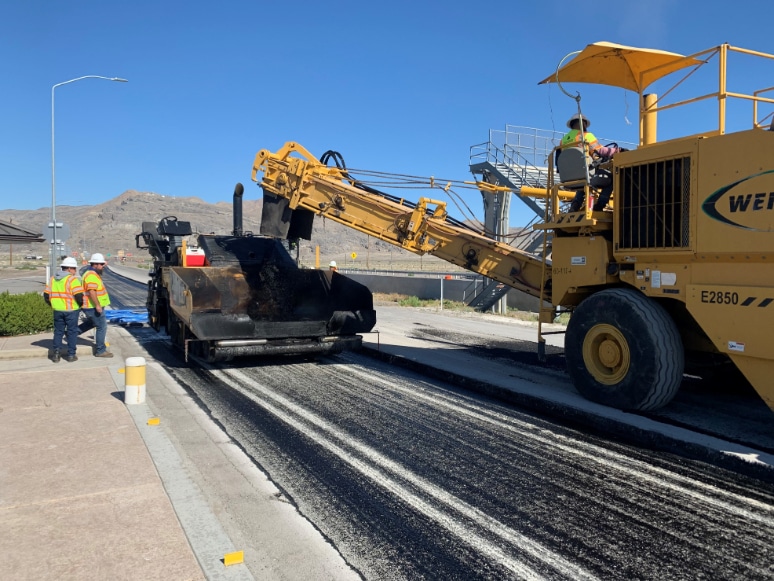
Despite how sticky the mix was, pickup wasn’t a problem for Staker Parson’s Weiler E2850 material transfer vehicle, nor its Cat AP1055E paver.

This included devoting nine belly-dump trucks to the job. “Normally, we’d have four trucks running between the job and the plant, but we didn’t want to do that with this job,” Stevens said. The company wanted to make sure they had the tonnage on site to complete the job so they could pave continuously. “Once you stop to wait for a truck with this type of mix, you’re going to run into problems.”

Staker Parson staggered its trucks from the plant 15 to 20 minutes apart. The only issue they hit was when a truck blew a tire on the 1.5-hour haul from the plant and paving had to briefly pause. That mix unfortunately had to go to the recycle pile.

“When you’re putting down such a thick lift, you’re running through the mix fast,” Anderson said. The lift was 7.5 inches thick, pre-compaction. “You have to have more trucks and maintain a steady stream of material. It’s a lesson learned, but definitely something we can deal with.”

Despite how sticky the mix was, pickup wasn’t a problem for Staker Parson’s Weiler E2850 material transfer vehicle, nor its Cat AP1055E paver. And, although the mix was stiffer and stickier than Stevens thought it would be, the company’s experience with SMA meant its crews were used to mixes that require excellence off the screed.

Staker Parson paved 100,000 tons of SMA in 2021.

“It’s not like a normal mix that you can take a shovel to and re-rake it,” Stevens said. “Thankfully, we had planned ahead, which is what made this job a success.”

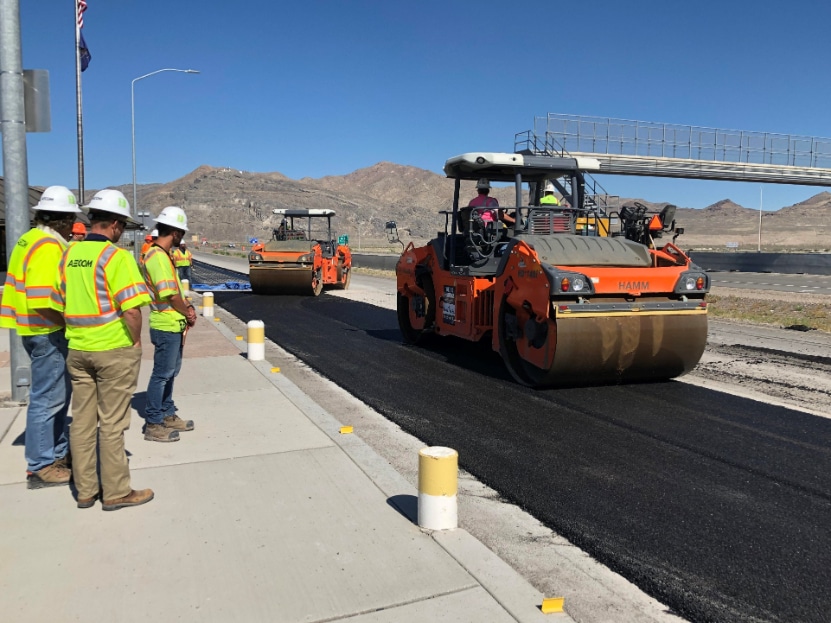
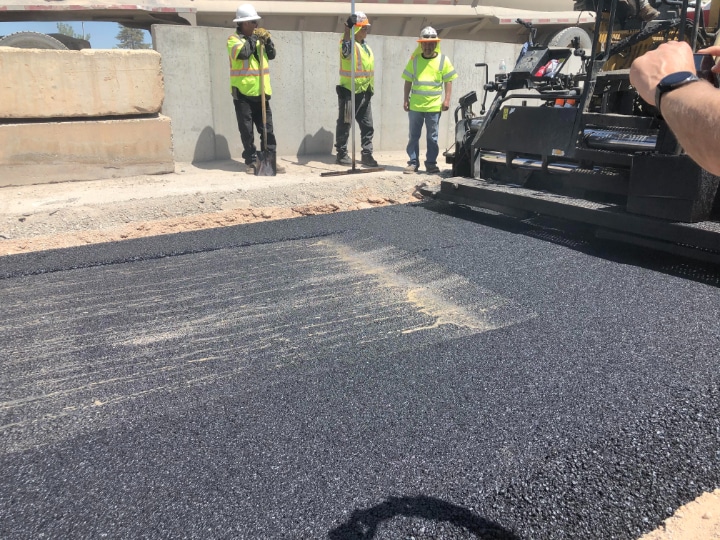
Prior to compaction, the single lift was 7.5 inches thick. Here’s how much compaction Staker Parson was able to achieve after one roller pass with vibration. “The material was stable even when the roller overlapped the edge,” Anderson said.

The rolling pattern included seven passes with a Hamm HD140VV double drum roller and a Cat CCS9 finish roller to take the lines out of the mat. According to Peterson, the area was so small so they didn’t have enough room to warm up the tires before compaction. With a pneumatic-tired roller, he added, the mix would have stuck to the cold tires. They did however use vibratory mode on the first pass. Although the crew had an extra double drum roller on site just in case, Stevens said they were able to achieve compaction throughout the entire lift without the backup roller.

“We were constantly monitoring the mat with Troxler 4640 nuclear gauges to see where we were on compaction,” Stevens said. Although they weren’t able to core the pavement until the following day for fear of parking a truck on the mat before it had cooled, the pavement had an average density of 97 percent.

“We didn’t compact at 1 percent voids and I didn’t think we could,” Anderson said. “When you do a 4 percent air void mix design, you’re shooting for 6 to 7 percent in the field. When we designed for 1 percent, we hoped for 3 to 4 in the field.”

Originally, UDOT was only going to test compaction on the top 3 inches of the 6-inch lift. However, based on the cores UDOT pulled, Staker Parson was able to achieve compaction throughout the 6-inch lift.

UDOT pulled four cores and ran them on the top 3 inches and the bottom 3 inches. The top 3 inches of the first core had a density of 97.9, the bottom, 98. The second core had a density of 97.8 on top and 94.4 on bottom. The third core had a density of 97.2 on top and 92.8 on bottom. And the fourth core had a density of 97.3 on top and 97.6 on bottom. “Four cores can’t tell you the whole story, but we were happy with the level of compaction we achieved,” Peterson said.

The only core that was low, at 92.8 percent, was located where paving briefly paused due to the haul truck that had blown a tire. “The other cores show we were able to get full depth compaction,” Anderson said.

Several months after the test strip was paved, Anderson returned to the port of entry and found that it continued to perform well. This photograph was taken five months after construction.

One full 6-inch core Staker Parson took on its own test strip achieved 97 percent compaction. “They didn’t even cut it in half,” Anderson said.

Ultimately, Staker Parson was able to achieve 100 percent pay for gradation, binder content and density.

“One of the challenges with paving thicker lifts is the rideability spec,” Peterson said. “When you increase thickness, you’re often decreasing smoothness because of the way it compacts. So, to achieve a better rideability, paving two 2-inch lifts can help improve performance on that ride spec.”

“Each time you put down a layer of asphalt, you can improve rideability and smoothness,” Anderson said. “Only paving one lift means less opportunity to make it smooth.” However, he added, this project hasn’t experienced any issues relating to smoothness.

Staker attributes this rideability to the crew’s commitment to the continuous paving method. They did, however, have to grind down the end joints. But Anderson considers that a benefit of how dense this pavement is; it’s possible to grind the surface without opening the pavement to water.

Several months after the test strip was paved, Anderson returned to the port of entry and found that it continued to perform well. “Even with the brutal temperatures of this past summer, it still didn’t budge,” Anderson said. “I think it’s past the danger zone where we’d see it rut if it was going to rut. If it made it through this past summer, I think it’ll do just fine next summer.”

Industry Expresses Interest

A number of UDOT regional directors, high-up UDOT and Staker Parson staff, Reed Ryan of UAPA, Dave Johnson from the Asphalt Institute, and other industry leaders were present on the day the port of entry was paved.

The team at Staker Parson also attributed the success of the project to partnership and trust between contractors, the asphalt industry, and UDOT.

Peterson said the establishment of the Utah Asphalt Pavement Association (UAPA) in 2012 had a significant impact on the asphalt industry within the state. “Before UAPA, there were a bunch of single voices talking to UDOT and it was just a lot of noise,” he said. “UAPA talks to UDOT with one voice and it’s possible to have a conversation back and forth.” Now, he said, UAPA sits down with UDOT once a month to go over ideas, including Anderson’s thick lift idea.

“I think this project shows a high amount of collaboration between UDOT and industry,” said UAPA Executive Director Reed Ryan. “Anderson envisioned this type of trial project, put the parameters of the mix design through the proverbial ‘ringer’ and proved out a concept that was worth pursuing for the DOT. Marchant was willing to put this application down in a very rigorous and tough setting (the port of entry). Then came industry with the willingness to assume some of that risk and actually build and place the mix.”

“We learned together and communicated together long before the mix ever went down and I feel that is vital to the success of this trial project,” Ryan said. “I commend UDOT because we (industry) never felt left out of this process.”

Ryan was also present on the day the port of entry was paved, along with a number of UDOT regional directors, high-up UDOT and Staker Parson staff, Dave Johnson from the Asphalt Institute, and other industry leaders. Word of the project has even made it to the Utah state legislature.

“There is so much interest in this,” Anderson said, adding that thick lifts offer a number of benefits. They could speed up contractors’ production rates and reduce disruption to the traveling public. Paving thick lifts could also result in cost savings from eliminating the tack coat, reducing traffic control to what’s required for one lift, and not having to perform quality control on two separate lifts. “If you can save money on all of those things, you can instead put that money into the pavement by spending a bit more on a high polymer mix,” Anderson said.

Meet the State Exec: William (Reed) Ryan

Furthermore, this could expand Utah’s paving season. “The contractors are excited that with this idea, we could put out a project in November or April,” Anderson said. “We could actually use the cooler weather to speed up how fast the mat cools down after compaction.”

Already, other DOTs are seeing the potential. Several have reached out to him for the specs. Within Utah’s state lines, UDOT higher-ups have expressed their support. “I think you will see more thick lifts happening in Utah, more projects with 1 percent air voids, and more use of 76-34 binder,” Anderson said.

His own personal dream is to see this concept on the interstate. “If I could get a 10-mile section of road, remove the pavement, and put in up to 8 inches of a new high polymer, low void mix, I think it would be a perpetual pavement,” he said.

Although the lift at the port of entry was 6 inches thick, Anderson said he thinks they might be able to go as thick as 8 inches and still achieve compaction.

“If we can pave at a similar depth to concrete, we could put this where we might normally put concrete,” Anderson said. “If we can place this faster than concrete and open pavements up sooner, with similar or even better performance because there won’t be any joints, this could be a very exciting opportunity for the asphalt industry.”

“For the asphalt industry as a whole, we owe it to ourselves to start thinking out of the box when it comes to the mix design and construction process,” Ryan said. “I recognize we must be careful and responsible when it comes to the hard-earned dollars of taxpayers in the country, but we currently stand on the shoulders of giants – people in the past that gave us Marshall Mix Design and Superpave Mix Design – and we have to take on that legacy and do something with it. What was true 70 years ago with Marshall and 30 years ago with Superpave still works today, but we are in a time and place where we can and should do more to build on that legacy.”