Central Specialties Wins Excellent IRI

The team at Central Specialties Inc., headquartered in Alexandria, Minnesota, isn’t new to achieving quality with its work. With the motto of “It’s on Us,” the full-service general road contractor has received accolades from various departments of transportation and recently expanded operations to handle the additional work that comes with success.

As demonstrated in the Highway 85 project we discussed in the October issue, they’re open to trying out new technology and they put innovation into their day-to-day business for continuing success. Let’s look specifically at an award-winning project CSI performed on Interstate 94 (I-94) in Stark County in 2023 for another example of their innovation and quality workmanship, and how it all contributes to the expansion.

SDX Trial Success

I-94 Project

The mill-and-overlay project called for two 1.5-inch lifts along 9.6 miles of two-lane interstate. Operations Manager Joey Johnson shared that it involved concrete removal and repair, as well as hot-mix asphalt (HMA) repairs before the team mobilized their HMA plant for mainline paving to the tune of 38,000 total tons—about 18,500 per lift.

The plant they used for the project is a parallel flow drum plant from CWMF, Waite Park, Minnesota, which can produce up to 700 tons per hour (TPH). CSI positioned their plant about 14 miles from the project and produced the RAP Superpave FAA 45 with a PG58H-34 asphalt cement at 295°F.
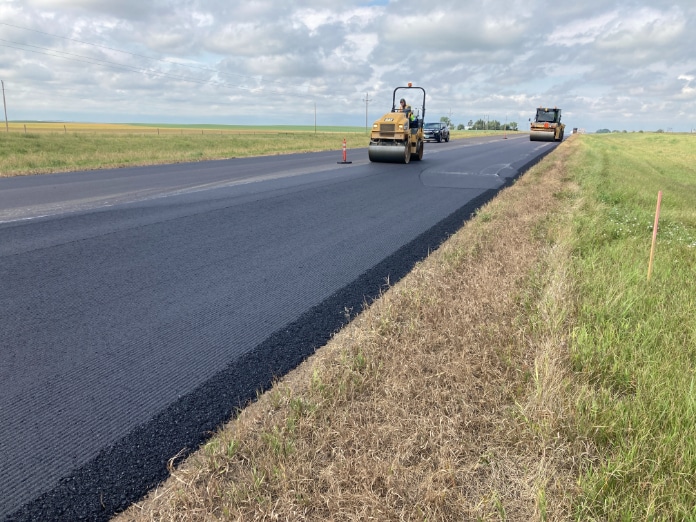
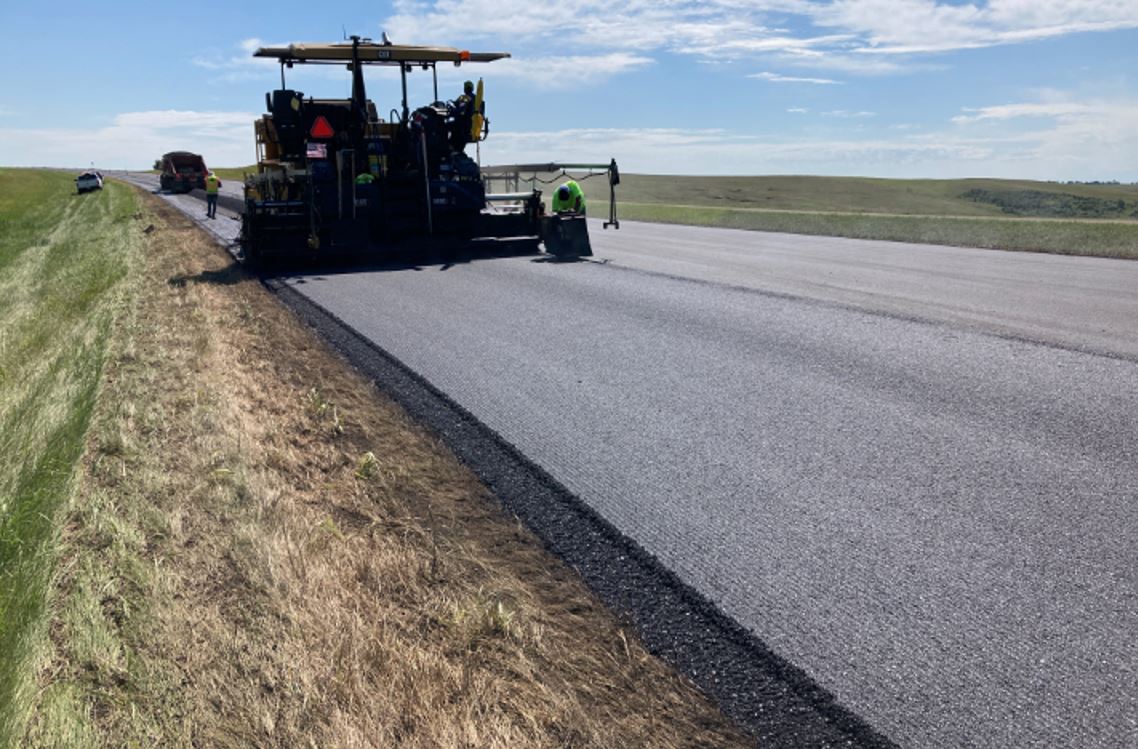
Here we can see the SDX screed pattern on the mat and the roller operators performing their passes. All photos provided by CSI

CWMF Vice President Travis Mick spoke in glowing terms of the team. “Partnering with Central Specialties has been a rewarding experience due to their dedication to excellence and integrity, which perfectly complements our own values at CWMF. Their ‘get it done attitude’ and commitment to building the best road infrastructure ensure our equipment is utilized to its fullest potential, resulting in outstanding outcomes for their projects.”

While the crew used state of the art equipment and new technology like infrared thermal mapping and the patterned SDX screed, Johnson also credits the people who take the time for best practices for a stunning finish. You see, the I-94 project won a North Dakota Pavement Quality Award for ride and density. Johnson reported the bonus-worthy overall total international ride index (IRI) was 25.8 and the average density was 98.7%.

Preferred Materials Executes the Plan to Get the Best IRI in Florida

Those are numbers worth emulating. Here’s how they did it.

On I-94, the team was getting good density right off the bat. Immediately behind the breakdown roller, which was a CAT CB 15 with VersaVibe, purchased in 2020, they were getting a density of 92.5. In the intermediate position, on the bottom lift, they ran a CAT CW34 pneumatic purchased in 2017. In the intermediate position, on the top lift, they ran a CAT CB 15 purchased in 2018. The finish roller was a CAT CB 34.

Laying the first lift was straightforward. It was a standard mill-and-fill. On the second lift, they used the notched wedge joint system from Willow Designs LLC on the center seam to increase longitudinal joint density.
Now that the company has expanded operations to Western North Dakota, they’ve hired additional mechanics to maintain equipment rather than hauling heavy machinery to and from headquarters about 450 miles away.

First of all, they were getting good density numbers behind the screed. Johnson shared: “The Trimble infrared thermal imaging camera was used for tracking mat temperature. Combined with VETA data and analysis software it gave us good confidence with our rolling pattern coverage which resulted in good densities.” As mentioned above, they were seeing densities of 92.5 behind the breakdown roller.

“To be honest, this [thermal mapping] is a very helpful tool to be able to better help get density and ride, seeing issues and ways to improve rolling patterns,” Johnson shared.

The crew wasn’t using a material transfer vehicle on this project—just best practices and a cohesive team. The paver operator, Tomas Chavez, has been with the company for two years and was at the helm of a CAT AP 1055F paver equipped with the new SDX screed CSI is testing for Caterpillar.

Highly Modified Asphalt (HiMA) Offers Results on I-40

Johnson shared that the paving widths varied along the project from 10 to 12 to 16 feet, yet the crew handled the changes smoothly. The dump man on the project was Jose Becerra, and the screed operator, Carlos Pasillas, has nine years of experience.

“Carlos is a very strong leader for our main line crew and a positive person,” Johnson shared. “I believe the reason we won the award was that the crew works together to make the best road possible. There is really a team atmosphere when it comes to Plant 4 crew for CSI. It really starts with John Fales leading the crew and developing them and then the crew taking ownership of the paving. At the end of every job the crew is always asking how they did on ride and density, which shows they have pride in their work.”
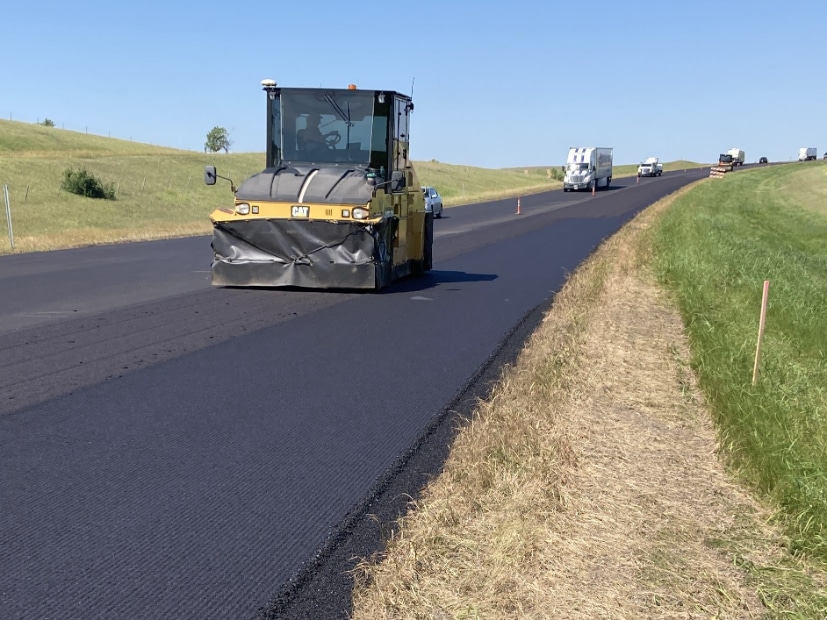
Jill O’Brien operates the intermediate roller toward the award-winning density and ride numbers on I-94.

Winning Against Challenges

CSI began the I-94 project April 4, 2023, and finished it Aug. 14. During those four months, the crew had challenges to overcome to hit an award-winning completion.

“There was a lot of concrete removal, and the state would only close down a certain amount of interstate at a time,” Johnson explained. “Then we would have to go out and patch back in to let traffic back on it. It was difficult scheduling to keep subs on track working and getting a crew deployed on a short window to get the patching done.”

He gave credit to Dave Winkler, the project manager, and John Fales, the paving superintendent for their leadership and expertise on the job. “The project manager really kept a close eye on the subs on when they would be completed with their phases and lining up our paving crew to come in and patch in mix, then move the subs to the next phase to complete to stay on track for the job.”

Supervisor John Fales and Dump Man Jose Becerra—in the foreground—work on the I-94 project.

One aspect of the project that the crew gave extra attention to was the centerline joint. “Making sure centerline is clean after the milling machine,” he shared. “On the bottom lift we had some longitudinal joint failures that we had to mill out and repair because we did not get centerline completely clean but after finding the issue the crew took ownership and got the project back on track.”

At the end of the day, the crew handled best practices and challenges with professionalism that Johnson’s proud of. “I like the fact that when there were issues the crew stuck together to get the job done. They never pointed the finger; they owned the issue and moved on. That is what makes a great crew.”

The completed side of I-94 looks gorgeous and won a 2023 Hot Mix Asphalt Quality Award.

New Location

If you think the logistics of the I-94 project look complex on paper, consider what it was like in the field. With the amount of work available across North Dakota, CSI management decided it was time to expand operations. They purchased a building to start a shop and office in Watford City, North Dakota.

“We expanded with offices and a shop in Watford City, North Dakota, in January of 2024,” Johnson said. The team then used the office space to hold interviews every two to three weeks and set up the offices and a conference room for the project managers to use during the 2024 construction season for both a home base and for meetings with local agencies when needed.

Joey Johnson is the operations manager for Central Specialties.

Immediately behind the breakdown roller, they were getting a density of 92.5.

“The shop is running well,” Johnson shared. “We have three current mechanics working out there and are looking to staff up to four to six full-time mechanics in the future. That will really save us time and money in the future not hauling our equipment in the area all the way back to our main shop in Alexandria, Minnesota.”

Fleet maintenance, whether in Watford City or Alexandria, is another key to CSI’s success. “We really feel that we keep our equipment up to date and have some of the best technology. We swap out our mainline pavers every three years and we send our crews to paving classes every year to keep them up to date on new methods and ideas. We are constantly trying innovation to see what works, such as the new SDX screed CAT has us trying out.”

With updated technology and innovation for a fully trained workforce, CSI takes ownership of its success on every project. The award-winning I-94 project exemplifies this attitude and aptitude and offers a great example of the company’s motto “It’s On Us.”
Prevent Fatalities with Better Truck Driver Training, Best Practices

A safe and quality job site starts with well-trained truck drivers delivering HMA to the paver

The haul truck is not just the vessel that brings vital, perishable material to our job sites throughout each shift. It’s a large and lumbering piece of equipment. The unladen truck can be 50,000 pounds by itself. Add 18 to 23 tons of hot-mix asphalt (HMA), and you have a heavy vehicle for the driver to control. The heaviest one I’ve seen arrive on a job was about 50 tons. That was on a project in Montreal where it’s not uncommon for larger live-bottom trailers to bring heavy loads to the paving project.

Get AsphaltPro’s 12 Safe Steps for Haul Truck Driver Training white paper! Click here to download now.

No matter what size of truck they’re driving, if the driver hasn’t been properly trained and shown best practices for every aspect of loading and delivery, they can be a liability for their company, the general contractor and the traveling public. Let’s look at the main areas where they need training:

  • Cleaning out the truck bed and getting out of the work zone
  • At the plant and during loadout
  • On the road, routes to and from the job
  • Getting into the work zone and to the paver
  • Charging the hopper

Before we look at some tips for training in each of these areas, let me share an example of why they’re all vital. During the 2024 construction season, I was helping a crew on a night project that involved paving one 12-foot lane of a five-lane highway. We followed the MUTCD and had barrels delineating the work zone; four state troopers were assisting with traffic control.

A subcontracted haul truck driver completed charging the hopper of the Shuttle Buggy around 3:15 a.m. and pulled away from the paving train. We didn’t know it, but the driver pulled over about a half of a mile ahead to clean out the bed of his triaxle while still within the safe confines of the work zone. He raised the body to clean it out and returned to traffic with the body still up.

Use a Sunroof to Spot Overhead Obstructions

About a quarter of a mile from his self-appointed cleanout area—still in the work zone—the elevated body struck and knocked down an overhead highway sign, resulting in debris in the road. The driver didn’t tell anyone what had happened, but continued to the plant, where he parked his damaged truck, signed out and went home.

Back at the debris field, tragedy was about to unfold. A motorcyclist entered the closed work zone at highway speeds and encountered the mangled signage. The tack truck driver saw this accident happen and was able to call for help, but the motorcyclist didn’t survive his injuries.

Training haul truck drivers for the niche job of delivering HMA sometimes falls to the asphalt contractor. Here are a dozen tips to help keep drivers and crew members safe and perishable material on-spec.

This loss of life could have been prevented if the driver had been trained on proper cleanout practices, if he had an alarm that alerted him when his truck body was elevated when moving at travel speeds, if he had stopped and asked for help after striking the highway sign, if the motorcyclist had heeded the signs telling him the highway was closed, and so on. A series of mistakes and lapses in judgment led to a terrible accident that we can only learn from now. Let’s look at a few lessons we can take away from this awful scene.

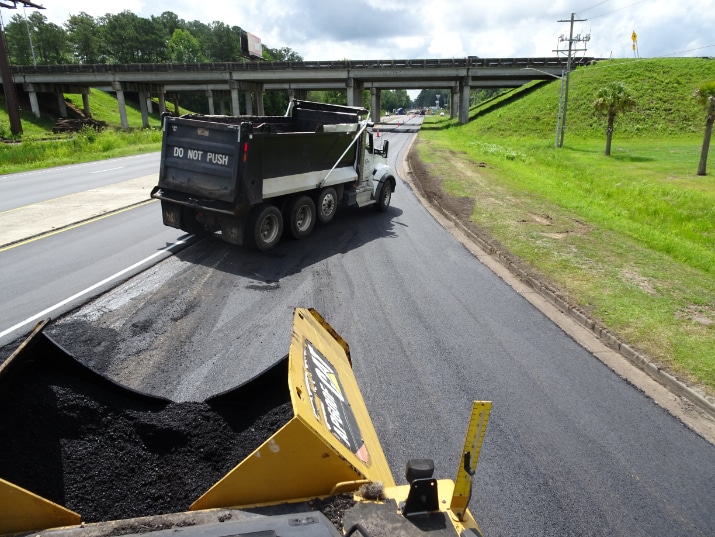
In this picture we have a bad practice in play. You can see turn marks on the fresh mat in the background. This is where one of the haul trucks made a U-turn on the uncompacted mat. No haul truck driver should be driving on the new mat, much less turning on it. Those tire marks represent an area that won’t achieve good density but will achieve potholes and raveling with weather events this winter. This is a sign of an untrained or apathetic truck driver who needs to be removed from the project.

Clean out the bed and get out of the work zone safely

The main training category for this article is that of assigning a dedicated cleanout area for trucks and making sure all drivers understand where it is and how to use it safely. Each driver who will be bringing material to the site should know a designated cleanout area exists and should know where that area is.

If the work zone is exceptionally long and the cleanout area will “move” before the job is complete, then each area designated on a map should be pointed out to each truck driver. Each area should be highlighted with the date and/or time it will be available for drivers to use. This type of update is easy to indicate in today’s work zone apps. Check with your app provider to ensure all members of the team—including subcontracted drivers—have access to the information in real time.

Tips to Maintain your Haul Truck

When the cleanout area is available for drivers, it should have clear, legible signage in the languages your team members read. Lights and arrows should designate how to access the area and where cleaning can happen. Tools and safety equipment should be easy to use. Then additional lights and arrows should designate how to leave the area safely.

For nighttime work zones, the cleanout area needs additional lighting to not only give the truck drivers a well-lit work area, but also to make it painfully obvious to motorists that this is a dangerous construction area off to the side of the road and not a rest stop or place where the traveling public is welcome. Signage and arrows should make it clear this is a lighted area for large trucks/heavy equipment only. The last thing you want is for confused motorists to think they’ve come to the end of the work zone “early” and enter this well-lit area where a haul truck driver might be outside of his or her cab.

The driver uses a 3-inch putty knife or scraper to maneuver around the tailgate and hinges/dog ears to clean. This is also the time to reposition the mud flaps. They were lifted out of the way of the paver’s push rollers—now lower them back where they need to be for legal travel.

As cumbersome as it may seem, setting up a mechanical flagging system that clears the haul truck for return to traffic at the end of the cleanout area could prevent the type of accidents that happen from raised truck bodies. A system that prevents the truck from leaving the area if it can’t fit under a mechanical flagger’s arm will keep drivers from hitting bridges, overpasses, highway signs and other overhead obstructions. (Check out the Federal Highway Administration’s technical report “Review of Low-Clearance Early Device Warning Options for Illinois” for ideas on how LCDW systems are being used on bridges and other structures to reduce collisions here.)

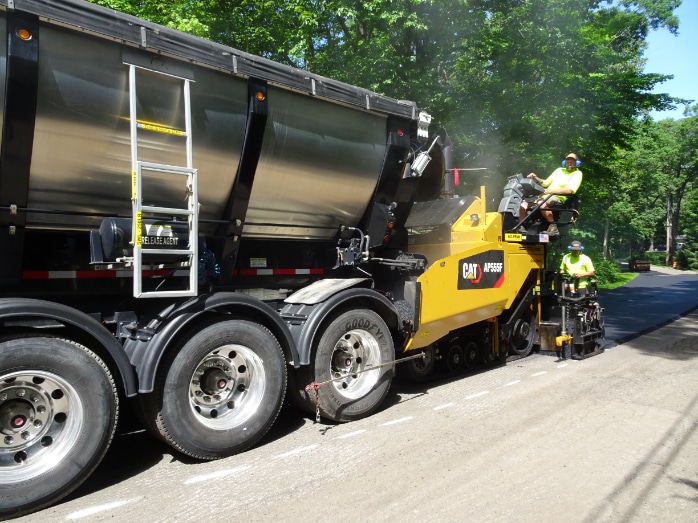
Notice a host of best practices in play here. First, the crew members are using headsets for clear communication. The guidebar on the paver is clean and follows a marked line for the paver operator to guide off of. The haul truck’s mud flap is up out of the way of the push rollers, which the back tires are snuggled against so the live-bottom can feed the hopper without dribbling mix in front of the paver.

Implement Procedures

The other training points mentioned at the beginning of this article can be covered when a company implements procedures and makes it clear those procedures are to be followed.

There absolutely should be a procedure in place for drivers to sign in, do a walk-around of the truck in a safe and well-lit location at the plant site, ensure previous maintenance items have been addressed, and check out the vehicle for the shift. When a shift is complete, there should be a procedure for the driver to do a walk-around of the truck in that same safe and well-lit location as before, perform cleaning of the equipment, ensure an easy and well-documented way to inform mechanics of any maintenance issues or worries, and to check in the vehicle at the end of the shift.

Have you cleaned the reflective tape, taillights, safety placards and other lighting lately? Make sure reflective tape, safety signs and lights on your haul truck aren’t obscured by grease or asphalt build-up. You want headlights hitting the tape to reflect light to the motoring public. You want them to see you. Your lights cannot do their job of protecting you, the crew and the public if they’re filthy and covered with grime. Get these and other training tips in this white paper from AsphaltPro.

Save on Costs with Your Professional Guide to Asphalt Mix Delivery, Part 5—Haul Truck Safety Pays Dividends

To make truck traffic safer at the plant, to make loadout safer under the silos, to make travel safer along designated routes to and from the job site, to make backing to the paver a safer operation and to make charging the hopper safer, drivers should be aware of the proper procedures at each step. And they need to be told why.

The reason for using the three-drop method of loadout at the silo makes perfect sense to the seasoned plant operator and the paving superintendent out on the job site. But the subcontracted driver who’s been hauling asphalt for two hours has no idea why he must stop the truck, receive a drop, back it up, receive another drop, and so on. This may feel like wasted time to him when he could center the bed under the silo gate and receive one lump stockpile of 20 tons, then get on with delivering the load. He doesn’t understand—yet—that taking one lumped load leads to material segregation and contributes to problems when charging the hopper. This isn’t something he’s born knowing—he has to learn it, like each one of us had to learn it. (Watch the November issue for an article on how to load out different types of trucks most efficiently.)

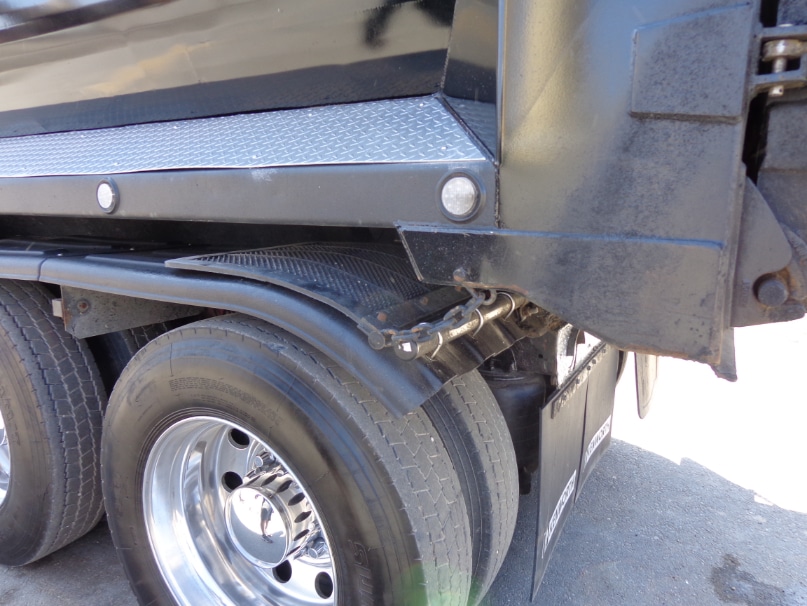
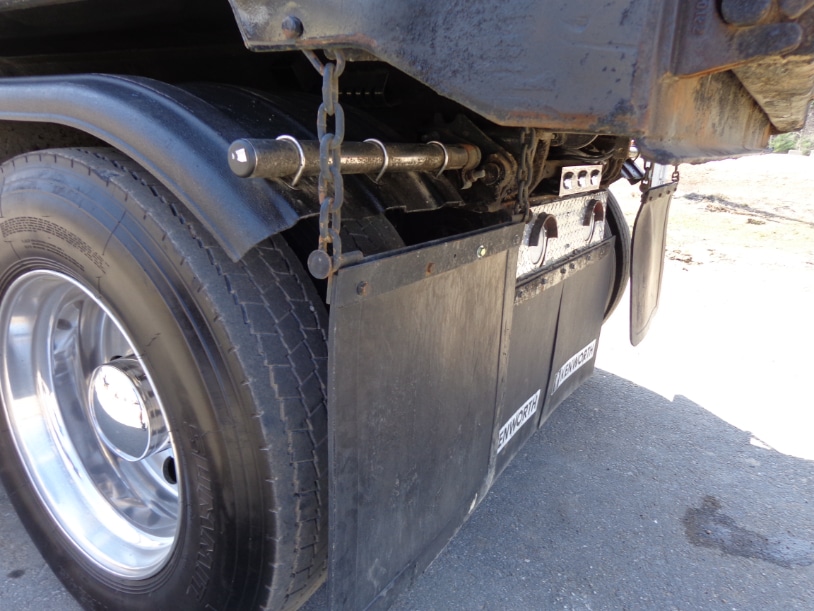
The mud flaps lay on the back tires, out of the way. | When the haul truck backs to the paver, either the dump man or the truck driver will want to position the mud flaps over the back tires. There are systems available for trucks today that allow the driver to press a button and have the mud flaps retract or lift without anyone having to physically touch them. This means there’s nothing between the truck tires and the paver’s push rollers. When the truck is ready to leave the paver, the mud flaps need to be returned to their proper position not only for traffic safety but also to be “street legal.” If the driver has a button he can press in the cab to lower the flaps back in place, that’s great. Otherwise, he can ensure they’re hanging properly when he stops at the designated cleanout area.

The mud flaps are returned to hanging position for safe travel. | When the haul truck backs to the paver, either the dump man or the truck driver will want to position the mud flaps over the back tires. There are systems available for trucks today that allow the driver to press a button and have the mud flaps retract or lift without anyone having to physically touch them. This means there’s nothing between the truck tires and the paver’s push rollers. When the truck is ready to leave the paver, the mud flaps need to be returned to their proper position not only for traffic safety but also to be “street legal.” If the driver has a button he can press in the cab to lower the flaps back in place, that’s great. Otherwise, he can ensure they’re hanging properly when he stops at the designated cleanout area.

When the driver gets to the paving site, depending on the type of project, he’ll have a variety of options for backing to the paver. The first and most important procedure is to locate the dump man when he gets to the job. In the pre-job meeting or tailgate talk, he’ll be told who the dump man is for the job—and that might be the paver operator or the foreman. (See the sidebar titled “You Can’t Skip the Tailgate Talk” for information.)

No matter what kind of project the driver is delivering to, the dump man will be the person who guides him and helps him get lined up to the paver’s push rollers. That person, normally, will be wearing a different colored shirt, vest and/or hat. He should have a safety baton or a safety whistle, as well, to acknowledge the driver and direct him. (See the article “Save on Costs with Your Professional Guide to Asphalt Mix Delivery, Part 3—An Independent Look at Best Haul Truck Practices” here for a detailed discussion of how to get to the job and deliver material to the hopper efficiently.)

Save on Costs with Your Professional Guide to Asphalt Mix Delivery, Part 3—An Independent Look at Best Haul Truck Practices

For drivers who will be receiving millings in an empty bed, locating the ground man is just as important. This person is the driver’s second set of eyes; both driver and ground man must trust one another but this doesn’t leave room to forget good training. On a recent parking lot project, a haul truck driver watching the milling machine via his side mirror neglected to watch where he was going and ran into a parked work truck (See the sidebar titled “Train Drivers to Watch Where They’re Going” for details). This accident proves we need to keep all our senses on alert when in the field.

The haul truck driver can’t be expected to handle everything that’s happening around his truck when he gets to the job site, but we can give him a fighting chance at safe success when we train him on the proper, safe procedures expected of him. We must train the drivers who are controlling these large and lumbering vehicles that come so close to our co-workers, pricy equipment and motoring public if we want to have quality jobs with safe records.


John Ball is the proprietor of Top Quality Paving & Training, Manchester, New Hampshire. For more information, contact him at (603) 493-1458.

Get Full Pay on Any Job

Increasing quality for your customers starts with well-maintained equipment that can function the way it’s meant to

As Eric Swan pointed out in his preventive maintenance article on page xx, performing in any sector of the asphalt industry requires all the moving parts be in sync—right down to a well-oiled engine. If the broom you intended to use behind your cold planer suddenly seizes, you can’t get the fine millings up, thus the tack isn’t going to stick properly, thus the asphalt isn’t going to adhere uniformly. If this takes place on a parking lot job, you might not see an immediate financial hit from an inspector docking dollars from the project, but you might have an angry customer calling you to come back and repair potholes in a couple months.

If the striping equipment arrives at 4 a.m. to prepare the lot for the day’s traffic, but someone didn’t tuck it away correctly last night and you must replace clogged nozzles before you get started, guess whose customer is about to get mad at a delay.

If you allow material to build up on the paver’s tires, the tractor will have a bumpy ride. This means you’re not paving a smooth mat, and you could risk cooled, caked material falling from other areas onto your new mat, resulting in non-compactible areas that turn into potholes later. Photo courtesy of John Ball

What Swan said holds true: paving is a high-stakes performance of people, equipment, traffic, schedules and materials. You need your equipment to be well-maintained. That takes training of invested workers who understand the importance of clean, working machines. John Ball, the proprietor of Top Quality Paving, Manchester, New Hampshire, has preached this gospel for years. When consulting from week to week, he sees asphalt professionals of all skill levels, and he commented on what he sees in the newcomers to the industry.

“These guys out there on the crew aren’t regimented,” Ball said. “There’s a certain procedure for cleaning and maintaining the equipment, but these guys aren’t following a procedure. They’ve got to learn to care. That attitude has to be homegrown. They’ve got to be taught so they know why they’re taking time at the end of the shift to clean the paver.”

Members of this paving crew get to work with putty knives, screwdrivers and release agent to remove built up material from different sensitive areas of the endgate to ensure it can function properly during the day’s shift. Without a smoothly moving endgate, you can’t expect to have a smooth mat. Photo courtesy of John Ball

When the distributor truck driver sprays disappointing strings of tack on the surface to be paved, someone must care enough to speak up. As seen in the image above, the operator didn’t have the right pressure dialed in and had clogged nozzles on the right side of the spray bar. “You can’t have spaghetti strands,” Ball reminded readers. (See the article titled “Prevent Callbacks for Pavement Slippage” for best practices in tack applications.) But someone has to train the operator on this, and the crew—or mechanic—must know how to solve the problem.

The most important machine to check over is the paver.

No matter the size of machine you’re working with—whether that’s a sidewalk paver for a last-minute walking trail, a commercial paver handling a parking lot mill-and-fill or a highway class paver taking care of 1,200 tons on the mainline today—that machine is your lifeblood on the paving project. Its care and maintenance is the difference between achieving a quality job that gets full pay from the customer and a problematic job that gets a costly call-back to fix something later.

This distributor truck driver needs help from the mechanic to get the spray bar leveled and the nozzles cleaned properly. A member of the crew needs to be empowered to call an audible to have this area re-sprayed or the tack isn’t going to do its job. Photo courtesy of John Ball

“The paver is your bread and butter,” Ball said. “If the endgates aren’t flush with the screed, you can’t pave a good joint. If you wrap your tires with asphalt, the tractor’s ride is going to be bumpy and the screed, which is your hot iron, won’t be able to smooth it out. Good cleaning and routine maintenance of the paver will make or break you.”

Due to the importance of this topic for a contractor’s pay, we’ll return to it soon. Use the tips offered with these pictures to guide your cleaning and maintenance routine and watch for upcoming articles on this topic from Ball.

Prevent Downtime on the Job

Albuquerque Asphalt’s I-40 paving project highlights the company’s streamlined preventive maintenance operations featuring two-man crews on service trailers requiring no CDL/HAZMAT.

Highway asphalt paving is a high-stakes performance of people, equipment, traffic, schedules and materials. It requires the best at it to be smart, organized and intentional. It also doesn’t hurt to have a little attitude, be a little lucky, and have a whole lot of commitment—to the work itself, and to the team around you.

Having spent time with the team from Albuquerque Asphalt Inc. as they completed a deep mill-and-fill project on I-40 in Albuquerque, it is evident the company has these traits in spades.

Founded in 1981, Albuquerque Asphalt Inc. specializes in arterial road rehabilitation, road reconstruction, commercial and industrial asphalt paving, and site development. Since the company’s founding, it has grown from a small asphalt repair company to a leading asphalt paving contractor, servicing much of central New Mexico and surrounding areas.

The project included a deep mill across two lanes of interstate and two lifts of fresh asphalt—all put down at night with the road being turned back over to the public at 5 a.m. every day.

The Thunder Creek MTO 690 is built to hold a total capacity of 690 gallons, but no one tank holds more than 115 gallons, according to the manufacturer, which means the trailer doesn’t require a HAZMAT endorsement. When the contractor tows it with the right truck, it doesn’t require a CDL, either.

For Albuquerque Asphalt, a team of more than 200 people spread across asphalt, dirtwork, concrete, crushing and production crews, it’s an extremely deliberate deployment of people and resources to ensure optimal asphalt quality while also working efficiently enough to make business profitable. That includes the timely and efficient performance of preventive maintenance fleet management activities.

Supported by Four Rivers Equipment, Albuquerque Asphalt restructured its preventive maintenance work to move away from larger service trucks that required drivers to have a commercial driver’s license (CDL) and hazardous materials (HAZMAT) endorsement because it became increasingly difficult to find those drivers. Oftentimes, those who do have the endorsements don’t always have the mechanic’s mindset to do preventive maintenance work. The solution: a two-person team matched with a truck hauling a Multi-Tank Oil [MTO] 690 trailer from Thunder Creek Equipment.

The Multi-Tank Oil (MTO) trailer is a hybrid preventive maintenance and fueling solution designed to handle up to 920 gallons and up to six different service fluids including oil, coolant and reclaim, as well as daily fluids like diesel, DEF and grease. It can also be equipped with various power systems.

Nighttime Paving Leads to Daytime Prevention

In addition to the practical convenience of nighttime paving—especially in New Mexico where the combination of hot asphalt and high daytime temperatures can be brutal—Albuquerque presents a unique logistical challenge as it relates to traffic: there are only so many bridges that cross the Rio Grande River. Minimizing traffic disruption is critical.

Albuquerque Asphalt plans each shift of milling and paving intricately to ensure that it can get the day’s work milled and covered with at least one lift of asphalt on it so that it’s drivable by 5 a.m. With the deep mill on this project, each section works in a three-day cycle.

  • Day 1: Mill a section and pave lift one.
  • Day 2: Mill a section and pave lift one.
  • Day 3: Pave the final lift across the previous two days’ work.

All equipment is lined up in the interstate median during the day and brought back to life again after dark to repeat the cycle.

The company has been at the forefront of many trends in the industry that have allowed larger paving companies to streamline operations. It owns its own asphalt plant, controlling the production, quality and access to asphalt. They also do their own quality testing at an in-house lab. And they have been long-time leaders in recycling crushed and milled materials, including using it as road base and by introducing a certain percentage of millings into the hot mix.

Thunder Creek Launches New MTO Service, Fuel, Lube Trailer

With their growth has come more equipment, greater scrutiny on uptime and a changing mindset on how to perform preventive maintenance work. The previous method involved larger lube trucks that required drivers with a CDL and HAZMAT endorsement. As the fleet grew, it became more difficult to find those drivers, and if they did find them, they were not always interested in doing preventive maintenance work.

“You can find CDL/HAZMAT drivers, but you’ve gotta find the CDL/HAZMAT drivers willing to do this type of work,” said Jacky Spencer, vice president of operations, Albuquerque Asphalt. “We’ve taken younger people with more of a mechanic background and a good work ethic, and we train them to this specific task.”

It was this challenge that led Four Rivers Equipment to introduce Albuquerque Asphalt to the MTO 690 trailers, which the company now owns three of.

“The last few years you can’t find anyone,” said Robert Wood, president and partner, Albuquerque Asphalt. “If you limit yourself to CDL-driven service trucks, that limits your pool of employees. My manager said ‘we can’t find CDL drivers,’ and these were available, and we thought it was a good idea.

“Now we have three of these units and we haven’t bought any more service trucks.”

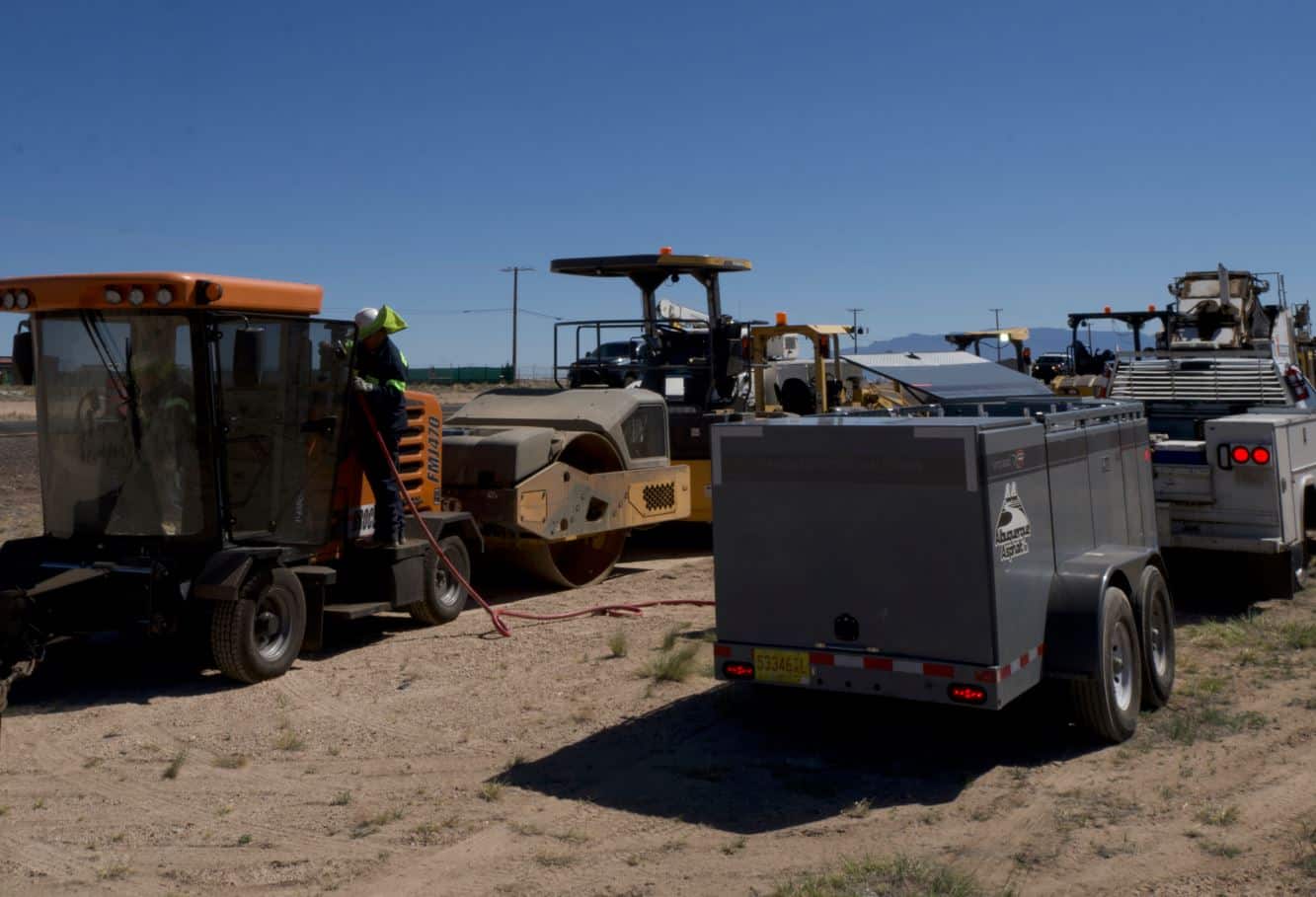
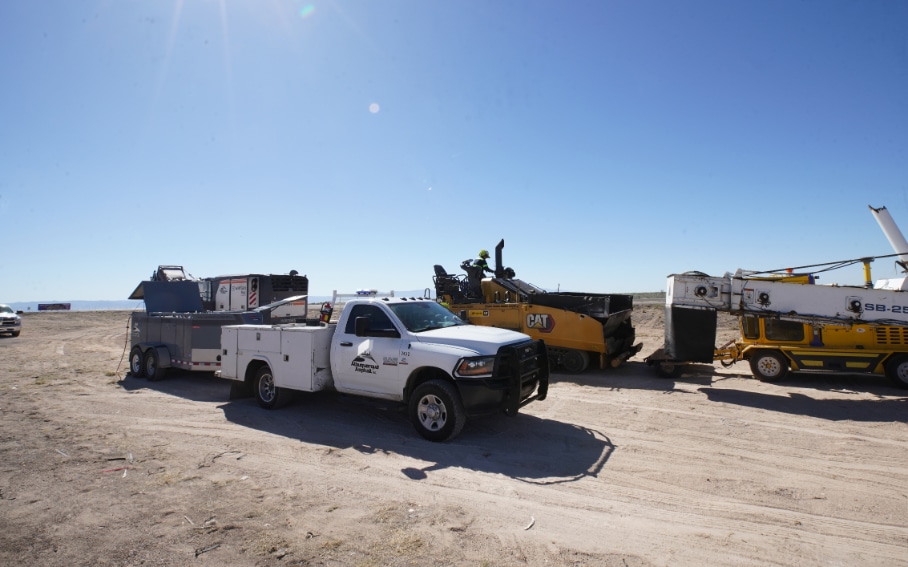
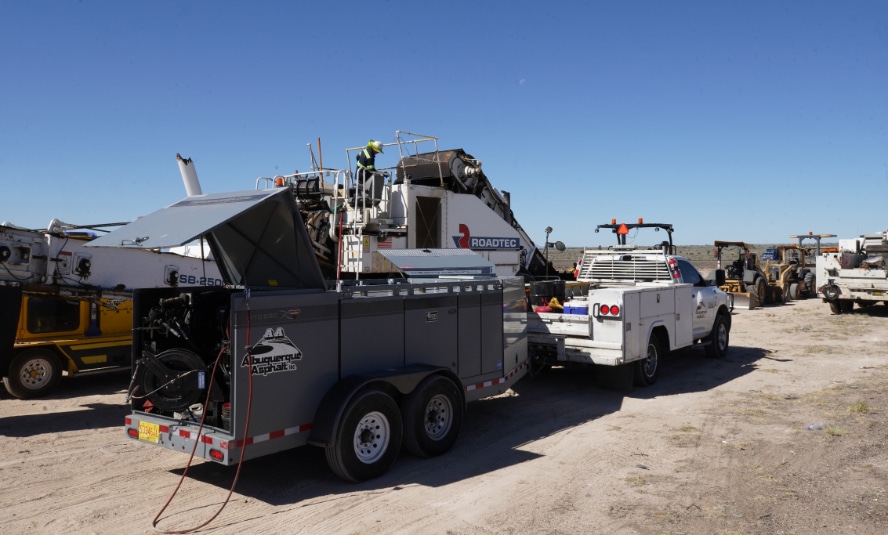
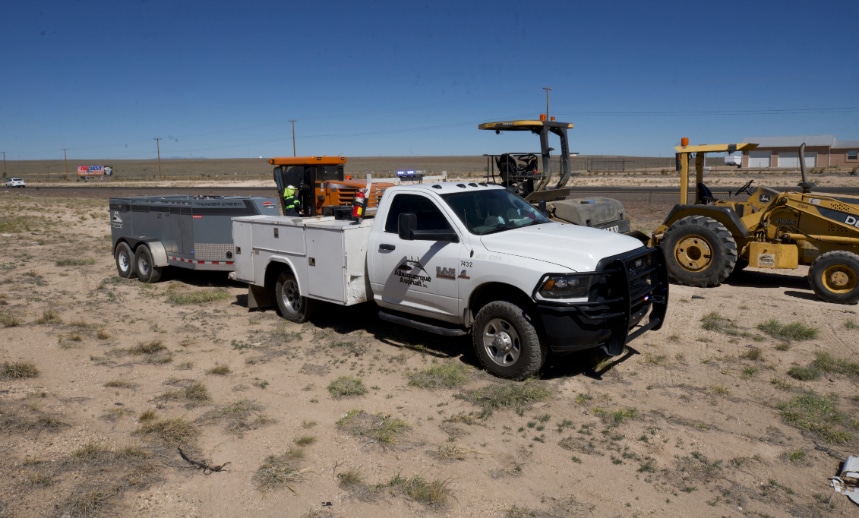
To ensure equipment is ready for nighttime milling and paving operations, a two-person preventive maintenance team tows one of the Thunder Creek MTO 690 trailers to the job site. The heavy equipment is staged in the median for the evening’s work, which makes it easy and efficient for the team to go from one machine to the next, fueling, greasing, filling DEF, blowing out air filters, topping off fluids and performing a final walkaround. Photos courtesy of Thunder Creek

Thunder Creek and Two-Man PM Crew Key to Success

Spencer and Joseph Otero, a superintendent with the company, have spearheaded much of this new approach to preventive maintenance. It revolves around the MTO 690 and a two-man crew. The men pull up to the median or right-of-way (or wherever the equipment might be staged), and they go methodically from machine to machine performing preventive maintenance work. One fuels while the other greases. One fills diesel exhaust fluid (DEF) while the other blows out air filters. One does a walkaround of the machine to identify any issues while the other tops off fluids. And then they move on to the next machine.

The Thunder Creek MTO 690, with its ability to hold critical service fluids in combination up to 690 gallons, is the centerpiece of this operation. Towed behind any of the company’s pickup or service trucks, the trailers navigate each job site and allow each team member to get close to the equipment they are working on.

“If you take a big lube truck, and you take this setup—this is still a lot easier to get inside of [safety] barrels and get next to stuff,” Spencer said. “I like that they’re not climbing up and down the side of the truck all the time. That’s a big deal for me. Everything is really accessible.”

Because each fluid compartment holds less than 119 gallons (115 gallons is the max), the trailer does not require a HAZMAT endorsement. When matched with the right truck, it does not require a CDL. Albuquerque Asphalt outfits each of its trailers with a combination of diesel, engine oil, hydraulic fluid, DEF, a greasing system and an oil reclaim system, allowing each team to perform all critical preventive maintenance work in the field. The on-board air compressor helps for numerous tasks, including blowing out filters.

What’s New in Material, Equipment Transport?

“What’s nice about the Thunder Creeks is, when we go to do oil changes, you get the reservoir where you suck it up and put it in the tank as opposed to putting it in buckets—makes everything more efficient,” Otero said. “Greasing, fueling, oil changes. Then at the end of the day we regroup and dump everything out. It’s just rolling, rolling, rolling—it’s all productive.”

The two-person crew gives the company flexibility in its staffing and helps ensure that preventive maintenance work is completed in a timely manner each day, versus being short-handed if a driver is unavailable. If one of the crew calls out, they can be substituted by any team member. This has also helped prevent unnecessary downtime on the weekends.

“We cut down the cost, as far as hours,” Otero said. “Instead of working 60-70 hours, you include these bad boys and break up the work evenly…everything gets done across the board and it’s not slowing us down.”

Four Rivers has helped Albuquerque Asphalt every step of the way, serving as both fleet consultants for the equipment, and fleet management consultants as it relates to preventive maintenance.

How You Should Handle DEF

“Four Rivers is always looking for a way to improve our business,” Spencer said. “When they have new products, they don’t push them on us, they bring them to our attention. A big part of our success right now is because of Four Rivers. They always answer the phone. They’re available 24 hours, seven days a week, because that’s what we run. Having somebody like Four Rivers is huge.”

For Spencer, the new approach to preventive maintenance and the flexibility of the Thunder Creek trailers are critical to the company’s highway paving success.

“They’ve been a gamechanger for us,” he said. “Servicing equipment is a fast-paced job. Everything’s got to be checked. Fueled up. Oil levels checked,” Otero said. “With the Thunder Creeks, everything’s done, everyone’s happy, and we don’t have to worry about anything.”


Eric Swan is the territory sales manager, Thunder Creek Equipment.

The Mandate for Snow Removal This Winter: Do More with Less

Innovations in snow removal equipment is enabling a leading New England company to clear more snow with less equipment, labor, maintenance and repair

Many snow removal businesses base their decision on acquiring snow plow or pusher attachments on the initial cost, overlooking long-term expenses, improved efficiency, quality of clearing, and the potential to secure additional projects. When considering these factors for the upcoming winter down season, the optimal return on investment is achieved through adaptable and agile attachments, even if the upfront expenditure is a little higher.

According to Degen Kelly, director of operations at Outdoor Pride, Manchester, New Hampshire, a company that generates approximately $13 million in annual revenue from snow removal services, it is tempting to focus on the lower initial purchase cost or to simply order the same attachments other companies use. This leads many to just “rinse and repeat,” he says.

However, for the greatest overall returns, more attention should be given to the ROI that higher quality attachments provide. These attachments offer more flexible choices that allow a variety of movements in tight spaces, while adding to the value of skid steers, which are specifically designed to be nimble. Unfortunately, many standard snow plows and pushers have limited functionality, and if big and bulky, turn a nimble skid steer or wheel loader into a large, clumsy piece of equipment with limited maneuverability.

Of course, given the harsh environments where snow removal is required, these attachments must not only perform efficiently but also must last over time.

“Once you crunch the numbers, you see how much time [high quality attachments] can save, how much onsite equipment you can eliminate, how much quicker your operators can work, and how much longer the equipment lasts,” Kelly said. Earlier in his career, he was responsible for operating snow clearing machinery with a range of attachments from different manufacturers.

“Once you start to think about the ROI with the goal of doing more with less equipment, using a more flexible, quality attachment is a no-brainer,” Kelly said.

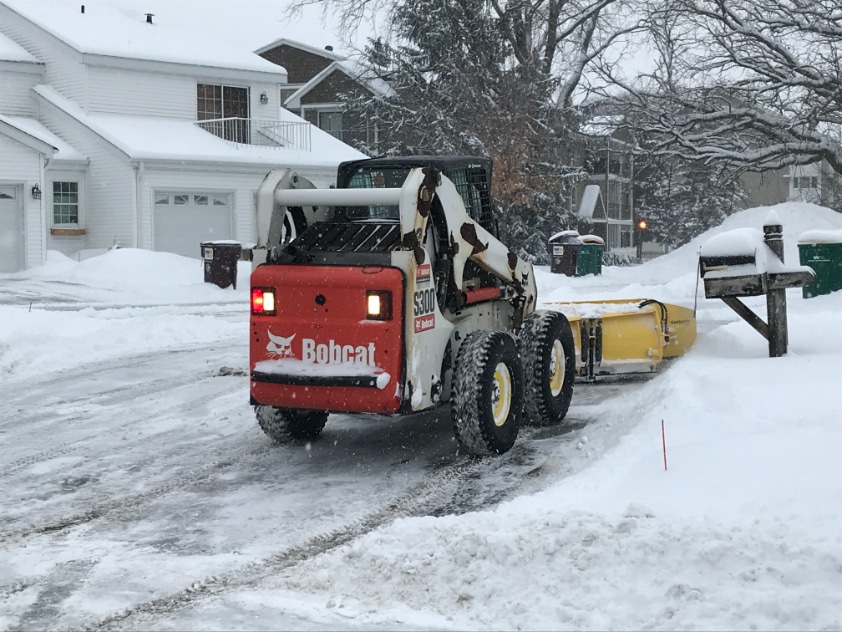
Given the harsh environments where snow removal is required, these attachments must not only perform efficiently but also must last over time. Photos courtesy of SnowWolf Plows

Removing New England’s Heaviest Snow Loads

Founded in 1988, Outdoor Pride has become one of the largest landscape and snow management providers in New England. Like many landscape contractors, the company offers year-round service that includes snow removal in the winter for large commercial and government-owned properties.

“All the facilities we maintain are zero tolerance, which means that if they ever had to shut down, they could lose a lot of revenue every hour,” Kelly said. “So, the ability to quickly and safely clear snow from a site is essential. We need our entire fleet of equipment effectively performing every day during snow events.”

According to Kelly, the average annual snowfall in New Hampshire amounts to approximately 60 inches. However, as recently as 2020, the state experienced winters with snowfall exceeding 100 inches. To keep up with the high demand for snow removal services, Outdoor Pride maintains a large fleet of more than 300 machines, ranging from trucks and full-size loaders to skid steers and walkway equipment.

For snow removal, the company has 85 Bobcat skid steers and mini loaders, each equipped with a unique AutoWing attachment from SnowWolf Plows, xxx, Minnesota.

Founded in Minnesota in the 1970s as a family run snow removal and landscaping contract business, SnowWolf transitioned into the role of equipment manufacturer in 1990. Today, the OEM offers a variety of models and sizes of snow plows, pushers, blowers and other snow removal accessories that are compatible with skid steers, wheel loaders, front-end loaders, tractors and other machinery.

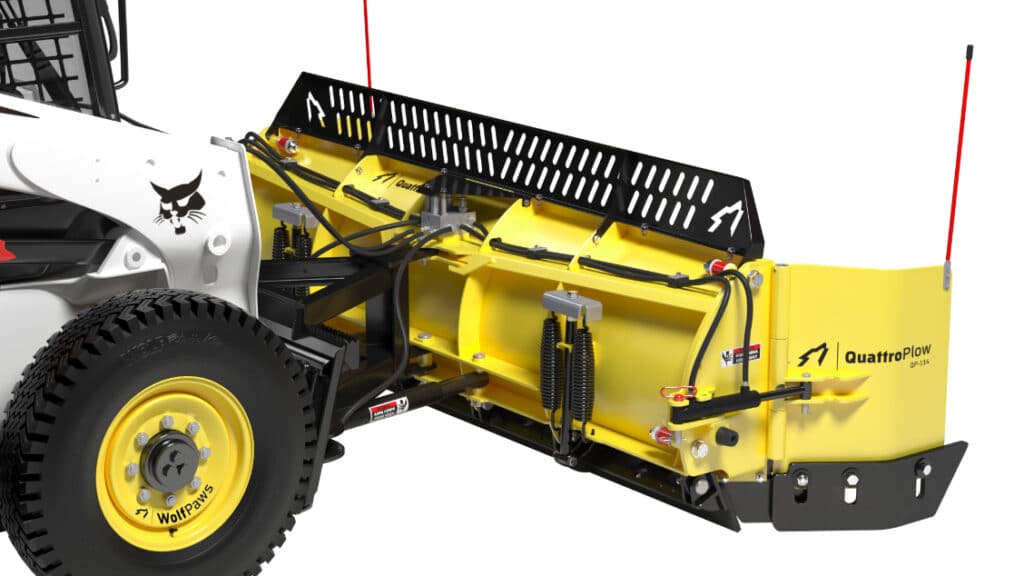
Among the OEM’s offerings is its patented AutoWing QuattroPlows, available in four models and machine operating weights, which are specialized attachments that allow operators to switch between angle plowing, wide-angle plowing, pushing and back dragging on the fly.

According to Kelly, Outdoor Pride discovered the QuattroPlow seven years ago, at a time when they were looking for an alternative to the attachments they were using.

“Most of the other options were flimsy, fixed box [snow pushers]. You really didn’t have the flexibility to drag or angle. The attachments where backdragging and angling was an option were bulky and limited the ability to easily maneuver the skid steer.”

In contrast, a key feature of the AutoWing design is the ability to extend and retract its side wings independently, depending on the width of the road or the amount of snow cleared. This allows operators to clear wider swaths of snow without manually adjusting the plow’s position, increasing productivity and reducing the need for additional passes.

The AutoWing is also unique because it only requires one hydraulic circuit for operation. No additional wiring is necessary and there are no specialized controls. The attachment can be angled left or right with a standard control feature on the joystick. The user-friendly design simplifies operator training.

“[The QuattroPlow] has all the great aspects of a fixed box, along with the ability to easily angle and back drag,” Kelly said. “It has a very simple setup with just two hydraulic lines.”

Outdoor Pride also elected to use SnowWolf’s ActivEdge, a unique design involving multiple cutting-edge sections with individual adjustability and adaptability. The floating cutting edges allow for more precise snow removal even on varied surfaces and minimizes the need for excessive salt or deicing agents.

“We have seen a benefit from utilizing the [ActivEdge]. Our plow edges are now following the contours of the pavement a lot easier.”

The increased efficiency of Outdoor Pride’s snow removal equipment has substantially improved its operations. Kelly estimates the amount of time to clear a complex area has been reduced by one-third, which often means an additional machine is not required. Due to its ability to conform to surface contours, the ActivEdge more effectively clears the area, reducing the necessity for additional passes or excessive salt applied post scrape.

Although decreasing operator time is important to Outdoor Pride, Kelly says there are other ancillary factors that contribute to the ROI. One of those factors is the ability of the equipment to withstand the rigors of annual snow clearing.

According to Kelly, some of the accessories on the market, “seem to get banged up a lot easier and require some serious attention to maintenance. With some of the competitors [that we were utilizing at the time], the implement was unusable after just a few years and the repair cost would’ve been too much,” he said, adding that the QuattroPlows the company purchased seven years ago are still in service and other than new edges from time to time have required very little maintenance.

“The [attachment] is an investment, but from what we have found, it is an investment that gives us results and lasts,” Kelly said. “We are experiencing significant ROI in decreased operator time to get through an entire property. We also see it in the longevity of the product.”

While the initial cost of equipment like snow plows or pushers can be significant, it is essential to evaluate their long-term benefits, including increased efficiency, better quality of clearing and the ability to handle more jobs.

By opting for more flexible and nimble attachments, snow removal services can enhance their operational efficiency and effectiveness. When the ROI is carefully analyzed, it becomes evident that the initial higher investment in advanced attachments pays off, making them an indispensable component of modern snow removal strategies.


For more information, contact SnowWolf at (800) 905-2265 or email info@snowwolfplows.com.

How to Maintain Your Milling Machine

When Tom Chastain presented the best practices of milling at CONEXPO-CON/AGG 2023, every tip and trick was based on one assumption: “Everything I’m saying is based on a well maintained machine.”

In Chastain’s 29 years in the milling industry, presently as milling product manager at Wirtgen America, Antioch, Tennessee, he’s learned the importance of properly maintaining one’s milling machine in order to achieve quality results.

“As soon as these machines hit the ground, they’re beating themselves to death. That’s their life,” Chastain said. “So we have to make sure we maintain them.” Here are a few of Chastain’s top tips for mill maintenance.

Maximize Milling with these Best Practices

Start Your Walk-Around

A key step in any maintenance routine is to properly take care of the cutter drum, Chastain said. “The cutter drum is the lifeblood of a milling machine,” he said. “I could strap two jet engines to a milling machine, but if the cutter drum is not in proper working order, we’re not going to get production and we’re not going to get quality.”

Also check the kicker paddles on your drums. “They are there to help get the material out of the housing,” Chastain said. “If you don’t have those or they’re worn out, that material is just going to sit there in the housing and we’re going to be putting a lot more wear on the machine.”

If the material isn’t swiftly making its way out of the housing, chunks of material may get stuck on the conveyor belt. “Then they act just like pizza cutters and they start slicing up the belt,” he said. “If you don’t have a conveyor belt, you’re not milling.”

Chastain also suggests checking wear items on the housing, like the rear scraper, the front moldboard, the side plates, etc.

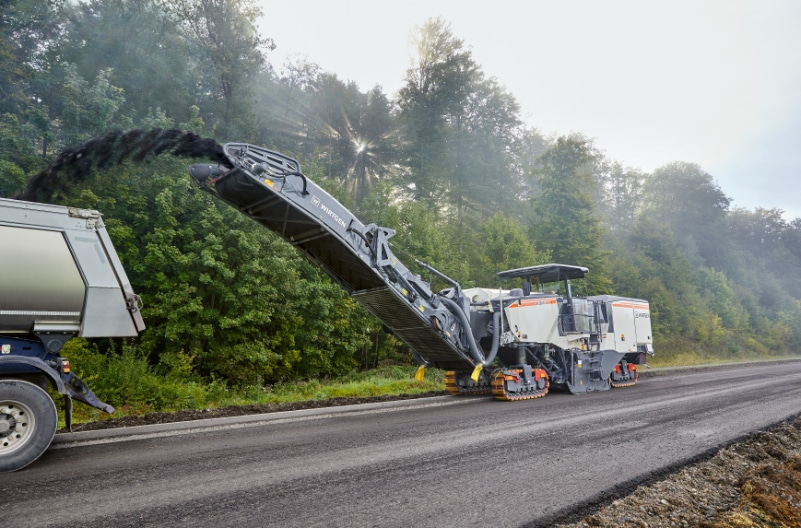
With a working width of 2.5 meters, the Wirtgen W 220 Fi mills off the 46 cm thick road surface in two passes on Interstate 55 in Bolingbrook, Illinois.

Spray to Play

It’s also important to check that the spray system is working correctly. “Water is our friend,” Chastain said. “It’s not only a cutting tool coolant, but it’s also a lubricant—and we want to keep those teeth rotating.”

Water also plays an important role in silica dust suppression and helps prevent buildup on the machine’s components. “It eats me up when I’m on a job site and someone says ‘I’m going to need you to mill dry because we’re going to be paving right behind you’,” Chastain said. “I’m like, ‘No you’re not, because we’ve got to broom it, and damp material is easier to broom up because it’s clumped together.’”

Chastain chooses to run soap in his water tank, but avoids Dawn and other surfactants. “Think about those Dawn commercials where they’re washing oil off of birds,” he said. He was on a job in western Canada where the milling crew went heavy on the Dawn. “They broomed it and tacked it, but there was still residual Dawn on the road that broke down the tack coat.”

Instead, he uses a capful of cheap liquid laundry soap a couple times a day. “If you’re going to put soap in the water tank, put water in first, then soap,” Chastain said. “If you put soap in first, the machine’s going to foam up like a rabid dog.”

Chastain points out that many new machines have multiple sections across the water bars. “With older machines, if we make a full pass then back up to make a half pass, we’re putting down a lot of water and end up with residual water that we’ve got to let dry out before we tack,” he said. “[With new machines] we can cut off sections of water to make sure we’re not doing that.”

Selecting Your xD for Mill-and-Fill Workflow

Check & Change Teeth

A maintenance item worthy of its own section is checking the milling teeth and holders. “Every time a tooth makes contact with asphalt, it generates upwards of 1,800 degrees Fahrenheit,” Chastain said. “You take that heat and the abrasiveness of the material that we’re cutting, that’s where you actually start to get tooth wear.”

According to Chastain, the dead giveaway of a bad tooth is a white streak behind the mill. Although an operator may be tempted to wait until they see more than one streak, it’s important to change a bad tooth as soon as you see it or the wear might make its way to the holding.

“The way these drums are designed is that they hit at about a 36-degree angle, give or take 5 degrees of skewing,” Chastain said. “When we get to the holding and we put a new tooth in there, you might think you’re all good, but you’re not. We’ve changed the angle of attack of that holding. Now, you may not even be hitting the carbide. You’re going to be bouncing off the side of the body of that tooth. That tooth is going to wear out three to four times faster than the others.”

Behind the machine, this issue is going to look like a scuff mark like a crescent moon. “If you don’t replace that holding, you go from cutting asphalt to bludgeoning asphalt,” Chastain said. “That’s like trying to cut asphalt with a Baskin Robbins tasting spoon. It’s not going to work and the machine is going to let you know.”

Chastain was once on a job in Louisiana in an area with very abrasive rock. He suggested spot checking teeth every half-hour. When he left the job for 40 minutes, he could already see the white streak behind the mill from ½-mile away. In that time, the abrasive rock had damaged 30 holders on the drum. “The cost of operation goes through the roof with mistakes like that—and you can’t even say the word ‘quality’ at that stage,” he said.

Bomag Americas Displays Two New Gen Milling Machines

As a crew mills, Chastain said the goal should be to see a uniform pattern behind the machine. “What we tend to see sometimes is new teeth in old holders or new holders with old teeth,” he said. “When you put a new tooth in with a bunch of used ones, it’s going to create a deeper groove. This can get our pattern all out of whack.”

Chastain gave the following suggestion: “Let’s say we cut a bunch of residential streets this week, but next week we’re going on the interstate. We might rerack that drum to start off fresh.” But, he said, do not throw away the removed teeth. “If they’ve still got 60 to 70% life on them, put them in a box and keep them with the machine. When you go out on that interstate project and you break a tooth, use one of those teeth because it’s going to match your pattern much better than a new tooth.”

Chastain also stresses the importance of always having spare teeth and holders. He was on a project in the middle of nowhere when the crew broke some teeth and forgot any spares. “The spare teeth were at the shop two and a half hours away,” he said. “Everything went downhill because we weren’t prepared for the job.”

Although some of these tips may seem basic, according to Chastain, “Advanced milling training is the basics.” Ultimately mill maintenance can boil down to one key question: “Ask yourself, ‘Have we maintained our machine to get quality?’”