Preferred Materials Executes the Plan to Get the Best IRI in Florida

Preferred Materials Inc., a CRH company based in Tampa, has a host of quality in construction (QIC) project wins to its name, but there’s a pair of projects along Interstate 75 (I-75) in Florida that deserves extra attention. Let’s start with the one you can find between exits 254 and 256, which crews returned to traffic Oct. 12, 2021.

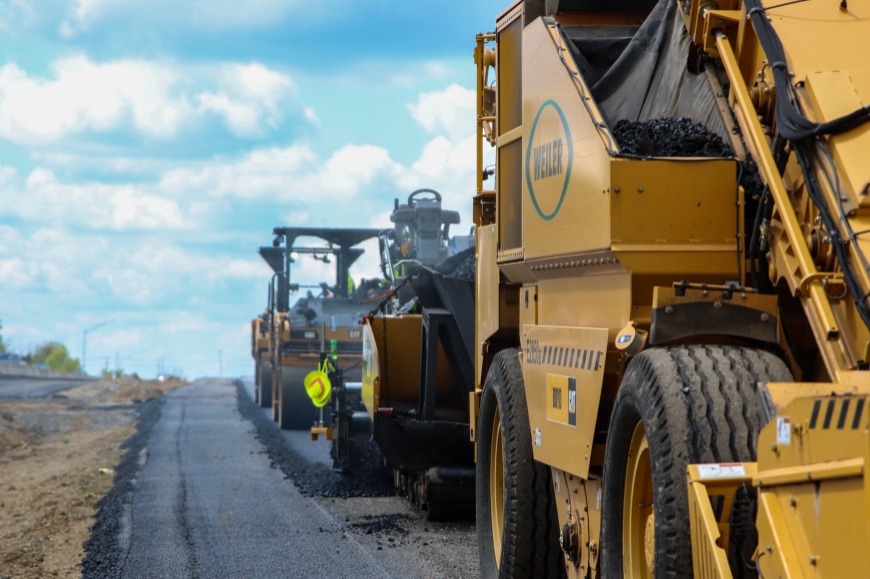
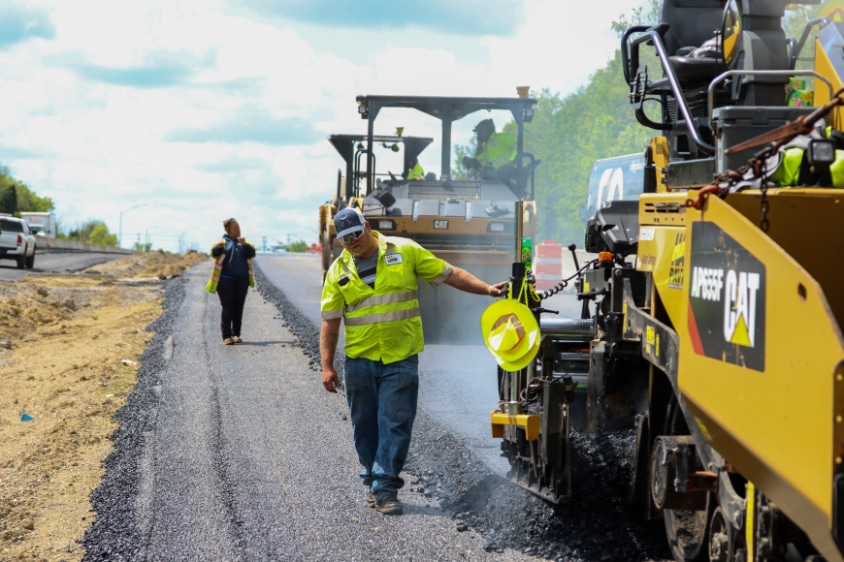
The company took home a QIC award from the National Asphalt Pavement Association (NAPA) in January 2022 for this project of over 50,000 tons. The mill-and-fill encompassed eight total lanes north of CR672 to south of Progress Blvd. on SR93A/I-75 where the company placed a surface mix of FC5 Superpave mix design. The crew first milled and replaced 2 inches compacted of structural course, then placed the open-graded friction course (OGFC) at a mere ¾ of an inch, yet they achieved something remarkable—an average international roughness index (IRI) on the project of 25.

What’s more remarkable than that? The same crew performed the same mill-and-fill work with the same mixes immediately south of the 8-mile project in 2020 with an average IRI of only 24.

Farhad Zafaranian, E.I., M.S., is the construction manager for Florida Department of Transportation (FDOT), Tampa Operations Center, and shared this represents the “[s]moothest pavement in the history of FDOT since IRI has been recorded. It is important to note that the low IRI number would reflect consistency in production as well as placement procedures, which is the ideal goal of FDOT’s quality control process.”

“As both the state construction pavement engineer and a road user, I’m very happy to see our roads getting smoother than ever before,” said FDOT’s Richard M. Hewitt, P.E. “I believe it is a direct result of the department’s incentive/disincentive smoothness specifications and a contractor who has put effort into trying to pave smoother than ever before. I’m very proud of the work Preferred Materials achieved on their two I-75 projects, as well as the majority of our asphalt paving contractors who have been paving significantly smoother in recent years.”

That pride is shared. Richard Crocker, operations manager of Preferred Materials Asphalt Division Tampa, wore his commemorative “24-IRI Club” polo shirt during our interview at CONEXPO-CON/AGG and spoke readily of his team’s accomplishments. He proudly named the foremen and roller operators who contributed to the success of the 24-IRI project and easily spoke about their skills, not only on the I-75 projects, but also on a recent racetrack project that took all hands on deck.


“A year-and-a-half later, we went up and did another project just north of it and repeated the same,” Crocker said. “That same crew with the same rollers, with the same operators. And this is why you must take care of your people. You don’t want your people coming and going and losing their expertise.”

The secret to success is working with skilled operators who know their best practices and know their equipment. “Try to keep people on the same piece of equipment as often as you can,” Crocker said. He advised the successful companies out there will crosstrain crewmembers and have multiple workers who can perform the vital tasks on the paving train, but you’re building a team of experts.

Pat Longstreet is the foreman for the crew that handled the I-75 project and his breakdown roller operator is Javier Gonzalez, who has 14 years with Preferred Materials. He runs a Sakai in the breakdown position and typically runs it with both drums in oscillation mode.

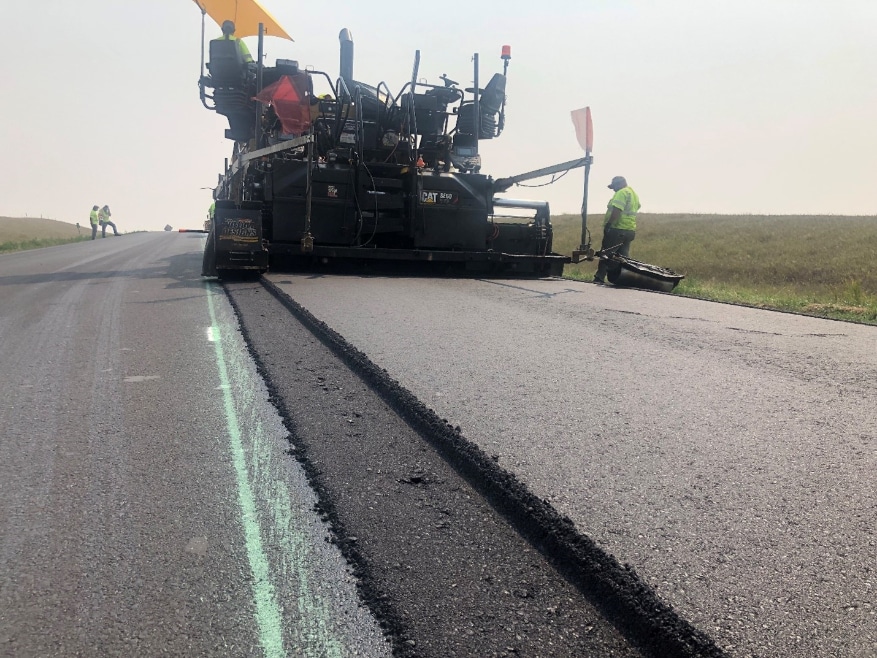
“For I-75, for the structural mix, we were putting down about 900 to 1,000 tons per shift due to lane closure restrictions,” Crocker said. The team performed layout and milling, so they had about six hours of paving before they had to turn things over to striping and open it up to traffic. “We were paving at about 28 to 32 feet per minute on the structural on 75 at 12 feet wide, 2 inches compacted.”

Collaboration Across the Board

Charles Holzschuher, P.E., is the state pavement materials engineer for FDOT. He spoke of attaining smoothness as a collaboration: “Based on collaboration with industry and the department, roadway construction and implementation of these smoothness specifications has improved the quality of paving resulting in smoother IRI. Ultimately, the goal of smoother pavements and utilizing industry leading construction techniques is to embrace innovation, technology, and competition which has resulted in smoother pavements on a statewide level.”

While FDOT isn’t going to dictate a specific technology, the one Crocker spoke of as integral to smoothness success during our time at CONEXPO was oscillation for compaction.

Good Density Equals Smoothness Bonus

The crews use rollers from Sakai, as mentioned above, and they typically have them set in oscillation mode, according to Crocker. It’s a feature of Sakai rollers that the front and back drums can be set in either vibratory or oscillation mode, or be switched from one mode to the other, or be both in oscillation mode.

“I like the capabilities of both drums being able to oscillate,” Crocker said. “Very seldom do we oscillate with only one drum. 99% of the time, we are oscillating with both drums. We do use the vibration on the 750 pneumatics, too. That’s usually on a #3 or #4 setting, whether we’re putting out a poly mix or not, we use them. And, again, that’s training roller operators and setting expectations and knowing what to do.”

While at the booth at CONEXPO, attendees could gather information about the benefits of mixing and matching technologies. Studies showed using both drums in oscillation mode offered bonus potential; check out the sidebar below for that information.

Crocker also spoke of the importance of collaboration and cooperation with all the partners and owners. By communicating needs and requests up front, contractors increase their opportunities to use best practices. They increase their chances to achieve the smooth results the asphalt industry can offer the taxpayers.

“We try to do a lot of continuous paving and that’s why we get the IRI result numbers we do,” Crocker said. “We coordinate, we plan, and we execute. There are a lot of partners that go along with that. Trucking, traffic control, the plant, QC, milling, cleanup.”

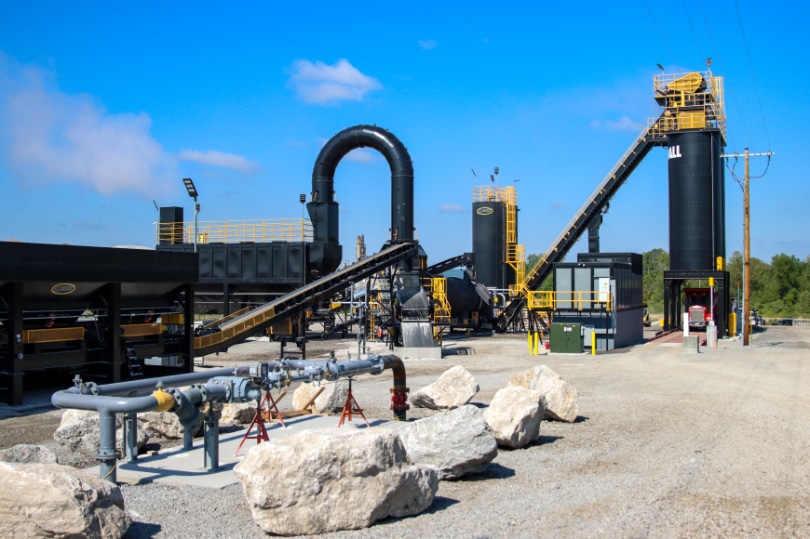
Crocker explained that the plant might be producing 4,000 tons of FOB mix on a given day, but his crew needs to pull 1,000 tons of structural. That takes coordination. Planning. A dedicated group of silos and one lane of the scales that the truckers know they’re to access.

Simon Wins for Smoothness on SH-14

“It’s all relative,” Crocker said. “If we can continuously pave, then we can continuously roll.”

One way to increase the time spent paving is to ask for it. If you have a good reputation, you might get that time. For example, he said the I-75 projects had clear start times at 10 p.m. and stop times before rush hour traffic kicked in. “You had to be off the road, and that’s painted, everything’s off the road by 6, some spots of the road was by 5.”

What Crocker shared is how to wisely extend that time. “If you can go out and show, hey listen, over this 12 miles, I can eliminate four sets of transverse joints,” you could gain “an hour or an hour and a half at the beginning of the shift.”

He explained that you can approach the project owner, even if that’s a DOT with set specs for the project, and show them what you can do with the extended time. By eliminating transverse joints, you eliminate the potential for bumps in the road. By extending time on the northbound lanes while most traffic is building up southbound, you’re using time wisely.

“You gain an hour, hour and a half at the beginning of the shift going northbound because all the traffic then is trying to go south,” Crocker said. “Then when you go the other way, you get it on the other end.”

Quality, Smoothness and Speed to Completion in Colorado

Crocker said you must then execute what you say you will, or the agencies won’t be eager to grant requests in the future. That means instilling pride in workmanship in your crewmembers and getting quality results that back up what you say you’ll do.

“We try to empower all of our people from the guy putting out the cones all the way up to our VP,” Crocker said. “We try to empower our people to take pride. Our reputation has got to get us something. And it has. We have a great safety record, and we have the smoothest road in the history of Florida DOT.

“And this is worth talking about; you have to back up what you say. With our equipment, with our rollers, I was confident we were going to get joint density, I was confident we were going to get mat density, and I was confident we were going to get ride.”

Asking for what your crew needs helped Preferred Materials get the recent racetrack paved in an efficient manner as well. Crocker explained they worked with the owner to gain access to the site for continuous paving. “We had to talk to the (track) owner about access, about ingress and egress because they had the guardrail up. There’s only so much opportunity to get in on a racetrack.”

As Crocker said above, the team coordinates, plans and executes the plan. For the racetrack project, they wanted to eliminate any centerline joint, so they made a plan to build up, staggering and layering with echelon paving in mind. “We figured out which crew should be wider and which narrower to stagger the center joint.”

They placed the base with one paver and material transfer vehicle paving 17 feet wide; the other coming alongside at 13 feet wide to total the 30-foot width. When it was time to place the surface, they staggered differently. “For the friction course, the joint was right down the center.”

The racetrack crew also faced a temperature challenge with a high-polymer mix. It was produced at about 340 degrees but lost temperature in a hurry once it left the haul truck. “We had a 15-minute haul. By the time it was coming out the back of the screed, it was already down to 285, 290 degrees and that’s with 80-degree ambient temperatures in Florida.”

“We were only paving 18 to 20 feet per minute,” Crocker said. “We’re using automation on the paver. We’re using two non-contact skis. It’s a MOBA-based system. Your rollers are trying to roll this joint. The first roller has to stay off the joint. The second roller has to roll it over and push it down. The rollers are the key. We had to look at when do you start the breakdown process? In this case, immediately.” And the rollers had to come right up to the screed. “We had to communicate that in the pre-construction meeting.”

Solve Rideability at the Paver Track

Best practices came into play. “When the roller starts to approach, he has to come right up to the screed. We can’t stop 20 feet away, and we can’t stop straight. He has to always stop at an angle. And when we come onto the mat; we have transverse joints, we can’t come onto the mat straight, we have to come on at an angle.”

Pat Longstreet and his crew had Gonzalez as the breakdown roller operator on the racetrack project. Chris Longstreet and his crew were the second crew on the project. They had two breakdown roller operators during the project: Ceasar Jimenez, who has been with the company for eight years, and Mytara “Nubs” McCray, who has been with the company for 22 years.

That longevity, coupled with the skill and pride in workmanship so evident in the Preferred Materials ethos, lends itself to a set of low-IRI, high-quality pavements that our industry can point to as examples of exemplary asphalt construction. As the team at FDOT pointed out, getting high quality translates to long lasting pavements for the taxpayers, and that’s a win we can all be proud of.


Smoothness Matters

The Florida Department of Transportation (FDOT) has put time and energy into its smoothness specifications to encourage and reward those contractors who take on state projects. One of the measurements of smoothness is the International Roughness Index (IRI), which members of FDOT discuss here.

Farhad Zafaranian, E.I., M.S., Construction Manager, Tampa Operations Center: “IRI describes how much total vertical movement a standard passenger vehicle’s body would experience if driven over a 1-mile segment of the subject pavement at 50 mph. IRI is useful for assessing overall pavement ride quality; a higher IRI value indicates a rougher road surface. It is used by highway professionals throughout the world as a standard to quantify road surface roughness. A continuous profile along the road is measured and analyzed to summarize qualities of pavement surface deviations that impact vehicle suspension movement.

“Lower IRI equates to a smoother pavement surface which equates to increased pavement life and it will create a more pleasurable driving experience for the travelling public. Ultimately it would contribute to lower number of accidents, and decreased maintenance cost.”

Charles Holzschuher, P.E., State Pavement Materials Engineer: “Pavement smoothness is a key performance indicator and top priority for road users. Smooth-riding pavements provide comfort, raise optimum travel speeds, maintain traffic flow, reduce safety hazards, and increase fuel efficiency. Pavement smoothness also imparts a positive reflection on the construction and maintenance proficiency of the owner agency. Furthermore, research has shown that over time, smooth roads cost the owner/agency and users less in maintenance and lead to longer pavement service lives.

“To better achieve smooth pavements and increase the service life of our roads, FDOT in partnership with the paving industry has formed smoothness-based specifications to promote good construction practices and to develop and implement profile-based construction smoothness specifications. The long-term success of profiler-based specifications relies in part on the implementation of an FDOT profiler certification program to verify the accuracy and repeatability of test equipment to measure a longitudinal surface elevation profile.

“To realize this goal, a certification test track was constructed at Williston Municipal Airport. The test track meets the reference and inertial profile requirements set forth in AASHTO R-56. This certification program will ensure profiler operators have the ability to collect profile data and evaluate the quality of the acquired data.”

Richard M. Hewitt, P.E., State Construction Pavement Engineer: “Smoother pavements are not only more enjoyable to ride on, but they last longer and can help reduce some vehicle maintenance costs. Since smoother pavements last longer, the cost is spread out over a greater number of years resulting in a lower annual cost for pavement.

“The IRI provides a rating of the quality of a pavement’s ride with lower numbers representing smoother pavements and higher numbers representing rougher pavements. Lower IRI, i.e., smoother pavements, last longer and result in less maintenance costs for the state and for road users’ vehicles.

“Most drivers are not familiar with asphalt content, aggregate gradation, air voids, or density, but they do know if a pavement is smooth or not. As such, smoothness is the measure by which road users evaluate pavements.”


Let’s Oscillate

The team from Sakai set up an educational section of their booth at CONEXPO-CON/AGG 2023 where they displayed three slabs of SMA pavement, constructed using six passes of a breakdown roller moving at 3.4 miles per hour.

The first sample showed results of a Sakai SW994ND roller with both drums in vibratory mode at 3,000 VPM. The objective results showed an IRI of 99 (inch/mile), a theoretical maximum specific gravity (TMD) of 95.9% and MPD of 0.39. The summary suggested fair rideability and that “Vibe may reduce surface air void due to downward pressure.”

The second sample on display at the Sakai CONEXPO-CON/AGG 2023 booth showed results of a Sakai SW994ND with both drums in oscillation mode. Photo courtesy of AsphaltPro

The second sample showed results of a Sakai SW994ND roller with both drums in oscillation mode. The objective results showed an IRI of 50, a TMD of 97% and MPD of 0.61. The summary suggested this one’s IRI value fell in the FHWA’s “very good” rideability category; its highest MPD value of the three tested offered better draining and the quietest, safest ride; and that “Dual drum oscillation with reduced amplitude reduces scoring of binder content.”

The third sample showed results of a conventional roller with one drum in oscillation mode and one in static. The objective results showed an IRI of 174, a TMD of 97% and MPD of 0.42. The summary suggested this one’s IRI value fell in the FHWA’s “very poor” rideability category and that “Excessive oscillation amplitude in single drum scores aggregate/binder, reducing life.”
Pave Wiser with Pavewise

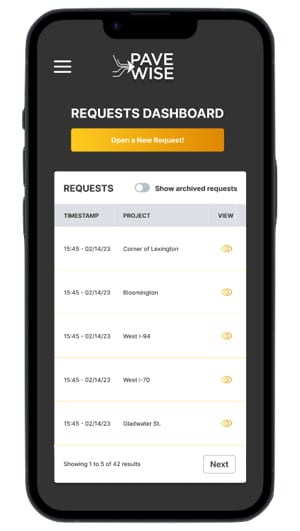
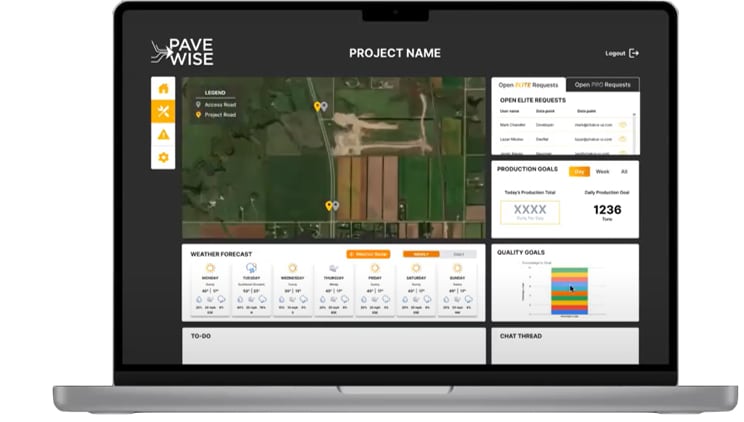
Although Pavewise was first released in early 2023, the asphalt paving project management software has been years in the making. For years, former Paving Consultant Bryce Wuori tracked data across the hundreds of paving projects he consulted on.

“I was almost obsessed with data,” Wuori said. “I was tracking details with the contractors, seeing causes and effects, and using that information to mitigate risk next time. I’d present them with the data I gathered and be able to show them why a project didn’t go like they wanted it to.”

Over the years, he honed his methods, isolated the most useful data to track, and tested his results on his consulting jobs. “I’ve been testing this with beta contractors for four years without even knowing I was building a software,” he said.

When Wuori stopped consulting, his former customers would frequently ask for access to the software, but it was previously only ever something Wuori himself used and it was not user-friendly. Then, in December 2022, Wuori decided to build out a fully fledged software solution, and Pavewise was born. “Now, it can help so many more people than what it could before,” he said.

In 2022, Pavewise was tested on two projects and in 2023 will be implemented on more than 38 projects. One of the first projects managed by Pavewise in 2022 was a $23 million job where the contractor was able to pave 82 lane miles without a single grind in tandem paving.

“The contractor made over $350,000 in density and ride incentives in three months of paving,” Wuori said. Ultimately, the contractor estimates that Pavewise assisted the company in producing more than a million dollars in improved efficiency, incentives, and enhanced project scheduling procedures. “After running the software on a handful of projects in 2022, I didn’t even have to sell it to them. They wanted to run the software on all their active 2023 projects.”

“If contractors can identify the cause and effect of paving projects this assists them in being more profitable and ultimately builds a higher quality asphalt road as well.”—Bryce Wuori

FleetWatcher Introduces Dynamic Yield Calculator

The Wisdom Behind Pavewise

The cloud-based subscription software solution, accessible via computer or smartphone/tablet applications, was built specifically with the asphalt contractor in mind. “There are all kinds of great programs, but many of them aren’t concentrating on a single industry,” Wuori said—unlike Pavewise. “The primary focus of Pavewise is its ability to investigate the causes of asphalt contractors’ biggest issues—lost time, money and quality. If contractors can identify the cause and effect of paving projects this assists them in being more profitable and ultimately builds a higher quality asphalt road as well.”

The core of Pavewise is a series of decision engines Wuori has developed based on his 16 years of experience with asphalt paving.

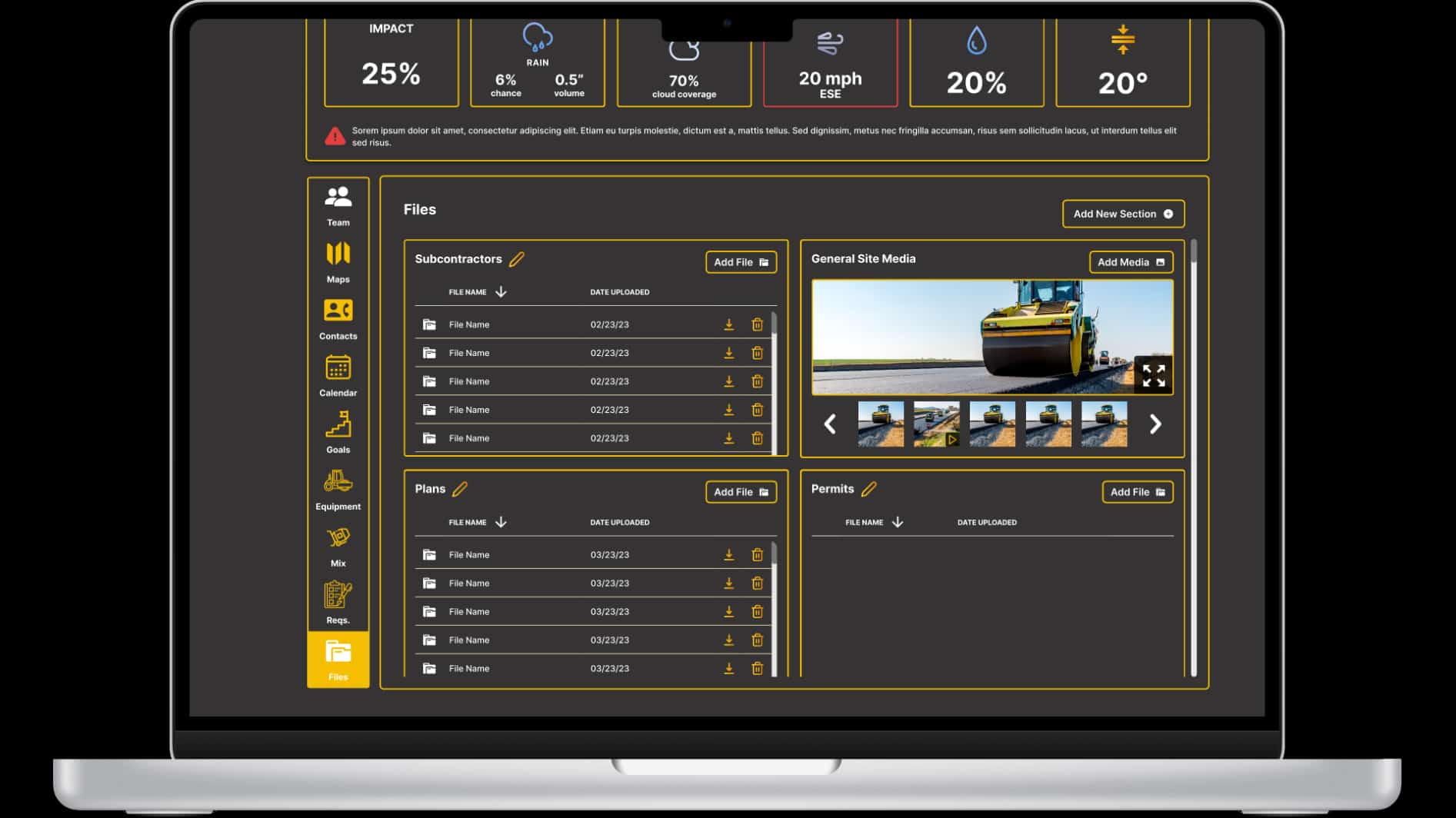
Like most features in the app, the weather recommendations are based on an automated decision engine Wuori built based on his expertise. “A 70-degree day with 0-10 mph wind makes for perfect paving conditions,” he said. “But as you deviate from that in terms of temperature, wind, etc., that can affect your project efficiencies and the quality incentives for that project.”
“I know what a 30 mph wind or a 40-degree day will do to a project’s efficiencies,” Wuori said, estimating efficiency to drop by 10 to 20% in 30 mph winds. Pavewise feeds hyper local, 95% accurate weather data, via OpenWeatherMap, into the decision tree to show contractors how much efficiency may be lost (or gained) based on the weather.

Knowing that information can help contractors black out rain days to prevent crews waiting for bad weather to clear up and also to work longer hours on days where they anticipate higher efficiency as a result of optimal weather conditions. Or, for contractors with multiple crews across several towns, this can guide them to move people and equipment as needed to optimize efficiency and minimize downtime.

When poor weather is expected, Pavewise sends out a proactive text to the user in the field two hours ahead of the inclement weather and makes recommendations based on the expected conditions. For example, in the event of high winds, Pavewise might recommend increasing plant temperatures, reminding contractors to cover trucks, tighten up the rolling pattern or add a ¼-dose of compaction aid. “It’s a proactive way to identify what’s coming and what can be done to optimize conditions to return to the highest efficiency possible,” Wuori said.

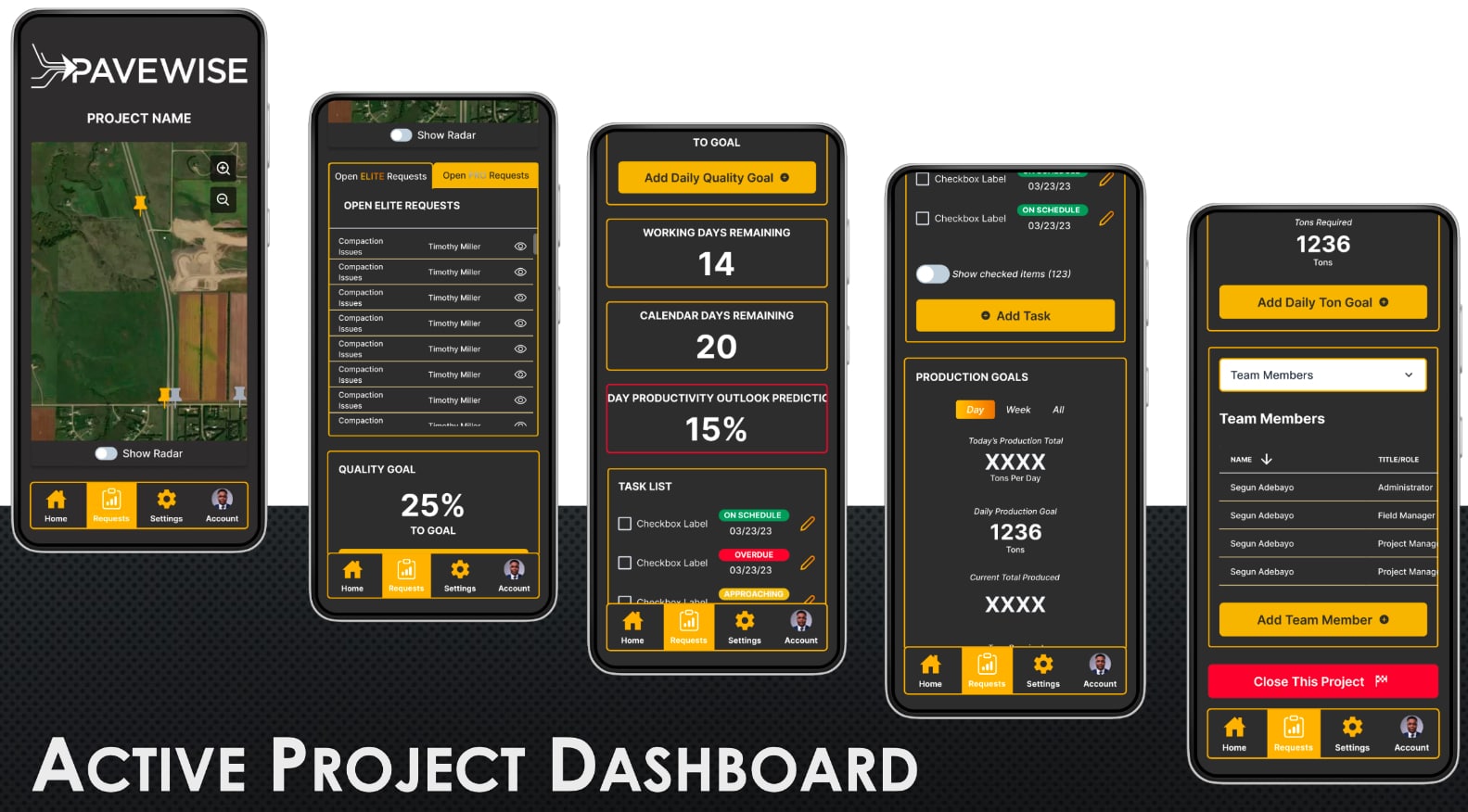
Although the user must input data such as working days completed by project, tons placed and tons remaining, daily tonnage needed to finish the job on time, and where the crew is compared to the bid and incentive goals, Pavewise tracks this data and also sends notifications when desire doesn’t match reality.

“If you bid a project at 300 tons per hour but you’re only getting 250, the system will send a text notification to that project manager and suggest they make a change,” Wuori said. “It’s a way to let them know something needs to change or else they’re going backwards and losing money.”

Honeywell Safety Watch Monitors Staff to Maximize Safety

Elite Attention

In the event that a supervisor or project manager doesn’t have the skill set or knowledge to solve the problems on his or her own, Wuori also offers individualized recommendations via Pavewise Elite, where users can buy credits that can be used to request one-on-one assistance.

“I’ve seen the same things happen over and over again in the field,” Wuori said. “But if you haven’t yet acquired that knowledge, or if you want a second opinion, this can help get a contractor through that challenge.”

With Pavewise Elite, the user supplies photos, videos, mix designs, etc. and Wuori or one of his vetted paving experts will work with the customer to resolve the issue. “We can look through everything and help them navigate that issue, whether that’s setting up the paver with automation, changing the rolling pattern, or troubleshooting a new technology,” Wuori said.

A recent example was a paving job at an airport in South Dakota where the contractor struggled to achieve compaction. “They’d failed four test strips before reaching out to us,” Wuori said. Once they sent over videos of their rolling pattern, he immediately knew what the issue was: all steel-drum rollers. “On a P209 aggregate base, you need a rubber tire roller to compact it from the bottom up to get 94% density.”

“I’ve been in that exact situation, where I was managing a crew paving at an airport and we didn’t have a rubber tire roller and we struggled hard to get density,” he said. With Wuori’s recommendations, the crew was able to achieve density and passed its fifth and final test strip.

Much of the interest in Pavewise Elite, Wuori said, relates to pre-paving plans. For example, requesting guidance for a particular job with a joint density spec or ride spec. “A lot of Pavewise Elite aims to fix a problem before it costs a company time or money,” he said. “That’s the whole goal behind Pavewise in general: to be proactive.”

Know Where You’re Working With OnStation

An AI Future

From the very beginning, Pavewise has been built on a machine learning platform. “[My developers] said the concept was so similar to a machine learning model software with the way I’d built my decision engines from the very beginning,” Wuori said. “And that’s how we continue to build it in the future.”

By the third generation of the app, Wuori thinks the platform “is going to be running as a project manager’s full time assistant,” he said, “making decisions, reviewing past projects, giving recommendations on logistics and paving, tracking production and efficiency.”

In the future, Wuori hopes to integrate truck and plant logistics solutions into the software “to make it as frictionless as possible,” he said.

“If we increased the quality of the entire asphalt industry in the U.S. by 5%, that would amount to billions of dollars and years of road longevity and quality for the traveling public,” Wuori said. “If this software can help do that for 5-10% of the industry, then it will have done what we hoped it would.”

Pavewise is available now at www.pavewise.pro.


Health Diagnostics Center

“Employee health is huge,” Wuori said. “I know what it’s like to be burned out working 90-hour weeks running these crews in high-stress environments.”

That’s why he created the Health Diagnostics Center within Pavewise, scheduled for release by the end of summer 2023. The wellness tool sends a text message to every crew member during every shift, requesting them to rate how satisfied they are with their job on a scale of one to 10. The answers are logged in the system and fed through a decision tree.

If an employee selects eight or higher, Pavewise initiates no action. If an employee selects between three and seven a certain number of times within a set period of time, the system sends a notification to the project manager to take action. If an employee selects anything less than three at any time, a notification will be sent to the manager recommending immediate corrective action.

“Maybe that person needs some time off, or there’s a pressing issue that needs to be resolved, or they’re struggling with a mental health issue,” Wuori said. “Keeping employees is a big issue in this industry. The Health Diagnostics Center is all about making a change before someone quits.”

On one of the 2022 Pavewise pilot projects, Wuori estimates the Health Diagnostics Center saved five employees from quitting. “They were checked in averaging a seven to 10 and when they checked in at a zero to two, they were ready to quit that day,” Wuori said. After the employees’ responses reached the threshold to notify the project manager, the PM was able to take action. One person had some personal problems and needed some time off; another person was struggling to get along with a crew member and needed to be moved to a different position. “They were ready to quit, and now that person is in a leadership position at the company.”

Wuori said in his experience the text message system works better than asking face-to-face. “The fact that this is a digital solution helps them speak their mind without any pressure,” Wuori said. “This gives them a chance to share their feelings in a way that doesn’t make them feel like they’re showing weakness.”

The system gives the employee a chance to include additional comments with their daily ratings, and in the future, Wuori said Pavewise might also include suggestions for how to resolve common issues.

“A lot of people don’t realize the happiness of the employee directly affects the quality of the job,” Wuori said. “When an employee is not happy or satisfied with their work this can lead to distractions and/or safety issues for them and their crew members. If they have a negative attitude or do not care about the environment they are working in we have the obligation to remove them from that opportunity or correct the opportunity.”

How to Fix Core Damage

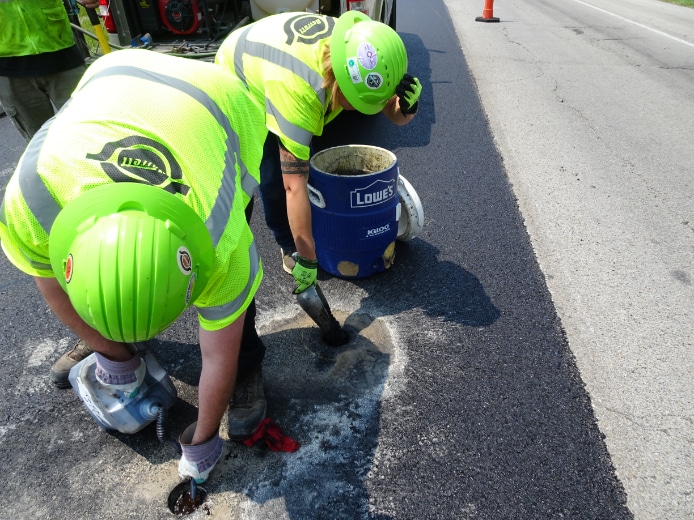
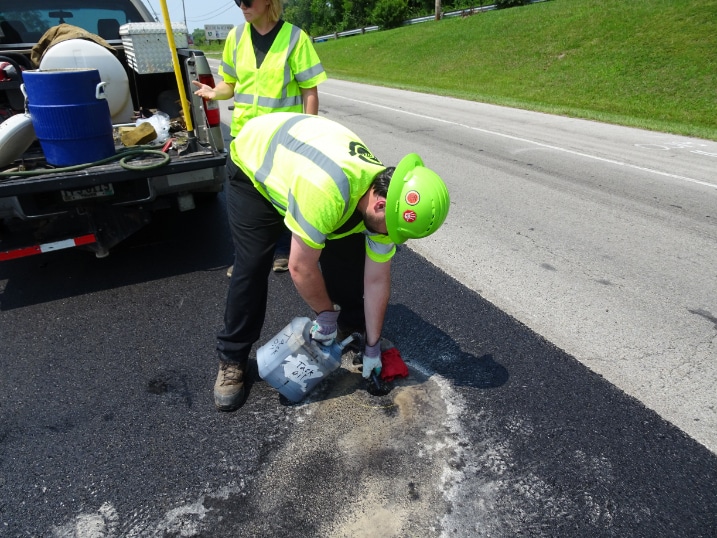
Taking core samples for quality control/quality assurance (QC/QA) is a destructive process, but there’s a right way to fix the pavement after coring. To give your new pavement its best chance at long life, repair the core damage with best practices.

Step 1. Dry the hole with a cloth. Taking the core sample requires the use of water, and that water will present adherence problems for tack and mix if you try to patch directly. Your first step is to dry the hole as best you can.

Step 2. Tack the base and sides of the hole with appropriate tack material.

Step 3. Bring hot-mix asphalt to the project in a cooler that can hold its temperature. Use a trowel or other hand-held tool to deliver mix directly to the hole without making a mess around the edges. You want to pile the mix about half an inch higher than the pavement surface to allow for compaction.

Step 4. Compact the material into the hole with a hand tamper.

Core sampling is a necessary evil in the field and sealing up the pavement afterward is vital to the life of the pavement structure. Make sure your QC/QA team is performing their best practices.


John Ball is the proprietor of Top Quality Paving & Training, Manchester, New Hampshire. For more information, contact him at (603) 493-1458 or tqpaving@yahoo.com.

How to Exceed the Long Joint Density Spec

Northern Improvement Company, Dickinson, North Dakota, completed a cold in-place recycle (CIR) and paving project on Highway 8 in Dickinson County Sept. 17, 2021, with impressive density numbers. Their secret to success is wrapped up in proper equipment and best practices with the state’s new joint density spec. Let’s take a look at how Northern Improvement built a 26-mile notched wedge joint and achieved an average of 94.8% density on the longitudinal joint with 93.9% average density on the mainline.

To begin work on the Hwy. 8, JCT ND 12 to W JCT ND 21 project in early August 2021, Northern Improvement performed CIR to a depth of 3 inches.

The paving consultant on the project, Bryce Wuori of Wuori Consulting LLC, Bismarck, North Dakota, observed, “The existing road surface prior to the CIR was so rutted and had such deep transverse cracks it was almost unsafe to travel down the road at the designated speed limit. There was no ride incentive included on the project for Northern due to how rough the existing road surface was prior to construction. After the CIR and before the asphalt paving, the road surface rode very nicely, almost comparable to that of a common low-volume asphalt highway.”

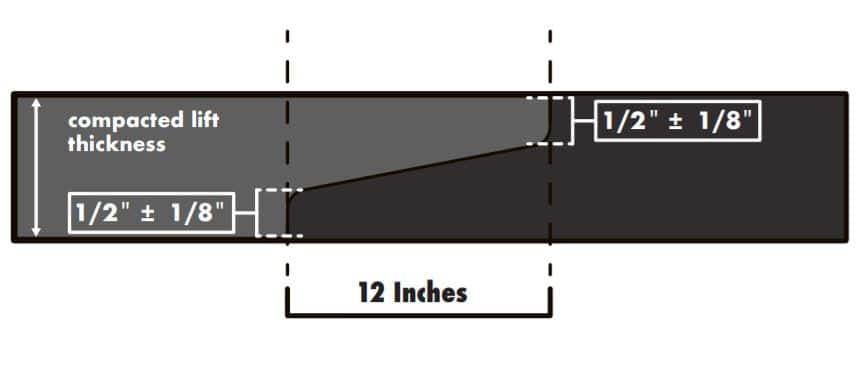
The North Dakota Department of Transportation released a special provision Jan. 5, 2021, detailing the manner in which contractors would be paid for density of longitudinal joints for hot-mix asphalt pavements. If a notched wedge joint is used, it is to be constructed according to the diagram in Appendix A of the special provision. Illustration by Maranda Wilbanks for AsphaltPro

Paving began Aug. 9 and involved two lifts of 1.5 inches of Superpave FAA 43 with a CHS 58S-28 AC for a total design lift thickness of 3 inches. As required by the Jan. 5, 2021, NDDOT longitudinal joint for hot mix asphalt pavements special provision, the team built a notched wedge longitudinal joint, which had a required average density of 90.5 on the joint. The project called for at least a 92.5 required density on the mat. They used the Notch Wedge System from Willow Designs LLC, East Berlin, Pennsylvania, attached to a CAT SE60 screed. The system consists of the Willow Designs notch wedge joint maker and notch wedge pneumatic roller.

“Something unique about Bryce is that he uses ground penetrating radar (GPR) as quality control to improve density consistency in the mat and, more specifically, the longitudinal joint,” Jerod Willow said. “We share a lot of the same clients in that region and we often converse on how to improve a contractor’s ability to get density in the mat and joint. He has some pretty impactful data from this season.”

Wisconsin Job Exceeds Longitudinal Joint Density Expectations

Wuori explained how Northern Improvement built the joint with quality control as part of the process. “We used the Notch Wedge System from Willow Designs to construct a ½-inch notch. The key part of this system is rolling the wedge properly to set the joint in for optimum density. The density on the joint is measured with a combination of a Troxler nuclear gauge and the PaveScan 2.0 GPR.”

The technology he references is from Geophysical Survey Systems Inc. (GSSI), Nashua, New Hampshire, which makes the PaveScan RDM 2.0 continuous, non-destructive, asphalt density assessment tool described in the May 2017 Here’s How It Works department. Wuori explained that he can walk the entire length of the project with the PaveScan device, taking readings along every inch of the joint. If he were to receive a reading indicating a weak area, he could inform the paving crew immediately, rather than waiting until after construction is complete to return to the field to address possible failures.

“In the event of reading below the 90.5 requirement, I would advise Northern to look at rolling patterns and what rollers are being used for compaction, then inspect and evaluate the setup of the notch wedge system as well,” Wuori said. “Typically, if the notch wedge is being constructed properly and rolled correctly the contractor will pass joint density requirements on every paving day. I have been on over six projects this year where the addition of the Willow notch wedge and correct rolling procedures brought the paving contractor from failing required density specifications and getting deducts on the joint density to passing with incentives with the addition of the notch wedge and correct rolling procedures.”

The construction of notched wedge joints to achieve a quality end result is catching on. Jerod Willow shared: “I have heard Wyoming and South Dakota are in the process of implementing a joint density spec. It also sounds like Illinois is starting to dabble with notch wedge joints on their J-band projects. Arkansas has fully specified a joint density spec now after working with it the past 18 months. I have also heard some limited talk in West Virginia and Ohio.” Photos courtesy of Bryce Wuori, Wuori Consulting

The PaveScan, coupled with density gauges, played a hand in setting up the rolling procedures. Wuori explained: “Average mat density is recorded with the combination of destructive coring, nuclear testing and the PaveScan GPR. We use the PaveScan GPR and nuclear gauge to set up rolling patterns and develop a paving process for success and compare this data to the results performed in the destructive coring process. Northern Improvement also used intelligent compaction on this project to give roller operators temperature zones for optimum compaction and roller pass counts for efficiency and accuracy in the rolling process.”

The rollers they used were a CAT CB 16 with an oscillating front drum in the breakdown position, a CAT CB 66 with dual vibratory drums in the intermediate position, and a CAT CB 68 set in static only in the finish position. The operators stayed aware of temperatures and rolling zones, which fluctuated for this mix.

Schellinger Construction Hits Notch Wedge Joint Density Specs

“The average temperature the mix was delivered to the paver ranged from 250 to 280 degrees depending on the weather that day and the distance we were paving from the asphalt plant,” Wuori explained.

“Notch wedge joints work because they confine the asphalt mix in the joint better than a butt or vertical joint, meaning that there is 85% less loose mix in the joint,” Willow explained. “Loose mix in the joint means a failure. Notch wedge joints are also stronger joints due to the increased surface area of the joint; this style of joint and similar forms of this joint have also been used in other construction materials from wood, metal and stone dating back hundreds of years.”

“This mix had a very good design and was an average mix to achieve density with when compared to the FAA 43 mix designs,” Wuori said. “Due to the high amounts of aggregate absorption in the aggregate used in the design, the AC content was higher than what is normally seen on this type of mix design (6.8 percent). The one drawback of this mix in the field was its ability to turn tender on the hotter days of paving.

The quality control team was able to run the PaveScan 2.0 ground penetrating radar device along the joint to take continuous density measurements. The device is available through InstroTek Inc. as of Q1 2021.

“On these days, we would have to get most of our compaction up front on the hot mat with steel drum rollers before the mix cooled to 200 degrees. At 200 degrees the mix would develop a tender zone that would hold until about 160 degrees. This was only on days that the ambient temperature was above 85 degrees with very little wind on the project.”

On the hotter days, when the tender zone appeared, the rolling train switched out the CB66 steel drum with a Sakai GW750-2 vibratory pneumatic roller. “We would also introduce a pneumatic roller into the train to get through the tender zones because a steel drum would tear and fold the mat if used when the mat was tender.”

Despite the tender zone challenges, the roller operators achieved higher-than-required results. “The overall average joint density for the project was 94.8%,” Wuori shared. “One day’s average joint density was a 95.7 on 13 core locations. The roller operators do an exceptional job of holding patterns and understanding when the mix would become tender or what would need to be done to battle this issue. Having good, trained roller operators that understand their equipment and how important their skill is to the finished asphalt product is key in producing successful projects. These roller operators have been trained very well and have been put through some of the most difficult projects out there and have shown how a skilled roller operator can make or break a project.”

Willow Designs’ Notch Wedge Pneumatic Roller

The roller operators included Raquel Davis on breakdown, Kim Bumgardner on intermediate, and Luellen Johnson on finish. The Hwy. 8 CIR and pave project was a team effort that included the skills of roller operators and the entire quality-minded crew. Superintendent Joshuah Davis shared: “The crew from front to back were Brad Barnick dump man; Alyssa Polanski paver operator; Mac Cook screed operator; Amber Hoots and Ron Comon QC; fill in roller operators were Deryk Drew, Cody Bellon; plant operator and foreman Tom Stickel; supervisors were Jason McIntosh foreman and myself. Also a huge part of all this is Bryce Wuori. Because of his training and vast knowledge, he has helped me make this crew into what they are today. Without them we would never be able to achieve this. They do such a good job with the flow and consistency to achieve the compaction and ride.”

Wuori also commented on some of the best practices he saw in the field.

“Their best practices for quality included paver setup/ and consistency. By eliminating paver stops and keeping the paver at a consistent speed throughout the day. Then roller consistency using Intelligent Compaction as a tool to keep operators in designated temperature and pass count efficiency. And proactive quality control to ensure paving and rolling techniques being performed during paving operations produced the desired results.”

By the time Northern Improvement was ready to turn the pavement over to the stripers Sept. 17, they had a new roadway made safe for motorists in Dickinson County.

Hall Moves on I-Move in Kentucky

I-Move Kentucky is a $180 million investment that will widen and improve interstates, as well as revamp congested interchanges, to improve safety along three busy interstates in Jefferson and Oldham counties: Interstate 64, Interstate 71 and Interstate 265 (Gene Snyder Freeway).

The four-year project will be the largest single construction project in Kentucky since the Ohio River bridges project was completed in 2016. Hall Contracting, Louisville, Kentucky, began work on the project in May 2020.

“I-Move Kentucky will improve safety and mobility on three major interstates that join together in eastern Jefferson County and will allow travelers and freight to move freely through the region,” said Greg Thomas, secretary of the Kentucky Transportation Cabinet (KYTC). “These were among the most important projects identified during last year’s SHIFT prioritization.”

SHIFT, or Strategic Highway Investment Formula for Tomorrow, is KYTC’s data-driven approach to compare capital improvement projects to prioritize transportation funding. The project consists of a number of improvements, including reconfiguring interchanges at I-71/I-265 and I-64/I-265 for better safety and traffic flow. The widening of I-71 adds one 12-foot lane of traffic in each direction, for a total of six lanes between Interstate 265 and KY 329. I-265 will also be widened with an additional 12-foot lane in each direction to create a total of six lanes between KY 155 and I-71.

The widening of I-265 was SHIFT’s number one transportation priority, the I-71/I-265 interchange was ranked sixth, and the widening of I-71 was ranked eleventh. “By tackling [these projects] together, we’re saving Kentucky taxpayers time and money,” Thomas said.

The Design-Build Dash

In 2018, the Kentucky General Assembly passed HB 385, which authorized KYTC to use design-build methods of project delivery for major projects like I-Move. Kentucky has already begun using the design-build approach for two projects in northern Kentucky, including the I-65 bridge project over the Ohio River.

“It seems that KYTC wants design-build to be the new normal on large projects,” said Hall’s Quality Control Manager Jordan Sandquist. “Once one section [of the design] is approved by the state, we can start constructing that section instead of waiting for the whole design all at once.”

Kentucky is also looking into balanced mix design (BMD). Sandquist said both design-build project methods and BMD are indicative of a greater trend within Kentucky’s transportation agencies. “The idea is to give contractors flexibility to meet KYTC’s standards,” Sandquist said. “If you can produce a mix that meets their specs on various tests, how you get there is up to you.”

In total, the project will require between 400,000 and 450,000 tons of asphalt.

Roscoe Willis, manager at Hall Paving, a division of Hall Contracting, added, “I think [balanced mix design] is an example of the direction the state is headed in, not only for materials but also for the bid process. It’s results oriented, versus process oriented.”

With the design-build method, Hall will be able to complete the project more quickly. The I-Move project is expected to be broken up into more than 50 buildable units, nine of which are asphalt-related.

Last fall, Hall finished the mill and fill work on I-265, a total of 3 miles or 12 lane miles. In August, the company milled and filled the existing lanes on I-71, a total of 5.5 miles and 22 lane miles. Although I-71 was in pretty bad shape, the construction was more about handling growth and improving safety, said Roscoe Willis, manager at Hall Paving, a division of Hall Contracting.

“This plant gives us a lot of opportunity to add new features down the road,” Willis said. “From injecting additives at the drum to blowing in different products, this plant has the ability to grow with us.”

Hall performed variable depth milling with its Wirtgen mill. The paving crew then placed 3 inches of Class 4 base mix with PG76-22 asphalt cement on the existing lanes.

By the end of the 2021 construction season, Hall anticipates finishing a substantial amount of the asphalt base for the widening of I-71 and all the base for the road widening on 265, completing both the I-71 and I-265 interchanges, and finishing the drainage blanket from Shelbyville Road to Avoca.

The project, totaling 25 contiguous miles, including ramps, is roughly 40 percent asphalt, plus an asphalt drainage blanket beneath the concrete. New lanes along the concrete sections of the pavement will also have an asphalt drainage blanket beneath. The new lanes in the asphalt segments of the project will have a 4-inch drainage blanket, then a 4.5-inch lift Class 4 asphalt base 1.50D with PG64-22, a 3.5-inch lift of Class 4 mix with PG76-22 and 3 inches of Class 4 base mix with PG76-22 to match the existing pavement. The entire span of road will then be topped with 1.5 inches of a Class 4 surface mix.

The crew also used the Pave-IR quality control system from MOBA, Limburg, Germany, to record asphalt temperatures immediately behind its Cat paver.

In total, the project will require between 400,000 and 450,000 tons of asphalt. “From an asphalt standpoint, we’re only just getting kicked off,” Sandquist said. Willis estimates they are 20 percent complete.

New Project, New Plant

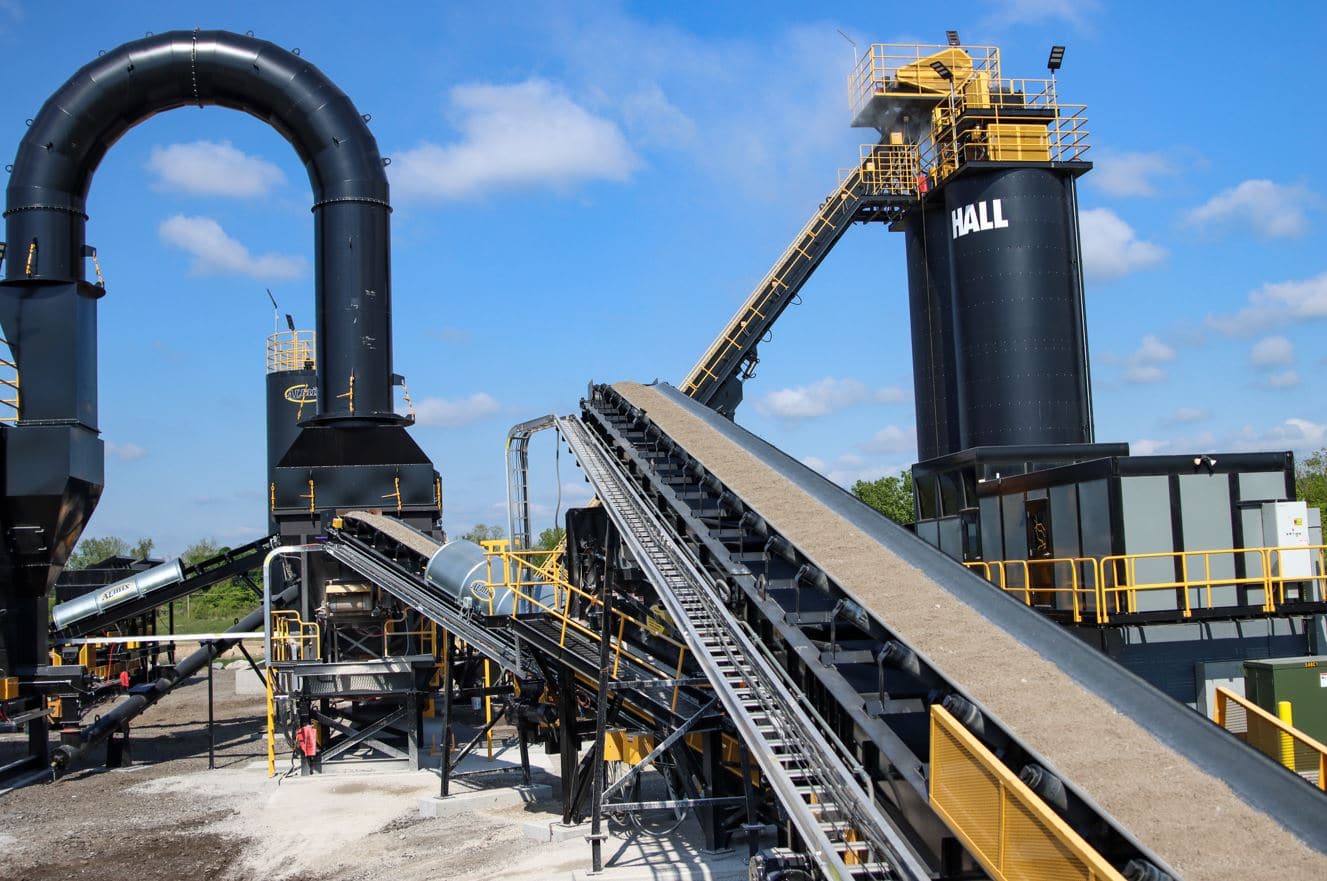
The I-Move project was a catalyst in Hall’s decision to invest in a new 400 ton-per-hour asphalt plant in Charlestown, Indiana, from ALmix, Fort Wayne, Indiana. They purchased the plant in February 2020 and planned to have it running for last year’s paving season.

“We were close to full capacity at our other plant, so this project put us over the edge,” Willis said. However, the pandemic resulted in planning and zoning delays. “It’s not that they were fighting us on it, but simply that the committees weren’t meeting.” They weren’t able to have the requisite meetings until July 2020, finally getting the new plant fired up in May 2021.

Kentucky Puts Low Gyration Mix to the Test

Those delays meant Hall had to rely on its existing asphalt plant south of Louisville, a 400-tph Cedar Rapids plant with three 200-ton silos, for the first segments of the I-Move project. “Since we only had one plant and we couldn’t lose access to it for our daytime projects, we did a lot of night work last year,” Sandquist said.

The new plant currently has two 250-ton silos, but Hall has already laid the foundation for future growth. “This plant gives us a lot of opportunity to add new features down the road,” Willis said. “From injecting additives at the drum to blowing in different products, this plant has the ability to grow with us.”

That was one of several reasons Hall chose the ALmix plant. “ALmix is a great company to be able to add pieces as needed,” Willis said. “We didn’t buy anything we didn’t need, but there are sure to be things we’ll need in the future that we plan to add.”

The I-Move project was a catalyst in Hall’s decision to invest in a new 400 ton-per-hour asphalt plant in Charlestown, Indiana, from ALmix, Fort Wayne, Indiana.

Although the company’s Cedar Rapids plant “has been a blessing to us and has held up very well,” its age confines the company to certain limits in terms of innovation, Sandquist said.

“The new one gives us the opportunity to try things we weren’t able to try before,” Willis added.

For example, they’ve been working with aramid fiber for its anti-cracking properties. “We’ve been using it on jobs with the city and showing our customers the advantage of it for asphalt flexibility and strength,” Sandquist said. “Now that Kentucky is moving toward balanced mix design, it will be one more tool we can utilize.”

Hall got its new ALmix asphalt plant up and running in May 2021.

New Project, New Technology

In addition to its new plant, the I-Move project has also propelled Hall Paving to invest in several technologies that are new to its crews, including e-ticketing, intelligent compaction, thermal mapping and 3D paving.

“The state is interested in the ability to do forensics if something goes wrong with the pavement in the future,” Willis said. “By accumulating that data, they can go back and analyze it to see temperature and compaction data for problem areas.”

The technology that Willis has found most useful is e-ticketing. “The ability to manage trucks differently, track materials and improve efficiency is very exciting,” he said. They use a tool called Broadloop, which was created locally and allowed them to customize the tool to suit their needs. “The ability to see where our asphalt is in real time is amazing.”

Willis found the use of e-ticketing, a technology new to the company, very useful during the I-Move project. “The ability to manage trucks differently, track materials and improve efficiency is very exciting,” he said.

The crew also used thermal mapping and intelligent compaction on last year’s segments of the project. It used the Pave-IR quality control system from MOBA, Limburg, Germany, to record asphalt temperatures during paving. To ensure the crew was ready to use this technology on its I-Move projects, Hall had its crews trained by the technology provider and also had them use the tech for several weeks prior to the start of the project.

The last new piece of technology on the project is 3D paving, which they will use on future segments of work on I-71, I-265 and I-64 to ensure the final surface elevation of the pavement is correct.

“We’re not afraid to try new things and be on the cutting edge,” Willis said. “This project is propelling us to continue to grow.”

Although Hall Contracting was founded in 1954, its asphalt division wasn’t established until 2013. “On day one, we were starting from square one, and now we’re working on one of the largest projects in Kentucky state history,” Willis said. The division started out with 22 employees and now has a staff of 65. “And we’re looking for more,” he added.

In addition to its new plant, the I-Move project has also propelled Hall Paving to invest in several technologies that are new to its crews, including intelligent compaction.

As an employee-owned company, everyone at Hall Contracting has a feeling of ownership of the company and its projects. “We have the type of team that wants to move the industry forward,” Sandquist said.

Willis added, “We’re really pushing this division of the company to do great things. We’re constantly learning and growing and want to be on the forefront. We want to change the world, one ton of asphalt at a time.”

Kentucky Takes Micro Surfacing to the Taxiway


Logistics in Louisville

According to research platform Macrotrends, the population of Louisville is growing faster than the national average (respectively 0.83 percent and 0.58 percent in 2021). However, it isn’t necessarily population growth that is driving infrastructure demand in and around Louisville.

“Although population growth has something to do with it,” Willis said, “I think it’s mostly a result of improved connectivity with southern Indiana and the growing logistics sector.”

According to the Lane Report, a monthly business magazine covering central Kentucky, Louisville is within a one-day drive of roughly 50 percent of all U.S. markets. Louisville’s website, louisvilleky.gov, states Louisville’s logistics sector is more than twice as dense as the U.S. average.

Furthermore, Louisville is the primary hub of UPS Airlines, a wholly owned subsidiary of United Parcel Service (UPS) and the world’s fourth-busiest air cargo hub in terms of freight volume flown, according to UPS, according to the Lane Report.

Train Proper Straight Edge Use for Bonus Quality Paving

This article will talk about the proper use of the metal straight edge for good quality control during paving, but we have some extra tips to point out along the way. Let’s start with the reason for having a straight edge out on the paving job.

The untrained or new laborer might not understand why the crew has an 8-foot-long, 11- or 14-gauge, 2 by 4 steel tube on the deck of the paver or in the back of the work truck. This vital tool will help all the laborers—from the new guy with the rake to the foreman trying to figure yield. It helps you keep track of slope, high and low spots, crown, and proper takeoff depth in the mat. You’ll use the straight edge to check joints, match height and any number of quality control/quality assurance (QC/QA) factors that affect your pay.

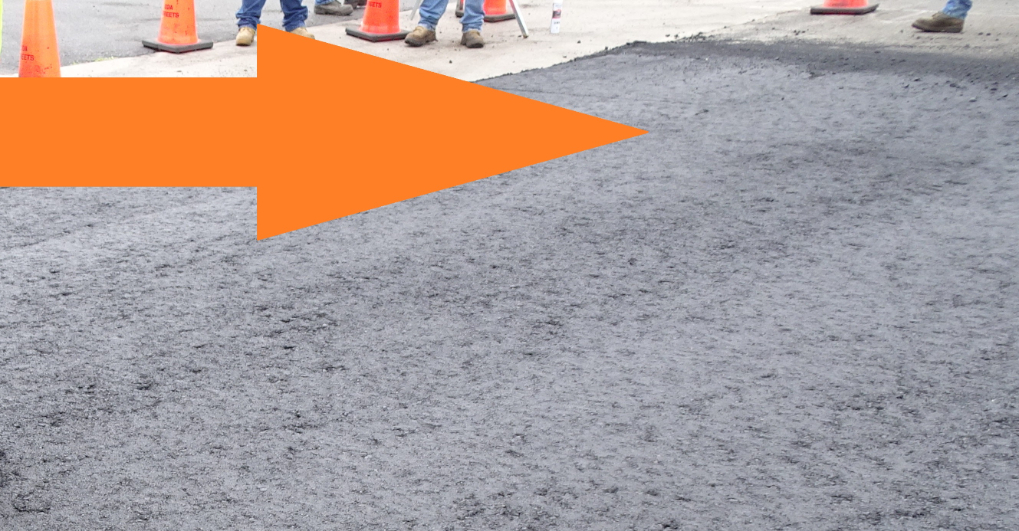
The orange arrow points to the area where beginning-of-load segregation showed up in this binder course. You can minimize this if you avoid running the hopper empty between trucks.

Before you even begin the paving day, here are some steps we need to do first.

  • Step #1 null out tow point cylinders while the screed is on the ground.
  • Step #2 with another worker, null out the depth cranks on each side of the screed.
  • Step #3 on each side of the paver, make the endgates level with the screed.

With those steps done, you’ll raise the screed and place the straight edge against its underside to double-check the smoothness of the screed plate. For this quality check, make sure the slope extensions are not engaged.
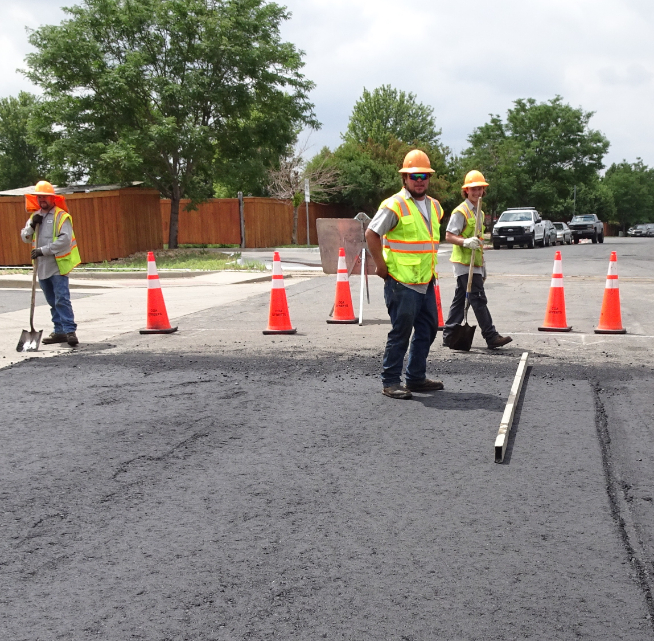
You’ll place the straight edge against the trailing edge of the screed for this check. A sixteenth of an inch of crown in the screed is acceptable/normal. Anything more than that is a problem. These back-to-basics steps are spelled out in detail in the online training course.

Back in the old days, when screed plates were 36 inches wide, we had the lead crown and tail crown to consider. Don’t worry about multiple readings now that the typical screed plate is only 18 inches.

Once you’re ready to pave, you may be starting the project with a takeoff pad. You can read the article “Get Basics Right for Top Quality Overall” on TheAsphaltPro.com about how to build one of those in a parking lot scenario.

As the paver operator paves forward, one of the laborers needs to place the straight edge on the mat to check the fluff factor. He will place the straight edge parallel to the longitudinal joint, behind the left side of the screed first. This initial 8- or 12-foot section will let you see if there’s a dip or a bump in the mat where the screed may have settled when you took off. If you see a dip or bump, you know to adjust your angle of attack.

Read the article “Check the Angle of Attack” on TheAsphaltPro.com for a primer on that.

When you place the straight edge parallel to the long joint, you can see where any dips or rises in the mat might affect the smoothness of the ride down the travel lane.

After checking this section of the mat for quality, the laborer will move the straight edge to parallel to the longitudinal joint, but behind the right screed plate. You want to check both sides of the mat because both depth cranks are controlled independently; if one has more height in it than the other, you could have different results happening on the right and left sides of the mat.

Another element to watch out for when taking off is the beginning-of-load segregation seen in the picture in this article. The area of segregation occurred because the crew ran out of mix in the hopper when they sat down. They moved the material to the auger while the paver was stationary. You can end up with a full auger section, but an empty hopper, if you run the augers while the paver is sitting and waiting for trucks. When the next truck arrives and charges the hopper, you introduce new, hot mix to the system. The material at the auger chamber is one temperature and one consistency. It’s not homogenized with the new material coming in. You’re introducing beginning-of-load segregation, which will show up in the mat.
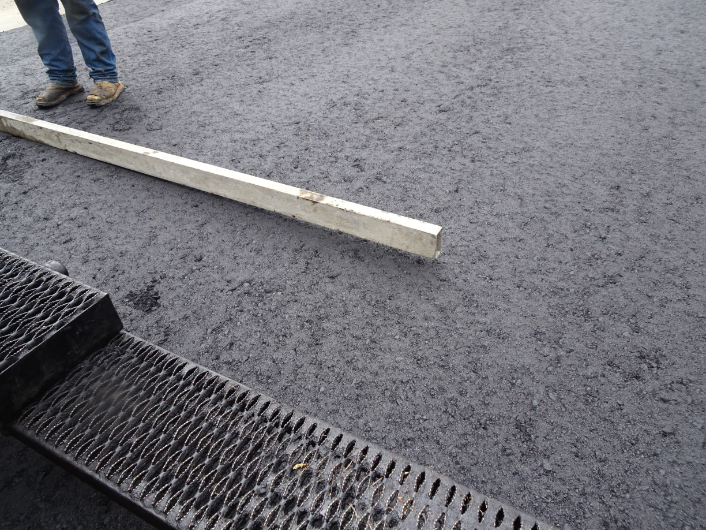
Avoid beginning-of-load segregation by waiting for the truck to back into position and to charge the hopper as you simultaneously move material with the feed conveyors to the auger chamber.

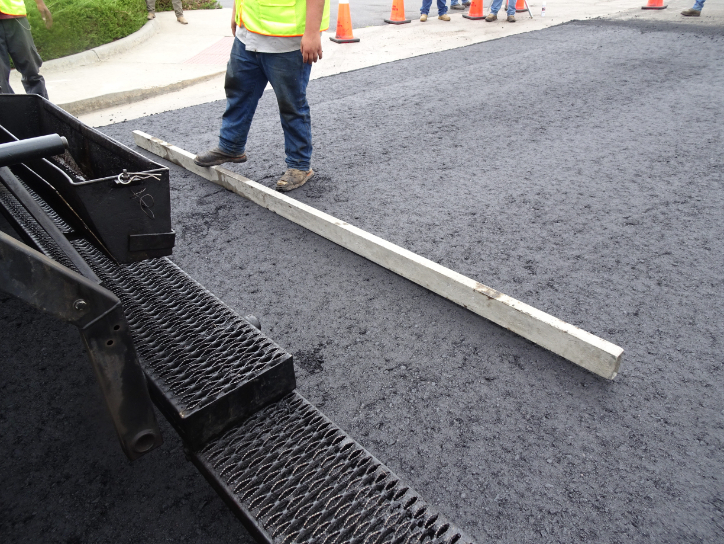
Depending on the type of project, you may want a crown in the mat or a hint of slope to drain toward the shoulder or so on. In the picture, the straight edge shows that the crew has about a quarter-inch of crown in the mat. This means there’s slope in the extension. This crew is paving the first 15-foot-wide binder course pass of a 30-foot road.

A closer look at the end of the straight edge shows how far it is off the mat. Use a ruler to measure this distance and double-check your slope settings. Here we can see that we have about half an inch of discrepancy. If we didn’t want the crown in the mat, we would need to adjust the match height down the quarter inch on that side, bringing the extension level with the main screed plate.

When we look more closely at the space under the straight edge, we can see that we have about half an inch of discrepancy. If we didn’t want the crown in the mat, we would need to adjust the match height down the quarter inch on that side, bringing the extension level with the main screed plate. By balancing the screed all the way across, we would remove the slope. We double-check our success with the metal straight edge.

If you receive the Monday morning toolbox tips from AsphaltPro, then you know about having a wooden 2 by 4 on the paving project for supporting the uncompacted edge and other best practices. For QC/QA checks, you want your straight edge to be steel, not wood or string between a couple stakes. The metal straight edge is less likely to warp from moisture and heat than a lumber 2 by 4; it also won’t stretch the way string will. That means the metal straight edge will stay useful for checking quality.

Sign up for the Monday morning toolbox tip email here.


John Ball is the proprietor of Top Quality Paving & Training, Manchester, New Hampshire. He provides personal, on-site paving consulting services around the United States and into Canada. For more information, contact him at (603) 493-1458 or tqpaving@yahoo.com.