
PPE Must Fit Properly (Or Else)
BY AsphaltPro Staff
Ensure PPE fits workers properly this construction season or face OSHA fines
As of Jan. 13, 2025, when most of the asphalt industry was performing winter equipment maintenance, a new Occupational Safety and Health Administration (OSHA) final rule went into effect. In layman’s terms, the rule mandates anyone required to wear personal protective equipment (PPE) during construction work must be wearing PPE that fits properly. This is a revision to the PPE standard for construction—29 CFR 1926.95(c)—and explicitly requires the equipment to fit any construction worker who needs to employ it.
The press release dated Dec. 11, 2024, states, “Many types of personal protective equipment must be sized to fit a worker properly. Improperly sized PPE can be ineffective in protecting workers; create new hazards for the worker, such as oversized gloves or protective clothing being caught in machinery; and discourage use because of discomfort or poor fit. The matter has been a longstanding industry safety concern, particularly among some women as well as among physically smaller or larger workers.”
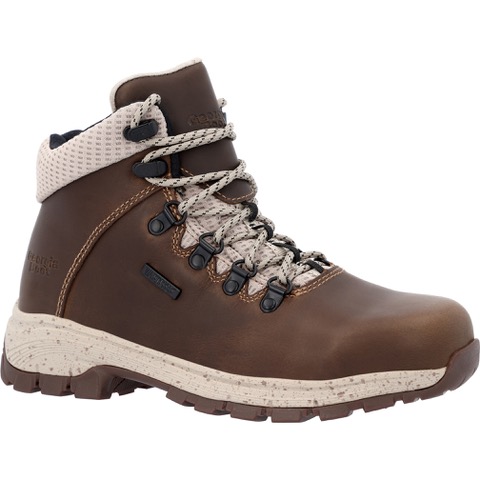
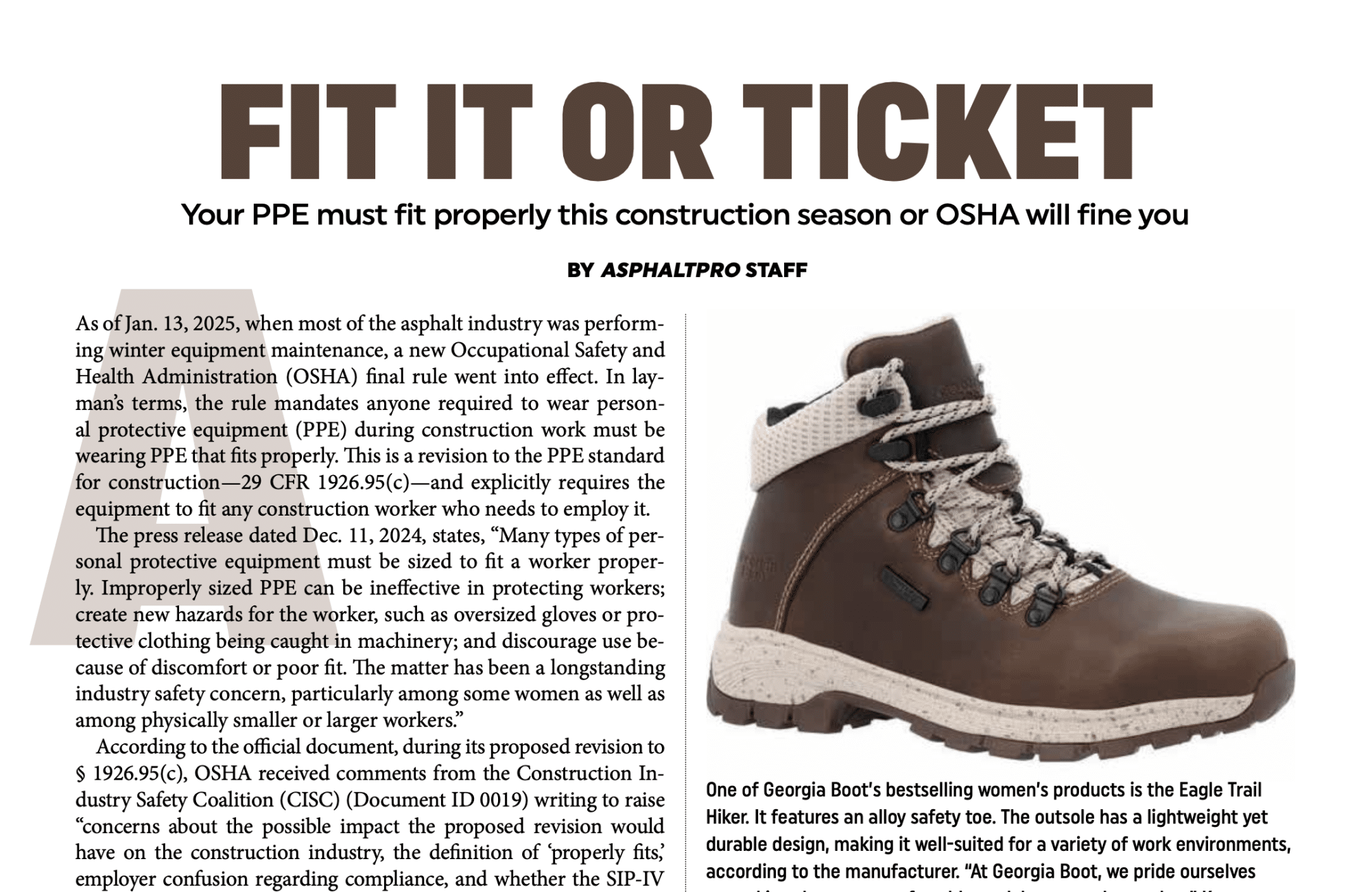
One of Georgia Boot’s bestselling women’s products is the Eagle Trail Hiker. It features an alloy safety toe. The outsole has a lightweight yet durable design, making it well-suited for a variety of work environments, according to the manufacturer. “At Georgia Boot, we pride ourselves on making the most comfortable work boots on the market,” Kasey LaCourse said. “We design each boot with comfort features like cushioned footbeds and different midsole technologies that absorb shock and reduce foot fatigue. Our women’s work boots fit the female foot better, offering improved arch support and a comfortable fit.”
According to the official document, during its proposed revision to § 1926.95(c), OSHA received comments from the Construction Industry Safety Coalition (CISC) (Document ID 0019) writing to raise “concerns about the possible impact the proposed revision would have on the construction industry, the definition of ‘properly fits,’ employer confusion regarding compliance, and whether the SIP-IV rulemaking was the appropriate means to revise the standard.”
AsphaltPro would like to focus on the concept OSHA spelled out, from CISC’s concerns, thus: “[t]he proposed revision does not simply clarify the standard, but ‘opens up construction employers to subjective standards of whether particular PPE fits properly and what steps employers must take to ensure that such PPE fits properly, particularly when most PPE does not come in exact sizing for employees’ (Document ID 0019). They added that, in many cases, whether PPE properly fits is subjective, and it would be difficult for employers in construction to assess PPE for many employees of varying sizes in every situation.”
One of the hallmarks of the asphalt industry, and the construction industry in general, is its innovative nature. In the asphalt community, original equipment manufacturers (OEMs) have worked side by side with contractors, associations and agencies to develop fume extraction and dust abatement devices ahead of safety regulations in the past
Anyone can see the common sense in ensuring a fall protection harness fits a worker properly, as an ill-fitting one could cause as much harm as no protection at all in the event of a slip or fall. Handing oversized work gloves to an employee who will be working near moving components could result in snagged fabric and ensuing damage to fingers or worse. Thus, accommodating differently sized workers with appropriate PPE shouldn’t be seen as a heavy lift but ensuring safety directors and other management know where to find it, how to distribute it to workers and so on, could be seen as problematic in an industry spread across an entire continent.
J. Keller and Juno Jones Collaborate to Provide Safety Footwear for Women in Construction
In addition to asking basic questions of local safety product suppliers, you could make this a topic of discussion at your next state asphalt pavement association (SAPA) meeting or lunch-and-learn program. Brainstorm resources with others who have found competitive pricing for the volume of safety devices you need. Think outside the box on what “properly fit” might mean for your team.
For example, in the Safety Spotlight column in our February issue, we shared the award-winning programs Granite Construction, Watsonville, California, has instituted for its teams, and spelled out how they moved from using hard hats to helmets with a focus on fit and comfort. Check out the article “7 Habits of Highly Effective Safety Leadership” from the February 2025 issue.
The focus on fit and comfort is not only important for ensuring PPE can do its job but is also important for ensuring the worker uses it. Kasey LaCourse, the senior director of product development for Georgia Boot, said, “When work boots are comfortable, they promote consistent wear, which ensures that the boots provide the protection they are meant to offer.”
LaCourse provided: “All Georgia Boots in our product offering that feature a safety toe comply with OSHA regulations for impact and compression protection. Georgia Boot offers a variety of safety toe styles, including composite, steel and alloy options. Regardless of the material used for the toe, all of these boots meet the ASTM F2413 protective toe classification and the ASTM F2413 electrical hazard standard.”
From head to toe, getting the PPE sized properly for the worker is the first step in ensuring the worker uses it and complies with the new OSHA rule revision.