
Rethinking Aggregate Performance for Long-Term Friction Safety After One Million Cycles
BY Phil Blankenship, PE, and Zack McKay
BATT’s groundbreaking million-cycle test sheds new light on aggregate performance for friction safety
In early 2024, the asphalt specialists at the Blankenship Asphalt Tech and Training Laboratory (BATT Lab) in Richmond, Kentucky, set out to challenge a long-standing assumption: that only dolomitic limestone aggregates can provide durable surface friction under traffic when compared to Kentucky aggregates containing silica and other hard minerals. Under the direction of Phil Blankenship, PE, MSCE, and led by Lab Operations Manager Zack McKay, BATT conducted what we believe is the first known one-million-cycle aggregate polishing test using the three-wheel polishing device (TWPD).
Historically, Kentucky’s reliance on limestone has been based on legacy data from quarry ledges, correlated with skid numbers obtained through locked-wheel or sideway-force coefficient routine investigation machine (SCRIM) testing. An open question is whether alternative Kentucky aggregates can also provide adequate long-term friction performance.
Bluegrass Testing Laboratory Focuses on Asphalt Mix Designs, Binder and Aggregate Testing
Traditionally, answering this question required constructing a highway test section and waiting 5-10 years for natural polishing under approximately 8-10 million vehicle passes. To accelerate the evaluation, three-wheel polishing (TWP), combined with dynamic friction testing (DFT), offers a promising laboratory approach.
Research from the National Center for Asphalt Technology (NCAT) suggests 100,000 to 150,000 TWPD passes may approximate typical traffic exposure, since the test is always conducted wet (a worst-case condition) with a contact pressure of 87 psi per tire—equivalent to a semi-truck tire footprint—multiplied by three tires. Still, caution is essential when applying this benchmark. If the polishing requirement is underestimated, an aggregate may appear acceptable in the lab yet lose friction prematurely in service. Unlike pavement cracking, which can often be managed, inadequate surface friction is a direct safety hazard. Because little work has been done to calibrate this method, BATT undertook a study to refine the approach while assisting a local aggregate producer and quarry operator.
Can alternative aggregates also provide adequate long-term friction performance? The million cycle TWPD test recently performed at the Blankenship Asphalt Tech and Training Laboratory (BATT Lab) in Richmond, Kentucky, offers answers.
The Million-Cycle Approach to Aggregate Wear
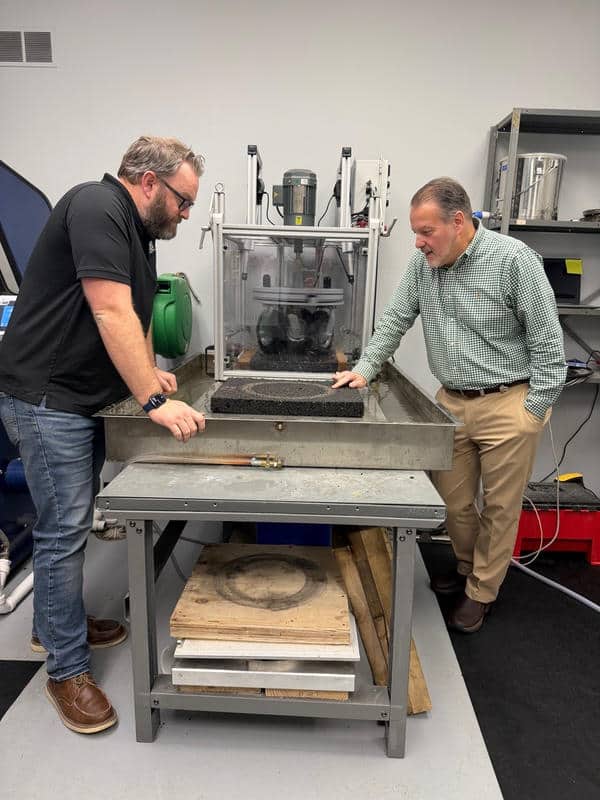
BATT’s Million Cycle TWPD test ran 24/7 for three months, requiring 270 hours of machine time and duplicate slabs to reduce variability and improve confidence in the results. Many DFT measures were made throughout the 1 million cycles pausing at 25,000, 75,000, 150,000, 200,000 and then every 100,000 thereafter to understand the effect of the extended polishing.
What the test revealed was striking: Even some of the best dolomite limestone surface declined over time, while the silica-based materials continued to resist polishing under extended loading. These findings challenge long-standing assumptions about aggregate wear and open the door to new thinking that could improve asphalt mix designs for long-term friction performance and durability.
While the silica-based material did not start with the higher friction values of the dolomite limestone, it maintained the friction longer than the limestone. This doesn’t mean that dolomite limestone is not well suited for high-traffic roads. Rather, it means that we should be able to use the silica-based aggregate or any aggregate combination as defined in the DFT where the polishing slope is flatter (changing less with continuous polishing) and thus maintaining friction.
The purpose of this extended testing was to validate assumptions and assist research into accelerated lab testing to certify aggregate mixes based on lab properties instead of waiting years to see aggregate wear in roadways. The main goal is always to improve the safety of asphalt pavements.

From left, McKay and Blankenship stand beside the Humboldt TWPD after completing an unprecedented one million cycle test.
Beyond Rutting: A New Role for Aggregate Testing
While traditional tests like the Hamburg wheel track test focus on rutting and moisture damage, they stop short of evaluating aggregate polishing, which is a key contributor to loss of friction and skid resistance over time. That’s what makes the million cycle TWPD test that BATT conducted so significant. It pushed well beyond conventional testing windows that simulate aggregates’ long-term surface wear under real-world traffic conditions.
NCAT’s Nathan Moore shared that there is very little information published on what is a suitable amount of polishing to accurately simulate real-world traffic. Polishing times that are too short can produce results that favor limestone in short-term performance due to not applying enough traffic to simulate field polishing.
But the extended test performed by BATT showed that materials like granite and crushed gravel retain surface texture longer, potentially offering safer, more durable pavement surfaces.
While BATT does not recommend that million-cycle polishing be used in everyday testing, the experiment proved useful in taking these mixes to the limit. One-million-cycle polishing can lead to other issues such as stripping of the mix, which can cause variability in friction results, changing the microtexture of the pavemet. However, the stripping and friction loss we observed are real-world effects.
Locally Sourced Aggregates and the Case for Re-Evaluation
Limestone’s dominance in asphalt mixes isn’t solely based on lab test performance. It’s widely available, especially across the Midwest, making it a locally sourced, cost-effective option. It’s also easier to crush and tends to meet moisture susceptibility, stability and gradation requirements with less processing. Combined with agency specs written around its characteristics, these advantages have made limestone the go-to aggregate, even when harder aggregates may outperform it over time.
Aggregate is one of the costliest materials to transport in highway construction and hauling it long distances adds both financial and environmental burdens. If a polish-resistant aggregate is available closer to the project site, it can reduce costs, lower carbon impact and simplify logistics.
This raises an important consideration: some local materials may not currently be “approved,” yet they could still provide excellent long-term skid resistance if properly evaluated. BATT’s million-cycle polishing testing raises important questions:
- Is it time to rethink aggregate acceptance criteria based solely on acid insolubility residue, and consider TWP and DFT as additional mix design tools?
- Should we place greater priority on polish-resistant local materials that may deliver longer-lasting friction, reduced maintenance costs, and improved roadway safety?
KYTC: Leading the Way in Friction Safety Research
BATT’s work aligns closely with an ongoing research initiative by the Kentucky Transportation Center (KTC) and funded by the Kentucky Transportation Cabinet (KYTC) to improve pavement friction and reduce roadway fatalities.
In 2021, KYTC/KTC launched a project focused on integrating friction testing into BMD. Track sections at NCAT (S7A and S7B) were designed to test medium- and high-friction mixes while validating both the TWP and the DFT. The project aims to correlate lab-measured friction values and polishing cycles to real-world traffic performance and build them into performance-based specifications alongside rutting and cracking resistance.
These tests strive to make friction a core design criterion, not just a performance afterthought—a goal that aligns directly with the implications of BATT’s million cycle TWPD that pushes the limits of the test.
Polishing the Asphalt Surface: Tennessee Researches Aggregate Frictional Properties
Limestone’s Earlier Polishing Calls for Smarter, Safer Designs
The KYTC study also highlights a key geographic concern: sedimentary limestone is widely used in the Midwestern states like Kentucky, Missouri, Indiana, Ohio, etc., where it polishes more quickly under traffic. In contrast, more eastern states often use granite or other hard materials that are more durable under traffic.
The combination of soft aggregates and high traffic volumes makes friction loss more likely in these regions. That’s why designing asphalt mixes that better resist polishing over time is essential. This also has implications for how reclaimed asphalt pavement (RAP) is classified and incorporated, since most modern mixes contain reclaimed materials. These findings highlight the increasing focus on the importance of BMD and other performance testing methods—especially when using RAP, additives and regionally available aggregates—to ensure long-term safety and sustainability.
The one-million-cycle polishing test performed by BATT is more than a research milestone. If these findings are validated in further studies, they may spark a shift in how friction, polishing and long-term durability are considered in asphalt mix design.
With BATT, KYTC, NCAT and others leading the way, the future of asphalt design is moving toward data-driven, safety-focused solutions, where smart testing and long-term thinking determine which materials make it from lab to pavement.
Phil Blankenship, PE, is the president of the Blankenship Asphalt Tech and Training Laboratory (BATT Lab) and Zack McKay is the lab operations manager.