
Maui Paving Recycles 100% on Haleakalā Highway Reconstruction
BY Sandy Lender

Maui Paving offered an asphalt update for the island’s Haleakalā Highway
Maui Paving, a joint venture formed by Goodfellow Brothers and Grace Pacific, recently completed the reconstruction of Haleakalā Highway for the Hawaii Department of Transportation (HDOT) ahead of schedule. Tyrone Pullman, foreman and construction manager for Maui Paving, shared in a video interview this highway is one of the biggest on the island. It connects the densely populated valley with the surrounding rural areas.
The team from Maui Paving removed and replaced 4.2 miles of divided highway at a depth of 8 inches. They used two Wirtgen milling machines—a W 210 Fi and a W 200 Fi—as well as a SUPER 2000-3i paver from Vögele among other equipment on the project.
“It is the demolition of 4 inches of ultra-thin white top and 4 inches of asphalt treated base, and then placing back 6 inches of asphalt treated base and 2 inches of Mix IV,” said Zack Gonzales, general manager of Maui Paving.
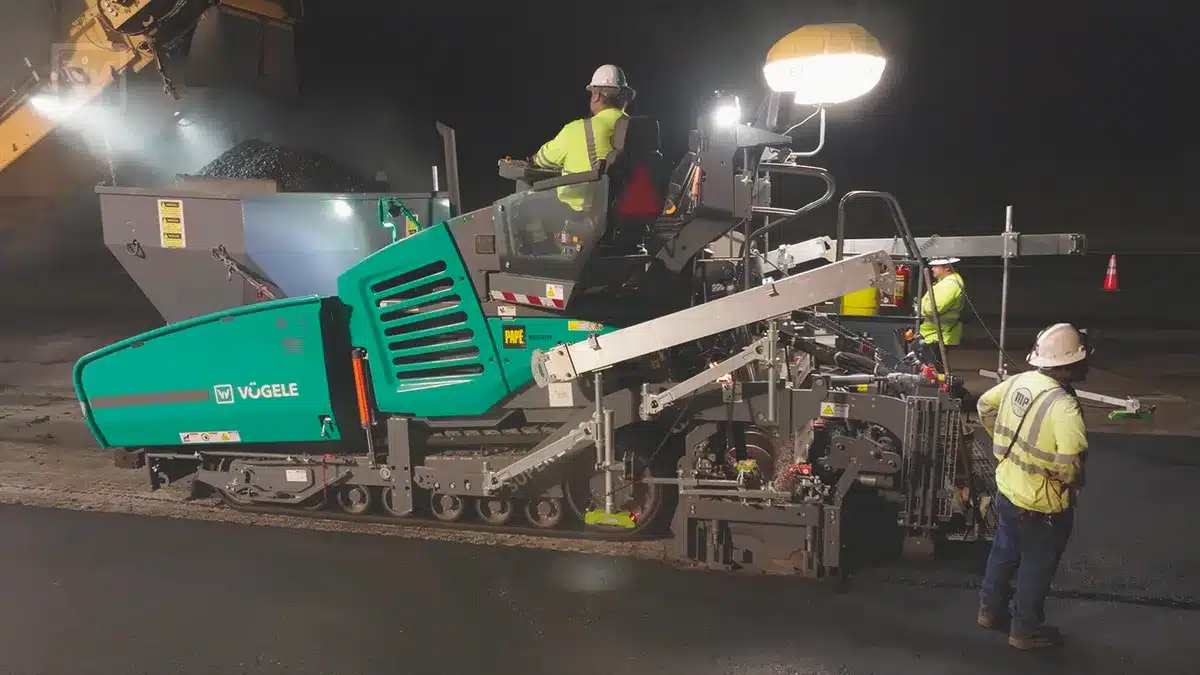
The SUPER 2000-3i highway class paver from Vögele with an engine rated output of 186 kW (250 hp), in combination with the VF 600 paving screed, was used to place the PMA with 20% RAP in lifts of 6 and 2 inches.
Gonzales shared in a video interview that the plan was originally to cut up and remove those sections with an excavator, but Maui Paving had a better idea. It was more sustainable to mill the highway and recycle all that material. And with the Wirtgen cold planers, they were able to mill the full depth in one pass.
“It’s a hundred percent recyclable,” Gonzales shared. “We’re recycling the material that we’re demoing out and then also our asphalt that we’re placing also includes 20% RAP, which is a recycled asphalt pavement as well.”
Members of the DOT provided the details, with Brandon H. Hee, the Geotechnical and Pavement Design and Shoreline Section Head for the DOT, explaining the 16-year-old pavement’s condition prior to project start. Hee shared that the 4 inches of ultra-thin white topping (UTW) placed in 2008 over the existing 3 to 5.5 inches of ACB placed in the 1970s was failing. “The failure appeared to extend into the underlying ACB, and this is why the cold-planing was done to 8 inches deep,” Hee explained.
“The highway had a Pavement Quality Index (PQI) of 78. “78 is rated at fair and would be in the range of warranting minor rehabilitation.”— Kyle Suzuki, P.E.
Kyle Suzuki, P.E., of HDOT Highway Division, explained the department doesn’t use pavement condition indices (PCI) to assess structures. “We use internal indices to characterize pavement condition and performance. The closest index to the PCI is HDOT’s Pavement Quality Index (PQI), which this road had a score of 78 out of 100. 78 is rated at fair and would be in the range of warranting minor rehabilitation.” He also shared the pavement had an average IRI (MRI) of 163 in/mi as measured on Jan. 19, 2023.
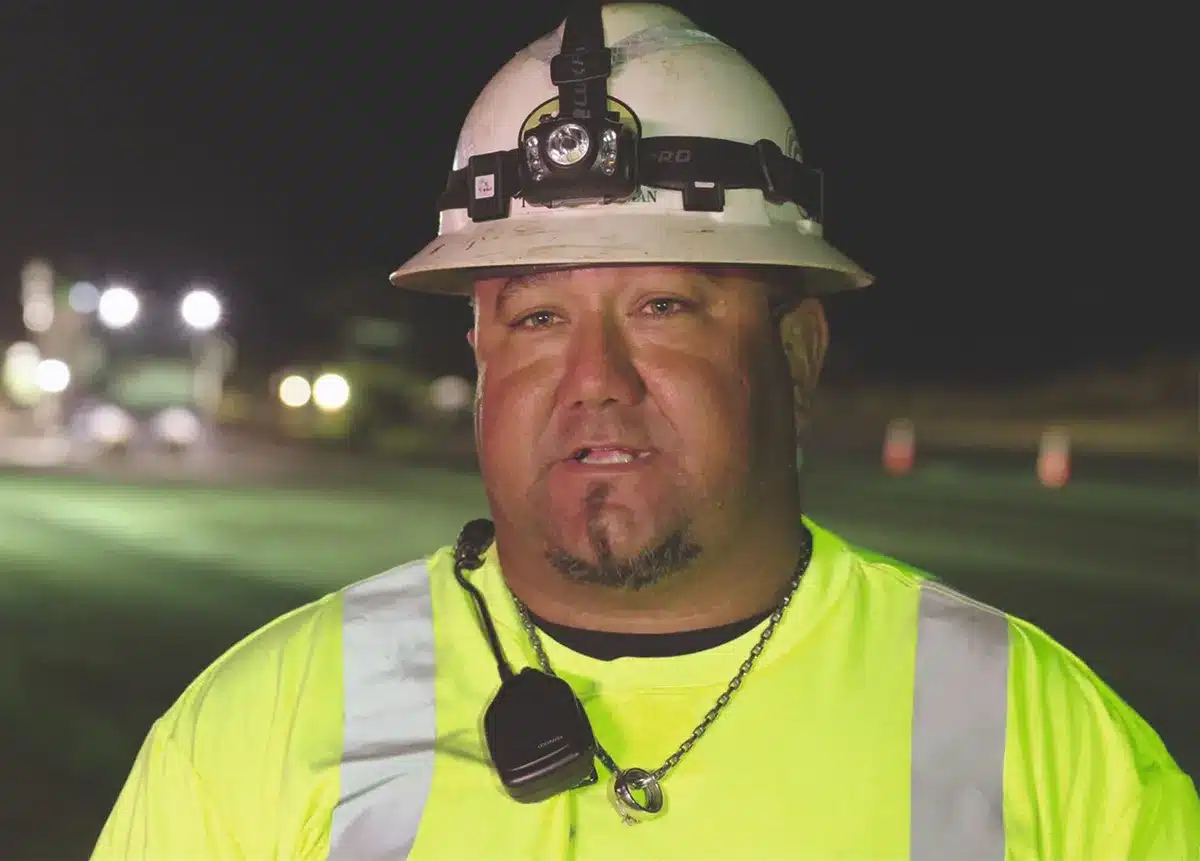
Tyrone Pullman, foreman and construction manager for Maui Paving, shared details of the projects progress and the crew’s experience with the new equipment.
To replace the pavement, the Maui crew used the Vogele Super 2000-3i to pave a 2-inch polymer-modified asphalt (PMA) Mix IV over a 6-inch ACB with polymer, Hee explained. “We use the SBS polymer.”
Kristi Grilho, Bituminous Engineer for HDOT, discussed the mixes in more detail. “Mix IV is a ½-inch dense-graded mix. Both ACB (also called Hot Mix Asphalt Base Course (HMAB)) and Mix IV used PG64E-22 asphalt binder. From mix design submittals, both used 20% RAP. HDOT doesn’t require additives or other accommodations for RAP percentage allowed (up to 20% for surface, and 40% for HMAB (drum plant).”
New Equipment on Maui
Wirtgen Group reported: The deployment of this paver was a première on the Hawaiian island of Maui. To enable Maui Paving’s personnel to exploit the full potential of the machines, they all received appropriate training from Wirtgen America before the start of the project. The familiarization of the crew with the machines went off without a hitch for everyone, from the mechanic to the operating personnel on the site.
All three machines deployed on the project [paver and two cold planers] impressed the construction crew with powerful performance, precision and low noise levels.
“The transition to the Wirtgen milling machines has been so smooth and seamless, not only due to their efficiency, but also to the fast delivery of parts by Pape, (the local John Deere/Wirtgen Group dealer) and the training provided by the Wirtgen Group,” reported Zack Gonzales, general manager of Maui Paving.