How to Mill to Get Compaction, Full Pay

Pass deducts to the milling crew when they don’t prepare a true surface

In today’s pavement maintenance environment, I think we should charge costly overruns to the milling subcontractor when the milling crew leaves the paving crew with a mess to pave over and get density on. Let me explain why.

If you are on the cold planer, you have an important responsibility that can make or break the whole project. You are creating a new surface that the crew will pave a specific number of square yards on. If you’ve milled incorrectly or created gouges, high spots, delamination and other problems for the paver to correct, you’ve made it hard to get smoothness and yield. The material overrun and potential deducts from the owner/agency aren’t the paving crew’s fault; they’re your fault for failing to get grade, slope and a true surface for paving and compaction.

Here are some tips for milling a surface that makes smoothness and full pay possible.

In the 2023 article “Maximize Milling with These Best Practices,” with Wirtgen’s Tom Chastain, The Asphalt Pro talked about company and crew communication, getting the right size of machine on the project, operating in the right pattern mode for the job, using the right drum for the material you’re milling, learning how your grade technology works and how to set it, knowing how different tooth/pick options affect the material you’re working with, starting/stopping, safety, and the all-important speed.

Quick Tip: Don’t try to use a micro mill drum on recycled asphalt pavement. If you do, 10-12% of the material will be turned into dust when you hit it with 1,100 teeth.

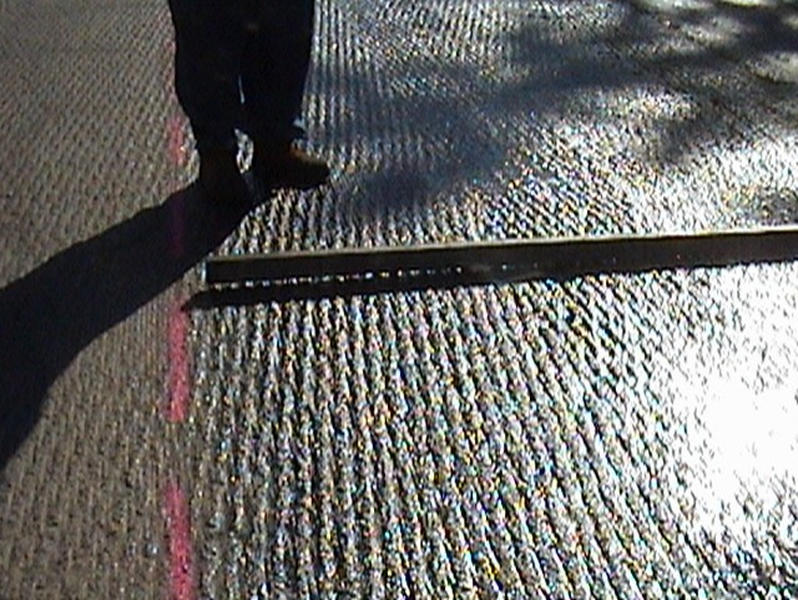
Every milling crew should have a straight edge and should be taking the time to double-check their work. If you’re seeing gaps under the edge where the surface should be flat, something needs to be corrected. In this picture, the light under the straight edge shows where too much depth has been removed along the centerline of the pavement. If there was going to be a crown in this road, the high spot would be along the red center line, where the worker’s feet are. Instead, we can see that the two 6-foot passes with the mill were cutting for depth, but the crew didn’t check to ensure the passes matched up.

Faster Isn’t Better

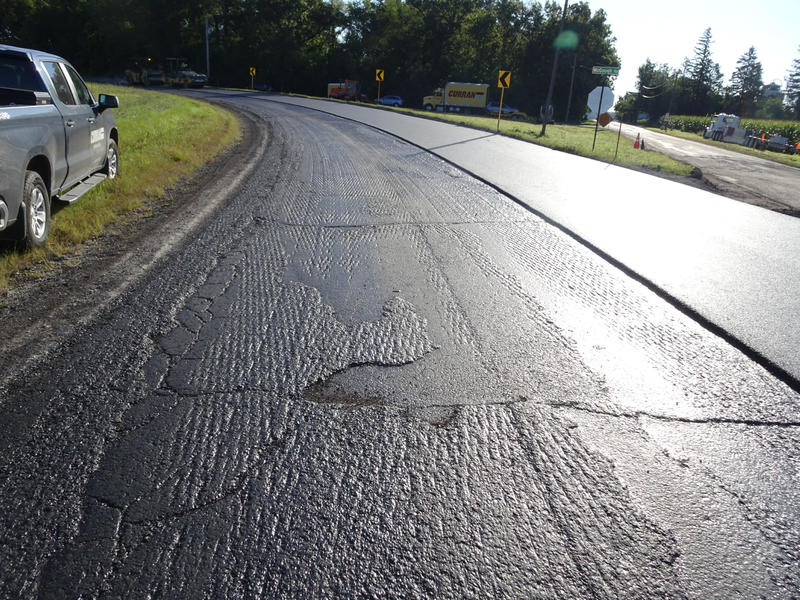
Let’s start here by talking about speed. You cannot mill 100 feet per minute (fpm) and expect to be smooth. The cutter drum will skip down the lane when you’re going too fast. Instead of milling the product, it gouges, tears and rips, making the cut irritated. In the picture above, you can see delamination left behind by a milling crew that was subcontracted for a road in Illinois. The skipping of the drum caused this.

Instead, the crew should have gone at 60 fpm. You’ll see “60 fpm” listed as an average speed for milling, and you’ll want to set your sweet spot based on many variables, such as:

  • the type and size of drum you’re using
  • the depth you’re required to mill
  • the type/hardness of material you’re milling
  • the condition of the subgrade
  • the type of project
  • and other considerations.

How to Mill With Less Dust

Depth Settings

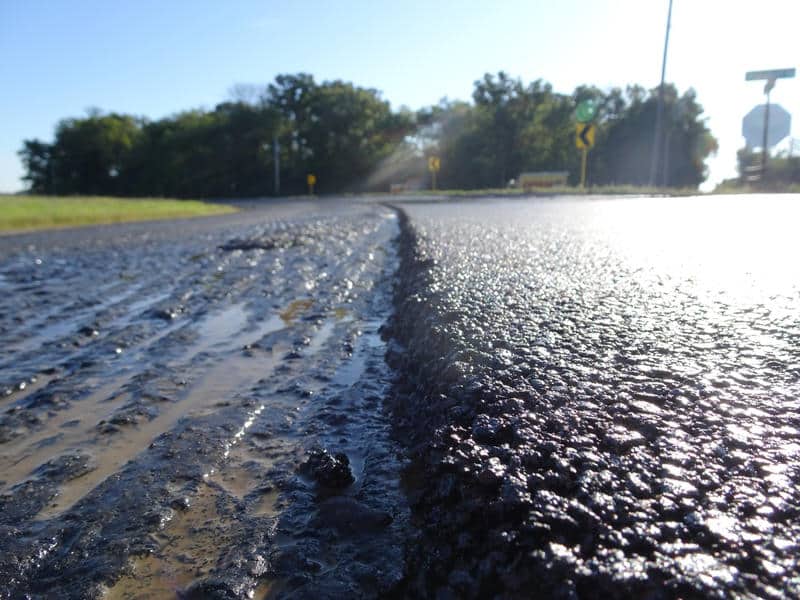
Another best practice is to keep an eye on your depth, whether you’re running manually or using grade and slope with the ski. When you mill, you’re profiling the pavement. For the example in the top picture, the mill needed to remove 2 inches so our crew could lay 2 inches of asphalt down on top of it. The mill was taking out 2 inches on the left and acquiring 2% slope on the right. (Caution: On the slope side, you may not get 2 inches; it depends on the subgrade.) They made two passes to accomplish the full lane—one lane was grade and one lane was grade plus slope.

Remember, the goal is smoothness. On the left side of the picture where we see the shoulder of the road crumbling, that’s where the subgrade has given way. The road has broken off because removing 2 inches was removing too much. The mill operator should have come up a quarter of an inch, and he wouldn’t have left this problem for our paving crew to solve. If he’d come up a quarter or half an inch, we would have a truer surface for our crew to pave on.

Tack collects in the gouges of a poorly milled surface.

Milling for the Screed

If you have a 12-foot lane to mill 2 inches deep, the first 6-foot pass you mill is along the joint so that you can establish your depth and grade. The next 6-foot pass includes the soft shoulder; why not take out 1.5 inches instead of 2, and leave a truer surface? The milling guys have got to take another look at what they’re doing and how they do it. This is where a straight edge is vital for QC/QA.

With the soft subgrade giving way in the top example, the surface isn’t uniform for the paver. This causes a rise in the road, where the screed will drag. Depending on the nominal maximum aggregate size in the mix, you could be setting the roller operators up to fracture the material in the middle of the mat.

How to Maintain Your Milling Machine

Haul Millings Correctly

Most mill-and-fill projects will see the haul truck receive millings, drive those millings to the plant, dump them at a designated area, load with mix for the job, and return to the job to charge the hopper. There are some additional steps the haul truck driver needs to take to ensure the milling fines (the number 200s) don’t contaminate subsequent loads and mar the mat.

Here’s the problem: Not all truck drivers take the time to clean out the bed after dumping the millings. This leaves stray millings and dust from the fines melted to the truck bed, which was still hot from unloading HMA. When he drives under the silo gates, new HMA loads on top of cooled chunks and fines. When he delivers mix to the paver, those 200s look like dust on top of the new mat we’re paving.

Here’s the solution: When the truck drivers get to the plant, have a designated wash-out area and release agent spray station before the loadout scales. For a project in Alabama, we introduced a backhoe to scrape out the bed, ensuring the melted fines and millings were all cleaned out before the truck went under the release agent spray station. It’s just not feasible to let a truck sit at a cleanout area on the side of the road, cooling for 30 minutes before getting in front of a milling machine, so the next best thing is to engineer quality control at the plant.

Maximize Milling with these Best Practices

Get Paid

The milling crew gets paid by the square yard. They think they can get more money by going faster and getting more square yards done. They beat the estimate by going fast, then they’re off to the next job. Because of the way they ripped and tore and delaminated the pavement, they left the paving crew without a true surface. This type of poor milling job ends up costing the paving crew in material overruns and poor density results across the mat.

When the smoothness numbers come back as unsatisfactory because the depth is irregular, the deducts get billed to the paving contractor. But it’s time those deducts get charged back to the milling company for not leaving a true surface. If he has to, the paving contractor should run a profilograph on the milled surface to prove how bad it is. By sharing the cost of deducts and penalties among the guilty parties, we should be able to increase the care and attention of the workmanship we want to see in the milling subcontractors out there.

I’ve not seen anyone challenging the milling subcontractors to adhere to best practices. But we need all milling companies to care. We need them to take the time to do a better job of providing a true surface for paving. Milling subcontractors need to follow best practices, not only to prevent material overruns and embarrassing deducts from inspectors, but also to provide the end user with a top quality pavement that lasts.

John Ball is the proprietor of Top Quality Paving & Training, Manchester, New Hampshire. For more information, contact him at (603) 493-1458 or tqpaving@yahoo.com.

GPS Performs on Runway Project

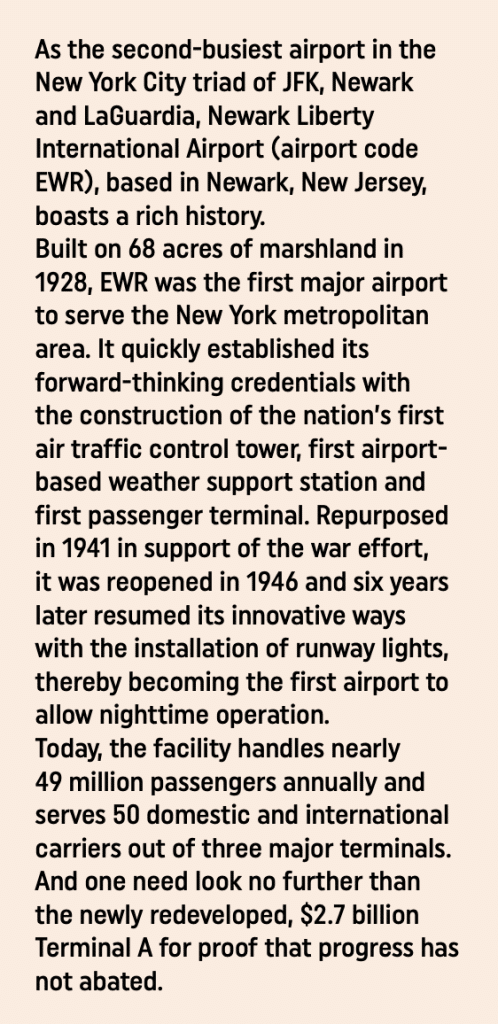
Using enhanced GPS-based milling technology, The Crisdel Group completes Newark runway project 20% early

When an aviation crisis at Newark Liberty International Airport reared its head in the spring of 2025, travel into and out of the nation’s busiest airline corridor was severely impacted. Issues with air traffic control staffing and electronic systems was compounded by an inopportune closing of one of the airport’s runways for reconstruction, resulting in a dramatic spike in flight delays and cancellations, as well as overall safety concerns by the traveling public.

While general contractor The Crisdel Group, in charge of the reconstruction effort, could do nothing about the ATC problem, it certainly could do its part to help alleviate the runway-related scheduling issues. To do so, it used an innovative GPS-based solution for the milling facet of the paving operation, a move that helped the company complete the time-critical project 13 days ahead of schedule.

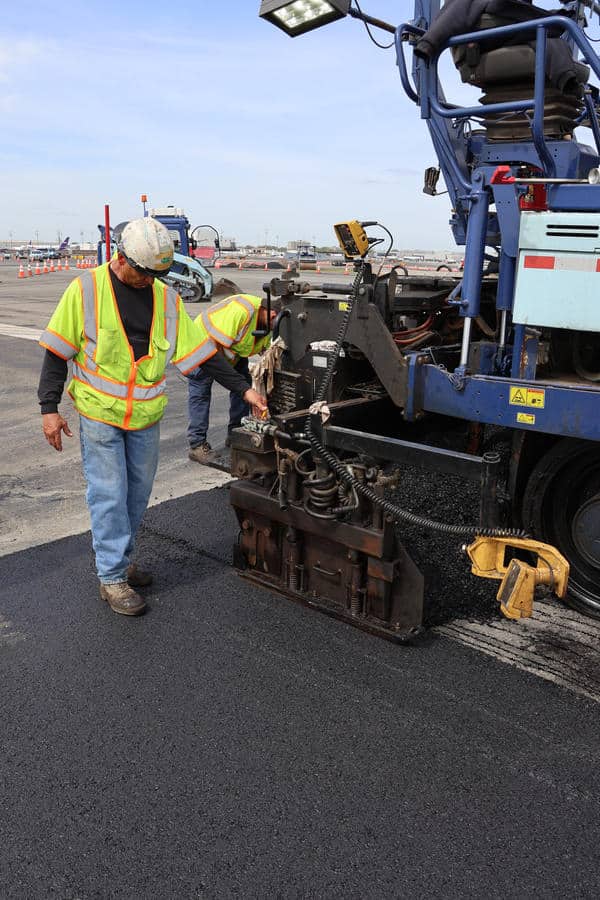
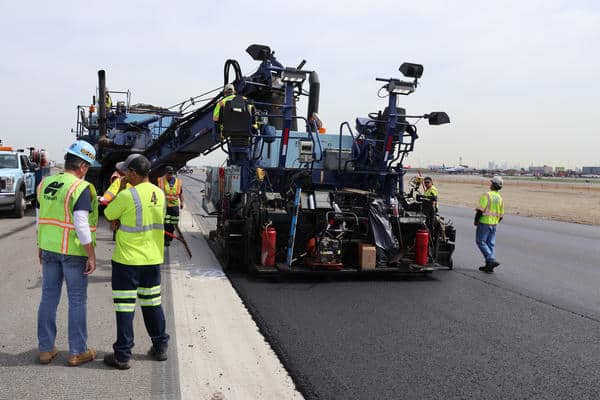
The Crisdel crews milled and paved more than 467,000 square feet of runway and taxiway.

Major Upgrades

On the runway side of things, EWR features two, 11,000-foot, north-south structures (4L and 4R) which undergo regular rehabilitation to ensure smoothness and durability for the roughly 460,000 flights that come in and leave each year. According to Chris Walsh, one of Crisdel’s surveyors, the job, officially known as “Runway 4L-22R Rehab,” included a range of upgrades.

“In addition to milling/paving more than 467,000 square feet of runway and taxiway, there were updates for the edge lights and stop bar lights, airfield signage was converted to LED lighting, and the electrical infrastructure was improved,” he said. “All that work was done by Con El, a local electrical contractor. Preliminary work for us began in March but really took off on April 15 with a 60-day total runway shutdown.”

With runway 4L-22R being EWR’s busiest runway for departing flights, the impact on airport operations was significant, lending added urgency to Crisdel’s already tight schedule. The company looked for the most expeditious way to get the job done and determined that streamlining the milling workflow was the answer.

Put Away the Paint

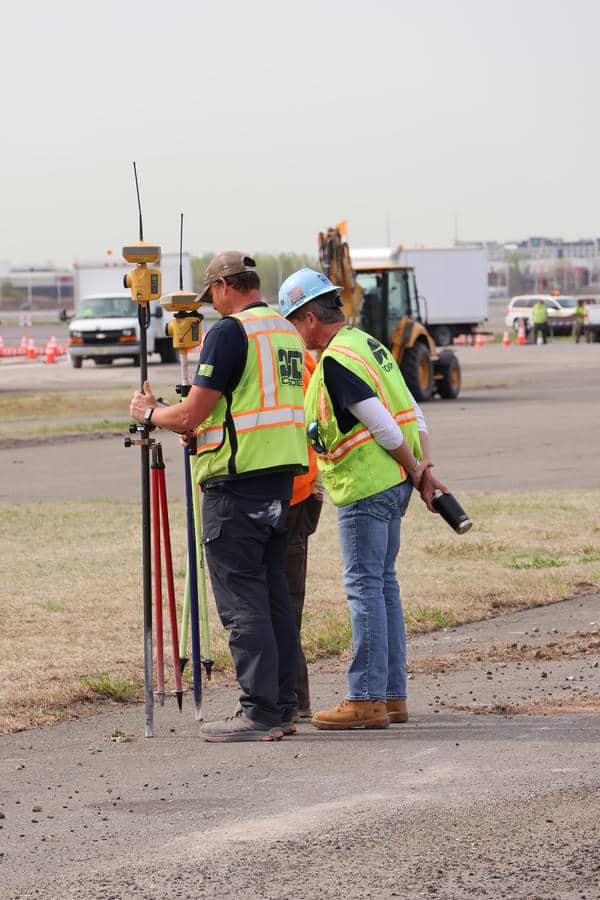
The means to that end, Crisdel found, was Topcon Millimeter GPS, a solution that utilizes a series of laser transmitters to establish a grade control zone, which is acquired by a receiver on the mill. That information is then decoded to establish a precise, millimeter grade, vertical position anywhere on the job site and set the depth of the milling drum accordingly. According to Walsh, it changed the complexion of the project from the outset.

“Without Millimeter GPS, the workflow would have been much different out here,” he said. “We would first have had to go out and, using a rod/data collector, lay out what’s called a ‘grid on grade,’ in which we create a 25-foot grid, then mark each segment of the grid with the proposed milling depth. Obviously, that is a labor-intensive, time-consuming process. Instead, a digital file with all that info was loaded into the control box of the milling machines—we have two mills working out here—and the mill knew the precise depth to cut. It was a huge improvement in productivity, easily shaving several days off the process.”

Crisdel used the 2D paving solution—a P-32 screed control box used in conjunction with sonic trackers—to get required smoothness results.

Jim Cleary, the owner of Cleary Machinery, the area Topcon dealer, said that, while he’s outfitted many customers over the years who used the Millimeter GPS solution, he was impressed by the level of confidence Crisdel placed in it.

“Most customers I’ve worked with—even though they are relying upon the millimeter system—will still paint numbers on the ground,” Cleary said. “Not so for Crisdel. They did all the milling without any paint on the surface. They had complete trust in the system and have been rewarded for it. The accuracies they got early on—100% within ½-inch and 90% within ¼-inch—bear that out.”

S.T. Wooten Wins National Airport Paving Award

A Numbers Game

The FAA-sanctioned specifications for both milling and paving were understandably tight. For the milling facet of the project, Crisdel committed to a “Mill to Provide” of 3 inches. Similar to what is often called variable-depth milling, it essentially means that milling needs to be 3 inches below the determined finished grade.

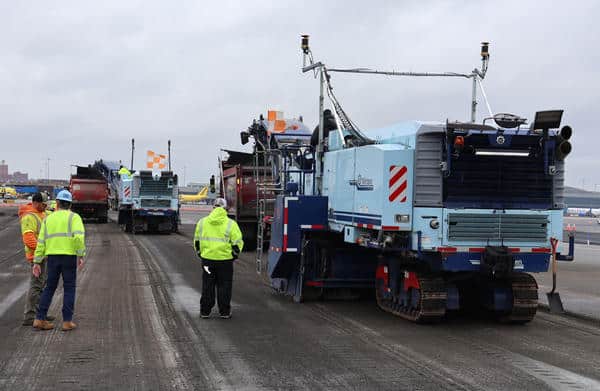
“It is not just a full-on 3-inch run,” Walsh said. “We were provided a TIN file by our survey company, with varying grades from every part the project. We simply told our mills—a pair of Wirtgen W250i units—to cut to -0.25, which is 3 inches below finished grade, and they adjusted. It worked out great; the numbers we got were far better than even The Port Authority specified.”

Compaction at EWR was handled by Crisdel’s fleet of high frequency vibratory tandem rollers.

Collaboration

Perhaps the only thing more constant than solid performance at EWR during the rehab project, was the presence of Cleary. The 30+ year veteran equipment dealer with an extensive history of airport work prides himself on ensuring that his customers have access to his expertise.

“It’s no secret that the Topcon solutions I bring to my customers represent some of the finest equipment in the business,” Cleary said. “But things happen on job sites and when they do, I like to be available to ensure that any impact on my customer and their operation is minimal. So, it sometimes appears as if I’m always on site. In fact, I’ve had customers tell me, ‘It’s almost like you’re part of the crew.’ That, to me, is the highest praise anyone could ask for.”

Crisdel’s Walsh will attest to the value of support they get from Cleary and his team. “Jim is always on point, and if we need something, he’s there,” Walsh said. “It really doesn’t matter: time of day, if he’s in the middle of anything, whatever—he’ll get us the solution or the answer that we need. That’s huge for us.”

Fresh Pavement for Pago Pago

Upgrade is in Order

As alluded to above, Crisdel’s milling success lent itself to excellence in the paving portion of the Runway 4L-22R Rehab. Using a pair of Cat AP-1055E pavers, each equipped with an upgraded paving solution, the company achieved smoothness and solid production rates.

“Shortly before the runway job kicked off, Crisdel was still running an older Topcon paving solution,” Cleary said. “Wanting to take advantage of current technology without investing in an entirely new system and having redundant components, we talked, and I was able to connect them with an upgrade program offered by Topcon. That program allowed them to retain part of their older system while benefiting from Topcon P-32 automation technology—it was a perfect fit.”

Using Topcon Millimeter GPS to improve the overall milling and paving operations saved more than 20% project time.

Crisdel used the 2D paving solution—a P-32 screed control box used in conjunction with sonic trackers—to get the aforementioned required smoothness results. The system’s high-contrast control box shows the screed man the slope and elevation information on one or both sides of the screed, then follows through with fully automatic screed control.

Compaction at EWR was handled by Crisdel’s fleet of high frequency vibratory tandem rollers. Though hampered by a series of rainy days, Crisdel still managed regular production rates of 2,000 tons per paver/per day.

“I attribute a lot of our success here to the outstanding team that put in long days to get the job done as quickly as we did,” Walsh said. “But there’s no denying that the ability to create such an accurate milled surface played a key role as well. This runway was last rehabbed in 2014, so the need for an upgrade was definitely there. We will be leaving them with an excellent product.”


Crisdel used the 2D paving solution—a P-32 screed control box used in conjunction with sonic trackers—to get required smoothness results.

Green Runways

Success in achieving sustainable practices—as they relate to airline travel—is the result of many small efforts. Keeping airport runways and taxiways in peak operating condition is a part of those efforts.

Studies show that aircraft ground operations, taxi/runway movements being one of those, account for nearly 8% of total aircraft emissions, which is several times the amount of all other airport emissions combined.

In addition, when companies like Crisdel use technology like Topcon Millimeter GPS to improve the overall milling/paving operation of a project, less time is spent working on the runway (in this case more than 20% less time) and fewer trucks are needed to haul asphalt in and out, reducing vehicle emissions. And since better application of the asphalt generally yields reduced material volumes, demand on area asphalt plants is also lessened.

Buck Brothers Pushes Tech Advantage

Buck Brothers commits to new technology across its fleet and operations

The Buck family has been involved in asphalt and concrete paving services for the Toledo, Ohio, metropolitan area since 1947. As 5th generation owners of Buck Brothers Asphalt Paving & Concrete, Chad (founder), Jacob and Zach Buck have a solid foundation in asphalt paving and milling tools and techniques as well as a clear understanding about the importance of continuous improvement.

Recently, the company sought to resolve some inefficiencies that had begun to emerge in the firm’s paving practices. For many years, crews relied on manual lasers and an old asphalt paver to achieve grade. However, a diminishing workforce created some real challenges when performing fine grading in the company’s conventional way.

Jacob explained, “We didn’t have graders or dozers at the time, so we would run stone through an old asphalt paver to achieve grade. While it worked, it was difficult to achieve a perfect grade. It became a ‘guess and check’ process that requires considerable skill.”

He knew the company needed to find a better way to fine grade, particularly on larger projects.

“It was either learn machine control or learn to manually operate a grader/dozer. It made more sense to go the machine control route,” he said.

After perfecting the workflow, Jacob Buck trained team members to survey a project and send the data back to Trimble Business Center, where it can be modeled for action.

Technical Transition

In 2023, Jacob reached out to the SITECH® Ohio team, his local Cat® dealer, to get started.

He said, “They initially suggested a laser system, because, at the time, I had no AutoCAD® or 3D experience. I didn’t even know what a data collector was or how to use a total station. But I wanted the full experience.”

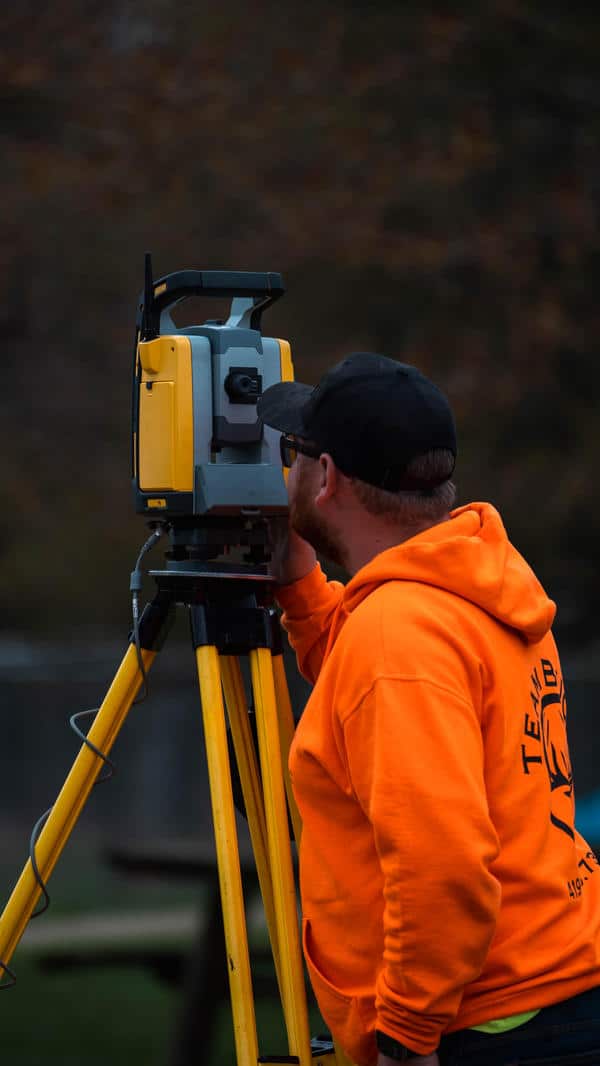
After some discussion, Jacob opted for a Trimble® SPS930 Universal Total Station (UTS) because it’s both a survey and machine control instrument, providing precision measurements (in the 3-mm range). The robotic and reflectorless solution is ideal for capturing field conditions like parking lots with speed and accuracy.

After a quick training session, he immediately put the instrument to work on a job. Jacob surveyed an entire project and then sent the data back to Trimble Business Center, where he modeled it.

“Remember, I went from no 3D experience to creating a full survey and grade model, plus learning machine control,” he said. “The instrument was easy to use but I needed to think more carefully about model development.”

His next step was to connect with Trimble and SITECH specialists as well as Alan Sharp from Rockpile Solutions, an authorized software development and consulting partner for Trimble. Jacob added, “With help from all of them, I was able to get a model built in one day and begin establishing a good surveying and modeling workflow.”

He would spend the next year perfecting that workflow and is now teaching other team members.

NDDOT Trials New Technologies on Hwy 14

Efficient Flow, Paved to Spec

For new construction, Jacob will set up the UTS and survey existing curbs and surrounding surfaces and structures. He explained, “I shoot everything including curbs, drainage, flush surfaces, utility lids, etc. I send that data to Trimble Business Center to be cleaned and modeled. Then, I can establish a grade off of that model.”

That model is then sent to a compact grading machine equipped with the SPS930 UTS for blade control. “The finished surface is always accurate because I’m working directly from as-built conditions, so our drainage, flushes and transitions are all going to be exactly right.”

For a reconstruction, like a mill and overlay, the process is somewhat similar.

Jacob continued, “Before we mill it, I’ll survey the existing lot and then model it in Trimble Business Center, again paying particular attention to drainage.”

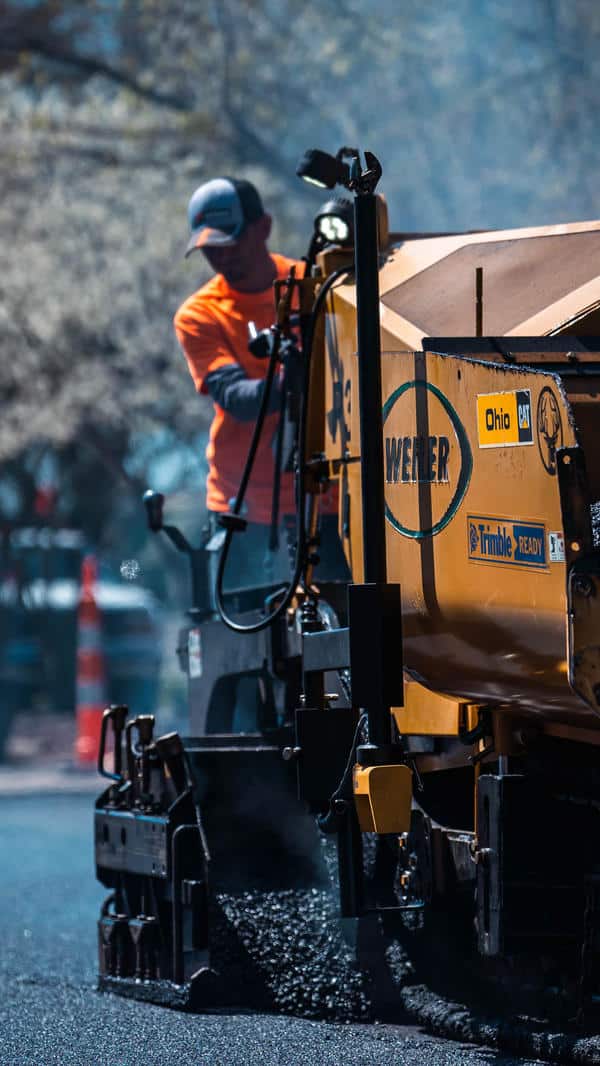
Subsequently, the crew mills with Trimble 3D Roadworks on a Cat PM820 and then paves to depth with Trimble 2D Roadworks on a Weiler P385B asphalt paver with sonics.

Not every job is modeled. Jacob said, “If it’s a sizable job, 25,000 square feet or more, or a more complex job with drainage issues, then I’ll model. There are many times I’ll model seemingly simple driveways, because drainage was not considered in the initial design. We can fix those problems with re-grading.”

In the two short months before the season closed in 2023, Buck Brothers was able to fine grade over 300,000 square feet of stone base before paving. Jacob said, “We literally cut our prep time in half and delivered effective drainage in every situation.”

Those benefits continued in 2024. For instance, Cornerstone Church in Maumee, Ohio, had a 20-year-old parking lot that deteriorated quickly and a number of drainage issues that led to potholes and unsafe conditions. When complete, the Buck Brothers crew had regraded the 100,000-square-foot area to 1/16-inch precision. The curbs and islands were optimized for drainage, and they had created 24-foot drive lanes for improved access and safety.

Another project was a 50,000-square-foot freight yard, which was a unique effort because instead of asphalt, the surface was all stone, and well above grade. Conventional methods would have required the crew mill and pave multiple times to achieve the desired thickness. Jacob recalled, “I knew we needed to come down about 4 inches—but what would that do to the drainage?”

Instead, he surveyed the existing conditions with the Trimble SPS930 UTS and modeled the final surface, drainage included. A Cat PM820 cold planer equipped with the Trimble Roadworks 3D Paving Control Platform was then used to mill the parking lot to the specified grade.

He added, “Since we are able to mill 3D, it is considerably easier to pave to depth than using traditional paving methods such as checking depth with a dipstick or using sonics. We completed the work on time and to exact specifications, all while working around the client’s ongoing operations.”

The Buck Brothers crew paves with a Weiler P385B asphalt paver with sonics equipped with Trimble 2D Roadworks.

Sustainable, Precise, Efficient

When asked about measuring the success of the company’s technology enabled workflows, Jacob noted he hasn’t run any official numbers. “For me, it’s more of a reality that I can’t do things the way we did before anymore; I needed a different solution. That said, I see value every day in this current workflow.”

He pointed to greater efficiency of materials. “With this modeling workflow, I know we’re not going to be over on asphalt. The cost savings on materials alone likely pays for the technology investment.”

Arguably, the greater benefit is confidence in the results. He continued, “Our old methods were inefficient, and sometimes inaccurate, which required rework. Now I know that everything we pave is at the right thickness and is going to drain correctly—and that’s big in the asphalt world. I can’t picture us ever going back to the way we did it before.”

Selecting Your xD for Mill-and-Fill Workflow

The satisfaction and comfort of using the 3D-modeling workflow has prompted Jacob to begin training others in the organization in how to build the models. He’s also looking to invest in other machines including a dozer and excavator.

Customer satisfaction is at an all-time high. Jacob concluded, “My customers, both owners and general contractors, are kind of in awe of what they’re seeing. Many people assume this technology is only for large scale construction sites and workflows, but we’re finding it has huge benefits for smaller sites where precision and material yields are equally important.”

Kevin Garcia is the general manager of civil specialty construction for Trimble.

Maui Paving Recycles 100% on Haleakalā Highway Reconstruction

Maui Paving offered an asphalt update for the island’s Haleakalā Highway

Maui Paving, a joint venture formed by Goodfellow Brothers and Grace Pacific, recently completed the reconstruction of Haleakalā Highway for the Hawaii Department of Transportation (HDOT) ahead of schedule. Tyrone Pullman, foreman and construction manager for Maui Paving, shared in a video interview this highway is one of the biggest on the island. It connects the densely populated valley with the surrounding rural areas.

A&A Paving Invests in its First Mill for Mega-Growth

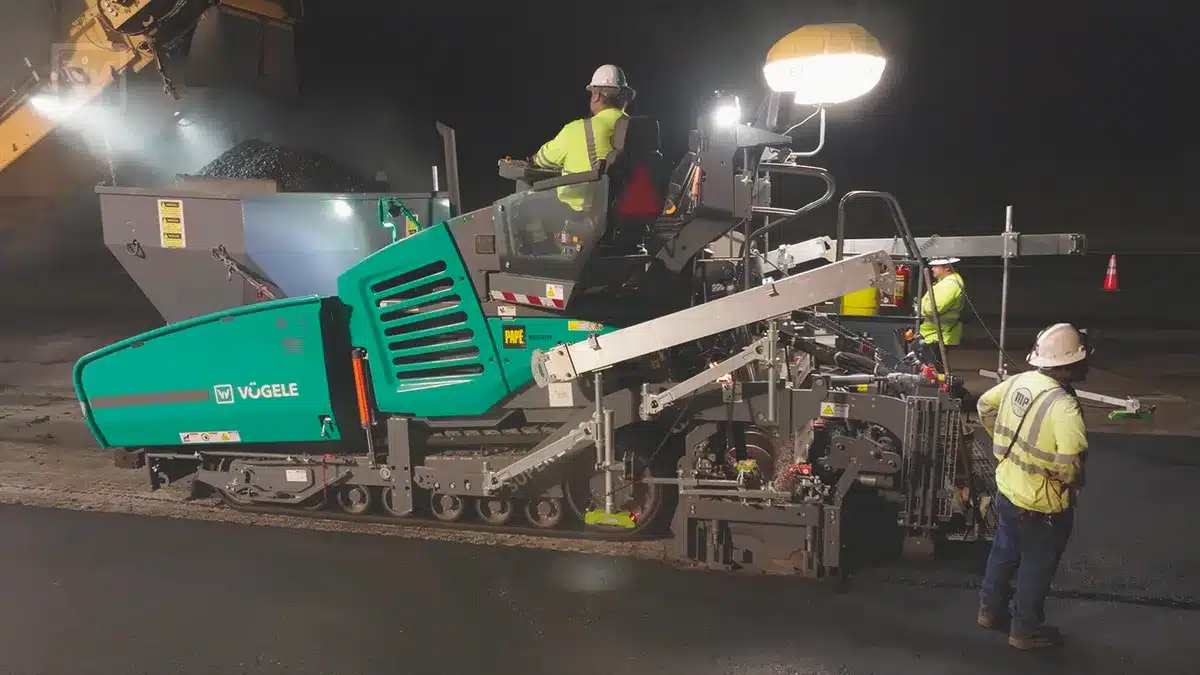
The team from Maui Paving removed and replaced 4.2 miles of divided highway at a depth of 8 inches. They used two Wirtgen milling machines—a W 210 Fi and a W 200 Fi—as well as a SUPER 2000-3i paver from Vögele among other equipment on the project.

“It is the demolition of 4 inches of ultra-thin white top and 4 inches of asphalt treated base, and then placing back 6 inches of asphalt treated base and 2 inches of Mix IV,” said Zack Gonzales, general manager of Maui Paving.

The SUPER 2000-3i highway class paver from Vögele with an engine rated output of 186 kW (250 hp), in combination with the VF 600 paving screed, was used to place the PMA with 20% RAP in lifts of 6 and 2 inches.

Gonzales shared in a video interview that the plan was originally to cut up and remove those sections with an excavator, but Maui Paving had a better idea. It was more sustainable to mill the highway and recycle all that material. And with the Wirtgen cold planers, they were able to mill the full depth in one pass.

“It’s a hundred percent recyclable,” Gonzales shared. “We’re recycling the material that we’re demoing out and then also our asphalt that we’re placing also includes 20% RAP, which is a recycled asphalt pavement as well.”

How to Mill for Profit

Members of the DOT provided the details, with Brandon H. Hee, the Geotechnical and Pavement Design and Shoreline Section Head for the DOT, explaining the 16-year-old pavement’s condition prior to project start. Hee shared that the 4 inches of ultra-thin white topping (UTW) placed in 2008 over the existing 3 to 5.5 inches of ACB placed in the 1970s was failing. “The failure appeared to extend into the underlying ACB, and this is why the cold-planing was done to 8 inches deep,” Hee explained.

“The highway had a Pavement Quality Index (PQI) of 78. “78 is rated at fair and would be in the range of warranting minor rehabilitation.”— Kyle Suzuki, P.E.

Kyle Suzuki, P.E., of HDOT Highway Division, explained the department doesn’t use pavement condition indices (PCI) to assess structures. “We use internal indices to characterize pavement condition and performance. The closest index to the PCI is HDOT’s Pavement Quality Index (PQI), which this road had a score of 78 out of 100. 78 is rated at fair and would be in the range of warranting minor rehabilitation.” He also shared the pavement had an average IRI (MRI) of 163 in/mi as measured on Jan. 19, 2023.

Tyrone Pullman, foreman and construction manager for Maui Paving, shared details of the projects progress and the crew’s experience with the new equipment.

To replace the pavement, the Maui crew used the Vogele Super 2000-3i to pave a 2-inch polymer-modified asphalt (PMA) Mix IV over a 6-inch ACB with polymer, Hee explained. “We use the SBS polymer.”


Kristi Grilho, Bituminous Engineer for HDOT, discussed the mixes in more detail. “Mix IV is a ½-inch dense-graded mix. Both ACB (also called Hot Mix Asphalt Base Course (HMAB)) and Mix IV used PG64E-22 asphalt binder. From mix design submittals, both used 20% RAP. HDOT doesn’t require additives or other accommodations for RAP percentage allowed (up to 20% for surface, and 40% for HMAB (drum plant).”


New Equipment on Maui

Wirtgen Group reported: The deployment of this paver was a première on the Hawaiian island of Maui. To enable Maui Paving’s personnel to exploit the full potential of the machines, they all received appropriate training from Wirtgen America before the start of the project. The familiarization of the crew with the machines went off without a hitch for everyone, from the mechanic to the operating personnel on the site.

All three machines deployed on the project [paver and two cold planers] impressed the construction crew with powerful performance, precision and low noise levels.

“The transition to the Wirtgen milling machines has been so smooth and seamless, not only due to their efficiency, but also to the fast delivery of parts by Pape, (the local John Deere/Wirtgen Group dealer) and the training provided by the Wirtgen Group,” reported Zack Gonzales, general manager of Maui Paving.

PFAS Update

ATL offers guidance for potential PFAS contamination from airport millings out of New York

The subject matter experts at Atlantic Testing Laboratories (ATL), headquartered in New York, have examined the issue of per- and polyfluoroalkyl substances (PFAS) occurring in the pavements milled during pavement maintenance activities at airfields. As discussed in the January 2024 issue at this link, PFAS are a group of man-made chemicals, including perfluorooctanesulfonic acid (PFOS) and perfluorooctanoic acid (PFOA). The PFAS from firefighting foam is the specific concern for the asphalt maintenance and preservation industry that we’ll focus on here because the foam has been used in training operations at airfields and other locations where contractors now mill and overlay.

Cheyenne J. Dashnaw, P.E., is a senior engineer at ATL and wrote recently of the hazards contractors may encounter when milling at airports and other locations with a history of using firefighting foam. Contractors collecting contaminated recycled asphalt pavement (RAP) and/or recycled concrete aggregate (RCA) need to be aware of potential environmental and legal consequences.

“If contaminated RAP or RCA are relocated to a different site, the contractor could be considered a potential generator and transporter of hazardous materials,” Dashnaw wrote. He explained to AsphaltPro readers how the contractor could be seen as a “generator” in this circumstance.

“If you have a project that may require sampling for PFAS or any other environmental analyte, ATL, a WBE certified company, has experienced environmental professionals located throughout New York State to perform sampling and coordinate applicable analysis.”

“The definition for generator is ‘any person, by site, whose act or process produces hazardous waste…or whose act first causes a hazardous waste to become subject to regulation.’” In these cases, the United States Environmental Protection Agency (USEPA) and the New York State Department of Environmental Conservation (NYSDEC) “would generally view the site owner as generators for most hazardous wastes, but could consider site owner and contractor as co-generators of certain hazardous wastes, especially for the scenario of a material being relocated to a different site without yet knowing it is a hazardous waste,” Dashnaw shared. “Additionally, if the materials are used as fill or an ingredient in new pavements, there is a risk of contaminating multiple other sites.”

In Defense of Segregation

The New York State Department of Transportation (NYSDOT) allows up to 30% RAP in its mix designs, according to Materials Method 5.16. Of course, the RAP material must meet spec. The NYSDOT Standard Specifications section 703-09 states:

“The aggregate component of the RAP shall meet the requirements of section 703, Aggregates. The bitumen component of the RAP shall be asphalt cement and shall be free of significant contents of solvents, tars, or other contaminating substances that will make the RAP unacceptable for recycling as determined by the Department.”

Dashnaw shared that in January 2021, NYSDEC Division of Environmental Remediation (DER) released a technical guidance document titled, “Sampling, Analysis, and Assessment of Per and Polyfluoroalkyl Substances (PFAS),” requiring sampling and analysis of environmental media for PFAS as part of remedial programs under 6 NYCRR Part 375. This guidance document has since been updated, with the current version dated April 2023.

Currently, NYSDEC DER requires the use of EPA Method 1633 for analysis of PFAS in all environmental media (not including drinking water), Dashnaw wrote. The background on EPA Method 1633 and PFAS cleanup is found at this link.

“Guidance values for limits in soil have been developed for sites in New York State, but soil cleanup objectives (SCO) are not planned to be established until at least a proposal and approval in a future revision to 6 NYCRR Part 375-6. The current guidance gives limit values for PFOA and PFOS based on the anticipated site use for soil and groundwater. While regulations are in progress, it is important to rely on knowledgeable environmental scientists and engineers to ensure that sampling and analysis are completed reliably and in accordance with the most recent and updated regulatory standards.”

Only the Paranoid Survive

Dashnaw clarified: “While the guidelines include soil cleanup objectives based on site use conditions, these are not yet established as regulatory standards and future regulatory standards may differ. If millings are known to be contaminated with PFAS, disposal at a permitted facility should be considered to err on the side of caution. At the very least, I would recommend deferring to the guidance value for Unrestricted Use, which is 0.66 ppb for PFOA and 0.88 ppb for PFOS. If you have samples exceeding these concentrations, disposal should be strongly considered.

“It is important to note that there is a risk that SCO could end up being lower than the current guidance values (and SCO could be developed for additional PFAS compounds other than PFOA and PFOS), but should at least work within the bounds of existing guidance.”

If a contractor suspects PFAS contamination, it’s wise to keep those incoming materials in their own stockpile. “Being able to separate materials is always beneficial, albeit not always obvious or practical,” Dashnaw said. “If a material does end up being discovered as contaminated, and it was managed separately, it is more efficient to track and less costly for subsequent removal and disposal.”

For more information, contact Cheyenne Dashnaw at (315) 386-4578 or info@atlantictesting.com.

Meet A Woman of Asphalt: Triple A Milling’s Amanda Harrington

Promote from within! After an early career driving trucks, this woman of asphalt seized the opportunity to run heavy equipment.

Since 2021, Amanda Harrington has worked as a float driver, skid steer operator and milling machine operator for Triple A Milling, headquartered in Concord, Ontario. She joined the construction industry in 2019 after a decade driving trucks, so her skills translated perfectly into the role of transporting machines from site to site. But Harrington had her eye on doing more and increasing her responsibilities. In 2023, when Triple A was short on operators—as most contractors can sympathize with—Owner Andrew Alfano gave her the opportunity to try her hand at learning to operate the mill. She enjoyed that and jumped at the chance to learn new skills. Triple A has five sizes of cold planers from the Wirtgen Group and Harrington has a comfort level with the W 150 mid-size machine specifically. She recently took some time to share her story and encourage others as a woman of asphalt.

AsphaltPro: You shared that you were a truck driver for 10 years before moving into the asphalt industry. Could you share with the readers what attracted you away from truck driving and into the asphalt/construction industry?

Amanda Harrington: I started out my truck driving career as most drivers do—hauling freight in a dry van or a reefer van. I quickly discovered that sitting behind the wheel all day staring out the windshield was not mentally or physically stimulating enough for me. I have always enjoyed learning new skills/roles and welcome challenges that push me out of my comfort zone. So when the long-haul gig became a lesson in what not to do, and what I did not want to do, I started looking for something else. Through the years I have driven a variety of different types of trucks with many applications. A good portion of my career was in the solid waste industry, and when I felt I had learned and experienced all that I could in that industry, I got a job at a road construction company. After the first few weeks of driving water trucks and dump trucks, my boss gave me the opportunity to learn how to drive the lowbed truck to transport our equipment to and from job sites. I absolutely loved learning how to run and load and unload the equipment, how to chain the different pieces, and to drive with an oversize load. I felt like I was getting to “play” every day at work, and after my nerves settled, felt very much at home in the construction industry.
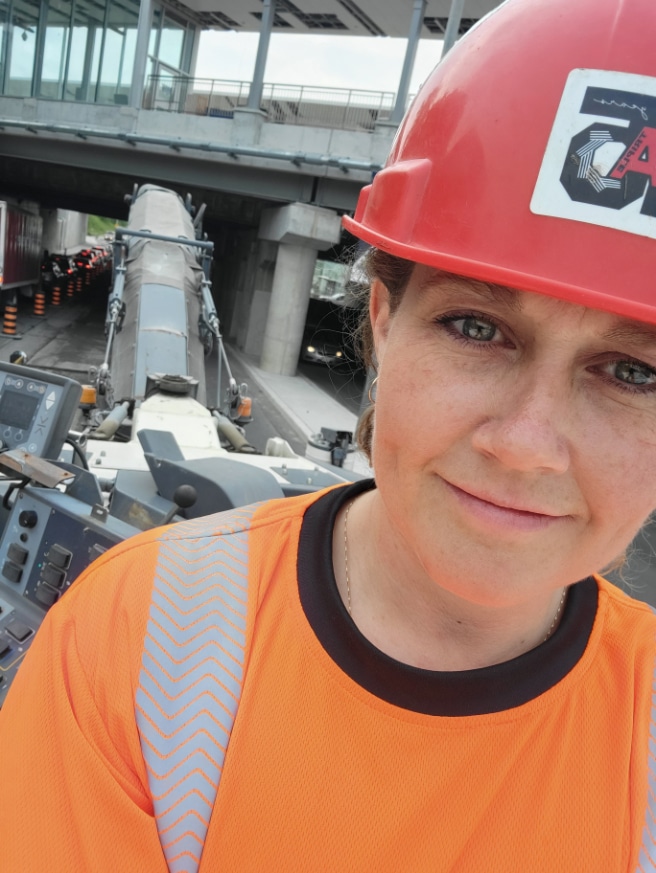
Amanda Harrington shared one of her best practices for career advancement: “I made a point to be present on the job site, available to help in any way that I could when needed.” She asked questions and showed interest in the various roles available at Triple A Milling, Concord, Ontario; she turned a shortage of mill operators into an opportunity to learn and grow.

AsphaltPro: What physical and soft skills from the truck driving experience did you find yourself transferring to your role in the construction industry early on?

Amanda Harrington: You definitely have to have a certain amount of stamina to work in seasonal road construction. As anybody who works in it knows, the days are long and the summer heat can be unbearable, so it takes a lot, mentally and physically, to keep going and push through. My friends often ask me how I do it, and I reply, “I have no idea!”

Communication is crucial—it can make or break your day. Time management, work ethic, prioritization, multi-tasking, attention to detail, adaptability, problem solving, being able to work as part of a team—they all matter.

AsphaltPro: Could you tell the readers what you found most valuable about your first job as a lowbed driver in the asphalt industry?

Amanda Harrington: Being a lowbed driver gave me additional skills and showcased that I was capable of being a versatile and valuable employee. It also gave me a great confidence boost and proved to me that I am quite capable of doing this type of work and doing it well. It ultimately led me to where I am now and opened the door for me to become an operator.

Meet a Woman of Asphalt: Rock Road’s Wendy Lou Bloedow

AsphaltPro: Could you share with the readers what your different roles as a lowbed driver, skid steer operator, and milling machine operator generally require of you for the Triple A Milling team?

Amanda Harrington: It requires that I am consistent and reliable and to give my best effort to show up ready to complete the job—some days this is more challenging than others. I would also say that this is where those soft skills that I previously mentioned come into play.
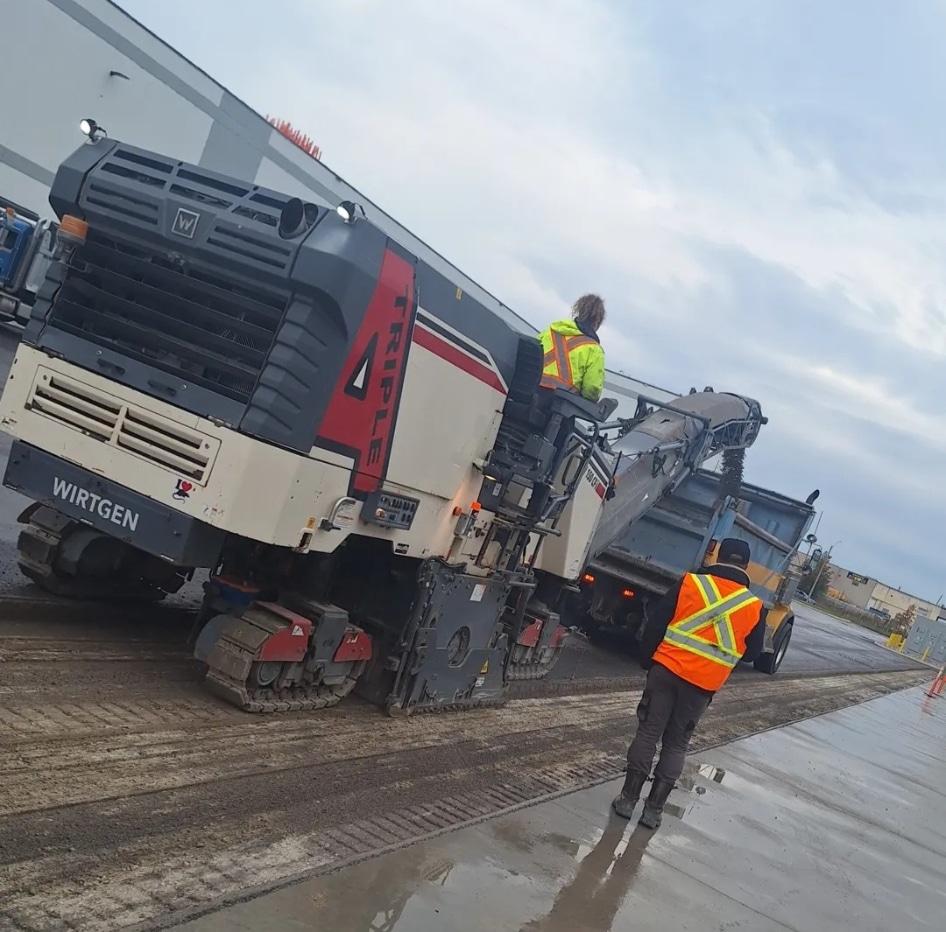
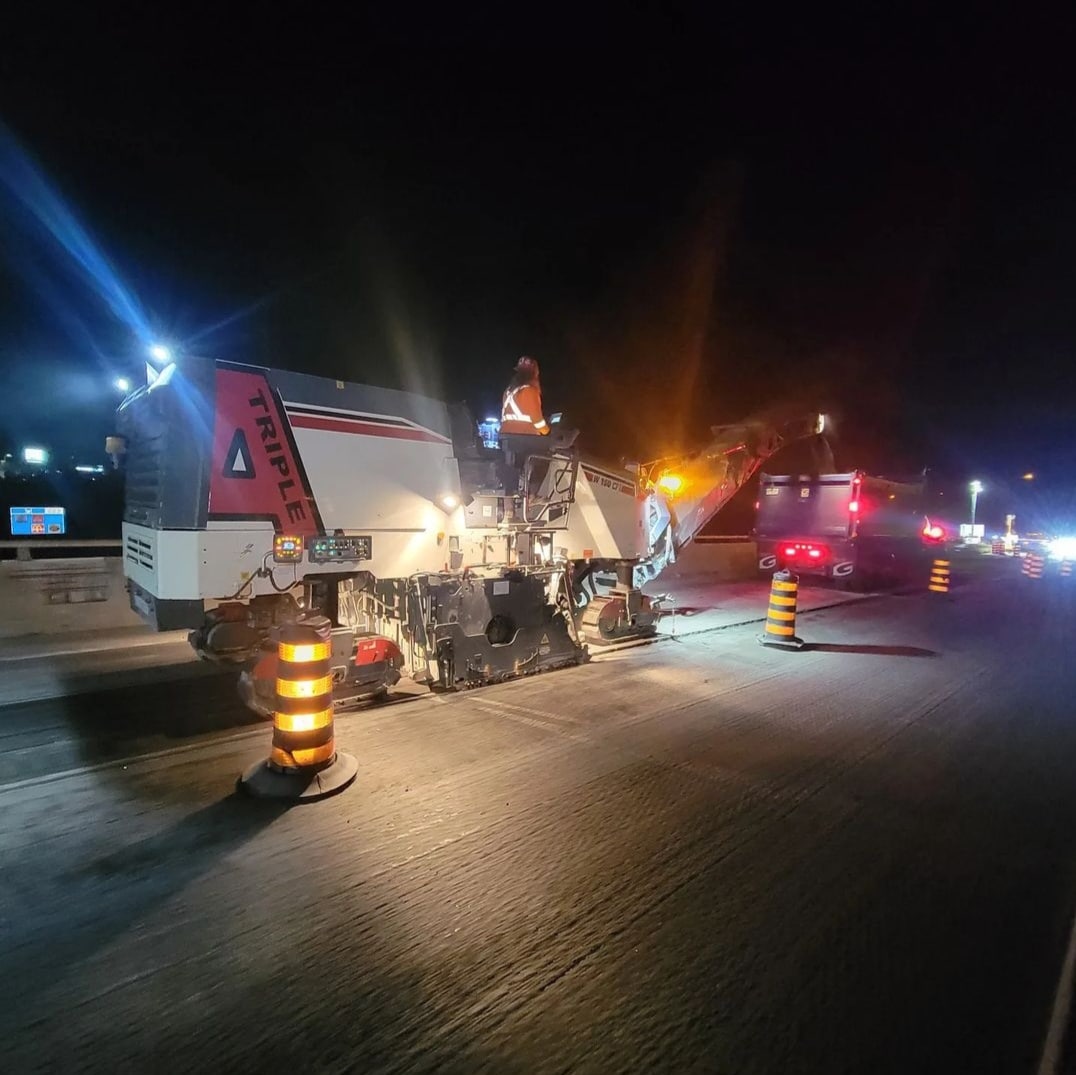
Whether night or day, Harrington takes operation of the mill seriously. The mid-size W 150 mill from Wirtgen Group is one with which she has the greatest comfort level due to its ease of visibility. She shared that filling the grindings into the truck comes more easily with this machine than the larger W 220 for her thanks to its conveyor width and operator controls.

AsphaltPro: Then what are some of your daily responsibilities when it comes to operating the milling machine specifically?

Amanda Harrington: The majority of the time I am responsible for transporting our mill to the jobsite. While on the jobsite my role is to operate, which entails completing a daily inspection and report, moving and steering the machine, controlling the conveyor belt to load the dump trucks, signaling and directing the dump truck driver, controlling the speed of the machine’s travel, staying in constant communication (verbal, eye contact, hand signals) with my gradesman, assisting with checking/replacing teeth in the drum, watching for/marking manholes, catchbasins or any other items we need to avoid in the asphalt or concrete, washing the machine down at the end of the day, and refilling the water tank and other fluids when necessary. Also, communicating with the mechanics regarding any necessary repairs and maintenance.

Meet a Woman of Asphalt: Modern Hydrogen’s Emily Houston

AsphaltPro: You mentioned the opportunity to run the mill came about due to the shortage of workers at your company. Could you share with the readers a little more about how that opportunity presented itself and how you approached Andrew Alfano to volunteer for the job?

Amanda Harrington: In my second season working at Triple A Milling, I learned how to load and unload our larger milling machines by myself, and once I was comfortable doing that, I voiced my desire to learn how to operate. I was told I had to learn how to operate the skid steer and sweep behind the machine first to understand what the finished outcome was supposed to look like. So I spent the better part of my second season in a skid steer as well as transporting our equipment. At the beginning of my third season, unfortunately (but fortunately for me) we were short a handful of mill operators, so my boss took me under his wing and gave me the opportunity to start learning how to operate.

AsphaltPro: What training/experience did you have prior to taking on operating the mill?

Amanda Harrington: The only prior experience with the mills was from loading/unloading them on and off my trailer and moving them around in the yard or at the jobsite. Also, my experience driving various trucks and machines from my 14 years as a truck driver.

Meet a Woman of Asphalt: Jim Reynolds Asphalt Contractor’s Chelsea Ellis-Hogan

AsphaltPro: What training did Triple A offer once you showed interest?

Amanda Harrington: It has all been on the job training. There are different techniques and approaches for different types of jobs, for example, a parking lot with a lot of curbs and islands versus mainline work on highways. So, I would watch the operators to see how they did things when I was on site with them as a driver or while in the skid steer, paying attention to things they did and when they did them. I made a point to be present on the job site, available to help in any way that I could when needed, asked questions, showed interest.

AsphaltPro: What about operating the milling machine is “most cool” to you?

Amanda Harrington: So many things come to mind! Being able to maneuver a large machine safely and accurately, when you get into a zone and everything is going as it is supposed to, milling a next to perfectly straight pass (not easy to do!), when you look back at the pattern left behind and it’s clean and consistent, when you and your gradesman become in tune and you can pull off some pretty technical and complicated maneuvers without stopping and with minimal discussion. The machine itself is incredibly impressive. And this is pure ego, but I think being one of only four women (that I know of) in North America that operate a milling machine is pretty cool.

Meet a Woman of Asphalt: WAPA’s Deb Schwerman

AsphaltPro: You mentioned the W 150 is the machine you had the chance to operate most often. Could you share with readers what is most comfortable about that equipment for you compared to other models that Triple A has in its fleet?

Amanda Harrington: The W 150 is what I have had the most time on, which is why I feel most comfortable on it. There is far more visibility around the W 150 compared to the larger models like the W 220. The conveyor is narrower, which allows you to easily see into the back of the dump truck, whereas the conveyor on the W 220 is much wider and obstructs most of your view. The conveyors have cameras, which helps, but I definitely still find it challenging to load a dump truck “nicely” with a W 220.

My approach to learning is to hold my breath and just do it. I try different techniques and see what works the best for me, take my time until I get the hang of something new, watch what other operators do and ask questions.

AsphaltPro: As a subcontractor with a variety of mill sizes, Triple A gets to work on a variety of projects. You mentioned government jobs for the Ministry of Transportation of Ontario (MTO), bridge decks, parking lots, as a few. What is your favorite type of project to work on and what makes that intriguing to you?

Amanda Harrington: I do enjoy the jobs that are not so straight forward, that require more thought and more attention. For me, these jobs are usually gas stations, which are a great type of job to learn on, but they can also be frustrating. There are a few of us that I would say have a love/hate sentiment for gas stations!

But so far my favorite job was when we worked on the Canadian side of the Blue Water Bridge between Sarnia, Ontario and Port Huron, Michigan. Besides having a beautiful view all day, we managed to mill 7,800 square meters (84,000 square feet) in one day. It was also a memorable job for me because it was on this bridge where I felt my confidence grew substantially.

Meet a Woman of Asphalt: R.K. Hall’s Mindy King

AsphaltPro: What do you think is the most important skill you’ve brought to your position as an equipment operator in the asphalt industry? And how would you encourage other women entering the industry to hone a similar skill?

Amanda Harrington: My attention to detail and ability to learn and take direction. You have to learn what the machine is supposed to sound like, feel like, look like and sometimes even smell (or not smell) like in whatever function it is performing. These are large, complicated and expensive toys, so the more in tune with it you are, the better it is for everyone, and I believe that is one of my strong suits. If anyone is interested in becoming an operator, you just have to have the drive and interest to learn. It comes naturally to some people, others need a little extra practice, but that does not mean it cannot be achieved. There are courses you can take for many types of equipment. If it’s specifically related to road construction, just get your foot in the door with a paving company as a laborer and work your way up. Be vocal from the beginning about your goals (the squeaky wheel gets the grease). I got my foot in the door as a truck driver. If you are always trying to better yourself and learn new skills, you will be successful and get noticed by the right people. It may take some time, but you have to be willing to prove yourself and to put in the work. This is not an industry for anyone who is not willing to break a sweat and get dirty.

AsphaltPro: What would you say was the most challenging “obstacle” you, as a female on a subcontractor’s crew, had to overcome in the past, and how DID you overcome that obstacle?

Amanda Harrington: “Imposter Syndrome” has been my biggest obstacle. I am harder on myself than anyone else is. Having to convince myself that when I excel at my job, it is because I have put the effort in, I have learned from my mistakes, I have developed the skills—it is not a fluke or a coincidence. I will honestly say that I have not overcome this—it is an ongoing struggle. The way I deal with it is to remind myself that I work hard, I try my best, I believe I am good at my job and that I am valued in my workplace. I have a wonderful support system within my friends and community of other women that work in the trades to lean on.

The other obstacle is finding a clean washroom close to the job site when we are working out in the middle of nowhere!

The best advice I can give is to find a community of other women who can relate to the challenges we as women face in a male-dominated field. If possible, find a mentor or an ally at your workplace or in the same industry as you to encourage you and to be a witness to your achievements.

Meet a Woman of Asphalt: Zipp’s Asphalt & Sealcoating’s Brynn Zipp

AsphaltPro: You mentioned the regional community “Women On Site” as a positive and encouraging group you’re a part of. Tell our readers about the group.

Amanda Harrington: Women On Site has grown into a national community, and has already crossed the border into the United States. It was started by four women that work in male dominated fields as they identified a need for a community like this. It can be very lonely and isolating as the only woman on a jobsite or crew. Even the most empathetic man cannot truly understand what that is like. I have been fortunate that I have felt welcomed and comfortable in the majority of companies I have worked for, but not all women are as fortunate and have to face a lot of adversity and harassment. Having a community of like women to lean on and share stories with is so valuable.

Women On Site has chapters across Canada and one in the United States. They host a few large events throughout the year, as well as local monthly meetups. The group originated on Instagram (@women.on.site), they also have a website (www.womenonsite.ca), and I would highly recommend that women get involved with this organization. I have met some amazing, bad ass ladies through this community, and I am so grateful that I have.

AsphaltPro: How has Women On Site been a help to you in your career or in your day-to-day role as a woman in the construction industry?

Amanda Harrington: It may seem trivial, but just knowing how many women are actually out there working in the trades and construction makes a difference. It sounds cliché, but it really does show you that you are not alone.

AsphaltPro: How can other women, maybe those who aren’t in the Toronto area, be involved in Women On Site?

Amanda Harrington: Follow them on Instagram and go to one of the monthly meetups! The meetups are on the first Wednesday of every month in most major cities in Canada. The website will have a list of local chapters.

@women.on.site

www.womenonsite.ca

Meet a Woman of Aggregates: Capital Materials’ Ericka Baxter

AsphaltPro: Let’s talk about Teamwork. What is the most challenging project you’ve been a part of and how did you and the Triple A Milling crew overcome the challenge?

Amanda Harrington: One job does not really stand out more than any other to me as far as being more challenging – each job presents its own set of challenges. Overcoming any challenge as a crew of more than one person will always require communicating—discussing different approaches and techniques, possible outcomes, etc. You cannot accomplish anything without communicating with your crew on ANY job. You have to work together as a team to get the job done.

AsphaltPro: Let’s talk about Perceptions. What do you think is an incorrect perception that we, as an industry, can re-educate young people about to encourage more women to consider a career in the asphalt business?

Amanda Harrington: An incorrect perception of people in construction is that we are unintelligent, uneducated, unsavory dregs of society who barely pass for humans. I have met so many intelligent, caring, hilarious, decent people that are just trying to make a nice living for themselves and their family. Of course, there are always a few bad apples, but that is true of any industry. I follow a great account on Instagram that touches on this subject of misconceptions and perceptions of people in construction. I recommend checking it out. @humansideofconstruction

Meet a Woman of Asphalt: Superior Asphalt Materials’ Beth Conley

AsphaltPro: What is something you would tell a young lady to encourage her in this industry?

Amanda Harrington: I would tell her that there is a place for her in this industry, and it is absolutely possible for her to have a successful career, that she can make a comfortable living for herself. I would also tell her that it will instill a sense of confidence and resiliency in her that she may not get from an industry that is female dominated.

AsphaltPro: What is the most rewarding aspect for you of being in the asphalt business?

Amanda Harrington: My sense of accomplishment, the confidence, strength and resiliency that I have gained over the years. The ability to financially take care of myself and not want for anything. Job security too—the roads will always need to be maintained.

AsphaltPro: Will you tell us about a person who served as a mentor for you? Is there a piece of advice from this person that you would share with other women in the industry/other operators?

Amanda Harrington: I would have to say my boss, Andrew Alfano. He encouraged me by giving me the opportunity to operate, by not limiting me and making assumptions about my abilities based on me being a woman. He is patient in his instruction, takes the time to explain to me what we are doing and why we are doing it, answers all of my questions, pushes me when I need to be pushed, and creates an environment that allows me to learn and grow.

This is more of a reminder/encouragement than advice: I was operating one of the bigger machines (W 220), having a rough day, feeling very overwhelmed with trying to operate faster, but also load the dump truck without “spilling” the grindings over the edge of the box, but also trying to keep the machine in a straight line, and trying to remember where all the controls are by feel (the control panel on a W 220 is much different than the one on the W 150) and I felt like a complete disaster. It must have been quite obvious to my boss that I was struggling, so he told me to come down off the machine. He said many encouraging things to me, but what he said that stuck with me the most was, “If this was easy, everyone would do it.” So, I took a deep breath and got back up on the machine and kept going. I try to remind myself of this when I am having a difficult day.