
CheckProof’s Benchmark Report on Maintenance and Safety in Construction Shows Gaps
BY AsphaltPro Staff

CheckProof’s benchmark report shows four gaps in construction industry operations
CheckProof, the SaaS operations management platform for heavy industry, headquartered in Stockholm, Sweden, released a helpful report ahead of Hillhead 2026. The company published “Mind the Gap: A Construction Materials Industry Benchmark Report.” This survey-based study of 107 professionals working across quarrying, aggregates, asphalt, concrete, cement and recycling examines how the industry manages maintenance, safety, and operational data on the ground, and where the process consistently breaks down.
Mind the Gap: A Construction Materials Industry Benchmark Report is available to download here.
The data gap is not where most people expect it to be
The findings of CheckProof’s survey challenge a common assumption: that the construction materials industry lacks data. 79% of respondents say they use operational data regularly to make decisions. The problem is what happens next. 56% admit they are not getting full value from it.
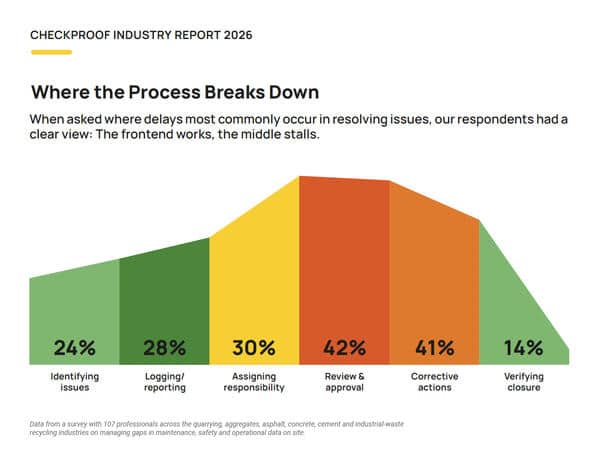
The breakdown is not at the front end. 58% of operations log issues the same day they are identified. The real bottleneck is what comes after:
- 42%say issues stall at the review and approval stage,
- 41%say carrying out corrective actions is where things grind to a halt,
- 30%say assigning responsibility is a consistent delay point, and
- 14%say verifying that an issue has actually been closed is where things break—meaning completed work often goes unconfirmed.
These findings weren’t necessarily a surprise to industry leaders, but a confirmation of areas for improvement. Tom O’Boyle, the chief product officer for CheckProof, said: “These are patterns I recognized from my own time in operations. Issues get logged, and then nothing—no owner, no deadline, no confirmation the work was done. That gap between identifying a problem and closing it out is where downtime happens and where safety risks compound. This report shows it’s not one site’s problem. It’s industry-wide.”
Four gaps define the current state of the industry
The report identifies four interconnected gaps, which are data, execution, tools and priorities. Let’s break those down.
- The Data Gap:79% collect data regularly. 56% say they are not getting full value from it.
- The Execution Gap:58% log issues the same day. 42% say those issues then stall before anyone acts on them.
- The Tool Gap:Over 6 in 10 operations still run on paper forms or spreadsheets as their primary system.
- The Priority Gap:Unplanned downtime tops the priority list, but training and knowledge retention (57%) and accountability and follow-up (52%) are cited by even more respondents overall, pointing to a people and process problem, not just an equipment one.
When asked where the biggest opportunity for improvement lies:
- 31%say real-time visibility from the field
- 16%say predictive or preventative maintenance
- 13%say better issue tracking and closure
Analysis and recommendations
The report includes a diagnostic framework and eight sequenced recommendations developed by O’Boyle, drawing on 13 years of experience in engineering and maintenance operations, including nine years at Heidelberg Materials. The recommendations are deliberately ordered: earlier steps create the conditions for later ones, starting with defining the process before digitizing it and securing site-level management commitment before anything else.
About the survey
The survey was distributed through a verified industry contact list and promoted to relevant industry audiences. All 107 completed responses are included in the analysis. Respondents span quarry and plant management, maintenance and engineering, health and safety, executive leadership, and quality and environmental management, across companies ranging from under 20 employees to over 500. The majority of respondents are based in the United States, with a smaller group from the United Kingdom.
Note on percentages: Several survey questions allowed respondents to select more than one answer. Where this applies, percentages will exceed 100% and reflect the proportion of respondents who identified each factor, not a share of a single total.