
Harness Centrifuge Technology: A Smart Path to Water Conservation in Mining and Aggregates
BY Stephen Benyo and Patrice Maillet
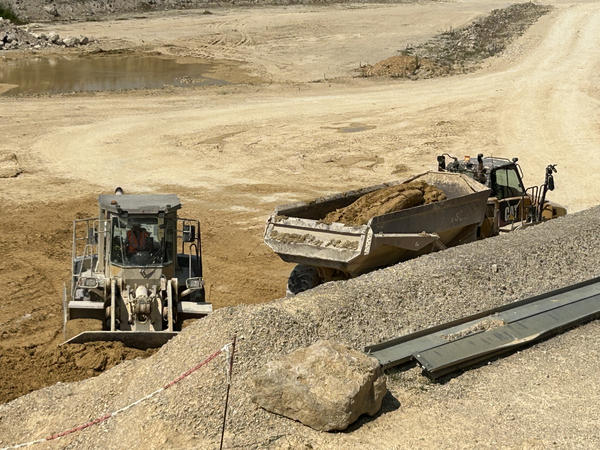
Around the globe, businesses have been tasked with responding to climate change and increasingly stringent environmental regulations. Nowhere is this more evident than in the mining and aggregates sectors, where water is both a critical resource and a costly liability.
Historically, these industries have relied on conventional water treatment and waste management methods to stay operational. While effective in the past, many of these traditional approaches are now struggling to meet today’s challenges. Demand for raw materials like sand, gravel and limestone is climbing rapidly driven by urbanization, infrastructure development and consumer consumption. At the same time, the availability of clean water is dwindling, and disposal options for industrial sludge are becoming more limited and expensive.
In this evolving landscape, companies are being pushed to reimagine how they operate. The question is no longer whether change is necessary, but how quickly it can happen—and what technologies can lead the way. Among the emerging solutions, centrifuge technology has quietly begun to revolutionize how water is recovered and sludge is managed. By dramatically reducing freshwater usage and increasing process efficiency, this technology is proving itself to be a best practice.
This article explores a real-world case study from France, where a major aggregates producer not only met government-mandated water reduction targets but also improved operational efficiency using advanced centrifugation. It’s a story of persistence, partnership and technological progress that offers a glimpse into what could be the future of sustainable resource management worldwide.
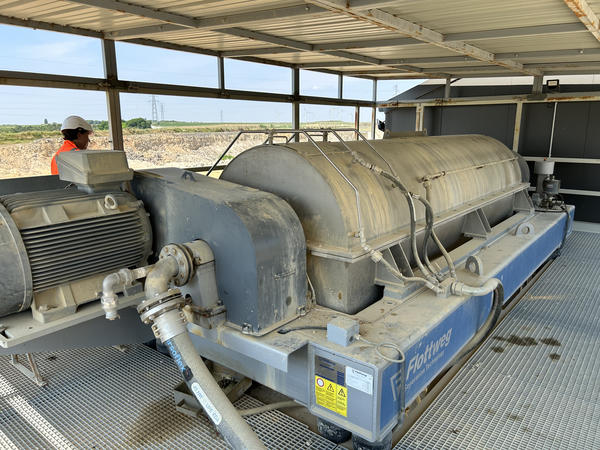
The Flottweg Z92 centrifuge spins the slurry at extremely high speeds, using centrifugal force to separate solids from water much more efficiently than gravity-based methods alone.
A French Case Study in Water Efficiency
Facing legislation that required a 33% reduction in water usage, a sand and gravel producer in France turned to a blend of conventional methods and cutting-edge centrifugation. The result was an 80 to 90% reduction in freshwater consumption—and a leaner operation that reduced staffing needs.
The story doesn’t end there. This was just one piece of a broader, long-term initiative by a global manufacturer of aggregates.
Over a decade, this manufacturer explored numerous solutions to a persistent challenge: how to recycle water more effectively during sludge dewatering. Their journey began with lab tests and small pilot studies, and by 2016, they were ready to trial a full-scale industrial project just south of Paris.
Initial tests with one centrifuge manufacturer didn’t yield the desired results. Undeterred, the company partnered with Flottweg, a recognized name in separation technology. By mid-2017, Flottweg France was on board, after a deeper analysis of first pilot tests results and ultimately recommending the Z92 centrifuge, equipped with a sophisticated control system. The project gained momentum to deliver a turnkey solution, especially after a close collaboration with partner Veolia Agriculture France—an offshoot of a major water technology company.
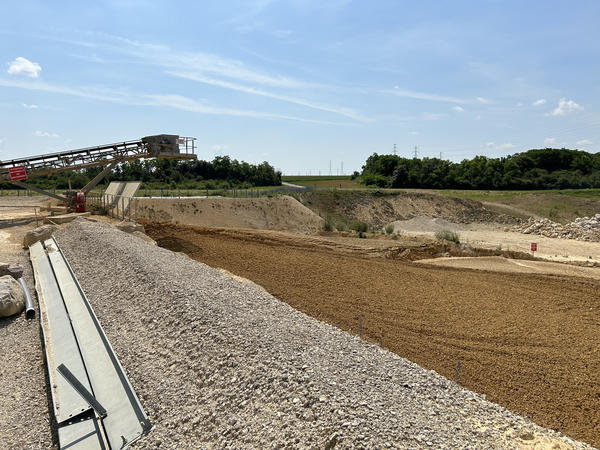
This centrifuge solids conveyor leads to the loading/transport preparation area.
The Gravel Washing Process
At the heart of this project lies a highly water-intensive operation: the washing and processing of gravel and aggregates. For decades, this process has depended on large volumes of fresh water to clean raw materials and remove fine particles. But with growing environmental pressures and local regulations tightening, producers are being forced to rethink how they manage water in every stage of production.
In this case, the end user faced a significant challenge. Their annual water consumption had reached 160,000 cubic meters, primarily drawn from local groundwater sources. However, due to new environmental directives, they were required to reduce their consumption to 105,000 cubic meters per year. This was a mandated cut of over 34%.
To achieve this, the company implemented a multi-step process centered on centrifuge technology, supported by traditional thickening methods. First, quarry sludge, which contains fine particles suspended in wash water, is routed to a clarifier, where gravity is used to settle the heavier solids. This initial thickening step concentrates the sludge and reduces the volume that must be treated downstream.
The thickened sludge is then transferred to a dehydration unit, where a high-performance Flottweg Z92 centrifuge takes over. This powerful machine spins the slurry at extremely high speeds, using centrifugal force to separate solids from water more efficiently than gravity-based methods alone. The result is a drier sludge and a clarified centrate that can be reused within the system.
The goal was clear: achieve a water recovery of at least 62,500 cubic meters per year—a 46% reduction in fresh groundwater withdrawal. The centrifuge not only helped meet this target but did so with minimal chemical input, maintaining a focus on cost-efficiency and environmental stewardship. By recovering water directly from the sludge, the company retained the flexibility to maintain production volumes without over-reliance on groundwater, even during dry months or times of restricted water access.
In essence, the gravel washing process was transformed from a high-consumption, high-waste operation into a far more sustainable, closed-loop system—one that’s better equipped to meet both environmental goals and long-term operational needs.
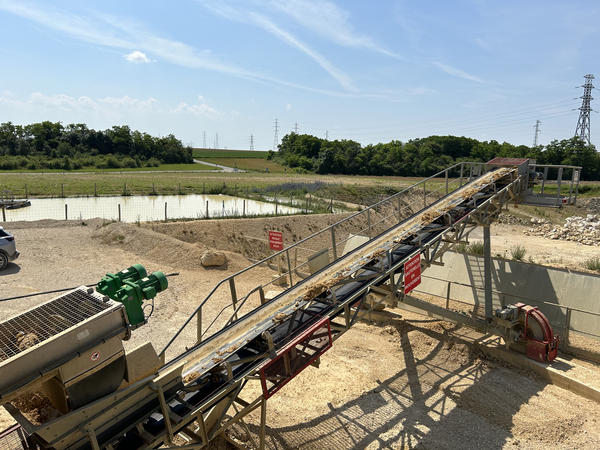
Here the solids conveyor belt is receiving solids from the single screw conveyor.
Strengths, Challenges and a Centrifugal Shift in Sustainability
The project wasn’t without its challenges. Here’s a breakdown of the SWOT analysis:
Strengths:
- A decade-long trusted partnership
- Strong lab and pilot testing and analysis support
- A complete, turnkey solution from Flottweg and SEDE
- Proven project management and local language support
Weaknesses:
- Limited market presence and references
- Higher energy consumption than filter presses
- Higher upfront cost compared to some competitors
Opportunities:
- Water management becoming mandatory in large quarries
- Potential for government funding in eco-initiatives
Threats:
- Power supply limitations in some regions
- Strong local competition from filter press providers
As industries worldwide face growing scrutiny over their environmental impact, solutions like centrifuge technology are proving to be more than just effective—they’re essential.
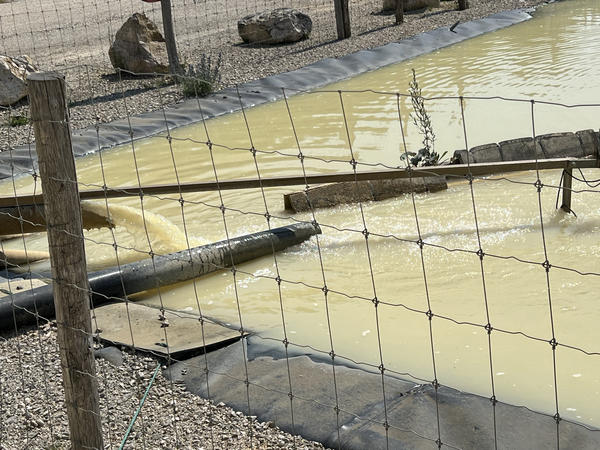
The client wanted to decrease polymer cost, so the centrate is not clear, but the water is sufficient for their wash water re-use.
The story from France demonstrates how collaboration, innovation and a willingness to evolve can lead to significant environmental gains without compromising productivity. What started as a compliance challenge became an opportunity to lead in sustainable water management.
This is not just about sludge or water; it’s about mindset. The transition from traditional dewatering methods to high-performance centrifugation represents a broader shift that embraces efficiency, resilience and long-term thinking.
By investing in smarter infrastructure today, companies not only future-proof their operations against tightening regulations but also build trust with increasingly eco-conscious stakeholders.
Gradation Blender by Gradation.ai Unlocks Mix Designs in Seconds
Yet the story remains unfinished. North America has yet to fully embrace this proven innovation. The absence of permanent centrifuge installations across the continent signals both a challenge and a call to action.
With escalating environmental pressures and rising water scarcity, the time to act is now. Adopting these technologies can help shape the future of sustainable mining and aggregate production.
Stephen L. Benyo is a Global Mining executive for Flottweg Separation Technology, engaged in placing the “puzzle-piece” of innovative technology in its most needed locations—striving toward more efficient utilization of our world’s natural resources.
Patrice Maillett has more than 25 years of experience in operational management within the industry, in France and internationally. For Flottweg, he aims to deploy resources and talents to accelerate performance by relying on teamwork.
System Specs and Performance
Here’s what the operation in France looks like in numbers.
General Operation:
- Annual production: 800,000 tons of limestone aggregates
- Dry matter produced annually: 75,000 tons
- Feed flow: Up to 100 m³/hour
- Max solids throughput: 25 tons of dry solids/hour
- Sludge density: Between 1.25–1.3
- Operating days/year: 210 out of 220 quarry days
- Daily operation: 16 to 22 hours
Performance Highlights:
- Process flow rate: 45-65 m³/hour
- Mass flow rate: 20 TDS/hour
- Solids content: 250–450 g/l
- Centrate clarity: Average 45 NTU
- Flocculant used: SNF 934 SEP, at 0.70 kg per ton of dry solids
- Solids dryness: 58–65%
- Weir diameter: 650 mm (in use since October 2018)
Importantly, the focus wasn’t just on dewatering but on maximizing water recovery with minimal use of flocculants. The company struck a balance between performance and sustainability.