
Burner Technology Trends in Asphalt Plants: What’s Driving Innovation in 2025
BY Sandy Lender

For the May edition of AsphaltPro Magazine, our product gallery focuses on the hot-mix asphalt plant (HMA), warm-mix asphalt (WMA) plant, aggregates management, and other asphalt mix production products and services. One of the components integral to the asphalt facility is, of course, the industrial combustion system. Since 1998, I’ve covered original equipment manufacturer (OEM) advancements in research and development of burners that offer lower and lower emissions opportunities.
The Hades burner is also available from Tarmac International as a LoNox offering and was on display at the Tarmac booth during WOA. For more information, visit https://tarmacinc.com/
SEO Executive Ganesh Dukare of Persistence Market Research, Brentford, London, offered some forward-looking statistics for the industry, stating: “The industrial burner market is expected to grow from US$ 6.4 billion in 2024 to US$ 9.18 billion by 2031, with a CAGR of 5.2%. Growth is driven by industrialization, mining and petrochemical activities, while leading companies are investing in advanced burner technologies to reduce pollution and carbon footprints.”

This is the Detroit® HADES-125 (125 MBtu/hr) Low Emissions, Long Nose Burner Firing Recycled Fuel Oil (Natural Gas Capable). Installed on a Herman Grant 400 TPH counterflow dryer at David A. Bramble, Inc. in Wye Mills, Maryland. For more information, visit HADES Burners – Detroit Stoker Company
According to the company’s research, the top three trends driving growth in the next few years are a growing demand for energy efficiency and sustainability, the integration of automation and the Internet of Things (IoT) into burner management, and the shift toward multi-fuel burners, all of which we’ve seen happening in the asphalt industry. At the recent World of Asphalt (WOA) and AGG1 trade show in St. Louis, the team from Honeywell Industrial Automation, Houston, had the Honeywell Hauck Multi-fuel MegaStar burner on display in the booth directly across the aisle from AsphaltPro Magazine’s booth. One couldn’t walk the show floor without noticing the preponderance of evidence of our industry’s proactive stance on energy efficiency and sustainability, and there’s more on that concept in the WOA wrap-up coming in the June issue.
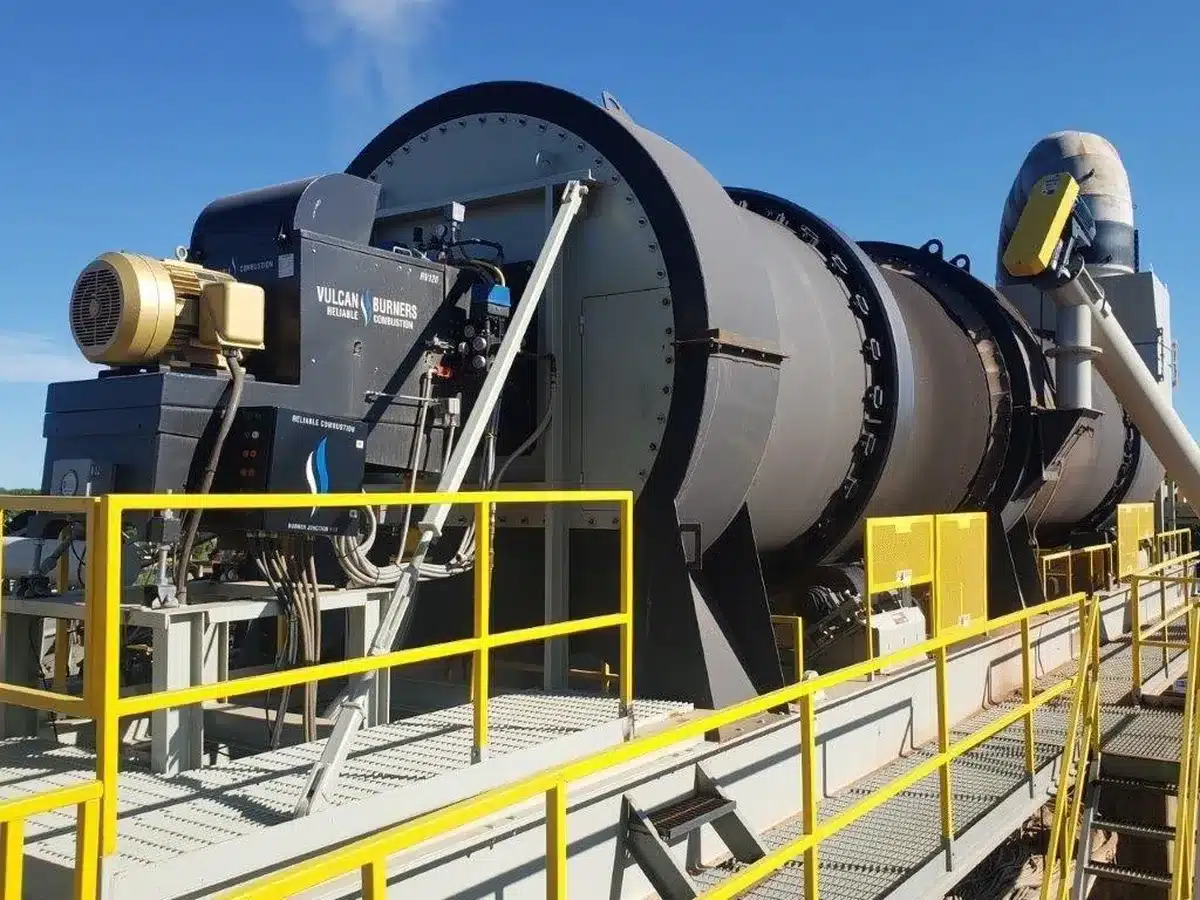
This is the RV120 long nose set up for natural gas and a single oil fuel. Currently running on natural gas. Located in Canton, Ohio. The Vulcan Burner is designed to accommodate various mounting configurations and plant layouts. Its low maintenance requirements stem from a direct-driven fan with no belts, coupled with a split housing design that facilitates easy access for servicing. The burner is capable of operating on multiple fuel sources and incorporates a comprehensive air system to enhance air control and overall efficiency. Safety is a priority, with features including an over-temperature switch and an additional switch to alarm when the housing is separated. Powered by a 75-horsepower motor, the direct drive axial fan delivers an air output comparable to larger motors while maintaining energy efficiency. The sound-insulated fan intake ensures quieter operation. Vulcan Burners are readily available. Replacement parts are also kept in stock for fast shipping. For more information, visit https://reliableasphalt.com/
Persistence Market’s research also shows the top three innovations in industrial burner technology are low emission burners, burners with smart combustion control systems and burners for renewable energy applications. One of the market opportunities they see for burner manufacturers is a focus on retrofit and upgrade solutions. As an example, the team at Meeker Equipment, Belleville, Pennsylvania, offers the Patriot-E electric hot oil heater, which is designed to fit into the footprint of a producer’s “former” combustion hot oil heater.
Examples of how the asphalt industry’s original equipment manufacturers (OEMs) provide systems in all the trending categories above abound. I can point directly to the Whisper Jet® LE burner from Astec Industries, Chattanooga, and the company’s Intelliflex burner controls on display at World of Asphalt as merely one in a robust and environmentally responsible industry of options. Let’s look specifically at what Persistence Market Research had to say about integrating automation and IoT into industrial burners. They began by acknowledging this integration is revolutionizing how these systems are managed and monitored.

The Whisper Jet® LE burner from Astec Industries, Chattanooga, is designed to cleanly and efficiently burn oil, natural gas or propane, and its compact flame makes it compatible with virtually all drum designs without complicated adjustments. Rapidly swirling high energy air is the key to the Whisper Jet burner’s combustion. The swirling air and flame are created by the fixed internal spin vanes and the patented castellated nose, ring and nozzle design. True to its name, the Whisper Jet burner is designed and equipped to reduce burner noise over competitive burners. For more information, visit https://www.astecindustries.com/products/details/whisper-jet-burner
“Modern industrial burners are now equipped with sensors and control systems that allow for real-time monitoring and adjustments. These IoT-enabled systems provide operators with valuable insights into burner performance, helping them detect inefficiencies, prevent malfunctions, and optimize performance.
“Furthermore, automated combustion control systems enable precise air-fuel ratio adjustments, enhancing combustion stability and efficiency. This integration not only improves operational efficiency but also reduces human error, leading to safer and more reliable operations. This trend toward automation and data-driven management is expected to continue as industries seek to improve productivity and reduce downtime.”

The MegaStar burner from Honeywell Hauck is designed to burn multiple fuels and was on display during World of Asphalt. For more information, visit https://process.honeywell.com/us/en/products
One aspect of burners we should focus on from the company’s research is that of the low-emission offerings. “These burners are designed to reduce the production of pollutants such as nitrogen oxides (NOx), carbon monoxide (CO) and particulate matter,” they wrote. “Low-emission burners are often equipped with advanced features such as staged combustion, flue gas recirculation and catalytic converters to achieve cleaner combustion. Innovations in burner technology, such as the use of advanced flame sensors and improved burner management systems, have made it easier to meet stricter emission standards while maintaining high efficiency. As governments around the world implement more stringent environmental regulations, the demand for low-emission industrial burners is expected to continue to rise.”
Watch for this department to feature more updates from WOA/AGG1 over the next few editions!
Check out the article from Malcolm Swanson of e5 Engineers, “Using Combustion Quality Management in Burner Emissions Control,” in the February 2025 issue for a detailed discussion of this technology and its application in our industry.
Using Combustion Quality Management in Burner Emissions Control
Persistence Market concluded their report stating, “The industrial burner market is evolving rapidly, driven by technological advancements, a growing focus on sustainability and the need for energy-efficient solutions. Innovations in low-emission burners, automation, multi-fuel burners and renewable energy applications are shaping the future of industrial combustion systems. With expanding markets in emerging economies and a growing emphasis on retrofitting older systems, the market holds promising growth opportunities.”
The plant-and-production product gallery following the successful WOA/AGG1 show would be remiss if it only focused on one component of the production process. Check out production iron and services in the next few pages from companies who exhibited at the industry event and companies who were unable to attend. Some of these products are new to the marketplace and some are tried and true technologies with upgrades to renew their efficacy for enhancing your bottom line. If there’s something that catches your eye, make sure you reach out to the OEM and let them know you saw it in the pages of your industry partner, AsphaltPro Magazine. And watch for this department to feature more updates from the recent show over the next few editions, as space allows.
ADM Unveils EX 8845 Asphalt Plant for High-Capacity Production
Astec Updates IntelliPac Moisture System for RAP Compatibility
CWMF Unveils Dust Pilot Baghouse for High-Capacity Asphalt Plants
Eagle Crusher Launches Next Gen 1200-CC Portable Crushing Plant at WOA
John Deere Adds Jobsite Monitoring Features to Operations Center
Lippmann Crushers Expands Midwest Reach With US Equipment Sales Partnership