
Northern Improvement Smooths Out National Park Paving Challenge
BY Sandy Lender
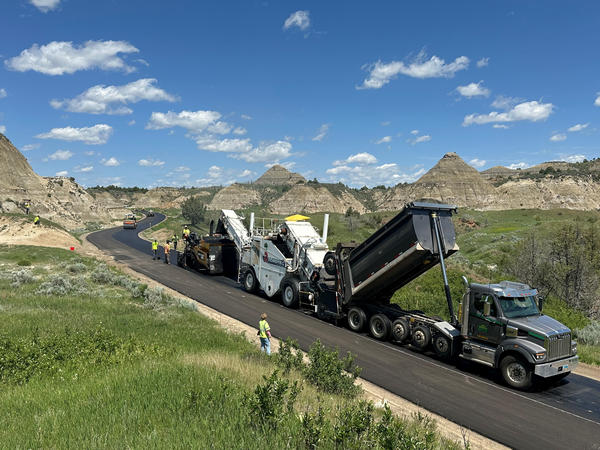
Northern Improvement smooths out Theodore Roosevelt National Park paving challenge
From accommodating a prairie dog town to discovering soft subgrades, the team at Northern Improvement Company, Dickinson, North Dakota, had their work cut out for them when they got the go-ahead to pave a winding path up and down 6 miles of South Unit Scenic Loop. With incredible patience and skill, they put down two 2-inch lifts of Superpave mix with 1% lime to provide a new road for visitors to the Theodore Roosevelt National Park.
As our nation celebrates its 250th birthday this year, it’s an honor to highlight a challenging yet successful project in one of our national parks. Congratulations to the Wagner and Northern Improvement Company teams for making the South Unit Scenic Loop in the Theodore Roosevelt National Park a lovely and safer route for visitors.

Trucking had to be coordinated to deliver enough material to “pave through” curves when the crew was coming up on an area where they recognized trucks wouldn’t be able to drive past the paver. Conditions were often tight. Photo courtesy of Northern Improvement
Challenging Subbase Sets Up Delays
The project was let in 2022 with Wagner taking the role of prime contractor. The scope of the project included, but was not limited to, widening, adding slope, and performing soil-cement treatment (CTB) and full-depth reclamation (FDR) of the base in many areas, according to Bryce Wuori, CEO of Pavewise Inc., Bismarck, North Dakota. Wuori served as a consultant to Northern Improvement on this project.
“The cement-treated base was 4 inches thick in most areas but needed to be more than 6-7 inches, which halted everything,” Wuori said. “The base lift became a patching project. It didn’t turn into a mainline paving project. We put in a change-order for a prime coat on top of the gravel on the hills.”
“The soils in the Badlands are very challenging,” Cassandra Tobin said. She’s the quality control manager at Northern Improvement and worked from Day 1 on the project, preparing the mix design and seeing it placed. “Retaining walls had to be built to hold up the road structure.”
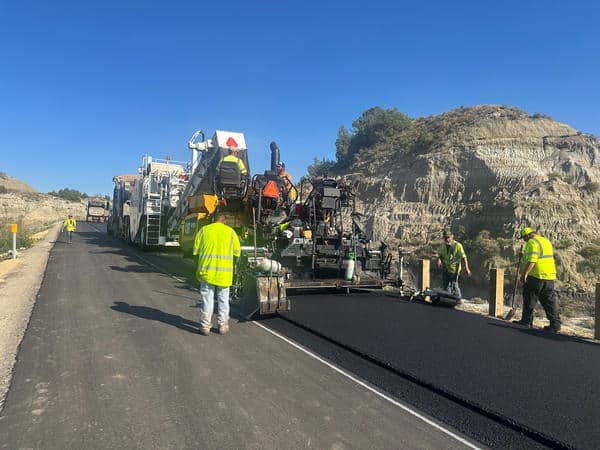
The Northern Improvement paving crew placed a 2-inch lift with the notched wedge joint system from Willow Designs on the centerline joint and a safety edge roller on the shoulder side. Photo courtesy of Northern Improvement
She explained that shortly after Wagner began work in 2022, the project became complex. “They encountered weather challenges; wet winter, wet spring, so the road collapsed in a couple places,” Tobin said. “The original paving plan didn’t happen during 2024 because of the subgrade issues.”
When it came time for Northern to begin paving in 2025, their plan was thwarted again by subgrade issues. “We started paving in June and started encountering issues with the subgrade almost immediately.”
If you’re in Vegas, meet with Bryce Wuori during his Ask the Expert session, Thursday, March 5, from 9:30-11:30 at Booth GL30901 during CONEXPO-CON/AGG.
They demobilized before the July 4 holiday, so the prime could repair a section of the cement-treated base. Northern returned to pave in August 2025.
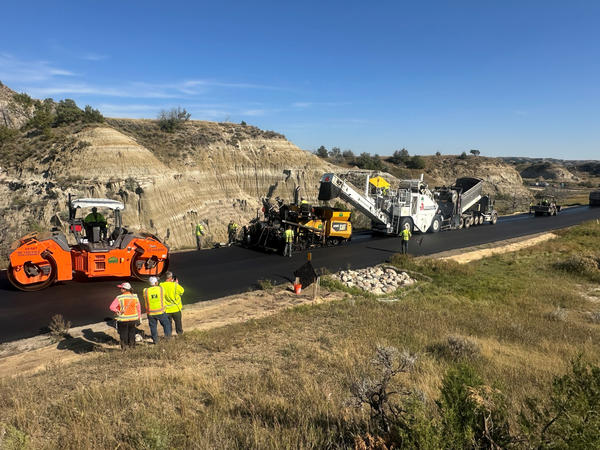
Tobin said the use of a material transfer vehicle on this project helped immensely with improving the ride results. Photo courtesy of Northern Improvement
“A lot of it was only 4 inches of CTB, and it just wasn’t enough structurally to hold up construction traffic, especially with those types of soils,” Tobin said. The first section of roadway had thicker portions of CTB and FDR, she explained, but the paving crew ran into a problem when they got past that first section.
“Once we got to the top of the first hill, we found soft spot after soft spot. Our equipment would sink. Wagner would dig down, put fabric in, rework it. We ended up putting some asphalt in the patches in the subgrade itself. We had to do a lot of skipping around and changing where we were going to pave that day…”
She described the first lift’s execution as paving a quilt, rather than one ribbon of highway.
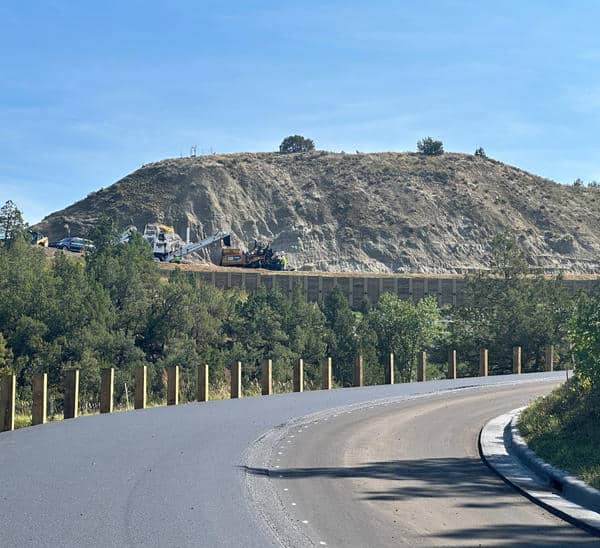
Prime Contractor Wagner built retaining walls in addition to treating the subbase prior to turning the project over to Northern Improvement for paving. Here we see the paving train, which included a Shuttle Buggy to deliver material to the tracked paver. Photo courtesy of Bryce Wuori
“We had different sizes of patches spread out all over the place.”
As you can imagine, this start-and-stop patching was frustrating for a paving crew who planned to get in and pave. “It was very hard on our crew. We’re very quality oriented. It does wear on you, day in and day out to skip a section, or we’d try a section, and it would fail.”
Because of the initial approach they had to take, “a lot of the days were patching days,” she said. “There were multiple patch areas that we ended up having to pave multiple times. That type of paving is labor-intensive. It tied up our plant at the same time. This is a lime mix design. A lot of the projects wouldn’t approve that same mix.”
To create the Superpave ½-inch virgin mix with 58S-34 asphalt binder and 1% lime, the parallel flow hot-mix asphalt (HMA) plant needed some modification. “We had to add a lime silo and pugmill to our normal set up for this project,” Tobin said.
But there was a light at the end of the tunnel.
“Once we got that bottom lift down, everything started looking a lot better. Once it was covered in asphalt, the top lift went so much easier.”
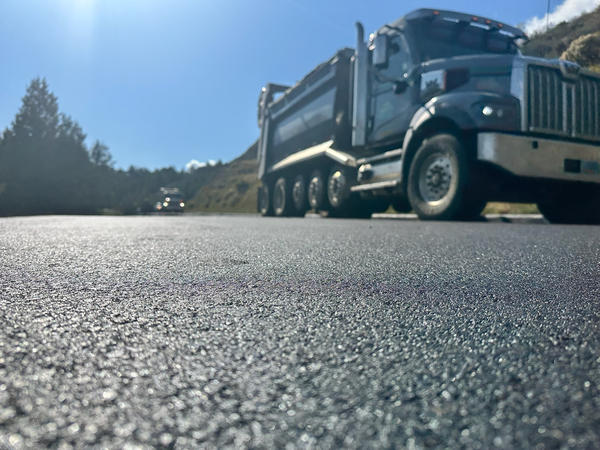
Haul truck drivers were taking it slow and being extra careful delivering mix to the paving train due to the curvy road interrupting communications and the presence of visitor and pedestrian traffic in peak tourist season. Photo courtesy of Bryce Wuori
Coordinated Trucking
The mobile plant providing the specialized mix was set up at Northern Improvement’s South Heart, North Dakota location. Plant Operator Paul Byron, who has worked for the company for almost 25 years, was averaging 180-200 tons per hour at production temperatures of 318-335°F.
This location gave the haul trucks a travel time to the beginning of the project of just over an hour. But their journey at that point was far from over.
“Our plant site is fairly close, but it takes the trucks about an hour to get in there,” Tobin said. “It was peak season for tourists, and you never knew when you’re going to come around a corner and someone’s going to be standing in the middle of the road taking a picture.”
The terrain, coupled with tourist and pedestrian traffic, meant coordinated communication was essential for mix delivery. Due to the sharp buttes and twisting curves, radio signals were often interrupted, making it difficult to get messages back and forth. To combat this, the team set up a relay system for communication. Tobin called it “traffic control for our construction traffic only.” They placed one person at the front of the construction zone, someone in the middle, and someone at the moving paving train to keep the one-way truck traffic in motion. Tobin explained that the team would plan ahead to have enough trucks deliver material to let them pave through winding sections when it was obvious space would be tight.
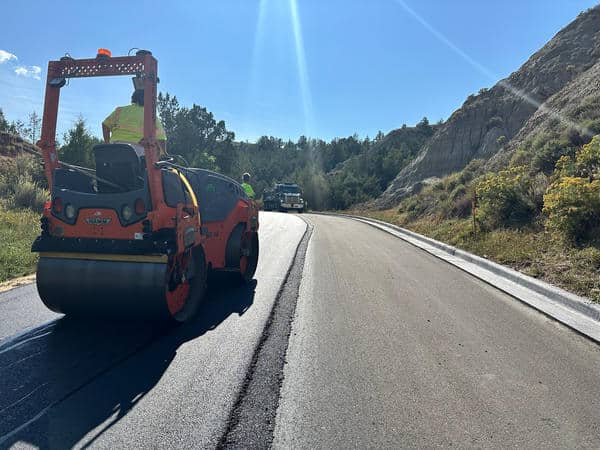
It took incredible coordination and communication to bring material to the paving zone amid the hills and curves. Photo courtesy of Bryce Wuori
“Sneaking trucks by the paver was sometimes not possible,” she said. “There’s nowhere to turn around. Radio traffic was difficult because of the terrain, so we were keeping track of where everything was at all times. Some areas did have curb-and-gutter. We had to plan out to have enough trucks to get us through an area of curves if we knew we couldn’t get trucks past the paver.”
It came down to communication, caution, and planning. “It was an existing low-speed road, but the amount of coordination it took was like a racetrack project,” Wuori said.
“There was a lot of walking—you parked where you started the day—there’s not much for parking, not much for turning around, not much room for extra,” Tobin said.

Due to the terrain, the rolling train didn’t use intelligent compaction with the Hamm HD 120i V10-2 breakdown roller. Cassandra Tobin shared, “With jumping around so much, it just wasn’t feasible. We used Density+ by Pavewise to track our density results from our nuclear and non-nuclear density gauges.” Photo courtesy of Bryce Wuori
Smooth Paving
When trucks reached the paving train, they fed a Roadtec SB-2500e material transfer vehicle (MTV), which fed a CAT AP655F paver equipped with the notch wedge joint maker from Willow Designs. They placed two 2-inch lifts across the total top roadway width of 22 feet in 11-foot pulls.
The mix temperature coming off the screed averaged 280-300°F and performed well for the crew. “The mix was easy to work with, but challenging in areas that were difficult to roll (tight curves, steep grades),” Tobin shared.
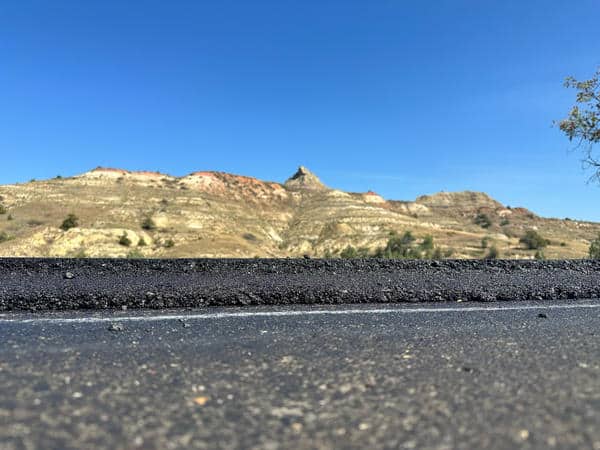
To achieve compaction, the team used a Hamm HD+ 120i VIO-2-HF with both drums in oscillation mode in the breakdown position. Tobin reported average densities of 89-90% in the breakdown zone, which was essential for achieving the percent within limits (PWL) spec on the project.
“The PWL density spec was challenging,” Tobin shared. “We had to achieve similar densities on the base lift and top lift, as well as the edges and center of the mat. Generally, you see a lot of variability in density on tight curves and up/down hills. We were able to keep consistent density throughout the project using a combination of technology and technique. We had a quality control technician, Kim Bumgardner, monitoring density with a nuclear density gauge throughout the project. She is a great roller operator herself, and using her experience and the data she was collecting, she was able to see when any changes needed to be made to the rolling operation.”
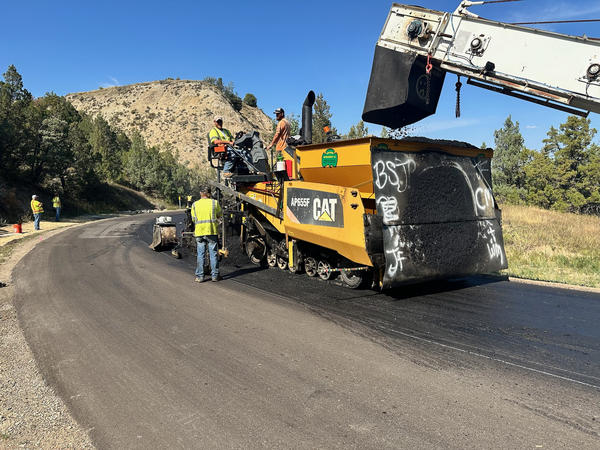
The Shuttle Buggy delivers material to the paver, helping the crew maintain smooth production around tight curves and hills. Photo courtesy of Bryce Wuori
One technology, intelligent compaction (IC), wasn’t feasible on the project due to the terrain, thus good equipment, best practices, and other technologies came into play.
“The big part of technology was that Hamm roller itself,” Tobin explained. “We could adjust the drums if we needed to either oscillate or vibrate, and the settings can easily be swapped around if needed. It is kind of like having several rollers in one. We didn’t set up Intelligent Compaction on this project because of the terrain. With jumping around so much, it just wasn’t feasible. We used Density+ by Pavewise to track our density results from our nuclear and non-nuclear density gauges.”
A combination, smaller, intermediate roller with rubber tires on the back was used in the intermediate position; a smaller, steel drum was in the finish position.
“The Hamm oscillation in breakdown was key in this terrain,” Tobin said. “It was still challenging getting up close to the curbs on such tight curves. The guys had their work cut out for them…The smaller rollers were very beneficial to us in this terrain.”
In addition to the PWL spec, the team had a two-part ride spec to consider and random core sampling to arrange.
“The ride spec for this job was especially difficult considering it is a 25-mph road with very tight curves and a lot of curb transitions,” Tobin shared. “That was further complicated by all the soft spots and subgrade repair areas. The spec includes two parts. One for the overall ride and the other for localized roughness (each bump). The use of the [MTV] helped immensely with improving the ride results.
“The asphalt sampling for testing was truly a group effort that required quick coordination,” she continued. “The inspectors would give us short notice when coming up on a sample. The logistics of getting the testers and the people needed to be able to pull the sample from the mat behind the paver was very difficult given the challenging terrain, lack of cellular coverage, and the congested narrow roadway with extremely limited parking. Terracon had a QC team made up of multiple testers, which were always on site or transporting samples back to the lab during paving to make this happen. It was an impressive, coordinated team effort.”
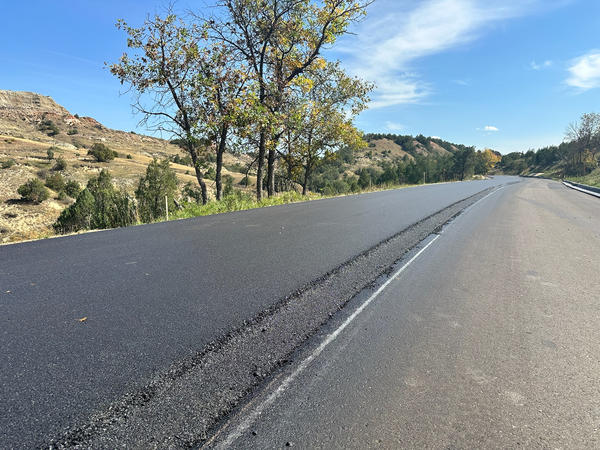
Side view and detail of the notch wedge joint build. Both photos courtesy of Bryce Wuori
“They did a really good job, especially with the level of difficulty,” Wuori said. “They held to all FHWA specs of density and ride.”
The result was approximately $200,000 bonus on material and density for Northern Improvement, and a fresh new road for the National Park Service and the visitors to the Badlands National Park.
Prairie Dog Chatter
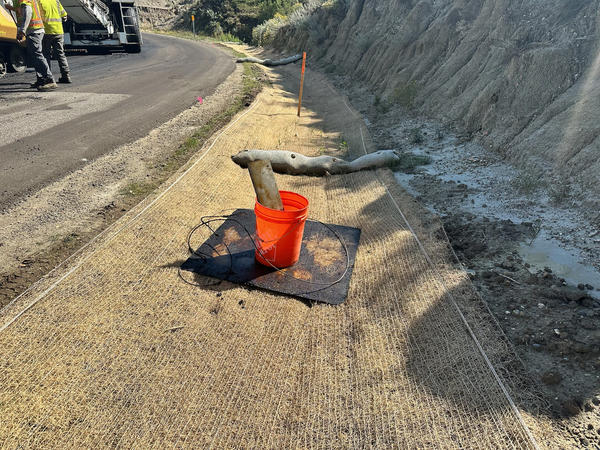
Wagner, the prime contractor for the project, placed a rodent barrier along the shoulder at the outset of the project, for the crew from Northern Improvement Company, Dickinson, North Dakota, to pave over; the goal of this system is to keep the prairie dog population from burrowing under the road, thus causing damage. When rolled out, the netting is quite flexible, making it a challenge to place an asphalt lift on top of.
Northern Improvement Quality Control Manager Cassandra Tobin described it as a “flexible wire, folded back across the shoulder.”
She explained that even though the mesh was fastened down, it tended to flex when being paved over. “It flexed and that caused some cracks. The top lift covered that.”
The flexible netting also impeded the paving sensors. “They picked up some of that chatter,” Tobin said.
But the professional crew understands paving basics and could guide the CAT AP655F smoothly through the beginning of the project. In the end, the rodent barrier was successfully installed and covered for both the pavement system’s and the prairie dog town’s protection.