
AutoTMA: Bringing AI-Driven Alerts to the Frontline of Work Zone Safety
BY AsphaltPro Staff
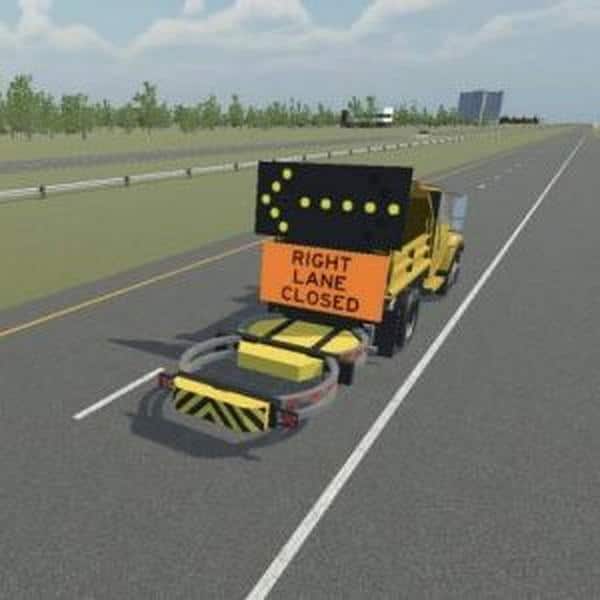
AutoTMAs bring AI to Work Zone Safety in Missouri
Highway work zones have always been hazardous places. Crews operate inches away from high-speed traffic, relying on signage, cones, arrow boards and the heavy shield of truck-mounted attenuators (TMAs) to keep them safe. The job of the TMA is to absorb impact energy when a driver fails to stop in time. But for all their effectiveness, TMAs are reactive devices. By the time a TMA absorbs a hit, the danger has already arrived.
A recent study led by the University of Missouri–Columbia in partnership with the Missouri Department of Transportation (MoDOT) proposes a shift in approach: that of using the TMA to prevent a crash by warning drivers of an obstruction or work zone danger in real time. The project, documented in MoDOT Research Report cmr 25-007, introduces the Automated Audible Alert System (AutoTMA), which is an AI-enabled solution designed to detect errant vehicles and trigger audible and visual warnings automatically.
The findings point to an advancement in how work zones can be secured, with direct implications for the professionals who set cones, operate TMAs and maintain roads under live traffic every day. Let’s explore the report’s information now.
Response times were under 0.15 seconds, ensuring virtually immediate hazard recognition.
OEMs Manufacture Attenuators to Meet Modern Crash Conditions
The Work Zone Challenge
Work zone crashes have been climbing nationwide. According to the authors’ findings, in 2021, over 105,000 crashes occurred in U.S. work zones, resulting in nearly 1,000 fatalities and Missouri had seen its own troubling rise in TMA strikes, with incidents increasing by more than 20% between 2020 and 2023.
For crews, every TMA collision represents more than just damaged equipment. It means direct risk to the TMA driver, the workers ahead of the truck and the motorists themselves. Many of these incidents trace back to distracted driving, speeding or late lane changes, all factors that static signage and even high-visibility attenuators cannot fully counteract.
Traditionally, audible alerts in TMAs have been manually activated by the driver or a spotter. This method relies on human vigilance, fast reactions and constant monitoring of approaching traffic.
AutoTMA: How It Works
AutoTMA is built to take human reaction time out of the equation. Using a sensor fusion package that combines cameras, radar and LiDAR, the system continuously monitors traffic approaching the TMA.
At the heart of the system are two deep learning models: YOLOv5.0, which identifies and classifies vehicles in real time; and DeepSORT v2.2, which tracks those vehicles across frames, maintaining continuous awareness of their position and movement. The system then applies a time-to-collision (TTC) model to determine whether an approaching vehicle is a risk. Based on this analysis, AutoTMA categorizes threats into escalating levels: normal, elevated, severe and danger.
At the severe and danger levels, the system automatically activates audible alarms (sirens or air horns) and visual strobes. Alerts are graduated. Quieter and shorter alarms are for less urgent threats. Louder and sustained alarms are for imminent impacts. All of this happens within 100-150 milliseconds, which is a response speed that no human operator can consistently match.
Testing and Validation
The research team subjected AutoTMA to a multi-phase evaluation program, starting with simulations and ending with deployment.
- Simulation Testing: Using Unity 3D models and controlled driving scenarios, the system’s detection algorithms and alert logic were validated against varied traffic and environmental conditions.
- Laboratory Calibration: Sensors were tuned for precision in speed, distance and trajectory estimation. False positives and negatives were measured and minimized.
- Controlled Field Trials: At MoDOT’s test facilities, TMAs equipped with AutoTMA were exposed to staged vehicle approaches under varying speeds and lighting.
- Operational Deployment: The system was mounted on MoDOT TMAs in real work zones to capture live performance data.
Researchers noted some key outcomes. First, detection accuracy was greater than 98%, with near-zero missed detections during structured field trials. Response times were under 0.15 seconds, ensuring virtually immediate hazard recognition. False alarms stayed low thanks to multi-sensor fusion, improving crew confidence and reducing unnecessary disruptions.
Driver behavior was impacted as well. In more than 80% of high-risk cases, the audible alerts prompted drivers to slow down or change lanes in time to avoid collisions.
How to Set Up the Roller and Rolling Zone for Safest Practices
Implications for Crews and Operators
For those working in or around work zones, AutoTMA offers advantages such as reduced reliance on manual monitoring; consistent protection because automated alerts fire every time conditions warrant; improved warning effectiveness because audible cues reach errant drivers at the critical moment, increasing their chances of corrective action; and safer operating procedures. Crews can focus more on their tasks when they know an intelligent system is continuously scanning for threats.
The system is designed to integrate with MoDOT’s existing TMA fleet with minimal modifications, ensuring a smoother adoption curve for crews already familiar with current setups. From a policy perspective, AutoTMA is breaking new ground. Current Manual on Uniform Traffic Control Devices (MUTCD) guidance does not specifically address automated TMA warning systems, so this places Missouri at the forefront of shaping how such technologies will be regulated and standardized.
In chapter six, the report recommends a phased deployment strategy:
- 2024–2025: Final testing and optimization of AutoTMA.
- 2025–2026: Secure regulatory approvals and integrate SOPs for operators.
- 2026: Begin rollout in high-risk operations such as bridge repair and striping.
- 2027–2028: Expand to statewide use across MoDOT districts.
- Beyond 2028: Integrate with smart work zones and pursue national expansion.
In parallel with the deployment strategy, the team recommends developing training protocols for TMA operators and supervisors; aligning AutoTMA with federal policy through collaboration with FHWA and AASHTO; and exploring technical refinements, such as adaptive warning tones for different vehicle types and integration with vehicle-to-infrastructure (V2I) systems.
Looking Ahead
AutoTMA represents a transition from reactive to proactive safety in work zones. By merging AI, sensor technology and automated alerts, the system directly addresses the risks posed by distracted or high-speed drivers approaching work zones. For road-building professionals, the benefits go beyond reduced crash risk. Fewer TMA strikes mean lower equipment repair costs, fewer work delays and greater worker confidence in their safety on the job.
As Missouri prepares for phased deployment, the system holds promise not just as a local solution but as a potential national model. The combination of technical performance, operational feasibility and policy alignment positions AutoTMA as a leading candidate to set new standards in work zone safety.
For crews and contractors, TMAs have long been the last line of defense against errant drivers. With AutoTMA, they may soon also become the first line of warning. By detecting threats faster than humans can react and issuing unmistakable alerts, AutoTMA has the potential to reduce both the frequency and severity of work zone crashes. For professionals working daily in Missouri’s work zones, this technology offers more than innovation. It offers peace of mind.
Testing AutoTMAs
AutoTMA (Automated Audible Alert System) is a next-generation safety system designed for truck-mounted attenuators (TMAs). Unlike traditional TMAs that passively absorb crashes, AutoTMA actively scans traffic, predicts collision risks, and issues audible and visual alerts in real time. Its modular architecture combines AI-driven perception with rugged hardware to reduce TMA strikes and protect work crews.
What Did MoDOT Test?
During development, researchers evaluated multiple system configurations to balance performance, cost and reliability under real-world work zone conditions. They found that automated detection was consistently faster and more reliable than human observation and multi-sensor systems (camera + LiDAR or radar) significantly reduced false alarms while extending detection range up to 150 meters. They also found that radar-based configurations offered the best all-weather reliability, making them practical for year-round deployment. While camera-only systems provided a cost-effective entry point, researchers recommended multi-sensor setups for broader adoption.
Let’s look at what they tested, specifically:
Camera-Only (Vision-Based Prototype)
- Uses rear-mounted cameras with AI detection (YOLOv5) to identify approaching vehicles.
- Strengths: Cost-effective, straightforward setup.
- Weaknesses: Struggles in low light and adverse weather; higher false alarms from shadows or lane-adjacent vehicles.
Vision + LiDAR Integration
- Adds LiDAR to improve depth accuracy and object detection precision.
- Strengths: Maximum accuracy and detailed object profiles; strong performance in clear weather.
- Weaknesses: Expensive; reduced effectiveness in rain or fog.
Vision + Radar Integration
- Combines cameras with radar for speed and distance verification.
- Strengths: Reliable all-weather performance; reduces false alarms by confirming vehicle trajectory and speed.
- Weaknesses: Less object detail than LiDAR but balances cost and resilience.
AutoTMA Iterations (V1 vs. V2)
- V1: Early camera-only prototype, validated viability of automated detection.
- V2: Multi-sensor system with refined fusion algorithms, reduced false positives, and improved robustness in field conditions.
The bottom line is AutoTMA is adaptable. Agencies can choose a cost-efficient camera-only version or invest in multi-sensor configurations for maximum accuracy and reliability. Both options shift TMAs from reactive barriers to proactive safety systems.