
Mobius Brings Machine Coordination to Autonomous Asphalt Job Sites
BY AsphaltPro Staff
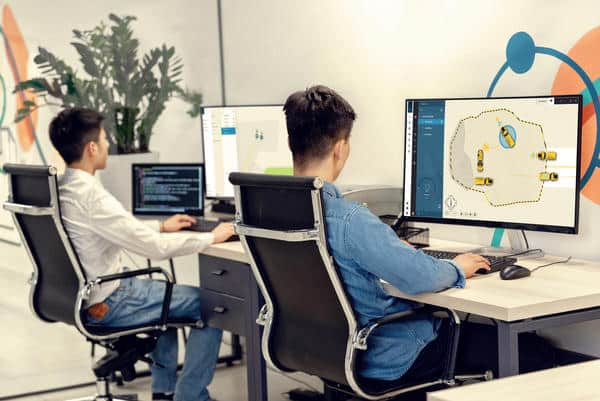
From quarries and asphalt plants to earthwork and prep ahead of paving, many equipment operators face challenging conditions on the job. Unstable terrain, fatigue, human error and proximity to traffic can all raise safety concerns.
Autonomous Solutions, Inc. (ASI) has developed Mobius®, a platform designed to manage multiple autonomous machines on a single site. Rather than focusing on one brand or machine type, the system is built to coordinate mixed fleets, with current applications in off-road settings like plants, quarries, and construction sites.
By enabling machines to operate autonomously or under remote supervision, Mobius reduces the need for personnel to be physically present in hazardous areas. That means operators can be moved out of machines on unstable slopes, away from live traffic zones, or off long-haul routes where fatigue becomes a factor. At the same time, the system allows a single worker to oversee multiple machines, offering a practical way to maintain productivity amid workforce shortages.
How Mobius Works
ASI has focused exclusively on vehicle automation for more than 25 years. The company was founded after a graduate research project on automating farm tractors caught John Deere’s attention, which ultimately became ASI’s first customer. While ASI’s history is rooted in agriculture, its autonomy work now spans heavy construction, agriculture, landscaping, logistics and more.
Across these sectors, the company’s central technology is the Mobius platform, which operates as both the hardware and software backbone of an autonomous job site. “Mobius is both a hardware platform, which we refer to as the onboard technology, as well as an umbrella software application to manage the operation of the onboard systems,” said ASI VP of Products Todd Rigby.
The platform’s purpose is to allow multiple machines to operate not only independently, but in coordinated workflows. At the most basic level, a single machine can be teleoperated to remove the operator from danger. A more advanced setup includes fully autonomous machines operating in parallel. The most complex scenario—what Mobius is designed to handle—involves mixed fleets of different machine types working together on a shared job site.
INSET: Teleoperation refers to controlling a machine remotely, often using video feeds and wireless controls. Unlike full autonomy, the machine doesn’t make its own decisions. Instead, it’s operated in real time by a person from a safe, off-site location. This allows crews to remove operators from high-risk areas without losing control of the machine.
Rigby explained that this kind of coordination is possible because ASI’s system doesn’t rely on a single brand or machine class. “We’re brand agnostic,” he said. “We don’t have exclusive affiliations with OEMs.” As a result, customers can automate machines from multiple manufacturers—provided they are equipped with ASI’s hardware—without being required to buy an entirely new fleet.
Applications to Asphalt
While ASI has not yet deployed Mobius on a paving train, the platform is already able to automate machinery in use at asphalt plants, hauling, and earthworks, such as soil compactors, wheel loaders, and haul trucks. “We believe we’ll have our first construction site up and running early in the first quarter of 2026,” Rigby said. That earthwork project will focus on tasks such as general grading, cut and fill, and compacting.
In asphalt plant operations, Mobius is well-suited to automate machines like wheel loaders and haul trucks that perform repeatable tasks at closed sites. “These are the kinds of environments where early adoption is happening,” Rigby said.
Another market with promise for automation is haulage operations. “Perhaps our biggest success story would be the operation of Roy Hill with Epiroc in Western Australia, which is the iron ore mine that we’ve worked with implementing their autonomous fleet,” Rigby said, adding that the autonomous fleet has driven millions of miles. The byproduct of this partnership was a world-first autonomous haul truck solution that is fully interoperable, scalable, and original equipment manufacturer (OEM) agnostic.
INSET: While ASI sold its mining division to Epiroc, the companies remain closely aligned. “As part of the acquisition, Epiroc has exclusive rights for mining and for aggregate extraction, but ASI retained rights to all other applications and use cases,” Rigby said.
Although ASI’s focus thus far has been on off-road autonomy, machines ASI has autonomized for off-road construction—including compactors, haul trucks, and loaders—may ultimately be adapted for use in live-traffic paving zones, pending regulatory approvals.
Epiroc and Luck Stone Deploy First Fully Autonomous Drill in U.S.
Boosting Safety, Bridging the Labor Gap
Many job site hazards stem from having people and heavy equipment operating in close proximity. Fatigue, human error and unstable terrain only compound the risks. At the same time, the industry is facing a labor shortage that makes it harder to keep those positions filled.
Mobius addresses both issues by enabling a new model of work: experienced operators can manage multiple machines from a remote location, staying out of harm’s way while keeping production moving. “The idea of having an autonomous operation is that you’re dramatically increasing the ratio of machines to people,” Rigby said.
That increase doesn’t come at the cost of safety—it enhances it, according to the manufacturer. Mobius enforces consistent rules of operation: machines move along defined paths, respect speed limits, and maintain exclusion zones around active workers or hazards. “Automation is safer than manned, because you can program around unsafe actions,” Rigby explained. “The machine simply won’t perform something it shouldn’t do.” For example, Mobius can prevent a haul truck from crossing a steep slope while fully loaded, a maneuver a human operator might risk.
This shift also opens doors for current employees. Rather than replacing skilled operators, Mobius makes it possible for them to scale their expertise across more machines. “Our business case does not rely on displacing anyone from their job,” Rigby said. ASI built the system so current employees can transition into remote oversight roles with minimal training. “If they can navigate the internet, they can be trained to manage and operate a Mobius system.”
INSET: Rigby noted that autonomy also eliminates the threat of fatigue-related incidents. “Most mines operate on 12-hour shifts,” he said. “If any of us were driving a truck for 12 hours, we would be fighting to stay awake. Computers don’t fight to stay awake.”
Tomahawk Construction Deploys Autonomous Capabilities from Teleo
Deployment & Implementation
Because every operation is different, ASI takes a customized approach to automation. “We can help each potential client put together a custom plan that makes sense for their organization, their budgets, their concerns,” Rigby said.
In most cases, getting started is less disruptive than contractors expect. Mobius can be added to existing machines without major changes to the fleet or workforce. “We have standard components which we can mix and match like Legos to throw a system together relatively quickly to get a machine up and running in basic autonomy,” Rigby said.
INSET: Machine compatibility depends on the type and age of the equipment. Newer models with electronic controls are typically faster to integrate. Older equipment may require more custom interfacing, but ASI has built out a broad hardware library to support a wide range of scenarios.
Training requirements are also modest. Rigby likened it to learning a new loader or adjusting to a wireless control system for a crushing plant. “It doesn’t particularly take some special education or special class of training,” he said. Most operators simply need curiosity and a willingness to learn.
Looking Ahead
As ASI prepares for its first construction site deployment, Mobius is beginning to show how autonomy can support asphalt operations in the near term. Current applications at quarries, plants and during site prep offer a practical way to improve safety and sustain productivity with fewer personnel. Looking ahead, machines developed for off-road use may also be adapted for live-traffic paving zones as the technology and regulations evolve.
With its emphasis on custom solutions, mixed fleets, and modular hardware, Mobius presents a realistic starting point for autonomy—one that builds on the equipment asphalt crews already use.