
10 Things That Change When You’re Paving on a Hill
BY Bill Stanley
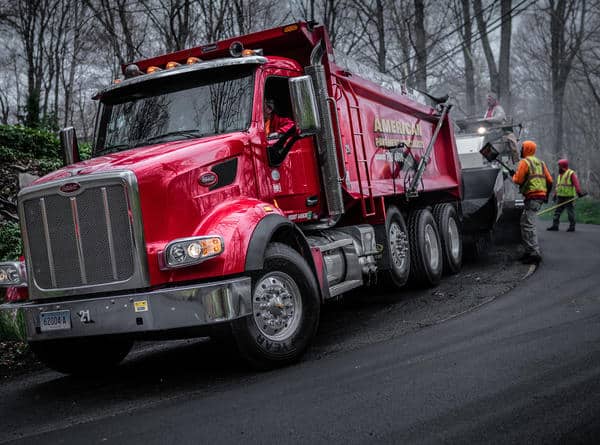
After decades of paving steep grades, Bill Stanley breaks down 10 rules that help crews plan, pave, and compact asphalt safely on hills.
Paving on hills can be an adventure—and not always the fun kind. Once you get above about a 7-10% grade, especially if there’s a turn involved, everything changes. Equipment performs differently. Trucks behave differently. Rolling is different. Even what the finished pavement looks like is different from flat ground.
We pave hills all the time where we’re at, and we’ve learned the hard way that you can’t treat them like a normal job. Safety, planning, mix choice, hauling, and traffic control all get amplified. If you don’t recognize that going in, a hill will find every weak spot in your operation fast.
Here are 10 rules we follow to safely plan and execute a hill paving job.
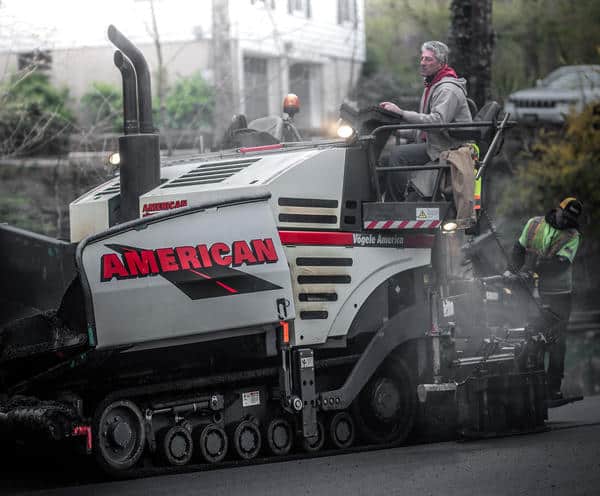
Bill Stanley operates the paver during a hill paving job. On steep grades, experienced operators are critical for maintaining steady material flow and keeping the machine moving smoothly.
Manage Customer Expectations
When we quote a hill job, the very first conversation we have is about expectations. Paving up or down a hill is not the same as paving flat ground, and if you don’t explain that up front, you’re setting yourself up for problems later. Hills don’t roll the same. They don’t finish the same. And they don’t behave the same under equipment.
So we warn them early. We explain that hills may show more texture, more movement, or minor imperfections—and that’s not a failure. That’s the reality of gravity, traction, and safety all fighting each other.
Beyond the Spec Book: Bill Stanley’s Standards for Blue-Collar Quality Control
Choose the Right Mix
On steep grades, mix selection matters more than people realize. We don’t want a soft, sandy mix on a hill. That kind of material is fine on flat driveways, but on a slope, it wants to push, shove, split, and move.
On hill jobs, we typically order a more aggressive, stony mix. It holds together better under the rollers, gives better traction, and stands up to the extra wear you get from vehicles climbing and braking on a slope. In snow country, that added texture also helps with winter traction, which some customers specifically ask for on steep hills.
On hills, we often recommend going thicker than we would on flat ground. It’s not about appearance—it’s about durability. The wear factor on a hill is much higher, so if a job is typically a 2-inch pave, we may recommend going heavier, closer to 3 inches.
Plan Drainage
Drainage is a big deal on hills. We all know what happens when water sits on the pavement, but if water moves across the pavement too fast for too long, it can cause stripping.
When we can, we’ll pitch the pavement left to right, right to left, or add a crown to get the water off quickly. On some jobs, we’ll even build what we call a whoop-de-doo—a slight bump or cross slope—to break the flow and kick the water off the pavement partway down the hill instead of letting it run all the way to the bottom.
We also try to avoid curbing on hills unless there are proper catch basins. Once water leaves the mat, it has to go somewhere, and if the edges aren’t protected with curb, shoulder material, or a swale, that runoff will erode the sides of the hill and undermine the pavement.
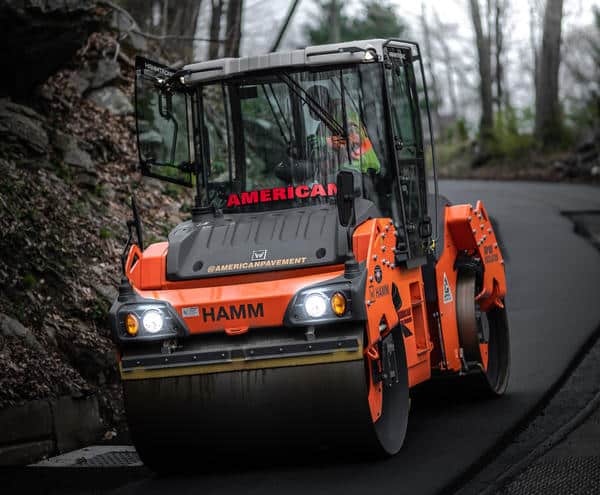
A roller operator begins compaction on a freshly placed mat along a steep roadway. On hills, crews typically start with lighter rollers and allow the mat to cool slightly to reduce the risk of pushing or tearing the asphalt.
Position Equipment Safely
Before we ever start paving, we think about how we’re getting equipment onto the hill and how it’s going to behave once it’s there. With a paver, direction matters. If we’re paving downhill, we’ll drive the paver down the hill. We don’t back it down. If we’re paving uphill, we’ll back the paver up the hill, not drive it up. That keeps the weight where it belongs and helps maintain traction. Lastly, we only ever pave on hills with our tracked pavers.
Rollers also need to be thought through before they ever touch the mat. On steep grades, we want two-wheel-drive rollers, not single-drive machines that can spin easily. Getting equipment positioned safely and correctly at the start makes everything else on the job go smoother and safer.
When we’re paving on a hill, we bring our best equipment. Trucks, pavers, and rollers all need to be in top condition, especially brakes and traction. If a piece of equipment is compromised, it doesn’t go on a hill job, because on a steep grade, equipment problems turn into safety problems.
Deliver Mix with Care
Hauling changes immediately when you’re on a hill, and the first concern is safety. When a truck is backing up or down a grade, braking, traction, and bed lift are all working against gravity. Backup alarms mean something different on a hill. When you hear one, everyone needs to be clear, because mistakes can get worse on a slope.
Truck selection and driver experience matter a lot here. We put our best drivers on the steepest parts of the job. If a driver is green and the hill is severe, we’ll stage the truck at the top and have one of our experienced drivers bring it down and unload. We’ll also stage trucks on flat ground and bring them up one at a time instead of stacking trucks on the hill.
Lastly, we don’t run full loads on hills. If a truck normally hauls around 22 tons, we’ll cut that back depending on the grade. Lighter loads are safer for backing, easier on brakes, and put less strain on the truck when the driver raises the bed.
What Goes Up… Must Come Down | Paving downhill brings its own set of problems, and one of the biggest is material control. When the paver is pointed downhill, asphalt wants to move. If you’re not careful during loading, material can roll out of the hopper and spill in front of the paver, getting under the tracks. On a steep grade, that can cause a machine to move when you don’t want it to, and that’s a dangerous situation.
Balance Tack
Tack is important on any job, but on a hill you have to think about safety just as much as bond. You need enough tack to properly bond the lifts together, which is especially important on a slope where gravity is always working against you. At the same time, you don’t want a surface that’s so slick that a truck or the paver can lose traction.
Trackless tack can help, but it has to be applied right. If it’s too heavy or still wet, a truck backing down a grade can slide when it hits the brakes. Because of that, when we can, we’ll tack hours ahead of time or even the night before, so it’s set up and dry before trucks are on it.
You also have to remember that the asphalt itself can move on a hill. If the tack is too heavy and the mat is hot, the material can slide when you start rolling. It’s always a balance—enough tack to do its job without creating a safety issue.
Deliver to the Paver
Overloading the paver on a hill can cause it to spin, lose traction, or jerk the screed when you try to move. That’s why on steeper grades, we don’t overload the hopper. We’ll fill it partway and take a lot of small dumps instead of one big one. We also try to avoid loading the paver in the steepest part of the hill. Instead, we fill lower on the grade and then pull through the steep section before the next dump.
Whether we’re paving on flat ground or a hill, we never want the truck bumping the paver. On a hill, the truck will stop close, but it will stop a little farther away than it normally would, just in case it can’t stop as quickly on the grade. Just like any other job, the paver will drive into the truck. But unlike any other job, the paver does not (and probably could not) push the truck.
On hill jobs, having a dump man helps a lot. Someone watching the dump, flagging the driver, and guiding how close to get, when to stop, and how much to raise the bed keeps everything controlled and prevents problems before they start.
Change the Paving Technique on Grades
On steep hills, we don’t try to pave full width. Opening the screed all the way and loading it up with material is a good way to get stuck. The wider you go and the more material you carry, the harder it is for the paver to pull. We’ll narrow it up, even if it means making an extra pass, because less material on the screed and less weight in the machine gives you a much better chance of climbing without losing traction.
Control the Roll
Rolling on a hill takes a quality operator. Going up a hill, a roller can spin and tear the asphalt. Going down a hill, it can push it. Because of that, the first thing we do on steep grades is go with one of our lighter rollers.
Temperature matters more on hills, too. If the asphalt is too hot, it makes both of those problems more likely, uphill or downhill. Because of that, we’ll often let the mat cool 10 to 15 degrees more than we normally would before rolling. We also don’t let rollers get nearly as close to the screed when rolling downhill, for obvious reasons. Sometimes, we’ll even take the screed operators off the screed.
There’s no uniform rolling pattern for all sloped jobs. But one rule we follow is the roller will climb the hill on material that’s already been rolled and make new passes coming back down. That way, every time the roller goes uphill, it’s on asphalt that’s already been compacted, which helps reduce spinning and damage to the mat.
Manage Traffic Control
On a hill, sightlines are shorter, cars come over crests or around curves faster than you expect, and drivers don’t always see what’s happening until they’re right on top of the job. This makes flagging and traffic control even more critical.
On steeper hill jobs, we’ll shut traffic down while trucks are on the hill. There’s no safe way to have a truck backing on a grade and cars trying to get by at the same time. We’re not risking the crew, the driver, or the public to save a few minutes.
We also control what’s happening inside the work zone more tightly. We don’t have laborers standing near moving equipment, and nobody is walking between trucks, pavers, or rollers on a hill. When machines are moving on a slope, people are clear and out of the way.
In our neck of the woods, we sometimes pave what I like to call goat paths. On these really steep hills, we take a different approach. We might pave two lifts instead of one, paving the first lift downhill and the second lift uphill to get to the required thickness. Pulling uphill on asphalt reduces the amount of mix we’re loading into the paver, and it gives us better traction than we’d have trying to pave uphill on gravel or dirt.
How to Grow Your Paving Business in the Golden Age of Opportunity
Conclusion
Paving on a hill isn’t a different job. It’s the same job, just turned up. Everything is heightened. Trucks, equipment, rolling, traffic, and people all have less room for error. Things happen faster, and when something goes wrong, it goes wrong in a hurry.
The crews that do this work well are the ones that think ahead, slow themselves down mentally, and stay disciplined. You bring your best people, your best equipment, and you respect what gravity is doing to the job. When you do that, you can pave hills safely while building pavement that lasts.
Bill Stanley owns American Pavement Specialists, Danbury, Connecticut, with his wife, Colleen. Stanley has more than 50 years of experience in the asphalt industry.