
From Cages to Cameras: Field-Tested Paver Safety Upgrades
BY Sandy Lender
Augment your equipment some more to make the paving crew’s job safer, more efficient
In the November issue, we looked at a variety of ways to augment the paver delivered from the dealership or auction house, so it might offer its most efficient environment for the paving crew when handling, storing and using auxiliary equipment. Crew members need a safe, uncluttered workspace where they can access an increasing number of tools and tablets during the shift. Let’s take the discussion a step further this month with a deeper dive into safety and trucking, starting with a patent-pending design from N.B. West Contracting Co., Pacific, Missouri.
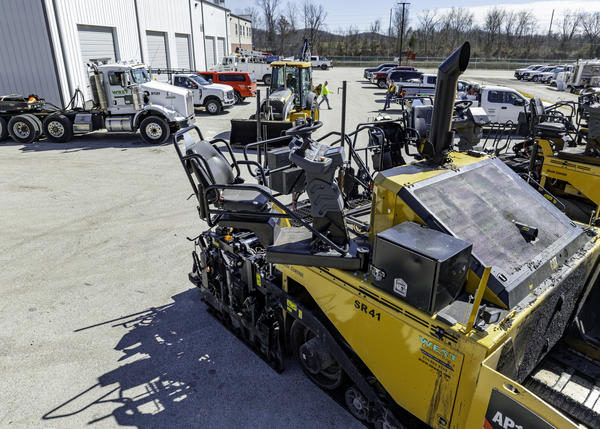
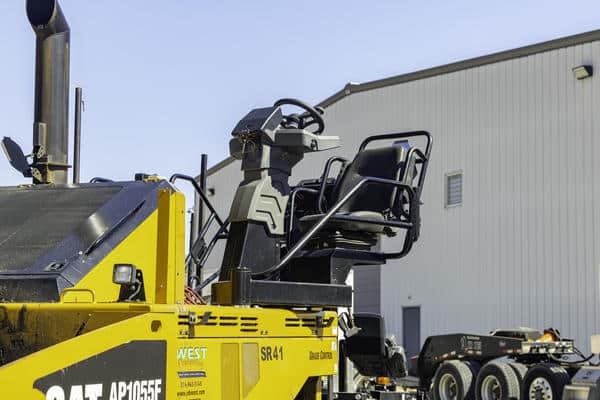
As of November 2024, all seven of N.B. West’s pavers had the safety cages installed. Now paver operators have added protection against struck-bys when they need to position seats for improved visibility. Photo courtesy of N.B. West
Award-Winning Aftermarket Safety Cages
The National Asphalt Pavement Association (NAPA), Greenbelt, Maryland, awarded N.B. West the 2024 Asphalt Operations Safety Innovations Award during a ceremony at the association’s 70th annual meeting, for its protective guards for paver operators. While original equipment manufacturer (OEM) standard guards protect operators in fixed positions, N.B. West’s custom-fabricated guards, welded to the operator’s seat frame, provide protection regardless of seat position. Since the first installation in May 2024, the company had reported zero incidents or near-misses and, as of press time, had received approval to move forward in the patenting process.
NAPA stated in a press release, this worker safety initiative fills a void in commercially available paving equipment protection and offers a replicable solution for other paving companies. N.B. West Safety Director Tim Swaringam confirmed this concept, stating all seven of the company’s pavers, which include various makes and models, had the safety cages installed as of November 2024.
Logistics Manager Noah DeRousse and Shop Manager Nick Brewer worked with Swaringam on the company’s safety committee and helped design and build the protective guards.
Before he took on the role of logistics manager, DeRousse spent six months working directly with Swaringam in the safety department as the field safety coordinator. “During that six-month period, we really worked on these cages and tried to improve the safety of our operators here at N.B. West,” DeRousse said. “Prior to the six months in the safety department, I ran one of these machines…for 21 years. I’ve seen a lot of incidents happen over the years, a lot of operators injured, a lot of really close calls.”
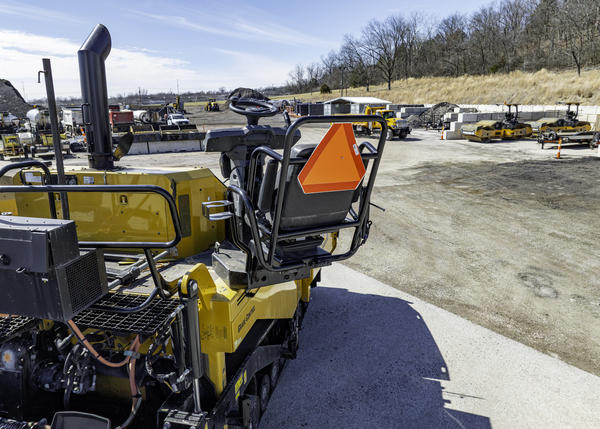
Another aspect of N.B. West’s award-winning safety cage design was to add the slow-moving vehicle triangle as a visual safety factor to the back of the operator’s “seat.” Photo courtesy of N.B. West
Brewer explained that his team in the shop helped design and install the safety cages. He shared that whenever the paver operator’s seat is positioned right along the inside of the confines of the paving machine, there’s protection for the operator with the OEM’s platform structure. This position is typically used when transporting the machine.
“This is more for transportation of the machine out on the highways to and from the job sites,” DeRousse shared. “If I’m sitting here and my asphalt hopper is lifted up…I can see just fine.” If the hopper wings are down for paving, “you can’t see your line. You can’t see where you’re trying to pave. So, you end up kicking this seat out the second or third click. Once you kick it out where you can see down the hopper, then you’re exposed out here if you don’t have a safety cage. Over all my years of running an asphalt paver, I was hit several times—one time causing some nerve damage in my elbow that never has gone away. And every operator that I’ve known that’s been a paver operator for any substantial amount of time has been hit or had a really close call. I would say over my 20-year career, probably 15 times I had trucks hit the back of my seat. Not all of them have hit me, but it would only take one to be a really big injury for someone.”
The safety cage design includes signage to alert drivers that the seat has been kicked out from the confines of the operator platform. Swaringam and Brewer spoke of adding the slow-moving vehicle triangle to the back of the operator’s seat.
When the operator moves the seat “out” to get a better view for paving, his upper torso is exposed. “The only thing protecting him is the back of that seat, which doesn’t really provide any protection at all,” Swaringam said. “Anything that hits that seat could possibly harm the operator. At nighttime whenever there’s low visibility, you can see there’s nothing on the back of that seat to visually see the operator sitting out there. The only thing is [the operator’s] Class 3 vest, but that’s really all that a passing motorist would see is his sleeve sitting there.”
The team began problem-solving by considering administrative controls—such as how to adjust truck driver behavior. But a truck pattern can’t always be perfected in a tight work zone, and passing motorist behavior is an uncontrollable variable. The next step was engineering controls—that’s where the safety cages began. The last step is personnel protective equipment (PPE), but the team focused on an engineered solution.
“That safety cage provides a lot of protection for the upper torso, the neck and back and head area, the sides. Whenever Nick designed this, he designed it where the side flanges actually will deflect anything away from the operator, not allow it to come in.”
“It was kind of a different aspect for me,” Brewer said. He shared that oftentimes, when different department heads approach the fabrication shop to make equipment modifications, the purpose is to increase production or functionality. This was one of the few times he’d been involved in a project with the sole purpose of increasing safety for the operator. “So, it was a little bit of a different kind of scope, but I wanted to design something that gave the operator a lot of protection, but didn’t disrupt the communication between him and the screed or anybody else working behind the paver or any trucks while using the paving machine. So, it started as just a simple sketch. I went around and took measurements because we own several different models and several different brands of machines. I wanted [the cages] to be somewhat universal, easy to install, and provide the protection needed…It seems to provide a lot of protection for the operator with no downfall of communication visually or verbally.
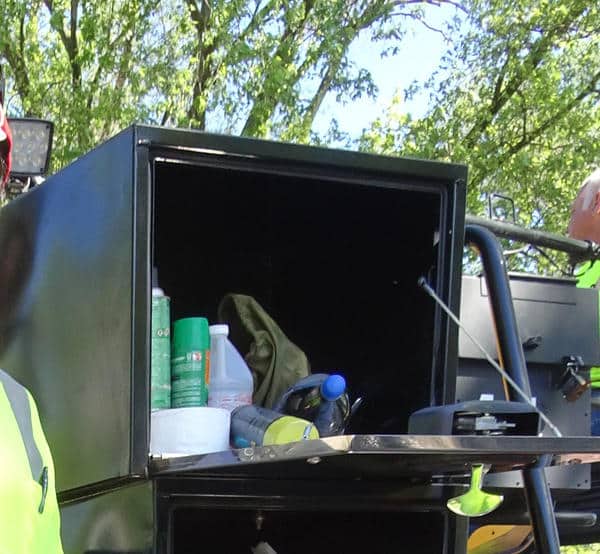
This crew has affixed an 18- by 24-inch box on the back of the paver to store pavement marking paint, headsets, measuring tape, release agent spray and other smaller items you don’t want to trip over or lose track of at the side of the project. The box can include a lock to protect the expensive items like headsets or sensors overnight. Photo courtesy of Ball
“Another aspect of the design was to add a visual safety factor as a slow-moving vehicle triangle to the back of the operator’s protection.”
The award committee for NAPA helped N.B. West create a video announcing their achievement in which Swaringam said, “It really helped propel our safety culture to a more collaborative safety culture where everyone wants to be involved in making safety innovations and looking at ways that we can improve our safety out in the field, for our workers that are working out there every day.”
Not only the collaborative nature of the project, but the winning of an award for the effort has brought renewed energy to the safety culture. “This really brought a lot of energy to our field workers to be bringing up safety innovative ideas to us…we’re all a team, we’re all trying to achieve the same goal, and that’s to make sure that the employees working out in the field make it home safely to their families every night.”
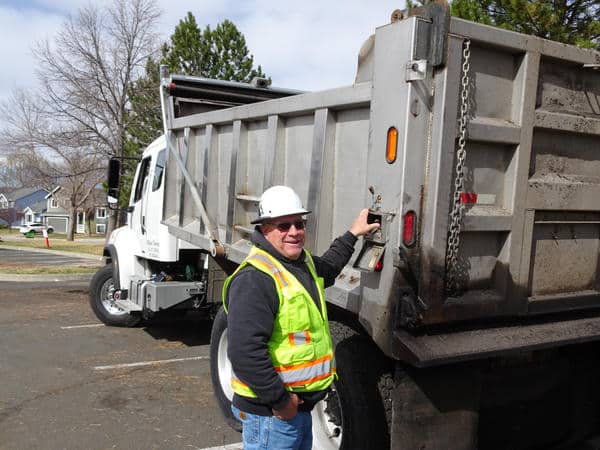
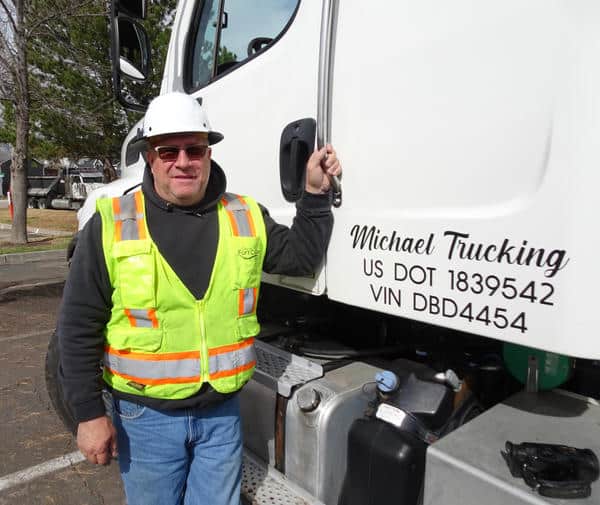
To help the paving crew when doing handwork, Dwight Michael of Michael Trucking, Ft. Collins, Colorado, installed a covered switch at the back of the haul truck. Now, from outside the cab, he can toggle the switches to hydraulically raise and lower the truck bed. The round button above the two switches turns the hydraulics on. Photos courtesy of John Ball, Top Quality Paving & Training, Manchester, New Hampshire
Safe Hauling
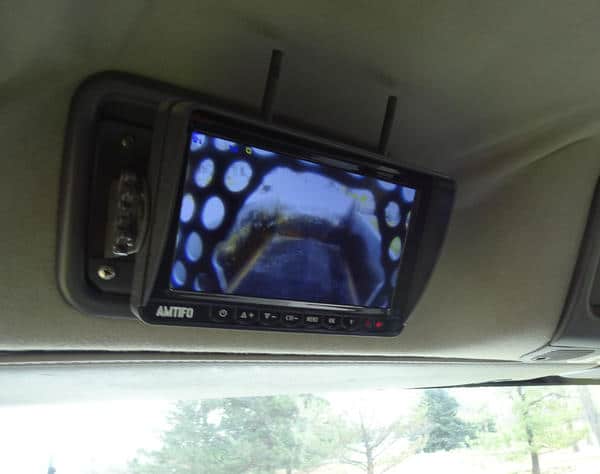
Dwight Michael of Michael Trucking, Ft. Collins, Colorado, has taken safety and efficiency a step further by installing a camera atop his haul truck cab and directing its feed to a screen above his driver’s seat. This helps with safety because, from inside the cab, he can monitor what’s happening in the truck bed. The camera lens is protected by a steel-mesh screen bolted around the camera’s housing.
The camera Michael installed is protected by a steel mesh cage. Photos courtesy of Ball
When sharing mix delivery and loadout articles, AsphaltPro Magazine reminds haul truck drivers to stay inside the safety of the haul truck cab at all times. We’ve stressed the importance of building systems at the asphalt plant and cleanout areas near the work zone to enable drivers to do all the stages of their jobs without having to wander around dangerous areas. Keep in mind, there are exceptions to every rule.
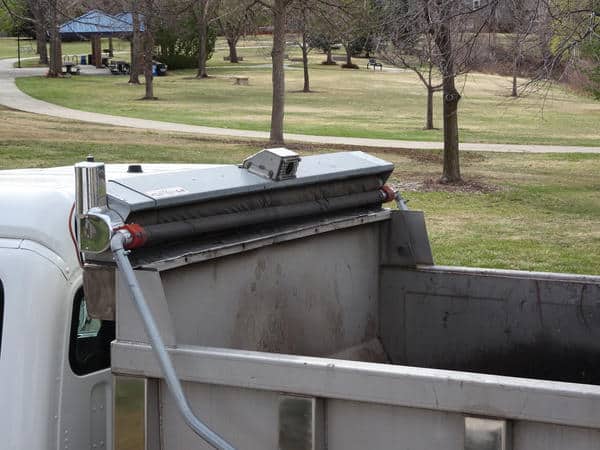
Dwight Michael of Michael Trucking, Ft. Collins, Colorado, installed a camera atop the cab of his haul truck. The camera gives him a view of the haul truck bed on a monitor while he’s in the driver’s seat. Photos courtesy of John Ball, Top Quality Paving & Training, Manchester, New Hampshire
Michael is an entrepreneur who has devised a way to safely and efficiently help the paving crew that performs extensive handwork. In this case, he has built a hydraulic control at the back of his truck for lifting and lowering the bed when he’s outside the cab.
Dwight Michael of Michael Trucking, Ft. Collins, Colorado, installed a camera atop the cab of his haul truck. The camera gives him a view of the haul truck bed on a monitor while he’s in the driver’s seat. Photos courtesy of John Ball, Top Quality Paving & Training, Manchester, New Hampshire
The control is housed in a protected box on the side of the truck. Inside is a button to turn on/off the hydraulics and two toggle switches to raise or lower the truck bed. In the image in this article, you can see the chute in the center of the tailgate, which will feed material to the wheelbarrow as Michael gently lifts the bed with the toggle switch. You can also see in that image that Michael has parked the truck on a solid, level surface for this work.
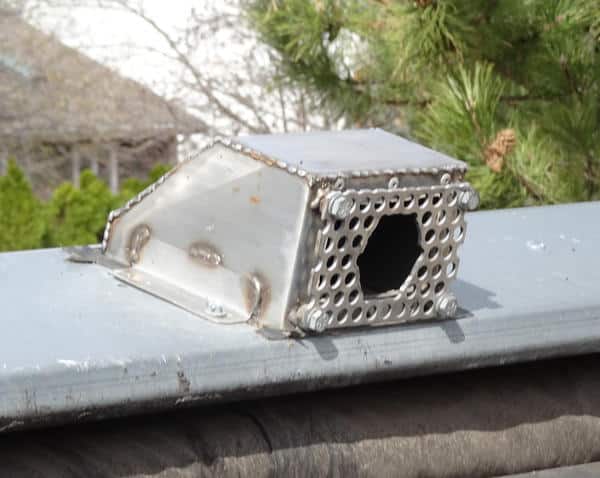
The camera Michael installed is protected by a steel mesh cage. Photos courtesy of Ball
Because he has built this hydraulic system and can control it from this safe vantage point, he can watch and control the material flow without running back and forth from the cab to start the truck, raise the bed, etc. He has made the operation more efficient for the laydown crew he works with as well as himself.
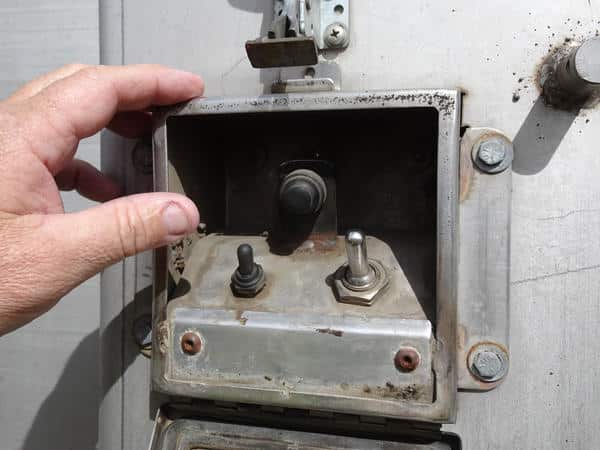
To help the paving crew when doing handwork, Dwight Michael of Michael Trucking, Ft. Collins, Colorado, installed a covered switch at the back of the haul truck. Now, from outside the cab, he can toggle the switches to hydraulically raise and lower the truck bed. The round button above the two switches turns the hydraulics on. Photos courtesy of John Ball, Top Quality Paving & Training, Manchester, New Hampshire
As we saw in the November issue and here, many crews in the field devise those extra systems and clever contraptions to give equipment in the work zone that additional edge when it comes to safety and efficiency. Tell us about the unique device or setup your crew has built to make the job easier, faster or safer. You can share on our social media channels or send an email to our editor, sandy@theasphaltpro.com.
Watch a video from N.B. West Contracting on the creation of the safety cages at the company’s YouTube channel.