Meeker Streamlines Conveyors for Customers

Consistent, reliable components shore up the supply chain for OEMs and producers

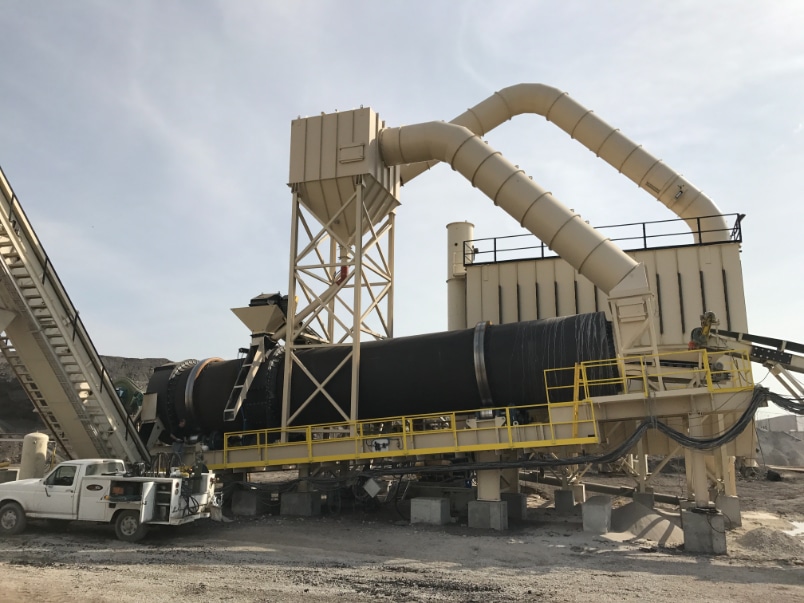
In the hot-mix asphalt (HMA) industry, time is of the essence to store and transport asphalt. Meeker Equipment, a family-owned company in Belleville, Pennsylvania, offers HMA storage silos designed to provide an innovative solution to maintaining the temperature of the product.

Meeker constructs silos to have a “coffee thermos” effect for the HMA. They seal the tops and the bottoms of their silos to keep the HMA hot inside, while minimizing any air getting in. By sealing the silos, their customers can store material overnight—or however long is necessary for best production management.

How to Inspect the Drag Slat Conveyor

Components not only have to stand up to the harsh application needs of the asphalt and aggregate industries, but stock must be readily available for Meeker to acquire.

Meeker makes most of their products in-house. When looking for a parts supplier, Meeker sought a company that not only matched its company values, but also matched the level of quality its customers have come to expect. High-quality products and quick delivery are crucial for success in the asphalt and aggregate industries, so these components would not only have to stand up to the harsh application needs, but the supplier would also need stock readily available for Meeker to acquire.

This brought Meeker to Regal Rexnord Corporation, Milwaukee, Wisconsin.

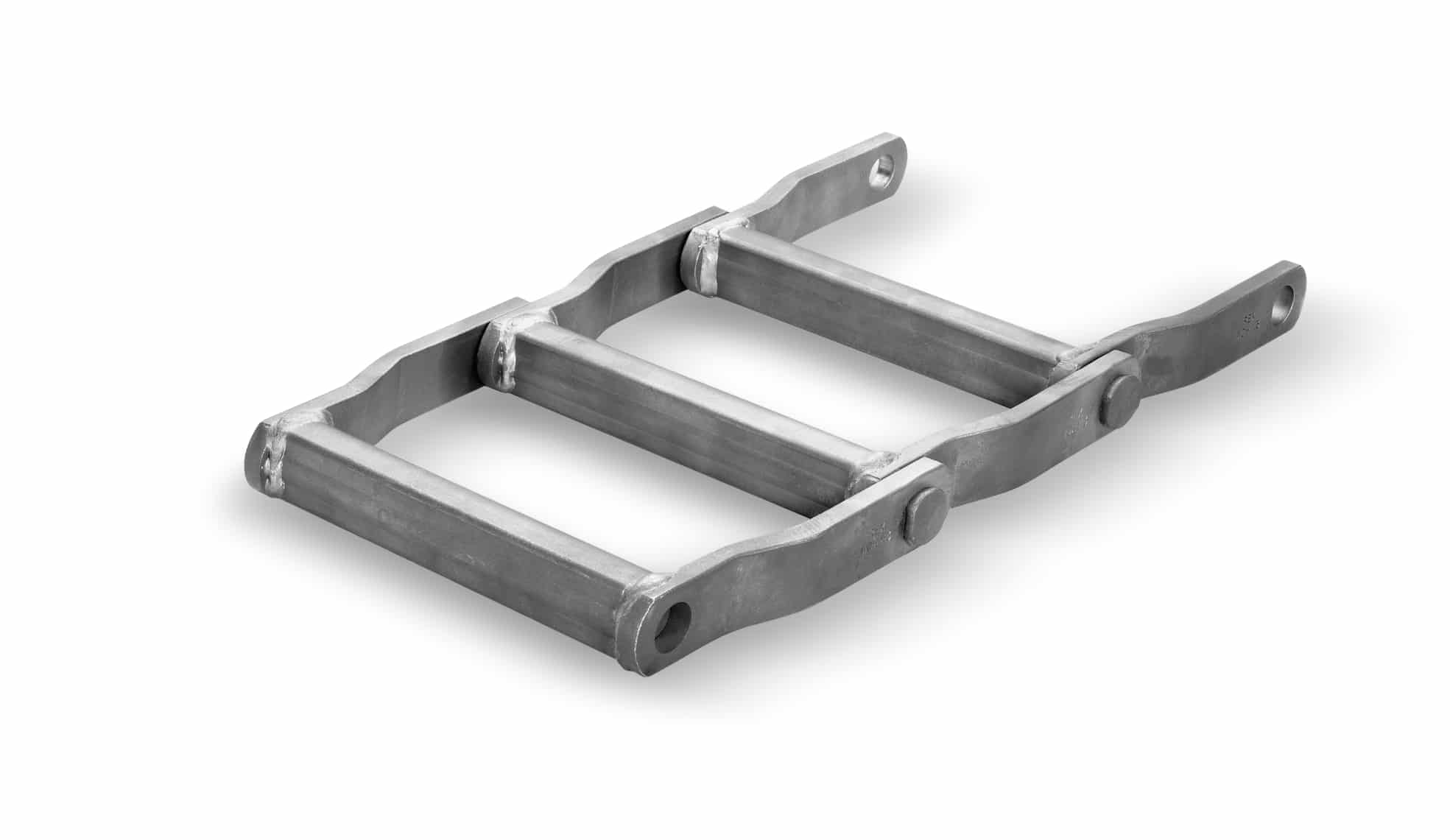
The broad Regal Rexnord portfolio provides a “one stop shop” for customers to have a single source supplier for their components. Kyle Zimmerman pointed out Regal Rexnord now offers chain, bearings, Planetgear reducers, as well as Omega couplings to Meeker, constituting a significant portion of the slat drag conveyor. Photos courtesy of Regal Rexnord

“Meeker provides a quality product to the asphalt industry thus [we] want to partner with similar manufacturers who offer high quality products, as well have a good name in the industry,” Kyle Zimmerman said. He’s the inside sales supervisor/business development for Meeker. “Regal Rexnord is certainly a company that fills those requirements.”

The partnership between Meeker and Regal Rexnord began with engineered steel chain for their drag slat conveyor for the asphalt silos. Meeker had used other chain manufacturers in the past. After testing out the chain from Regal Rexnord and seeing improved performance, Meeker decided to make it a standard component on the drag slat conveyors for its customers.

Conveyor Chain Stretch Will Drag Profits Next Season

For further optimization, the relationship later expanded to include additional components recommended by Regal Rexnord expert engineers. These included Rexnord® Planetgear™ speed reducers and Omega® couplings, along with Link-Belt flange bearings, for a complete powertrain solution that fit Meeker’s asphalt application needs.

Zimmerman stated: “Meeker has observed ROI by working with a manufacturer that can offer ‘one stop shopping.’ With Regal Rexnord now offering chain, bearings, Planetgear reducers, as well as Omega couplings to Meeker, this constitutes a significant portion of the slat drag conveyor. This results in saving time and offers us a cost savings when processing orders.”

Here’s Your Next Best Asphalt Plant Investment

Since partnering with Regal Rexnord, Meeker has seen significant returns with their drag slat conveyor applications in the asphalt silos. With components from Regal Rexnord being readily available for timely purchase and implementation, they have noticed a reduction in both maintenance and production time and allowed for strategic planning of orders for Meeker customers.

The broad Regal Rexnord portfolio provides a “one stop shop” for customers to have a single source supplier for their components. By partnering with Regal Rexnord, Meeker streamlined its purchasing. Being able to obtain a significant portion of the components needed for its drag slat conveyor from one supplier instead of four separate suppliers allowed the company to save both time and money when processing orders. Meeker has also seen uptime increases with customers’ equipment due to the high-quality components Regal Rexnord supplies.

Meeker Equipment Introduces Line of Vertical HMA Bucket Elevators

In addition to working with one supplier, Zimmerman said he enjoys having a close relationship with a single point of contact. Mike O’Connor, a longtime heavy industry account manager, has been Zimmerman’s point of contact at Regal Rexnord since day one.

Zimmerman said, “Meeker Equipment has always prided ourselves on building relationships with like-minded organizations and people. We consider our customers and suppliers as partnerships no matter how large or small the scale. Mike has always provided a level of communication and forwardness that creates a positive partnership between Meeker Equipment and Regal Rexnord. As we continue to grow as a company, our partnerships solidify a foundation to providing a quality product at a competitive price.”

For more information, visit Regal Rexnord Powertrain Solutions at www.regalrexnord.com or Meeker at www.meekerequipment.com.

How to Make Your Plant Efficient, Part 2

Astec Industries offers more ways plant efficiency can reduce your carbon footprint before and during next season


Editor’s Note: For 2024, AsphaltPro Magazine allows experts in the industry to share how to expand your operations to the next phase of business. Are you ready to build or update your own hot-mix asphalt (HMA) plant? Let’s turn to some professionals who have equipment, services, software and tenure to help you expand to mix design, production, hauling and more. This installment from Greg Renegar, vice president of customer success at Astec Industries, dives into the environmentally responsible task of implementing tactics that reduce carbon and increase efficiencies throughout the plant.

It is possible to work hard at being more energy efficient and not really move the needle. It is also possible to create a culture of efficient plant operational behavior and have an efficient operation that requires little extra effort.

The key is understanding your plant’s energy needs, knowing how to reduce required energy, reduce energy losses, and understanding how overall plant operations can have a significant impact on energy and profitability.

A sustainability / energy efficiency revolution has started, and this article discusses proven methods and strategies to use significantly less energy.

Relieve These Top 8 Pain Points When Laying Out Your New Plant

Producing asphalt with less energy requires understanding where the energy (heat) goes; how much goes into the mix, and how much escapes. In addition to minimizing hidden energy losses, there are operational strategies that can have a significant impact on overall energy consumption. The following suggestions will help producers minimize energy consumption per ton, maximize profitability and maintain high mix quality.

In this discussion, efficiency is defined as producing the greatest quantity of mix with minimal energy. Although the largest portion of the energy (heat) comes through the aggregate dryer burner, there are other plant-related activities that consume energy; e.g., liquid asphalt tank farm, front end loader, etc. For this discussion, the energy consumption considered will begin at the stockpiles and continue to the silo loadout.

Plant operation methodologies can certainly move the needle with respect to efficiency, but there are several efficiency basics that should be considered for every plant operation. Each topic below plays a part in maximizing plant efficiency.

  • Operate at the lowest drum gas outlet temperature possible, but always stay safely above the dew point in the baghouse. Excessive stack gas temperature is wasted energy. Using variable frequency drive (VFD) technology to vary the speed of the aggregate dryer (with appropriate flighting) can minimize stack gas heat loss for each individual mix design and production rate.
  • Ensure that the burner system is capable and tuned to operate with a balance of minimal excess combustion air and minimal CO emissions while not overheating the dryer shell. This will help minimize the fuel per ton and maximize the tons per hour. The burner must be tuned to perform in the ranges encountered in day-to-day operation. Electronic air-to-fuel ratio control has an advantage over mechanical linkages in that the efficient burner output range can be maximized.
  • Use VFD technology to replace outlet dampers on large centrifugal fan drives, like the baghouse exhaust fan. The electrical energy savings will be significant. There are other benefits as well.
  • Manage the mix temperature. Address excessive mix temperatures, and when possible, use a warm-mix technology (foam or chemical) that allows lower mix production temperatures. A lower mix temperature means less energy is required. The impact can be significant. VFD technology can help keep drum exit gas temperatures above the baghouse dew point while running cooler mixes.
  • Select the most economical, emission compliant, available fuel and use it well. For example, waste oil must be conditioned correctly, or it can significantly diminish anticipated fuel cost savings by damaging downstream equipment. Each fuel/burner combination has its own operational characteristics. It is important to be aware of those characteristics. For example, natural gas might be the preferred fuel, but some older technology burners do not completely burn natural gas at higher firing rates.
  • Insulate everything too hot to touch on the asphalt tank farm/hot oil system. When this is not done energy “trickles” away hour by hour.
  • Do not neglect hot oil system burner tuning. It is a relatively small burner, but it runs much of the time. Also, recover otherwise wasted heat in the hot oil heater exhaust with available heat exchanger solutions.
  • Manage waste mix by minimizing production stops and starts. Start-up and shutdown at the same low production rate to reduce waste. Covering material in the cold feed bins if rain threatens also helps reduce waste mix.
  • Design the plant site to minimize front-end-loader operation.

Expand into Production: Plant Ticketing Software Basics

How to Run a Plant

Next, two schools of thought regarding how to operate an asphalt plant for maximum efficiency will be examined.

One school of thought is to simply keep the plant running throughout the day, faster or slower, depending on how the day develops. In this scenario, midstream stops/starts are avoided as well as stops and starts where the plant is cleaned out.

Many plant production managers follow this simple methodology because it allows flexibility for unpredictable production demands, produces a higher quality of mix via the steady state flow of mix constituents, and minimizes the risk of unscheduled downtime. Although this strategy is flexible, it is typically reactionary. Often little is done to proactively create conditions where a more efficient operation can occur.

Another school of thought is to run the day’s production at the highest production rate possible and store the mix until needed. The goal is to produce at a rate where the plant is most efficient. This assumes that plants run more efficiently closer to the rated production. A 2,500-ton day might look like 6.25 hours of production at 400 tph versus 8 hours at 313 tph.

Expand Into Production: Navigate the Permit Process

Regarding which school of thought is best, it depends on the plant equipment capabilities, training and local market constraints.

The simplest production scenario is knowing the mix type(s) and quantity(s) required for a day’s production and having adequate surge/storage capacity.

With this ideal scenario, one could make a case for the production methodology of running at the highest efficient production rate and storing the mix until needed.

The most efficient production rate will depend on several factors, which vary from plant to plant. It will be a balance of the highest production rate and the lowest drum exit gas temperature. Also, for this to be the most efficient condition, the burner must also have a balance of the correct amount of combustion air (too much is bad, and too little is bad) and low CO emissions. This requires having the right burner technology, controls, maintenance and adjustment.

For example, if the plant can produce 360 tph, but the stack temperature is 300°F, that is probably not the most efficient operational condition. If the stack temperature is, say, 220°F at a lower tph, then that might be a more efficient point from an energy (fuel) consumption viewpoint.

One could operate at the more efficient, lower production rate or take steps to lower the stack temperature at 360 tph, thus becoming more thermically efficient. If a lower production rate is the most energy efficient condition, one must consider the effect of taking longer to make the mix and the amount of mix that can be supplied in a day/week/year.

Higher level business “efficiencies” could mean the plant should operate at a less-than-optimal condition from a thermal energy consumption viewpoint. Optimizing a single efficiency (plant or business) might not be the best course of action in every situation. The goal is to have the equipment technology and training provide optimized plant production (high tph and high efficiency) simultaneously with optimum business efficiencies.

How to Become Your Own Hot-Mix Supplier

Electrical efficiency is another factor to consider. Once the large centrifugal fan drives use VFD technology, the most electrically efficient production rate is where the electrical motors, without VFD drives, are operating between 75% and 100% of rated load. It is important for the electrical power factor (how efficiently electricity is being used) to be high enough to avoid excessive utility bills as well as utility penalties.

The second production scenario is when the mix type and mix quantity is known, but there is not sufficient silo/surge capacity to produce the mix at the maximum production rate. In this case, the best one can do is produce the mix at a production rate that balances demand and silo capacity but keeps the plant running at steady state as much as possible.

Maximum plant energy efficiency in this scenario results from a handful of best conditions:

  • Running steady (no stops)
  • Burner efficiency
  • Dryer heat transfer being efficient at different production rates. In other words, getting the heat into the aggregate while maintaining low stack temperature.

This can be very difficult to accomplish with older plant technology, but is the methodology followed by many production managers. It balances production output, efficiency and mix quality.

What You Need to Know About Burner Size and Performance

The goal is to have the equipment technology and training provide optimized plant production (high tph and high efficiency) simultaneously with optimum business efficiencies.

When multiple mix designs must be produced from a continuous plant, the most efficient way to operate is to start out producing the finer mixes, and transition to the coarser mixes. The reason for this is to make “on-the-fly” mix changes where the larger aggregate cannot contaminate the next mix being produced. A modicum of communication and planning is required to obtain this degree of efficiency. One successful contractor was quoted as saying, “We aren’t the best communicators in the world, but we at least try to know what we have to produce the next day.”

Even after communicating as much as possible, changes will occur, but having an idea about mixes and quantities still helps plan for the most efficient production day.

The final scenario describes a very efficient asphalt plant operation. Note that in this last scenario, the energy basics have been addressed; therefore, there is little energy “left on the table.”

Add High-RAP to Your Production

  • The day starts with silos full of mix produced the previous afternoon. This would have kept the plant running, filling silos, even if the plant was “on hold” while a paving crew determined the final amount of mix needed to finish the previous day.
  • Communication with internal and external customers makes it possible for the first round of trucks to depart with mix made the day prior.
  • Even if you experience a plant issue that delays start-up, trucks can be loaded with stored mix while it is being addressed.
  • The first mix production of the day can be started with only a couple of tons of waste. This can be taken to the RAP pile to be “trickled” in later.
  • The day’s production was planned with the finer mixes being made before the coarser mixes so the changes could be made “on-the-fly.”
  • There is enough silo capacity to enable transitioning from one mix to another without stopping the plant.
  • The day starts with one dedicated silo filled with a fine mix for the private customers who arrive unannounced so they can be serviced quickly. Quick service ensures continued business.
  • As the day’s production demands wind down, the plant fills the silos for the first round of trucks the next morning. If the jobs are rained out, the mix can be stored until the weather clears.
  • The plant is shut down at a low production rate (same as start-up) and only produces a couple of tons of waste.
  • If rain is forecast overnight, the cold feed bins can be covered. Without a change in moisture in the start-up aggregate, the operator knows where the burner needs to be to start up with minimal waste.

This final scenario illustrates what a very efficient asphalt operation can look like. There is no new technology that makes efficiency suddenly appear. The efficiency is simply a result of taking care of the basics and operating with common sense.

In summary, there are several facets to maximizing plant efficiency.

Step Up Hot-Mix Production with Your Facility’s Own Crushing Plant

There are the energy “basics,” some of which are listed above, that every plant operation should consider. Some are major and some are minor depending on each plant/market situation. There are equipment requirements, such as the drying system, exhaust system, storage/surge capacity. There are training requirements so the production manager, plant operator and loader operator understand the “whys.” There are management requirements to ensure correct actions occur consistently. No efficiency “basic” or methodology is effective without consistent action.

In general, plant efficiencies that are behavior-dependent can be maximized by the three “Rs.”

  • Record: Anything that is recorded receives more attention.
  • Review: Review progress of that which is recorded. This heightens attention to the next level.
  • Reward: Done well, this can not only keep efficient behaviors in place, but result in additional efficiencies.

As the asphalt industry continues to hyper-focus on energy efficiency and sustainability, it is important that there is a thorough understanding of the factors that can make a real difference. The good news for producers is that energy efficiency and sustainability can increase quality and profitability. The good news for the public is that energy efficiency and sustainability increase the miles of paving possible for each tax dollar.

How to Make Your Plant Efficient, Part 1

Industry veterans offer real-world scenarios for planning or updating efficiencies to make your asphalt plant its most sustainable and cost-effective operation.


Editor’s Note: For 2024, AsphaltPro Magazine allows experts in the industry to share how to expand your operations to the next phase of business. Are you ready to build or update your own hot-mix asphalt (HMA) plant? Let’s turn to some professionals who have equipment, services, software and tenure to help you expand to mix design, production, hauling and more. This month’s installment takes a deep dive into the environmentally responsible task of finding and implementing tactics that reduce carbon and increase efficiencies throughout your HMA plant.

For our final two-part installment of 2024 in the series on expanding your asphalt business, we’re looking specifically at reducing your carbon and environmental footprint at the hot-mix asphalt (HMA) plant. No two plants are alike, but of course similarities abound. Those constants help us identify scenarios wherein problems can be averted and best practices implemented. For example, at one of the many National Asphalt Pavement Association (NAPA) environmental committee meetings I’ve attended, Ron Sines of CRH shared with the attendees his top “quick tip” of turning off the lights.

Every asphalt plant that runs past dusk will turn on the lights for safe operation. When the sun comes up, leaving the lights on is a waste of energy as well as utility budget. Doesn’t that sound simple? Sines has stated that it’s an easy fix for a plant manager to put lights on a timer but it’s not a fix that everyone stops and thinks about.

In the August 2020 issue of AsphaltPro, we reported on the ENERGY STAR program that NAPA and the U.S. Environmental Protection Agency (EPA) were introducing to the asphalt industry. The article here includes the “treasure hunt” concept that helps asphalt producers discover simple-to-complex energy savings like the one Sines starts with when decreasing a plant’s environmental footprint.

How to be an ENERGY STAR®

If you’re in the planning phase of setting up your plant, which is the spirit of the Expand Your Business series, you may not be ready to conduct a treasure hunt in a full-fledged ENERGY STAR capacity. Instead, let’s take a look at the laundry list of great ideas industry veterans like Greg Renegar of Astec Industries, James M. (Jay) Winford, Jr., and Troy Bollich of Prairie Contractors LLC, and Malcolm Swanson of E5 Engineers can add to Sines’ advice above. And as you read this article online, share on our social media platforms the tips you would add to this discussion to showcase your industry knowledge as well.

Prairie’s Plant Manager Troy Bollich explained, once the plant is running, you want to keep it running steadily. That takes communication between the foreman at the job site and the plant operator. “Every time the plant starts and stops, the company will lose, on average, 4 to 8 tons of material.”

What You Need to Know About Burner Size and Performance

Access Industry Resources

If you’re assembling your new HMA facility this winter, the asphalt industry has resources to assist you in making it an efficient operation. But how does the industry define efficiency? Over the past few years, you might have heard the word “efficiency” shifting in meaning to include the energy and sustainability discussion. Astec’s vice president, customer success, Renegar, wrote in Part 2 of this feature, “a second sustainability/energy efficiency revolution has started” whereby producers are focusing on where heat can be saved or used more effectively.

For Part 1 of this feature, we’ll look at all manner of energy savings, including heat, to explore areas where producers can improve operations while cutting down on wasteful “emissions.” Winford reminded readers of the brochure NAPA published in 2008. The “101 Ideas to Reduce Costs and Enhance Revenue,” written by Kent Hansen and Roger Sandberg, is available at the NAPA store and includes a list of common-sense tweaks and best practices that a committee of producers shared in the spirit of helping the industry during a fiscally challenging time.

While making upgrades and changes to an asphalt plant is certainly not a game, Winford shared that it doesn’t have to be drudgery either, saying it can be fun to find ways to save money at the plant. “Even if every little incremental change saves a nickel, that adds up to a large amount of savings over a decade because we run such volumes,” Winford said. “The best ways to learn are to visit a best-in-class peer, go to an Astec School and read the AsphaltPro Magazine.”

No matter which component you’ll put on a variable frequency drive (VFD), the electronics must be installed with care. The drives and their wiring must be located in a dust-free, cool environment. Photo courtesy Patrick Ahern of Ahern Industries

Top Tips

Of course, we think those are great tips from Winford! We also like this list of 10 items he prepared for industry peers:

  1. Eliminate air leaks.
  2. Pave stockpiles.
  3. Cover stockpiles where you can; especially the fine aggregate piles that are prone to higher moisture contents.
  4. Insulate everything!
  5. Use variable frequency drives where you can. (Editor’s note: Check out the in-depth article titled “Vary Your Energy Use, Increase Your Utility Savings” and see some of the non-traditional places you can make good use of VFDs from the January 2018 issue.) https://theasphaltpro.com/articles/vary-energy-use-increase-utility-savings/
  6. Use more RAP.
  7. Take advantage of excess sized materials at the quarry/pit.
  8. Maintain proper levels in the silos.
  9. Check aggregate/RAP moistures frequently and keep the plant moisture input accurate.
  10. Make sure the plant is properly calibrated.

Add High-RAP to Your Production

Winford expanded on the concept of RAP, specifically, sharing that not only is it good for the environment when we increase the percentages we use, but that increased use also gives us the opportunity to showcase that we’re engineering the stone back into a valuable product.

For example, Prairie Contractors is one of the producers in our industry that takes milled or fractured concrete and pays a nominal fee to have it crushed to be reused. Every recycled rock that finds its way to Prairie’s yard has a place in our infrastructure. And that’s a win for Prairie, for elected officials and for Louisiana DOT personnel to talk about.

Troy Bollich, the plants manager at Prairie Contractors, reminded readers that fractionating RAP also offers more opportunity. “The process of fractionating the RAP is very important to help in the plant’s efficiency and production.”

Industry Agrees on Efficiency Points

Swanson is the proprietor of e5 Engineers and shared the nuances of correct baghouse sizing in the December 2023 issue’s “Mix-and-Match Asphalt Plants” article, which you can read here.

Mix-and-Match Asphalt Plants

“As I wrote several months ago, mismatched components can stifle production,” Swanson said. “For instance, a baghouse that is too small for the dryer is the bottleneck to the whole plant system.” There’s even more insight on this concept in Part 2 of this feature, by Renegar, on page 46.

Bollich turned to baghouse efficiency when discussing shoring up areas against air leaks. When eliminating air leaks, also check the condition of the bags, Bollich suggested.

For the new plant site, you have the opportunity to slope and pave the area where you’ll build your stockpiles. Renegar shared, if your plant is in an area where rain is frequent, you can better manage aggregate moisture by sloping and paving under the wettest stockpiles. “The impact on energy efficiency and tons produced per day can be significant,” Renegar wrote. “The return on investment occurs quickly.”

Bollich suggested taking the extra time to slope the piles and training the wheel loader to pull material from the “higher” face. This leads into best practices for your loader operator—you’ll want to train him or her to load from the dry side above the moisture line.

“Take the time to explain to your loader man that he can make or break you on the day,” Bollich suggested. “Teaching the loader man to eat the material that is the driest even if it’s eating 2 feet or 3 feet up on the pile is important. A lot of them think it’s just their job to get the material from the pile to the bin. But explaining to them and including them in plant efficiency and operations is key. Remember, they sit in a loader all day without a lot of outside interaction.”

You also want to train incoming aggregate suppliers to dump material where it won’t contaminate the drier material. “This process goes hand in hand with trying to control plant moistures,” Bollich shared. “Moistures need to be checked at least twice a day, if possible. Incorrect moistures can cost you a lot in liquid if not input correctly.”

Step Up Hot-Mix Production with Your Facility’s Own Crushing Plant

Moisture will also affect fuel use, as will temperature loss. Winford listed insulation as one of his top 10 efficiency points, and Bollich echoed that idea. “Insulate all asphalt piping. Once piping is insulated, you will need to retune your heater burner so this is running efficiently. Also, while the tech is there, have him tune the drum burner.”

Swanson reminded readers to assess the burner’s age and condition. “Older burner types that have little control of excess air and combustion efficiency are also a detriment to plant productivity and profitability.”

“Calibration is another forgotten key factor in plant efficiency,” Bollich shared. “Not only is it a huge cost savings but also can eliminate the lab tech from having to spend a lot of time trying to figure out mix design issues.” He explained one of the common factors in deducts on jobs can be linked back to plant calibration.

Increasing the use of RAP also gives industry the opportunity to showcase that we’re engineering the stone back into a valuable product.

How to Be the Plant Everyone Buys From

Calibrate Efficiency

With equipment tuned and calibrated, make good use of the VFDs. Bollich explained that putting the drum on a VFD can help in reducing the drying costs of material. “By speeding it up when it’s dry to slowing it down when it’s wet can save a lot on fuel consumption.”

When you put the drag slat on a VFD, you can expand its wear life. “One of the greatest expenses on a drag is reflooring it,” Bollich shared. “On the average, to redo a drag from material and labor is around $250,000. Slowing the drag down will reduce the wear on the floor and extend the life of the drag floor.”

Swanson also spoke of the opportunity producers have to save on costs and energy when focusing on the dryer and parameters there. “There are many dryers in the industry—and I am including drum mixers in this context—that are not performing nearly as well as they could for a small variety of reasons. First, there really are not many good flight systems and some of the good ones are worn. Second, variable frequency drum drives are still not used on many drums and, actually, a VFD typically does not help with conventional flights. It usually only helps with the new generation of flights, the Astec V-Flight and the e5 Engineers FlexFlight, but, with those flights and some understanding of dewpoint temperature, the VFD offers big saving and production gains. It can be used to control baghouse temperature through an extreme range of mix designs including extremes of RAP content.”

Solve Asphalt Plant Odor Issues

One area the producer might overlook when it comes to improving the plant’s sustainability is communication and scheduling. Bollich shared that these elements are key to plant cost and efficiency. For example, you want to have enough trucks on hand to keep the plant running at a steady pace.

“Also let the plant know what is needed in the future,” Bollich said. “Because once the plant is running, it’s in the plant’s best interest to run as long and as much as possible. Like storing mix for the following day, which goes under silo usage. In order for that to happen the foreman on the job site has to communicate with the plant. Every time the plant starts and stops, the company will lose, on average, 4 to 8 tons of material.”

With the variety of components to double-check and best practices to implement, HMA producers have ample opportunity to enhance performance. Readers have myriad options for setting up a new facility, or updating an existing one, with efficiency in mind for their most sustainable operation.

Get Clean Production Next Season

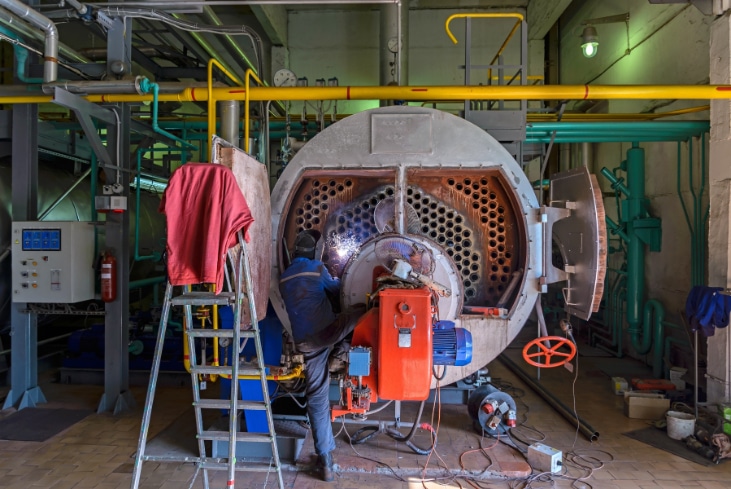
To gear up for season shutdown, you’re probably making your maintenance plans. Over the next few pages, original equipment manufacturers (OEMs) and others show off the components and services they can offer to help you through the winter. An OEM tangentially related to our industry offered some ideas for cleaning your heating elements. Let’s look at getting scale off the boiler tubes before it becomes a hazard.

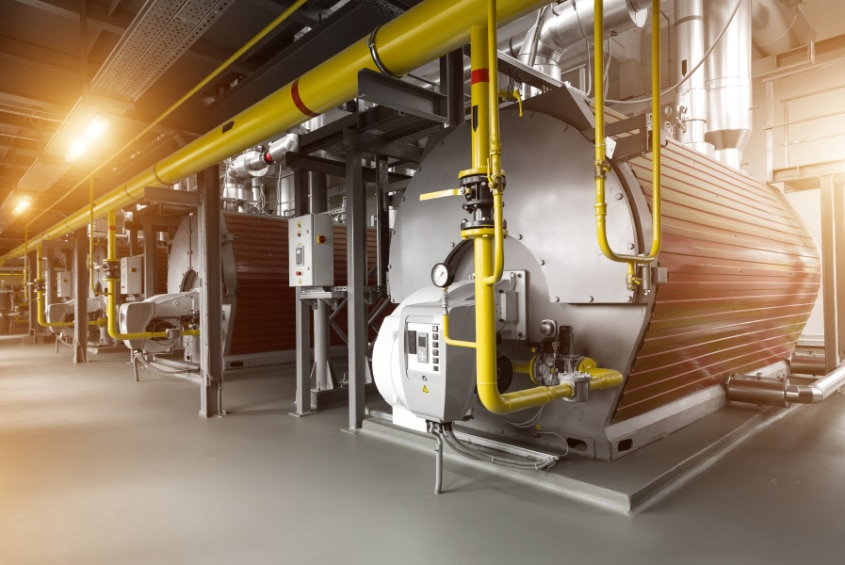
For boilers that produce hot water and steam for industrial activities, scale buildup can creep into operations without you realizing it. The team at Cortec® Corporation explained scale forms when minerals such as calcium carbonate in the water combine and create scale deposits on boiler internals. The thicker the buildup, the harder it is for water or steam to flow through the pipes. This means heat transfer efficiency drops, demanding more energy to heat the boiler water and create steam.

Not all heating systems look alike but the concept remains the same. Preventing liquid asphalt cement coking or scale buildup on different heating elements protects those elements from inefficiencies and potential ruptures or breakdowns.

Scott Bryan, CWT and technical sales manager of Water Treatment at Cortec® Corporation, summarized, whenever scale is forming in any system, “If you are starving that system of its needed heat transfer efficiency, you are hurting the performance of that whole process.”

As discussed in the October issue of AsphaltPro, it takes a good overall controls system to monitor all the parts and pieces of a plant. Not every asphalt plant will employ steam heat these days, but if you’ve got it and your system doesn’t alert when there’s a change in flow or heat transfer efficiency, your facility could experience scale buildup problems long before realizing their effects. Bryan explained, if this proceeds too far, it could result in a boiler pipe that ruptures without warning, leading to major problems.

“A boiler will blow a tube and cause the whole system to come down, and that could create a catastrophic event at worst and an unplanned maintenance shutdown at best,” Bryan said. In either case, at least some plant operations will grind to a halt.

Anti-scalants have chemistries to keep dissolved minerals such as calcium carbonate from combining and depositing on the metal. This buildup prevents efficient heat transfer.

Scale Prevention

To avoid such serious problems, it’s important that boiler owners and managers take preemptive steps. The best plan is to minimize the formation of scale deposits by adding an anti-scalant to the normal water treatment program. These chemistries keep dissolved minerals such as calcium carbonate from combining and depositing on the metal. Cortec advises its own product, the S-14 Series, be added to standard water treatment formulations.

It’s a good idea to conduct scale removal every few years during routine maintenance. Photos courtesy of Cortec Advertising

Scale Removal

The second step is to periodically remove scale that has formed. This should be done whenever pressure increases and heating demands rise. However, since these indicators can be difficult to detect in a boiler, it is a good plan to conduct scale removal every few years during routine maintenance. Cortec advises using a product like EcoClean® Biodegradable Scale and Rust Remover, which is designed to dissolve scale.

Scale is a normal nuisance in boilers. However, by catching the problem early, boiler owners can avoid the most serious issues that come from scale-induced surprises such as melting or bursting boiler tubes.

For more information, contact the Cortec team at https://www.cortecvci.com/contact-us/.


https://theasphaltpro.com/product-gallery-almix-unveils-two-story-control-house-for-enhanced-asphalt-plant-operations/

https://theasphaltpro.com/product-gallery-ammann-america-launches-high-capacity-counterflow-drum-mix-plant-for-enhanced-asphalt-production/

https://theasphaltpro.com/product-gallery-astec-industries-enhances-fiberbed-mist-collector-with-charcoal-filters-for-improved-odor-control/

https://theasphaltpro.com/product-gallery-brock-llc-unveils-versatile-asphalt-cement-tanks-with-enhanced-features/

https://theasphaltpro.com/product-gallery-eagle-crusher-hosts-aem-manufacturing-express-to-celebrate-american-manufacturing/

https://theasphaltpro.com/product-gallery-major-unifies-mining-and-aggregate-solutions-with-enhanced-app-update/

https://theasphaltpro.com/product-gallery-masaba-inc-breaks-ground-on-new-steel-fabrication-facility-to-boost-production/

https://theasphaltpro.com/product-gallery-major-unifies-mining-and-aggregate-solutions-with-enhanced-app-update/

https://theasphaltpro.com/product-gallery-meeker-equipment-introduces-advanced-baghouses-for-enhanced-dust-management/

https://theasphaltpro.com/product-gallery-process-heating-company-analyzes-asphalt-heating-costs-across-multiple-fuels/

https://theasphaltpro.com/product-gallery-rotochopper-expands-rd-innovation-center-with-new-12000-square-foot-facility/

https://theasphaltpro.com/staar-lubricants-introduces-eco-friendly-trick-shot-asphalt-release-agent/

Crossing the Finish on S.T. Wooten’s I-40 Overhaul in Raleigh

Completed interstate in Eastern North Carolina offers milestone for S.T. Wooten

While S.T. Wooten crews knew the I-40 road widening project was going to be expansive, nobody could have guessed just how far it would take them. The project already marked a milestone as the biggest in company history when construction kicked off in 2018, but new initiatives combined with Raleigh’s fast growth brought adjustments that added extra years of work to the scope.

After the project was underway, the North Carolina Department of Transportation (NCDOT) was challenged to address additional traffic concerns along Jones Sausage Road from a new Amazon distribution center, which S.T. Wooten also worked on.

S.T. Wooten’s I-40 project was initially scoped as a four-year, $360 million job, but expansions added an extra $60 million to the budget along with two additional years of construction. The project will be reaching completion this fall as crews put the finishing touches on years of hard work and dedication.

I-40 Gets a Redesign in Raleigh

Enhancements to the plan

The purpose of the I-40 project was to improve traffic conditions through a busy 13-mile stretch—extending from the I-440 divide in Raleigh to 2 miles east of the N.C. 42 interchange in Johnston County—with two new lanes added in each direction. Construction also involved a total of 15 bridges being built or revamped, along with the installation of two diverging diamond interchanges (DDIs).

After the project was underway, the North Carolina Department of Transportation (NCDOT) was challenged to address additional traffic concerns along Jones Sausage Road from a new Amazon distribution center, which S.T. Wooten also worked on. The NCDOT took swift action and with recommendations from their engineers, decided to retrofit a DDI across the existing bridge that crosses I-40 to help with congestion. That’s just one example of how the NCDOT was flexible in making accommodations for the developing area to better help the traveling public.

Crews from S.T. Wooten handled nighttime and day paving to complete different portions of the project as it developed and expanded over the years.

Diverging diamonds

The first DDI crews tackled for the I-40 project was positioned at the 40/42 area, which is where Highway 42 crosses over I-40. To accommodate the DDI, two new bridges were constructed with the roads widened on either side of the bridge. The new pattern was put in place during the spring of 2024.

For construction on the DDI at Jones Sausage Road, the process was unique since it was built utilizing the existing bridge. Work included:

  • Tearing down existing barrier rail and adding sidewalk and 3-bar metal rail
  • Installing new latex deck overlay
  • Installing a median barrier to separate traffic

In the fall of 2023, the intersection was put into a temporary single-lane DDI pattern. Crews had to pave the first lift of surface then adjust and activate new signals for the pattern over a single weekend. Once in this pattern, there was a 28-day timeline to complete the median barrier and islands before opening to a full pattern. Crews successfully opened into the full pattern on the weekend before Thanksgiving in 2023.

A 280-foot-long conveyer handled about 169,000 tons of asphalt, saving crews about 8,500 truckloads entering and exiting traffic.

Asphalt conveyer comes in handy

Faced with constant traffic surrounding the I-40 work zone near Clayton, S.T. Wooten engineered a unique asphalt conveyor to help streamline hauling processes for crews. The solution helped move asphalt safely from the Astec double barrel plant, over the highway, and into an 85-ton Gencor silo in the median-area work zone. From there, dump trucks were able to transport the asphalt to onsite paving equipment without having to haul through traffic and impact the traveling public.

The plant had two 300-ton silos and was rated for 350 tons per hour. The team produced multiple mixes for the project—the average load out temperature was 300 degrees for standard B and C mixes utilizing 64-22, and 325 degrees for the D mixes utilizing 76-22 asphalt cement.

After the project was underway, the North Carolina Department of Transportation (NCDOT) was challenged to address additional traffic concerns along Jones Sausage Road from a new Amazon distribution center, which S.T. Wooten also worked on.

We used Astec’s Weighmate system for controls and ticketing; communication among our team members was excellent. Between the plant control house, median control house, as well as the person controlling the trucks dumping for transfer across the conveyor, we used handheld radios. We also used red and green lights operated by the median control house to make sure the hopper and belt weren’t overloaded when the trucks were dumping.

The approximately 280-foot-long conveyer offered benefits to both crews and drivers. The system:

  • Handled about 169,000 tons of asphalt, transporting it through an enclosed conveyor belt over the highway.
  • Prevented dump trucks from needing to merge in and out of traffic while working. This ended up saving crews about 8,500 truckloads entering and exiting traffic.
  • Reduced the total number of trucks and fuel needed to run the project. A single truck only has to drive around 100 yards to move the asphalt from the plant to the conveyer. Compare this to a 20-mile round trip that might be required without the conveyer.

While it was a unique structure, S.T. Wooten has used the asphalt conveyor approach before—about a dozen years ago on a separate stretch of I-40.

The Astec double barrel plant had two 300-ton silos and was rated for 350 tons per hour.

Bifurcated slope creates efficient split

Like most large highways, I-40 has a split between the eastbound and westbound lanes. To accommodate construction, a tall barrier wall was installed the full length of the median and in some areas with the roadway positioned at different elevations. This was done to ensure crews could adjust the profile of the roadway to accommodate the additional lanes.

That difference in elevation, also called a “bifurcated” slope, was successful in allowing each direction of I-40 to have necessary variation and reduce the amount of cut or fill dirt needed. Using this bifurcated setup also made it easier to split off the ‘collector’ and ‘distributor’ lanes that people use for entering and exiting the highway, which was important in helping ease the flow of traffic in the NC-42 and newly added Cleveland Rd. interchange.

Strategic planning and close communication between crews and subcontractors was instrumental in staying on schedule with so many moving parts across the I-40 job.

With the additions considered, the number of lanes throughout the length of the entire project varies from 12 lanes (six in each direction) to six lanes (three in each direction) and due to the very wide pavement section and the curvature of the road the bifurcation was required.

Making the Shift on S.T. Wooten’s I-40 Road Widening Project 

Strategically overcoming setbacks

While traffic was the most consistent challenge for crews on I-40, other obstacles came up as they do with any project. The pandemic, employee turnover and bad weather all threw a wrench into plans at times. Traffic shifts were also a unique element to manage and execute – since crews were on a tight turnaround to complete the paving and grading before traffic had to be re-opened with each transition.

Strategic planning and close communication between crews and subcontractors was instrumental in staying on schedule with so many moving parts across the I-40 job. Experience was also an asset for the team, as S.T. Wooten has now worked with the NCDOT on numerous large road construction projects – including a similarly expansive overhaul taking shape on I-95 near Fayetteville.

Wooten Expands North Carolina’s I-95

End of a journey

The I-40 project wouldn’t be reaching its completion date without the significant progress made by crews this past year. Crews have been working diligently to finish the surface and complete the punch list for the final stretch running from 70 bypass to Cornwallis Road. Extending 4 miles, that covers roughly a third of the total project. Final touches will also include wrapping up construction at NC42, Cleveland Road and Rocky Quarry Road.

While the team is excited to finally cross the finish line, lessons learned from the project will be invaluable for future jobs. One such thing is the ability to adapt to changing conditions and situations. We go into these projects with a very detailed plan and schedule, but being flexible to make adjustments as you move forward—even if it’s not what you initially had in mind—is key to success.

To accommodate construction, a tall barrier wall was installed the full length of the median and in some areas with the roadway positioned at different elevations.

Hundreds of crew members had a hand in construction on the I-40 project over the past six years. They should be proud of their work and a successful product that commuters will be grateful for in Wake and Johnston County’s growing communities.

Matt Davis is a division manager for S.T. Wooten Corporation. He shared, “Our hearts are with all the individuals and communities affected by Hurricane Helene, which unfolded as this article was going to press. We stand in solidarity with everyone impacted, and we are committed to supporting recovery efforts during this challenging time.”

How to Load Different Asphalt Haul Truck Bodies

Editor’s Note: For 2024, AsphaltPro Magazine allows experts in the industry to share how to expand your operations to the next phase of business. Are you ready to start making your own hot-mix asphalt? Let’s turn to some professionals who have equipment, services, software and tenure to help you expand efficiently to mix design, production, hauling and more. This month’s installment from Top Quality Paving & Training, Manchester, New Hampshire, delves into the mechanics of safe loadout for the new plant operator and new haul truck driver, no matter the type of truck.

Not all haul trucks are built the same. They shouldn’t all be loaded the same to deliver our perishable hot-mix asphalt (HMA) to the job site. Something I noticed while helping a crew in 2023 made me reconsider offering the same old advice of the three-drop method for loading all trucks at the silo.

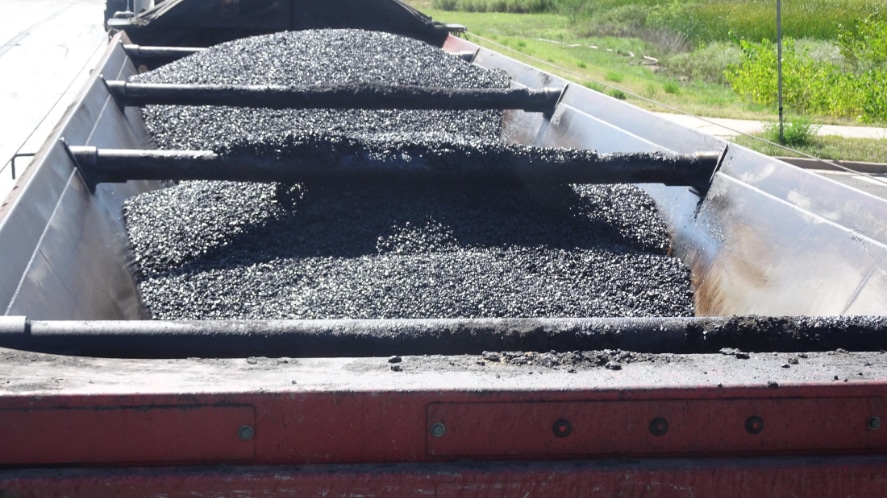
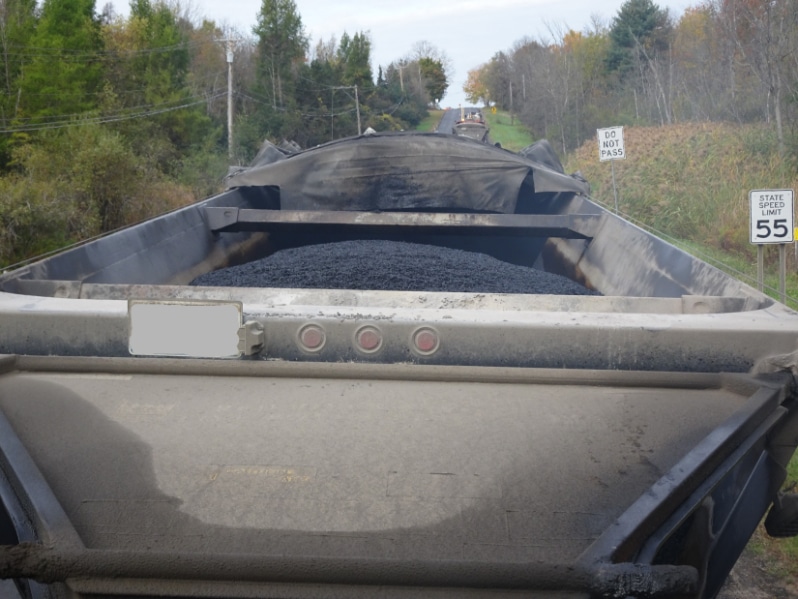
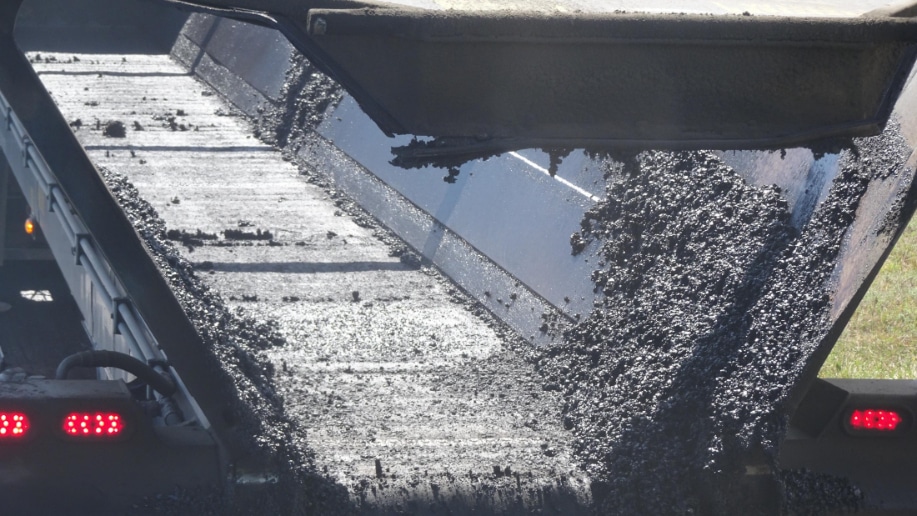
In the first picture, we can clearly see the support frame of the live body trailer with material loaded properly beneath and between the supports. In the next picture, we can see where the material was loaded too high and dropped over the supports. Mix has piled on top of the frame where it has cooled. The next load of mix will knock these cooled chunks into the bed where they will contribute to segregation.

We had a live-bottom trailer on its second round-robin to the job site and as the material slid into the hopper, chunks of cooled hot-mix asphalt (HMA) plopped in, too. When I investigated, I discovered the railings across the top of the truck’s bed were acting as a shelf for mix that had dropped from the silo.

Mix sitting on the support structures cooled as the perishable material was delivered to the job. The material cooled more as the truck returned to the plant. Then new mix knocked the cold chunks into the bed. Let’s talk about how to avoid this problem and how to best use different truck bodies for asphalt delivery.

Save on Costs with Your Professional Guide to Asphalt Mix Delivery, Part 3—An Independent Look at Best Haul Truck Practices

Conventional Trucks

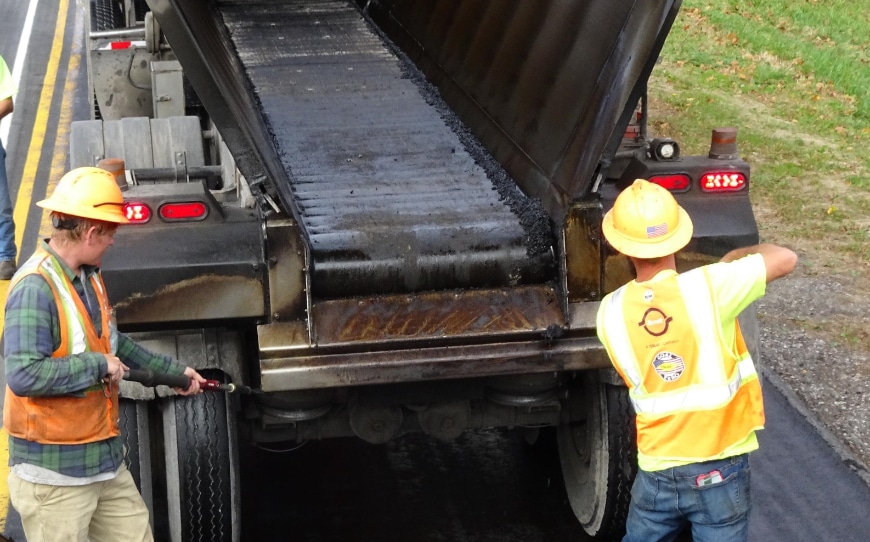
Think about your tandem haul trucks. They’re typically square-bodied. They haul about 20 to 24 tons on average. It’s smart to put a plastic liner in them to create curves in the corners so mix isn’t lodging and building up in the corners. Make sure to stop and spray a release agent in the bed before approaching the scale.

When you get to the scale, follow the marks or lights that the plant has in place to help you line up under the gate correctly. Many plant loadout controls these days won’t let the silo gate open until the operator sees that you’re in the correct position and presses a button “unlocking” the system. This is for your safety. (See the sidebar about AI Loadout Technology for more information.)

Save on Costs with Your Professional Guide to Asphalt Mix Delivery, Part 5—Haul Truck Safety Pays Dividends

The plant operator will want to use the three-drop method to load in three “hills” in the truck to minimize material segregation. You start with the first drop at the very front of the bed; pull forward so the second drop lands in the back of the bed; then back up so the third drop lands in the center. Pull forward, raise the tarp, and proceed directly to the job site. When charging the paver’s hopper, you can raise the bed in a manner that helps the material move as a mass, but the mix tends to roll. (See the article “Save on Costs with Your Professional Guide to Asphalt Mix Delivery, Part 3—An Independent Look at Best Haul Truck Practices” on TheAsphaltPro site for best practices when approaching the job site and backing to the paver.)

In the first picture, we can clearly see the support frame of the live body trailer with material loaded properly beneath and between the supports. In the next picture, we can see where the material was loaded too high and dropped over the supports. Mix has piled on top of the frame where it has cooled. The next load of mix will knock these cooled chunks into the bed where they will contribute to segregation.

U-Shaped Truck Bodies

U-shaped bodies have no corners or crevices for material to build up in. They haul about 20 to 24 tons on average. You’ll want to use the same three-drop method for these trucks. When you charge the hopper at the job site, the mix won’t roll as much as it slides. Be aware, it’ll slide out quickly.

Loading mix correctly at the plant is only one step in preventing material segregation. Maximize loadout efficiency by considering truck body style. All photos courtesy of John Ball, Top Quality Paving & Training

Live-body Trucks

The live-body trucks are typically v-shaped with a chain, like a lattice, or a conveyor belt at the bottom of the V. This conveyor moves the whole load in a mass to help eliminate material segregation; the mix doesn’t roll at all, but moves as a mass. These trucks haul anywhere from 20 to 28 tons, although I’ve seen ones in Canada capable of hauling 35 tons.

For this type of truck body, you want to load in four 5-ton dumps instead of three larger dumps. It’s smart to line the truck up under the silo so you center the gate between the support bars of the truck body. You want to keep each of the “hills” lower than the rafters so the material can’t collect up there and begin to cool.

When drivers fail to clean the truck beds, material can build up on the sloped walls of the live-body trailers as easily as it can build up in the corners of tandem bodies. Spraying beds with a release agent at the plant prior to loadout will only go so far to help with charging the hopper smoothly and with cleanout. Make sure you get to a designated cleanout area and take care of issues like this before they can cool and become a material segregation problem in the next load of material.

Conclusion

Getting the mix loaded correctly at the plant is only one step in preventing material segregation. You can maximize the efficiency of that loadout if you take your truck body style into consideration.

John Ball is the proprietor of Top Quality Paving & Training, Manchester, New Hampshire. For more information, contact him at (603) 493-1458 or tqpaving@yahoo.com.