
Relieve These Top 8 Pain Points When Laying Out Your New Plant
BY Wally Olson
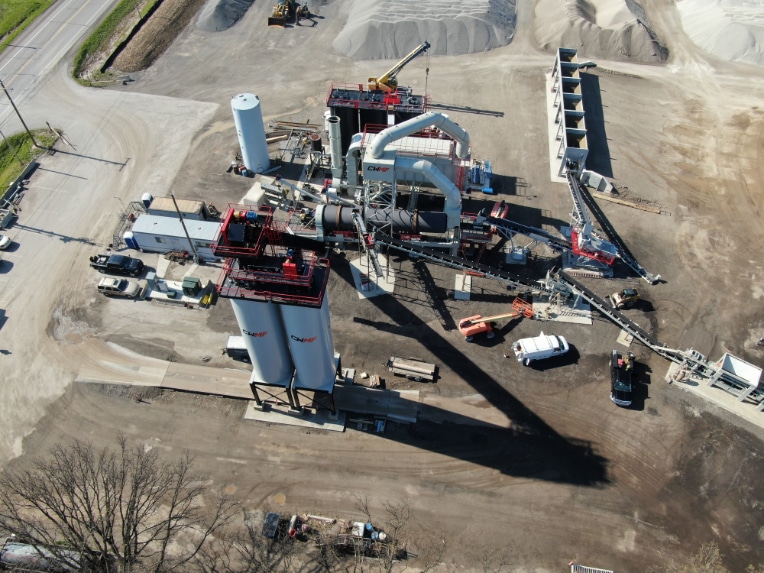
Editor’s Note: For 2024, AsphaltPro Magazine allows experts in the industry to share how to expand your operations to the next phase of business. Are you ready to start making your own hot-mix asphalt? Let’s turn to some professionals who have equipment, services, software and tenure to help you expand to mix design, production, hauling and more. This month’s installment from CWMF takes an overarching look at the plant footprint.
If you’re considering or planning on building a hot-mix asphalt (HMA) plant or expanding on your existing operation, you likely have a question or two. Or maybe a couple hundred. That’s because it’s complex and highly specialized. And not everyone who recognizes the marketplace opportunities of asphalt and paving is necessarily already an expert in what it takes to build an efficient asphalt production facility. Getting this massive undertaking right requires vast experience and deep expertise. Here are a few things to consider when you start planning your new asphalt plant.
1. Stationary or Portable and Tons per Hour (TPH).
The choice between a portable and stationary asphalt plant depends on various factors, including project size, duration, location, environmental regulations and mobility requirements. Stationary plants are best suited for large, long-term projects, while portable plants offer flexibility and mobility for shorter-term, varied, or remote projects. You will also need to determine how many tons per hour your market requires. Bigger isn’t always better when considering the overall investment.
2. Equipment Placement.
Determine the optimal arrangement of key equipment within the plant. When designing an asphalt plant, two crucial factors demand careful consideration.
Available Real Estate for Stockpiles
The extent of available property plays a pivotal role in determining the layout of the plant. To optimize both cost and efficiency, it is essential to focus on key features such as minimizing the distance and ducting required between the drum and the baghouse. Additionally, when positioning the asphalt cement (AC) tank package, minimizing the amount of piping that needs heating is paramount for enhanced efficiency.
Truck Traffic Flow in the Yard
Determine the optimal arrangement of key equipment within the plant. The goal is to minimize the distance virgin and recycled materials must travel through the plant and ensure efficient material flow.
When planning for current and future cold feed and recycled asphalt pavement (RAP) bins, it is imperative to be mindful of the traffic flow. The available real estate will dictate the optimal angle and configuration for the plant.
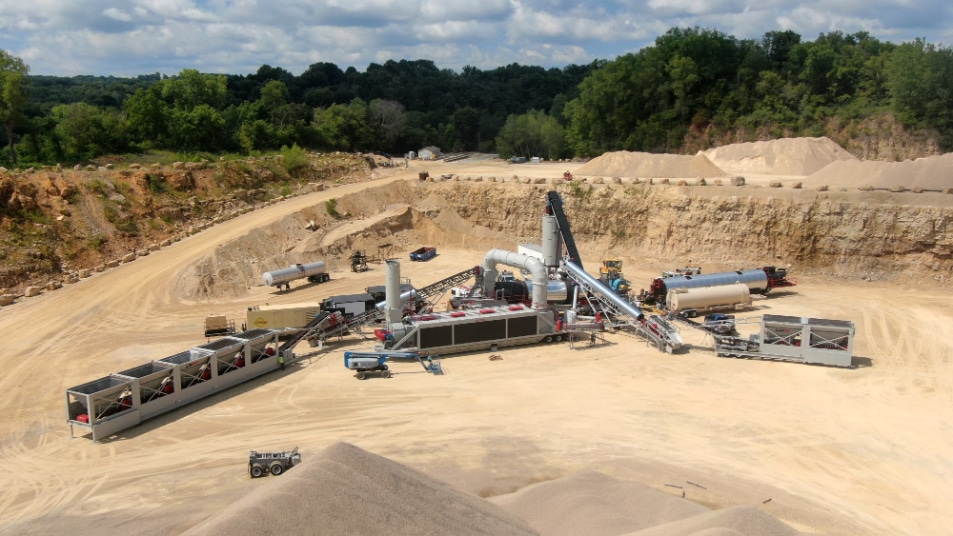
Even if you have plenty of real estate to spread out plant components for optimum visibility and multiple stockpiles of on-spec material, you want to focus on such things as minimizing the distance and ducting required between the drum and the baghouse. Keep these efficiencies in mind when designing your layout. Photos courtesy of CWMF Corp.
3. Control Room.
Design a control room with a clear view of the entire plant operation. This allows operators to monitor equipment, adjust parameters and respond to issues. CWMF offers integrated industrial automation and control solutions for asphalt plant equipment. We can provide the engineering, manufacturing, installation, start-up, and training to get you up and running at peak efficiency.
4. Install Electric and Plumbing.
Establishing the required equipment for your plant is one thing, but defining your needs to get it up and running is an entirely separate process that requires significant planning and preparation. Be sure to team up with an equipment manufacturer that can walk you through each step of the process.
Plan Ahead! Implement safety measures, such as clear traffic patterns, proper signage and emergency response plans. Getting the right signage in the right places is part of your successful plant layout plan, not only for traffic flow and proper stockpile management, but also for emergency preparedness.
5. Environmental Impact Assessment.
Evaluating the potential environmental impact of your new asphalt plant is critical. You’ll need to make sure you are following the local environmental regulations and obtaining the necessary permits. Consider implementing a pulse jet or reverse flow baghouse, such as CWMF’s Dust-Eater.
The baghouse dust collector is considered the “lungs” of a plant. When the plant cannot breathe effectively, it negatively affects production. This is an essential part of asphalt plant operations, along with the dust control system employed upstream to help retain and return usable dust particles back into the drum mixer rather than putting them immediately into the exhaust airstream.
6. Zoning, Land Use Regulations and Permitting.
Understanding the local zoning laws, land use regulations, and permitting that govern where industrial facilities like asphalt plants can be located is incredibly important.
7. Safety and Emergency Preparedness.
Prioritize safety for both employees and the surrounding community. Implement safety measures, such as clear traffic patterns, proper signage and emergency response plans. Ensure that fire protection systems, hazardous material handling, lockout/tagout, and confined space entry procedures are in place.
8. Replacement Parts.
Once your plant is up and running, are you prepared for untimely breakdowns? Team up with a company you can trust to get you the replacement parts you need ASAP. The CWMF sales and service teams are ready to work through determining what you need to get your plant up and running, whether for the first time, during scheduled maintenance, or after unplanned downtime. Never underestimate the importance of the parts that make up the whole or the value of the professionals who go the extra mile to keep your plant online.
CWMF has been a trusted company in the stationary and portable asphalt industry for decades. As a full-service manufacturing company, we engineer all our products to order, allowing us to serve as a full-service, end-to-end provider of asphalt plant solutions. We have the machinery and equipment you need, and a confident team working together to make this happen. This provides an exceptional experience for our customers, and for the dedicated team standing behind their products. We work hard not only to retain our reputation but to stay current on the latest industry trends and technologies.
Wally Olson is CWMF Corporation’s sales manager. For more information, contact him at (320) 251-1306 or visit cwmfcorp.com.