Atlanta Paving’s Growth Goes Sky-High

When McCarthy Improvement Company, Davenport, Iowa, hired Atlanta Paving, Peachtree Corners, Georgia, as a subcontractor to pave at Hartsfield-Jackson Atlanta International Airport in 2016, it was a big deal. “That was the first time any contractor outside of Atlanta’s biggest two or three had touched the airport in a long time,” said Atlanta Paving Vice President Mandy Neese.

Atlanta Paving was started by Ernie Lopez III in 1997 as a driveway paving and patching company. “Back in the ‘90s, a $25,000 job—like a shopping center or maintenance contract—was probably a big deal for us,” Neese said. “Now, our average project is $2 to 3 million.”

Although the job wasn’t on the airfield itself, but instead mostly ancillary pavements and parking areas, Neese said the airport was initially hesitant. “We weren’t the normal contractors they were used to working with, so they put us under a microscope at first,” she said. After all, the airport has been considered the world’s busiest airport since 1998. “Once we proved what we could do, they’ve come to trust what we do and how we do it.”

Since its first job at Hartsfield, Atlanta Paving has been involved in numerous others, paving multiple ramps, around the cargo bay, parking facilities and shoulder repairs along the runways. Atlanta Paving also worked on the 9L end-around taxiway, completed November 1, 2022.

“That first job at the airport has opened so many doors,” Neese said. Not only other jobs at the airport, but across the city. Since then, Atlanta Paving has also done several projects for the Metropolitan Atlanta Rapid Transit Authority (MARTA), including paving the Atlanta Streetcar route along historic Auburn Avenue with CW Matthews. “We’re getting ready to start work on MARTA’s bus rapid transit route with Archer Western,” Neese said. The company has also paved at the Atlanta Speedway, for CSX and Norfolk Southern railroads, and at both Truist Park (home of the Atlanta Braves baseball team) and Mercedes-Benz Stadium (home of the Atlanta Falcons football team)

Although Neese enjoys those high profile jobs, she also still appreciates the company’s smaller jobs. “When you pave someone’s driveway, you know you’re helping create their dream home,” she said. “We take just as much pride in a driveway as we do in a runway.”

Meet a Woman of Asphalt: Atlanta Paving’s Mandy Neese

In the fall, Atlanta Paving paved a driveway at-cost for the Calvin Center, an equestrian therapy center for children with special needs, in Hampton, Georgia. “I called Ernie [the owner of Atlanta Paving] to get his permission and he said let’s send our salaried employees to drive down the costs and see if our supplier will donate materials,” Neese said. “The equestrian manager was in tears of joy when we got done and she was able to take these kids down a newly paved driveway from the housing facilities to the barn, some in their wheelchairs. Now that we’re large enough to give back in a big way, we love being able to do those sorts of projects.”

How it Started vs. How it’s Going

Atlanta Paving was started by Ernie Lopez III in 1997 as a driveway paving and patching company. “Like many asphalt paving contractors, Ernie built the business little by little, one year at a time,” Neese said.

After more than a decade of slow but steady growth, Lopez was ready to go big and grow big; he wanted to get approved to perform work for the Georgia Department of Transportation. In 2009, he hired Neese and Chief Financial Officer Darryl Adams. “Ernie knew that to survive and thrive through the recession, he’d need to set the company up to do government work,” Neese said. “Ernie knew he could do the work, he just needed people who could manage the finances and bid the jobs.”

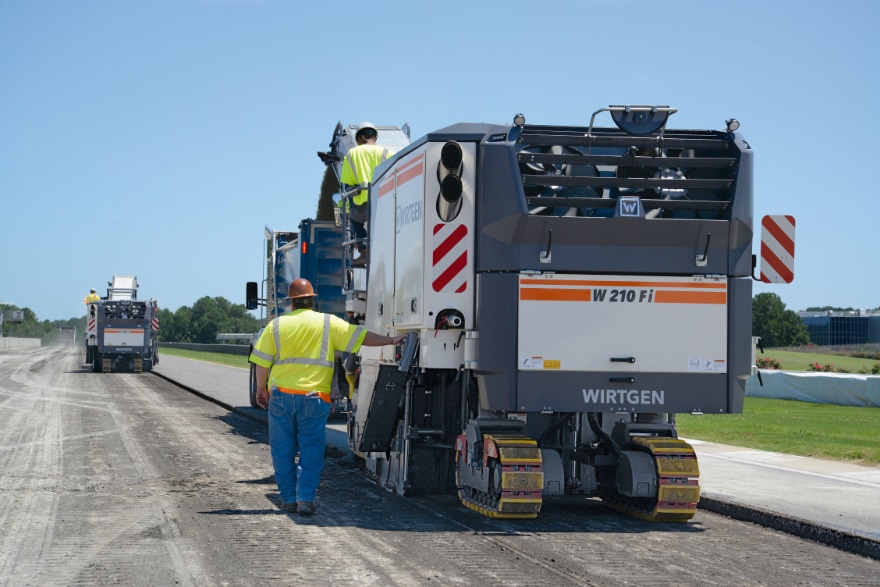
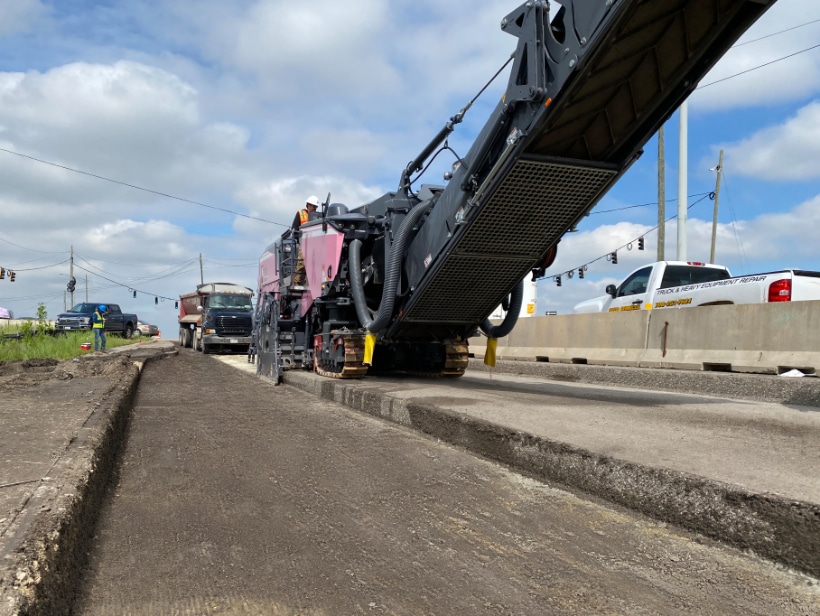
Atlanta Paving’s milling machines and reclaimers are Wirtgen machines. “Those machines are just phenomenal to have and never let us down,” Neese said. “They’ve proven themselves over and over.”

Neese had been working at one of the largest asphalt paving companies at the time, but had young children and was looking for a job that required less travel at a company with strong family values. Atlanta Paving was a perfect fit.

The company was able to acquire its GDOT certification and Neese got to work bidding bigger and bigger jobs. “I can remember the first million dollar job we did, and the first $2 million job, and it wasn’t long before I was bidding our first $5 million project,” Neese said. At the time, the company’s bonding capacity for a single job was $5 million, so Neese’s bid was $4,999,999.99. “Each one of those moments was a turning point for us.”

Fine Airport Grind

“Back in the ‘90s, a $25,000 job—like a shopping center or maintenance contract—was probably a big deal for us,” Neese said. “Now, our average project is $2 to 3 million, and our upcoming MARTA project is worth $8 million.”

When Neese started at Atlanta Paving, the company had 17 employees. Today, it has 176. “Our growth has been exponential,” she said. “I remember talking to Ernie in 2015 and thinking 50 employees is a good size. Then we’d get a big project and hire 10 more employees.”

Atlanta Paving’s larger pavers are all Roadtec and the company just purchased two new Leeboys for some of its smaller work.

What does Neese think is the root of the company’s success? “The willingness to invest and to take a chance,” Neese said. For example, when the company purchased its first milling machine, a 4-footer. “That was a big decision in those days. Ernie has always been willing to invest, and it’s his fearlessness that gives our company its ‘We can do it’ mentality.”

“I think that’s one thing that sets Atlanta Paving apart,” Neese said. “We’ll take on jobs other companies won’t do.” For example, the MARTA streetcar project or paving at the Atlanta Public Safety Training Center, the police and fire training facility in downtown Atlanta.

Among Atlanta Paving’s many jobs at Hartsfield Airport was the 9L end-around taxiway, completed November 1, 2022.

“No one wanted to do that job because it’s been in the news a lot and there have been protests there [related to the ‘defund the police’ movement],” Neese said. But she felt Atlanta Paving was up to the scrutiny and challenge. “That’s been our mentality every step of the way: let us show you what we can do.”

Also key to the company’s growth are the relationships it’s built with its customers. “They’ve watched us grow and they’ve come to know that they can rely on us,” Neese said. “And that boils right down to our crews, who always show up and do what they’re supposed to do.”

Quality Asphalt Paving Upgrades Anchorage Airport

All in the Family

Despite the company’s growth, Atlanta Paving continues to be family-owned and family-oriented. Lopez’s four sons and stepson all work for the company. Ernie Lopez IV is an estimator and project manager, Brandon Lopez is a paving foreman, Zach Lopez is a paving foreman, Joey Lopez is a milling foreman and tanker driver, and Dustin Bryson is the vice president of Dykes Materials.

“Each one of them has a unique talent that they bring to the company,” Neese said. “They were kids when I started working at the company, so it’s been really cool to see them graduate and come work for us full-time. Now, I have these four boys I can lean on, who are as invested in the company as I am because they love their dad and have taken this company into their hearts.”

Like the Lopez namesake Ernie, Atlanta Paving is a tradition that will continue throughout the generations. Ernie IV has a five-year-old son, Ernie V, and two of the other brothers also have children. “One of them is named Houston Silo—as in asphalt silo,” Neese said.

Despite the company’s growth, Atlanta Paving continues to be family-owned and family-oriented. Lopez’s (left) four sons and stepson all work at the company: Ernie Lopez IV, Brandon Lopez, Zach Lopez (right), Joey Lopez and Dustin Bryson.

After 14 years at Atlanta Paving, Neese also feels like part of the family. “Ernie is like a father to me,” she said. When Neese was diagnosed with cancer in December 2022 and required major surgery to remove a football-sized tumor in her abdomen, the Lopez family was at her side. “The concern Ernie and his boys had over my health was unreal. To have the owner of the company standing over me in tears saying ‘My family is your family and your family is my family’…there are no words.”

Today, Neese’s husband, Darrell Neese, is the company’s safety director, and her step-son, Joseph, is a milling foreman and runs the company’s airport milling crew. “I think we’re up to 12 sets of father-son and father-daughter combos, not including the Lopez boys,” Neese said, adding that a lot of the company’s employees recruit family members to work at Atlanta Paving. “You see a lot of the same last names come up on our time reports.”

“In a time where it’s this hard to recruit people to work blue collar, having our employees help us recruit the next generation is huge,” Neese said. “What better way to train than to have a dad teach his son?”

After 14 years at Atlanta Paving, Neese (right) feels like part of the Lopez family, adding that Ernie Lopez III (left) is like a father to her.

The Place to Be

To have employees recruit those they love to Atlanta Paving shows a high degree of loyalty. Loyalty, Neese said, is at the heart of what makes Atlanta Paving a great place to work. “Loyalty is a two-way street,” she said. “Our employees are loyal to us, and we are loyal to them.”

What does loyalty look like at Atlanta Paving? “We pay people well and we keep our crews employed year round,” Neese said. “We want to make sure they feel secure working for us.”

In the fall, she strives to line up projects for the whole winter to best use the company resources and keep its employees busy. “Over the winter, we do a lot of demolition work,” Neese said. For example, they performed a large demolition project at Hartsfield Airport last winter. This winter, they’ll be milling the MARTA BRT project.

The company also invests in quality equipment. “Ernie has always made sure all of our equipment is top-notch,” Mandy said. “He’s also taken it very seriously that they have whatever they need to do their job.”

Lately, loyalty has been particularly crucial to retaining Atlanta Paving’s employees. “These past two years, we’ve had people coming to our job sites trying to pick off our employees constantly,” Neese said. The company has strived to stay ahead of market wages, but even when other companies have tried to poach employees for $1 or $2 more per hour, most have remained with Atlanta Paving. “The men and women who work for us are committed to us because we are committed to them.”

This also benefits the company’s customers. “It’s made relationships with our customers easy, because my crews don’t let me down and in turn we don’t let the customer down.”

When Neese started at Atlanta Paving in 2009, the company had 17 employees. Today, it has 176.

Even as the company retains employees, Atlanta Paving still faces the challenge of finding employees as it continues to grow. They’ve been involved in the Georgia Highway Contractors Association program to equip local schools with construction equipment simulators. “I think we’re up to 15 schools, spread out across the state,” Neese said. “The ultimate goal is to make sure every school in the state that wants one can get one.”

Growing its own talent has long been Atlanta’s approach. “I think companies resort to poaching employees when they get really desperate for the pool of talent available,” Neese said. “We’re trying to expand the pool.”

Pike Paves Airport Smoothness for Years to Come

The company isn’t afraid to hire newbies and take on the time and cost to train them. “We try to pair every new employee with an older one who knows everything the new person needs to know to be successful,” Neese said.

They’ve also invested in BuildWitt’s training program. “We wanted a systematic approach to introduce our younger employees to what we do,” Neese said. “When you’re hiring right out of highschool, the two and three-minute BuildWitt videos pushed right on their smartphones are kind of Construction 101. The program sparks their interest in our industry and gets them thinking about the career options they have in construction.”

Why Emotional Intelligence Matters on the Job Site

Atlanta Paving is also investing in technology to shore up its numbers as the company continues to grow. One of Neese’s passions is the potential for automation in construction. “Anytime you can automate a process to allow that labor and skill to be utilized elsewhere, you’re creating efficiencies, you’re improving accuracy, and you’re removing people from dangerous situations.”

In addition to dangerous jobs, Neese also thinks automation technology is promising for projects like those Atlanta Paving has done at the airport. “It’s a big, open flat area where things have to be highly accurate,” she said. “To be able to set up our milling machines with GPS, import our survey data and let that machine go—no spray painting on the ground, no survey control, the operator doesn’t have to control depth—that’s the accuracy and efficiency I’m excited about.”

Other technology Atlanta Paving has deployed includes drones to perform survey checks and take inventory, “things that used to take two guys weeks, we can now do in hours. And then those guys can go do something else instead.”

Another high-profile project Atlanta Paving has worked on is the reconstruction of the Brookhaven MARTA station currently under construction.

Future-Focused

Despite the growth trajectory Atlanta Paving will likely continue along, Neese’s hopes for the future of the company are firmly planted in its family roots.

“I think it would come full-circle for me to watch the Lopez boys, my own son and all the young people we have working for us continue to grow, evolve, and take on leadership roles in the company,” Neese said. “I want Ernie to be able to someday retire happily and know his company and his legacy will continue.”

“I think I’ll probably stick around 20 more years or so, which will be just enough time to see Ernie V graduate and maybe come join the company,” she said. “I want to see the legacy of this company—of working hard and being fearless—continue into the next generation, and the next.”


Another major milestone for Atlanta Paving was its 2019 acquisition of Dykes Construction, along with its recycling and crushing operations and Astec asphalt plant in Peachtree Corners, Georgia.

Plant Power

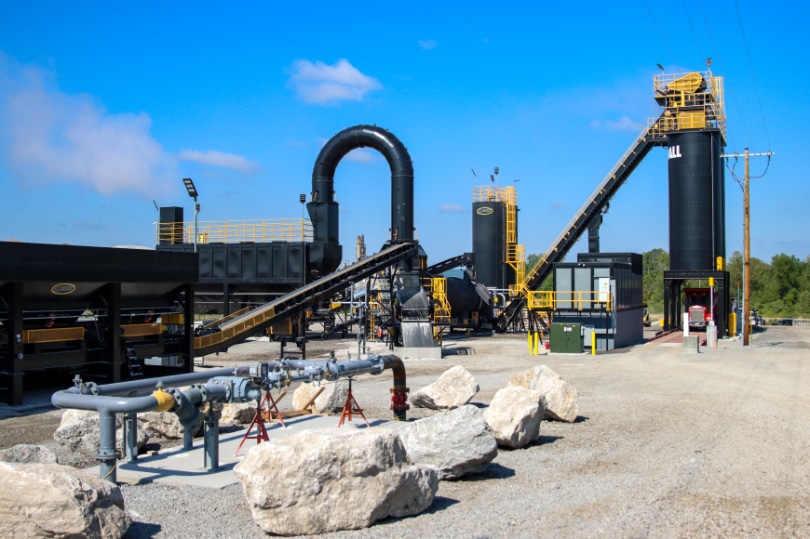
Another major milestone for Atlanta Paving was its 2019 acquisition of Dykes Construction, along with its recycling and crushing operations and Astec asphalt plant in Peachtree Corners, just north of Atlanta at the intersection of I-85 and I-285.

“It’s in a suburb, but right between our two major interstate systems in Georgia, and in Gwinnett County, the second most populated county in the state,” Neese said. “So, it’s a great area to have our one and only plant.”

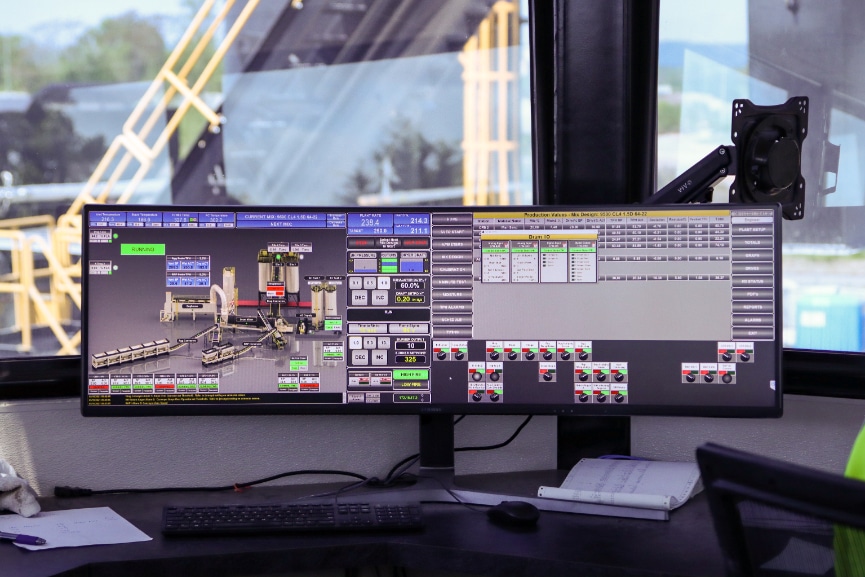
“The plant is a source of pride, for Ernie, for me, for the whole company,” Neese said. “We’re not integrated like the big players in Atlanta, but it is cool to be able to produce mix for our jobs up in that area.”

Having its own plant, run by Ernie Lopez III’s stepson, Dustin, has also enabled Atlanta Paving to do work on weekends if needed and during the two weeks around Christmas and New Years when many of the larger companies shut down. “Before we had our own plant, that meant there was less work for us to give to our employees.”

Neese estimates that 90% of the 60,000 tons the company produced in 2022 was placed by its own crews. “Buying our plant was definitely a start for us, and certainly a milestone in our growth.”
How to Maintain Your Milling Machine

When Tom Chastain presented the best practices of milling at CONEXPO-CON/AGG 2023, every tip and trick was based on one assumption: “Everything I’m saying is based on a well maintained machine.”

In Chastain’s 29 years in the milling industry, presently as milling product manager at Wirtgen America, Antioch, Tennessee, he’s learned the importance of properly maintaining one’s milling machine in order to achieve quality results.

“As soon as these machines hit the ground, they’re beating themselves to death. That’s their life,” Chastain said. “So we have to make sure we maintain them.” Here are a few of Chastain’s top tips for mill maintenance.

Maximize Milling with these Best Practices

Start Your Walk-Around

A key step in any maintenance routine is to properly take care of the cutter drum, Chastain said. “The cutter drum is the lifeblood of a milling machine,” he said. “I could strap two jet engines to a milling machine, but if the cutter drum is not in proper working order, we’re not going to get production and we’re not going to get quality.”

Also check the kicker paddles on your drums. “They are there to help get the material out of the housing,” Chastain said. “If you don’t have those or they’re worn out, that material is just going to sit there in the housing and we’re going to be putting a lot more wear on the machine.”

If the material isn’t swiftly making its way out of the housing, chunks of material may get stuck on the conveyor belt. “Then they act just like pizza cutters and they start slicing up the belt,” he said. “If you don’t have a conveyor belt, you’re not milling.”

Chastain also suggests checking wear items on the housing, like the rear scraper, the front moldboard, the side plates, etc.

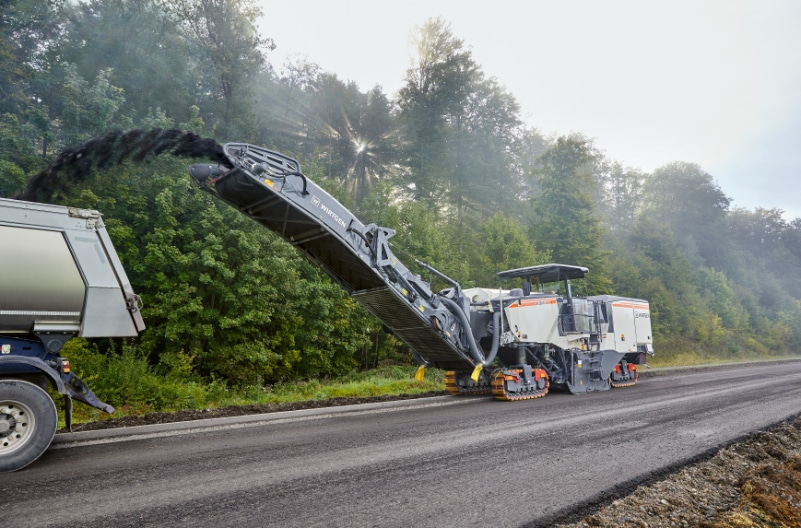
With a working width of 2.5 meters, the Wirtgen W 220 Fi mills off the 46 cm thick road surface in two passes on Interstate 55 in Bolingbrook, Illinois.

Spray to Play

It’s also important to check that the spray system is working correctly. “Water is our friend,” Chastain said. “It’s not only a cutting tool coolant, but it’s also a lubricant—and we want to keep those teeth rotating.”

Water also plays an important role in silica dust suppression and helps prevent buildup on the machine’s components. “It eats me up when I’m on a job site and someone says ‘I’m going to need you to mill dry because we’re going to be paving right behind you’,” Chastain said. “I’m like, ‘No you’re not, because we’ve got to broom it, and damp material is easier to broom up because it’s clumped together.’”

Chastain chooses to run soap in his water tank, but avoids Dawn and other surfactants. “Think about those Dawn commercials where they’re washing oil off of birds,” he said. He was on a job in western Canada where the milling crew went heavy on the Dawn. “They broomed it and tacked it, but there was still residual Dawn on the road that broke down the tack coat.”

Instead, he uses a capful of cheap liquid laundry soap a couple times a day. “If you’re going to put soap in the water tank, put water in first, then soap,” Chastain said. “If you put soap in first, the machine’s going to foam up like a rabid dog.”

Chastain points out that many new machines have multiple sections across the water bars. “With older machines, if we make a full pass then back up to make a half pass, we’re putting down a lot of water and end up with residual water that we’ve got to let dry out before we tack,” he said. “[With new machines] we can cut off sections of water to make sure we’re not doing that.”

Selecting Your xD for Mill-and-Fill Workflow

Check & Change Teeth

A maintenance item worthy of its own section is checking the milling teeth and holders. “Every time a tooth makes contact with asphalt, it generates upwards of 1,800 degrees Fahrenheit,” Chastain said. “You take that heat and the abrasiveness of the material that we’re cutting, that’s where you actually start to get tooth wear.”

According to Chastain, the dead giveaway of a bad tooth is a white streak behind the mill. Although an operator may be tempted to wait until they see more than one streak, it’s important to change a bad tooth as soon as you see it or the wear might make its way to the holding.

“The way these drums are designed is that they hit at about a 36-degree angle, give or take 5 degrees of skewing,” Chastain said. “When we get to the holding and we put a new tooth in there, you might think you’re all good, but you’re not. We’ve changed the angle of attack of that holding. Now, you may not even be hitting the carbide. You’re going to be bouncing off the side of the body of that tooth. That tooth is going to wear out three to four times faster than the others.”

Behind the machine, this issue is going to look like a scuff mark like a crescent moon. “If you don’t replace that holding, you go from cutting asphalt to bludgeoning asphalt,” Chastain said. “That’s like trying to cut asphalt with a Baskin Robbins tasting spoon. It’s not going to work and the machine is going to let you know.”

Chastain was once on a job in Louisiana in an area with very abrasive rock. He suggested spot checking teeth every half-hour. When he left the job for 40 minutes, he could already see the white streak behind the mill from ½-mile away. In that time, the abrasive rock had damaged 30 holders on the drum. “The cost of operation goes through the roof with mistakes like that—and you can’t even say the word ‘quality’ at that stage,” he said.

Bomag Americas Displays Two New Gen Milling Machines

As a crew mills, Chastain said the goal should be to see a uniform pattern behind the machine. “What we tend to see sometimes is new teeth in old holders or new holders with old teeth,” he said. “When you put a new tooth in with a bunch of used ones, it’s going to create a deeper groove. This can get our pattern all out of whack.”

Chastain gave the following suggestion: “Let’s say we cut a bunch of residential streets this week, but next week we’re going on the interstate. We might rerack that drum to start off fresh.” But, he said, do not throw away the removed teeth. “If they’ve still got 60 to 70% life on them, put them in a box and keep them with the machine. When you go out on that interstate project and you break a tooth, use one of those teeth because it’s going to match your pattern much better than a new tooth.”

Chastain also stresses the importance of always having spare teeth and holders. He was on a project in the middle of nowhere when the crew broke some teeth and forgot any spares. “The spare teeth were at the shop two and a half hours away,” he said. “Everything went downhill because we weren’t prepared for the job.”

Although some of these tips may seem basic, according to Chastain, “Advanced milling training is the basics.” Ultimately mill maintenance can boil down to one key question: “Ask yourself, ‘Have we maintained our machine to get quality?’”

Minnesota Contractor Improves Efficiencies and Productivity with Asphalt Milling Tool

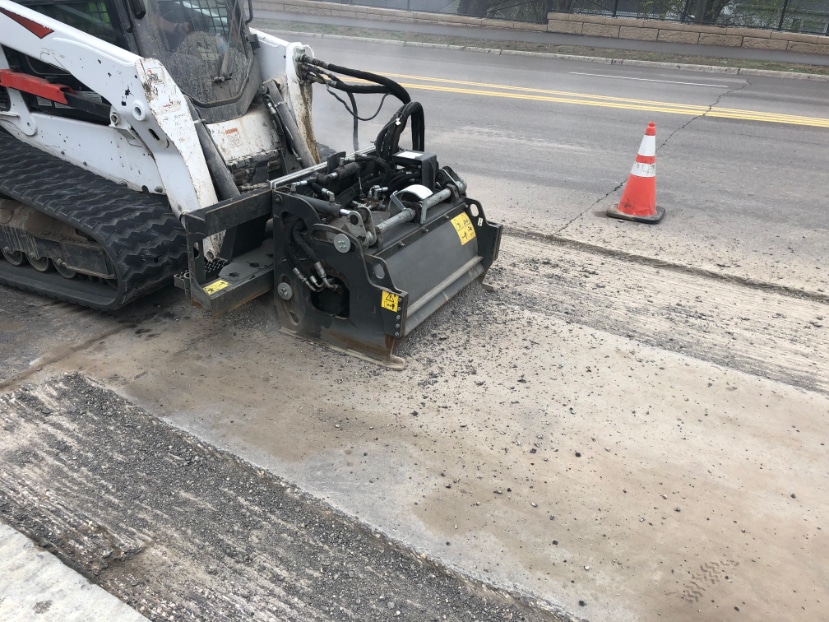
Asphalt milling—also called cold planing, profiling or grinding—to extend the life of pavement on parking lots, roads and bridges is far from glamorous. Often completed in the heat of the summer and amidst traffic, the application can be slow and maintenance-intensive due to the extremely physical nature of the work.

The method of removing and replacing the existing surface layer of pavement to a certain depth while leaving the sub-surface intact is a practical and effective way to extend pavement life. Project owners often choose it as a cheaper alternative to demolition or repaving. With asphalt pavement’s status as one of the oldest urban development technologies still in use today, some contractors seek alternatives to traditional surface milling technologies.

Micro Milling Provides Formula 1 Retexture

Searching for Something New

FPI Pavement Contractors Inc., a privately held asphalt company based in St. Paul, Minnesota, has performed various road restoration and construction jobs since 1995, ranging from parking lot design and resurfacing to mill/overlay and crack sealing. As the company grew, so did its project portfolio and scope of work. The company now offers demolition, bumper installation, striping, concrete work, utility construction and improvements, drainage systems, and site grading, to name a few, to meet the growing needs of its customers. Today, asphalt paving is FPI’s core specialty. About 90% of its asphalt paving business consists of performing asphalt milling and overlay work in commercial parking lots in the Twin Cities.

Until recently, when performing mill patching, paving, dig-out of asphalt chunks and patching work, FPI’s crews dealt regularly with the limitations of the carbide picks found on conventional asphalt milling attachments. The company’s existing asphalt milling tools required tooth—or carbide pick—replacement as often as twice a week to maintain performance. The milling machine’s teeth also required lubrication at cumbersome intervals, further slowing down projects. Additionally, FPI’s asphalt milling tools often left behind a rough, jagged milled surface that visibly showed through any new layer of compacted asphalt. These surfaces needed to be fixed, costing the company time and money.

“The downtime we experienced due to constant delays and rework ate into our productivity,” said David Mathis, a foreman at FPI. “We knew that we needed to invest in a piece of equipment that we could count on to maximize production and keep up with our demanding workload.”

As a small company, FPI needed to be resourceful and find an asphalt milling technique that was both reliable and could ensure that they could execute pavement restoration projects on time and with a polished finished product. Their search led them to Rolling Wedge LLC, based in Peoria, Illinois. The company featured its milling tool at the World of Asphalt conference.

The manufacturer displayed a Rolling Wedge milling tool meant to address the unique asphalt milling challenges faced by companies like FPI. FPI was using cold planers or milling heads with milling drums that were equipped with carbide picks. They mounted these drums on skid steers or similar host machines for asphalt milling. Rolling Wedge milling tools are designed to replace the traditional carbide picks on these drums for improved asphalt milling efficiency.

With Rolling Wedge Milling Tools, FPI went from replacing carbide picks once or twice a week to a replacement interval of one to three months.

These tools are uniquely mounted to milling drums in lieu of traditional carbide picks. Rolling Wedge milling tools utilize a wedging-lifting action, placing concrete and asphalt in tension to mill the material as opposed to the crushing percussion action carbide picks traditionally apply in road milling. When put in tension, material such as concrete has just 20% of the tensile strength of its compressive strength, which allows the milling tool to break the material apart more easily. As a result, the Rolling Wedge milling tool is more energy efficient than traditional methods, which saves on fuel costs. The milling drum’s forward milling speed is dependent on the hydraulic system of the machine it is attached to, with typical forward milling speeds of between 8 to 12 inches per minute.

FPI was so impressed by the Rolling Wedge milling tool drum on display at World of Asphalt that the contractor brought one of its mechanics to the event the next day to learn more. They soon scheduled a trial of the equipment and were quickly convinced to outfit all their milling machines with new Rolling Wedge milling tool drums.

Pike Industries Invests in PCD Milling Tools from Wirtgen

Filling a Need

Today, FPI owns several Rolling Wedge milling drum widths to execute the wide range of their projects more efficiently. The contractor utilizes planers or milling heads equipped with Rolling Wedge milling tool drums operated by Bobcat compact track loaders and skid steers. Crews typically arrive on site with a selection of 18-inch, 24-inch and 40-inch width milling drums. The smallest of the drums (18 and 24 inches) are ideal for seam repair while FPI often uses the 40-inch milling tool for overlaying hot-mix asphalt or profiling around concrete curbs. FPI can easily adjust the milling depth to fit specific project needs—most often 2 inches, but anywhere from 0 to 4 inches.

Maximize Milling with these Best Practices

In Mathis’ words, FPI saw a “night and day difference” both in how long the Rolling Wedge milling tools lasted and how quickly they could be changed compared to traditional carbide picks. The Rolling Wedge milling tool hardened steel and carbide-tipped teeth lasted longer than traditional carbide picks and could be replaced in as little as 20 minutes rather than the previous one to two hours, according to the contractor. Additionally, with Rolling Wedge milling tools, FPI went from replacing carbide picks once or twice a week to a replacement interval of one to three months. The new Rolling Wedge milling tool drums didn’t require water cooling or lubrication and asphalt didn’t stick to them. Additionally, there is no heat generated in the asphalt or concrete milling work.

“With Rolling Wedge milling tools, we’re able to complete milling projects faster and with greater precision,” Mathis said.

FPI benefited from the Rolling Wedge milling tool’s quality of output. The milling tool created a uniform and consistent surface quality thanks to the drum’s ability to produce a more stable base than what’s achieved with percussive planing forces. Its forces leave no ridges or visual abrasions to mar the finished, compressed asphalt. The improved Rolling Wedge milling tool quality allowed the crew to be more efficient by not having to go back and repave with hot mix to smooth ridges that may show through the surface.

FPI benefited from the Rolling Wedge Milling Tool’s quality of output. The milling tool created a uniform and consistent surface quality thanks to the milling tool drum’s ability to produce a more stable base than what’s achieved with percussive planing forces.

“With carbide picks, you had to constantly go back and redo it, which takes extra time to make sure it’s milled properly,” Mathis said. “In our line of work, you can’t afford to have anything slow you down.”

Though the work is tough and unforgiving, FPI finds pride in a job well done. This process is now easier thanks to new methods redefining how some contractors complete asphalt milling applications.

For more information, contact LeRoy Hagenbuch, Rolling Wedge at (309) 322-1600, info@rollingwedge.com.

Maximize Milling with these Best Practices

Tom Chastain has learned a thing or two about quality milling in his 29 years in the milling industry. Currently the milling product manager at Wirtgen America, Antioch, Tennessee, he regularly conducts application training on milling machines for dealers, contractors, unions and municipalities and has assisted with projects and conducted training on four continents. At CONEXPO-CON/AGG 2023, Chastain shared some of his advice for maximizing milling quality.

“The job of a milling crew is to give the paving crew a clean palette to paint a masterpiece on,” he said. With each passing year, Chastain said the standards for milling crews have risen. “With asphalt paving, they’re using big skis and more technology to get a smoother ride. With rolling, they’ve got intelligent compaction, oscillation, etc. to get a smoother ride. Now, the focus is on [milling to get a smoother ride].”

“The job of a milling crew is to give the paving crew a clean palette to paint a masterpiece on.”—Tom Chastain

Of course, achieving a smoother milled surface involves technological improvements, but Chastain said milling quality is mostly about getting the basics right. “I hear all the time, ‘We’ve been through basic milling training. We want advanced milling training,’” he said. “But advanced milling training is the basics.”

Here are eight best practices any milling crew should know based on Chastain’s nearly three decades of experience.

Know the details of the job.

Chastain shared a story from a project he was on in Missouri many years ago on I-55 southbound. “The milling crew was already there when I showed up to the job site,” he said. “I asked them where the machine was and they said they didn’t know. I asked where we’re going to start milling and they said they didn’t know. Eventually, the machine shows up and we start rolling down I-55 southbound. The DOT shows up an hour later and says, ‘What are you doing? You’re supposed to be going northbound.’”

Chastain said it is possible to get quality and quantity, but that he only sees these ‘unicorn projects’ about once a decade. Often, on a job with multiple full-lane machines, each with their own water trucks, and ample trucks to remove millings from the job site.

His example stresses the importance of quality communication. “If you communicate with your team regarding the job, the better chances you have to achieve quality,” he said. Chastain stresses the importance of the information in the office making its way to the superintendent, foreman and milling crew. “But it doesn’t stop there.”

“We have to remember we’re making ½ of VELCRO®. The paver is coming in with the other half.”—Tom Chastain

“We also need our safety personnel—our flaggers and anyone else involved—to be on the same page,” Chastain said. He also recommends discussing with the truck drivers how you want them to maneuver in front of the machine, how to leave the job site, and the importance of operating safely in the work zone. “If we’re working for a prime on a project, we need to have an understanding of what we’re going to do on that project.”

“Everything we do starts with communication,” Chastain said.

Leica Geosystems 3D Milling Keeps Yield on Track

Know the right machine for the job.

Choosing the right machine for the job is key to a project’s success and efficiency. “We’ve got to understand what machines we need for the project,” Chastain said.

“Maybe we think we can get away with a small machine because we think we’re just doing some patchwork,” he said. “So, you take out the compact machine, knock those out, then you find out you need to mill three lane miles. We can do it with that [compact] machine, but it’s not going to be the most time efficient.”

However, small milling machines are handy to have in one’s fleet. “The reason is they can flush cut around manhole covers,” he said. One issue he’s noticed with using a skid steer with a milling head attachment is that they are challenging to operate well. “That manhole cover often ends up looking like a great white shark’s been gnawing at it and we have to go in with a pickaxe or a jackhammer to clean it up. Having a small milling machine makes it that much easier.”

Measure Yield to Maximize Milling Benefits

Know your milling modes.

These days, Chastain said most manufacturers offer milling machines with several operating modes. For example, eco mode for fuel efficiency and power mode when “you want everything the machine’s got,” he said.

Many machines also have a pattern mode for optimal milling quality, Chastain said. “With the way milling used to be, when we hit a hard section of asphalt the machine slows down because of the load against the machine drum, and that would tighten up our pattern,” he said. “With new machines, you can put them in pattern mode, tell the machine what drum you’ve got, what teeth you’re running, and what pattern quality you want it to maintain. If you hit that same hard section of asphalt, not only is that machine going to slow down but now the drum is going to slow down as well. That way, we keep a consistent pattern, curb to curb.”

Like 3D grade control, Chastain said, this is another way to “make it easier for inexperienced operators to get us to a higher quality of milling.”

“I hear all the time, ‘We’ve been through basic milling training. We want advanced milling training’. But advanced milling training is the basics.”—Tom Chastain

Choosing the right machine for the job is key to a project’s success and efficiency, and Chastain said sometimes the best machine for the job is a compact milling machine such as Wirtgen’s W 100 Fi.

Know your drum types.

“You’ve got standard drums, then you have fine drums, then you have micro drums,” Chastain said. “A standard drum is made to mill to the machine’s maximum cutting depth. If the machine’s maximum cutting depth is 14 inches, it’s made to cut 14 inches. Fine or micro drums are for thin lifts or profiling.”

Sometimes, Chastain said, a milling crew will get the idea that they can use a fine drum to mill faster while maintaining pattern quality. For example, on a job in the Midwest, an operator planned to cut 7 inches with a fine textured drum. “He put the machine in the ground, one track pad rolled over, and it stalled the machine.”

Why? “Because the material couldn’t get out of the housing,” Chastain said. He explained that with a standard drum, there’s space between the material and the teeth. With a fine drum, “there’s not much space. If you pick that machine, you’re going to have to do a bunch of 1 ½-inch passes all day.”

Another thing to keep in mind if using a fine or micro drum is its implications on reclaimed asphalt pavement (RAP). “If we’re going to use a finer micro drum, we need to understand we’re going to lose 10 to 12% of that material,” Chastain said. “We’re turning it into dust because we hit it with so many teeth.”

However, the worst thing about a micro drum, according to Chastain? “Somebody’s got to change all 1,100 teeth on that drum.”

Pike Industries Invests in PCD Milling Tools from Wirtgen

Know how your grade technology works.

Chastain said these days there is a wide variety of grade controls available for milling machines.

“We need to understand what grade controls we need,” he said. “There’s a big difference between copying the road and profiling it.”

“If you’re copying the road, basically what you see is what you get,” Chastain said. “If there’s a bump in the road, unless you’re really good at using your grade controls, there’s still going to be a bump in the road.” Although the road may look all right after milling and immediately behind the paver, Chastain said once it’s compacted, “you’re back to exactly what you had.”

When a crew is simply copying the profile of the road, Chastain said they may even risk making bumps worse if they’re milling at a high feet-per-minute rate. “If you’re milling faster, you didn’t do anything to that bump except lengthen the size of that bump because the hydraulics need enough time to react.”

“With profiling, like with a sonic averaging system, you can take a big bump and turn it into three smaller ones,” he said. “Is it perfectly flat? No. But it’s a whole lot smoother than it was before.” Depending on the road conditions, Chastain said a crew may need to cut the road two or three times with an averaging system to get it perfectly flat. “It all depends on that road.”

Although 3D technology has been a “big topic in dirt,” Chastain said, “it’s coming over to the asphalt side.” He said there are a variety of 3D systems out there. “The big thing now is doing road scans. They’ll drive the job, get their plotting, make a 3D plan, then plug the plan into the street and go.”

“[3D] takes the guesswork out of milling,” Chastain said, while achieving a quality milled surface. “This also helps less experienced operators to get acclimated to the machine quickly.”

Milling at high speeds can result in a poor pattern. According to Chastain, 30 feet per minute is a tight pattern; 60 to 80 feet per minute is still a good pattern; at 85 to 90 feet per minute, the pattern begins to stretch out.

Know your teeth options.

“[Manufacturers] make different teeth for different applications,” Chastain said. “When you have soft asphalt, it’s going to wear out the body, but not really the carbide. Hard asphalt is going to wear the carbide, but not really the body.”

In addition to carbide teeth, diamond teeth may be a good alternative depending on the application. “Say you’re in the middle of nowhere, diamond teeth can be the way to go because they’re rated for 400,000 tons,” he said. “You can get a whole season on a set of teeth.”

The higher-wear teeth aren’t the solution for every application. “Someone who’s been milling a while might think, ‘I don’t have to change teeth anymore? Yeah, I’ll do that’,” Chastain said. But you have to understand the application. “I once saw a guy put a diamond drum on a machine, it goes 50 yards and hits a manhole cover.” Chastain shared that the operator wasn’t experienced enough to know what to do. “The whole time, that manhole cover is inside the housing bouncing around.”

“Your standard carbide milling tooth is $7, whereas a diamond tooth is $275 a tooth,” Chastain said. “That mistake cost 38 teeth. You do the math.”

Cryogenic Hardening Lengthens Milling Tool Life

 Know how to start—and how to stop.

“My philosophy of starting off is this: start slow, stop slow,” Chastain said.

“The hydraulics need time to react, so when we start off we have to go slow to let those rear tracks walk into the cut,” he said. Otherwise, the machine will put a dip in the road about 3 feet from where it started. “Once the tracks get into the cut, then ramp up speed.”

The same applies when it’s time to stop the machine. “With older machines, everybody used to think that it would leave a dip in the road because the machine settled when it came to a stop,” Chastain said. However, that isn’t the case.

Let’s take a closer look at how the teeth of the mill work. “Some people think that the teeth rotate while they’re in the cut,” Chastain said, but that’s not the case. “When the tooth is in the cut, it’s actually flexed. There’s pressure working against that tooth. Once the tooth releases from the cut, that’s where we’re actually getting the tooth rotation, and that’s what we’re wanting to see between that flex release and material flying around inside that housing, we want to get that tooth rotation.”

When the mill comes to a stop, it isn’t that the mill settles. “It’s actually that you didn’t have pressure working on that tooth, so it relaxed from the holding about ¼ inch,” he said. “Now, when good operators come to a stop, they bump their grade controls up about ¼ of an inch. When they get going again, they bump it back down.”

Safety First | When you think about what’s inside that cutter housing, it’s chaos,” Chastain said. “We’re trying to control chaos. We’ve got chaos working for us. When you give chaos an opening, chaos can bite back.” He shared an example of a milling job on an interstate where the mill hit a buried manhole cover. “It got underneath the side plate, skipped like a frisbee and embedded into the guardrail,” Chastain said. “You need to put a bubble around that machine. You have to put safety first.”

Micro Milling Provides Formula 1 Retexture

Know how fast to mill.

“The three magic words to a milling crew are production, production, production,” Chastain said. “We’re production oriented. We’ve got to go, go, go.”

Is it possible to get quality and quantity? Chastain said it’s possible, but that he sees one of these “unicorn projects” about once a decade. “The last one I had was shutting down a major interstate outside New York City where we had six full lane machines, each with their own water trucks, and thirty trucks,” he said. “We went 2 ½ miles down and 2 ½ miles back without stopping.”

However, on a normal job where a milling crew might only be running half an hour out of every hour, going 30% faster in order to wait longer isn’t worth the potentially reduced quality, Chastain said. “Instead of milling at 150 feet per minute and then sitting there 40 minutes [instead of 30], slow down your feet per minute,” he said. “Work more out of an hour and get better quality while still getting your production. Unless we have trucks to burn, that should be sufficient.”

Milling at high speeds, Chastain said, can result in a number of issues. First, “You’re not actually cutting at the depth you set,” he said. “The machine starts to water ski a bit when you go that fast.”

Having a poor pattern also reduces the interlocking capability between the milled surface and the asphalt to be paved. “We have to remember we’re making ½ of VELCRO®,” he said. “The paver is coming in with the other half.”

Solve Poor Milling Patterns

Because milling at high speed can result in erratic milling depth, the tonnage may be off. Although Chastain said this might not matter much on a small project, it can have a significant impact on an interstate project.

Furthermore, poor milling quality is going to cause compaction numbers to fluctuate. “Say we’re doing a thin lift mill-and-fill at full speed,” he said. “The paver paves it, then the breakdown roller comes by and hits one of our high spots. We could break the aggregate. It’s not the roller’s fault. It’s our fault.”

Milling quickly can also put an unnecessary amount of wear on the machine. “These machines are beating themselves to death and we’re trying to put one foot in the grave by running them that hard,” Chastain said.

Lastly, milling at high speeds can cause issues with sizing material. “We’re trying to use that RAP material,” Chastain said. “The slower feet-per-minute we go, the tighter the pattern, the smaller the RAP material. The faster we go, the more coarse the pattern, the larger the RAP material. We have to screen that RAP, we may even have to crush it, too. So, we’ve added a process simply because we like to mill fast.”

Those chunks can also present a risk to safety. “It’s possible that a chunk could find its way toward live traffic,” Chastain said.

According to Chastain, 30 feet per minute is a tight pattern; 60 to 80 feet per minute is still a good pattern, “but you can see that the drum is no longer [pulling] that material toward the center.”

“When we get to 85 to 90 feet per minute, we’re starting to get a little coarse and stretching out that pattern,” he said. “When you get over 170 feet per minute…the machine’s actually walking faster than the drum is turning.”

He gives milling machine operators the following bit of homework: “If you’re used to running fast and you don’t believe me, slow down by 20 to 30 feet per minute and look at what happens to the pattern quality and the RAP going into the truck.”

“[Milling too quickly] equals lower quality, a waste of material and loss of money,” Chastain said. He reiterates that advanced milling best practices are, in fact, the basics. “Milling in a nutshell is this: common sense and simple math. I can teach simple math, but I cannot teach common sense.”

Measure Yield to Maximize Milling Benefits

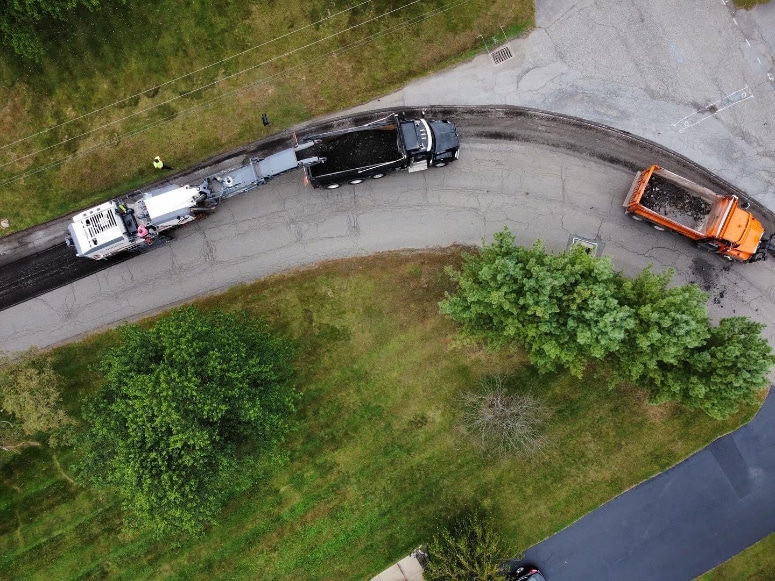
Located in the Hudson Valley alongside the Hudson River about 70 miles north of New York City, East Fishkill, New York, is home to around 30,000 residents. For three of the past four years, Intercounty Paving Co. (IPC), Carmel, New York, has won the bid to perform the paving and pavement maintenance work in the town.

However, 2021 was the first year the town’s highway supervisor agreed to allow IPC to mill prior to paving.

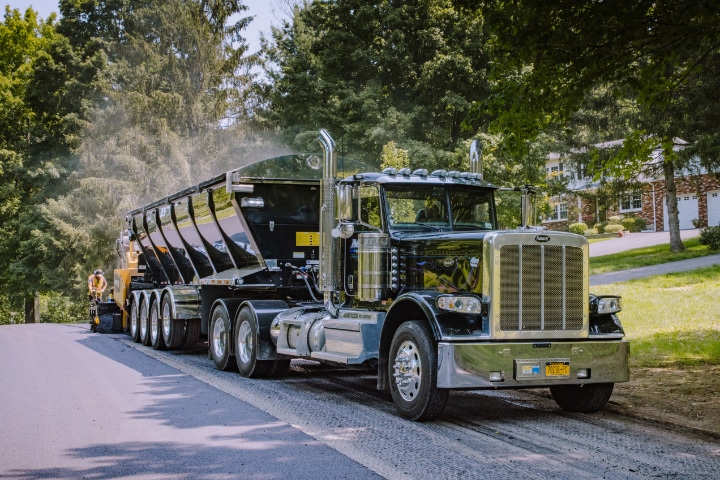
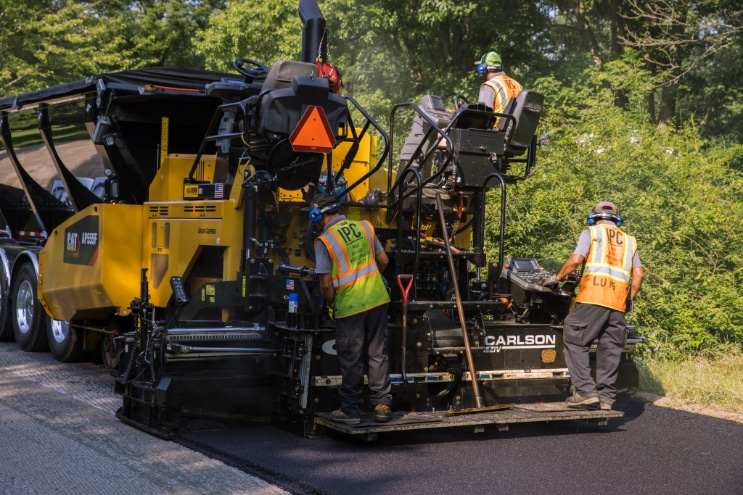
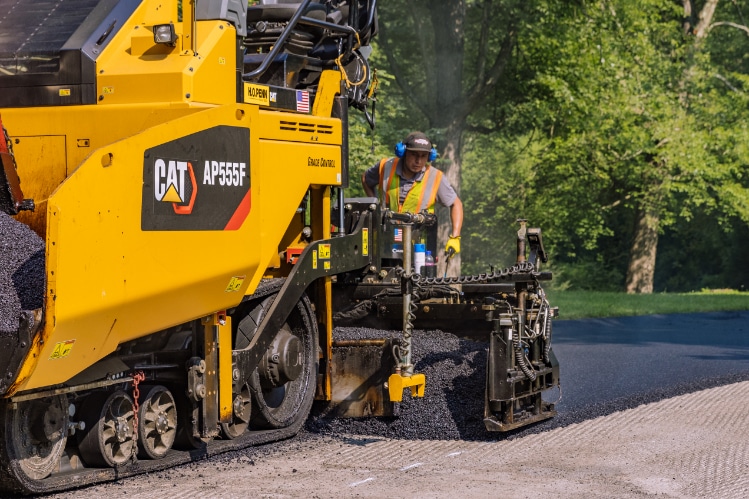
After the crew milled off 2 inches of pavement with its Wirtgen 200 milling machine, broomed and applied tack coat, it paved 2 inches of New York state 6F top mix asphalt with its Caterpillar 555 paver equipped with Cat grade control.

“Milling is nothing new on highways or state roads, but in our area towns are just starting to adopt the practice,” said Project Manager Tyler Spano. “We’re seeing that trend and we want to be on the leading edge of it.”

Spano has been working to educate highway superintendents in IPC’s area of operation on the benefits of milling. “Not only does it maintain current elevation, but it reduces reflective cracking and results in a smoother ride,” Spano said.

In addition to paving more than 10,000 tons of asphalt in East Fishkill—including several mill-and-pave projects—IPC also performed mill-and-overlay jobs in two other New York towns, Yorktown and Sommers, in 2021.

However, many municipalities have been reluctant to try a new process with which they are unfamiliar. “For years, they’ve just paved on top of the existing pavement,” Spano said. For decades that approach worked, but eventually road elevation became a problem. All the catch basins and manholes were low, and municipalities began to experience more callbacks from residents asking to have a lip paved on their driveways.

Keeping close track of their yield was key to the project’s success, since the reduced asphalt tonnage helped the municipality afford to mill. In total, the job required around 1,200 tons of asphalt.

When East Fishkill hired a new highway superintendent, Ken Williams, one who was open to trying new things, Spano took his shot. He explained the benefits of milling, including how it minimizes trimming and leveling and could reduce the total amount of required asphalt. “I explained how those savings could be applied to the cost of milling,” Spano said. “In the end, a 2-inch mill-and-pave was only 10 percent more than their traditional 2.5-inch overlay with leveling and made for a much better pavement.”

Intercounty Paving Evolves, Grows Through Three Generations

It also didn’t hurt that IPC had multiple years of history performing work for the municipality. Williams gave them a chance to illustrate to him the benefits of milling and paving on a ¾-mile section of East Fishkill’s Dale Road in September 2021.

“It’s probably not by accident that they wanted to test out a mill-and-overlay on a small project first,” Spano said. He knew he and his crew had to bring their A game. “I’d been in his ear all year about milling, so if the job didn’t come out right I knew they’d never mill and pave again.”

Make the Case With a Test Case

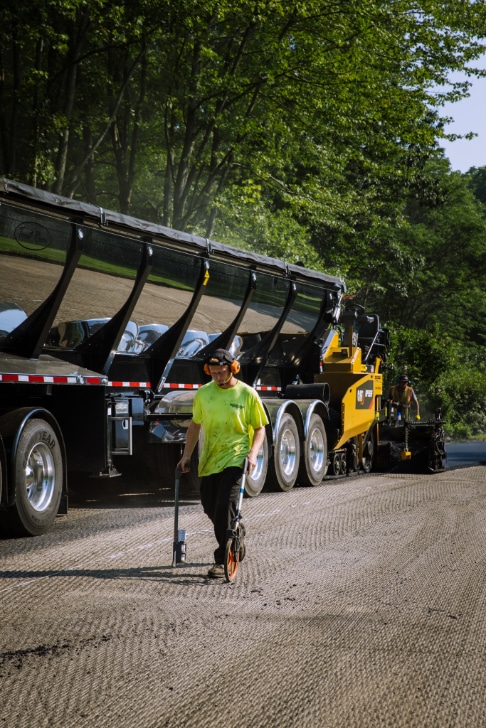
Spano set off with his measuring wheel and began marking out the milled pavement with anticipated yield at several points throughout the project so he could monitor and control tonnage as the crew paved.

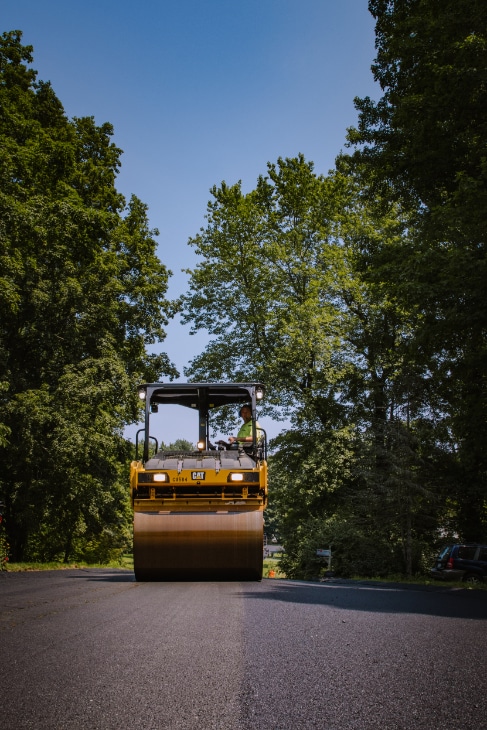
After the crew milled off 2 inches of pavement with its Wirtgen 200 milling machine, broomed and applied tack coat, it paved 2 inches of New York state 6F top mix asphalt with its Caterpillar 555 paver equipped with Cat grade control and Carlson EZIV screed. They compacted the mat with a Cat CB 10 10-ton roller for breakdown and Bomag 138 5-ton roller for finishing and compacting up against the country curb.

In total, the job required around 1,200 tons of asphalt, which IPC purchased from Thalle Industries in Fishkill.

Keeping close track of their yield was key to the project’s success, since the reduced asphalt tonnage helped the municipality afford to mill. “I told the highway superintendent that we could use less asphalt if we milled and paved,” Spano said. “If we went over, that disproved my theory.”

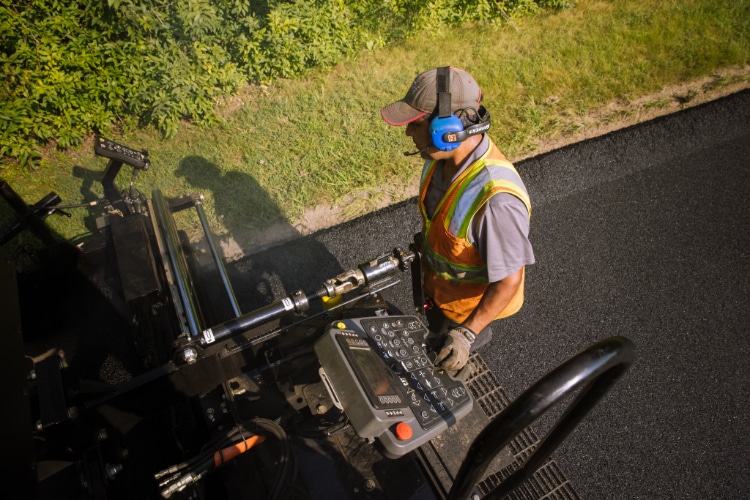
IPC utilizes Sonetics wireless headsets to communicate with one another on the job site.

IPC has worked with paving consultant John Ball of Top Quality Paving and Training, Manchester, New Hampshire, for years. Among the skills they’ve picked up is how to measure and monitor yield throughout the project. The company honed its measuring skills on its private jobs, where blowing their yield could mean breaking even on a project. Half of the company’s work is for municipalities, the rest is parking lots, condos and private roads.

“Even when we get paid by the ton, it’s a good practice to have,” Spano said. “Regardless of the job, the materials we’re playing with are expensive. We try to be right on the money with tonnage.”

Spano calculated the yield for the whole project, and then divided it by each pass. Spano set off with his measuring wheel and began marking out the milled pavement with anticipated yield at several points throughout the project so he could monitor and control tonnage as the crew paved.

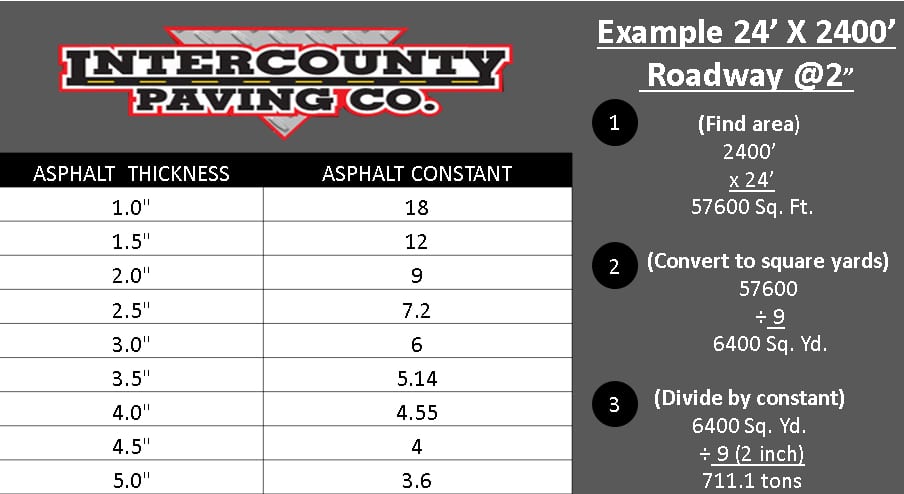
Spano made this chart to help him calculate yield on IPC’s projects.

“If I have the load ticket in my hand, and I know how far 21 tons should have taken me on a 10-foot-wide pass, I can easily monitor how close we are to our initial calculations,” Spano said. It also helps him call for the right number of additional trucks as the crew gets close to finishing for the day.

Between markings, Spano relies on the smartphone app Measure Map. “I can sit on the paver and lock in my location, draw a line to the end of the road and it will tell me how far I am from the end of the road,” he said. He then multiplies that linear footage by the width of the pass to figure the balance of the unpaved area.

Spano has been working to educate highway superintendents in IPC’s area of operation on the benefits of mill-and-overlays. All photos courtesy of Nick Spruck.

“Measuring beforehand, marking on the ground how much each pass calls for, and checking that against each pass is a lot of work,” Spano said, “but it’s worth it because we’re dealing with a lot of money.”

Intercounty Communicates Clearly with Wireless Headsets

Calculate & Communicate

On the Dale Road job, Spano’s calculations were within 20 tons of the amount of asphalt the crew ultimately placed. “That’s pretty good, especially with the challenge of calculating with the country curb on both sides,” he said.

The geometry of the job was tricky, with about two dozen driveways tying in and ending in a cul de sac. The job also called for a country curb, which is a 4-inch tall integrated berm on both sides of the road.

Country curbs are quite common in the northeast and growing in popularity year by year, Spano said, since they are more cost effective than installing costly concrete curbs that frequently get damaged by snow plows.

The job also called for a country curb, which is a 4-inch tall integrated berm on both sides of the road.

To create the berm, the last 12 inches of IPC’s Carlson screed extension is angled upward to pave a wedge that is 4 inches taller at the end gate than the rest of the pass.

Spano calculated yield for the country curb by adding 1 foot to each side of the road. “If the road is 20 feet wide and has a country curb on both sides, I’ll figure the yield as though the road is 22 feet wide,” he said, since the area of a triangle with a base of 12 inches and a height of 4 inches is 24 square inches (or, the same area of a 12-inch-wide by 2-inch-tall lift).

The country curb is uncompacted, achieving a density of 77 percent from the strikeoff.

To calculate the yield of the cul de sac, Spano will use the formula for the area of a circle if the cul de sac is a perfect circle. Otherwise, he will use the Measure Map app to draw around the cul de sac to get its square footage and perimeter.

With the unique challenges on this job in terms of yield, constant communication was a useful tool on the project. IPC utilizes Sonetics wireless headsets to communicate with one another on the job site.

Spano, who usually runs IPC’s milling crew, would often find that he needed to stop milling in order to communicate with other members of the crew. “If I have to get off the machine to tell him what to do, that reduces my own productivity,” he said. With the headsets, everyone on the crew can hear one another clearly. “They really improve our efficiency.”

IPC compacted the mat with a Cat CB 10 10-ton roller for breakdown and Bomag 138 5-ton roller for finishing.

If Spano is out measuring and the paver operator needs to know the yield on the paving job, Spano can tell him his measurements from 400 feet away without stopping the paver, and the screed operator will hear the answer simultaneously. “Everyone is talking about the job and how it’s moving versus how it should be moving,” Spano said.

Intercounty Paving Dives into Intelligent Compaction

Mill More

“We had to nail the job on Dale, because we only had one shot to show the benefits of milling,” Spano said. And they did. After IPC finished its project on Dale Road, East Fishkill’s highway superintendent opted to have them mill and pave an entire neighborhood, a 3,200-ton job on the aptly named Miller Drive.

On the Dale Road job, Spano’s calculations were within 20 tons of the amount of asphalt the crew ultimately placed.

In addition to paving more than 10,000 tons of asphalt in East Fishkill—including several mill-and-pave projects—IPC also performed mill-and-overlay jobs in two other New York towns, Yorktown and Sommers, in 2021.

“It’s hard to convince someone to spend money, but once they see the value of not getting called back and ending up with a better product, it speaks for itself,” Spano said. “The best part of this job was the opportunity to prove to the municipality that this process is the way to go.”

Hall Moves on I-Move in Kentucky

I-Move Kentucky is a $180 million investment that will widen and improve interstates, as well as revamp congested interchanges, to improve safety along three busy interstates in Jefferson and Oldham counties: Interstate 64, Interstate 71 and Interstate 265 (Gene Snyder Freeway).

The four-year project will be the largest single construction project in Kentucky since the Ohio River bridges project was completed in 2016. Hall Contracting, Louisville, Kentucky, began work on the project in May 2020.

“I-Move Kentucky will improve safety and mobility on three major interstates that join together in eastern Jefferson County and will allow travelers and freight to move freely through the region,” said Greg Thomas, secretary of the Kentucky Transportation Cabinet (KYTC). “These were among the most important projects identified during last year’s SHIFT prioritization.”

SHIFT, or Strategic Highway Investment Formula for Tomorrow, is KYTC’s data-driven approach to compare capital improvement projects to prioritize transportation funding. The project consists of a number of improvements, including reconfiguring interchanges at I-71/I-265 and I-64/I-265 for better safety and traffic flow. The widening of I-71 adds one 12-foot lane of traffic in each direction, for a total of six lanes between Interstate 265 and KY 329. I-265 will also be widened with an additional 12-foot lane in each direction to create a total of six lanes between KY 155 and I-71.

The widening of I-265 was SHIFT’s number one transportation priority, the I-71/I-265 interchange was ranked sixth, and the widening of I-71 was ranked eleventh. “By tackling [these projects] together, we’re saving Kentucky taxpayers time and money,” Thomas said.

The Design-Build Dash

In 2018, the Kentucky General Assembly passed HB 385, which authorized KYTC to use design-build methods of project delivery for major projects like I-Move. Kentucky has already begun using the design-build approach for two projects in northern Kentucky, including the I-65 bridge project over the Ohio River.

“It seems that KYTC wants design-build to be the new normal on large projects,” said Hall’s Quality Control Manager Jordan Sandquist. “Once one section [of the design] is approved by the state, we can start constructing that section instead of waiting for the whole design all at once.”

Kentucky is also looking into balanced mix design (BMD). Sandquist said both design-build project methods and BMD are indicative of a greater trend within Kentucky’s transportation agencies. “The idea is to give contractors flexibility to meet KYTC’s standards,” Sandquist said. “If you can produce a mix that meets their specs on various tests, how you get there is up to you.”

In total, the project will require between 400,000 and 450,000 tons of asphalt.

Roscoe Willis, manager at Hall Paving, a division of Hall Contracting, added, “I think [balanced mix design] is an example of the direction the state is headed in, not only for materials but also for the bid process. It’s results oriented, versus process oriented.”

With the design-build method, Hall will be able to complete the project more quickly. The I-Move project is expected to be broken up into more than 50 buildable units, nine of which are asphalt-related.

Last fall, Hall finished the mill and fill work on I-265, a total of 3 miles or 12 lane miles. In August, the company milled and filled the existing lanes on I-71, a total of 5.5 miles and 22 lane miles. Although I-71 was in pretty bad shape, the construction was more about handling growth and improving safety, said Roscoe Willis, manager at Hall Paving, a division of Hall Contracting.

“This plant gives us a lot of opportunity to add new features down the road,” Willis said. “From injecting additives at the drum to blowing in different products, this plant has the ability to grow with us.”

Hall performed variable depth milling with its Wirtgen mill. The paving crew then placed 3 inches of Class 4 base mix with PG76-22 asphalt cement on the existing lanes.

By the end of the 2021 construction season, Hall anticipates finishing a substantial amount of the asphalt base for the widening of I-71 and all the base for the road widening on 265, completing both the I-71 and I-265 interchanges, and finishing the drainage blanket from Shelbyville Road to Avoca.

The project, totaling 25 contiguous miles, including ramps, is roughly 40 percent asphalt, plus an asphalt drainage blanket beneath the concrete. New lanes along the concrete sections of the pavement will also have an asphalt drainage blanket beneath. The new lanes in the asphalt segments of the project will have a 4-inch drainage blanket, then a 4.5-inch lift Class 4 asphalt base 1.50D with PG64-22, a 3.5-inch lift of Class 4 mix with PG76-22 and 3 inches of Class 4 base mix with PG76-22 to match the existing pavement. The entire span of road will then be topped with 1.5 inches of a Class 4 surface mix.

The crew also used the Pave-IR quality control system from MOBA, Limburg, Germany, to record asphalt temperatures immediately behind its Cat paver.

In total, the project will require between 400,000 and 450,000 tons of asphalt. “From an asphalt standpoint, we’re only just getting kicked off,” Sandquist said. Willis estimates they are 20 percent complete.

New Project, New Plant

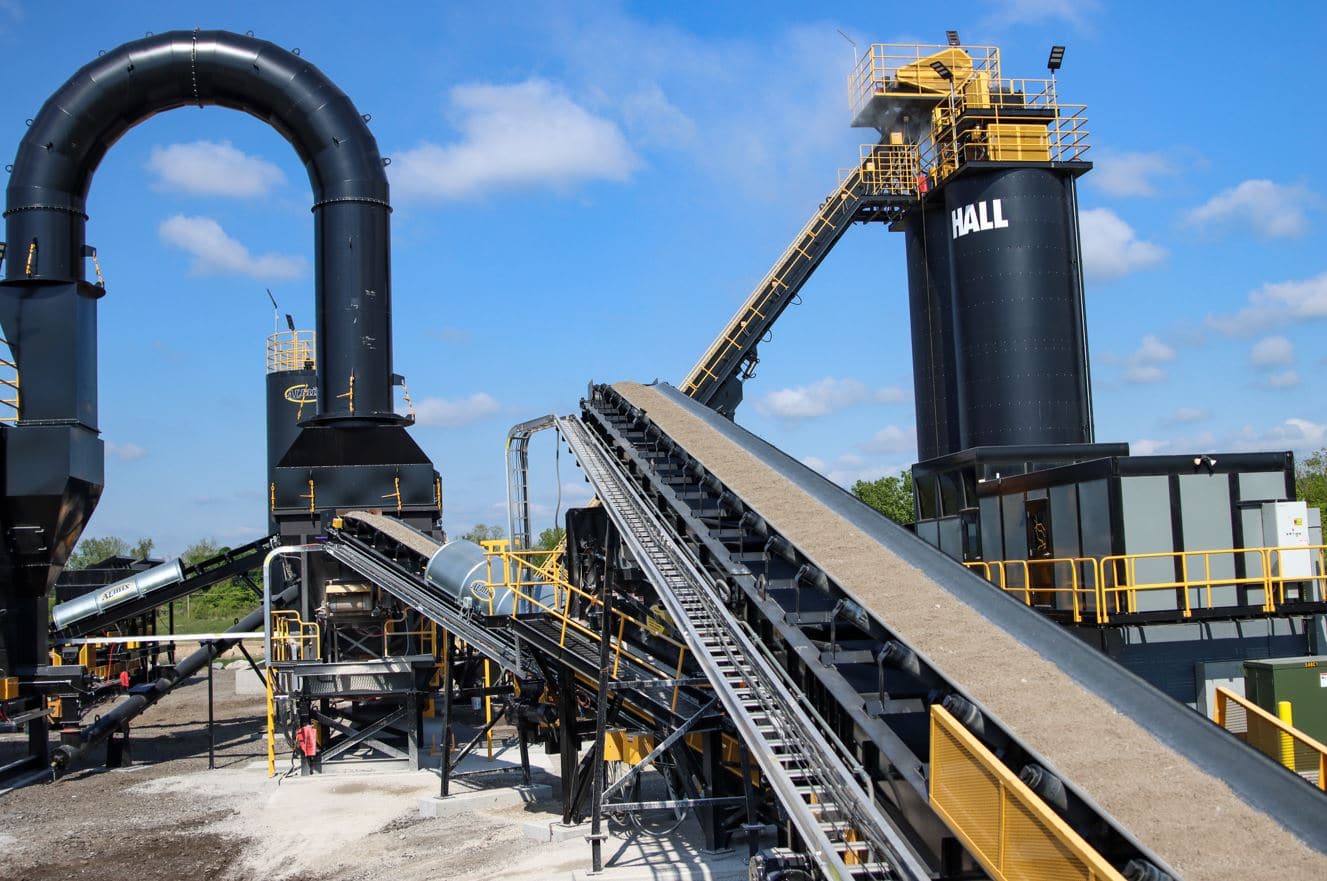
The I-Move project was a catalyst in Hall’s decision to invest in a new 400 ton-per-hour asphalt plant in Charlestown, Indiana, from ALmix, Fort Wayne, Indiana. They purchased the plant in February 2020 and planned to have it running for last year’s paving season.

“We were close to full capacity at our other plant, so this project put us over the edge,” Willis said. However, the pandemic resulted in planning and zoning delays. “It’s not that they were fighting us on it, but simply that the committees weren’t meeting.” They weren’t able to have the requisite meetings until July 2020, finally getting the new plant fired up in May 2021.

Kentucky Puts Low Gyration Mix to the Test

Those delays meant Hall had to rely on its existing asphalt plant south of Louisville, a 400-tph Cedar Rapids plant with three 200-ton silos, for the first segments of the I-Move project. “Since we only had one plant and we couldn’t lose access to it for our daytime projects, we did a lot of night work last year,” Sandquist said.

The new plant currently has two 250-ton silos, but Hall has already laid the foundation for future growth. “This plant gives us a lot of opportunity to add new features down the road,” Willis said. “From injecting additives at the drum to blowing in different products, this plant has the ability to grow with us.”

That was one of several reasons Hall chose the ALmix plant. “ALmix is a great company to be able to add pieces as needed,” Willis said. “We didn’t buy anything we didn’t need, but there are sure to be things we’ll need in the future that we plan to add.”

The I-Move project was a catalyst in Hall’s decision to invest in a new 400 ton-per-hour asphalt plant in Charlestown, Indiana, from ALmix, Fort Wayne, Indiana.

Although the company’s Cedar Rapids plant “has been a blessing to us and has held up very well,” its age confines the company to certain limits in terms of innovation, Sandquist said.

“The new one gives us the opportunity to try things we weren’t able to try before,” Willis added.

For example, they’ve been working with aramid fiber for its anti-cracking properties. “We’ve been using it on jobs with the city and showing our customers the advantage of it for asphalt flexibility and strength,” Sandquist said. “Now that Kentucky is moving toward balanced mix design, it will be one more tool we can utilize.”

Hall got its new ALmix asphalt plant up and running in May 2021.

New Project, New Technology

In addition to its new plant, the I-Move project has also propelled Hall Paving to invest in several technologies that are new to its crews, including e-ticketing, intelligent compaction, thermal mapping and 3D paving.

“The state is interested in the ability to do forensics if something goes wrong with the pavement in the future,” Willis said. “By accumulating that data, they can go back and analyze it to see temperature and compaction data for problem areas.”

The technology that Willis has found most useful is e-ticketing. “The ability to manage trucks differently, track materials and improve efficiency is very exciting,” he said. They use a tool called Broadloop, which was created locally and allowed them to customize the tool to suit their needs. “The ability to see where our asphalt is in real time is amazing.”

Willis found the use of e-ticketing, a technology new to the company, very useful during the I-Move project. “The ability to manage trucks differently, track materials and improve efficiency is very exciting,” he said.

The crew also used thermal mapping and intelligent compaction on last year’s segments of the project. It used the Pave-IR quality control system from MOBA, Limburg, Germany, to record asphalt temperatures during paving. To ensure the crew was ready to use this technology on its I-Move projects, Hall had its crews trained by the technology provider and also had them use the tech for several weeks prior to the start of the project.

The last new piece of technology on the project is 3D paving, which they will use on future segments of work on I-71, I-265 and I-64 to ensure the final surface elevation of the pavement is correct.

“We’re not afraid to try new things and be on the cutting edge,” Willis said. “This project is propelling us to continue to grow.”

Although Hall Contracting was founded in 1954, its asphalt division wasn’t established until 2013. “On day one, we were starting from square one, and now we’re working on one of the largest projects in Kentucky state history,” Willis said. The division started out with 22 employees and now has a staff of 65. “And we’re looking for more,” he added.

In addition to its new plant, the I-Move project has also propelled Hall Paving to invest in several technologies that are new to its crews, including intelligent compaction.

As an employee-owned company, everyone at Hall Contracting has a feeling of ownership of the company and its projects. “We have the type of team that wants to move the industry forward,” Sandquist said.

Willis added, “We’re really pushing this division of the company to do great things. We’re constantly learning and growing and want to be on the forefront. We want to change the world, one ton of asphalt at a time.”

Kentucky Takes Micro Surfacing to the Taxiway


Logistics in Louisville

According to research platform Macrotrends, the population of Louisville is growing faster than the national average (respectively 0.83 percent and 0.58 percent in 2021). However, it isn’t necessarily population growth that is driving infrastructure demand in and around Louisville.

“Although population growth has something to do with it,” Willis said, “I think it’s mostly a result of improved connectivity with southern Indiana and the growing logistics sector.”

According to the Lane Report, a monthly business magazine covering central Kentucky, Louisville is within a one-day drive of roughly 50 percent of all U.S. markets. Louisville’s website, louisvilleky.gov, states Louisville’s logistics sector is more than twice as dense as the U.S. average.

Furthermore, Louisville is the primary hub of UPS Airlines, a wholly owned subsidiary of United Parcel Service (UPS) and the world’s fourth-busiest air cargo hub in terms of freight volume flown, according to UPS, according to the Lane Report.