
Dec 07, 2025
AsphaltPro’s 15 Top Products: Bergkamp Journeyman Mobile Mix Plant: Mobile CCPR for Contractors
BY AsphaltPro Staff
 This product was selected for the inaugural AsphaltPro’s 15 Top Products Feature.
Bergkamp, Salina, Kansas, boasts decades of experience in slurry and microsurfacing solutions. In June 2025, the company announced its Journeyman Mobile Mix Plant, which is the company’s first entry into the cold central plant recycling (CCPR) market.
State departments of transportation (DOTs) have performed demo projects with CCPR treatments—check out a handful of articles on TheAsphaltPro.com like the recent “CCPR in Indiana” and “Central Plant Recycles it Cold”—to gain a cost-effective, sustainable solution for pavement rehabilitation.
The process begins by milling reclaimed asphalt pavement (RAP) from a roadway and, typically, storing it in a nearby stockpile. Once subgrade treatment or stabilization is complete, a pugmill at the stockpile site blends the screened RAP with an asphalt emulsion (or foamed process) to create the CCPR mix. This mix is paved on the nearby stabilized base.
Scott Bergkamp, president of Bergkamp, said the new Journeyman unit is “built to make CCPR more intuitive, more consistent and more reliable from day one.”

The Journeyman Mobile Mix Plant from Bergkamp is rated at a maximum capacity of 275 tons per hour production, depending on mix ratio variables, and features an aggregate hopper of 8 feet, 7 inches (10 cubic yard capacity).
To achieve that goal, Bergkamp began its development process in 2017, building and testing an early prototype to validate performance and operator experience. Rather than retrofitting existing equipment, the team refined the concept, drawing on the success of its EMCADS control technology and input from contractors and operators.
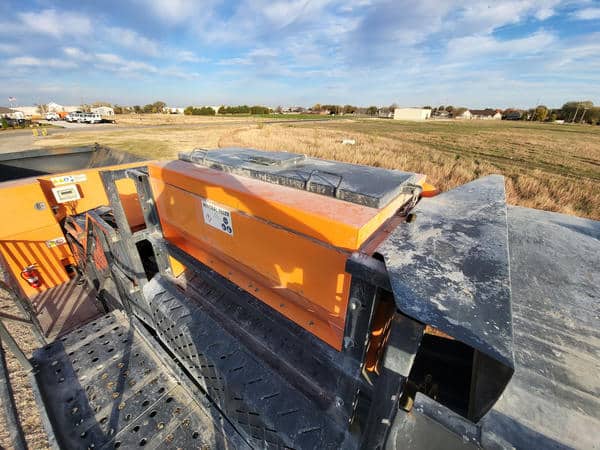
The result is a machine that integrates proprietary automation and metering controls to reduce calibration time. It brings flexibility and precision to the job site, capable of producing mixes with 100% RAP, 100% virgin aggregates or a blend in between, according to the manufacturer. Aggregate and/or RAP is fed into a 10-cubic-yard-capacity hopper at one end of the unit. A conveyor sends this material into a pugmill. A 208-horsepower engine powers hydraulic pumps, and hydraulic motors power all the functions. The pugmill discharges the material into a stockpile.
Bergkamp explained the entire mobile plant can be hauled to a site behind a semi-tractor without the need for wide-load permits or other delays. The contractor can take the unit directly to an agency’s stockpile or their own, set it up and get to work.
“You can set this up in an hour or less at the stockpile site and start working,” Bergkamp said.
This plant is serving the needs of contractors who need to repair or reconstruct roads in remote locations.
“We see so much potential for CCPR,” Bergkamp said. “Now contractors can take a plant without any permits, without any wide-load signs because it’s as easy to move as any other semi-trailer, and perform in remote areas.”
The company plans to have a unit on display at CONEXPO-CON/AGG 2026 but it is available for the North American market now.
Learn more at https://www.bergkamp.com/products/journeyman-mobile-mix-plant.