
May 01, 2024
Episode 1: Break the Silence | Vince Hafeli Shares Advice for Your First Mental Health Conversation
BY AsphaltPro Staff

This podcast is sponsored by Dynapac.
Listen to the audio-only version of this podcast on our Suicide Prevention page, and take a moment to sign the Suicide in Construction Awareness Proclamation while you’re there.
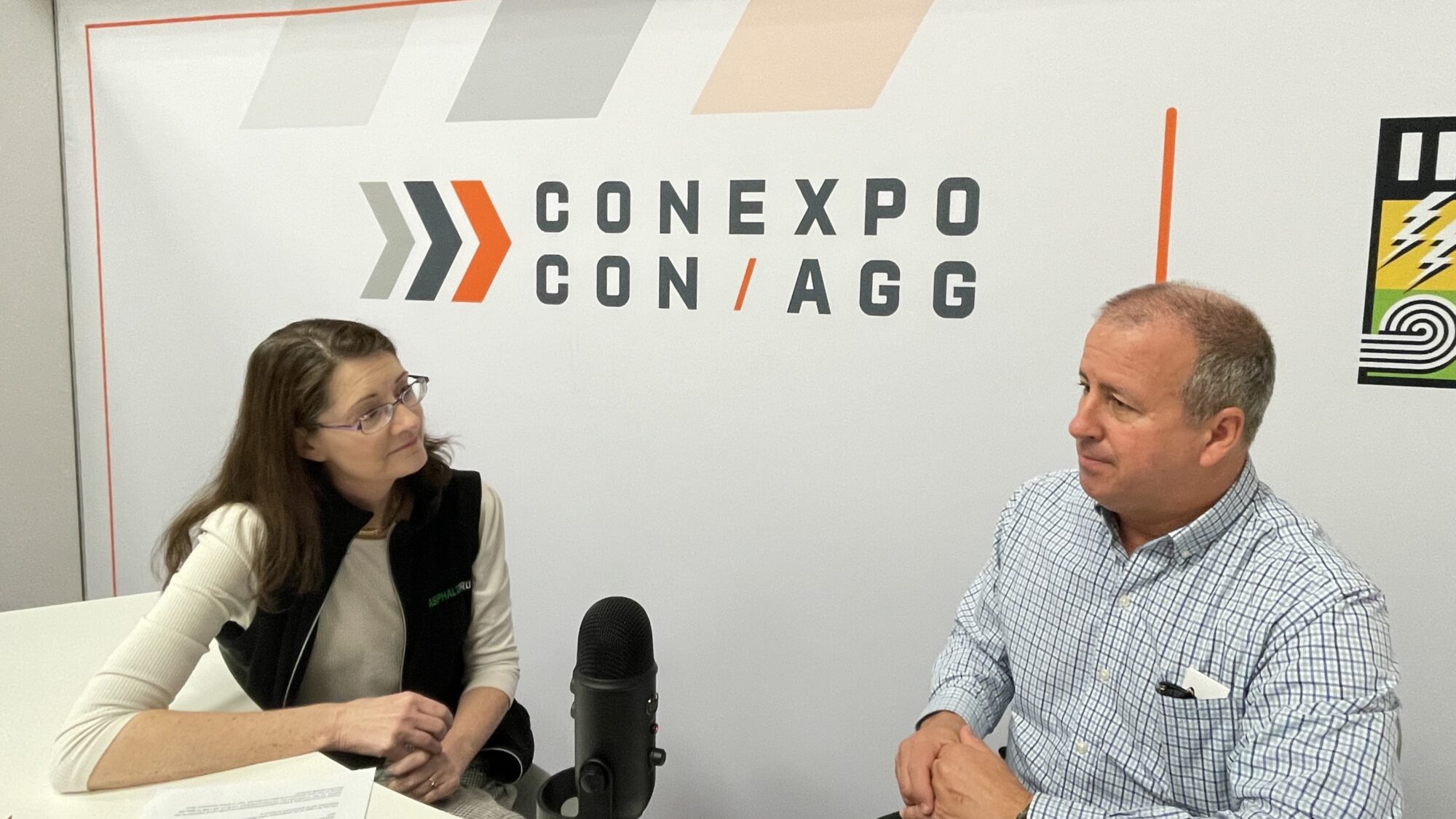
Sandy: Welcome to Part One of the AsphaltPro Magazine podcast mini series for mental health wellness and suicide prevention. I’m magazine editor Sandy Lender and your host for this mini series. In this three part podcast, we’ll explore ideas for incorporating a mental health wellness component into your safety program. AsphaltPro is honored to expand the conversation around this important topic and to bring Ajax Paving’s Vince Hafeli to the podcast for that purpose.
Sandy: Let’s begin part one of this three-part podcast getting a feel for what Vince has seen in the asphalt subset of the construction industry. Regarding suicide in construction and the atmosphere around mental health wellness. I’d like to start talking specifically about breaking down barriers to the conversation in our sector of the industry. Can you give our audience a feel for why it was initially difficult for members of the asphalt industry to talk about mental health.
Vince: I think it’s difficult for a lot of them to talk about it because they aren’t aware that it’s a problem. Until you can acknowledge there’s a problem, it’s difficult to have those conversations. In the research I’ve been doing, I’ve targeted executives, but I had to modify my research question because I thought I would get stories about the things they were doing, but what I got from them instead was that they didn’t know there was a problem. I modified my research now to where I’m actually targeting some companies in different segments of the industry that have programs in place and trying to build best practices from that, if you will. So, back to your question, it was difficult to have those conversations because most people don’t know it’s an issue. But, generally, when I open the door with them, the conversations become very easy.
Sandy: Initially, did you see any reluctance in the CEOs and executives to talk about mental health and suicide prevention, or just that they didn’t know there was a problem?
Vince: There’s always going to be some that are reluctant. The companies that say people are our most important asset—they all say that. I’ve never heard a contractor not say that. But what I ask is, “Are they really your most important asset, or do you just say that because it makes you feel good?” When you ask them, “How are you doing,” are you really asking them how they are doing?
Vince: In our organization, mental health was never discussed. It was kind of a taboo topic. When we began addressing it was when I stood in front of 400 people at our safety day and said we’re going to talk about it and it’s going to become part of our culture. When I said that we were going to be addressing it, within hours of that meeting, I received emails, calls, text messages saying “Thank you,” saying “I’m going to get some help,” saying “I can suddenly talk about it.” The conversion has to begin at the top. It can’t begin at the paving foreman level because they are living in the culture created by the executives. So, until the executives say we’re going to change our culture, the culture remains the status quo.
Sandy: What we want to do with this is change that status quo. How can we make it so that the paving foreman can come forward and be the person who speaks up?
Vince: I think you do what we did in my company. I stood in front of everyone and said we would do it. Within hours of that meeting, a project manager was riding with a project superintendent back to Tampa. The project manager initiated the conversation and said, “Hey, I think you’ve been struggling for some time and I just didn’t know what to do about it. Now I finally feel I can ask you about this.” So he did, and that superintendent went and got some help, which the company paid for. and six months later at the midyear bootcamp, he said to the project manager, “I want you to know that what you did in January saved both my career and my personal life.” We had to pull that gentleman off of a job in downtown Tampa where he was having a breakdown if you will, yelling at someone in a car, confrontational, and had stopped traffic. He got help. People know that he’s gotten help because it’s open. He chose to tell people. We don’t publicize it. That was his decision. But it started with one conversation, and the first conversation is the most difficult to have. They get easier after that.
Sandy: How, over the past few years, have you seen that resistance to talking about mental health. How have you seen that change you over the past couple of years that you’ve been doing this work?
Vince: I’ve talked about it in Wales to people, Indiana, Alabama, Iowa, Oklahoma, Illinois. People, once they hear the numbers, they’re shocked about the numbers, the ranking of our industry, our industry being the second highest in the U.S. and when you combine mining/extraction with construction, we’re actually the highest sector in the U.S. Once they know that, you get the questions, “What do we do, what’s the next step, what does it look like, where do we go?” Again, not from everybody. But I’ve not been laughed off of any stages.
Vince: I’ll tell you about the email I received from Mel, the association director, after my talk in Alabama. He said that in 20 years he’s never heard an audience be that quiet and in 20 years he’s never seen a speaker have a standing ovation. He also shared with me that he had a conversation with a business owner later that evening that said, “That talk was very uncomfortable. It was difficult to listen to. I don’t know anyone this has ever happened to.” One of his employees that was with him said, “What if I were to tell you that I sat on our property a few years ago, going through a divorce with a gun inside my vehicle, contemplating what I was going to do?” Suddenly now the owner knew someone and he didn’t before that. And he found out because of the conversation. So, we just have to keep the conversations going and the change will happen.
Sandy: And these folks out there, they need this.
Vince: I’ve not yet been to a place where I’ve given a talk where I haven’t sat with an adult male, typically the baby boomer males, where they’ve not shed tears and wanted to tell the stories of their lives.
Sandy: It’s important. We’ve got to help these people. That’s why I want to ask you—and you said the conversation was uncomfortable—are you seeing people show more comfort in discussing this, more willingness to discuss the mental health and wellness of their employees.
Vince: I guess I run in two different circles. I have this national circles I’ve been running it. It’s hitting places where this topic has never hit before. So, there, it’s kind of shock and awe. I tell people that, “Hey, I told my story July 16, 2021, to 16 people.” And my story is that in 2007, I was going to take my life and for 14 years I never shared that with anyone. Three people knew. Me, my now ex-wife and my son. As I told my story to the 16 people in that room, it was just silent. You could have heard a feather hit the floor. There was no conversation, there was no dialogue, simply me talking. I wasn’t preaching, I was just talking. And when I was done, they all got up and they left. Nobody said, ‘Hey if you need anything, let me know. Call me if you need someone to talk to.’ I tell people that I don’t hold any ill feelings against any of them. I get it. For 14 years, I couldn’t talk about it, so how could I expect them to talk about it after four minutes?
Vince: Now some of those people of that 16 are involved in organizing some suicide walks that we’re doing. One gentleman in our office, he’s one door down and until we began having this conversation, I never knew his father took his life. The gentleman two doors to the left lost several military buddies to suicide and a family member to suicide. I never knew the lady down the other end of the hall once stopped her mother and had lost several family members. Once we began having the conversation, my other circle I run in—my intimate one, if you will—we began organizing the statewide walk in Florida, where we brought in Hubbard Construction, Duval Asphalt, CWR Contracting, the South Florida Engineers, the Asphalt Group. In our first meeting with that group, the conversations weren’t that deep or meaningful. Five or six months now into the walk, into biweekly meetings, the conversations become easier and people are more energized and excited about what they’re doing.
Vince: I’ve done some TedX talks and I always say the conversations are going to be awkward, there are going to be periods of silence or even awkward silence. When you’re having these conversations with people, don’t think you have to make jokes to make them feel comfortable. Don’t think you have to lead the conversation. Sometimes the conversation will be short and you’ll move on. Sometimes people have to process the data. So, don’t think the first time you approach someone or a company or a CEO or that once the CEO does it and the first time he approaches the paving forman that they’ll immediately be on board. This is a deep, dark subject that people need to be provided time to absorb and think about and take it in. They need to be able to go home and have a conversation with their spouse, or their pastor on Sunday or their buddy they’re playing golf with and have the conversation. You need to allow people to process it and work through their emotions and feelings and when I’ve seen people do that, I’ve only seen a couple people who are still against it, but the majority of people say, “What can I do, where do we go from here?”
Sandy: What kind of hope does that give you in that shift toward more people wanting to get active, more people wanting to do stuff?
Vince: I’m very hopeful. The proclamation I did was on suicide. If I could go back and rewrite the proclamation now, it would probably be more on mental health. Because the talks I’ve been giving a lot hinge on mental health. My research was on suicide, so it’s natural that the proclamation was on suicide, but I’m trying to educate people more [on mental health] now in the talks I’m giving. For example, what happens if you have an employee that walked out of his house today and was told, “Hey, when you get home, I won’t be here with the kids,” or they just learned their mother has breast cancer. That person at that point is struggling mentally and he shows up at the job site and you have your morning huddle and you say let’s all make sure we’re wearing our hard hats and we have our hearing protection in and our safety glasses on and steel toe boots on. None of that will protect the individuals around him from what he could possibly do with an excavator or crane or stop/go paddle flagging traffic in the road. You can put all the PPE you want on him, but if he’s not mentally in the game, you’re putting him and everyone around him at risk. The mental health aspect of it is important. In this industry, we’re very safety oriented. So, I’m hopeful that when people understand that there’s a link between the mental and the physical—and the mental is probably more powerful than the physical—that that will help us move the needle. That’s where my hope comes from.
Sandy: There’s talk about presenteeism in all levels of work. You talk about presenteeism in corporate America, where people are coming to work and they’re not quite in the game and you’re not getting your full productivity out of them. But presenteeism in our industry is downright dangerous. Say you have an individual who shows up to work and you don’t know his spouse has said I’m not going to be home when you get home tonight, you don’t realize you have a worker here who’s not in the game. They’re present but could cause an accident. And you aren’t going to know that unless you ask.
Vince: You’re not going to know that unless you create a culture to where he’s allowed to say it and you don’t have to ask.
Sandy: You mentioned the proclamation just a moment ago. Can you tell the audience a little bit about the Suicide in Construction Awareness Proclamation. What motivated you to make this proclamation and how did that come about?
Vince: What motivated me was that I’m a dreamer. That’s the first piece. The true motivation came from the research I’m doing. The CDC has its numbers. They all have the research that’s been done about alcoholism and opioids, stressful work environments and all that. Those are causes, but I don’t think that’s the cause. That’s why I wanted to do the proclamation. What I’m finding in my research is I think the cause is that we have company leaders that haven’t accepted that there’s a problem. So, we can’t fix the guy that’s struggling financially. We can’t fix the guy that’s drinking excessively because he’s been injured. Until we create an environment where people can express those feelings and concerns. Once a worker can go to his boss who had gone to his boss who had gone to the owner—again, it’s top down—and he can say, “You know what, I think I need some alcohol treatment,” and the company says, “God, I’m grateful you told me that. Let’s do it, let’s fix you, let’s help you.” The proclamation was my way to get industry leaders involved.
Vince: People sometimes ask me why I picked the people I picked. It’s because I had engineers, manufacturers, national construction organizations, state of Florida construction organizations, government officials from the department of transportation, trade association leaders from ARTBA, NUCA, and more. My goal for the proclamation is that they’ll go back to their organizations. I was just at the NUCA meeting; they wanted me to come in because all the state directors were there and I could talk to them to filter the word down. The goal of the proclamation is to get leaders in our industry to acknowledge there’s a problem, to talk about the problem, so they can get their subsector of the contractors that works under NUCA, under ARTBA, those owners will then talk to their people and transform their culture. I have a bad habit of going all the way to the top and going backwards, so I went to the top to get them to buy in. How powerful would it be if we get the Association of Equipment Manufacturers to rewrite their manuals a little bit. I spoke to Jamie Roush at Dynapac and said what if every piece of equipment you sold came with four toolbox talks about mental health? I said what if we get AEM to say we’re going to change and we’re going to get all manufacturers to put something in there about mental health. That’s why I had the equipment manufacturers there. I wanted the engineers there because they’re out on the job inspecting and watching our people and they can see changes in our people more readily than we can. The DOT, when they heard I was doing this in Florida, they reached out to me and they said we have a suicide problem. I’m sure you’ve heard of all the deaths off the Skyway bridge. We want to get involved and see how maybe we could change that. That’s the long answer to your question of why I wanted the proclamation. The short answer is I wanted to change [the culture] from the top down and all the people that are in there could make a huge national impact.
Sandy: It’s been a pleasure talking with Vince Hafeli today. I hope everyone listening in has picked up something they can use in their companies to expand the conversation around mental health wellness and suicide prevention. I want to encourage you again to follow Vince on LinkedIn. You can follow his company online at ajaxpaving.com or on Facebook at Ajax Paving Industries of Florida. Be sure to visit theasphaltpro.com/suicideprevention to read and sign his Suicide in Construction Awareness Proclamation. If you or a colleague needs immediate help, the Suicide and Crisis Lifeline has licensed counselors standing by at all times to speak with you. Please call or text 988. Thank you for tuning in and thank you for your willingness to share this podcast and conversation with others.