
Sheboygan County Wins Preservation Award
BY Rick Church

January conference features preservation award for Wisconsin county’s proactive pavement work
Sheboygan County, Wisconsin, is the recipient of the 2024 FP2 Inc. James B. Sorenson Award for Excellence in Pavement Preservation for its proactive approach to emerging trends in preservation. The Sorenson Award recognizes superior pavement preservation practice, usually to a city, township, county or state agency.
With a population of more than 117,000, Sheboygan County is comprised of 28 municipalities and is located on the shore of Lake Michigan. The county manages more than 2,100 centerline miles.
The award was presented to Sheboygan County at the January 2025 Winter Highway Conference, conducted by the Wisconsin County Highway Association (WCHA). A highlight was a tribute to Sheboygan County by U.S. Rep. Glenn Grothman (R-Wis.).
Honoring Jim Sorenson: The Legacy Behind FP2’s Pavement Preservation Award
“On behalf of Sheboygan County, we’re humbled and honored to accept this award for pavement preservation,” said Bryan Olson, transportation director, Sheboygan County Transportation Department Highway Division, who also thanked the county board for its support. “In 2017, with the support of the local businesses, our county board implemented having some sales tax proceeds used for transportation. This was a key factor in helping our department continue our mission. In a time when budgets were tightening and material costs were on rise, through the sales tax, we were able to expand our paving program to include more pavement preservation programs.”

Sheboygan County, like many Wisconsin counties, had a robust chip sealing program for many years prior to an agreement with WisDOT. Bryan Olson, transportation director, Sheboygan County Transportation Department Highway Division, shared information and expertise with the area DOT maintenance specialist regarding a chip seal treatment for a 10,000-foot segment of STH 144. They achieved such good results that they chip sealed the remaining 5 miles of the road in 2023.
Multi Faceted Approach
Sheboygan County’s pavement preservation strategy is based on education and research, including a live traffic test track (Sheboygan County Operational Pavement Preservation Evaluation, or SCOPE), and participation in preservation efforts through the National Road Research Alliance (NRRA).
The county focuses on “pre-preservation” treatments like void-reducing asphalt membranes (VRAM) and penetrating asphalt emulsions to extend maintenance timelines. Additionally, the county addressed funding shortfalls by enacting a transportation tax nearly 10 years ago, leading to significant increases in pavement preservation activities.
Sheboygan County recognizes that funding streams, however innovative, will not keep pace with the standard 15-year pavement life cycles. With a stated goal of reaching a 30-year pavement life cycle, buying into the pavement preservation approach was required. “We have tried various preservation products on many of our paving projects and have formulated a process that we believe will take us to our goal of reaching a 30-year pavement life cycle,” Olson said.
By investing in a less expensive preservation treatment instead of investing in a new surface at year 15, agencies can use savings to complete the needed improvements on other roads. Since the county owns and manages roads “cradle to grave,” it has invested heavily in pre-preservation treatments including VRAM (approximately 15 miles in 2024 alone) as well as post-construction activities.
Vertically Integrated
Sheboygan County, like many Wisconsin counties, had a robust chip sealing program for many years prior to an agreement with WisDOT. WisDOT did little regarding early-life preventive treatments leading up to the agreement. When it became clear to WisDOT that processes such as chip sealing were required to stretch budget dollars, Sheboygan County stepped up to offer expertise.
“I knew the asphalt overlay would last longer with the proper maintenance in the future,” Olson said. “I began to have conversations with our DOT area maintenance specialist and his supervisor about trying to chip seal a segment of STH 144. After meeting with them and showing them other completed chip sealing projects throughout the county, the DOT agreed in 2022 to chip seal a 10,000-foot segment of STH 144, which resulted in an outstanding outcome with the remaining 5 miles of road being chip sealed in 2023.”
Olson and his team also invest significant time and resources into working with local municipalities to improve pavement outcomes. Acting as a consultant to the local municipalities builds trust and removes an additional barrier between the public and the decision makers.
The amount of local municipal work completed by Sheboygan County has grown steadily since 2016, sometimes at rates of over 10% annually. Sheboygan County is an influential leader in regional preservation activities from the Interstate and state highways, to the county, down to the lowest volume township roads, a case study in vertically integrated pavement preservation.
Judith Corley-Lay Sets Goals to Advance Pavement Preservation
Success with Legislation
In 2016, leaders within Sheboygan County, including past transportation director Greg Schnell, submitted a proposal to the Sheboygan County Board of Supervisors for a 0.5% county sales tax to support transportation infrastructure needs within the county. A similar initiative was voted down twice before, once in 2004 and again in 2009.
By working with the local business community, local municipalities and taxpayers, the third time was the charm. County leadership took an important step to dedicate revenue generated from the sales tax to transportation only. The results are impressive. A portion of the tax is also shared directly with local municipalities ($1.6 million in 2023), which is put towards improving critical local infrastructure.
The tax revenues produce a more predictable revenue stream, allowing Sheboygan County to plan several years into the future with a higher level of confidence. In 2023, the county was able to budget chip sealing on 32 miles of road, which is more than a 200% increase from 2016 before the tax revenue was available.
Centerline Rumble Strips
Wisconsin, like many states, is using centerline rumble strips (CLRS) at an increasing rate, and Sheboygan County sees this is likely to continue. Sheboygan County is an active participant in an ongoing research project funded by NRRA titled Materials-Based Methods to Improve Rumble Strip Durability. The project aims to identify materials that can be used to preserve the integrity of the CLRS from the time of construction.
Sheboygan County agreed to allow researchers to install two preservation treatments to a section of CTH LL the county had planned to rebuild in 2023. Although CLRS were not originally planned for CTH LL, an exaggerated S-curve running through the project made it a suitable candidate, and the county agreed. Construction took place in August and September 2023. Sections using VRAM were installed prior to paving the upper layer, and sections using a penetrating asphalt emulsion were applied after milling of the CLRS. Untreated control sections will allow the county and researchers to monitor performance with time.
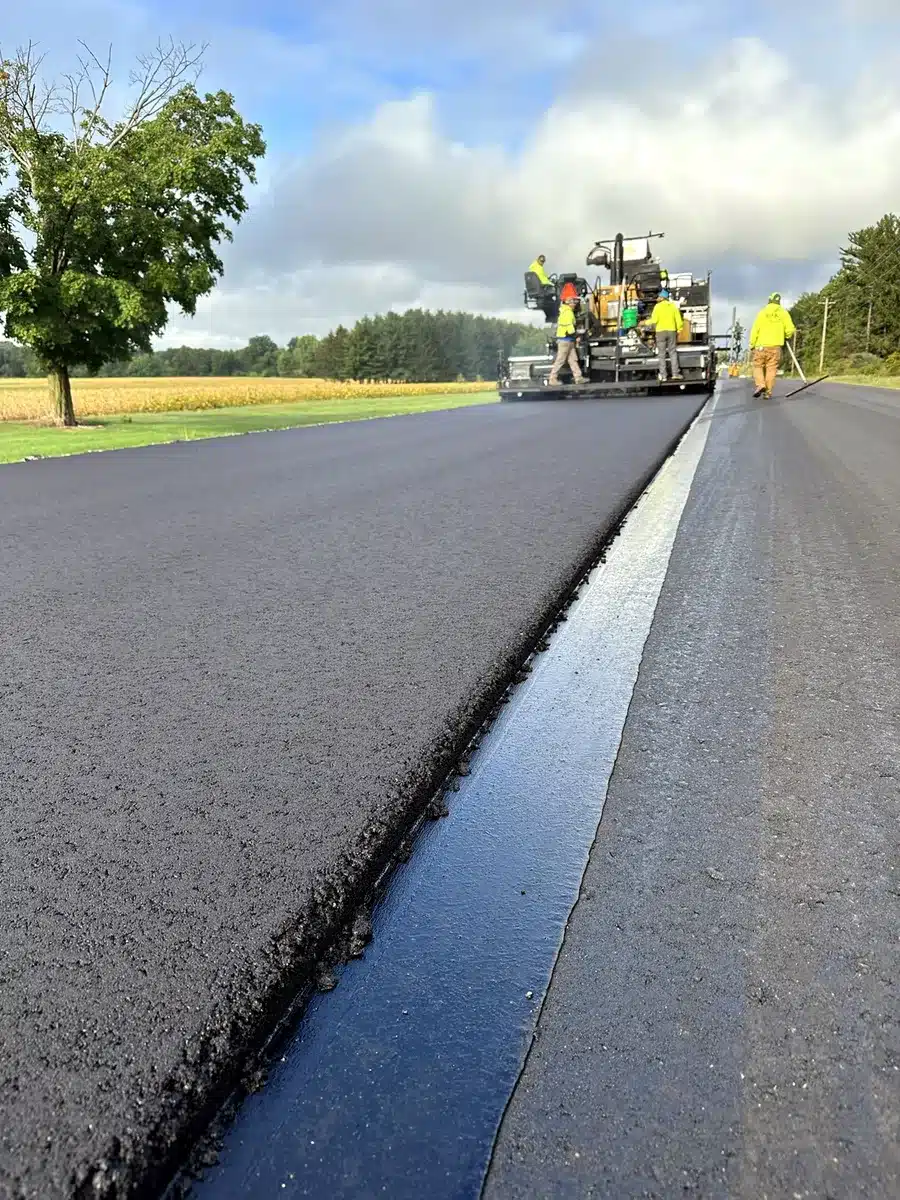
During construction of the Sheboygan County Operational Pavement Preservation Evaluation (SCOPE), the county installed void-reducing asphalt membrane (VRAM) along one section and joint adhesive along another. All photos courtesy of FP2
Scope Research
In 2020 a 6-mile segment of a highway in southern Sheboygan County was budgeted for full reconstruction. Consulting with industry colleagues, the county decided to use the segment as a live-traffic, full-scale research section called the Sheboygan County Operational Pavement Preservation Evaluation (SCOPE). SCOPE is built from a concept similar to MnROAD or the NCAT Test Track, but SCOPE is uniquely focused on preservation at the county level.
By addressing common problem areas during construction, a pavement will age and exhibit distresses in a more consistent and predictable way. Longitudinal joints, for example, are commonly one of the first areas to exhibit distress. During construction of SCOPE, Sheboygan County installed VRAM along one section and joint adhesive along another. The benefits of these treatments were clear to the county, and VRAM has been used by the county every season since SCOPE.
“This proactive approach has led to better understanding of roadway stresses and how to better maintain our roadway infrastructure,” Olson said. “Using products such as VRAM, we are seeing the huge benefit of keeping our center seams together sealed from the opportunity of moisture seeping into the roadbed. Sealcoating our roads earlier is proving to help to combat the damaging effects that UV has on the roadway surfaces maintaining the structural integrity for the next 20-30 years.”
Transparency Success Key
Transparency is key to Sheboygan County’s success. The county maintains an up-to-date web page with project and treatment information, including a printable summary of all paving, reconstruction and preservation work. The website prominently displays information about the 0.5% sales tax. For larger projects, the county holds public information meetings, inviting the public through direct mailings and local newspaper advertisements. During projects, portable message boards and clear signage keep the public informed about progress and important updates.
When asked what the greatest strength of the Sheboygan County Highway Division is, director Olson said, “It’s our dedicated team of like-minded, goal-oriented staff.” Olson continued that the best way to preserve and leverage this strength is “…by providing the staff with the tools and resources needed to produce and install a well-maintained road infrastructure.”
“Serving as vice president for AASHTO,” said outgoing WisDOT secretary Craig Thompson, “I see firsthand what [Wisconsin does] differently. The biggest key is the relationship that the 72 counties have with the state of Wisconsin, which is constantly being reinforced because of our routine maintenance agreements.
“Sheboygan County is truly a leader in its level of collaboration and innovation, which I can see firsthand from all my visits here,” Thompson said. “Every time I’m here, the quality of the roads really impresses me. Sheboygan County clearly values pavement preservation and invests in it, which is so important for our constituents. By spearheading new initiatives in the state, like its SCOPE program, the county sets an excellent example for the rest of our state.”
Adapted from the Spring 2025 issue of Pavement Preservation Journal.