
Focus on Performance: Burner Retrofit Improves Plant Efficiency
BY Jim Feese, P.E.
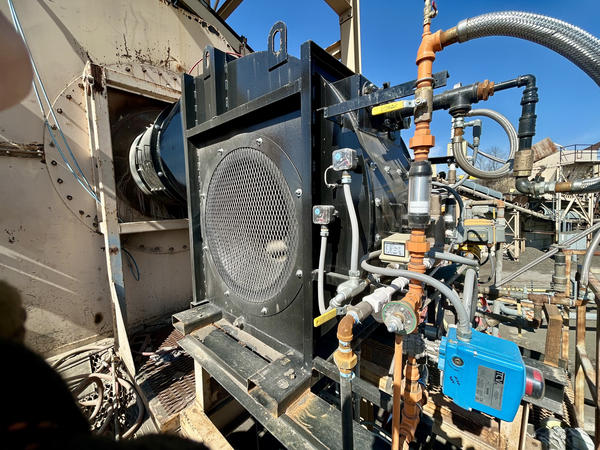
Editor’s Note: The Focus on Performance series from AsphaltPro Magazine allows OEMs and service providers in the industry to highlight asphalt professionals who have improved efficiencies and the bottom line through best practices and performance. This month’s installment, featuring a producer in the Northeast, dives specifically into efficiencies gained through a burner retrofit.
When a Maryland producer was looking to upgrade their dated burner system to improve reliability and energy efficiency, Detroit Stoker Company, Monroe, Michigan, responded with a HADES burner and HBC burner control system.
The customer operates a 400 tph, dual drum plant, which includes a counterflow dryer and separate mixing drum. The burner replaced a dated 100 MBtu/hr sealed in burner, which had proven to be difficult to service and maintain. Detroit Stoker with partner, Meeker Equipment Company LLC, Belleville, Pennsylvania, provided a new HADES-100 (100MBtu/hr) dual fuel burner capable of firing natural gas (primary fuel source) with No. 2 and/or recycled fuel oil backup fuel.
The original burner system included:
- Direct drive fan with 1,800 rpm 100-Hp motor.
- Single control actuator with linkages driving a fan outlet damper (airflow control) and fuel control valve(s) for gas and fuel oil.
The new burner system features include:
- A direct drive, 1,800-rpm fan; however, due to the energy efficient design of the burner, only a 60-Hp motor was required to achieve the same burner rated capacity. In addition, a variable frequency drive (VFD) is now used for precise combustion air flow control via the HBC panel.
- Independent (gas and fuel oil) direct coupled fuel actuators controlled by the HBC panel.
- More compact footprint/package as a result of smaller combustion air fan and reduction in ancillary dampers/drives/linkages. This improved design results in higher reliability and maintainability.
These features offer numerous advantages, such as precise combustion air/fuel ratio control across the entire burner input range (low to high fire). This means maximum fuel efficiency can be achieved regardless of plant production rate.
Additional benefits include enhanced safety as the HBC panel is continuously monitoring both air and fuel demand versus feedback and “cross-limiting” the air/fuel ratio such that the burner cannot go rich. In a linkage-based system, when the linkage slips or fails, the burner can literally be firing at any ratio, and the writer has seen burners firing in extremely rich and potentially explosive conditions as a result.
VFD savings are well documented. The motor horsepower is proportional to the speed cubed, resulting in significant energy savings by adjusting the motor’s speed to match the required load, instead of running at full speed constantly. A small speed reduction results in large energy savings. VFDs also improve efficiency with a better power factor and can extend motor life by reducing startup current.
Final tuned CO emissions were well under 200 ppm corrected to 7% O2 dry across multiple firing rates. Burner tuning is not only much more precise but far easier to accomplish with the use of fully characterizable air/fuel tuning curves in a burner control panel like the HBC. Tuning is accomplished with the simple change of combustion air VFD speed and/or the fuel valve(s) position electronically with the push of a button. This is of course accomplished while monitoring emissions, burner and overall plant performance.
This burner retrofit provides the producer with a future-proof, energy-efficient combustion system designed for decades of reliable operation. By replacing an outdated, maintenance-intensive burner with the HADES-100 and HBC control platform, the plant now benefits from significantly reduced electrical energy consumption, precise and repeatable air/fuel ratio control, lower emissions, and a streamlined mechanical design with fewer wear components.
The VFD, independent fuel actuators, and modern cross-limiting combustion logic all contribute to sustained fuel savings, extended equipment life, and enhanced operational safety. Together, these improvements ensure that the plant will continue to operate at peak efficiency with lower operating costs and reduced environmental impact—delivering long-term sustainability for both production and energy management.