
Avoid Explosions and Oxidation When Preheating RAP
BY Sandy Lender
Here’s how bringing RAP up to mixing temperature can solve problems at the asphalt plant
When the oil embargo of 1973 caused a spike in liquid asphalt cement (AC) prices, our industry rallied around ways to reuse existing asphalt pavements and their constituent parts. Everyone from state departments of transportation (DOT) engineers to contractors experimented with up to 100% recycled asphalt pavement (RAP). You can look up the research papers to learn field trials took place in pioneering states like Pennsylvania and Florida. There were even some lane miles tested in the Los Angeles area of California.
The sad ending to that mid-1970’s tale is riddled with premature cracking and pavement failures, which today’s research attributes to lack of performance-based specs, a lack of rejuvenators, improper gradation control, and inadequate mixing or heating in the batch plants of the day.
As everyone knows, our industry didn’t give up on the concept.
As early as 1980-1982, the Federal Highway Administration (FHWA) gave the green light for formal studies on the viability of RAP in pavement design. By the mid-1980s, Florida seemed to be on board, completing a handful of 100% cold-in-place recycling projects incorporating emulsified asphalt. Minnesota was right behind them with 100% RAP sections on low-volume roads. Our industry was learning how to use various percentages of RAP correctly in mix design because our industry is environmentally responsible. We find ways to incorporate recycle with long-lasting performance.
“RAP material sourced from different origins will have different characteristics with inherent performance variability. Importantly, even RAP sourced from the same location can have variable characteristics, making homogenization a critical step whenever a plant is preparing to use the material.”—Krishna Srinivasan
From reporting on the use of RAP in various layers of the pavement system, to its status within the FHWA and National Asphalt Pavement Association (NAPA) annual RAP and warm-mix asphalt (WMA) survey, AsphaltPro has kept the recycle topic in heavy rotation for nearly 20 years. When it comes to the RAP discussion, we’ve covered performance specs with various National Center for Asphalt Technology (NCAT) engineers, we’ve covered the use of rejuvenators with a number of suppliers, and we’ve covered fractionating with a number of original equipment manufacturers (OEMs) and others in the field, but we haven’t examined “heat” as closely.
Let’s rectify that now.
The Importance of Preheating RAP
Every asphalt producer out there understands the importance of getting temperature right in the various sections of the drying drum. Stop and consider the effect of adding ambient-temperature RAP after the combustion zone of the drum.
Carlos O. Cardenas, the Midwest area sales manager for Ammann America Inc., Orlando, spoke in terms of efficiency, safety and quality control when sharing why Ammann recommends preheating RAP before introducing it to the mixing drum.
“When RAP enters the mixing drum at ambient temperature, it can cause significant operational challenges,” Cardenas shared. “Cold RAP can lower the temperature of the virgin aggregates, requiring the plant to use more energy to heat the mix to the desired temperature. Typically, this obstacle is overcome by superheating the virgin material, which increases fuel consumption and dust. By preheating the RAP before it enters the drum, plant operators ensure a more efficient heating process, reducing energy consumption and improving the overall mix quality. Preheating RAP enables it to blend more evenly with the virgin aggregate, resulting in a homogeneous and consistent final product.”
“The secondary mixer serves only to coat the RAP and virgin dried and mixed product with virgin liquid AC.”—Mike Mauzy
Basically, by preheating the RAP, you ensure the binder from the RAP will mix uniformly with the virgin material, thus improving the strength and durability of the asphalt mixture.
Cardenas shared that matching the temperature of RAP and virgin materials is important for safety reasons, too. “Cold RAP entering the drum can lead to inconsistent heating, creating hot spots and increasing the risk of burns or fires,” he said. “This is particularly true when high moisture is present in the RAP. Proper steam removal during the RAP preheating process is crucial for both safety and operational efficiency. Preheating the material mitigates these safety concerns by ensuring the RAP reaches the correct temperature before it enters the mixing zone, reducing the chance of accidents.”
Krishna Srinivasan, CEO at Sripath® Technologies, LLC, Mahwah, New Jersey, also spoke of efficiency and variables in production as well.
“High-RAP mixes contain 30, 40, 50+% of RAP, which is a high percentage of the material in an overall batch,” Srinivasan explained. “If the RAP comes in cold, the material will act as a heat sink and lower the mix temperature to unacceptable levels. This could not only lead to poor quality mix production, but also higher heating costs required to bring the RAP up to proper mix temperatures.
“Preheating RAP can also help drive off moisture, which can also act as a heat sink and drive up energy costs if introduced into the mix chamber. Most contractors will say that on rainy or damp days, they lower the amount of RAP in their mixes, reduce throughput tonnage, or both. Therefore, in order to maintain appropriate production throughput (i.e. tons per hour) and good quality mix that does not lead to compactability issues in the field, RAP is preheated before adding to the mixing drum at a plant.”

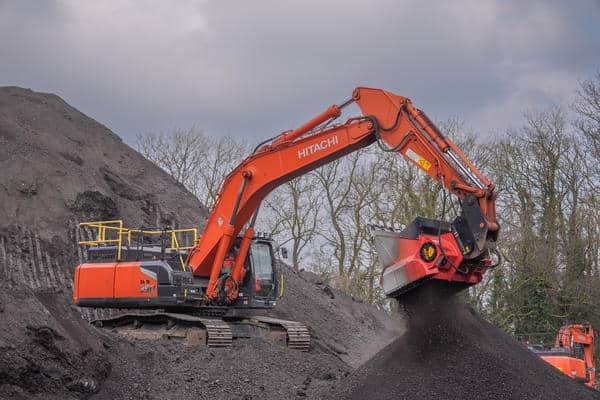
The new ALLU asphalt bucket attachment is designed to process RAP—crushing clumps and screening—in one pass. Photo courtesy of ALLU Finland Oy
How to Preheat RAP Through Mechanical Means
As Cardenas mentioned above, superheating virgin material is one method plant operators will use to ensure incoming RAP reaches mix temperature, but it isn’t a recommended best practice. Mike Mauzy of Reliable Asphalt Products Inc., Shelbyville, Kentucky, brings us to the next idea in our discussion by suggesting additional methods producers can implement.
“Several producers have also recognized the benefit of lengthening the dwell and mixing time for the superheated virgin and the RAP prior to injecting the virgin liquid AC,” Mauzy shared. “This has been accomplished by substantially lengthening counterflow drum mixers, or in the case of Duval Asphalt and some others, adding a secondary mixing drum to a conventional counterflow unitized drum mixer. The secondary mixer serves only to coat the RAP and virgin dried and mixed product with virgin liquid AC.” (The concept of dwell time will be covered at length in the October edition.)
The goals of preheating RAP are, obviously, to bring it up to an optimal temperature, but you’re also eliminating steam. These goals can be achieved in the secondary drum, as outlined in detail by Cardenas.
“The optimal temperature for preheating RAP is typically between 250-300°F,” he began. “It’s essential to avoid overheating, as this can cause the binder to degrade. A secondary drum or two-stage heating process works well to achieve this. The RAP is first heated gently in a secondary drum before it enters the main mixing drum, preventing direct exposure to high temperatures and ensuring that the binder is not harmed.”
From there, Cardenas detailed steam removal. “Proper steam removal during the RAP preheating process is crucial for both safety and operational efficiency. As moisture in the RAP heats, it turns into steam, which can build up dangerous pressure if not properly managed. If steam is not removed efficiently, it can cause steam pockets to form in the mixing area, leading to inconsistent heating, operational disruptions, and even potential damage to the equipment.
“Additionally, uncontrolled steam can suddenly release and create safety hazards that could cause burns or other injuries to plant personnel,” Cardenas continued. “Ensuring proper steam removal through a well-designed venting system reduces these risks, maintains consistent temperatures, and allows the plant to operate smoothly, minimizing downtime and maximizing safety.” (See sidebar on Key Mechanisms for Steam Removal.)
During a presentation titled “A Practical Guide for High-RAP Mixes” for the University of Oklahoma May 20, Srinivasan shared with the audience, “Once you start running 25, 30, 35% RAP, you need to invest in more infrastructure to make that happen.”
Multiple OEMs can help with this, of course, but two in particular shared information for this article. Meeker Equipment Co., Belleville, Pennsylvania, has U.S. Patent 5,090,813, covering the dual‑drum cycle (one drum for RAP drying/pre‑heating, the other for final mixing). Ammann offers one in its Ammann HRT (High RAP Technology) plants. It’s worth talking to your plant manufacturer about the concept if you don’t already have a secondary device for preheating higher amounts of RAP in your operation.
While producers may be hesitant to invest in a second drum for preheating RAP, it’s a best practice OEMs promote for more reasons than their own pocketbooks. By bringing RAP up to temperature in a secondary device prior to introducing it to the mixing drum, the plant operator avoids the safety hazard mentioned above and increases the chances for quality blending. Cardenas explained the key to successful RAP preheating, thus blending, lies in selecting the right heating mechanism.
He broke this into two types: indirect heating and burner heating. First, with indirect heating, he explained you’re using a secondary drum to preheat RAP at a controlled temperature before it enters the main mixing drum, which helps maintain the integrity of the recycled binder. Then, low-intensity indirect burners or counterflow drums can be set to apply heat gradually, “reducing the risk of burning off the binder,” he shared. “The gradual heat ensures that the RAP is heated without causing any significant drying or aging of the binder content.”
Once you have your heating mechanism in place, Cardenas has three steps for feeding RAP into the process.
First: Preheat the RAP in the secondary drum or pre-heating unit to a controlled temperature that doesn’t compromise the quality of the binder.
Second: Use a pugmill mixer or post-mixer to blend the pre-heated RAP with the virgin aggregate to thoroughly integrate the RAP into the mix.
Third: Inject rejuvenator at this stage. Cardenas stated specifically, “The rejuvenator should be injected just before the RAP enters the mixing drum or pugmill to ensure that it interacts properly with the RAP binder and helps achieve the desired properties in the final mix.”
RAP + Recycling & Rejuvenating Agents = Roadway Sustainability
How to Preheat and Treat RAP Through Material Management
The moisture removal discussed above harkens to material management. Srinivasan spoke to this specifically.
“Plant operators should keep in mind that stringent control and management of all raw materials, including RAP, are critical in order to produce an end product consistent in specifications and quality,” Srinivasan explained. “Pre-heating RAP to temperature has been shown to provide the advantages of drying and readying the RAP to be blended with virgin materials and dosed with an effective asphalt rejuvenator, all without negatively impacting properties in the final mix. Drum mixing (either single or double) as well as forced air burners are some of the most common, and most effective, options available for pre-heating RAP. In fact, open flame options are more likely to degrade or burn off the aged bitumen in the RAP.
“When feeding RAP, best practices include using lower capacity bins that steadily discharge the fractionated and homogenized material,” Srinivasan continued. “This should be done slowly, rather than in bulk, to reduce material compaction, and continuously, to prevent build-up or caking. RAP can be treated with an asphalt rejuvenator on the conveyor that brings the material from the bin and to the drum mixer. More commonly, dosing with a recycling agent occurs either by direct injection to a pugmill or into the bitumen tank or blender delivering the required virgin binder for the mix. This setup will vary depending on each plant’s design and equipment capabilities.”
We can’t talk about reducing moisture or material handling without talking about stockpile management. During his “High-RAP Mixes” presentation, Srinivasan said, “Every mountain of RAP is different. Every source of RAP is different.” He stressed that it’s vital we treat these stockpiles accordingly.
For the AsphaltPro audience, he offered some specific best practices, ranging from building to managing. “RAP piles can vary in height, with most in my experience ranging between 10-12 feet in height. The height will often be set based on operational convenience and the storage capabilities at each individual plant. While some RAP piles can certainly be larger or smaller, the height is less important than the drainage available to the material. Sloped storage surfaces are superior to flat slabs on the ground, where water can accumulate and cause moisture issues that require more time, energy and heat to preheat the RAP. Additionally, compacted or impervious surfaces with integrated water drainage techniques and material stored under cover tend to provide better regulated moisture content.
“Homogenizing RAP for storage and before use in a mix is essential. RAP material sourced from different origins will have different characteristics with inherent performance variability. Importantly, even RAP sourced from the same location can have variable characteristics, making homogenization a critical step whenever a plant is preparing to use the material. Homogenization, or the mixing and grading of RAP that has been fractionated based on particle size, can help with quality control throughout the mix design process. Plant operators will want to homogenize RAP to achieve average properties across batches to achieve a consistent mix output.
“As a best practice, RAP piles should be turned over several times before use to homogenize the material adequately. While this step can add to the required time and resources plant operators are managing, the result can be a more reliable product that plants can be confident will meet specifications. Heavy equipment can be used to turn over the material, moving RAP from top to bottom, back to front, within the pile, but the RAP should never be driven over as this can cause undesirable compaction.”
With the increasing use of RAP in balanced mix designs and surface courses throughout North America, getting production right is key to long-lasting pavement systems. The failures of the past gave us a solid base to work from when setting modern-day performance specs, designing effective rejuvenators, figuring proper gradation control, and discovering best practices for mixing and heating the materials. For more information, each of the sources mentioned herein would be happy to discuss these concepts with you.
Key Mechanisms for Steam Removal
Venting Systems: A well-designed venting system allows steam to escape safely from the preheating unit or mixing drum. These systems typically include exhaust ducts, vents, and steam condensers that direct steam away from critical areas and ensure it does not build within the equipment.
Temperature Control: Maintaining consistent temperature control during RAP preheating is essential. By monitoring and adjusting the temperature gradually, plant operators can minimize the rapid formation of steam. This helps avoid excessive pressure buildup that could lead to steam pockets. Lower, controlled heating ensures moisture evaporates at a steady rate, allowing steam to escape through the venting system.
Secondary Drums for Indirect Heating: Using a secondary drum or indirect heating systems, such as those in Ammann HRT plants, helps mitigate steam buildup. These systems apply heat to the RAP in a more controlled manner, without direct exposure to flames, allowing moisture to evaporate gradually. The steam is directed out of the secondary drum before it enters the main mixing drum, ensuring that the material enters the mixing process at the correct temperature without excessive moisture.
Continuous Monitoring: Constant monitoring of moisture levels and temperature throughout the preheating process is essential for ensuring that steam removal is effective. Sensors and automated controls can trigger adjustments in the heating process, ensuring that steam is released safely and consistently.
By integrating these strategies, asphalt plants can efficiently remove steam, maintaining both the safety of the operation and the quality of the final asphalt product. Sidebar courtesy of Ammann America