
Plant Operators Benefit from New Controls in the Market
BY Sandy Lender
Plant operations benefit from new controls in the asphalt market
For the “Today’s Asphalt Plant” theme of this edition of AsphaltPro Magazine, let’s look at the hot-mix asphalt (HMA) facility’s controls. Original Equipment Manufacturers (OEMs) like Astec Digital, FAYAT Mixing Plants, Gencor Industries and others, launched full plant controls systems or component monitoring systems around CONEXPO-CON/AGG 2026 (CECA). This breakdown gives an overview of offerings to make your plant operator’s job easier and your bottom line more robust.
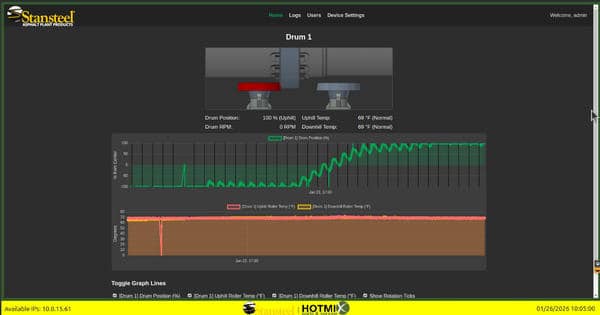
This graphic illustrates the positioning of the Drum Drift Monitoring System™ and Critical Status Modules with the ACCU-pulse system from Stansteel Hotmix Parts & Service.
New Tech to Control Your Plant
CECA attendees who stopped by the Stansteel Hotmix Parts & Service booth saw a handful of new products, including the ACCU‑pulse™ featuring the new Drum Drift Monitoring System™. ACCU-pulse is designed as a plant health monitoring platform.
Llew Williams, general manager, operations, for Stansteel Hotmix Parts & Service, explained that depending on how the system is configured, it can provide operators with visibility into critical operating conditions. “As an example, in addition to the Drum Drift Monitoring System, we recommend adding the Critical Status Modules. [This] includes sensors that monitor material or mix discharge temperature, baghouse inlet temperature, baghouse differential pressure and burner negative pressure.
“Viewed together, these measurements function much like vital signs for the plant. Rather than reacting after failure at the plant, operators gain early awareness of trends that affect production stability.”
At the tradeshow, the company introduced the Drum Drift Monitoring System, which is a way to detect when the rotary dryer has gone too far uphill or downhill. The alert system also monitors thrust roller temperatures.
“Monitoring the temperature of the uphill and downhill thrust roller bearings adds important context to drum drift data,” Williams explained. “When a drum is improperly aligned or no longer ‘floating’ correctly, it will tend to run continuously against one thrust roller. That sustained contact increases bearing load, friction and heat. By tracking bearing temperature in real time, the system helps operators distinguish between a short-term correction and a developing mechanical issue—such as misalignment, lubrication problems or excessive thrust load. Rising temperature is often one of the earliest indicators of a problem that could otherwise go unnoticed until accelerated wear or an unplanned shutdown occurs. In that sense, bearing temperature serves as a ‘confirmation signal’ to the drift data and strengthens early decision‑making.
“Drum position alone shows what the drum is doing; thrust roller temperature helps explain the impact of that movement on critical components. Together, those data points turn drift monitoring from a visual reference into a predictive tool.”
FAYAT Mixing Plants also brought new controls to the North American marketplace at CECA 2026. Subject matter experts demonstrated the company’s new Vision unified control software.
The Fayat Group, through its brands ADM, Ermont and Marini, now provides customers with broad-spectrum data sharing across its entire product portfolio. This is possible because Vision is a unified “language” that connects all systems. It features simple, user-friendly display modes with dynamic animation and visuals that track the flow of materials and features a digitized “notepad” to simplify daily orders. With Vision, operators can schedule daily production, utilize a predictive maintenance application, take advantage of a virtual assistant that provides the best actions for maintaining plant efficiency during the production process, and more.
The new Vision control software allows all of the ADM, Ermont and Marini brands’ systems to communicate with the outside world. In fact, Vision can receive notifications and data from a cloud platform that allows road construction site management programs to exchange data, receive lists of production orders from remote locations and gather pertinent weather information.
The new software will gradually replace the systems currently used by the respective brands, becoming the unified language for all of the plants. It will allow access to and sharing of big data while enabling comparisons between different types of production processes. For example, a customer with both continuous and batch plants on their production sites can evaluate, as needed, the most cost-effective and efficient process for similar types of recipes by comparing their energy consumption.
Technicians opted for a simplified dashboard, designed to show only the essential process information and material flows. In this way, should problems or anomalies arise, the operator can still dynamically recall additional functions.
With the Vision graphical interface, the company aimed to make the user experience and interaction between the operator and the system as intuitive as the devices many people, especially younger generations, already use every day.
Another key feature in the operator’s process display is the use of realistic digital animation, which visually represents the material flow within the plant in a way that is both immediate and intuitive. The use of different colors in the animation allows the operator to distinguish and recognize the various materials (solid, liquid and gaseous) as well as the different mixes being processed.
With the new interface, the operator will no longer be limited to controlling individual functions. He will be able to see where and how the material is being transported at any time, with different color flows when there are multiple active mixes in production.
The new Vision control software will also rely on Artificial Intelligence (AI) algorithms, complete with a new series of smart features to simplify the operator’s work. For example, the production orders can now be managed in a more energy-efficient way by creating sequential recipe lists.
In conjunction with the predictive maintenance application, the operator will be notified. Guided by the expertise of ADM, Ermont and Marini technicians, this program gathers data from the various systems and provides the operator with notifications and alerts on maintenance needs, potential system risks, possible causes of downtime, and suggestions for restarting operations, and other useful functions. The first tests of this exclusive application were conducted at the plant of an Italian customer, who made their facility available to the technicians for several days.
The operator will also have access to a virtual assistant, which, when consulted, can recommend the best actions to maintain the plant’s efficiency during the production process. In turn, the chatbot will be trained on the process using data collected from both the smart ecosystem cloud platform and specific information on the production flow of the individual plant. Consequently, the chatbot’s ability to provide information will refine over time, but it already starts with a substantial data set. The information that is gathered on the cloud platform is sent by the machine’s sensors, while the recipe, productivity and energy consumption data will be managed in a totally confidential manner.
An additional advantage of these solutions is that they will all be retro-installable: the open structure of the new Vision software will also allow for the integration of new applications in the future, which can be run within the same environment.
Astec Industries, Chattanooga, launched its Signal Connectivity Suite from Astec Digital during the show. The platform allows communication and monitoring across all plant and mobile assets, letting the owner stay connected, gain actionable insights and optimize operations. Specifically, Signal includes an asset map, machine overview, plant overview, LiveJob (live tracker) and paver tracker screens.
When on the Asset Map screen, you have a visual, location-based view of all assets, allowing you to check key statuses like fuel level and engine hours. This offers you access to your entire fleet for easy navigation and lets you spot assets needing attention.
When on the Machine Overview screen, you have a comprehensive, real-time snapshot of a specific piece of equipment. This shows you “live” machine status indicators for fuel, faults, location, live schematics and so on, letting you identify any issues with real-time diagnostics and historical data views.
When on the Plant Overview screen, you have a real-time, high-level snapshot in one dashboard of all the plant operations, from production rates and energy use to historical trends. This offers instant visibility into top-level plant performance with production and energy metrics and drill-down views into the individual details like mix information, silo inventory, tank inventory, alarm information and so on.
When on the LiveJob screen, you have a real-time, live dashboard of ticketed material output and job progress. This gives you visibility into tons loaded and job progress with detailed breakdowns by job, customer, mix and truck rotations.
When on the Paver Tracker screen, you have real-time location and activity tracking of the asphalt paver. This screen provides insight into job activity such as total runtime, distance paved, average feet per minute, idle events and reasons, and it integrates with Astec Digital’s telematics ecosystem for unified data and alerts.
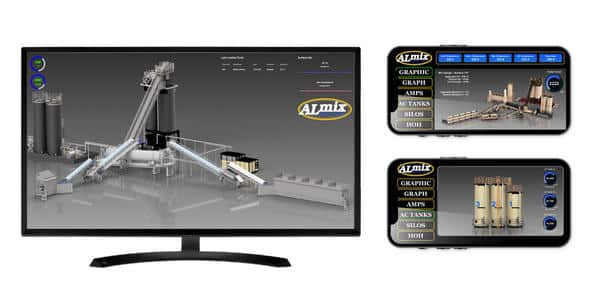
ALmix Insignia Vision provides information about the plant in real time, allowing users to view and organize data not just from the ICS blending controls, but also from the loadout and ticketing side of the plant.
Another total plant control system that’s been on the market for over a decade is the ALmix Insignia Control System (ICS), but ALmix debuted the ALmix Insignia Vision, its remote monitoring for ICS, during the show. ICS gives you a comprehensive view of your plant’s performance and now you can access that information remotely via the ALmix Insignia Vision remote monitoring app.
Rob Barker, an ALmix program engineer, explained that ALmix Insignia Vision provides information about the plant in real time, and that means you can monitor your ongoing operations from offsite. The remote capabilities aren’t just monitoring temperatures and product levels, but are also offering owners or managers a look at what’s happening in real time, such as loadout activities. Insignia Vision allows users to view and organize data from the ICS blending controls, and from the loadout and ticketing side of the plant.
“You can also see tickets from the Insignia Loadout System,” Barker said. “We have camera integration so you can see your local cameras from your iPhone or Android.” When owners can’t be on site, they can still be in tune with what’s happening. “This is for someone not to control their plant, but to look at their plant. If they [can’t] be there all the time, they can take a break and still monitor.”
Of course, monitoring materials in real time is a valuable aspect of the technology. “When looking at the hot oil heater, we can monitor all the status, such as status indicators for the e-stop, burner switch on, the oil level, circulation pump status, low or high oil pressure alarms, stack relay, burner enabled, call for heat, and more. For AC tanks, we can see the quantity that’s in there. Same thing with our inventory silos. We can see how much we currently have in our silos. And, of course, we can see all of our amp meter readings.”
The ALmix Insignia Vision mobile app will be available to ALmix customers. “It works with our Insignia control system and loadout and we also have it in the ALmix Cloud for casting to monitors in conference rooms.”
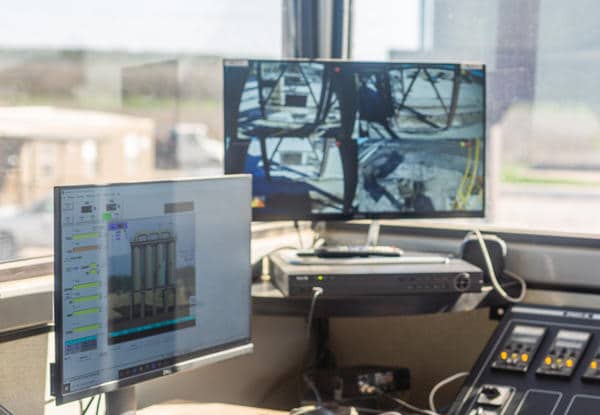
With the Command Intelligence Assistant from Command Alkon, dispatch and operations teams can evaluate delivery priorities and determine which orders should be fulfilled first based on operational conditions and available data.
Command Alkon hosted a press conference at the show during which Chief Product Officer Ranjeev Teelock previewed Command Intelligence, the company’s new agentic AI capability within its Command Cloud platform. Teelock introduced the capability as the company’s next step in bringing AI directly into operational decision-making for materials producers.
Command Intelligence enables users to interact with operational data in an intuitive and actionable way through the Command Intelligence Assistant. The assistant allows teams to access key performance indicators and operational metrics to support faster and more informed business decisions. For example:
- Dispatch and operations teams can evaluate delivery priorities and determine which orders should be fulfilled first based on operational conditions and available data.
- Billing personnel can rely on the assistant to identify and adjust incorrectly priced tickets, reducing manual effort and minimizing errors.
- Users can ask questions or issue directives, and the assistant can generate reports, visualized data elements, or prioritized task lists using data from the Command Cloud platform as well as production, quality control, and enterprise systems used across the industry.
The goal is to simplify how the user runs the business while reducing reliance on tribal knowledge by providing consistent, data-driven insights.
The company also previewed new Command Cloud capabilities designed to support more flexible operations, including multi-plant remote batching, which allows operators to manage batching activities across multiple locations from a single interface or tablet. This capability helps producers improve staffing flexibility, streamline plant operations and maintain production oversight across distributed facilities. With innovations like Command Intelligence and Batch AI, the company is continuing its mission to help producers modernize operations and move confidently into the next era of intelligent, data-driven materials production.
New Tech to Control or Monitor Your Burner, Heater
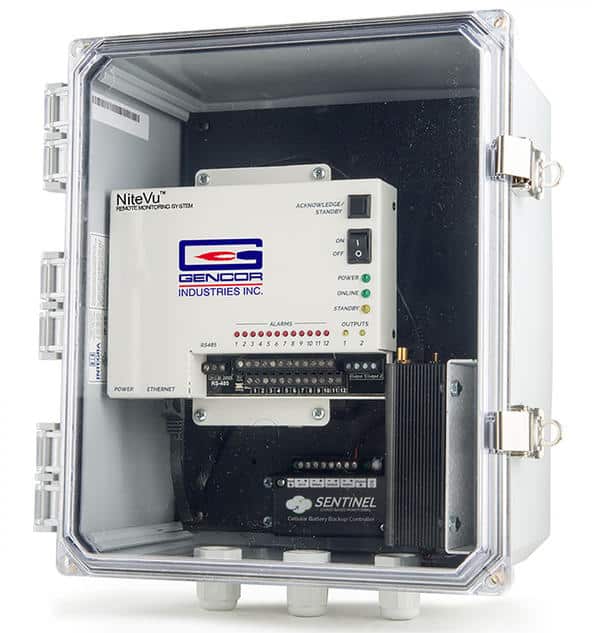
The self-contained NiteVu monitor from Gencor is mounted to a conventional thermal fluid heater or asphalt tank. Real-time monitoring and alert features detect early warning signs of equipment malfunctions or changes in conditions of the burner and fluid temperature.
Gencor Industries, Orlando, debuted the NiteVu™ cloud-based remote monitoring system for heater and asphalt tank applications during the show. Plant operators will recognize that thermal fluid heaters and liquid asphalt storage tanks are typically equipped with devices like burner flame scanners, thermocouples, pressure transducers and limit switches to control the heating process. You must monitor these elements along with everything else you’re tracking at the plant.
The NiteVu from Gencor takes the signals from these devices and inputs them to a software application that monitors them and their settings for you. Any failure or excess limits immediately triggers NiteVu to alert the user (or users sequentially).
It works via a NiteVu “box” that is mounted to any conventional thermal fluid heater or asphalt tank equipped with standard electrical connections. The device is completely self-contained in a NEMA weatherproof enclosure. Real-time monitoring and alert features detect early warning signs of equipment malfunctions or changes in conditions of the burner and fluid temperature. Because NiteVu uses a cellular connection, internet access isn’t required. When an alarm event occurs, NiteVu can send an email, text message or voice phone call to alert users via ATT or Verizon cellular service.
The NiteVu remote monitoring system stores all sensor readings in the cloud. Multiple devices can be managed from one account with an unlimited number of user profiles. Alarm levels are programmable. Enhanced data logging capabilities allow users to print, graph or export historical records. The system can also produce event reports as well as generate an audit trail of all user data activities, edits or deletions.
Basically, Gencor’s cloud-based NiteVu system lets facility managers monitor heater and asphalt tank functions, including critical conditions, remotely from any smartphone or internet device. The system takes the burden out of managing the tank farm by monitoring burner functions and temperatures, delivering alarms and datalogs, from various equipment sensors and giving you access to your readings from anywhere in the world.
Another remote monitoring system plant operators may be familiar with is the NiteOwl® Advantage Alert System from Stansteel Hotmix Parts & Service. During the tradeshow, the OEM introduced an expanded liquid AC circuit monitoring feature to the system and launched the Day&NiteOwl product.
The unit monitors the same points as the NiteOwl—which is designed to automatically call up to four phone numbers repeatedly until someone is alerted if the temperature of liquid AC or hot oil exceeds the pre-set high or low limits or when conditions are abnormal—but now also allows the plant operator and personnel to check and monitor other items on the plant, such as the level in the AC tanks. It also monitors for amps on motors in case the unload pump used by delivery drivers goes awry.
The foundational system includes a rugged back-up battery that automatically recharges and provides 20 hours of continuous operation should electric power fail. Other standard equipment includes a temperature probe in a stainless-steel drywell placed directly into the hot oil circulating line to continuously monitor temperature levels. A surface-mounted temperature sensor is also available.
Other expanded features of the Stansteel Day&NiteOwl include:
- The capability to call and/or text via cellular network when an alarm is triggered.
- Monitoring the main power connection. In case of failure, the system can still be fully operational for several hours and trigger an alarm alerting the user of the power failure situation.
- Registered users can inquire about the status at any time via call or text.
- Monitor, record and modify operations from the database records that are remotely accessible.
Basically, the Day&NiteOwl monitoring system is designed to prevent surprise cold-asphalt mornings and reduce weekend plant visits while giving you the ability to check tank farm status anytime. A prime benefit of the system is the remote accessibility of the Day&NiteOwl, which allows an immediate update of plant conditions available 24 hours a day, seven days a week from any location, using any telephone equipment.
New Tech to Control Your Crushing & Screening
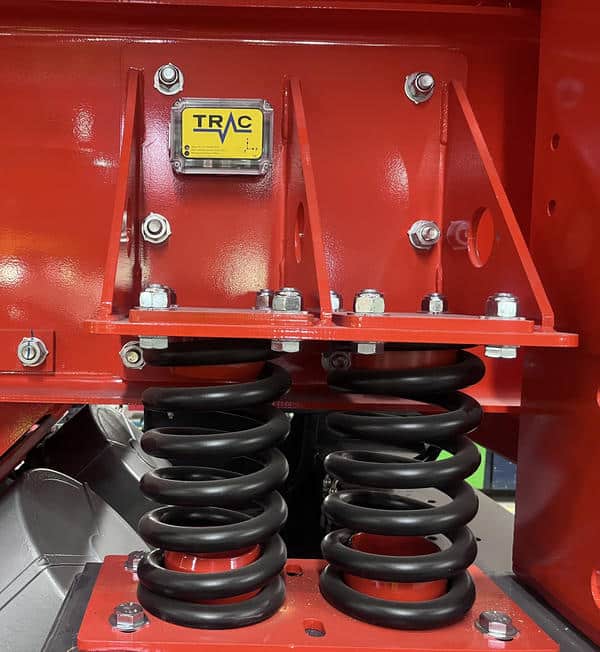
Developed by Terex screening engineers for vibratory screening equipment, the portable, multi-sensor system, TRAC, focuses on how screens behave in real operating conditions.
On the screening side of production, Cedarapids, a Terex brand, released its new TRAC vibration analysis system during the show. This system has been engineered specifically for crushing and screening environments, with the potential to extend across a broad range of vibrating equipment.
The system uses four WIFI-enabled sensors mounted on the screen structure to capture acceleration, velocity, movement, inclination, orbit and bearing behavior. This coordinated data allows operators to identify issues such as loose components, damaged media, broken springs, hazardous frequencies, imbalance and or timing problems, and to confirm correct screen installation and performance. (For an article on how to correct screen imbalances, check out the February issue’s “Crusher Maintenance: Let’s Correct Abnormal Vibrations” by Eagle Crusher’s Louis Fitzpatrick.)
The TRAC technology is now available across screening equipment within Terex Materials Processing (MP) brands including Powerscreen, EvoQuip, Terex MPS (Cedarapids, Simplicity) and others. Pat Brian, vice president of Terex Aggregates, said, “It helps take some of the guesswork out of understanding screen performance, giving customers and distributors clearer insight into how the screen is operating and where attention may be needed.”
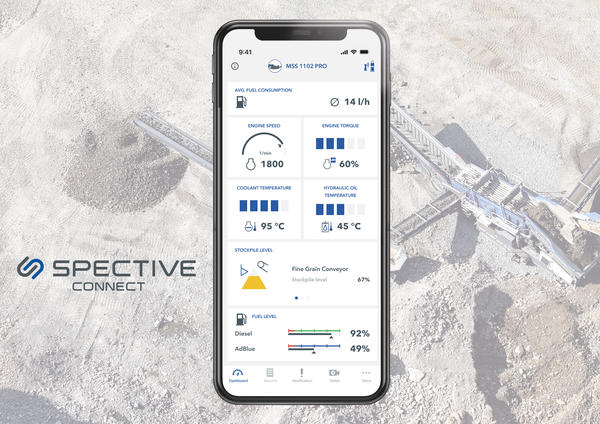
Kleemann, introduced the Spective Connect operator information app for screening systems to the North American market during CONEXPO.
Kleemann, in the Wirtgen Group family, now offers the Spective Connect operator information app for screening systems and launched it for the North American market during CECA. The company describes Spective Connect as “the logical extension of the Spective operating concept.”
With Spective Connect, all important information about the machines in a train is transmitted to the operator’s smartphone. Whether he’s in an excavator or wheel loader or somewhere else nearby, he has relevant information on the status of each connected machine.
The digital application provides the screening operator with relevant data such as speed, consumption values and fill levels directly on his smartphone. Stockpile monitoring can be used to display the status of material stockpiles. When a certain predefined value is reached, the operator is notified that the stockpile should be cleared promptly.
Editor’s Note: Does your company run software or an app that’s not listed above to control the blending, loadout, burners, crushing or other aspects of production? Whether your technology is all new in 2026, includes updates this year, or has features you’ve counted on for the past decade, the AsphaltPro audience could benefit from hearing of your experience. Either you or your OEM is welcome to reach out to share information. Send an email to sandy@theasphaltpro.com.