
Pleasants Construction Uses Sustainable Asphalt Innovation on Maryland’s MD 650
BY Doug Carlson

BMD with rubber-modified asphalt mitigates cracking and showcases sustainability
Pleasants Construction Inc., Clarksburg, Maryland, has taken asphalt paving to new heights with a pioneering balanced mix design (BMD) project featuring rubber-modified asphalt (RMA). This ambitious undertaking on a 10-mile stretch of MD 650 (New Hampshire Avenue) in Montgomery County showcases how innovative materials and forward-thinking collaboration can redefine pavement performance and sustainability.
Pleasants Construction, a family-owned leader in site development since 1964, has built a reputation for delivering turnkey site development solutions across the Washington Metropolitan area. With over 350 employees and a fleet of more than 300 vehicles, the company excels in earthwork, asphalt production, paving and more. Its commitment to quality and innovation is evident in its latest project, which leverages BMD and recycled tire rubber to enhance pavement durability.
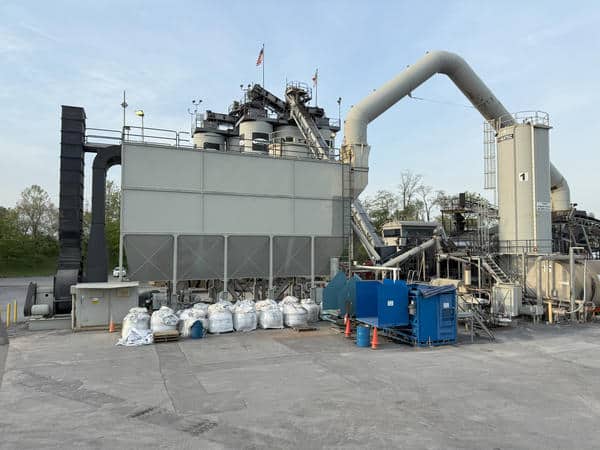
Supersacks of SmartMIX preswelled rubber are lined up for use in the Maryland 650 project. All photos courtesy of Liberty Tire
Leading the charge is Craig Michael, Pleasants’ quality control (QC) manager. With over a decade of experience and certifications like MARTCP Level 2 and NCAT Advanced Mix Design, Michael’s expertise in asphalt testing and mix design has been instrumental to the company’s growth. Michael brings both technical prowess and a passion for pushing boundaries.
A Legacy of QC | Michael comes from a family with deep roots in asphalt testing and innovation. His grandfather, Larry Michael, was an early adopter of polymer-modified asphalt and stone matrix asphalt in Maryland. His father, Rick Michael, ran QC labs and then became the production manager and superintendent of the asphalt division, until he retired last year.
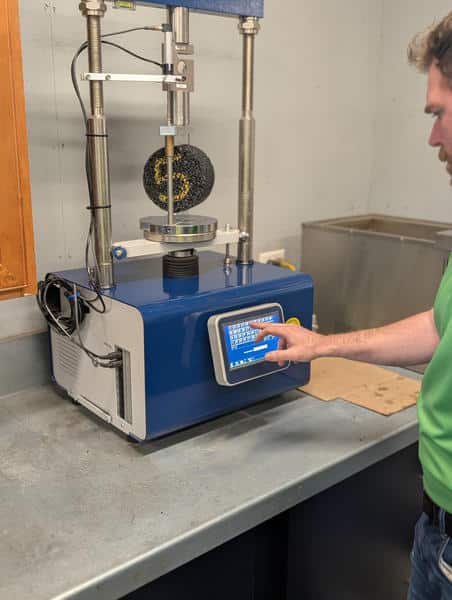
The team thought they had a big difference between the contractor and state lab, but the discrepancy in IDEAL-CT numbers turned out to be the sample aging during preparation. QC Manager Craig Michael shared, “It’s best to keep sample lots small, not make so many all at once.”
The MD 650 Project Under MDOT SHA’s Leadership
The MD 650 project, which began with milling on April 13, 2025, and overlay paving later that month, transformed a conventional Superpave overlay into a full-scale BMD pilot using RMA. Originally planned as a standard dense-graded mix, the project pivoted to incorporate rubber across the entire corridor, a bold decision driven by sustainability goals and performance potential.
This project is the first in Maryland to fully integrate BMD with a next-generation dry process for RMA. Unlike traditional methods, the dry process uses finely ground rubber powder dosed at 10% by weight of the binder. The rubber is added via a modified cellulose fiber blower through the reclaimed asphalt pavement (RAP) chute, or in the case of Pleasants’ plant, a port with a cam-lock fitting was installed by their plant personnel to provide a clean and secure location to handle powders and fibers.
Two rubber additives, SmartMIX from Liberty Tire and Elastiko from Asphalt Plus, were evaluated, paving the way for future Maryland State Highway Administration (SHA) specifications.
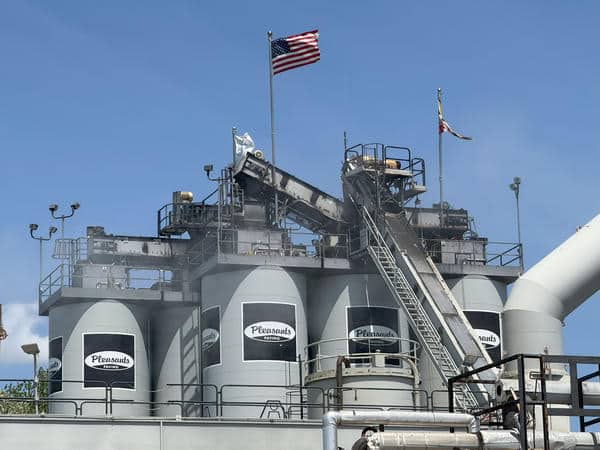
The team at Pleasants Construction fine-tuned the rubber dosing process, running at 285 tons per hour and pushing 57 pounds of rubber per minute.
The mix design is equally innovative, featuring 35% high-quality RAP, a PG58-28 binder and 5.4% total asphalt content (3.7% virgin). A liquid antistrip additive enhances durability, while the rubber boosts cracking resistance, as evidenced by a significant jump in the indirect tensile asphalt cracking test (IDEAL-CT) cracking tolerance (CT) index from 93 to 226 with rubber inclusion. The Indirect Tensile Strength (IDT) remained stable at 222, confirming the mix’s balanced performance.
The project’s success owes much to MDOT SHA’s forward-thinking engineers. Asphalt Technology Division Chief Chandra Akisetty brought insights from his doctoral research at Clemson University, where he studied recycled tire rubber in asphalt. Drawing on dry process successes in states like Georgia and Virginia, Akisetty crafted a special provision for Maryland’s pilot. Asphalt Field Engineer Larry Riggleman leveraged his industry experience to champion BMD and rubber integration, while Area Engineer with Construction Mike Little saw the project as a low-risk opportunity to innovate, building on his decades of asphalt construction expertise.
This collaboration reflects MDOT SHA’s renewed commitment to innovation. “The SHA was a leader in asphalt innovation years ago, and we’re excited to reclaim that position,” Riggleman said. The project also aligns with Maryland’s sustainability goals, spurred by legislative discussions about using local tire rubber in asphalt, even though a mandate didn’t pass.
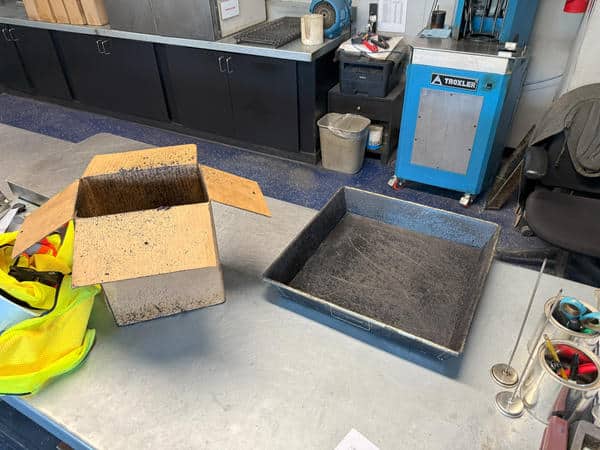
The team proved having loose mix on a tray ages the mix more than the mix kept in the carboard sample box, affecting the CT Index results.
Overcoming Challenges with Innovation
Implementing rubber-modified BMD wasn’t without hurdles. At Pleasants’ asphalt plant, the team fine-tuned the rubber dosing process, running at 285 tons per hour and pushing 57 pounds of rubber per minute. QC testing, conducted every 3,000 tons, revealed nuances in lab procedures.
For instance, oven burn-off tests required a 1.1% correction factor due to carbon black in the rubber, which behaves like fine aggregate. Compaction posed another challenge, as rubber mixes expanded post-extraction unless cooled under compression. However, the SmartMIX rubber is pre-swollen with extender oil to solve the swelling issues during compaction.
The team also discovered that prolonged oven heating during BMD specimen preparation skewed CT Index results, with later samples dropping significantly. This led to a best management practice of preparing only three samples at a time to minimize oven exposure.
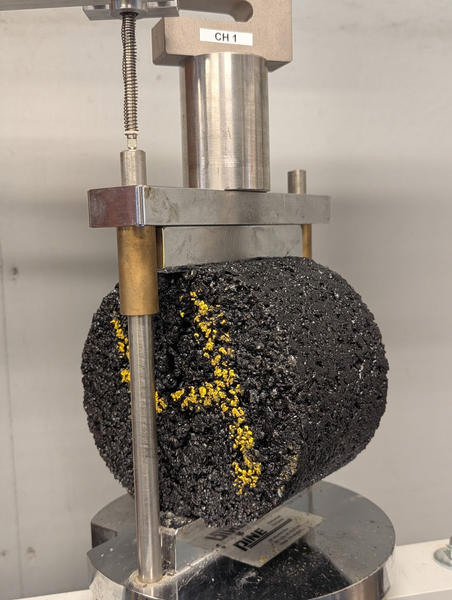
The team thought they had a big difference between the contractor and state lab, but the discrepancy in IDEAL-CT numbers turned out to be the sample aging during preparation. QC Manager Craig Michael shared, “It’s best to keep sample lots small, not make so many all at once.”
“We don’t want to just meet BMD criteria—we aim to exceed them,” Michael said, emphasizing Pleasants’ commitment to quality.
Michael shared some best management practices learned through this experience. “With the high frequency of testing and volume of mix manufacturing both the contractor’s and the agency’s specimens, we noticed a drop off in the CT Index results based upon how the mix was reheated in the oven. The longer the mix was held in the oven awaiting sample preparation, the lower the CT Index results. Also, having loose mix on a tray ages the mix more than the mix kept in the carboard sample box, affecting the CT Index results.
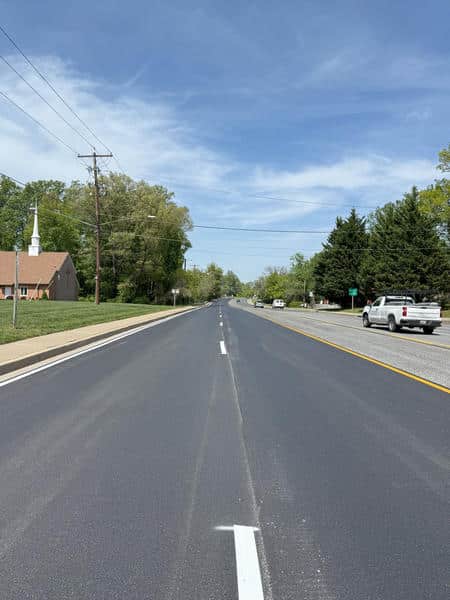
MD 650 looks smooth and gorgeous with its new balanced mix design in place.
“At first, we thought we had a big difference between our lab and the state lab, but it turned out to be the sample aging during preparation,” Michael continued. “It’s best to keep sample lots small, not make so many all at once.”
Riggleman added, “At first, we thought we had a material problem or an equipment problem, pretty big swings in test results, but it turned out to be a handling and preparation issue. Craig kept us informed and figured it out.”
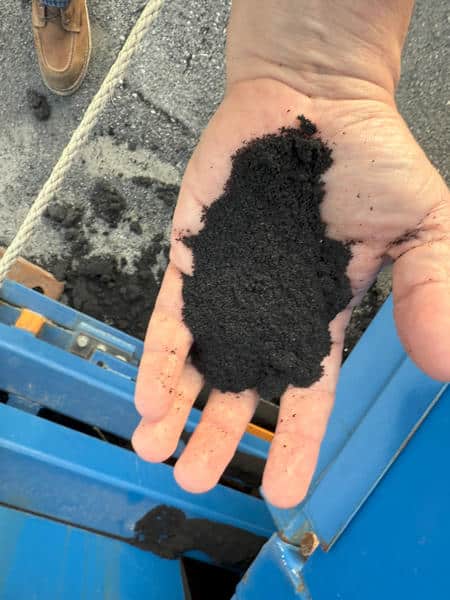
The SmartMIX rubber is pre-swollen with extender oil to solve swelling issues during compaction.
Michael offered the following fabrication details:
- Group A was prepared using fresh material straight from the plant. All five samples were completed in approximately 30 minutes.
- Afterward, we returned the material to the oven (uncovered) and allowed it to sit for about 30 minutes to give the molds time to reheat before beginning Group B, which also took around 30 minutes.
- Following Group B, the material was again placed back into the oven, and the molds were allowed to reheat before making Group C, which took about 30 minutes as well.
“While there may be other contributing factors to the downward trend in CT results, I believe the extended oven exposure—especially uncovered—is the primary cause. To prevent this in future, I recommend covering the material while it’s in the oven and minimizing the time in oven in general.”
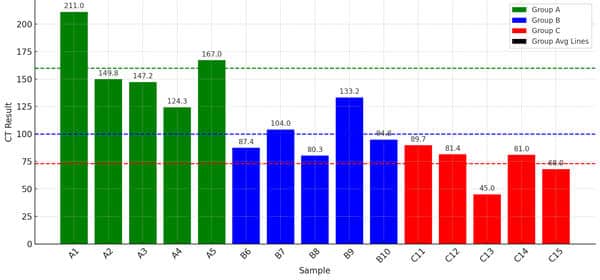
IDEAL-CT Results | Graph courtesy of Liberty Tire and Pleasants Construction
A Roadmap for the Future
The MD 650 project is more than a one-off pilot. It’s a proof of concept for sustainable asphalt solutions, demonstrating a viable market for Maryland’s recycled tires. According to Little, “The stretch of highway turned into a nice test section to compare technologies, featuring multiple mix types over an old concrete base: gap-graded mixes with PG76-22 and fibers, rubber-modified BMD, and conventional dense-graded asphalt.”
MDOT SHA is already planning a follow-up project with research partners like the University of Maryland and the University of Illinois, focusing on life cycle cost analysis and higher rubber content in gap-graded mixes.
For Pleasants Construction, the project underscores its role as an industry innovator. “The asphalt industry appreciates having options, not mandates,” Akisetty noted, praising contractors like Pleasants for embracing new technologies. As Maryland paves the way for greener, more durable roads, Pleasants Construction and MDOT SHA prove that innovation and collaboration can drive lasting change.