
6 Key Tack Takeaways from NCHRP Document 381
BY AsphaltPro Staff
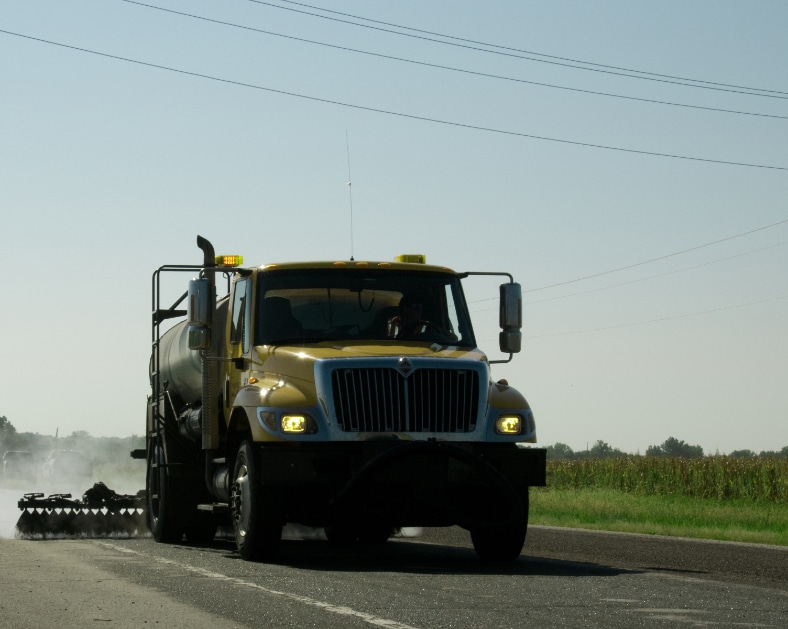
Proper bonding of asphalt pavement layers is crucial to achieving long-lasting, high-performing roadways. Tack coats play an indispensable role in creating monolithic structures that enhance resistance to strain and fatigue, thereby improving overall pavement durability. This bond enables the pavement to act as a cohesive system, efficiently transferring traffic loads while resisting structural failures.
Historically, says the team behind the National Cooperative Highway Research Program (NCHRP) Web-Only Document 381: Developing Laboratory Methods and Specification Language to Test Tack Coat Materials, tack coat application has often been guided by empirical judgment rather than rigorous testing or performance-based specifications.
Improper tack coat application—either too little or too much—can lead to significant issues, including slippage, delamination, fatigue cracking and potholes.
Improper tack coat application—either too little or too much—can lead to significant issues, including slippage, delamination, fatigue cracking and potholes. These failures can result in premature pavement deterioration, with repair costs potentially exceeding initial project expenses.
Recognizing the critical role of tack coats, NCHRP initiated Project 09-64 to develop standardized testing methods and specifications that accurately predict tack coat performance across various environmental conditions, pavement types and construction methods. Here are some of the key findings of NCHRP Document 381, and its detailed research-based recommendations for optimizing tack coat selection, application and testing.
Research Methodology: The research outlined in Document 381 was conducted in two phases. Phase I focused on gathering data to understand the challenges associated with tack coat materials, while Phase II emphasized developing laboratory test methods and draft specifications. Tack coat performance was evaluated through a range of metrics, including bonding strength, durability and tracking performance. Key laboratory tests included interface shear strength (ISS) tests, dynamic shear rheometer (DSR) testing and the BASF tracking test. These methods aimed to identify correlations between tack coat rheological properties and their mechanical performance.
1) The Importance of Proper Bonding
Properly bonded pavement layers resist strain more effectively, reducing the risk of fatigue and other structural issues. Tack coats must be selected and applied with attention to factors such as surface type (asphalt concrete [AC] vs. portland cement concrete [PCC]), surface texture, and rheological properties. The study demonstrated that AC surfaces typically achieve better bonding with tack coats than PCC surfaces due to their adhesive and absorptive properties.
2) Rheology as a Predictor of Performance
Rheological properties of tack coat materials—particularly the performance grade high temperature (PGHT) of the asphalt binder—are critical indicators of bonding strength. Tack coats with a PGHT one grade higher than the binder in the overlay mixture performed similarly to samples without tack coats, while those with a PGHT two grades higher enhanced bonding strength significantly. For high-risk facilities, such as highways and heavily trafficked areas, selecting a tack coat with a PGHT two grades higher is recommended by the researchers.
3) Interface Shear Strength (ISS) and Tack Coat Selection
ISS testing revealed that the bond strength between pavement layers is influenced by the texture and gradation of the bottom layer. For example, finer gradation mixtures (e.g., ½-inch nominal maximum aggregate size (NMAS)) achieved higher ISS due to increased surface contact. Additionally, PCC surfaces showed a pronounced benefit from tack coats, as all PCC samples without tack coat debonded during testing, whereas none of the tack-coated samples exhibited this issue.
4) Tracking and Durability Considerations
Tracking, where tack coat material adheres to construction equipment, reduces bond strength and can compromise performance. The research proposed using an onset tracking temperature (Tt), calculated by adding an offset (77°F/25°C) to the crossover temperature, to predict tracking behavior. Tack coat materials with a Tt lower than the pavement temperature are less likely to track.
Durability was assessed using aging index and ΔTc parameters, with a maximum allowable aging index of 4 recommended for tack coat materials. These measures help identify materials prone to premature aging or contamination.

5) Practical Recommendations for Residue Recovery and Testing
Three residue recovery methods—distillation, low-temperature evaporation (LTE) and vacuum recovery—were compared. Results showed no significant differences among the methods, making distillation the most practical choice, concluded the research team. Standardizing residue recovery methods ensures consistency in evaluating tack coat properties across projects.
6) Proposed Specifications for AASHTO Adoption
The study developed draft specification language in AASHTO format, integrating bond strength, tracking and durability criteria. These specifications aim to streamline tack coat selection and testing, making it easier for producers and contractors to ensure optimal performance. Notably, the proposed specifications rely on fundamental tests, such as G* and crossover temperature, which align with existing equipment and practices used for grading hot-applied binders.
The Bottom Line
The findings of NCHRP Document 381 underscore the importance of selecting tack coats based on their rheological properties, environmental compatibility and specific project requirements. Asphalt producers can benefit from adopting the proposed specifications, which provide a standardized framework for evaluating tack coat performance. Additionally, educating contractors about the relationship between tack coat selection, PGHT and pavement durability will help ensure long-lasting roadways.
For producers and contractors alike, the relatively low cost of tack coat materials compared to overall project expenses reinforces the value of getting this critical step right. With the guidance provided by NCHRP Document 381, the industry has a clear path toward more consistent and reliable tack coat applications.