
Fresh Pavement for Pago Pago
BY AsphaltPro Staff
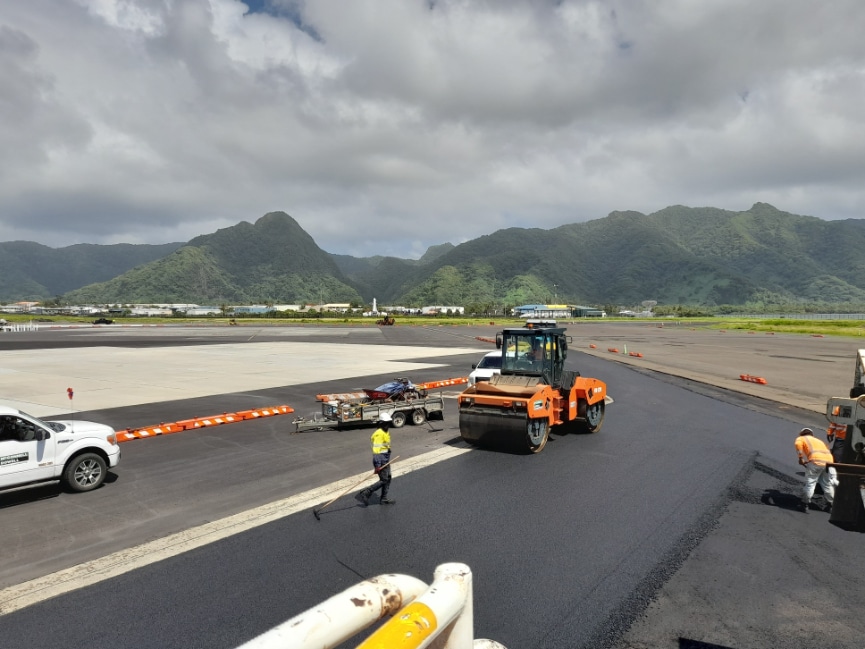
Paving on a remote island in the Pacific might sound like a dream job, but paving in paradise presents its own challenges.
Paving consultant Benjamin Everett and the crew of About Asphalt Limited, Auckland, New Zealand, faced formidable challenges while upgrading Runway 5/23 (Phase 3) at Pago Pago International Airport in American Samoa.
Alongside general contractor McConnell Dowell Limited of Melbourne, Australia, Everett’s crew has contended with unpredictable tropical storms, corrosive salt-laden air, and the lack of local infrastructure or vendors to supply essential materials and equipment. Every detail had to be planned meticulously, from securing the right machinery to implementing preventive maintenance strategies to combat the harsh coastal environment.
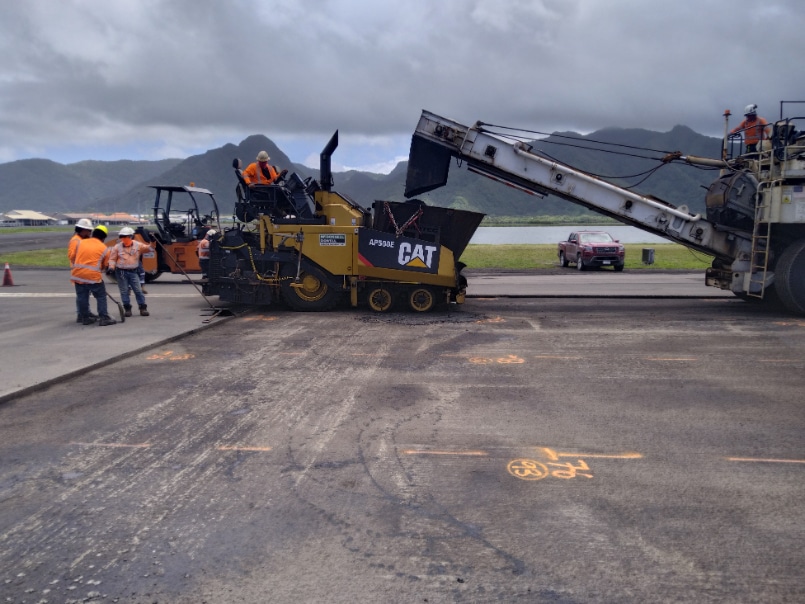
About Asphalt used its Caterpillar AP500E paver to pave 3 inches on the runway and 2.5 inches on the shoulders in 12.3-foot-wide runs.
Despite these hurdles, the crew has been steadily progressing on the project since September 2022, led by general contractor McConnell Dowell Limited, with the Government of American Samoa and the Department of Port Administration of American Samoa as the clients.
The rehabilitation involved a 3-inch mill and inlay of the runway and re-profiling of the shoulders to meet FAA standards. The project, expected to be completed by November 2024, also included upgrades to the taxiways and blast pads, ensuring enhanced safety and performance for the airport.
Everett shared the details of how his crew overcame the challenges this project presented in order to provide a quality pavement for Pago Pago.

Everett’s crew had to contend with corrosive salt-laden air impacting its equipment and the lack of local infrastructure or vendors to supply essential materials and equipment.
The 3-inch mill and inlay on the runway, as well as shoulder reprofiling and significant buildup with asphalt, aimed to correct the pavement’s crossfall and bring the runway up to current FAA requirements, Everett said.
The first step was to build up the shoulders ahead of the runway removal and replacement, in order to pave low to high, Everett said, “and create a shingle effect with the longitudinal joints to ensure water runoff was not impeded.” For this work, About Asphalt used its Vogele Super 1800-3 with tamping screed. “The other reason for placing the low side first was confinement from the previously placed mats prevents mat creep under the compactors.”
According to Everett, this methodology worked well at avoiding lateral displacement of material and maintaining the correct mat thickness. “It has been my experience on previous projects that placement of runs high to low inevitably tends to end up with a thinner, wider mat after compaction due to no downhill confinement,” he said. “Also, to ensure proper compaction against previously placed cold mats (such as the shoulder longitudinal joint) it’s necessary to leave the finished mat around ⅛ inch higher than the cold joint being matched to avoid bridging of the steel roller drums on the existing cold mat, plus it ensures proper water runoff down the slope.”

About Asphalt’s crew has significant experience on complex airport projects in New Zealand, Australia, Papua New Guinea, Rarotonga, Kiribati, Qatar, Kuwait and American Samoa.
“It has been my experience on previous projects that placement of runs high to low inevitably tends to end up with a thinner, wider mat after compaction due to no downhill confinement.” — Benjamin Everett
The depths for this part of the project varied, “as the existing profile was often up and down in the longitudinal plane, as well as the transverse grade,” Everett said. “It had to be built up in multiple layers, which often had to be feathered out to nothing.” There were also some high areas that had to be milled out to ensure correct depth of the new layers. “The only consistent thing about it was that it was inconsistent, but we nailed it and got it shaped up well.”
Once the shoulder work was done, Everett’s crew milled the runway surface to grade with its Wirtgen W 210, an older twin-engine model with a 2-meter or 6.56-foot cutter. “That entailed quite a lot of intensive surveying and was variable in the thickness that was cut,” Everett said. Each night, the crew milled out 328 lineal feet to the determined depth along one half of the 73.82-foot-wide runway. The next shift, the crew would apply the same methodology to the opposite side of the runway, Everett said, “to keep things squared up as we moved steadily along.”

Everett’s automatic grade and slope system of choice for the project was a T.F. Technologies dual grade G224 sonic ski system.
Next, the crew applied a standard emulsion-based tack at a residual rate of 0.04 to 0.08 gallons per square yard. Then came About Asphalt’s Caterpillar AP500E paver (fed by a Roadtec SB2500D with a Roadtec hopper insert in the Cat paver), this time with Vers-A-Mat AS2252C 8-foot front mount screed to pave 3 inches on the runway and 2.5 inches on the shoulders in 12.3-foot-wide runs. Everett’s automatic grade and slope system of choice for the project was a T.F. Technologies dual grade G224 sonic ski system.
Although the 8-foot screed with built-in extensions could be extended to 10 feet wide, Everett permanently outfitted the paver with 1-foot bolt-on screed extensions on each side, “which worked well for the 12.3-foot paving runs,” he said. “It also had 1-foot bolt-on auger extensions on either side permanently mounted to ensure the distance from the ends of each auger to the end gates was not exceeding 18 inches to help manage the 3/4-inch material and to keep segregation in check.”
The breakdown roller on the project was a Bomag BW151AD tandem vibratory steel, the pneumatic tire roller was an Ammann AP240 ballasted to 26.45 tons, and the finish roller was a Hamm HD90 tandem vibratory steel drum roller.

The breakdown roller on the project was a Bomag BW151AD tandem vibratory steel, the pneumatic tire roller was an Ammann AP240 ballasted to 26.45 tons, and the finish roller was a Hamm HD90 tandem vibratory steel drum roller.
“We basically needed to think of everything and bring it along, because we can’t just nip down the road to a dealership to get items that we might need.” — Benjamin Everett
About Asphalt’s crew has significant experience on complex airport projects in New Zealand, Australia, Papua New Guinea, Rarotonga, Kiribati, Qatar, Kuwait and American Samoa. Despite the crew’s experience with airport paving in a variety of destinations, the Pago Pago project brought unique challenges.
“The weather was very challenging, as American Samoa is coastal and subject to frequent tropical cyclones and other events that produce inclement weather,” Everett said. Furthermore, as a remote tropical island with a population of roughly 50,000 people, Everett said American Samoa lacked the infrastructure, support services and vendors typically available on the U.S. mainland or larger Pacific nations like Australia and New Zealand. “We basically needed to think of everything and bring it along, because we can’t just nip down the road to a dealership to get items that we might need.”
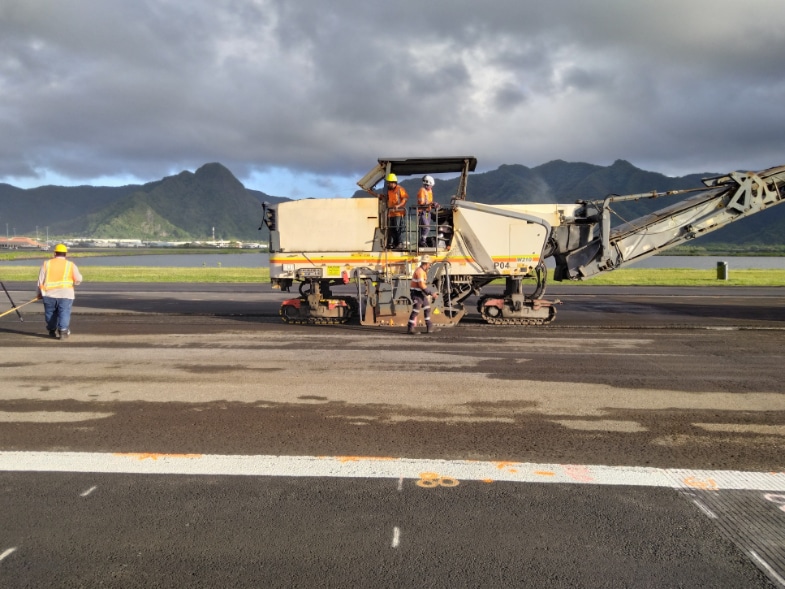
Everett’s crew milled the runway surface to grade with its Wirtgen W 210, an older twin-engine model with a 2-meter or 6.56-foot cutter.
The crew also had to contend with the effects of salt-laden air and the damaging and corrosive effect this had on equipment components. “We had to work out strategies to mitigate this, such as regular washing and wrapping hydraulic ram spears and things of this nature and routine treating with lubricants and corrosion inhibitors,” Everett said.
In spite of the variety of challenges the crew faced, Everett said the project is wrapping up slowly but steadily and is expected to be completed by mid-November.
However, Everett said the success of the project could not have been achieved without Timani Samau (previous American Samoa branch manager for McConnell Dowell) and Apenisa ‘Ben’ Maraivalu (project engineer for McConnell Dowell). “Without them, this project would not have been possible (or nearly as successful as it was),” he said.

The mix for phase 3 of the Runway 5/23 project at Pago Pago International Airport was a standard FAA type designed in accordance with the requirements and recommendations of the Asphalt Institute MS-2 Mix Design Manual, 7th Edition.
“I also could not have delivered this complex project without the dedicated help of five of my best and most skilled right hand men,” Everett said, “some of whom worked for my parents’ business more than 35 years ago and taught me a lot of the skills I have today!”
Everett gave special thanks to his MTV and paver operator Eddie, milling machine supervisor/operator Teuea, skid steer and roller operator Dante, screed and broom operator Rolando, and skilled mechanic and technician Josh, “without whom none of the gear would have worked as well as it did and kept going so steadily.”
Despite the unique challenges Pago Pago presented, ultimately it was teamwork and experience that saw the About Asphalt team through.

The crew applied a standard emulsion-based tack at a residual rate of 0.04 to 0.08 gallons per square yard and used a Roadtec SB2500D shuttle buggy to feed the paver.
About the Mix
The mix for phase 3 of the Runway 5/23 project at Pago Pago International Airport was a standard FAA type designed in accordance with the requirements and recommendations of the Asphalt Institute MS-2 Mix Design Manual, 7th Edition.
“Runway and shoulder final layer mix was an FAA spec dense graded mix with 100% of aggregate passing the ¾-inch sieve (Gradation 2) and the pre-levelling material was a dense graded mix with 100% of material passing the ½-inch sieve (Gradation 3),” Everett said.

In spite of the variety of challenges the crew faced, Everett said the project is wrapping up slowly but steadily and is expected to be completed by mid-November.
The asphalt plant was a P.P & P. (Paving Plant & Processes) design from New Zealand, which was based on a Boeing parallel flow design, with a Hauck diesel fired burner. “Mix production temperature was 330 degrees Fahrenheit,” Everett said, “and we targeted it to be placed and compacted before it reached 255 degrees Fahrenheit, which was able to be consistently met in order to achieve the specified density and air void standards.”
Depending on aggregate moisture content, Everett said the plant usually produced at a rate of around 110 U.S. tons per hour, adding that the plant was right on the perimeter fence boundary of the project. “The haul distance was minimal—maximum five minutes from loading to arrival at the paver.”