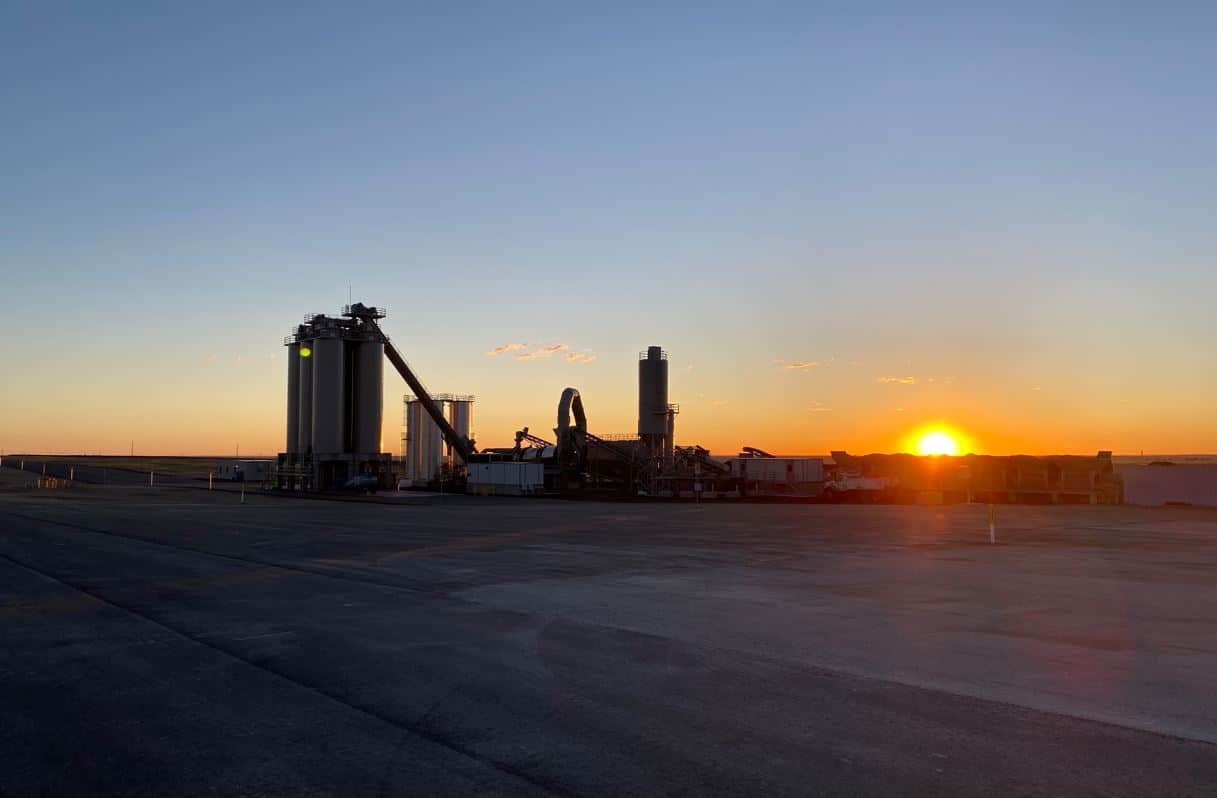
The secret’s in the silo. Are you using your storage silo as part of your business plan? If you have the heat in place to make mix before shutting down on Monday afternoon, you can store it for a quick load-outs Tuesday morning.
While your competitors across town are trouble-shooting morning start-up problems, you can load out all their customers and sell more mix. Now, keep in mind, some mixes lend themselves to storage overnight and some mixes don’t.
Check out the related article in this month’s AsphaltPro for ideas to become the plant everybody goes to.
Subscribe now to receive tips like this to your inbox each week.
Sample and Test Incoming Liquid Materials
Last week, we mentioned tracking the incoming recycled material to ensure millings from different projects went to the proper stockpiles. Are you using the same care and caution with incoming liquids?
You know the liquid asphalt cement (AC) is a vital ingredient in your DOT and other agency mix designs. Take a moment to test the binder grade of the AC coming into your plant.
Before the liquid AC gets to the tank farm, you can sample the material leaving the tanker to ensure you’re receiving the binder grade you requested. This level of quality control is a step asphalt producers find themselves taking to enhance mix design accuracy.
The team at Stansteel/Hotmix Parts developed the AC Verification Station™ to install inline between the unloading pump and the AC tanks to allow workers the option to take samples of any liquid material coming in. It’s one way to ensure the product in the tank is the product you think it is. Maxam Equipment also offers an inline sampling device. What others have you found to be exemplary for your safe quality control?
Subscribe now to receive tips like this to your inbox each week.
Avoid Drain Down at the Asphalt Storage Silo
This photo originally appeared in the article, ‘The Lab Manual Provides the Failsafe’.
During his World of Asphalt 2024 presentation on asphalt plant efficiency, Astec’s Greg Renegar shared ways you can turn your storage silo into a game-changer. By filling the silo at the end of the day, you’re ready for FOB customers first thing in the morning when other plants might be experiencing start-up woes. But Renegar and others cautioned producers on some of the reasons you might not want to take advantage of this business practice.
The Mix You Offer
Lack of planning on your customer’s part could result in wasted mix for you! There’s no point in producing 100 tons of state mix at 300°F if your first five customers show up wanting something less pricy at 340°F. Where’s the fellow who wanted the state mix? You want to make sure the right customer is in the right lane for the right mix.
Heat
Speaking of temperature, make sure you have heating systems in place to store mix overnight. If you don’t have proper heating systems in place, you run the risk of losing temperature and creating a solid problem. There are companies making electric heating elements that can be placed in silo cone packages to take the fear out of overnight storage. These entities might not make the silo itself but are experts in the manufacture of electric heating components and provide these to the OEMs who make the silo and cone.
Drain Down
Even with the concern of temperature under control, you want to consider the mix design itself. Experts in the field share concerns about storing open-graded mixes due to a phenomenon known as drain down. This is when gravity pulls the liquid asphalt cement (AC) away from the aggregate and down toward the silo cone.
Steve Jackson, the vice president of plant operations and sustainability for NB West Contracting, Pacific, Missouri, spoke of this in stone matrix asphalt (SMA) mixes. “The worst mix that I have seen for drain down is SMA,” he shared. “That is why some agencies are reluctant to remove the cellulose fibers even when you add ground tire rubber or reduce the mix temperature.”
Jackson offered examples of working with and around this problem in the June article “How to be the Plant Everyone Buys From.” His experience offers hope for adjusting the gap-graded mix so it can be stored overnight for quick loadout in the morning, if you’re willing to work with it.
For producers looking to optimize the use of the storage silos, it’s possible to adjust the mix design and temperature to ensure you have exactly what your customers are looking for first thing in the morning while avoiding the worry of drain down.
Stockpile Your Asphalt Plan
When you’re ready to move into the next stage of your asphalt operations, you seek consultants and professionals who’ve been there to guide you. From state asphalt pavement associations (SAPAs) to in-person asphalt-centric conferences to online training courses to publications like this one, you seek information to help you make informed decisions.
It makes sense that you’d reach out to asphalt industry resources when expanding your operations because you’re not building a typical business with typical operating concerns.
Sure, many business management truisms will translate across all industries, but the asphalt professional who wants to take his paving company to the next level needs information from places like TheAsphaltPro.com and his SAPA. Let’s face it—if you have five crews and an allergy to waiting on the local plant to produce your mixes, you might be ready to buy your own plant. “Frustration with the competition causing three projects to run late” isn’t a line item on a typical business spreadsheet.
You look to this publication, the state association and a trustworthy original equipment manufacturer to guide you in next steps. You’ll read up on how to assess the market for tonnage, upcoming agency funding allocations, residential or commercial infrastructure development and its potential to influence future projects, local workforce pressures, and so on. The consultants you talk to will have at least one foot in the asphalt industry because they will be able to assist in more than the financial planning—they can help map the physical plan for success.
I mean, while a new donut shop owner down the street might have a consultant taking into consideration traffic flow both onto and around his property, he’s probably not overly worried about company vehicle fuel economy on-site. You, on the other hand, will be extremely aware of stockpile placement in relation to cold feed bins for the purpose of optimizing wheel loader fuel use—or battery consumption.
You’ll also consider stockpile placement based on drainage and stormwater runoff, not only for environmental concerns but also to minimize moisture affecting your production temperatures and mix quality.
And don’t forget the neighbors. You can position the stockpiles close to the robust and beautiful tree line you build along the back perimeter to pose a noise barrier between your plant and potential developments moving in 10 to 20 years from now.
Note I’m assuming you’re building on a large plot of land in the middle of No and Where with room to pave beneath sloped stockpiles.
Whatever tract of land you have to work with and wherever that land is positioned, you want to seek out industry professionals to assist you in mapping it for your most efficient and environmentally friendly plant layout. Reducing the path for haul truck drivers to take around your yard for loadout means less opportunity for struck-bys, less dust kicked up for you to contend with and less fuel use for your customers.
The list of simple tweaks to the layout could fill this entire issue of AsphaltPro, but I asked the team at CWMF Corp., Waite Park, Minnesota, to tease a few for you here. Catherine Sutton-Choate from Astec Industries, Chattanooga, spelled out a few ideas in the article on permits in the February issue. And there are more articles in our Expand Your Business series coming to help you with planning the next stage in your growing operations.
Stay Safe,
Sandy Lender
Train Personnel to Get More Tons
This photo originally appeared in the article, ‘Plan Ahead: Where’s That Recycle Gonna Go?’
Everybody wants to make the plant run more efficiently. Take a look at the material handling all the way through the plant.
You’ll want to discuss with wheel loader operators, haul truck drivers and other material handlers the importance of keeping different types of material separated as it enters the yard.
For example, the millings from a city street project will be of a different quality than the millings from a county road’s shoulder, which will be of a different quality than the left-over fresh mix not used at the job site.
Then it’s time to fractionate and crush/screen for future use. Screen products and continue to keep them separated as you would virgin material. This is important for mix design quality. A RAP product of a certain size contains a certain percentage of aged binder. You’ll add it into the mix at a certain rate. It’s imperative you don’t have RAP product of a different size sneaking into the mix with its different percentage of differently-aged binder—not to mention its plain ol’ different size.
By fractionating and screening the materials that come in for use as recycle, you give your future mix designs a greater chance to meet all quality expectations.
Subscribe now to receive tips like this to your inbox each week.
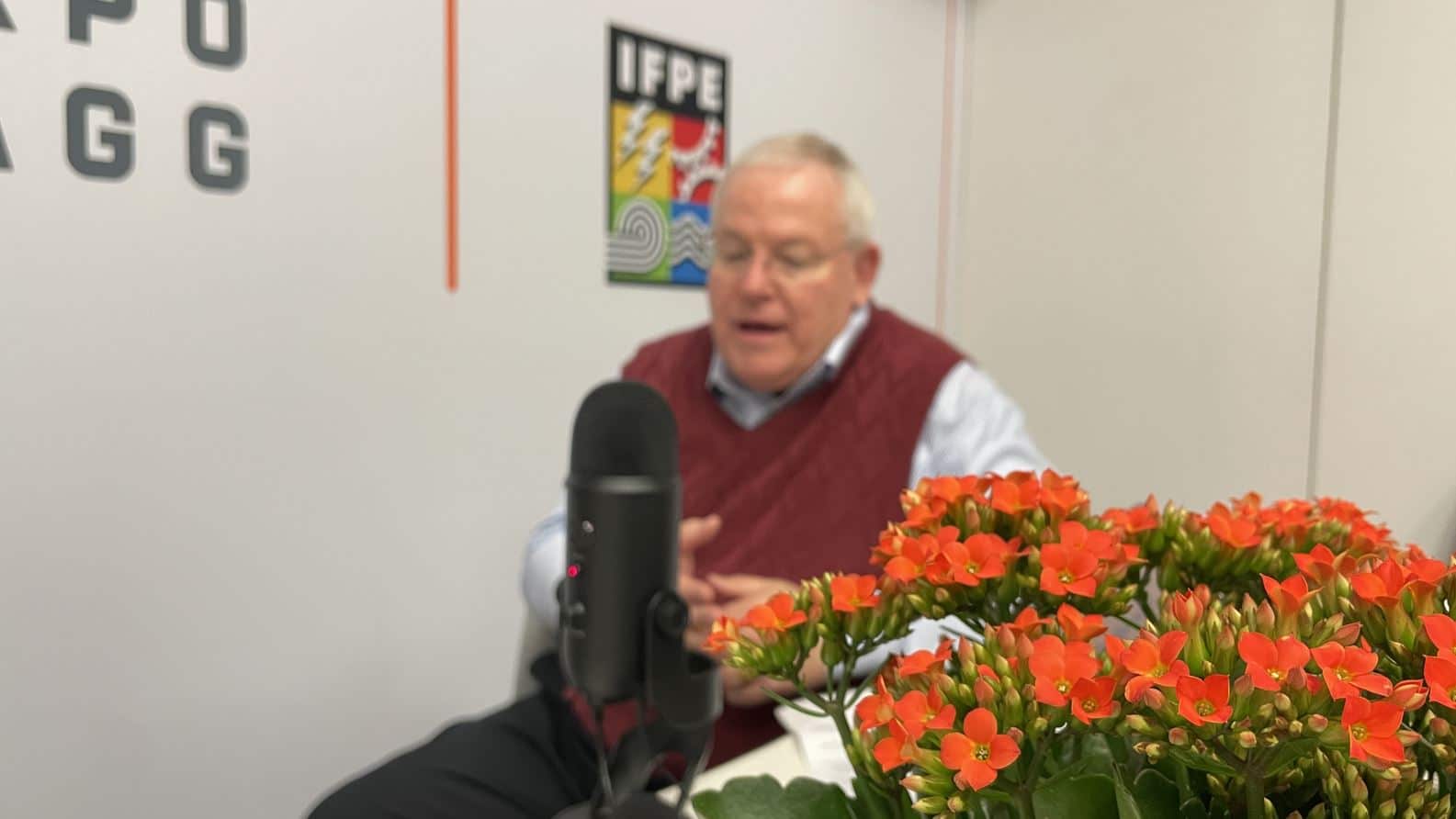
Episode 6: From Awareness to Action | Cal Byers Offers Practical Steps to Create a Supportive Workplace Culture
This podcast is sponsored by Dynapac.
Listen to the audio-only version of this podcast on our Suicide Prevention page, and take a moment to sign the Suicide in Construction Awareness Proclamation while you’re there.
Sandy: Welcome to part three of the AsphaltPro Magazine podcast mini series for mental health wellness and suicide prevention. I’m magazine editor Sandy Lender and your host for this miniseries. In this three-part podcast, we’ll explore ideas for incorporating a mental health wellness component in your safety program. AsphaltPro is honored to expand the conversation around this important topic and to bring Holmes Murphy’s Cal Byer to the podcast for that purpose. Calb has over 30 years of safety risk management and insurance experience. He has expertise in risk management and a host of emotional intelligence programs such as mental health suicide prevention, employee well-being, safety culture development, and transformation wellness program design, implementation, and evaluation, employee assistance programs, and more. He is the vice president of workforce risk and worker well-being at Holmes Murphy and Associates.
Sandy: Let’s begin part three of this three-part podcast switching gears from the human resources and manager-centric topics to a more general topic. I’d like to broaden our discussion to how we all help each other in the mental health wellness sphere. I believe that we don’t all have to be experts or psychiatrists to help each other or to help a coworker who’s struggling. So let’s talk a little bit about the buddy system. You know, we have the buddy system out there in the work zone where we help each other avoid physical dangers. Could you talk to me a little bit about how far we might be away from having the buddy system for our mental health out there? How far away in the future are we from being able to assign a partner out there in the field to make sure we’re present each day?
Cal: Sandy, I believe that reality is closer every year. There are some organizations that have been starting peer-to-peer support. It’s still in its infancy in terms of being rolled out, but there’s a growing body of literature that shows peer support is the pathway to effectively addressing mental health in the workplace. I was a panelist earlier this year for an organization called MindWise Innovations. I serve on their advisory board. They’re an international nonprofit behavioral health company, and the panel I participated in was on peer support. They have a project right now that’s nearing conclusion for a comprehensive manual that teaches an eight-step process for peer-to-peer support. They’re in the process of looking to roll that out with some sample organizations. I think because of the nature of the grant, the first rollout does need to be in Massachusetts because of the way it was funded. But their goal is to begin launching on May 11th.
Cal: I’m going to be hosting a national select invitation-only stakeholder meeting. It’s looking at an app that exists in the UK and in Canada. They’ve reached out to say, would the construction industry in the U.S. have an interest in learning about this peer support clinically supervised social media platform? It’s called Together All. What’s attractive is it’s peers supporting peers. It’s clinically supervised. So anytime someone is showing signs of inappropriate behavior or needing support, a clinical leader steps in and has side conversations with that person. But what’s been powerful is that they reach hard-to-reach populations. So in the military populations they’re serving in both the UK and Canada [there have been] higher than expected participation among males, in the tribal communities, stronger participation of persons of color. Those are the things that give us hope that if we could teach employees and leaders in companies about 988, the three-digit Crisis Text Line, teach them how to access employee assistance programs, that peers are very effective at providing support. We do spend more time with our work family during the season than we do our home family. So it’s natural that we’re going to look for ways to be supportive and to be offering care. I’m excited about peer support. It’s the future. It’s coming quickly. We just need more helpers, people willing to learn some of these techniques.
Sandy: And along the lines of people learning these techniques, I want to ask you, what are some basic steps that you can offer to our audience or easy-to-implement ideas that you would offer to a safety director or a CEO or a contractor? Some easy ideas for them to implement in a safety program to add mental health wellness and suicide prevention to their safety culture.
Cal: Yeah, Sandy, I think it’s important to keep this organic and to just build upon every year doing more. So if you haven’t taken the first step, make that your first step; resolve that we’re going to address this this year. And if you’ve taken one step or multiple steps, take the next step. I just encourage people to make this about continuous education, continuous improvement. One of the handouts that I’ll be sharing with you is a small eight-page color brochure. It’s called “Mental Health Awareness and Suicide Prevention Building Blocks.” Inside, it has 13 quick action steps for a company that hasn’t yet started. This is a journey, and the quicker you begin, the faster you’ll be able to start helping people. But practically speaking, it starts with top-down leadership support, and then it’s learning what our internal capabilities are. What do you offer in employee benefits? If you’re a union contractor, spend some time understanding what the union is offering. Partner with the union. Get educated together. Bring the union, come teach the field workers about the employee assistance program. I was doing that back in 2014, ’15, and ’16 when I worked for a paving contractor. I partnered with three labor unions, and they started helping us nationally. But there are so many of these little basic steps. Offer wallet cards, do toolbox talks. Take a stand for the Construction Industry Alliance for Suicide Prevention. They have a standup pledge. Again, there are so many steps. That 13-step guide is something that is sure to offer you support. Go to the website for AsphaltPro. You can go to the AGC of America. You can go to the Construction Industry Alliance for Suicide Prevention. Each group is populated with unique information. So just make this a priority and jump in.
Sandy: I’d like to give the audience some resources and examples for getting a safety program that includes mental health wellness off the ground. Could you share a couple of examples or ideas of safety programs you’ve helped get off the ground? I know you’ve done a few.
Cal: Yes, I have. I think the more personal you can make this, to let workers know that this is a core value, that part of what we believe is looking out for one another, building this caring culture. Partner with local nonprofits. There’s a lot of education. So the American Foundation for Suicide Prevention has a program that they do, typically in less than 45 minutes. It’s called “Talk Saves Lives,” and they can offer that in English and in Spanish. In many jurisdictions, there are many different versions of that program. There are many different resources they offer. Another group is the National Alliance on Mental Illness. Both groups have support groups, they have educational programs, they have support groups where families can go and seek help. Having information about recovery meetings from Alcoholics Anonymous to Narcotics Anonymous. The more resources that you share, [the more] people will watch. A really powerful movement we’ve seen beyond just toolbox talks have been hard hat stickers, wallet cards, QR codes in restrooms in porta-johns, put up in break rooms, so people can do this in private to access the help that’s available. Share information about 988. That’s one of the first steps. Train supervisors on a model called QPR, the QPR Institute. That stands for question, persuade, refer.
Cal: Bigger organizations that are willing to spend more time or have more resources are using mental health first aid to teach people; that 10-hour certification course makes people more comfortable to have conversations. It’s letting people know that you’re concerned about their well-being and that you’re taking actions. You don’t have to have the perfect program. You just have to have the foundation and build upon it over time. And that’s where you will have peer support leaders emerge. They’ll say things like, “I’m happy to help if you ever need someone to share a story.” You can go to a website called ManTherapy.org. It’s very effective. It uses humor to break down stigma. And on the web, there are so many resources. You can go to the Kevin Hines story. That’s a website. Kevin Hines, 20 years ago, survived a jump from the Golden Gate Bridge. He’s truly a hopeful champion and warrior for mental health and suicide prevention. And on his website, I can’t think of a time that I referred a family member or a worker to that website where they didn’t find something that changed their perspective. So we need to change the way we think about mental health. We need to treat it like physical health. And we need to see it as a sign of strength, not a sign of weakness when people seek and accept or offer help. This really is a safety, health, and wellness topic.
Sandy: Yeah, Vince Hafeli was on a podcast of ours, and he said that mental health is not mental illness. And that what you just said there, talking about mental health as something positive, it is a strength, is echoing what he was saying to us. I really like that message coming through again.
Cal: I got to partner with Vince a year ago on a webinar. I think his first webinar with Women of Asphalt. He’s been a longtime sponsor. This year, he said, “Hey, I’m willing to increase my sponsorship if you let me talk about mental health.” Next thing you know, they’re offering him a full-length webinar. And Vince called, he wanted to help right out of the bullpen. So, I got to partner with him. I was going to be in Florida. We got to spend some time together. We talk now every week, at least. As he’s been doing more presentations, we’re probably texting or emailing more than physically talking. But he’s been a great champion. I agree with Vince. Mental health doesn’t mean the absence of mental illness. Over 110 times, I’ve asked people and audiences, “What is the first thing you think of when you hear the words mental health?” In all but four times, the number one answer is the presence or possibility of mental illness. All but four times, it’s been between 85 and 95% of an audience. One time with 325 people in the room, 98% thought it meant the presence or possibility of mental illness. That’s a sign of how real stigma is. It’s how we’re socialized, conditioned to think about mental illness. The first thing they’re thinking of when you’re talking about mental health, meaning your mental well-being, they’re thinking of mental health conditions, mental health diagnoses, mental health crises, mental health challenges. They’re going to the stigma side instead of the well-being side.
Cal: If you’re going to be influencing leaders and they show up expecting well-being, they’re thinking nutrition, hydration, exercise, sleep. If all of a sudden you talk about any of these alarming statistics in construction, you run the risk of blindsiding people. And then you haven’t done safe messaging, and then it looks like shock and awe. And so I always want to encourage people to be gentle with the data. The news is not the numbers. The news is what companies and leaders are doing to address these well-being challenges.
Sandy: I think that kind of leads into the final question I have for our podcast. And that’s where people go from here?
Cal: Yeah, I think each leader who’s listening to this podcast who resolves, “I’m going to do something about this,”…One, I congratulate you, and two, thank you. We need more helpers. So, Sandy, one thing I know about you and the AsphaltPro, you have a robust website. I’ve seen you already add new materials and resources. They can listen to other podcasts. Some of the guests that you’ve had are people that I was helping teach and collaborate with now for many years. But the websites that you’ve already referenced, the Construction Industry Alliance for Suicide Prevention, www.preventconstructionsuicide.com, that’s very robust. AGC of America has resources, including some recent public service announcement videos. Those have been very effective. The more we have real people sharing real stories of lived experience, the more personal it becomes. People can relate. But there’s so many of these resources. I’m going to share a PDF with those 13 quick action building blocks. And there’s so many resources. I think this is an opportunity for leaders to take bold and decisive action. I think that 2023 is the year we’re going to tackle workplace mental health and well-being. And I hope what will happen is we will see an impact on suicide and overdose deaths.
Sandy: It’s been a pleasure talking with Cal today. I hope everyone listening in has picked up something they can use in their companies to expand the conversation around mental health wellness and reducing opioid use in their workforce. I want to encourage you to follow Cal on LinkedIn. You can find the Holmes Murphy and Associates Insurance Brokerage online at www.holmesmurphy.com. If you or a colleague needs immediate help, the Suicide and Crisis Lifeline has licensed counselors standing by at all times to speak with you. Please call or text 988. Thank you for tuning in, and thank you for your willingness to share this podcast and conversation with others.